

Cambridge IELTS 3 Listening Test 4
4 parts · 40 questions · 30 minutes
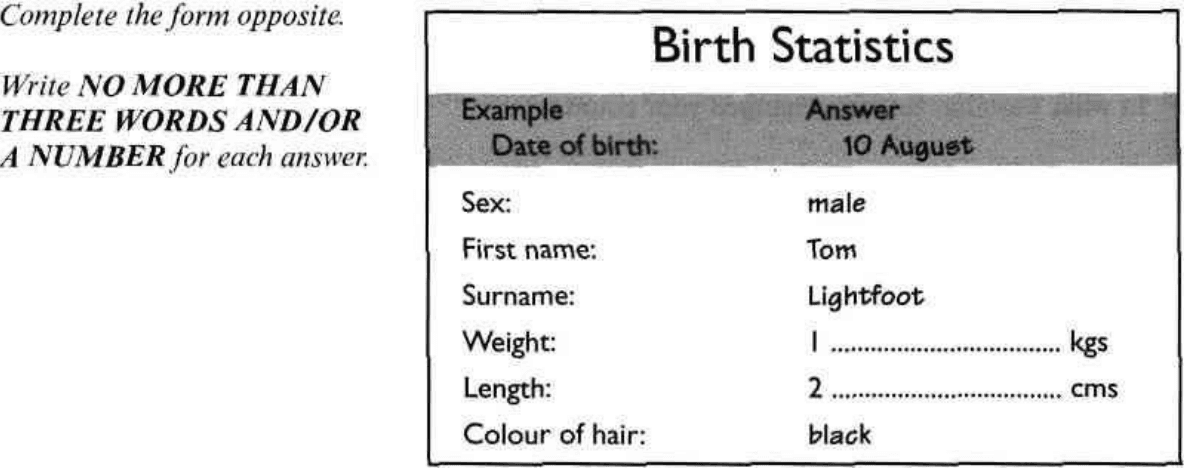
Buying gifts for a new baby
Questions 1–2
Complete the form below. Write NO MORE THAN THREE WORDS AND/OR A NUMBER for each answer.
Birth Statistics
Example — Date of birth: 10 August Sex: male First name: Tom Surname: Lightfoot
Weight: (1) ………………………… kgs
Length: (2) ………………………… cms
Questions 3–5
Label the map. Choose your answers from the box below. Write the appropriate letters, A–E, on the map.
Buildings
A State Bank
B St George's Hospital
C Garage
D Library
E University
3. Building 3 (next to John's house)
4. Building 4 (opposite, on the corner)
5. Building 5 (the other street corner)
Questions 6–10
Write NO MORE THAN THREE WORDS OR A NUMBER for each answer.
| Gift for Susan | Gift for baby | |
|---|---|---|
| What will they buy? | (6) ………………………… | (7) ………………………… |
| Where will they buy the gifts? | (8) ………………………… | (9) ………………………… |
| Approximate prices? | $15 | (10) ………………………… |
A radio review of household gadgets
Questions 11–20
Complete the table below. Write NO MORE THAN THREE WORDS for each answer. For the recommendation column, write A (You must buy this), B (Maybe you should buy this) or C (You should never buy this).
| Name | Advantage(s) | Disadvantage(s) | Recommendation |
|---|---|---|---|
| Unbreakable Vacuum Flask | • Contains no (11) ………………………… • Steel guaranteed for 20 years • Keeps warm for (11) ………………………… | • Expensive • Leaves (13) ………………………… | B |
| Whistle Key Holder | • Press-button light – useful for finding keyhole • (14) ………………………… | • Unpleasant noise • Doesn't work through (15) ………………………… | (16) ………………………… |
| Army Flashlight (squeeze light) | • Useful for (17) ………………………… • Works (17) ………………………… | • Has (19) ………………………… | C |
| Decoy Camera (to trick burglars) | • Realistic (20) ………………………… | • Difficult to fix onto wall | A |
A tutorial about a history project
Questions 21–23
Choose the correct letters A–C.
21. Amina's project is about a local
A school.
B hospital.
C factory.
22. Dr Bryson particularly liked
A the introduction.
B the first chapter.
C the middle section.
23. Amina was surprised because she
A thought it was bad.
B wrote it quickly.
C found it difficult to do.
Questions 24–26
What suggestions does Dr Bryson make? Write A if he says KEEP UNCHANGED, B if he says REWRITE, C if he says REMOVE COMPLETELY.
Example — Section headings: B
• Information on housing: (24) …………………………
• Interview data: (25) …………………………
• Chronology: (26) …………………………
Questions 27–30
Complete the notes below. Write NO MORE THAN THREE WORDS AND/OR A NUMBER for each answer.
SCHEDULE OF ACTION
Read 'Approaches to Local History' by John Mervis.
Read (27) ………………………… by Kate Oakwell.
Make changes and show to (28) …………………………
Do (29) ………………………… by 29 June.
Laser print before (30) …………………………
A lecture on environmental noise
Questions 31–34
Write NUMBERS AND/OR NO MORE THAN FOUR WORDS for each answer.
31. • Between what times is the road traffic lightest? …………………………
32. • Who will notice the noise most? …………………………
33. • Which day of the week has the least traffic? …………………………
34. • What will be the extra cost of modifying houses? …………………………
Question 35
Choose the correct letter A–D.
35. The noise levels at the site can reach
A 45 decibels.
B 55 decibels.
C 67 decibels.
D 70 decibels.
Questions 36–38
Complete the table showing where devices used in reducing noise could be fitted in the houses. Write W for walls, D for doors or C for ceilings.
Example — acoustic seals: D
• double thickness plaster board: (36) …………………………
• mechanical ventilation: (37) …………………………
• air conditioning: (38) …………………………
Questions 39–40
Choose the correct letters A–D.
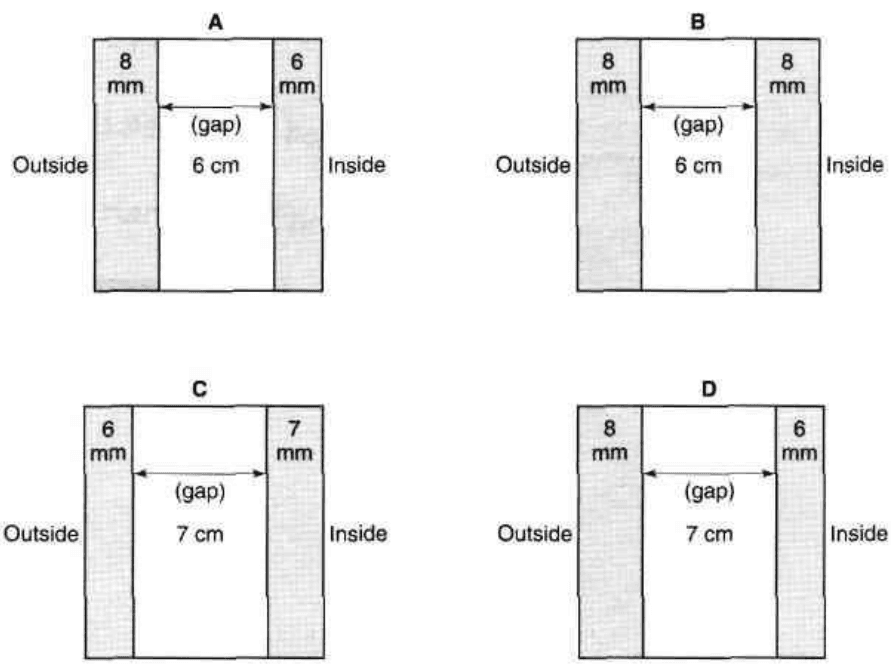
39. Which is the correct construction for acoustic double glazing?
A A
B B
C C
D D
40. What is the best layout for the houses?
A A
B B
C C
D D
Answers
1. 4.25
2. 46
3. A
4. D
5. C
6. chocolates
7. teddy bear
8. market
9. market
10. 35
11. glass
12. 18 hours
13. strange taste
14. small size
15. metal
16. A
17. outside activities
18. underwater
19. weak light
20. flashing light
21. hospital.
22. the middle section.
23. found it difficult to do.
24. C
25. B
26. C
27. Sight and Sound
28. Support Tutor
29. proof reading
30. 10 July
31. 7.30pm to 5.30am
32. housewives
33. Sunday
34. $25,000
35. 67 decibels.
36. C
37. W
38. C
39. D
40. C
Explanations
- 1. 4.25
- 'He weighed four and a quarter kilos when he was born.'Common trap: The figure is spoken as words ('four and a quarter'), not digits, and the length in centimetres follows straight after.
- 2. 46
- 'And he's long too, forty-six centimetres.'Common trap: 'over two metres' follows in the next turn — a prediction about his adult height, not his length now.
- 3. A
- 'It's next to a bank. The State Bank actually.' John's house at 15 Chesterfield Road stands next to the State Bank.Common trap: Sarah guesses the library first and is corrected — the library is opposite, not next door.
- 4. D
- 'The library is opposite us, on the corner.' It sits across Chesterfield Road from John's house.Common trap: Both corner buildings are given in consecutive turns — the library on one corner, the garage on 'the other street corner'.
- 5. C
- 'That's right, and there's a garage on the other street corner. I remember now.'Common trap: This one is supplied by Sarah rather than John, so it arrives from the other speaker after the correction.
- 6. chocolates
- 'What about a big box of chocolates?' — 'OK, chocolates sound fine.'Common trap: Flowers and a pot plant are both proposed and rejected first — flowers 'don't last', the plant needs watering.
- 7. teddy bear
- 'What about a soft toy of some sort?' — 'Yes, a soft toy.' — 'What about a teddy bear?'Common trap: Baby shampoo, talcum powder and a little hat are all suggested and dropped before the soft toy is agreed.
- 8. market
- 'I could get one early tomorrow at the market and I could probably get the chocolates there too.' Both gifts come from the market.Common trap: One sentence covers both gifts — 'there too' is what puts the chocolates in the same place.
- 9. market
- 'I could get one early tomorrow at the market...' The toy is bought at the market as well.Common trap: Because both columns share one answer, students expecting two different places often leave one blank.
- 10. 35
- 'I'd say the chocolates would be about $15 for something nice and not too small and the toy would be around $35 or so, I'd think.'Common trap: $15 is already printed for the chocolates, and '$25 each' follows immediately — that is what each of them pays, not a gift price.
- 11. glass
- '...most of all is the fact that it contains no glass and is therefore unbreakable to all intents and purposes.'Common trap: 'stainless steel' is named in the next clause and is already printed on the line below.
- 12. 18 hours
- '...it's true what the manufacturer claims - that it does maintain heat for 18 hours.'Common trap: 'guaranteed for 20 years' is in the sentence before and is already printed on the line above.
- 13. strange taste
- '...and, much more surprisingly, it unfortunately leaves a strange taste ... you know when you've drunk from it.'Common trap: 'quite expensive' opens the same sentence and is already printed as the first disadvantage.
- 14. small size
- 'I also felt the small size was a real advantage.'Common trap: The press-button light is described at length first and is already printed as the other advantage.
- 15. metal
- 'And I found that it didn't work through metal, so it's mainly useful for finding in coat pockets, cushions, etc.'Common trap: 'coat pockets, cushions' follow in the same sentence, but those are where it DOES work.
- 16. A
- 'But taken as a whole I thought it was a masterpiece of design and would highly recommend it.' A highly recommended item is a 'must buy' — A.Common trap: Two disadvantages are listed immediately before the verdict, which makes B feel safer than the 'highly recommend' actually given.
- 17. outside activities
- 'Its advantages are that it can be used for outside activities, and also ... it does work underwater.'Common trap: 'developed initially for military use' comes first and describes its origin, not what it is useful for.
- 18. underwater
- '...and this is one of the surprising features... it does work underwater.'Common trap: The fact is buried behind an aside ('and this is one of the surprising features'), which splits the verb from its complement.
- 19. weak light
- 'My main objection to it though was although it did work in these conditions, this model gave off a weak light.'Common trap: The concessive 'although it did work in these conditions' restates the advantages just before the actual objection.
- 20. flashing light
- 'The advantage of this model is something which makes it look very realistic ... its flashing light.'Common trap: 'Realistic' is already printed in the cell, and the answer arrives only after a pause at the very end of the sentence.
- 21. hospital.
- 'You can see that I decided to change the topic - I had been interested in looking at Barings Factory.' — 'Oh, I think the hospital was a much better choice.'Common trap: The factory is named first and in more detail — the change of topic has to be tracked to get the current one.
- 22. the middle section.
- 'It opens well and the first chapter is fine but the middle section really stood out for me ... most interesting.'Common trap: All three options appear in one sentence on a rising scale — 'opens well', 'is fine', 'really stood out'.
- 23. found it difficult to do.
- 'That's amazing because I really didn't find it a bit easy to write ...' She is surprised the middle section was praised because it was hard to write.Common trap: 'I dashed the writing off very quickly' comes a few turns later and matches option B word for word — but it answers a different question.
- 24. C
- 'Now, this information on local housing ... I can see why you put it there but it really isn't relevant to the approach you've taken.' Not relevant = remove completely.Common trap: 'I can see why you put it there' sounds like approval before the verdict lands in the second half of the sentence.
- 25. B
- 'They are, Amina, but they're very complex and rather unclear at the moment. You're going to have to spend a bit of time making the data a lot clearer.' — and he confirms they are not to be removed.Common trap: Amina asks 'as long as I don't have to remove them altogether' and he answers 'No, don't worry' — which rules out C explicitly.
- 26. C
- 'My advice on that is to take them out. I feel it makes the whole piece appear too simplistic.'Common trap: Amina asks whether she should REWRITE them ('I wasn't sure whether I should rewrite those'), which plants B before the answer comes.
- 27. Sight and Sound
- 'Have a look at Sight and Sound by Kate Oakwell.'Common trap: 'Approaches to Local History' by John Mervis is given first and is already printed on the line above.
- 28. Support Tutor
- 'So when you've made the changes I suggest you show the work to your Support Tutor.'Common trap: The book explicitly rejects 'Tutor' on its own — Dr Bryson is away, which is why it must be the SUPPORT tutor.
- 29. proof reading
- 'Then you do the proof reading ...' — 'When by, do you think?' — 'I'd aim for 29 June.'Common trap: The task and its deadline are split across three turns, with the date arriving only after Amina asks.
- 30. 10 July
- '...after that you should get it laser printed ... but be careful because the computer centre closes on 10 July.'Common trap: 29 June is in the same sentence and belongs to the proof reading on the line above.
- 31. 7.30pm to 5.30am
- 'The only noise after dark is from the highway and the traffic is somewhat reduced between 7.30pm and 5.30am.'Common trap: The airport hours (6pm to 7am) are given in the previous sentence — the book explicitly rejects '7.30 to 5.30' without am/pm.
- 32. housewives
- 'So, the people most affected by the noise will be, I expect, housewives.'Common trap: 'students and workers' appear in the very next sentence — but they are the ones who miss the worst of it.
- 33. Sunday
- '...the traffic is certainly reduced on Saturdays to a large extent and even more so on Sundays.'Common trap: Saturday is named first and also has reduced traffic — 'even more so' is what makes Sunday the quietest.
- 34. $25,000
- 'The modifications I am about to outline will add about $25,000 to the price of a newly-built house.'Common trap: The book explicitly rejects '25,000' written without the dollar sign being understood — and the figure is an addition, not the house price.
- 35. 67 decibels.
- 'As you all know, the normal noise threshold for private housing is 55 decibels. At this site the levels have been recorded as high as 67 decibels.'Common trap: Two figures come one after the other — the threshold first, then the actual reading.
- 36. C
- 'All ceilings will require double thickness plaster board to be used in the construction.'Common trap: 'two layers of plasterboard' is mentioned much later for interior bedroom WALLS — a near-identical phrase in a different place.
- 37. W
- 'In the noisiest areas mechanical ventilation will have to be installed in the exterior walls.'Common trap: Air conditioning is discussed in the very next sentence and goes in the ceilings — the two ventilation options are easy to swap.
- 38. C
- 'Air conditioning units could also be fitted in the ceilings of such houses but this is substantially more expensive than fans.'Common trap: The sentence goes on to say it 'may not be needed on this site' — but the question asks where it WOULD be fitted.
- 39. D
- 'The gap must be at least 7 centimetres. The thickness of the glass is also a factor, 8 millimetres on the outside and 6 on the inside pane.' Only D has an 8 mm outer pane, a 6 mm inner pane and a 7 cm gap.Common trap: Three numbers must all match at once, and the speaker repeats the rule ('thicker on the outside than on the inside') precisely because C inverts it.
- 40. C
- 'Living areas will have to be designed at the back of the houses away from the highway. Bedrooms and living rooms will have to be built towards the back... Those rooms constructed at the front of the houses should be garages, laundries, kitchens, bathrooms and dining rooms.' Only C puts the kitchen at the front and the living rooms at the back.Common trap: The list of front rooms is long (garages, laundries, kitchens, bathrooms, dining rooms), so several diagrams look partly right — only one gets both halves correct.
Audio transcripts
Part 1 — Buying gifts for a new baby
SARAH: John, I've just had some good news. Susan has had her baby. JOHN: Do you know when she had it? SARAH: Yesterday. The tenth of August. JOHN: Oh, my father was born on August the tenth. Give me the details and I'll make a note for everyone at work. SARAH: OK. JOHN: Well, was it a boy or a girl? SARAH: It's a boy. JOHN: And what are they going to call him? SARAH: Tom. Tom Lightfoot. It sounds quite good, don't you think? JOHN: Yes, that has quite a good ring to it. SARAH: You know he's quite a big baby. He weighed four and a quarter kilos when he was born. That does sound big, four and a quarter kilos. SARAH: And he's long too, forty-six centimetres. JOHN: Mmmm. Tall parents. He'll grow up to be over two metres, I'd say. SARAH: With masses of black hair, curly black hair. You know, we should go and visit them in hospital. What about tomorrow afternoon at around 1 pm? JOHN: Yes, OK. SARAH: Where should we meet? ... Ah, I could come and pick you up at your house, if you like. JOHN: Yes, that would be wonderful. My car is still off the road. SARAH: Just refresh my memory. What's the address again? JOHN: It's 15 Chesterfield Road, Paddington. SARAH: It's next to the library, isn't it? JOHN: Not exactly. It's next to a bank. The State Bank actually. The library is opposite us, on the corner. SARAH: That's right, and there's a garage on the other street corner. I remember now. JOHN: So, you'll pick me up at a quarter to one and we'll be there at one easily. SARAH: Now what should we take? We must take them something. JOHN: I always think flowers are good to take to someone in hospital, don't you? SARAH: Well, not really. Everyone always brings flowers and they don't last. I think it's much better to take a pot plant, so she can take it home with her. JOHN: Yes, but then she has to remember to water it. What about a big box of chocolates? SARAH: OK, chocolates sound fine. We should get something for the baby too. What do you think? JOHN: Yes, you're right. What do you think of something like baby shampoo or talcum powder? SARAH: Or we could get a little hat, or something like that. JOHN: We don't know the size, or the right colour, do we? SARAH: I think we should get something they wouldn't normally buy. What about a soft toy of some sort? JOHN: Yes, a soft toy. SARAH: What about a teddy bear? JOHN: I could get one early tomorrow at the market and I could probably get the chocolates there too. SARAH: Good. JOHN: So you'll pick me up at a quarter to one at my place and I'll make sure that I've got the presents. SARAH: You must remember how much you paid for the gifts, so I can pay you back for half. If they're going to be from both of us, I would like to go shares. JOHN: OK. I'd say the chocolates would be about $15 for something nice and not too small and the toy would be around $35 or so, I'd think. SARAH: Good, that'll be fine. About $25 each then. Good, I'll pick you up then on Sunday at twelve forty-five. JOHN: OK. SARAH: See you then. Bye.
Part 2 — A radio review of household gadgets
PRESENTER: Good evening. Tonight's show comes to you from the Good Home Exhibition in Duke's Court, where we've been trying out some of the latest gadgets on show here and getting our resident expert - Liz Shearer - to tell us which ones are worth buying and which will die a death. LIZ SHEARER: Well, hello. Yes, John, I've been investigating four new household gadgets and sorting out the advantages and disadvantages and then really deciding what are 'Must buys', what are 'Maybe buys' and what are 'Never buys'. Let's start with this vacuum flask for keeping drinks hot. Well... I felt this had quite a lot going for it, most of all is the fact that it contains no glass and is therefore unbreakable to all intents and purposes. It's made of stainless steel which is guaranteed for 20 years ... hope that's long enough ... and it's true what the manufacturer claims - that it does maintain heat for 18 hours. So that's pretty good. On the down side, it really works out to be quite expensive and, much more surprisingly, it unfortunately leaves a strange taste ... you know when you've drunk from it... so all in all, my recommendation would be it's got plenty of advantages, but it is rather expensive so I'd say you should maybe buy it. Moving on to a natty little device ... the Whistle Key Holder. Basically this is where you whistle and the key holder gives off a high pitched noise and flashes light so you can find it. One advantage of this model is that it also has a small light. You press the button and this means you can find keyholes easily. I also felt the small size was a real advantage. On the weaker side, I did find the noise unpleasant. Which I'm sure the designers could have done something about. And I found that it didn't work through metal, so it's mainly useful for finding in coat pockets, cushions, etc. But taken as a whole I thought it was a masterpiece of design and would highly recommend it. The third gizmo is called the Army Flashlight because it was developed initially for military use. It works by squeezing the handle to generate the power. Its advantages are that it can be used for outside activities, and also ... and this is one of the surprising features... it does work underwater. My main objection to it though was although it did work in these conditions, this model gave off a weak light. So my recommendation I'm afraid would have to be to avoid this one. The decoy camera was last on my list. This is a fake video camera which you fix to your wall to scare off burglars. The advantage of this model is something which makes it look very realistic ... its flashing light. On the down side, it was quite difficult to fix to the wall. However, burglary is such a major problem these days that it is worth the effort, so this gets my strong recommendation. PRESENTER: OK. Thanks for that, Liz.
Part 3 — A tutorial about a history project
BRYSON: Well, Amina, thanks for letting me have your draft in such good time. AMINA: Oh, that's alright. I was just very anxious to hear what you think of it. You can see that I decided to change the topic - I had been interested in looking at Barings Factory. BRYSON: Oh, I think the hospital was a much better choice. In fact... well... I have to say that I thought it was good. AMINA: Oh? BRYSON: There's still lots of work to be done ... AMINA: Oh yes ... of course. BRYSON: But there's plenty of good ideas. It opens well and the first chapter is fine but the middle section really stood out for me ... most interesting. AMINA: That's amazing because I really didn't find it a bit easy to write ... BRYSON: How long did you work on the whole thing? AMINA: Well, I spent about two or three weeks reading and doing general research and then I dashed the writing off very quickly ... so about four weeks in all. BRYSON: Well, that's about par for the course. You've got a while yet to make the changes. AMINA: Oh right... no problem ... BRYSON: Right. Let's have a look at my notes here. OK. Starting with section headings ... the broad divisions are good but you'll have to re-do the actual headings. I've made some suggestions in the margins ... AMINA: OK. Thanks. BRYSON: Now, this information on local housing ... I can see why you put it there but it really isn't relevant to the approach you've taken. AMINA: I think I see what you mean. BRYSON: Now ... what did I say about the interviews? AMINA: I worked very hard on those. I really thought they were valuable. BRYSON: They are, Amina, but they're very complex and rather unclear at the moment. You're going to have to spend a bit of time making the data a lot clearer. AMINA: OK ... as long as I don't have to remove them altogether ... BRYSON: No, don't worry. AMINA: What about the chronology ... the list of dates? I wasn't sure whether I should rewrite those. BRYSON: My advice on that is to take them out. I feel it makes the whole piece appear too simplistic. AMINA: OK, if it'll help. BRYSON: Now, there are a couple of other books I'd like you to look at. Have you got a pen? Right... Approaches to Local History by John Mervis ... AMINA: Right... BRYSON: And then I think you need to think about ways of representing interview data. Have a look at Sight and Sound by Kate Oakwell. AMINA: Sight and Sound. BRYSON: Then you know I'm going away on holiday next week ... AMINA: Yes. BRYSON: So when you've made the changes I suggest you show the work to your Support Tutor. AMINA: Support Tutor ... right... BRYSON: Then you do the proof reading ... AMINA: Proof reading ... uh-huh. When by, do you think? BRYSON: I'd aim for 29 June and after that you should get it laser printed ... but be careful because the computer centre closes on 10 July. AMINA: And then I hand it in to ... ? BRYSON: Oh, the Faculty Office as usual. AMINA: OK, that's fine. I think I'm all set now! Thanks very much for all your help. BRYSON: A pleasure. See you when I get back. AMINA: Yep. Thanks, Dr Bryson. Bye. BRYSON: Bye.
Part 4 — A lecture on environmental noise
Good afternoon. I'm Paula Bundell and I am giving you the lectures on Environmental Noise this term. Today we are going to look into the effects of noise on a planned housing estate in a particularly difficult part of the new Manchester Park area. This site is not as bad as some I have researched in the past. The Blacktown airport is closed from 6pm to 7am and this is a great advantage to the site. The only noise after dark is from the highway and the traffic is somewhat reduced between 7.30pm and 5.30am. So, the people most affected by the noise will be, I expect, housewives. By the time most of the students and workers have arrived back home in the evening during the week the noise will have abated to a fairly large extent. The weekends are still a problem of course, but the traffic is certainly reduced on Saturdays to a large extent and even more so on Sundays. Of course modifications to houses will be necessary at a site like this and they come at a significant cost to the developer and home buyer. The modifications I am about to outline will add about $25,000 to the price of a newly-built house. That will still mean a cheaper house than in a less noisy and more desirable area. A bit of background would not go astray. I understand that you are all familiar with the proposed development site at Manchester Park. It's a particularly difficult one in terms of noise with the highway along the eastern perimeter and the Blacktown airport not 3 kilometres away to the north. Of course, those nearest the highway will be the worst hit, with heavy traffic noise as well as the noise from the light planes overhead. As you all know, the normal noise threshold for private housing is 55 decibels. At this site the levels have been recorded as high as 67 decibels. The construction of the houses has to be somewhat modified from houses in most areas. In the houses on the highway and in the noisiest areas of this site there will be a need for specialised double glazing and special acoustic seals will have to be fitted to the doors. All exterior doors in this especially noisy pocket will have to be solid core wood doors with hinges. Every house built on this site, not just those adjacent to the highway or nearest to the airport, will require high density insulation materials in the roof. Not only will all the roofs need insulating, the exterior walls will be required to be double brick. All ceilings will require double thickness plaster board to be used in the construction. In the noisiest areas mechanical ventilation will have to be installed in the exterior walls. In those areas with sealed windows it will be necessary to fit fans with absorbers to cut out the noise in those particular houses. Air conditioning units could also be fitted in the ceilings of such houses but this is substantially more expensive than fans, and may not be needed on this site. Coming back now to the double glazing I mentioned before. Specialised double glazing requires a larger air gap between the inner and outer glass than normal double glazing. The gap must be at least 7 centimetres. The thickness of the glass is also a factor, 8 millimetres on the outside and 6 on the inside pane. It is essential that the glass be thicker on the outside than on the inside and that the gap between the panes of glass be a minimum of 7 centimetres. Obviously, the noise factor will have to be taken into consideration with the layout of the houses. Living areas will have to be designed at the back of the houses away from the highway. Bedrooms and living rooms will have to be built towards the back, and for those houses closest to the highway two layers of plasterboard will be needed for the interior bedroom walls. Those rooms constructed at the front of the houses should be garages, laundries, kitchens, bathrooms and dining rooms. I have come to the conclusion that this development should go ahead, but with various acoustic modifications according to the position of the block in relation to the highway and intersection.
Comments
Loading comments…