

Cambridge IELTS 3 Listening Test 3
4 parts · 40 questions · 30 minutes
Planning a Christmas dinner
Questions 1–10
Complete the notes below. Write NO MORE THAN THREE WORDS AND/OR A NUMBER for each answer.
NOTES – Christmas Dinner
Example — Number to book for: 45
Date of dinner: 21 December
Choices for venue:
• First choice (1) ………………………… (Tel. number: not known)
• Second choice (2) ………………………… (Tel. number: 777192)
• Third choice (3) …………………………
Tel. number: (4) …………………………
Price per person: £12
Restaurant must have vegetarian food and a (5) …………………………
Menu: First course – French Onion Soup OR Fruit Juice
• Main course – Roast Dinner OR (6) …………………………
• Dessert – Plum Pudding OR Apple Pie · Coffee
Restaurant requires from us:
• (7) ………………………… and letter of confirmation
• and we must (8) ………………………… in advance.
Must confirm in writing by: (9) …………………………
Put notice in (10) …………………………
A talk about a sports centre
Questions 11–13
Complete the table below. Write NO MORE THAN THREE WORDS OR A NUMBER for each answer.
MEMBERSHIP OF SPORTS CENTRE
| Details | |
|---|---|
| Cost | £ (11) ………………………… per (11) ………………………… |
| Where? | (13) ………………………… |
| When? | 2 to 6 pm, Monday to Thursday |
| Bring: | Union card Photo Fee |
Questions 14–16
Complete the table below. Write NO MORE THAN THREE WORDS for each answer.
14. Always bring sports …………………………
15. when you come to ………………………… or use the Centre's facilities.
16. Opening hours: 9 am to 10 pm on ………………………… (10 am to 6 pm on Saturdays)
Questions 17–20
Look at the map of the Sports Complex below. Label the buildings on the map. Choose your answers from the box below and write them against Questions 17–20.
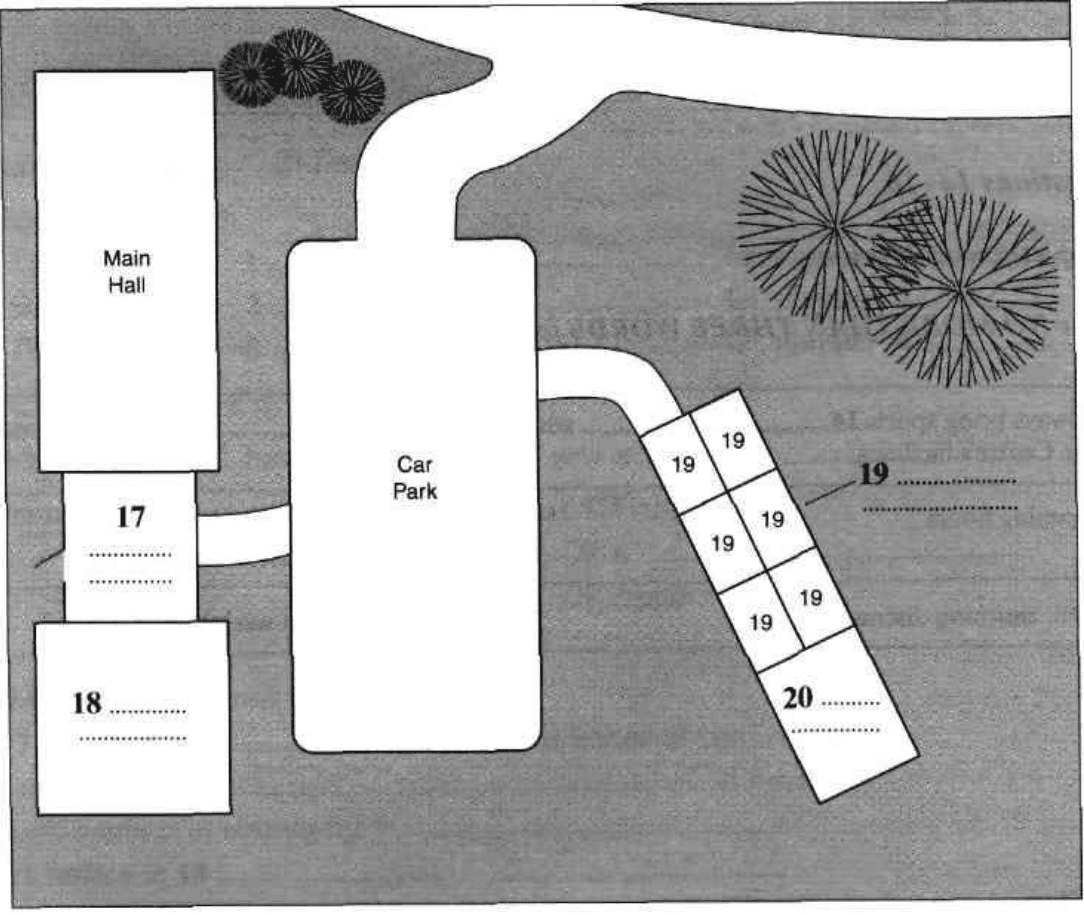
Sports Complex
Arts Studio · Football Pitch · Tennis Courts · Dance Studio · Fitness Room · Reception · Squash Courts
• Building 17: (17) …………………………
• Building 18: (18) …………………………
• Buildings 19: (19) …………………………
• Building 20: (20) …………………………
Help with a competition entry form
Questions 21–30
Complete the form below. Write NO MORE THAN THREE WORDS AND/OR NUMBER for each answer.
YOUNG ELECTRONIC ENGINEER COMPETITION
Name(s) of designer(s): John Brown
(21) …………………………
Age: (22) …………………………
Name of design: (23) …………………………
Dimensions of equipment — Width (24) ………………………… cm · Length (24) ………………………… cm · Depth (24) ………………………… cm
Power: Battery
Special features: (25) …………………………
(26) …………………………
(27) …………………………
Cost: parts $5
(28) ………………………… $9.50
Other comments: need help to make (29) …………………………
would like to develop range of sizes
Send by: (30) …………………………
A talk on ostrich farming
Questions 31–33
Complete the table below. Write NO MORE THAN TWO WORDS for each answer.
| "NEW" MEAT | CAN BE COMPARED TO | PROBLEM |
|---|---|---|
| kangaroo | (31) ………………………… | (32) ………………………… |
| crocodile | chicken | fatty |
| ostrich | (33) ………………………… | — |
Questions 34–36
Complete the table below. Write NO MORE THAN THREE WORDS for each answer.
| OSTRICH PRODUCT | USE |
|---|---|
| Ostrich feathers | • tribal ceremonial dress • (34) ………………………… • decorated hats |
| Ostrich hide | • (35) ………………………… |
| Ostrich _____ | • 'biltong' |
Questions 37–40
Choose the correct letters A–C.
37. Ostrich meat
A has more protein than beef.
B tastes nearly as good as beef.
C is very filling.
38. One problem with ostrich farming in Britain is
A the climate.
B the cost of transporting birds.
C the price of ostrich eggs.
39. Ostrich chicks reared on farms
A must be kept in incubators until mature.
B are very independent.
C need looking after carefully.
40. The speaker suggests ostrich farms are profitable because
A little initial outlay is required.
B farmed birds are very productive.
C there is a good market for the meat.
Answers
1. Rajdoot
2. Park View
3. London Arms
4. 208657
5. non-smoking section
6. lentil curry
7. £50 deposit
8. choose the menu
9. 4 November
10. Newsletter
11. 9.50
12. year
13. reception
14. card
15. book
16. weekdays
17. Reception
18. Dance Studio
19. Squash Courts
20. Fitness Room
21. Anne Rea
22. 16
23. blind puzzle
24. 20 50 2.5
25. safe for children
26. educational
27. cheap price
28. electrics
29. plastic pieces
30. 1 July
31. rabbit
32. tough
33. beef
34. ladies' fans
35. leather
36. meat
37. has more protein than beef.
38. the price of ostrich eggs.
39. need looking after carefully.
40. farmed birds are very productive.
Explanations
- 1. Rajdoot
- 'That new Indian restaurant in Wetherfield is supposed to be excellent... the Rajdoot.' — 'How do you spell that?' — 'R-A-J-D-O-O-T.' — 'let's put that down as the first choice'.Common trap: The Red Lion is named just before as LAST year's disappointing venue, not this year's first choice.
- 2. Park View
- 'What about the Park View Hotel as a second choice?' — 'Yes, that's always reliable.'Common trap: Three venues are proposed in quick succession and each is tied to its own phone number further down the notes.
- 3. London Arms
- 'And the London Arms in case.' — the third fallback venue.Common trap: This one is offered in a half-sentence ('in case'), much more briefly than the first two.
- 4. 208657
- 'Not for the Rajdoot, but... right... Park View Hotel: 777192 and... London Arms: 208657.'Common trap: Two numbers are read out together and the first (777192) is already printed against the second choice.
- 5. non-smoking section
- 'And we'd better make sure there's good vegetarian food.' — 'And a non-smoking section! You know what the boss is like.'Common trap: 'good vegetarian food' opens the exchange and is already printed in the note.
- 6. lentil curry
- 'Roast dinner or lentil curry... sounds ordinary but my friend said it was really tasty.'Common trap: The three courses are read out in one run — the first and third courses are already printed.
- 7. £50 deposit
- 'Oh, and if we go ahead, they'd like a £50 deposit.' — 'And they want a letter.'Common trap: £12 (price per person) is already printed above, and the letter of confirmation is already printed beside the gap.
- 8. choose the menu
- 'And they say with such large numbers we have to choose the menu in advance.'Common trap: 'in advance' is already printed, so only the action is wanted — and it comes at the end of a long clause about numbers.
- 9. 4 November
- 'When did you say they wanted confirmation by?' — 'It was... let's see... the 4th of November.'Common trap: 21 December (the dinner) and 'next Wednesday' (how long the booking is held) are both dates mentioned earlier.
- 10. Newsletter
- 'Well, the Newsletter is probably your best bet.' — 'Good idea.'Common trap: 'the cafe noticeboard' is suggested first and rejected — 'Hardly anyone looks at that.'
- 11. 9.50
- 'All students at the college are entitled to become members of the Sports Centre, for an annual fee of £9.50.'Common trap: The figure and the period it covers arrive in one phrase ('an annual fee of £9.50') and fill two separate gaps.
- 12. year
- '...for an annual fee of £9.50.' Annual = per year. The book rejects the adjective 'annual' on its own.Common trap: The recording says 'annual', but the printed 'per' demands a noun — the book marks 'annual' wrong.
- 13. reception
- 'To register with us and get your membership card, you need to come to reception, between 2 and 6 pm, Monday to Thursday.'Common trap: The book explicitly rejects 'Sports Centre' — that is the whole building, not the place you register.
- 14. card
- 'Then once you have got your sports card, you will need to bring it with you whenever you come to book or use any Sports Centre facilities.'Common trap: 'Union card' is one of the three things needed at registration and is already printed in the table above.
- 15. book
- '...whenever you come to book or use any Sports Centre facilities.' — reinforced by 'Booking over the phone is not allowed, so you have to come here in person, with your card, when you want to book.'Common trap: 'or use the Centre's facilities' is already printed, so only the first of the two activities is missing.
- 16. weekdays
- 'We are now open from 9am to 10pm on weekdays and from 10am to 6pm on Saturdays.'Common trap: 'Saturdays' is in the same sentence but already printed, and 'weekdays' recurs a moment later for the morning discount.
- 17. Reception
- The Main Hall is labelled on the map, and the dance studio is 'On the other side of the reception area' from it — so the space between the Main Hall and the dance studio is Reception.Common trap: Reception is never announced directly — its position has to be inferred from the Main Hall and dance studio described on either side of it.
- 18. Dance Studio
- 'On the other side of the reception area there is the dance studio.' It sits beyond Reception from the Main Hall.Common trap: 'Arts Studio' is in the box and sounds close to 'dance studio' — only one of them is ever mentioned.
- 19. Squash Courts
- '...in a separate building, which you may have noticed on your way here... it's on the other side of the car park... there are the squash courts (six of them).' The six small units beyond the car park.Common trap: 'Tennis Courts' is in the box, but those are at a local club 'only two miles away' — not on this map.
- 20. Fitness Room
- '...and at the far end of the building a fitness room. This is our newest facility, only completed in the Spring.'Common trap: It is in the same building as the squash courts — 'at the far end' is the only thing separating them on the map.
- 21. Anne Rea
- 'Then you must put her name in as well. Right... Ann Ray.' — 'Sorry. It's ANNE and her surname is spelt R-E-A.'Common trap: The teacher writes 'Ann Ray' first and is corrected — both the first name and the surname change spelling.
- 22. 16
- 'And age is easy. You're both 16.'Common trap: The age is given in passing, wrapped inside the praise for getting the name right.
- 23. blind puzzle
- 'What about jigsaw puzzle design for visually handicapped?' — 'Too long. Just say blind puzzle, that'll do.'Common trap: John's own suggestion ('jigsaw puzzle design for visually handicapped') is rejected as too long — the book marks 'Jigsaw' alone wrong.
- 24. 20 50 2.5
- 'width is 20 cm.' ... 'Length is 50 cm, and then the depth is... well, it's very little.' ... 'I'd say 2.5 cm.' All three must be given, in that order, for the single mark.Common trap: John says 'length' first and immediately corrects himself to 'width' — swapping the first two figures loses the mark.
- 25. safe for children
- 'Well, it's safe for children.' — the first of three special features. The book accepts the three features in any order across Questions 25–27.Common trap: The three features are volunteered one at a time between the teacher's encouragements, not read out as a list.
- 26. educational
- 'OK, and of course we think it's educational.' Any order is accepted across Questions 25–27.Common trap: Because the book allows any order, the risk is writing only two of the three features rather than all three.
- 27. cheap price
- 'Well, I think the price is good.' — 'That's probably the most important factor.' — 'OK... cheap price.' Any order is accepted across Questions 25–27.Common trap: The wording shifts between 'the price is good' and 'cheap price' within two turns — the book accepts either.
- 28. electrics
- 'And the electrics?' — 'They were more expensive... say, $9.50.'Common trap: The book explicitly rejects the singular 'electric' — and 'parts $5' is already printed on the line above.
- 29. plastic pieces
- 'Well, we would really like help with making plastic instead of wooden pieces.' — 'Well, put something like, need help to make plastic pieces.'Common trap: The book rejects 'pieces' alone — the material is the point, and 'wooden' is what they are replacing.
- 30. 1 July
- 'Well, the last date is 1 July. Why not say that?' — 'OK, that's what I'll put.'Common trap: '25 June' is suggested first and John asks to make it later — the agreed date is the second one.
- 31. rabbit
- 'It looks and tastes rather like rabbit, though it's slightly darker in colour, but it is rather tough.' Kangaroo is compared to rabbit.Common trap: Beef, lamb, chicken and pork are all listed a sentence earlier as the FAMILIAR meats, not as comparisons.
- 32. tough
- '...but it is rather tough, so that's a problem for some people.'Common trap: 'slightly darker in colour' comes first in the same sentence, but that is a description, not the problem.
- 33. beef
- '...ostrich, which most people say has a similar taste and texture to beef.'Common trap: Crocodile was compared to chicken in the row above — and chicken is named again in the opening list of familiar meats.
- 34. ladies' fans
- '...they were also exported to Europe and America where they were made into ladies' fans and used for decorating hats.'Common trap: 'tribal ceremonial dress' and 'decorated hats' are the other two bullets and are both already printed.
- 35. leather
- 'This can be treated to produce about half a square metre of leather - very delicate, fine stuff of very good quality.'Common trap: 'half a square metre' is the quantity, not the product, and the adjectives follow the noun rather than preceding it.
- 36. meat
- 'At the same time, some of the meat was used for biltong - the air-dried strips of meat popular in South Africa as a sort of fast food.'Common trap: 'biltong' is already printed in the USE column — the gap needs the product it is made from.
- 37. has more protein than beef.
- 'Ostrich meat is slightly higher in protein than beef - and much lower in fats and cholesterol.'Common trap: 'similar taste and texture to beef' was said much earlier, which makes B sound like a safe paraphrase.
- 38. the price of ostrich eggs.
- 'Mature breeding birds are very expensive - even a fertilised ostrich egg isn't cheap so you need quite a bit of capital to begin with.'Common trap: The climate is raised in the immediately preceding sentence, but as a NON-problem.
- 39. need looking after carefully.
- 'The young chicks are very dependent on human minders, and need a lot of attention from the people looking after them.'Common trap: 'incubators for the eggs' appears in the previous sentence, and 'dependent' is one letter away from sounding like independence.
- 40. farmed birds are very productive.
- 'A cow produces only one calf a year whereas a female ostrich can lay an egg every other day... the failure rate on farms is very low indeed and almost all the fertilised eggs will hatch out into chicks.'Common trap: 'once the initial outlay has been made' concedes that the outlay is large — the exact opposite of option A.
Audio transcripts
Part 1 — Planning a Christmas dinner
JOAN: Right... let's try and get it sorted out today so we don't have it hanging over us. OK? PETER: Good idea. I'll take notes. JOAN: First thing... numbers... have we got anything definite? PETER: Well... I've been working it out and I think 40 to 43. JOAN: Shall we put 45 to be on the safe side? PETER: Yep, fine. JOAN: Dates... well. That's straightforward. PETER: The last working day before Christmas... which is... JOAN: ... which is December the 21st. PETER: ... which is going to be pretty difficult to book at Christmas so we'd better think of two or three places just to be on the safe side. JOAN: Well, last year's was hopeless. PETER: The Red Lion, wasn't it? JOAN: Yep. We ought to go for something more expensive, cos you... PETER: ... you gets what you pay for. JOAN: That new Indian restaurant in Wetherfield is supposed to be excellent... the Rajdoot. PETER: How do you spell that? JOAN: R-A-J-D-O-O-T. PETER: But it's bound to be packed. JOAN: Well, let's put that down as the first choice and have some back-ups. What about the Park View Hotel as a second choice? PETER: Yes, that's always reliable. Park View Hotel... JOAN: And the London Arms in case. PETER: London Arms... JOAN: I'll call them now if you want. PETER: No. I'll do it, Joan. You're really busy. Have you got the numbers? JOAN: Not for the Rajdoot, but... right... Park View Hotel: 777192 and... London Arms: 208657. PETER: Great. Before I ring, we'd better just make sure they're within the price range. JOAN: Up to £15 a head? PETER: I think you'll find some people won't be able to go that high. JOAN: Well, you can't get anything decent under £10. PETER: OK. We'll say £12? JOAN: OK. PETER: And we'd better make sure there's good vegetarian food. JOAN: And a non-smoking section! You know what the boss is like. PETER: Don't remind me. I'll let you know as soon as I get anything. PETER: Good news. I found Rajdoot's number straight away and they can fit us in. Their Christmas menu sounds great. JOAN: What is it? PETER: French onion soup or fruit juice. JOAN: Uh-huh. PETER: Roast dinner or lentil curry... sounds ordinary but my friend said it was really tasty. JOAN: Umm... lentil curry... that's unusual. PETER: Then for dessert there's traditional plum pudding or apple pie, plus coffee. JOAN: That sounds really good for £12. Did you book it? PETER: Well, I said I'd check with the staff first. But they did say they'd hold the booking until next Wednesday anyway. Oh, and if we go ahead, they'd like a £50 deposit. JOAN: 50 is normal... that's fine. PETER: And they want a letter. JOAN: Right... to confirm. PETER: And they say with such large numbers we have to choose the menu in advance. JOAN: That won't be a problem. I'll put up a notice with details of the restaurant and the menu. When did you say they wanted confirmation by? PETER: It was... let's see... the 4th of November. JOAN: Where do you think I should put up the notice? Where everyone's guaranteed to see it. PETER: On the cafe noticeboard I should think. JOAN: Hardly anyone looks at that. PETER: Well, the Newsletter is probably your best bet. JOAN: Good idea. I'll go and do that now.
Part 2 — A talk about a sports centre
TUTOR: ... So, I'll hand over now to Julie Brooks. JULIE BROOKS: Thank you. Welcome to the Sports Centre. It's good to see that there are so many people wanting to find out about our sports facilities. First of all, membership. All students at the college are entitled to become members of the Sports Centre, for an annual fee of £9.50. To register with us and get your membership card, you need to come to reception, between 2 and 6 pm, Monday to Thursday. I'm afraid we can't register new members on Friday, so it's Monday to Thursday, 2 to 6, at reception. Now, there are three things that you must remember to bring with you when you come to register; they are: your Union card, a recent passport-sized photograph of yourself, and the fee. It doesn't matter whether you bring cash or a cheque. We can't issue your card unless you bring all three; so, don't forget: your Union card, passport photo and fee. Then once you have got your sports card, you will need to bring it with you whenever you come to book or use any Sports Centre facilities. Booking over the phone is not allowed, so you have to come here in person, with your card, when you want to book. Our opening hours seem to get longer every year. We are now open from 9am to 10pm on weekdays and from 10am to 6pm on Saturdays. For those of you who are up and about early in the morning, we are introducing a 50 per cent 'morning discount' this year. This is because the facilities tended to be under-used in the mornings last year. It means that all the sessions will be half-price between 9am and 12 noon on weekdays. So, what exactly are the facilities? What sports can you play here? Well, this room we are in at the moment is called the Main Hall, and it's used mainly for team sports such as football, volleyball and basketball, but also for badminton and aerobics. On the other side of the reception area there is the dance studio; this provides a smaller, more intimate space, which we use for ballet, modern dance and martial arts - not at the same time, of course. Then in a separate building, which you may have noticed on your way here... it's on the other side of the car park... there are the squash courts (six of them), and at the far end of the building a fitness room. This is our newest facility, only completed in the Spring, but it is already proving to be one of the most popular. As well as all these facilities available here on the campus, we also have an arrangement with the local tennis club, which is only two miles away, entitling our students to use their courts on weekday mornings in the Summer. So, I think that there should be something here for everybody, and I hope to see all of you at the Centre, making use of the facilities. If, in the course of the year, you have any suggestions as to how the service we provide might be improved or its appeal widened, I'll be interested to hear from you.
Part 3 — Help with a competition entry form
JOHN BROWN: Good morning, Mrs Collins. I just wondered if you could help me with this entry form for the Young Electronic Engineer competition. MARY COLLINS: Hello, John. Oh you've made the jigsaw for blind children, with the beeper. JOHN BROWN: When they put a piece in correctly, that's right. MARY COLLINS: OK, let's have a look at the form. JOHN BROWN: Right, thanks. I've never filled in one of these before, so... MARY COLLINS: Well, let's just do it in pencil first. So, name of designers... JOHN BROWN: Well, Ann helped me with some of the electronics work. MARY COLLINS: Then you must put her name in as well. Right... Ann Ray. JOHN BROWN: Sorry. It's ANNE and her surname is spelt R-E-A. MARY COLLINS: Good start! OK... REA. And age is easy. You're both 16. What have you called the design? Keep it short. JOHN BROWN: What about jigsaw puzzle design for visually handicapped? MARY COLLINS: Too long. Just say blind puzzle, that'll do. JOHN BROWN: OK. MARY COLLINS: Right now, size of equipment? JOHN BROWN: I've got it noted down here... urn, yes, length, sorry, width is 20 cm. MARY COLLINS: OK. JOHN BROWN: Length is 50 cm, and then the depth is... well, it's very little. MARY COLLINS: What would you say? I think you can be approximate. JOHN BROWN: I'd say 2.5 cm. MARY COLLINS: And the electricity supply? Is it mains operated? JOHN BROWN: No it isn't, it's actually battery. MARY COLLINS: OK, write battery. JOHN BROWN: Fine, OK. It's the next bit that I'm really not sure what to put. MARY COLLINS: Well, special features means, what is really new about this, you know, suitable for the group you made it for. JOHN BROWN: Well, it's safe for children. MARY COLLINS: That's fine. Put that in. JOHN BROWN: OK, and of course we think it's educational. MARY COLLINS: There you are, you've done it. Anything else? JOHN BROWN: Well, I think the price is good. MARY COLLINS: That's probably the most important factor. JOHN BROWN: OK... cheap price. MARY COLLINS: Which brings us on to the next bit. What's the cost? JOHN BROWN: Well, the pieces we made out of old wood... they cost, ooh, $5 MARY COLLINS: And the electrics? JOHN BROWN: They were more expensive... say, $9.50. Brilliant. Now what do they mean by other comments? MARY COLLINS: It's just a chance for you to say anything about the equipment, and problems you envisage. JOHN BROWN: Well, we would really like help with making plastic instead of wooden pieces. MARY COLLINS: Well, put something like, need help to make plastic pieces. JOHN BROWN: OK. And the other thing is, we'd like to develop a range of sizes. MARY COLLINS: That's fine, then, just put that. And the last bit is, when will you send the equipment? JOHN BROWN: Well, we've got a lot of work on at the moment and we want to get it as good as we can. MARY COLLINS: Well, say 25 June? JOHN BROWN: Can't we make it later? MARY COLLINS: Well, the last date is 1 July. Why not say that? JOHN BROWN: OK, that's what I'll put. MARY COLLINS: So that's the lot! JOHN BROWN: That's brilliant. Thanks very much, Mrs Collins. I'll send it off straightaway. MARY COLLINS: Glad to be of help. Very best of luck to you both. JOHN BROWN: Thanks, bye. MARY COLLINS: Bye.
Part 4 — A talk on ostrich farming
PAULA: Today I'd like to introduce Ted Hunter, who used to rear sheep and poultry but who is here to tell us about a rather unusual type of livestock that he's been concentrating on in the last few years. Ted Hunter is a member of the Domesticated Ostrich Farming Association, and is here to tell us about the possibilities of breeding and rearing these birds here in this country. TED: Thank you, Paula. When you look at international restaurant menus and supermarkets they all tend to feature the same range of meats - beef, lamb, chicken, pork, that sort of thing. But people are always interested in something different and we're now finding that farming can bring new types of meat to our tables. The kangaroo is one animal that's now being farmed for its meat and eaten outside Australia, where it comes from. It looks and tastes rather like rabbit, though it's slightly darker in colour, but it is rather tough, so that's a problem for some people. Crocodiles are also being farmed for their meat. This is rather like chicken, pale and tender, and it's getting quite fashionable. Some people also find it's rather fatty, but I think it makes a really tasty sandwich. Now a third type of meat becoming increasingly available, and the one that I think is by far the nicest of the three, is ostrich, which most people say has a similar taste and texture to beef. However, it's much better for you than beef, as we'll see later. Most people think of ostriches as wild animals, but in fact ostriches have been farmed in South Africa since around 1860. At first they were produced for their feathers. In Africa they were used for tribal ceremonial dress and they were also exported to Europe and America where they were made into ladies' fans and used for decorating hats. Later, feather fans and big decorated hats went out of fashion but ostriches were still bred, this time for their hide. This can be treated to produce about half a square metre of leather - very delicate, fine stuff of very good quality. At the same time, some of the meat was used for biltong - the air-dried strips of meat popular in South Africa as a sort of fast food. However, recently there's been more and more interest in the development of ostrich farming in other parts of the world, and more people are recognising its value as a food source. Ostrich meat is slightly higher in protein than beef - and much lower in fats and cholesterol. It tastes good too. A series of European taste tests found that 82% of people prefer ostrich to beef. And one ostrich produces a lot of meat - from around 30 to 50kg mostly from the hindquarters of the bird. Farmed ostriches don't need African climates, and in fact ostrich farming is now becoming well established in other parts of the world. However, setting up an ostrich farm isn't something to embark on lightly. Mature breeding birds are very expensive - even a fertilised ostrich egg isn't cheap so you need quite a bit of capital to begin with. Then the farmer needs special equipment such as incubators for the eggs. The young chicks are very dependent on human minders, and need a lot of attention from the people looking after them. In addition, ostriches can't be intensively farmed - they need space and exercise. But in spite of this they make good farming sense. A cow produces only one calf a year whereas a female ostrich can lay an egg every other day. And because the farmers can use incubators and hatched chicks are nourished well and protected from danger, the failure rate on farms is very low indeed and almost all the fertilised eggs will hatch out into chicks which will in turn reach maturity. This is very different from the situation in the wild, where the vast majority of chicks will die or be killed before they grow up into mature ostriches. So it's possible, once the initial outlay has been made, for the farmer to be looking at very good profit margins indeed. Ostrich farming is still in its early days outside Africa but we hope that ostrich meat will be freely available soon and before long will be as cheap as beef.
Comments
Loading comments…