

Cambridge IELTS 3 Listening Test 2
4 parts · 40 questions · 30 minutes
Enrolment at a language school
Questions 1–5
Complete the table below. Write NO MORE THAN THREE WORDS OR A NUMBER for each answer.
Programme of Activities for First Day
| Time | Place | Event |
|---|---|---|
| Example 10.00 | (1) ………………………… | Meet the Principal and staff |
| 10.15 | Talk by (2) ………………………… | |
| 10.45 | Talk by (3) ………………………… | |
| _____ | Classroom 5 | (5) ………………………… test |
Questions 6–10
Label the rooms on the map below. Choose your answers from the box below and write them next to Questions 6–10.
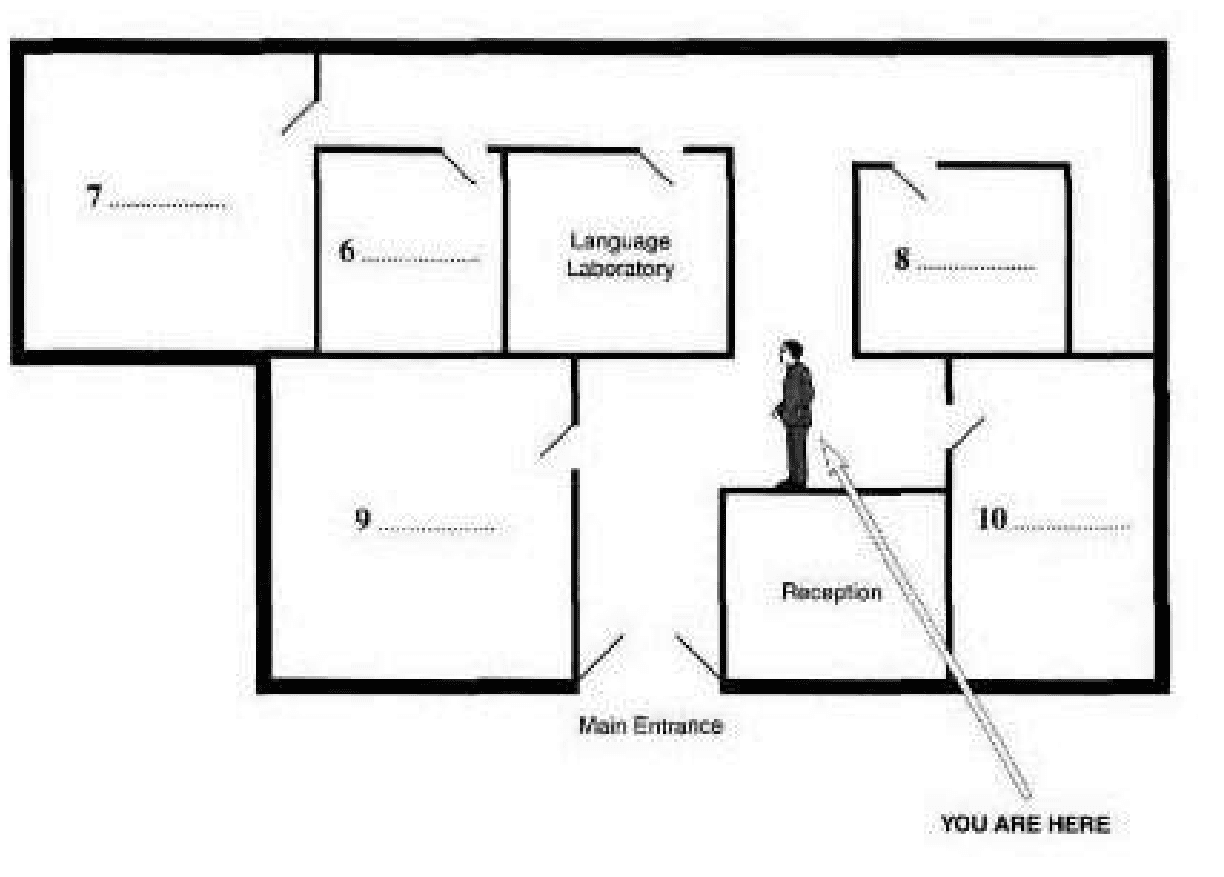
Label the rooms on the map
CL Computer Laboratory · DO Director's Office · L Library · MH Main Hall · S Storeroom · SAR Self Access Room · SCR Student Common Room · SR Staff Room
• Room 6: (6) …………………………
• Room 7: (7) …………………………
• Room 8: (8) …………………………
• Room 9: (9) …………………………
• Room 10: (10) …………………………
A talk about the University Helpline
Questions 11–15
Complete the table below. Write NO MORE THAN THREE WORDS for each answer.
| TYPE OF HELP | EXAMPLES |
|---|---|
| FINANCIAL | • grants • (11) ………………………… |
| _____ | • childcare • nurseries |
| ACADEMIC | • (13) ………………………… • using the library |
| _____ | • individual interests • (15) ………………………… |
Questions 16–20
Complete the notes below. Write NUMBERS OR NO MORE THAN THREE WORDS for each answer.
HELPLINE DETAILS
Address: Student Welfare Office, 13 Marshall Road
Officer: Jackie (16) …………………………
Telephone number: (17) …………………………
• (18) ………………………… (Saturdays)
Ring or visit office for (19) …………………………
N.B. At peak times there may be a (20) …………………………
A tutorial on staff selection
Questions 21–24
Choose the correct letters A–C.
21. At the start of the tutorial, the tutor emphasises the importance of
A interviews.
B staff selection.
C question techniques.
22. An example of a person who doesn't 'fit in' is someone who
A is over-qualified for the job.
B lacks experience of the tasks set.
C disagrees with the rest of the group.
23. An important part of teamwork is having trust in your
A colleagues' ability.
B employer's directions.
C company training.
24. The tutor says that finding out personal information is
A a skill that needs practice.
B avoided by many interviewers.
C already a part of job interviews.
Questions 25–29
Complete the notes below. Write NO MORE THAN THREE WORDS for each answer.
Personality Questionnaires
Personality Questionnaires
• completed during (25) …………………………
• used in the past by the (26) …………………………
and the (27) …………………………
• nowadays used by (28) ………………………… of large employers
• questions about things like: working under pressure or keeping deadlines
• written by (29) ………………………… who say candidates tend to be truthful
Question 30
Choose the correct letter A–C.
30. What is the tutor trying to do in the tutorial?
A describe one selection technique
B criticise traditional approaches to interviews
C illustrate how she uses personality questionnaires
A student presentation on a hat-making project
Questions 31–32
Complete the notes below. Write NO MORE THAN THREE WORDS AND/OR A NUMBER for each answer.
HAT-MAKING PROJECT — Project Profile
Name of student: Vivien
Type of school: (31) …………………………
Age of pupils: (32) …………………………
Questions 33–34
Label the diagrams. Write NO MORE THAN THREE WORDS for each answer.
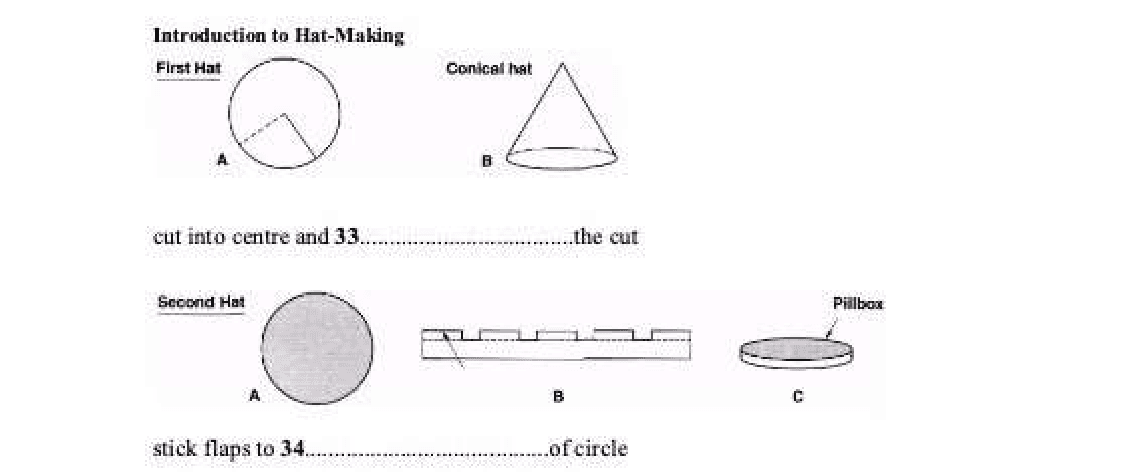
Introduction to Hat-Making
First Hat: cut out a circle (A), then make one cut up to the centre — the result is a conical hat (B).
• cut into centre and (33) ………………………… the cut
• stick flaps to (34) ………………………… of circle
Questions 35–37
Complete the notes below. Write NO MORE THAN THREE WORDS for each answer.
DESIGN PHASE
Constraints
Stage A: Refer to research and design a hat (35) …………………………
Stage B: Make a small-scale (36) ………………………… hat
• material: paper
• colours: (37) …………………………
• glue: must not show
Questions 38–40
Indicate who made the hats below. Write the appropriate letter, A–E, next to each name.
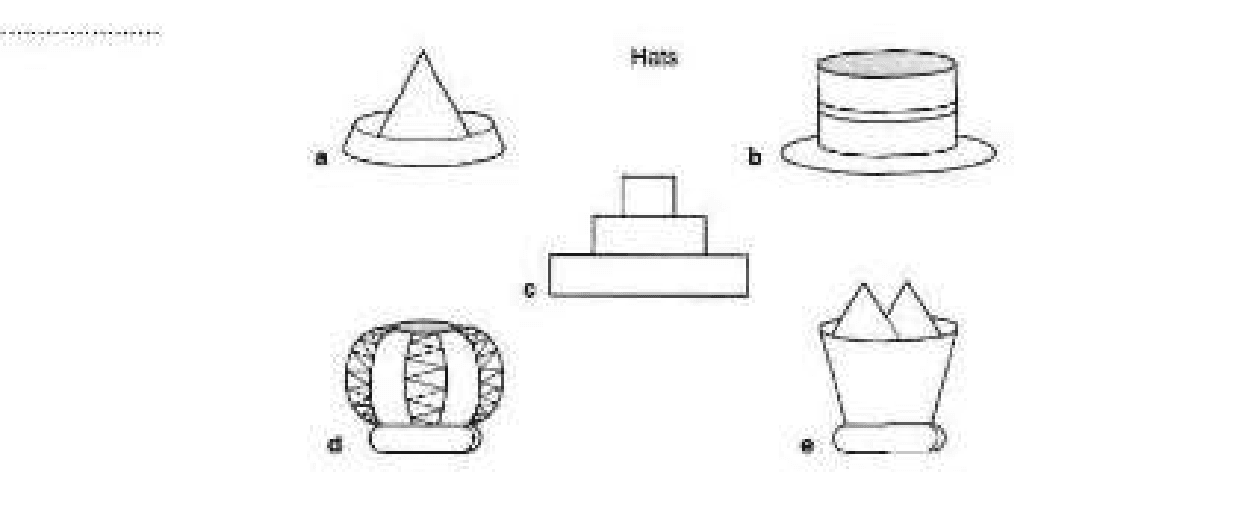
38. Theresa
39. Muriel
40. Fabrice
Answers
1. Main Hall
2. Director of Studies
3. Student Adviser
4. 11
5. placement
6. L
7. MH
8. CL
9. SR
10. SCR
11. fees
12. domestic
13. essay deadlines
14. social
15. outings
16. Kouachi
17. 3269940
18. 10 to 4
19. an appointment
20. waiting list
21. staff selection.
22. disagrees with the rest of the group.
23. colleagues' ability.
24. already a part of job interviews.
25. selection
26. ancient Chinese
27. military
28. two thirds
29. experts
30. describe one selection technique
31. secondary
32. 14
33. overlap
34. underside
35. on paper
36. three-dimensional
37. white, grey or brown
38. C
39. D
40. A
Explanations
- 1. Main Hall
- 'At 10 o'clock, all the new students will gather in the Main Hall to meet the Principal and the rest of the staff.'Common trap: Classroom 5 is the other venue mentioned, but that is for the 11 o'clock test and is already printed lower down the table.
- 2. Director of Studies
- '...the Principal's talk will last about fifteen minutes and then the Director of Studies will talk to you for half an hour about the courses...' The 10.15 talk is by the Director of Studies.Common trap: The Principal opens the morning but is already named in the Example row — the fifteen minutes is what puts the next talk at 10.15.
- 3. Student Adviser
- 'After that, the Student Adviser will tell you about the various services and activities we offer to students.'Common trap: Three speakers come in quick succession — Principal, Director of Studies, Student Adviser — and only the last two are asked for.
- 4. 11
- 'And then you'll go next door to Classroom 5 at 11 o'clock.'Common trap: 10 o'clock (the start) and the fifteen/thirty-minute talk lengths all come first — only the move to Classroom 5 gives this time.
- 5. placement
- 'It's just a placement test to help us find your level of English so that we can put you in the right class.'Common trap: 'test' is already printed in the cell, so only the type of test is wanted.
- 6. L
- 'Walk along past the Language Laboratory and then past the Library, which is next to the Language Lab, on the same side, and facing you is the Main Hall.' Room 6 sits between the Language Laboratory and the corridor end.Common trap: The Language Laboratory is already printed on the map — the Library is the room 'next to' it on the same side.
- 7. MH
- '...and facing you is the Main Hall, at the end of the corridor. You can't miss it.' — confirmed by 'So it's next to the Library, in fact.' — 'Yes, that's right.'Common trap: The Main Hall is described only by where it faces, after two other rooms have been passed on the way.
- 8. CL
- 'You go down to the end of this corridor again but, this time, don't turn left; turn right, away from the Main Hall. The Computer Lab. is immediately on your right.'Common trap: 'don't turn left' reverses the earlier route to the Main Hall — following the first set of directions puts this room on the wrong side.
- 9. SR
- 'The staff room is near the main entrance, on the left over there, just opposite the Reception desk.'Common trap: Both this room and the student common room are located relative to the Reception desk — 'opposite' versus 'to the right of'.
- 10. SCR
- 'It's this area here, very close to where we are now, to the right of the Reception desk as you come in the main entrance. There's tea and coffee facilities there.'Common trap: The staff room was placed 'opposite the Reception desk' one turn earlier — the two are easy to swap.
- 11. fees
- '...or you may have some queries regarding the fees you are paying if you are an overseas student.' Fees sit alongside grants under FINANCIAL.Common trap: 'grants' opens the same sentence and is already printed as the first bullet.
- 12. domestic
- 'Another area we can help with is what we generally term the domestic areas; things such as childcare and the availability of nursery provision.'Common trap: The four category names are all flagged with 'we generally term' or quotation marks — the examples beside them are already printed.
- 13. essay deadlines
- 'You may wish to know more about essay deadlines, for example, or how to use the library.'Common trap: 'using the library' is the second bullet and is already printed, so only the first example is wanted.
- 14. social
- 'The last example I've given here is simply termed social - and yes, there is a lot of social life here!'Common trap: The category name is given before the examples this time, so it arrives earlier than the pattern of the previous rows suggests.
- 15. outings
- '...or you may wish to participate in outings or trips if you don't know many people at the moment.'Common trap: 'a particular interest you wish to pursue' opens the sentence and is already printed as 'individual interests'.
- 16. Kouachi
- 'Generally you will see our Helpline officer Jackie Kouachi, that's K-O-U-A-C-H-I.'Common trap: The surname is spelled out letter by letter immediately after being said at speed.
- 17. 3269940
- 'If you wish to ring the office, the number is 326 99 40. That's 3269940.'Common trap: '13 Marshall Road' is given just before — an address number rather than a phone number.
- 18. 10 to 4
- 'The office is open between 9.30 and 6.00 on weekdays and from 10 to 4 on Saturdays.'Common trap: The weekday hours (9.30–6.00) come first in the same sentence and are already printed on the line above.
- 19. an appointment
- 'If you want to make an appointment you can phone or call at the office in person.'Common trap: 'phone or call at the office in person' matches the printed 'Ring or visit office', so only the purpose is missing.
- 20. waiting list
- '...you may have to go on the waiting list and then come back later.'Common trap: 'lunch time' is offered as the example of a peak time, which is already covered by the printed 'At peak times'.
- 21. staff selection.
- 'So, we've looked at various aspects of staff selection this term and I think by now you should all be beginning to see how much more there is to it than just putting applicants through a short interview or asking the right questions.'Common trap: Both distractors appear in the same sentence, but each follows 'much more to it than' — they are what selection is NOT reducible to.
- 22. disagrees with the rest of the group.
- 'But if they start work and you realise that they just don't get along with everybody else, that... say, they've got sharply contrasting views on how something will work ... well, with the best will in the world, you may be backing a loser.'Common trap: Qualifications and experience are both raised first — but as things the candidate HAS, which makes them tempting mis-selections.
- 23. colleagues' ability.
- 'People have to have faith in each other's ability to carry out the task their boss has set them.' Faith in each other's ability = trust in colleagues' ability.Common trap: 'their boss has set them' closes the same sentence, and company training is raised by a student immediately before.
- 24. already a part of job interviews.
- 'Well, in most interviews you usually ask candidates questions about their hobbies and what they like doing in their spare time ... so employers are already involved in the practice of ... well, doing part of the task.'Common trap: The word 'practice' is the trap — it means the customary doing of something here, not training or rehearsal.
- 25. selection
- 'They have to be filled out by the candidates some time during the selection procedure, often just before an interview.'Common trap: 'just before an interview' follows immediately, but that is a typical moment within the procedure, not the answer.
- 26. ancient Chinese
- 'Apparently they were used by the ancient Chinese for picking out clerks and civil servants, and then later they were used by the military.' The book accepts these two answers in either order across Questions 26 and 27.Common trap: 'clerks and civil servants' are who the tests were used ON, not who used them.
- 27. military
- '...and then later they were used by the military to put people in appropriate areas of work.' Either order is accepted across Questions 26 and 27.Common trap: The two historical users run together in one sentence, so the order they are written in does not matter — the key allows either.
- 28. two thirds
- '...there are about 80,000 different tests available now and almost two thirds of the large employers use them.'Common trap: 'about 80,000 different tests' sits in the same sentence — a much more striking number, but it counts tests, not employers.
- 29. experts
- 'These tests are compiled by experts and they believe that the answers can provide a few simple indicators... that people will generally be truthful in that situation.'Common trap: The book explicitly rejects the singular — it must be 'experts', matching 'they believe' in the same sentence.
- 30. describe one selection technique
- The whole tutorial builds towards personality questionnaires and explains what they are, who used them and how they work — a description of a single selection technique.Common trap: This is a purpose question — it must be answered from the shape of the whole tutorial, not from any one sentence.
- 31. secondary
- 'Mr Yardley has asked me to describe to you the project I did as a student teacher at a secondary school in London.'Common trap: 'in London' closes the same phrase — a location, not a type of school.
- 32. 14
- 'I was at this school for six weeks and I taught a variety of subjects to a class of fourteen-year-old pupils.'Common trap: 'six weeks' comes first in the same sentence — a duration, not an age.
- 33. overlap
- '...cutting out a circle and then making one cut up to the centre and then ... er ... overlapping the cut like this ... a conical hat that sits on your head.'Common trap: 'cut out a circle' and 'one cut up to the centre' are both already printed — the missing action is what you do WITH the cut.
- 34. underside
- '...you bend the flaps over and stick them ... with glue or prittstick ... to the underside of the circle ... like this.'Common trap: The book explicitly rejects 'side' — it has to be the underside, underneath or bottom.
- 35. on paper
- '...using their pages of research to draw a design of their hat on paper. That's the easy part.'Common trap: 'two-dimensional design' is used a sentence later when describing what has to be translated into a form — the same idea, a different stage.
- 36. three-dimensional
- 'I encouraged them to make a small-scale, three-dimensional hat first so that they could experiment with how to achieve the form they required.'Common trap: 'two-dimensional design' appears in the sentence immediately before — the dimensions flip between the two stages.
- 37. white, grey or brown
- 'They also had to limit their colours to white, grey or brown shades of paper which reflected the colours of the buildings they were using as a model.' The book requires all three colours to be stated.Common trap: All three colours must be given for the mark — naming only one or two scores nothing.
- 38. C
- 'This one here is based on a circular stairway in an old building in London. It uses three pillbox hats one on top of the other. This was designed by Theresa.' Hat C is the three stacked boxes.Common trap: The maker's name comes AFTER the description each time, so the hat has to be held in mind until the name arrives.
- 39. D
- '...a simple strip going round the base of the hat but has then gone on to add strips of paper that come out from the base and that meet at the top of the hat - rather like a crown - making a fairly tall hat. This was made by Muriel.' Hat D is the crown-like one.Common trap: 'a simple strip going round the base' also opens Fabrice's hat in the next sentence — the strips meeting at the top are what distinguish this one.
- 40. A
- '...a combination of the pillbox or single strip around the base and then the conical hat shape on top to form a castle turret. This was made by Fabrice.' Hat A is the cone sitting on a base.Common trap: 'pillbox' and 'single strip around the base' echo both earlier hats — only the conical top identifies this one.
Audio transcripts
Part 1 — Enrolment at a language school
RECEPTIONIST: Sorry to keep you waiting. Well, firstly, let me give you this booklet. It tells you a bit more about the school, the courses and the social activities we offer. Now, on the first page, there's an outline of this morning's activities. There, you see? The programme starts at 10 o'clock. Try not to be late as it's a very full day. At 10 o'clock, all the new students will gather in the Main Hall to meet the Principal and the rest of the staff. In fact, you spend most of the morning in the Main Hall. STUDENT: Where's that? RECEPTIONIST: I'll show you in a minute. Just let me quickly run through this morning's events first and then I'll explain how to get there. STUDENT: Yes, OK. RECEPTIONIST: Right. Where were we? Yes, so, the Principal's talk will last about fifteen minutes and then the Director of Studies will talk to you for half an hour about the courses and the different requirements for each. After that, the Student Adviser will tell you about the various services and activities we offer to students. Any questions? STUDENT: So, all of this is in the Main Hall? RECEPTIONIST: That's right. And then you'll go next door to Classroom 5 at 11 o'clock. STUDENT: What happens there? RECEPTIONIST: You'll have a test. STUDENT: Test? I don't like the sound of that. What sort of test? RECEPTIONIST: Oh, it's nothing to worry about. It's just a placement test to help us find your level of English so that we can put you in the right class. It won't last long. STUDENT: But how do I find the Main Hall? RECEPTIONIST: Right; if you look on the back of the booklet I gave you, you'll see a map of the school. Let me show you. Look: you came in through the Main Entrance, here, and now we're here at Reception. Now, to get to the Main Hall, you walk on to the end of this corridor in front of you and then you turn left. Walk along past the Language Laboratory and then past the Library, which is next to the Language Lab, on the same side, and facing you is the Main Hall, at the end of the corridor. You can't miss it. STUDENT: So it's next to the Library, in fact. RECEPTIONIST: Yes, that's right. STUDENT: I should be able to find that. And do you have a Computer Laboratory? RECEPTIONIST: Yes, we do. STUDENT: Could you tell me where that is? RECEPTIONIST: Certainly, yes. You go down to the end of this corridor again but, this time, don't turn left; turn right, away from the Main Hall. The Computer Lab. is immediately on your right. OK? STUDENT: And where's the staff room, in case I need to find a teacher at some stage? RECEPTIONIST: The staff room is near the main entrance, on the left over there, just opposite the Reception desk. In a day or two, I'm sure you'll find your way around very easily. STUDENT: Oh, one last thing. Is there a student common room? RECEPTIONIST: Oh yes, I forgot to mention that. It's this area here, very close to where we are now, to the right of the Reception desk as you come in the main entrance. There's tea and coffee facilities there. STUDENT: Great. Thank you very much. RECEPTIONIST: You're welcome.
Part 2 — A talk about the University Helpline
Hello, everybody and welcome to this informal meeting about the University Helpline. The Helpline was set up ten years ago by the Students Union and it aims to provide new students to the university with a service that they can use if they need information about practical areas of student life that they are unfamiliar with. Let me give you some examples of the type of help we can offer. We can provide information on financial matters; for example, you may feel that your grant is insufficient to see you through college life or you may have some queries regarding the fees you are paying if you are an overseas student. In both cases, the Helpline would be able to go through things with you and see what the outcome might be. Another area we can help with is what we generally term the 'domestic' areas; things such as childcare and the availability of nursery provision, for example, come under this. Then there's 'academic' issues that may arise while you are in the early stages of your course that you may not know what to do about. You may wish to know more about essay deadlines, for example, or how to use the library - there are all kinds of questions you will find yourself asking and not knowing where to get quick answers from. The Helpline would be able to provide these. The last example I've given here is simply termed 'social' - and yes, there is a lot of social life here! But you may have a particular interest you wish to pursue or you may wish to participate in outings or trips if you don't know many people at the moment. Let me give you some details so that you know where to go and who to see if you want to pay us a visit. Generally you will see our Helpline officer Jackie Kouachi, that's K-O-U-A-C-H-I. Jackie is a full-time employee of the Student Union and she works in the Student Welfare Office - that's the office that deals with all matters related to student welfare and it's located at 13 Marshall Road. I have some maps here for those of you who haven't been there yet. If you wish to ring the office, the number is 326 99 40. That's 3269940. The office is open between 9.30 and 6.00 on weekdays and from 10 to 4 on Saturdays and there'll be somebody there - usually Jackie or myself - between those times. If you want to make an appointment you can phone or call at the office in person. Please note that it may not be possible for anyone to see you straight away - particularly if it is a busy time - lunch time for example - and you may have to go on the waiting list and then come back later. Well, enough from me. Any questions?
Part 3 — A tutorial on staff selection
TUTOR: Good morning. So, we've looked at various aspects of staff selection this term and I think by now you should all be beginning to see how much more there is to it than just putting applicants through a short interview or asking the 'right' questions. So I think you should be ready for today's tutorial on 'matching the person to the job'. We're going to talk today about the importance of choosing that all round 'right' person. MURIEL: Right. So we have to put ourselves into the role of the manager or supervisor? TUTOR: Yes. And then we're going to imagine how different applicants would fit into the team or group they have to work with ... er ... we'll look at some examples later. MURIEL: It's just theoretical at the moment... TUTOR: Yes. The point is, you can select someone - even a friend - who has all the right qualifications ... degrees ... certificates, whatever. You can also check that they have a lot of experience ... that they've done the sort of tasks that you want them to do in your office already, in a similar environment. But if they start work and you realise that they just don't get along with everybody else, that... say, they've got sharply contrasting views on how something will work ... well, with the best will in the world, you may be backing a loser. DAVE: Wouldn't it be just a question of company training, though? TUTOR: Not always. Particularly in a team situation, and I think it's important to think in terms of that type of working environment. People have to have faith in each other's ability to carry out the task their boss has set them. They have to trust that everyone will do their part of the job, and you can't necessarily train people for this. DAVE: But it's like trying to find out what someone's personality is like in a job interview ... I mean you just can't do that. Even if you try, you won't find out what they're really like until they actually start work. TUTOR: Well, in most interviews you usually ask candidates questions about their hobbies and what they like doing in their spare time ... that sort of thing ... so employers are already involved in the practice of ... well, doing part of the task. DAVE: But it doesn't tell you anything. It doesn't tell you if they're easy-going or hate smokers or whatever. TUTOR: Well, arguably it does give you a bit of information about an applicant's character, but also ... more and more employers around the world are making use of what are called 'personality questionnaires' to help them select new staff and ... MURIEL: What's it called? TUTOR: A Personality Questionnaire. They have to be filled out by the candidates some time during the selection procedure, often just before an interview. The idea is actually quite old. Apparently they were used by the ancient Chinese for picking out clerks and civil servants, and then later they were used by the military to put people in appropriate areas of work. They've gained a lot of ground since then and there are about 80,000 different tests available now and almost two thirds of the large employers use them. MURIEL: Which makes you think that there must be something in them. TUTOR: That's right. They ask the sort of questions that you might expect, like do you like working under pressure or are you good at keeping deadlines. DAVE: And what if people can see through them and just write what they think the employer wants to see? MURIEL: Well that's always a possibility. DAVE: I mean, it's human nature to lie, isn't it? TUTOR: Well, that's the point. Apparently it isn't. These tests are compiled by experts and they believe that the answers can provide a few simple indicators as to roughly the type of person that you are ... that people will generally be truthful in that situation. MURIEL: And then you can go some way towards finding out whether someone's say, forward-looking ... a go-ahead type of person ... or resistant to change. TUTOR: Yes. And there are all kinds of (fade out)
Part 4 — A student presentation on a hat-making project
TUTOR: Right. Are we all here? OK. As you know, today Vivien is going to do a presentation on the hatmaking project she did with her class during her last teaching practice. So, over to you, Vivien. VIVIEN: Thanks. Um ... Mr Yardley has asked me to describe to you the project I did as a student teacher at a secondary school in London. I was at this school for six weeks and I taught a variety of subjects to a class of fourteen-year-old pupils. The project I chose to do was a hat-making project and I think this project could easily be adapted to suit any age. So, to explain the project... After we'd done the research, we went back to the classroom to make two basic hat shapes using rolls of old wallpaper. We each made, first of all, a conical hat by ... er ... if I show you now ... cutting out a circle and then making one cut up to the centre and then ... er ... overlapping the cut like this this ... a conical hat that sits on your head. The other hat we made was a little more complicated ... er ... first of all we cut out a circle again ... like this ... then you need a long piece with flaps on it - I've already made that bit which I have here - you bend the flaps over and stick them ... with glue or prittstick ... to the underside of the circle ... like this. Again, I've prepared this so that I don't get glue everywhere. The pupils do, of course, so you need plenty of covers for the table. And there you have a pillbox hat as in pill and box. Now variations and combinations of these two hat shapes formed the basis of the pupils' final designs. The next stage of the project was the design phase and this involved, first of all, using their pages of research to draw a design of their hat on paper. That's the easy part. They then had to translate their two-dimensional design into a form to fit their head. I encouraged them to make a small-scale, three-dimensional hat first so that they could experiment with how to achieve the form they required and I imposed certain constraints on them to keep things simple. For example, they had to use paper not card. Paper is more pliable and easier to handle. They also had to limit their colours to white, grey or brown shades of paper which reflected the colours of the buildings they were using as a model for their hats and they had to make sure their glue didn't show! Well, it was very enjoyable and just to give you an idea of what they produced, I've brought along three hats to show you. This one here is based on a circular stairway in an old building in London. It uses three pillbox hats one on top of the other. This was designed by Theresa. Here's another one that has a simple strip going round the base of the hat but has then gone on to add strips of paper that come out from the base and that meet at the top of the hat - rather like a crown - making a fairly tall hat. This was made by Muriel. And lastly there's a combination of the pillbox or single strip around the base and then the conical hat shape on top to form a castle turret. This was made by Fabrice, and there are many more that I could have brought. TUTOR: Thank you, Vivien. That was most interesting. Now what we can learn from this is that...
Comments
Loading comments…