

Cambridge IELTS 1 Listening Test 1
4 parts · 41 questions · 30 minutes
Reporting a stolen briefcase
Questions 1–5
Circle the appropriate letter.
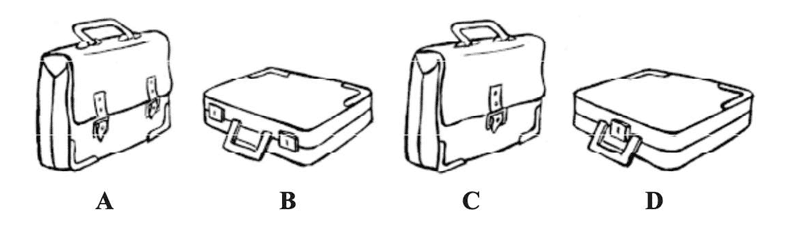
1. What does her briefcase look like?
A Picture A
B Picture B
C Picture C
D Picture D
2. Which picture shows the distinguishing features?
A Picture A
B Picture B
C Picture C
D Picture D
3. What did she have inside her briefcase?
A wallet, pens and novel
B papers and wallet
C pens and novel
D papers, pens and novel
4. Where was she standing when she lost her briefcase?
A Picture A
B Picture B
C Picture C
D Picture D
5. What time was it when she lost her briefcase?
A Picture A
B Picture B
C Picture C
D Picture D
Questions 6–10
Complete the form. Write NO MORE THAN THREE WORDS AND/OR A NUMBER for each answer.
PERSONAL DETAILS FORM
Name: Mary (6) …………………………
Address: Flat 2, (7) …………………………,
(8) ………………………… Road
Canterbury
Telephone: (9) …………………………
Estimated value of lost item: £(10) …………………………
A radio news bulletin
Questions 11–13
Tick the THREE other items which are mentioned in the news headlines.
11. Tick the THREE other items which are mentioned in the news headlines.
A Rivers flood in the north
B Money promised for drought victims
C Nurses on strike in Melbourne
D Passengers rescued from ship
E Passengers rescued from plane
F Bus and train drivers national strike threat
G Teachers demand more pay
H New uniform for QANTAS staff
I National airports under new management
12. Tick the THREE other items which are mentioned in the news headlines.
A Rivers flood in the north
B Money promised for drought victims
C Nurses on strike in Melbourne
D Passengers rescued from ship
E Passengers rescued from plane
F Bus and train drivers national strike threat
G Teachers demand more pay
H New uniform for QANTAS staff
I National airports under new management
13. Tick the THREE other items which are mentioned in the news headlines.
A Rivers flood in the north
B Money promised for drought victims
C Nurses on strike in Melbourne
D Passengers rescued from ship
E Passengers rescued from plane
F Bus and train drivers national strike threat
G Teachers demand more pay
H New uniform for QANTAS staff
I National airports under new management
Questions 14–21
Complete the notes below by writing NO MORE THAN TWO WORDS AND/OR A NUMBER in the spaces provided.
14. The Government plans to give $ ………………………… to assist the farmers. This money was to be spent on improving Sydney's
15. ………………………… but has now been re-allocated.
Australia has experienced its worst drought in over fifty years.
16. Farmers say that the money will not help them because it is ………………………….
17. An aeroplane which was carrying a group of ………………………… was forced to land just
18. ………………………… minutes after take-off. The passengers were rescued by boats and
19. …………………………. The operation was helped because of the good weather. The passengers thanked the
20. ………………………… for saving their lives but unfortunately they lost their
21. ………………………….
A new student asking about an Economics course
Questions 22–25
Circle the appropriate letter.
22. The orientation meeting
A took place recently.
B took place last term.
C will take place tomorrow.
D will take place next week.
23. Attendance at lectures is
A optional after 4 pm.
B closely monitored.
C difficult to enforce.
D sometimes unnecessary.
24. Tutorials take place
A every morning.
B twice a week.
C three mornings a week.
D three afternoons a week.
25. The lecturer's name is
A Roberts.
B Rawson.
C Rogers.
D Robertson.
Questions 26–31
Complete the notes below using NO MORE THAN THREE WORDS.
Course requirements:
Tutorial paper:
• A piece of work on a given topic. Students must:
• (26) ………………………… for 25 minutes
• (27) ………………………… work
• give to lecturer for marking
Essay topic:
Usually can (28) …………………………
Type of exam:
(29) …………………………
Library:
Important books are in (30) ………………………….
Focus of course:
Focus on (31) ………………………….
An introductory talk to new Social Science students
Questions 32–33
Circle the appropriate letter.
32. The speaker works within the Faculty of
A Science and Technology.
B Arts and Social Sciences.
C Architecture.
D Law.
33. The Faculty consists firstly of
A subjects.
B degrees.
C divisions.
D departments.
Questions 34–36
Complete the notes in NO MORE THAN THREE WORDS.
34. The subjects taken in the first semester in this course are psychology, sociology, ………………………….
35. Students may have problems with meeting ………………………… and
36. ………………………….
Questions 37–41
Circle the appropriate letter.
37. The speaker says students can visit her
A every morning.
B some mornings.
C mornings only.
D Friday morning.
38. According to the speaker, a tutorial
A is a type of lecture.
B is less important than a lecture.
C provides a chance to share views.
D provides an alternative to groupwork.
39. When writing essays, the speaker advises the students to
A research their work well.
B name the books they have read.
C share work with their friends.
D avoid using other writers' ideas.
40. The speaker thinks that plagiarism is
A a common problem.
B an acceptable risk.
C a minor concern.
D a serious offence.
41. The speaker's aims are to
A introduce students to university expectations.
B introduce students to the members of staff.
C warn students about the difficulties of studying.
D guide students round the university.
Answers
1. Picture A
2. Picture C
3. papers, pens and novel
4. Picture D
5. Picture C
6. Prescott
7. 41
8. Fountain
9. 752239
10. 65
11. Passengers rescued from plane
12. Bus and train drivers national strike threat
13. New uniform for QANTAS staff
14. 250 million
15. roads
16. too late
17. school children
18. 3
19. pleasure craft
20. pilot
21. musical instruments
22. took place recently.
23. closely monitored.
24. three mornings a week.
25. Roberts.
26. talk
27. write up
28. choose
29. open book
30. closed reserve
31. vocational
32. Arts and Social Sciences.
33. divisions.
34. history and economics
35. deadlines
36. attendance
37. some mornings.
38. provides a chance to share views.
39. name the books they have read.
40. a serious offence.
41. introduce students to university expectations.
Explanations
- 1. Picture A
- She describes 'a soft leather one, you know, not a heavy box-type like a man's', which rules out the two hard box cases. She then says it closes with 'buckles at the front ... two of them', and only A has two buckles on the front.Common trap: Two details have to be held at once. 'Soft leather' alone still leaves A and C; only the number of buckles decides it, and that detail arrives in a separate exchange after the officer asks 'how does it close?'
- 2. Picture C
- The only marks are the brand name, which is 'at the bottom in the left-hand corner', and a scratch 'directly above the brand name'. C is the only picture with SAGI at the bottom left and the scratch immediately above it.Common trap: The scratch is located relative to the brand name, not to the case, so both features must be placed correctly rather than just spotted. 'It's quite bad but small' also invites you to judge by the size of the mark instead of its position.
- 3. papers, pens and novel
- Inside were 'all my papers from college', 'my pens which I got for my birthday' and 'a novel I was planning to read on the train'. The wallet was in her pocket, so it was not in the briefcase.Common trap: A negative detail. 'Wallet' is said aloud, but the clause around it — 'in my pocket so I didn't lose that' — excludes it. Hearing the word and ticking an option containing it is the trap.
- 4. Picture D
- She was 'standing on the platform' with the briefcase 'right next to me' after she had 'just put it down on the floor'. She was still watching for her train, so it had not yet arrived — D shows her waiting on an open platform with the case beside her feet.Common trap: All four options are station scenes, so the discriminator is whether the train has arrived. 'I was watching for my train' means it had not, which eliminates the three pictures with a train at the platform.
- 5. Picture C
- She corrects herself mid-sentence: 'it must have been about 5.20 ... no a bit later. I'd say 5.30'. The time she settles on is 5.30, which is clock C.Common trap: Self-correction plus a second irrelevant time. The first time given (5.20) is withdrawn, and 'twenty-five to six' is the train's timetable rather than the moment of the theft, so the answer sits between two distractors.
- 6. Prescott
- She gives her name as 'Mary Prescott' and then spells the surname out letter by letter: P-R-E-S-C-O-T-T.Common trap: A spelt-out surname. 'Mary' is already printed on the form, so only the surname belongs in the gap, and it has to be transcribed from the spelling.
- 7. 41
- The address is 'Flat 2, 41, Fountain Road, Canterbury', and she confirms 'Yes, number 41' when the officer reads it back.Common trap: 'Flat 2' is already printed on the form, so the first number spoken is not the answer — the house number immediately after it is.
- 8. Fountain
- The street is 'Fountain Road', and the officer repeats 'Fountain Road' back to confirm it. Only the name goes in the gap because 'Road' is already printed.Common trap: 'Road' is already on the form, so writing 'Fountain Road' overruns the gap. The officer's read-back is the second chance if the name is missed the first time.
- 9. 752239
- 'it's 7-5 double 2-3-9' — 'double 2' stands for two 2s, giving the six-digit number 752239.Common trap: 'Double 2' has to be expanded into two digits; writing the digits literally as heard gives a five-digit number. The officer's read-back then groups them differently again ('7-5-double 239'), which can shake a correct answer.
- 10. 65
- Asked for a rough estimate of the value, she says 'I suppose about £65'. The £ sign is already printed on the form, so only the number is written.Common trap: Three amounts appear in one turn: £40 (what she paid for the case), £65 (the estimate the officer asked for) and 20–25 pounds (the contents). Only the overall estimate is wanted.
- 11. Passengers rescued from plane
- The headlines cover four stories: help for drought-stricken farmers (already given as the example, B), school children rescued from a plane that landed in the sea (E), a transport workers' strike in Melbourne spreading to other states (F), and a new look for QANTAS staff (H).Common trap: The headlines are read once, fast, and the distractors are near-misses of each real story: ship for plane, nurses for transport workers, floods for drought in 'the northern part of the country'.
- 12. Bus and train drivers national strike threat
- 'Transport workers are on strike in Melbourne over a pay claim and the strike looks set to spread to other states' — transport workers are the bus and train drivers, and spreading to other states is the national strike threat.Common trap: 'Transport workers' has to be recognised as bus and train drivers, and 'set to spread to other states' as a national threat — neither option word appears in the bulletin.
- 13. New uniform for QANTAS staff
- 'And on a fashionable note, there is to be a new look for the staff of QANTAS, Australia's national airline' — a new look for staff is a new uniform.Common trap: 'A new look for the staff' must be matched to 'new uniform', and hearing the airline's name tempts a jump to the airports option, which is never mentioned.
- 14. 250 million
- 'he will make two hundred and fifty million dollars available to help the drought stricken farmers' — written as a figure plus a word, this is 250 million.Common trap: The figure is spoken in full words, and three other numbers surround it — five years, 50 years, fifty years — so the amount has to be separated from the timespans.
- 15. roads
- 'Money that was to have been spent on the re-structuring of Sydney's road system has been re-allocated' — the money was earmarked for Sydney's road system.Common trap: The note reverses the order of the recording, which says what the money was for before saying it has been re-allocated. 'Sydney's' is already printed, so repeating it overruns the two-word limit.
- 16. too late
- 'Many farmers feel that while the money is welcome it has come too late to save them and their farms from financial ruin' — the objection is the timing, not the amount.Common trap: The sentence opens with a concession — 'while the money is welcome' — so the answer is the second half. 'Did not act sooner' says the same thing again in different words and does not fit the gap grammatically.
- 17. school children
- 'A group of school children who were travelling in a privately chartered aeroplane' — they are later referred to as 'the boys', which the answer key also accepts.Common trap: '50 passengers' is the number on board, not who they were, and the earlier headline called them 'passengers' — the notes want the specific group.
- 18. 3
- 'their aeroplane had to land in the sea just three minutes after taking off from Sydney airport'.Common trap: The headline version said only 'shortly after take-off', so the exact figure comes once, in the body of the report, close to the unrelated number 50.
- 19. pleasure craft
- 'boats and pleasure craft were able to come to the rescue of the boys' — the notes already print 'boats and', so the answer is the second rescuer named.Common trap: 'Boats' is already in the notes, so repeating it fails. The phrase runs on quickly inside a long sentence about Botany Bay.
- 20. pilot
- "'We owe our lives to the skill of the pilot,' said one of the boys" — it is the pilot the passengers thank.Common trap: The boats and pleasure craft did the rescuing, so they are the obvious guess; the thanks are given to the pilot, in a quotation rather than in the reporter's own words.
- 21. musical instruments
- 'However, all their musical instruments were lost and they never got to play at their concert.'Common trap: The very last clause of the bulletin, after the quotations, is easy to miss. 'Musical concert' appears earlier and tempts 'concert' as the answer, but the concert was missed, not lost.
- 22. took place recently.
- The lecturer refers to 'the handout which you should have received yesterday at the orientation meeting', and the student's reply — 'was there a meeting yesterday? I didn't know about that' — confirms it has already happened, and only a day ago.Common trap: The tense carries the answer. The meeting is mentioned only in passing, and 'next week' and 'tomorrow' both appear elsewhere in the conversation attached to other events.
- 23. closely monitored.
- 'We expect at least 90% attendance at this university you know', and when the student asks whether the rule is enforced the lecturer says 'Yes, we do. We're pretty strict about it actually.'Common trap: The student's own question, 'Do they enforce that rule?', plants the word 'enforce' just before the answer, making the 'difficult to enforce' option sound like an echo of the recording.
- 24. three mornings a week.
- 'Monday, Wednesday and Friday, all at 9 o'clock' — three days, and 9 o'clock is the morning.Common trap: The answer has to be assembled: a list of three days plus a time, converted into 'three mornings a week'. Both 'twice a week' and 'afternoon' appear in the recording, but attached to lectures, not tutorials.
- 25. Roberts.
- 'You'll have to talk to the lecturer on the course. Dr. Roberts is his name.'Common trap: All four names share the same opening sound, and Robertson differs from Roberts only by a final syllable, so the whole name has to be heard rather than just its start.
- 26. talk
- 'You'll have to give a small talk to your tutorial group', and when asked how long, 'Oh, about 25 minutes usually.'Common trap: The task and its length come in separate turns, with the student's disbelieving repeat ('I have to talk for 25 minutes?') in between. 'Small' is not part of the answer.
- 27. write up
- 'And then you have to write up your piece of work and give it to the lecturer to be marked.'Common trap: The phrasal verb must be kept whole — 'write' alone loses the sense. The 3,000-word essay mentioned shortly after is a separate requirement, listed under 'Essay topic' in the notes.
- 28. choose
- The student asks 'Can I choose the topic?' and the lecturer replies 'Yes, usually you can.'Common trap: The answer is in the student's question, not the lecturer's reply — the reply only confirms it with 'you can', which fits the printed 'Usually can' and gives no new word.
- 29. open book
- 'Well, it's an open book exam' — confirmed by the student's follow-up, 'Does that mean I can have the text book with me during the exam?'Common trap: A three-word answer where the heading already says 'Type of exam', so 'exam' is optional; the student's paraphrase about taking the text book in is a check, not the answer.
- 30. closed reserve
- 'But most of the important ones are held in Closed Reserve' — a part of the library where books can be read but not borrowed. The student's 'What did you call that section of the library?' prompts a clear repeat.Common trap: The name is unusual and is only spelt out by being repeated. Buying the core books is separate advice and does not answer where the important books are held.
- 31. vocational
- 'the course at this university has a vocational focus, that is a focus on preparing its graduates for work, so we're orientated very much towards employment' — the answer key accepts the vocational, work and employment wordings.Common trap: One idea is restated three ways in a single sentence, so any of the three phrasings is acceptable — but each must be trimmed to fit the three-word limit and the printed 'Focus on'.
- 32. Arts and Social Sciences.
- 'The Bachelor of Social Science is in one faculty within the university, that is the faculty where I work, known as Arts and Social Sciences.'Common trap: All four options are spoken within two consecutive sentences. Only the phrase 'the faculty where I work' separates the answer from the list of other faculties that immediately follows it.
- 33. divisions.
- 'At the top of the faculty we have a dean and below the dean we have three divisions' — divisions are the first level below the faculty head, with departments inside them and degrees and subjects below that.Common trap: The whole hierarchy — dean, divisions, departments, degrees, subjects — is described in three sentences, and every option appears. The question turns on the single word 'firstly'.
- 34. history and economics
- 'in the first semester you'll be doing four subjects psychology sociology history and economics' — psychology and sociology are already printed, so the remaining two are history and economics.Common trap: Four subjects are read out in one unbroken run, and the first two are already on the page — the same two that were named a moment earlier as the departments, which makes it easy to stop listening too soon.
- 35. deadlines
- 'you may find that you can't meet a deadline for an essay' — this is the first of 'the two most common problems that students face'.Common trap: The recording gives the problems as verb phrases ('can't meet a deadline', 'having problems with attendance'), so both have to be converted into nouns to fit 'problems with meeting _____ and _____'.
- 36. attendance
- 'or perhaps you're having problems with attendance. These seem to be the two most common problems that students face.'Common trap: Both answers sit in one sentence, so the second is easy to lose while writing the first. The confirming line — 'the two most common problems' — comes only afterwards.
- 37. some mornings.
- 'I'm available on Wednesday and Thursday mornings and on Friday afternoons' — two mornings out of five, so some mornings.Common trap: One sentence has to be weighed against four quantifiers. 'Friday' and 'mornings' both appear, but the Friday slot is an afternoon, which kills both the 'Friday morning' and 'mornings only' options.
- 38. provides a chance to share views.
- 'It's this discussion, this exchange of ideas, which really constitutes the basis of university learning, in my view' — the tutorial is where students present work and then discuss it.Common trap: She does rank tutorials above lectures, which makes the reversed statement in option B feel familiar. 'Exchange of ideas' must also be matched to 'share views' — neither phrase is repeated.
- 39. name the books they have read.
- 'you must remember to attribute the work to the original writer' — acknowledging where the material came from, which means naming your sources.Common trap: Three of the four options restate something she actually says, but as background rather than advice. 'Attribute the work to the original writer' has to be recognised as 'name the books they have read'.
- 40. a serious offence.
- 'If you don't acknowledge the source of your information then you run the risk of failing the subject or in very serious cases you might be denied entry to the university' — the penalties show how seriously it is treated.Common trap: The attitude is never stated directly; it has to be inferred from the punishments. The words 'risk' and 'common problems' both occur in the talk and pull towards two of the wrong options.
- 41. introduce students to university expectations.
- 'I'd like to tell you about the structure of the university and about some of the requirements of the degree that you're about to enter' — the whole talk sets out what is expected of new students.Common trap: A whole-text purpose question whose answer is signposted in the opening sentence, before any of the detail the distractors are drawn from — so it is decided at the moment students are least likely to be reading Question 41.
Audio transcripts
Part 1 — Reporting a stolen briefcase
R: Good evening, City Police Station. Can I help you? W: Oh hello, I'd like to report a stolen briefcase, please. R: Just a minute and I'll put you through. P: Lost property. Can I help you? W: Oh, yes. I've had my briefcase stolen. P: OK ... I'll take some details ... Tell me what it looks like, first of all. W: Well ... it's a soft leather one, you know, not a heavy box-type like a man's. P: Mmm ... and how does it close? W: It's got buckles at the front ... two of them. They're gold-plated ones. P: Fine ... Was it locked? W: No, I'm afraid not. P: Never mind. Any distinguishing features? W: Pardon? P: Any marks or badges on it that make it stand out? W: Only the brand name. P: And where's that? W: It's on the back ... at the bottom in the left-hand corner. It's Sagi. Oh and there's a scratch ... it's quite bad but small ... directly above the brand name. I did it recently putting it on my bike. P: Right, got that. So, what did you have inside the briefcase? W: Well all my papers from college. It's so frustrating but, thank goodness for computers, I haven't lost them completely! P: Yes, you're lucky. W: I had my wallet in my pocket so I didn't lose that but there were also my pens which I got for my birthday and a novel I was planning to read on the train. P: Right. Where exactly did you lose the briefcase? W: Well ... I couldn't believe it. I was standing on the platform ... it was right next to me. P: You were holding it? W: I'd just put it down on the floor but I could almost feel it beside me. I was watching for my train because sometimes it comes early and then next time I looked, my briefcase wasn't there. P: And what time was this? W: Ah ... it was ... it must have been about 5.20 ... no a bit later. I'd say 5.30 because it was just getting crowded and the train normally comes at about twenty-five to six. P: Right, if you'll just give me some personal details ... W: Yes. P: What name is it? W: I'm Mary Prescott. P: Can you spell that? W: Yes, it's P-R-E-S-C-O-T-T. P: And your address? W: Flat 2, 41, Fountain Road, Canterbury. P: Fountain Road. W: Yes, number 41. P: And have you got a contact telephone number? W: Yes, it's 7-5 double 2-3-9. P: 7-5-double 239. Fine. One last question — what would you say the value of your briefcase is? W: Including the contents? P: Yes, Just a rough estimate is fine. W: I'm not sure. Well, the briefcase itself is quite new; I bought it last month for £40. I suppose about £65. The contents are worth about 20 or 25 pounds at least. P: That's fine. Well, if you could come down to the station tomorrow, you can sign this form and have a look at what we've got here. W: OK, thanks. 'Bye. P: Goodbye.
Part 2 — A radio news bulletin
Newsreader: This is the 6 o'clock news for Tuesday 25 November. And first the headlines: The Prime Minister has promised to help the drought stricken farmers in the northern part of the country who haven't seen rain for nearly two years. And in Sydney a group of school children are successfully rescued from a plane which landed in the sea shortly after take-off. Transport workers are on strike in Melbourne over a pay claim and the strike looks set to spread to other states. And on a fashionable note, there is to be a new look for the staff of QANTAS, Australia's national airline. The Prime Minister has pledged today that he will make two hundred and fifty million dollars available to help the drought stricken farmers who have not seen rain for years, get through the next five years. Money that was to have been spent on the re-structuring of Sydney's road system has been re-allocated to what the Prime Minister described as 'a more worthy cause'. Farmers are to receive financial assistance to help see them through the worst drought in over 50 years. Many farmers feel that while the money is welcome it has come too late to save them and their farms from financial ruin and are angry that the government did not act sooner. A group of school children who were travelling in a privately chartered aeroplane from Sydney to Queensland to take part in a musical concert found themselves swimming for the shore when their aeroplane had to land in the sea just three minutes after taking off from Sydney airport. The pilot managed to bring the aircraft and its 50 passengers down safely in the calm waters of Botany Bay where boats and pleasure craft were able to come to the rescue of the boys. The fact that it was a weekend meant that there were hundreds of boats in the bay enjoying the good weather and this undoubtedly helped the rescue operation. 'We owe our lives to the skill of the pilot,' said one of the boys, but the pilot replied modestly that it was 'all part of a day's work'. However, all their musical instruments were lost and they never got to play at their concert.
Part 3 — A new student asking about an Economics course
M = male student F = female lecturer M: Hello can I come in? F: Oh yes, come in. How can I help you? M: I was looking for the Economics office. I've been all over the Arts Faculty building looking for it but I could only find the School of Accounting and Economic History. Is this the right place? F: Yes this is the School of Economics. M: Oh good. Um, I'm a new student and I was wondering if someone could give me some information. F: Well I might be able to help. I lecture on that program. What do you need to know? M: Quite a few things, actually. Firstly, how many lectures a week do I have to attend? F: Ah, well, the Economics I course is a double unit so there are two lectures a week and one tutorial. The lectures are scheduled for Tuesday and Thursday. M: What time? F: Let me see ... You know this information is all in the handout which you should have received yesterday at the orientation meeting. M: Oh, was there a meeting yesterday? I didn't know about that ... no one mentioned ... F: Yes, there was, but never mind. Now lectures are at four in the afternoon. M: Four's a bit late. I've got a part time job that starts at four thirty. F: Well, you can't be in two places at once, can you, and attendance at lectures is necessary. We expect at least 90% attendance at this university you know. M: 90%! That's high. Do they enforce that rule? F: Yes, we do. We're pretty strict about it actually. M: And what times have been set down for the tutorials — do you have that information? F: That's a very well attended course so there's a number of tutorial times. Monday, Wednesday and Friday, all at 9 o'clock. Yours will be allocated at the first lecture. M: Can't I choose the time? F: Maybe, maybe not. You'll have to talk to the lecturer on the course. Dr. Roberts is his name. M: Oh, OK. F: Anything else I can help you with while you're here? M: Well, yes, actually. Do you know what the course requirements are? I mean, how much work is expected for this course? F: Well, you have to complete a tutorial paper. M: What does that involve? F: Well, it's a piece of work on a given topic based on some set reading texts. You'll have to give a small talk to your tutorial group ... M: How long does that have to be? F: Oh, about 25 minutes usually. M: I have to talk for 25 minutes? F: Yes, that's right. And then you have to write up your piece of work and give it to the lecturer to be marked. M: Right. And is that all? F: No. You also have to complete a 3,000 word essay on a topic. M: Can I choose the topic? F: Yes, usually you can. M: Right. That shouldn't be too bad. F: And in addition to that there is an exam. M: An exam! What sort of exam? F: Well, it's an open book exam. M: Does that mean I can have the text book with me during the exam? F: Yes, that's right. M: And can you give me any idea about the content of the first year of Economics so that I can get into some reading? F: Well, you'll be getting the reading list next week when lectures start. All the books are in the library. M: Yes, but won't everyone else take them out as soon as they get the reading list too? F: Well, yes, they might. But most of the important ones are held in Closed Reserve ... that's a part of the library where you can go to read books but you can't take them out of the building. M: What did you call that section of the library? F: Closed Reserve. However, we do recommend that you buy the core books. You'll find them useful and you'll need them for the exam. M: Yes, I suppose I will. But what is the focus of the course? F: Well, the course at this university has a vocational focus, that is a focus on preparing its graduates for work, so we're orientated very much towards employment. M: So my chances of getting a job are good? F: Well, provided you get good results. M: Well look thanks for your time. You've been really helpful. F: That's fine. See you next week then.
Part 4 — An introductory talk to new Social Science students
Lecturer: Good morning and welcome to the University of Westlands. My name is Marcia Mayhew and I'm the coordinator of the Bachelor of Social Science degree. This morning I'd like to tell you about the structure of the university and about some of the requirements of the degree that you're about to enter. The Bachelor of Social Science is in one faculty within the university, that is the faculty where I work, known as Arts and Social Sciences. Here on this campus we also have the faculties of Architecture, Law and Science and Technology among others. It's important to know something about the structure of the faculty because, as you go through your course, you may need to call on members of the staff to help you. At the top of the faculty we have a dean and below the dean we have three divisions; each division has a divisional head and your degree is located in the Division of Social Sciences. Within each of the divisions, there are the departments and each of these offers the different degrees. For instance two of the departments which offer the major subjects for your award are Sociology and Psychology. Each has a departmental head but for practical purposes the people you are going to see the most of are myself as coordinator of the social sciences degree and the actual lecturers who are teaching the subjects that you are taking. For instance in the first semester you'll be doing four subjects psychology sociology history and economics. If you have any problems or difficulties, not that I'm anticipating you will, but you never know, then you should go and see your lecturers. For instance, you may find that you can't meet a deadline for an essay or perhaps you're having problems with attendance. These seem to be the two most common problems that students face. If your lecturers are unavailable, you can always come and see me in my office. I'm available on Wednesday and Thursday mornings and on Friday afternoons. Outside these hours, perhaps you could ring the secretary and make an appointment. Now you'll note that all of the subjects which you undertake in the first year are composed of lectures and tutorials. A lecture is about an hour long and a tutorial usually runs for about two hours. A lecture is rather like what I am doing now where one person will talk to all of you together on a subject. We do ask you to try to attend the lectures. A tutorial is perhaps where most of the learning occurs at a university. You will be divided into groups of between 12 and 15 students and each week one of you will have to present a piece of work to the group as a whole and then the group will discuss what you've said. It's this discussion, this exchange of ideas, which really constitutes the basis of university learning, in my view. Listening to lectures in many ways is just giving you information that you could access for yourself in the library but the discussion at the tutorial is very important. This doesn't mean that you shouldn't go to the lectures though! Other factors to be particularly concerned about are the structure of essays and delivery of written material and in particular I would like to mention the question of plagiarism. Plagiarism is taking other people's work without acknowledging it, that is, without saying where it comes from. Of course all essays are based on research done by other people but you must remember to attribute the work to the original writer. And while it's a good idea to work with other people don't hand in work which is exactly the same as your friend's work because we will notice! If you don't acknowledge the source of your information then you run the risk of failing the subject or in very serious cases you might be denied entry to the university. Last but not least, stay in touch with us. If things are getting you down, don't go and hide. Come and talk to us about it. That's what we are here for. Right, thank you very much for coming along today.
Comments
Loading comments…