

Cambridge IELTS 14 Listening Test 2
4 parts · 40 questions · 30 minutes
A new patient registering at a health clinic
Questions 1–10
Complete the notes below. Write ONE WORD AND/OR A NUMBER for each answer.
TOTAL HEALTH CLINIC
PATIENT DETAILS
Personal information
Name Julie Anne Garcia
Contact phone: (1) …………………………
Date of birth: (2) …………………………, 1992
Occupation: works as a (3) …………………………
Insurance company: (4) ………………………… Life Insurance
Details of the problem
Type of problem: pain in her left (5) …………………………
When it began: (6) ………………………… ago
Action already taken: has taken painkillers and applied ice
Other information
Sports played: belongs to a (7) ………………………… club
goes (8) ………………………… regularly
Medical history: injured her (9) ………………………… last year
no allergies
no regular medication apart from (10) …………………………
A guided tour of Branley Castle
Questions 11–15
Choose the correct letter, A, B or C. Visit to Branley Castle.
11. Before Queen Elizabeth I visited the castle in 1576,
A repairs were carried out to the guest rooms.
B a new building was constructed for her.
C a fire damaged part of the main hall.
12. In 1982, the castle was sold to
A the government
B the Fenys family.
C an entertainment company.
13. In some of the rooms, visitors can
A speak to experts on the history of the castle.
B interact with actors dressed as famous characters.
C see models of historical figures moving and talking.
14. In the castle park, visitors can
A see an 800-year-old tree.
B go to an art exhibition.
C visit a small zoo.
15. At the end of the visit, the group will have
A afternoon tea in the conservatory.
B the chance to meet the castle’s owners.
C a photograph together on the Great Staircase.
Questions 16–20
Label the plan below. Write the correct letter, A-H, next to Questions 16–20. Branley Castle.
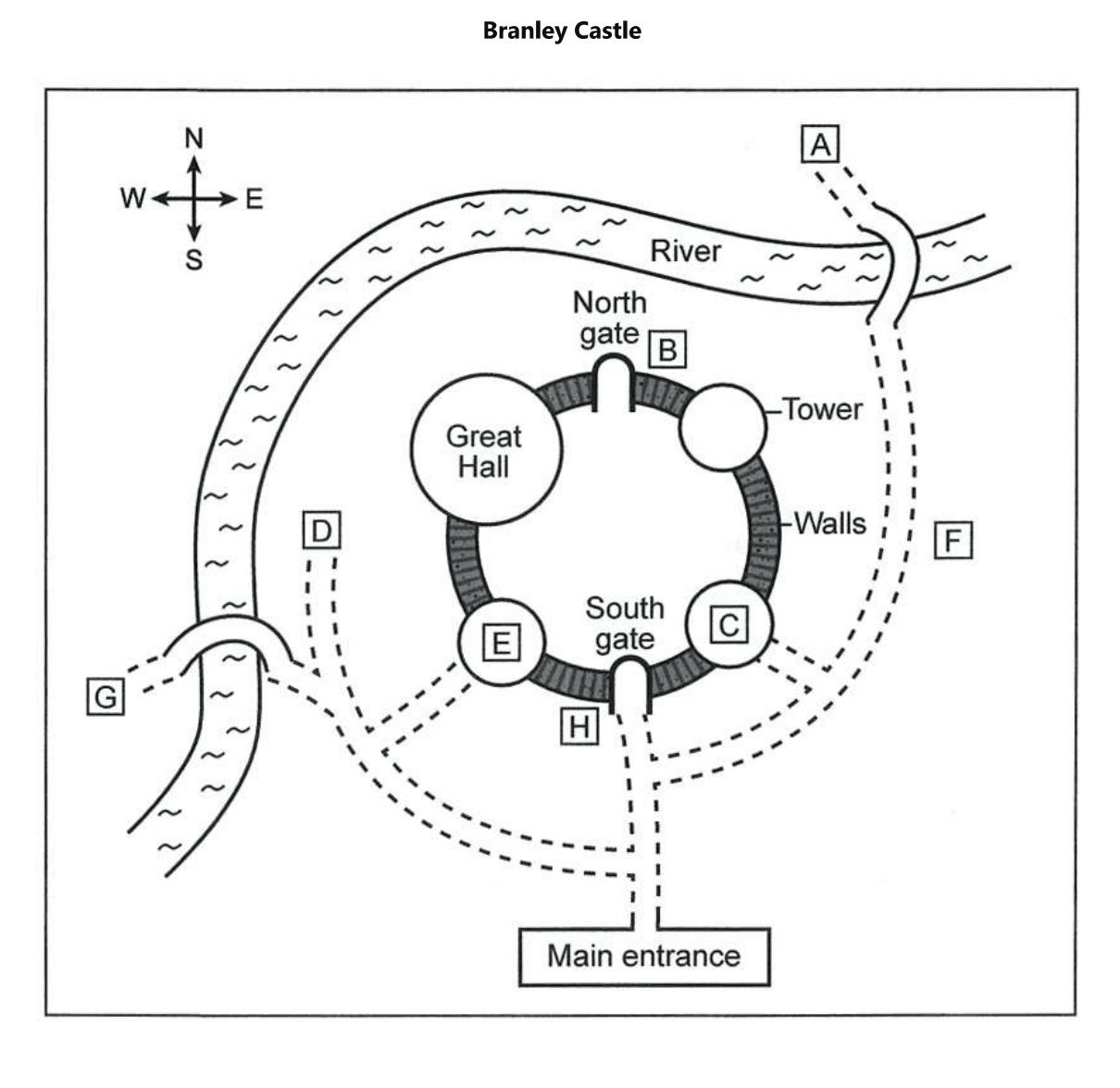
16. Starting point for walking the walls
17. Bow and arrow display
18. Hunting birds display
19. Traditional dancing
20. Shop
A tutorial discussing a student presentation on woolly mammoths
Questions 21–24
Choose the correct letter, A, B or C. Woolly mammoths on St Paul’s Island.
21. How will Rosie and Martin introduce their presentation?
A with a drawing of woolly mammoths in their natural habit
B with a timeline showing when woolly mammoths lived
C with a video clip about woolly mammoths
22. What was surprising about the mammoth tooth found by Russell Graham?
A It was still embedded in the mammoth’s jawbone.
B It was from an unknown species of mammoth.
C It was not as old as mammoth remains from elsewhere.
23. The students will use an animated diagram to demonstrate how the mammoths
A became isolated on the island.
B spread from the island to other areas.
C coexisted with other animals on the island.
24. According to Martin, what is unusual about the date of the mammoths’ extinction on the island?
A how exact it is
B how early it is
C how it was established
Questions 25–30
What action will the students take for each of the following sections of their presentation? Choose SIX answers from the box and write the correct letter, A-H, next to Questions 25–30.
Actions
A make it more interactive
B reduce visual input
C add personal opinions
D contact one of the researchers
E make detailed notes
F find information online
G check timing
H organise the content more clearly
25. Introduction
26. Discovery of the mammoth tooth
27. Initial questions asked by the researchers
28. Further research carried out on the island
29. Findings and possible explanations
30. Relevance to the present day
A lecture on the early history of weather forecasting
Questions 31–40
Complete the notes below. Write ONE WORD ONLY for each answer.
The history of weather forecasting
Ancient cultures
• many cultures believed that floods and other disasters were involved in the creation of the world
• many cultures invented (31) ………………………… and other ceremonies to make the weather gods friendly
• people needed to observe and interpret the sky to ensure their (32) …………………………
• around 650 BC, Babylonians started forecasting, using weather phenomena such as (33) …………………………
• by 300 BC, the Chinese had a calendar made up of a number of (34) ………………………… connected with the weather
Ancient Greeks
• a more scientific approach
• Aristotle tried to explain the formation of various weather phenomena
• Aristotle also described haloes and (35) …………………………
Middle Ages
• Aristotle’s work considered accurate
• many proverbs, e.g. about the significance of the colour of the (36) …………………………, passed on accurate information.
15th-19th centuries
• 15th century: scientists recognised value of (37) ………………………… for the first time
• Galileo invented the (38) …………………………
• Pascal showed relationship between atmospheric pressure and altitude
• from the 17th century, scientists could measure atmospheric pressure and temperature
• 18th century: Franklin identified the movement of (39) …………………………
• 19th century: data from different locations could be sent to the same place by (40) …………………………
Answers
1. 219 442 9785
2. 10 October
3. manager
4. Cawley
5. knee
6. 3 weeks
7. tennis
8. running
9. shoulder
10. vitamins
11. a new building was constructed for her.
12. an entertainment company.
13. see models of historical figures moving and talking.
14. go to an art exhibition.
15. afternoon tea in the conservatory.
16. H
17. D
18. F
19. A
20. E
21. with a timeline showing when woolly mammoths lived
22. It was not as old as mammoth remains from elsewhere.
23. became isolated on the island.
24. how exact it is
25. E
26. D
27. A
28. H
29. G
30. C
31. dances
32. survival
33. clouds
34. festivals
35. comets
36. sky
37. instruments
38. thermometer
39. storms
40. telegraph
Explanations
- 1. 219 442 9785
- Carl asks 'can I have a contact phone number?' and Julie reads it straight out: 'It's 219 442 9785.' The digits are given once, in groups, with no correction and no second number anywhere in the conversation — so the only risk is mishearing a digit, not choosing between candidates.Common trap: No competing figure — the section's other numbers (the date of birth, 114th Street) come later and belong to clearly different fields. Write the digits as spoken.
- 2. 10 October
- Julie gives her date of birth as 'October tenth, 1992'. The note already prints 1992, so only the day and month go in the gap, and the day is written before the month in the note's format. Carl then says he has 1991 on file and corrects it — the correction confirms Julie's year rather than changing it.Common trap: Correction of the printed part. 1991 is spoken immediately after the answer and is the kind of detail that pulls the pen — but the year is already on the form, and the wrong year is the clinic's error, now fixed.
- 3. manager
- Asked whether she has an occupation, Julie says she works full-time at a restaurant chain: 'I started off as a waitress there a few years ago and I'm a manager now.' The note asks what she works as, and 'now' marks the current role — manager.Common trap: Old job named first, employer named before that. 'Waitress' is the earlier role in the same sentence, and 'Esterhazy's' answers a different question — where she works, not what she works as.
- 4. Cawley
- Carl asks for 'the name of your insurance company' and Julie answers 'It's Cawley Life Insurance, that's C-A-W-L-E-Y.' 'Life Insurance' is already printed in the note, so only the company name goes in the gap — and she spells it, which settles the spelling.Common trap: No competing name — the trap here is purely spelling, which is why Julie spells it out. The clinic's own name, Total Health Clinic, belongs to a different field and is mentioned much earlier.
- 5. knee
- Asked what brought her in, Julie says 'I've been getting a pain in my knee, the left one.' The note prints 'left', so the gap is the body part. 'Not very serious at first, but it's gotten worse' explains why she has come now.Common trap: Second body part, wrong time. The shoulder is the other injury in this conversation, but it is last year's and has healed — it belongs to the medical-history line (Q9), not to the current problem.
- 6. 3 weeks
- Carl offers two options — 'Is it just a few days, or is it longer than that?' — and Julie chooses the second: 'It's been worse for the last couple of days, but it's three weeks since I first noticed it.' The note asks when it began, so the answer is when she first noticed it: three weeks.Common trap: Two shorter periods around the answer. 'A few days' is Carl's suggestion, rejected by 'Longer', and 'the last couple of days' is when it got worse — neither is when the pain began.
- 7. tennis
- Asked about regular sport, Julie says 'I play a lot of tennis. I belong to a club so I go there a lot.' The club she belongs to is the tennis club, which is what the note's 'belongs to a _____ club' asks for.Common trap: Three sports in one answer stretch. Swimming and running both appear, but only tennis is attached to a club — the note's word 'club' is what selects between them.
- 8. running
- 'But normally I go running a few times a week, maybe three or four times.' 'Normally' and 'a few times a week' match the note's 'regularly', which is what separates running from the swimming mentioned in the same turn.Common trap: One sport is occasional, another has stopped. Swimming happens only on holiday, and the tennis has stopped since the pain began — neither fits 'regularly', which running does.
- 9. shoulder
- Carl asks whether she has had problems before. Julie says 'No, not with my legs. I did have an accident last year when I slipped and hurt my shoulder, but that's better now.' The note asks what she injured last year, and that is the shoulder.Common trap: Negated body part spoken first. 'Legs' is the word immediately before the answer and connects to the knee she is here about — but it is preceded by 'not', ruling it out.
- 10. vitamins
- Asked whether she takes any medication regularly, Julie says 'Well, I take vitamins but that's all. I'm generally very healthy.' 'But that's all' marks vitamins as the only exception, which is exactly what the note's 'apart from' asks for.Common trap: A named drug earlier in the conversation. Tylenol is the obvious medication word and is stated by brand, but Julie takes it only for the current pain and says 'I don't like to keep taking it' — the note asks about regular medication.
- 11. a new building was constructed for her.
- With the visit announced, the castle 'was beginning to look a bit run down, and it was decided that rather than repair the guest rooms, they'd make a new house for her out of wood next to the main hall'. 'Rather than' rejects one course of action and chooses the other: a new building was put up for her.Common trap: Rejected plan and a later event. The repairs are named in the same sentence but explicitly not done, and the fire is real but comes after the visit — the question asks what happened before 1576.
- 12. an entertainment company.
- The Fenys family 'could no longer afford to maintain the castle ... and they put it on the market. It was eventually taken over by a company who owned a number of amusement parks.' A company running amusement parks is an entertainment company.Common trap: Seller and subsidy both mentioned in the same breath as the sale. 'Government support' supplies option A and the Fenys family supplies option B, but the question asks who bought it in 1982.
- 13. see models of historical figures moving and talking.
- 'In the state rooms there are life-like moving wax models dressed in costumes of different periods in the past, which even carry on conversations together.' Wax models of people from the past that move and talk to each other is exactly what the option describes.Common trap: Information without people. The booklets follow immediately and cover the castle's history, which is what option A promises — but a booklet is not an expert you can speak to.
- 14. go to an art exhibition.
- 'Nowadays the old zoo buildings are used for public displays of painting and sculpture.' 'Nowadays' is the key word: displays of painting and sculpture are what visitors can see today, which is an art exhibition.Common trap: Two things that no longer exist. The zoo and the ancient tree are both described vividly, and both distractors match the wording of the options — but one closed long ago and the other blew down in 1987.
- 15. afternoon tea in the conservatory.
- The group meets at the Great Staircase, goes to the long gallery to see photographs of the old owners taking tea in the conservatory, 'and we'll then take you to the same place, where afternoon tea will be served to you'. 'The same place' is the conservatory in the photographs.Common trap: Every element of the wrong options is present but recombined. Photographs, owners and the Great Staircase are all mentioned in this one stretch — options B and C simply attach them to the wrong people or the wrong activity.
- 16. H
- 'The starting point's quite near the main entrance — walk straight down the path until you get to the south gate, and it's just there.' Follow the path straight from the main entrance to the south gate and the start of the wall walk is right at that point.Common trap: Explicit warning against the other gate. The north gate is named right after the answer, and a listener tracking gates rather than instructions can mark it — 'there's no way up from there' rules it out.
- 17. D
- 'The quickest way to get there is to take the first left after the main entrance and follow the path past the bridge, then you'll see it in front of you at the end.' Three moves: first left, past the bridge, then straight to the end of that path.Common trap: Shared opening instruction. The shop's directions begin with the identical 'first left after the main entrance', so the two routes only separate at the next move — the archery display carries straight on, the shop turns right.
- 18. F
- 'If you go from the main entrance in the direction of the south gate, but turn right before you get there instead of going through it, you'll see it on your right past the first tower.' You head towards the south gate but turn off before reaching it, and the display is on the right beyond the first tower.Common trap: Same landmark, different instruction. The wall walk also sends you towards the south gate, but all the way to it — here you turn off before reaching it, and 'instead of going through it' is the phrase that separates them.
- 19. A
- 'That's right at the other side of the castle from the entrance, and over the bridge.' Two constraints fix the position: the far side from the main entrance, and across the bridge — which is why it is about ten minutes' walk away.Common trap: Past the bridge versus over it. The archery route also mentions the bridge, but going past it keeps you on the same side — only the dancing stage is reached by crossing.
- 20. E
- 'Just take the first left after the main entrance, go down the path and take the first right.' The shop is inside one of the towers, but the entrance is from the outside, which is why the route ends at a tower rather than inside the castle.Common trap: Mirror of Q17. Both routes open with the first left after the main entrance; the archery display continues to the end of the path, while the shop turns right off it.
- 21. with a timeline showing when woolly mammoths lived
- Three ideas are floated for the introduction: a cartoon video clip, a timeline with illustrations, and a drawing of mammoths in the ice. Rosie rejects her own first idea as 'a bit childish', and Martin settles it with 'No, let's go with your last suggestion' — the last thing Rosie suggested was the timeline.Common trap: All three options are spoken aloud as proposals. Only the decision at the end separates them, and it is made by referring back — 'your last suggestion' — rather than by naming the timeline again.
- 22. It was not as old as mammoth remains from elsewhere.
- Rosie explains why the tooth mattered: 'the mammoth bones previously found on the North American mainland were much less recent than that.' The tooth was 6,500 years old and earlier mainland finds were older still, so this one was surprisingly young — which is what the option means by 'not as old'.Common trap: Simile read as fact. 'As if it had been just extracted from the animal's jawbone' describes how well preserved the tooth was — option A turns the comparison into a literal claim.
- 23. became isolated on the island.
- The animated diagram traces a sequence: the island was once joined to the mainland and animals roamed freely, then 'the climate warmed up and the sea level began to rise, and the island got cut off from the mainland. So those mammoths on the island couldn't escape; they had to stay on the island.' Being cut off and unable to leave is isolation.Common trap: Earlier stage of the same animation. The free roaming with bears supplies both wrong options, and it is described first — but it is the 'before' picture, and the diagram's point is what changed.
- 24. how exact it is
- 'They concluded that the extinction happened 5,600 years ago, which is a very precise time for a prehistoric extinction.' Martin's own comment — 'very precise ... for a prehistoric extinction' — is what makes the date unusual, so the answer is how exact it is.Common trap: Method described in most detail. The mud samples, plants, ash and DNA take up far more airtime than the answer, and 'nearly two years' sounds remarkable — but Martin explicitly labels the method standard.
- 25. E
- Martin thinks the introduction is finished once the visual is ready, but Rosie disagrees: 'I think we need to write down all the ideas we want to include here, not just rely on memory.' Writing the ideas down rather than relying on memory is making detailed notes (E).Common trap: The word 'visual' next to a visual-related option. Martin's line mentions the visual and claims no more work is needed, which pulls towards B — but the action agreed is Rosie's, and it is about notes.
- 26. D
- On the tooth section Rosie says they have little material, 'only what we got from the online article. I thought maybe we could get in touch with the researcher who led the team and ask him to tell us a bit more.' Getting in touch with the team leader is contacting one of the researchers (D).Common trap: Online source named as the problem, not the solution. 'The online article' matches option F word for word and is spoken first — but it is what they already have, and the fix is to approach the researcher.
- 27. A
- For the researchers' initial questions Rosie proposes: 'We could ask the audience to suggest some questions about it and then see how many of them we can answer.' Involving the audience directly is making it more interactive (A), and the tutor confirms it 'would add a bit of variety'.Common trap: Timing raised in passing. Rosie's reassurance about length sits immediately after the answer and matches option G, but it defends the idea rather than being the action to take.
- 28. H
- Martin worries there is too much material; Rosie disagrees but says 'it's all a bit muddled at present', and Martin concludes 'maybe it would be better if it followed a chronological pattern'. Putting muddled material into chronological order is organising the content more clearly (H).Common trap: Rejected proposal spoken first. Cutting material is Martin's opening suggestion and points at reducing content, but Rosie answers 'I don't think so' — the agreed action is reordering, not cutting.
- 29. G
- 'The findings and possible explanations section is just about ready, but we need to practice it so we're sure it won't overrun.' Making sure a section does not overrun is checking timing (G), and Martin agrees: 'let's make sure'.Common trap: 'Just about ready' invites you to expect no action. The clause before the answer says the section is nearly done, so listeners relax exactly where the required action is stated — after the 'but'.
- 30. C
- The tutor's advice on the final section: 'you've got some good ideas but this is where you need to move away from the ideas of others and give your own viewpoint.' Giving your own viewpoint instead of other people's is adding personal opinions (C).Common trap: Praise before the instruction. The tutor opens by approving the ideas already there, which reads as no action required — 'but' introduces the one thing that is actually needed.
- 31. dances
- 'Many ancient civilisations developed rites such as dances in order to make the weather gods look kindly on them.' The note's 'and other ceremonies' corresponds to 'rites', so the gap takes the example given — dances. 'Look kindly on them' is the recording's version of 'friendly'.Common trap: Same 'such as' pattern earlier in the paragraph. Floods are introduced with identical phrasing a few sentences before, so anyone listening for the structure rather than the meaning can take the wrong example.
- 32. survival
- 'Observing the skies and drawing the correct conclusions from these observations was really important, in fact their survival depended on it.' 'In fact' escalates from 'important' to the real point: survival. The note's 'to ensure their _____' needs that noun.Common trap: Weaker word first. 'Really important' is the obvious candidate and comes first, but the note asks what observing the sky ensured — and 'in fact' signals the upgrade to survival.
- 33. clouds
- 'At around 650 BC, the Babylonians produced the first short-range weather forecasts, based on their observations of clouds and other phenomena.' The note's 'weather phenomena such as' matches 'and other phenomena', so the gap takes the one example named: clouds.Common trap: Neighbouring civilisation with its own date. The Chinese calendar follows immediately, and the two dates (650 BC and 300 BC) are easy to swap — the note's date is what anchors this line to the Babylonians.
- 34. festivals
- 'By 300 BC, astronomers had developed a calendar which divided the year into 24 festivals, each associated with a different weather phenomenon.' The note asks what the calendar was made up of, and the answer is festivals — the number 24 is the 'number of' already asked for in the note's wording.Common trap: Mirror of Q33. The Babylonian sentence sits directly before and carries its own weather nouns, so losing track of which civilisation is being described puts 'clouds' in this gap.
- 35. comets
- Aristotle 'described celestial phenomena such as haloes — that is, bright circles of light around the sun, the moon and bright stars — and comets'. Haloes are printed in the note, and the definition between the dashes is an aside, so the second item in the list is comets.Common trap: A longer list just before the answer. Rain, clouds, wind and storms are what Aristotle explained in his book, not the celestial phenomena he described — and the answer is separated from 'haloes' by a long parenthesis.
- 36. sky
- Medieval weather knowledge survived as proverbs, 'such as "Red sky at night, shepherd's delight; red sky in the morning, shepherd's warning"'. What the colour belongs to is the sky, and the lecturer confirms such proverbs 'are accurate, as contemporary meteorologists have discovered'.Common trap: No competing noun — the risk is answering with the colour itself, 'red', which the note has already accounted for with 'the colour of the'.
- 37. instruments
- 'For centuries, any attempt to forecast the weather could only be based on personal observation, but in the fifteenth century scientists began to see the need for instruments.' 'Began to see the need for' matches the note's 'recognised value of ... for the first time'.Common trap: Specific devices right after the general word. Weather vanes and rain gauges are named in the next sentence and are the more concrete nouns, but they are what already existed — the note wants what scientists newly saw the value of.
- 38. thermometer
- 'In 1592, the Italian scientist and inventor Galileo developed the world's first thermometer.' The note names Galileo, so the gap is simply the instrument he invented.Common trap: Second inventor, second instrument, same sentence pattern. The barometer follows immediately but belongs to Torricelli — the note's 'Galileo' is what keeps the two apart.
- 39. storms
- 'It was Franklin who discovered that storms generally travel from west to east.' The note asks what movement Franklin identified, and the cleft structure 'It was Franklin who' marks this as his specific discovery.Common trap: Franklin's better-known subject named first. Electricity and lightning are what he is famous for and are attached to his name in the previous sentence — but the note asks what moved, and only storms are given a direction.
- 40. telegraph
- 'People in different locations began to keep records, and in the mid-nineteenth century, the invention of the telegraph made it possible for these records to be collated.' Collating records kept in different places is the note's 'data ... sent to the same place'.Common trap: Consequence offered instead of the means. The weather services are the next development in the same century and close the paragraph, but they are the result of collating records, not what carried the data.
Audio transcripts
Part 1 — A new patient registering at a health clinic
CARL: Hi, come and take a seat.
JULIE: Thank you.
CARL: My name’s Carl Rogers and I’m one of the doctors here at the Total Health Clinic. So I understand this is your first visit to the clinic?
JULIE: Yes, it is.
CARL: OK, well I hope you’ll be very happy with the service you receive here. So if it’s alright with you I’ll take a few details to help me give you the best possible service.
JULIE: Sure.
CARL: So can I check first of all that we have the correct personal details for you? So your full name is Julie Anne Garcia?
JULIE: That’s correct.
CARL: Perfect. And can I have a contact phone number?
JULIE: It’s 219 442 9785.
CARL: OK, and then can I just check that we have the correct date of birth?
JULIE: October tenth, 1992.
CARL: Oh, I actually have 1991, I’ll just correct that now. Right, so that’s all good. Now I just need just a few more personal details … do you have an occupation, either full-time or part-time?
JULIE: Yes, I work full-time in Esterhazy’s – you know, the restaurant chain. I started off as a waitress there a few years ago and I’m a manager now.
CARL: Oh I know them, yeah, they’re down on 114th Street, aren’t they?
JULIE: That’s right.
CARL: Yeah, I’ve been there a few times. I just love their salads.
JULIE: That’s good to hear.
CARL: Right, so one more thing I need to know before we talk about why you’re here, Julie, and that’s the name of your insurance company.
JULIE: It’s Cawley Life Insurance, that’s C-A-W-L-E-Y.
CARL: Excellent, thank you so much.
CARL: Now Julie, let’s look at how we can help you. So tell me a little about what brought you here today.
JULIE: Well, I’ve been getting a pain in my knee, the left one. Not very serious at first, but it’s gotten worse, so I thought I ought to see someone about it.
CARL: That’s certainly the right decision. So how long have you been aware of this pain? Is it just a few days, or is it longer than that?
JULIE: Longer. It’s been worse for the last couple of days, but it’s three weeks since I first noticed it. It came on quite gradually though, so I kind of ignored it at first.
CARL: And have you taken any medication yourself, or treated it in anyway?
JULIE: Yeah, I’ve been taking medication to deal with the pain. Tylenol, and that works OK for a few hours. But I don’t like to keep taking it.
CARL: OK. And what about heat treatment? Have you tried applying heat at all?
JULIE: No, but I have been using ice on it for the last few days.
CARL: And does that seem to help the pain at all?
JULIE: A little, yes.
CARL: Good. Now you look as if you’re quite fit normally?
JULIE: I am, yes.
CARL: So do you do any sport on a regular basis?
JULIE: Yes, I play a lot of tennis. I belong to a club so I go there a lot. I’m quite competitive so I enjoy that side of it as well as the exercise. But I haven’t gone since this started.
CARL: Sure. And do you do any other types of exercise?
JULIE: Yeah, I sometimes do a little swimming, but usually just when I’m on vacation. But normally I go running a few times a week, maybe three or four times.
CARL: Hmm. So your legs are getting quite a pounding. But you haven’t had any problems up to now?
JULIE: No, not with my legs. I did have an accident last year when I slipped and hurt my shoulder, but that’s better now.
CARL: Excellent. And do you have any allergies?
JULIE: No, none that I’m aware of.
CARL: And do you take any medication on a regular basis?
JULIE: Well, I take vitamins but that’s all. I’m generally very healthy.
CARL: OK, well let’s have a closer look and see what might be causing this problem. If you can just get up …
Part 2 — A guided tour of Branley Castle
We’ll be arriving at Branley Castle in about five minutes, but before we get there I’ll give you a little information about the castle and what our visit will include.
So in fact there’s been a castle on this site for over eleven hundred years. The first building was a fort constructed in 914 AD for defence against Danish invaders by King Alfred the Great’s daughter, who ruled England at the time. In the following century, after the Normans conquered England, the land was given to a nobleman called Richard de Vere, and he built a castle there that stayed in the de Vere family for over four hundred years.
However, when Queen Elizabeth I announced that she was going to visit the castle in 1576 it was beginning to look a bit run down, and it was decided that rather than repair the guest rooms, they’d make a new house for her out of wood next to the main hall. She stayed there for four nights and apparently it was very luxurious, but unfortunately it was destroyed a few years later by fire.
In the seventeenth century the castle belonged to the wealthy Fenys family, who enlarged it and made it more comfortable. However, by 1982 the Fenys family could no longer afford to maintain the castle, even though they received government support, and they put it on the market. It was eventually taken over by a company who owned a number of amusement parks, but when we get there I think you’ll see that they’ve managed to retain the original atmosphere of the castle.
When you go inside, you’ll find that in the state rooms there are life-like moving wax models dressed in costumes of different periods in the past, which even carry on conversations together. As well as that, in every room there are booklets giving information about what the room was used for and the history of the objects and furniture it contains.
The castle park’s quite extensive. At one time sheep were kept there, and in the nineteenth century the owners had a little zoo with animals like rabbits and even a baby elephant. Nowadays the old zoo buildings are used for public displays of painting and sculpture. The park also has some beautiful trees, though the oldest of all, which dated back 800 years, was sadly blown down in 1987.
Now, you’re free to wander around on your own until 4.30, but then at the end of our visit we’ll all meet together at the bottom of the Great Staircase. We’ll then go on to the long gallery, where there’s a wonderful collection of photographs showing the family who owned the castle a hundred years ago having tea and cakes in the conservatory – and we’ll then take you to the same place, where afternoon tea will be served to you.
Now if you can take a look at your plans you’ll see Branley Castle has four towers, joined together by a high wall, with the river on two sides.
Don’t miss seeing the Great Hall. That’s near the river in the main tower, the biggest one, which was extended and redesigned in the eighteenth century.
If you want to get a good view of the whole castle, you can walk around the walls. The starting point’s quite near the main entrance – walk straight down the path until you get to the south gate, and it’s just there. Don’t go on to the north gate – there’s no way up from there.
There’ll shortly be a show in which you can see archers displaying their skill with a bow and arrow. The quickest way to get there is to take the first left after the main entrance and follow the path past the bridge, then you’ll see it in front of you at the end.
If you like animals there’s also a display of hunting birds – falcons and eagles and so on. If you go from the main entrance in the direction of the south gate, but turn right before you get there instead of going through it, you’ll see it on your right past the first tower.
At 3 pm there’s a short performance of traditional dancing on the outdoor stage. That’s right at the other side of the castle from the entrance, and over the bridge. It’s about ten minutes’ walk or so.
And finally the shop. It’s actually inside one of the towers, but the way in is from the outside. Just take the first left after the main entrance, go down the path and take the first right. It’s got some lovely gifts and souvenirs.
Right, so we’re just arriving …
Part 3 — A tutorial discussing a student presentation on woolly mammoths
TUTOR: So, Rosie and Martin, let’s look at what you’ve got for your presentation on woolly mammoths.
ROSIE: OK, we’ve got a short outline here.
TUTOR: Thanks. So it’s about a research project in North America?
MARTIN: Yes. But we thought we needed something general about woolly mammoths in our introduction, to establish that they were related to our modern elephant, and they lived thousands of years ago in the last ice age.
ROSIE: Maybe we could show a video clip of a cartoon about mammoths. But that’d be a bit childish. Or we could have a diagram, it could be a timeline to show when they lived, with illustrations?
MARTIN: Or we could just show a drawing of them walking in the ice? No, let’s go with your last suggestion.
TUTOR: Good. Then you’re describing the discovery of the mammoth tooth on St Paul’s Island in Alaska, and why it was significant.
ROSIE: Yes. The tooth was found by a man called Russell Graham. He picked it up from under a rock in a cave. He knew it was special – for a start it was in really good condition, as if it had been just extracted from the animal’s jawbone. Anyway, they found it was 6,500 years old.
TUTOR: So why was that significant?
ROSIE: Well the mammoth bones previously found on the North American mainland were much less recent than that. So this was really amazing.
MARTIN: Then we’re making an animated diagram to show the geography of the area in prehistoric times. So originally, St Paul’s Island wasn’t an island, it was connected to the mainland, and mammoths and other animals like bears were able to roam around the whole area.
ROSIE: Then the climate warmed up and the sea level began to rise, and the island got cut off from the mainland. So those mammoths on the island couldn’t escape; they had to stay on the island.
MARTIN: And in fact the species survived there for thousands of years after they’d become extinct on the mainland.
TUTOR: So why do you think they died out on the mainland?
ROSIE: No one’s sure.
MARTIN: Anyway, next we’ll explain how Graham and his team identified the date when the mammoths became extinct on the island. They concluded that the extinction happened 5,600 years ago, which is a very precise time for a prehistoric extinction. It’s based on samples they took from mud at the bottom of a lake on the island. They analysed it to find out what had fallen in over time – bits of plants, volcanic ash and even DNA from the mammoths themselves. It’s standard procedure, but it took nearly two years to do.
TUTOR: So why don’t you quickly go through the main sections of your presentation and discuss what action’s needed for each part?
MARTIN: OK. So for the introduction, we’re using a visual, so once we’ve prepared that we’re done.
ROSIE: I’m not sure. I think we need to write down all the ideas we want to include here, not just rely on memory. How we begin the presentation is so important …
MARTIN: You’re right.
ROSIE: The discovery of the mammoth tooth is probably the most dramatic part, but we don’t have that much information, only what we got from the online article. I thought maybe we could get in touch with the researcher who led the team and ask him to tell us a bit more.
MARTIN: Great idea. What about the section with the initial questions asked by the researchers? We’ve got a lot on that but we need to make it interesting.
ROSIE: We could ask the audience to suggest some questions about it and then see how many of them we can answer. I don’t think it would take too long.
TUTOR: Yes that would add a bit of variety.
MARTIN: Then the section on further research carried out on the island – analysing the mud in the lake. I wonder if we’ve actually got too much information here, should we cut some?
ROSIE: I don’t think so, but it’s all a bit muddled at present.
MARTIN: Yes, maybe it would be better if it followed a chronological pattern.
ROSIE: I think so. The findings and possible explanations section is just about ready, but we need to practice it so we’re sure it won’t overrun.
MARTIN: I think it should be OK, but yes, let’s make sure.
TUTOR: In the last section, relevance to the present day, you’ve got some good ideas but this is where you need to move away from the ideas of others and give your own viewpoint.
MARTIN: OK, we’ll think about that. Now shall we …
Part 4 — A lecture on the early history of weather forecasting
In this series of lectures about the history of weather forecasting, I’ll start by examining its early history – that’ll be the subject of today’s talk.
Ok, so we’ll start by going back thousands of years. Most ancient cultures had weather gods, and weather catastrophes, such as floods, played an important role in many creation myths. Generally, weather was attributed to the whims of the gods, as the wide range of weather gods in various cultures shows. For instance, there’s the Egyptian sun god Ra, and Thor, the Norse god of thunder and lightning. Many ancient civilisations developed rites such as dances in order to make the weather gods look kindly on them.
But the weather was of daily importance: observing the skies and drawing the correct conclusions from these observations was really important, in fact their survival depended on it. It isn’t known when people first started to observe the skies, but at around 650 BC, the Babylonians produced the first short-range weather forecasts, based on their observations of clouds and other phenomena. The Chinese also recognised weather patterns, and by 300 BC, astronomers had developed a calendar which divided the year into 24 festivals, each associated with a different weather phenomenon.
The ancient Greeks were the first to develop a more scientific approach to explaining the weather. The work of the philosopher and scientist Aristotle, in the fourth century BC, is especially noteworthy, as his ideas held sway for nearly 2,000 years. In 340 BC, he wrote a book in which he attempted to account for the formation of rain, clouds, wind and storms. He also described celestial phenomena such as haloes – that is, bright circles of light around the sun, the moon and bright stars – and comets. Many of his observations were surprisingly accurate. For example, he believed that heat could cause water to evaporate. But he also jumped to quite a few wrong conclusions, such as that winds are breathed out by the Earth. Errors like this were rectified from the Renaissance onwards.
For nearly 2,000 years, Aristotle’s work was accepted as the chief authority on weather theory. Alongside this, though, in the Middle Ages weather observations were passed on in the form of proverbs, such as ‘Red sky at night, shepherd’s delight; red sky in the morning, shepherd’s warning’. Many of these are based on very good observations and are accurate, as contemporary meteorologists have discovered.
For centuries, any attempt to forecast the weather could only be based on personal observation, but in the fifteenth century scientists began to see the need for instruments. Until then, the only ones available were weather vanes – to determine the wind direction – and early versions of rain gauges. One of the first, invented in the fifteenth century, was a hygrometer, which measured humidity. This was one of many inventions that contributed to the development of weather forecasting.
In 1592, the Italian scientist and inventor Galileo developed the world’s first thermometer. His student Torricelli later invented the barometer, which allowed people to measure atmospheric pressure. In 1648, the French philosopher Pascal proved that pressure decreases with altitude. This discovery was verified by English astronomer Halley in 1686, and Halley was also the first person to map trade winds.
This increasing ability to measure factors related to weather helped scientists to understand the atmosphere and its processes better, and they started collecting weather observation data systematically. In the eighteenth century, the scientist and politician Benjamin Franklin carried out work on electricity and lightning in particular, but he was also very interested in weather and studied it throughout most of his life. It was Franklin who discovered that storms generally travel from west to east.
In addition to new meteorological instruments, other developments contributed to our understanding of the atmosphere. People in different locations began to keep records, and in the mid-nineteenth century, the invention of the telegraph made it possible for these records to be collated. This led, by the end of the nineteenth century, to the first weather services.
It was not until the early twentieth century that mathematics and physics became part of meteorology, and we’ll continue from that point next week.
Comments
Loading comments…