

Practice Tests Plus 2 Academic Reading Test 6
3 passages · 40 questions · 60 minutes
Astronaut ice cream, anyone?
Freeze-drying is like suspended animation for food; you can store a freeze-dried meal for years, and then, when you're finally ready to eat it, you can completely revitalise it with a little hot water. Even after several years, the original foodstuff will be virtually unchanged.
The technique basically involves completely removing the water from some material, such as food, while leaving the rest of the material virtually intact. The main reason for doing this is either to preserve the food or to reduce its weight. Removing the water from food keeps it from spoiling, because the microorganisms such as bacteria that cause spoiling cannot survive without it. Similarly, the enzymes which occur naturally in food cannot cause ripening without water, so removing water from food will also stop the ripening process.
Freeze-drying significantly reduces the total weight of the food because most food is largely made up of water, for example, many fruits are more than 80-90% water. Removing this makes the food much lighter and therefore makes transportation less difficult. The military and camping-supply companies freeze-dry foods to make them easier for an individual to carry and NASA has also freeze-dried foods for the cramped quarters on board spacecraft.
The process is also used to preserve other sorts of material, such as pharmaceuticals. Chemists can greatly extend pharmaceutical shelf life by freeze-drying the material and storing it in a container free of oxygen and water. Similarly, research scientists may use freeze-drying to preserve biological samples for long periods of time. Even valuable manuscripts that had been water damaged have been saved by using this process.
Freeze-drying is different from simple drying because it is able to remove almost all the water from materials, whereas simple drying techniques can only remove 90-95%. This means that the damage caused by bacteria and enzymes can virtually be stopped, rather than just slowed down. In addition, the composition and structure of the material is not significantly changed, so materials can be revitalised without compromising the quality of the original.
This is possible because in freeze-drying, solid water - ice - is converted directly into water vapour, missing out the liquid phase entirely. This is called 'sublimation', the shift from a solid directly into a gas. Just like evaporation, sublimation occurs when a molecule gains enough energy to break free from the molecules around it. Water will sublime from a solid (ice) to a gas (vapour) when the molecules have enough energy to break free but the conditions aren't right for a liquid to form. These conditions are determined by heat and atmospheric pressure. When the temperature is above freezing point, so that ice can thaw, but the atmospheric pressure is too low for a liquid to form (below 0.06 atmospheres (ATM)) then it becomes a gas.
This is the principle on which a freeze-drying machine is based. The material to be preserved is placed in a freeze-drying chamber which is connected to a freezing coil and refrigerator compressor. When the chamber is sealed the compressor lowers the temperature inside it. The material is frozen solid, which separates the water from everything around it on a molecular level, even though the water is still present. Next, a vacuum pump forces air out of the chamber, lowering the atmospheric pressure below to 0.06 ATM. The heating units apply a small amount of heat to the shelves in the chamber, causing the ice to change phase. Since the pressure in the chamber is so low, the ice turns directly into water vapour, which leaves the freeze-drying chamber, and flows past the freezing coil. The water vapour condenses onto the freezing coil in the form of solid ice, in the same way that water condenses as frost on a cold day.
The process continues for many hours (even days) while the material gradually dries out. This time is necessary to avoid overheating, which might affect the structure of the material. Once it has dried sufficiently, it is sealed in a moisture-free package. As long as the package is secure, the material can sit on a shelf for years and years without degrading, until it is restored to its original form with a little hot water. If everything works correctly, the material will go through the entire process almost completely unscathed.
In fact, freeze-drying, as a general concept, is not new but has been around for centuries. The ancient Incas of Peru used mountain peaks along the Andes as natural food preservers. The extremely cold temperatures and low pressure at those high altitudes prevented food from spoiling in the same basic way as a modern freeze-drying machine and a freezer.
Questions 1–5
Complete the notes below. Choose NO MORE THAN THREE WORDS from the passage for each answer.
Uses of freeze-drying:
• food preservation
• easy (1) ………………………… of food items
• long-term storage of (2) ………………………… and biological samples
• preservation of precious (3) …………………………
Freeze-drying
• is based on process of (4) …………………………
• is more efficient than (5) …………………………
Questions 6–9
Label the diagram below. Choose NO MORE THAN TWO WORDS from the passage for each answer.
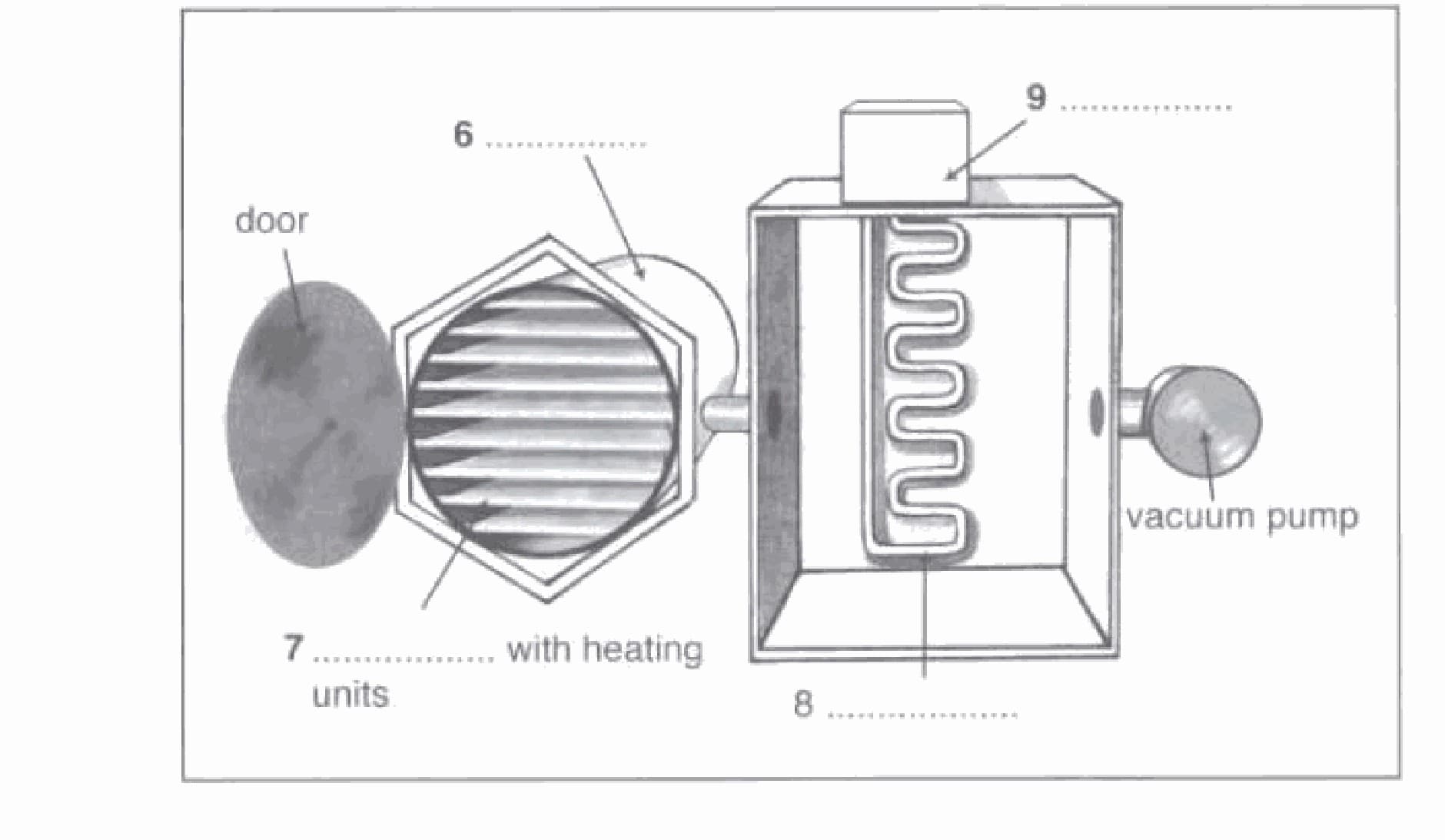
The freeze-drying machine
• (6) …………………………
• (7) ………………………… with heating units
• (8) …………………………
• (9) …………………………
Questions 10–13
Complete the summary below. Choose NO MORE THAN THREE WORDS AND/OR A NUMBER from the passage for each answer.
10. Freeze-drying prevents food from going bad by stopping the activity of microorganisms or ………………………….
11. Its advantages are that the food tastes and feels the same as the original because both the ………………………… are preserved.
12. The process is carried out slowly in order to ensure that ………………………… does not take place.
13. The people of one ancient mountain civilisation were able to use this method of food preservation because the conditions needed were present at ………………………….
The wild side of town
The past half century has seen an interesting reversal in the fortunes of much of Britain's wildlife. Whilst the rural countryside has become poorer and poorer, wildlife habitat in towns has burgeoned. Now, if you want to hear a deafening dawn chorus of birds or familiarise yourself with foxes, you can head for the urban forest.
Whilst species that depend on wide open spaces such as the hare, the eagle and the red deer may still be restricted to remote rural landscapes, many of our wild plants and animals find the urban ecosystem ideal. This really should be no surprise, since it is the fragmentation and agrochemical pollution in the farming lowlands that has led to the catastrophic decline of so many species.
By contrast, most urban open spaces have escaped the worst of the pesticide revolution, and they are an intimate mosaic of interconnected habitats. Over the years, the cutting down of hedgerows on farmland has contributed to habitat isolation and species loss. In towns, the tangle of canals, railway embankments, road verges and boundary hedges lace the landscape together, providing first-class ecological corridors for species such as hedgehogs, kingfishers and dragonflies.
Urban parks and formal recreation grounds are valuable for some species, and many of them are increasingly managed with wildlife in mind. But in many places their significance is eclipsed by the huge legacy of post-industrial land - demolished factories, waste tips, quarries, redundant railway yards and other so-called 'brownfield' sites. In Merseyside, South Yorkshire and the West Midlands, much of this has been spectacularly colonised with birch and willow woodland, herb-rich grassland and shallow wetlands. As a consequence, there are song birds and predators in abundance over these once-industrial landscapes.
There are fifteen million domestic gardens in the UK, and whilst some are still managed as lifeless chemical war zones, most benefit the local wildlife, either through benign neglect or positive encouragement. Those that do best tend to be woodland species, and the garden lawns and flower borders, climber-covered fences, shrubberies and fruit trees are a plausible alternative. Indeed, in some respects gardens are rather better than the real thing, especially with exotic flowers extending the nectar season. Birdfeeders can also supplement the natural seed supply, and only the millions of domestic cats may spoil the scene.
As Britain's gardeners have embraced the idea of 'gardening with nature', wildlife's response has been spectacular. Between 1990 and the year 2000, the number of different bird species seen at artificial feeders in gardens increased from 17 to an amazing 81. The BUGS project (Biodiversity in Urban Gardens in Sheffield) calculates that there are 25,000 garden ponds and 100,000 nest boxes in that one city alone.
We are at last acknowledging that the wildlife habitat in towns provides a valuable life support system. The canopy of the urban forest is filtering air pollution, and intercepting rainstorms, allowing the water to drip more gradually to the ground. Sustainable urban drainage relies on ponds and wetlands to contain storm water runoff, thus reducing the risk of flooding, whilst reed beds and other wetland wildlife communities also help to clean up the water. We now have scientific proof that contact with wildlife close to home can help to reduce stress and anger. Hospital patients with a view of natural green space make a more rapid recovery and suffer less pain.
Traditionally, nature conservation in the UK has been seen as marginal and largely rural. Now we are beginning to place it at the heart of urban environmental and economic policy. There are now dozens of schemes to create new habitats and restore old ones in and around our big cities. Biodiversity is big in parts of London, thanks to schemes such as the London Wetland Centre in the south west of the city.
This is a unique scheme masterminded by the Wildfowl and Wetlands Trust to create a wildlife reserve out of a redundant Victorian reservoir. Within five years of its creation the Centre has been hailed as one of the top sites for nature in England and made a Site of Special Scientific Interest. It consists of a 105-acre wetland site, which is made up of different wetland habitats of shallow, open water and grazing marsh. The site attracts more than 104 species of bird, including nationally important rarities like the bittern.
We need to remember that if we work with wildlife, then wildlife will work for us - and this is the very essence of sustainable development.
Questions 14–19
Do the following statements agree with the information given in Reading Passage 2?
TRUEif the statement agrees with the information
FALSEif the statement contradicts the information
NOT GIVENif there is no information on this
14. Write TRUE if the statement agrees with the information FALSE if the statement contradicts the information NOT GIVEN if there is no information on this There is now more wildlife in UK cities than in the countryside.
15. Write TRUE if the statement agrees with the information FALSE if the statement contradicts the information NOT GIVEN if there is no information on this Rural wildlife has been reduced by the use of pesticides on farms.
16. Write TRUE if the statement agrees with the information FALSE if the statement contradicts the information NOT GIVEN if there is no information on this In the past, hedges on farms used to link up different habitats.
17. Write TRUE if the statement agrees with the information FALSE if the statement contradicts the information NOT GIVEN if there is no information on this New urban environments are planned to provide ecological corridors for wildlife.
18. Write TRUE if the statement agrees with the information FALSE if the statement contradicts the information NOT GIVEN if there is no information on this Public parks and gardens are being expanded to encourage wildlife.
19. Write TRUE if the statement agrees with the information FALSE if the statement contradicts the information NOT GIVEN if there is no information on this Old industrial wastelands have damaged wildlife habitats in urban areas.
Questions 20–23
Answer the questions below, using NO MORE THAN THREE WORDS AND/OR A NUMBER from the passage for each answer.
20. Which type of wildlife benefits most from urban gardens?
21. What type of garden plants can benefit birds and insects?
22. What represents a threat to wildlife in urban gardens?
23. At the last count, how many species of bird were spotted in urban gardens?
Questions 24–26
Choose THREE letters, A–G.
24. Which THREE of the following ways can wildlife habitats benefit people living in urban areas?
A They can make the cities greener.
B They can improve the climate.
C They can promote human well-being.
D They can extend the flowering season.
E They can absorb excess water.
F They can attract wildlife.
G They can help clean the urban atmosphere.
25. Which THREE of the following ways can wildlife habitats benefit people living in urban areas?
A They can make the cities greener.
B They can improve the climate.
C They can promote human well-being.
D They can extend the flowering season.
E They can absorb excess water.
F They can attract wildlife.
G They can help clean the urban atmosphere.
26. Which THREE of the following ways can wildlife habitats benefit people living in urban areas?
A They can make the cities greener.
B They can improve the climate.
C They can promote human well-being.
D They can extend the flowering season.
E They can absorb excess water.
F They can attract wildlife.
G They can help clean the urban atmosphere.
Question 27
Choose the correct answer, A, B, C or D.
27. The writer believes that sustainable development is dependent on
A urban economic policy.
B large restoration schemes.
C active nature conservation.
D government projects.
Running on empty
[A] For almost a century, scientists have presumed, not unreasonably, that fatigue - or exhaustion - in athletes originates in the muscles. Precise explanations have varied, but all have been based on the 'limitations theory'. In other words, muscles tire because they hit a physical limit: they either run out of fuel or oxygen or they drown in toxic by-products.
[B] In the past few years, however, Timothy Noakes and Alan St Clair Gibson from the University of Cape Town, South Africa, have examined this standard theory. The deeper they dig, the more convinced they have become that physical fatigue simply isn't the same as a car running out of petrol. Fatigue, they argue, is caused not by distress signals springing from overtaxed muscles, but is an emotional response which begins in the brain. The essence of their new theory is that the brain, using a mix of physiological, subconscious and conscious cues, paces the muscles to keep them well back from the brink of exhaustion. When the brain decides it's time to quit, it creates the distressing sensations we interpret as unbearable muscle fatigue. This 'central governor' theory remains controversial, but it does explain many puzzling aspects of athletic performance.
[C] A recent discovery that Noakes calls the 'lactic acid paradox' made him start researching this area seriously. Lactic acid is a by-product of exercise, and its accumulation is often cited as a cause of fatigue. But when research subjects exercise in conditions simulating high altitude, they become fatigued even though lactic acid levels remain low. Nor has the oxygen content of their blood fallen too low for them to keep going. Obviously, Noakes deduced, something else was making them tire before they hit either of these physiological limits.
[D] Probing further, Noakes conducted an experiment with seven cyclists who had sensors taped to their legs to measure the nerve impulses travelling through their muscles. It has long been known that during exercise, the body never uses 100% of the available muscle fibres in a single contraction. The amount used varies, but in endurance tasks such as this cycling test the body calls on about 30%.
[E] Noakes reasoned that if the limitations theory was correct and fatigue was due to muscle fibres hitting some limit, the number of fibres used for each pedal stroke should increase as the fibres tired and the cyclist's body attempted to compensate by recruiting an ever-larger proportion of the total. But his team found exactly the opposite. As fatigue set in, the electrical activity in the cyclists' legs declined - even during sprinting, when they were striving to cycle as fast as they could.
[F] To Noakes, this was strong evidence that the old theory was wrong. 'The cyclists may have felt completely exhausted,' he says, 'but their bodies actually had considerable reserves that they could theoretically tap by using a greater proportion of the resting fibres.' This, he believes, is proof that the brain is regulating the pace of the workout to hold the cyclists well back from the point of catastrophic exhaustion.
[G] More evidence comes from the fact that fatigued muscles don't actually run out of anything critical. Levels of glycogen, which is the muscles' primary fuel, and ATP, the chemical they use for temporary energy storage, decline with exercise but never bottom out. Even at the end of a marathon, ATP levels are 80-90% of the resting norm, and glycogen levels never get to zero.
[H] Further support for the central regulator comes from the fact that top athletes usually manage to go their fastest at the end of a race, even though, theoretically, that's when their muscles should be closest to exhaustion. But Noakes believes the end spurt makes no sense if fatigue is caused by muscles poisoning themselves with lactic acid, as this would cause racers to slow down rather than enable them to sprint for the finish line. In the new theory, the explanation is obvious. Knowing the end is near, the brain slightly relaxes its vigil, allowing the athlete to tap some of the body's carefully hoarded reserves.
[I] But the central governor theory does not mean that what's happening in the muscles is irrelevant. The governor constantly monitors physiological signals from the muscles, along with other information, to set the level of fatigue. A large number of signals are probably involved, but, unlike the limitations theory, the central governor theory suggests that these physiological factors are not the direct determinants of fatigue, but simply information to take into account.
[J] Conscious factors can also intervene. Noakes believes that the central regulator evaluates the planned workout, and sets a pacing strategy accordingly. Experienced runners know that if they set out on a 10-kilometre run, the first kilometre feels easier than the first kilometre of a 5-kilometre run, even though there should be no difference. That, Noakes says, is because the central governor knows you have farther to go in the longer run and has programmed itself to dole out fatigue symptoms accordingly.
[K] St Clair Gibson believes there is a good reason why our bodies are designed to keep something back. That way, there's always something left in the tank for an emergency. In ancient times, and still today, life would be too dangerous if our bodies allowed us to become so tired that we couldn't move quickly when faced with an unexpected need.
Questions 28–33
Choose the correct heading for each paragraph from the list of headings below.
List of Headings:
i. Avoiding tiredness in athletes
ii. Puzzling evidence raises a question
iii. Traditional explanations
iv. Interpreting the findings
v. Developing muscle fibres
vi. A new hypothesis
vii. Description of a new test
viii. Surprising results in an endurance test
28. Paragraph A:
29. Paragraph B:
30. Paragraph C:
31. Paragraph D:
32. Paragraph E:
33. Paragraph F:
Questions 34–40
Classify the following ideas as relating to the Limitations Theory (A), the Central Governor Theory (B), or both theories (C). NB You may use any letter more than once.
Categories
A the Limitations Theory
B the Central Governor Theory
C both the Limitations Theory and the Central Governor Theory
34. Lactic acid is produced in muscles during exercise.
35. Athletes can keep going until they use up all their available resources.
36. Mental processes control the symptoms of tiredness.
37. The physiological signals from an athlete's muscles are linked to fatigue.
38. The brain plans and regulates muscle performance in advance of a run.
39. Athletes' performance during a race may be affected by lactic acid build-up.
40. Humans are genetically programmed to keep some energy reserves.
Answers
1. transportation
2. pharmaceuticals
3. manuscripts
4. sublimation
5. simple drying
6. chamber
7. shelves
8. freezing coil
9. compressor
10. enzymes
11. composition and structure
12. overheating
13. high altitudes
14. Not Given
15. True
16. True
17. Not Given
18. Not Given
19. False
20. woodland species
21. exotic flowers
22. (domestic) cats
23. 81
24. They can promote human well-being.
25. They can absorb excess water.
26. They can help clean the urban atmosphere.
27. active nature conservation.
28. iii
29. vi
30. ii
31. vii
32. viii
33. iv
34. C
35. A
36. B
37. C
38. B
39. A
40. B
Explanations
- 1. transportation
- The note's 'easy _____ of food items' paraphrases the passage's 'makes the food much lighter and therefore makes transportation less difficult' — 'easy transportation' is a compressed restatement of 'transportation less difficult', turning the comparative clause into a plain noun phrase.Common trap: None significant — the answer is directly stated.
- 2. pharmaceuticals
- The note's 'long-term storage of _____' paraphrases 'chemists can greatly extend pharmaceutical shelf life by freeze-drying the material' — 'extend...shelf life' is restated as 'long-term storage', and 'pharmaceutical' becomes the plural noun 'pharmaceuticals' filling the blank.Common trap: 'biological samples' sits right next to the blank in the note, which could tempt a student into repeating it as the missing word, but the note already states that noun separately — the blank needs the other material named in the passage.
- 3. manuscripts
- The note's 'preservation of precious _____' directly echoes 'even valuable manuscripts that had been water damaged have been saved by using this process' — 'valuable' is a synonym swap for 'precious', and 'saved' is restated as 'preservation'.Common trap: None significant — the answer is directly stated.
- 4. sublimation
- The note's 'is based on process of _____' directly echoes 'this is the principle on which a freeze-drying machine is based', which follows on from the passage naming the process 'sublimation' — the blank takes that exact named process.Common trap: None significant — the answer is directly stated.
- 5. simple drying
- The note's 'is more efficient than _____' paraphrases 'freeze-drying is different from simple drying because it is able to remove almost all the water... whereas simple drying techniques can only remove 90-95%' — removing more water is restated as being 'more efficient'.Common trap: None significant — the answer is directly stated.
- 6. chamber
- The label points to the sealed unit next to the door, matching the passage's 'the material to be preserved is placed in a freeze-drying chamber' — the diagram simply names the part the passage calls the 'chamber'.Common trap: None significant — the answer is directly stated.
- 7. shelves
- The label '_____ with heating units' directly echoes 'the heating units apply a small amount of heat to the shelves in the chamber' — the diagram takes the passage's exact noun 'shelves' as the part heated by the heating units.Common trap: None significant — the answer is directly stated.
- 8. freezing coil
- The label points to the coiled tube inside the chamber, matching the passage's 'connected to a freezing coil' and 'flows past the freezing coil. The water vapour condenses onto the freezing coil' — the diagram names this part exactly as the passage does.Common trap: None significant — the answer is directly stated.
- 9. compressor
- The label points to the unit on top of the chamber, matching the passage's 'connected to a freezing coil and refrigerator compressor' and 'the compressor lowers the temperature inside it' — the diagram names the same part the passage calls the 'compressor'.Common trap: None significant — the answer is directly stated.
- 10. enzymes
- The summary's 'stopping the activity of microorganisms or _____' paraphrases 'the enzymes which occur naturally in food cannot cause ripening without water, so removing water from food will also stop the ripening process' — stopping the enzymes' ripening activity is generalised as stopping their 'activity'.Common trap: 'bacteria' is the other microorganism mentioned right alongside enzymes in the passage, tempting a student to repeat it, but the note already separately names 'microorganisms' — the blank needs the other cause of spoiling, ripening enzymes.
- 11. composition and structure
- The summary's 'both the _____ are preserved' directly echoes 'the composition and structure of the material is not significantly changed, so materials can be revitalised without compromising the quality of the original' — 'not significantly changed' is restated as 'preserved'.Common trap: None significant — the answer is directly stated.
- 12. overheating
- The summary's 'carried out slowly in order to ensure that _____ does not take place' paraphrases 'the process continues for many hours (even days)... this time is necessary to avoid overheating' — 'carried out slowly' restates 'continues for many hours', and 'ensure...does not take place' restates 'avoid'.Common trap: None significant — the answer is directly stated.
- 13. high altitudes
- The summary's 'one ancient mountain civilisation' paraphrases 'the ancient Incas of Peru used mountain peaks along the Andes as natural food preservers', and 'conditions needed were present at _____' echoes 'the extremely cold temperatures and low pressure at those high altitudes prevented food from spoiling'.Common trap: None significant — the answer is directly stated.
- 14. Not Given
- The statement's direct comparison 'more wildlife in UK cities than in the countryside' is never made — the passage says wildlife habitat in towns 'has burgeoned' while the countryside 'has become poorer', but it never quantifies or compares total wildlife numbers between the two.Common trap: The 'reversal in fortunes' language strongly suggests a direct comparison, tempting 'True', but the passage never states cities now have more wildlife overall than the countryside.
- 15. True
- The statement's 'reduced by the use of pesticides' paraphrases 'the fragmentation and agrochemical pollution in the farming lowlands that has led to the catastrophic decline of so many species' — 'agrochemical pollution' is a synonym swap for 'pesticides', and 'catastrophic decline' becomes 'reduced'.Common trap: None significant.
- 16. True
- The statement's 'used to link up different habitats' paraphrases 'the cutting down of hedgerows on farmland has contributed to habitat isolation and species loss' — the implication that hedgerows previously prevented isolation (i.e. linked habitats) is confirmed by the fact that cutting them down caused isolation.Common trap: None significant.
- 17. Not Given
- The statement's 'planned to provide' implies deliberate design, but the passage only describes existing urban features (canals, railway embankments, road verges, boundary hedges) that happen to provide 'first-class ecological corridors' — no claim is made about these being newly planned for that purpose.Common trap: 'ecological corridors' is lifted straight from the passage, tempting 'True', but the passage describes existing infrastructure functioning this way, not new environments deliberately planned for it.
- 18. Not Given
- The statement's 'being expanded' is not addressed — the passage says parks are 'increasingly managed with wildlife in mind' and that private gardens 'benefit the local wildlife', but neither claim concerns physical expansion of park or garden area.Common trap: 'managed with wildlife in mind' is close to 'encourage wildlife', tempting 'True', but 'expanded' introduces a claim about growth in area that the passage never makes.
- 19. False
- The statement's 'damaged wildlife habitats' contradicts the passage's description of former industrial land being 'spectacularly colonised with birch and willow woodland, herb-rich grassland and shallow wetlands', with 'song birds and predators in abundance' — old industrial sites are shown creating habitat, not damaging it.Common trap: 'post-industrial land' sounds inherently damaging, tempting 'True', but the passage's actual claim is the opposite — these brownfield sites have become rich wildlife habitats.
- 20. woodland species
- The question's 'benefits most' paraphrases 'those that do best tend to be woodland species' — 'do best' is restated as 'benefits most', with 'woodland species' taken directly from the passage.Common trap: None significant — the answer is directly stated.
- 21. exotic flowers
- The question's 'can benefit birds and insects' paraphrases 'gardens are rather better than the real thing, especially with exotic flowers extending the nectar season' — a longer nectar season is the specific mechanism by which these plants benefit nectar-feeding wildlife.Common trap: None significant — the answer is directly stated.
- 22. (domestic) cats
- The question's 'represents a threat to wildlife' paraphrases 'only the millions of domestic cats may spoil the scene' — 'spoil the scene' is a euphemistic restatement of posing a threat to garden wildlife.Common trap: None significant — the answer is directly stated.
- 23. 81
- The question's 'at the last count' paraphrases 'between 1990 and the year 2000, the number of different bird species seen at artificial feeders in gardens increased from 17 to an amazing 81' — the most recent figure given (the year-2000 count) is 81.Common trap: '17' is the earlier, 1990 figure given in the same sentence, tempting a student to pick the wrong number — the question asks for the most recent count, which is 81.
- 24. They can promote human well-being.
- The option's 'promote human well-being' paraphrases 'contact with wildlife close to home can help to reduce stress and anger' and 'hospital patients... make a more rapid recovery and suffer less pain' — reduced stress and faster recovery are generalised as promoting well-being.Common trap: See optionExplanations for the reasoning behind each option.
- 25. They can absorb excess water.
- The option's 'absorb excess water' paraphrases 'sustainable urban drainage relies on ponds and wetlands to contain storm water runoff, thus reducing the risk of flooding' — 'contain storm water runoff' becomes 'absorb excess water'.Common trap: See optionExplanations for the reasoning behind each option.
- 26. They can help clean the urban atmosphere.
- The option's 'help clean the urban atmosphere' directly echoes 'the canopy of the urban forest is filtering air pollution' — 'filtering air pollution' is restated as 'help clean the... atmosphere'.Common trap: See optionExplanations for the reasoning behind each option.
- 27. active nature conservation.
- The option's 'active nature conservation' paraphrases the closing claim that 'if we work with wildlife, then wildlife will work for us — and this is the very essence of sustainable development' — 'working with wildlife' is restated as 'active nature conservation'.Common trap: None significant.
- 28. iii
- The heading's 'traditional explanations' paraphrases the paragraph's opening claim that 'for almost a century, scientists have presumed... that fatigue... originates in the muscles', all based on 'the limitations theory' — a century-old, presumed view is exactly what 'traditional' signals.Common trap: None significant.
- 29. vi
- The heading's 'a new hypothesis' paraphrases 'the essence of their new theory is that the brain... paces the muscles' and the naming of 'this central governor theory' — 'new theory' is restated as 'new hypothesis'.Common trap: None significant.
- 30. ii
- The heading's 'puzzling evidence raises a question' paraphrases the 'lactic acid paradox' where subjects 'become fatigued even though lactic acid levels remain low', leading Noakes to conclude 'something else was making them tire' — an unexplained result prompting a new question.Common trap: None significant.
- 31. vii
- The heading's 'description of a new test' paraphrases 'Noakes conducted an experiment with seven cyclists who had sensors taped to their legs to measure the nerve impulses' — the paragraph simply describes how the cycling test was set up.Common trap: None significant.
- 32. viii
- The heading's 'surprising results in an endurance test' paraphrases 'but his team found exactly the opposite' of what the limitations theory predicted, in 'this cycling test' — an endurance task — with the electrical activity 'declined' rather than increasing as expected.Common trap: None significant.
- 33. iv
- The heading's 'interpreting the findings' paraphrases Noakes explaining what the cycling results mean — 'this, he believes, is proof that the brain is regulating the pace of the workout' — drawing a conclusion from the data just described in paragraph E.Common trap: None significant.
- 34. C
- The statement's 'lactic acid is produced... during exercise' echoes the shared, undisputed fact that 'lactic acid is a by-product of exercise' — both theories accept that exercise produces lactic acid; they only disagree about whether its build-up actually causes fatigue.Common trap: None significant.
- 35. A
- The statement's 'use up all their available resources' paraphrases the limitations theory's claim that 'muscles tire because they hit a physical limit: they either run out of fuel or oxygen or they drown in toxic by-products' — hitting a physical limit is restated as using up all available resources.Common trap: None significant.
- 36. B
- The statement's 'mental processes control the symptoms of tiredness' paraphrases the central governor theory's claim that fatigue 'is an emotional response which begins in the brain' and that '[w]hen the brain decides it's time to quit, it creates the distressing sensations we interpret as unbearable muscle fatigue' — the brain deciding and creating sensations is 'mental processes' controlling tiredness symptoms.Common trap: None significant.
- 37. C
- The statement's 'physiological signals... linked to fatigue' is generalised across both theories — the limitations theory ties fatigue directly to muscles 'hitting a physical limit', while the central governor theory holds that 'the governor constantly monitors physiological signals from the muscles... to set the level of fatigue' — both link muscle signals to fatigue, differing only on whether those signals are the direct cause or just information.Common trap: None significant.
- 38. B
- The statement's 'plans and regulates... in advance' paraphrases 'Noakes believes that the central regulator evaluates the planned workout, and sets a pacing strategy accordingly', illustrated by the brain 'programming itself to dole out fatigue symptoms' based on the full distance to be run.Common trap: None significant.
- 39. A
- The statement's 'performance... affected by lactic acid build-up' paraphrases the limitations theory's claim that lactic acid's 'accumulation is often cited as a cause of fatigue' — fatigue affecting performance is the direct consequence this theory attributes to lactic acid build-up.Common trap: None significant.
- 40. B
- The statement's 'genetically programmed to keep some energy reserves' paraphrases St Clair Gibson's belief that 'our bodies are designed to keep something back' so 'there's always something left in the tank for an emergency' — 'designed' is restated as 'genetically programmed', consistent with the central governor's regulation of reserves.Common trap: None significant.
Comments
Loading comments…