

Practice Tests Plus 2 Academic Reading Test 1
3 passages · 40 questions · 60 minutes
Snow-makers
[A] In the early to mid twentieth century, with the growing popularity of skiing, ski slopes became extremely profitable businesses. But ski resort owners were completely dependent on the weather; if it didn't snow, or didn't snow enough, they had to close everything down. Fortunately, a device called the snow gun can now provide snow whenever it is needed. These days such machines are standard equipment in the vast majority of ski resorts around the world, making it possible for many resorts to stay open four months or more a year.
[B] Snow formed by natural weather systems comes from water vapour in the atmosphere. The water vapour condenses into droplets, forming clouds. If the temperature is sufficiently low, the water droplets freeze into tiny ice crystals. More water particles then condense onto the crystal and join with it to form a snowflake. As the snowflake grows heavier, it falls towards the Earth.
[C] The snow gun works very differently from a natural weather system, but it accomplishes exactly the same thing. The device basically works by combining water and air. Two different hoses are attached to the gun, one leading from a water pumping station which pumps water up from a lake or reservoir, and the other leading from an air compressor. When the compressed air passes through the hose into the gun, it atomises the water - that is, it disrupts the stream so that the water splits up into tiny droplets. The droplets are then blown out of the gun and if the outside temperature is below 0°C, ice crystals will form, and will then make snowflakes in the same way as natural snow.
[D] Snow-makers often talk about dry snow and wet snow. Dry snow has a relatively low amount of water, so it is very light and powdery. This type of snow is excellent for skiing because skis glide over it easily without getting stuck in wet slush. One of the advantages of using a snow-maker is that this powdery snow can be produced to give the ski slopes a level surface. However, on slopes which receive heavy use, resort owners also use denser, wet snow underneath the dry snow. Many resorts build up the snow depth this way once or twice a year, and then regularly coat the trails with a layer of dry snow throughout the winter.
[E] The wetness of snow is dependent on the temperature and humidity outside, as well as the size of the water droplets launched by the gun. Snow-makers have to adjust the proportions of water and air in their snow guns to get the perfect snow consistency for the outdoor weather conditions. Many ski slopes now do this with a central computer system that is connected to weather-reading stations all over the slope.
[F] But man-made snow makes heavy demands on the environment. It takes about 275,000 litres of water to create a blanket of snow covering a 60 x 60 metre area. Most resorts pump water from one or more reservoirs located in low-lying areas. The run-off water from the slopes feeds back into these reservoirs, so the resort can actually use the same water over and over again. However, considerable amounts of energy are needed to run the large air-compressing pumps, and the diesel engines which run them also cause air pollution.
[G] Because of the expense of making snow, ski resorts have to balance the cost of running the machines with the benefits of extending the ski season, making sure they only make snow when it is really needed, and when it will bring the maximum amount of profit in return for the investment. But man-made snow has a number of other uses as well. A layer of snow keeps a lot of the Earth's heat from escaping into the atmosphere, so farmers often use man-made snow to provide insulation for winter crops. Snow-making machines have played a big part in many movie productions. Movie producers often take several months to shoot scenes that cover just a few days. If the movie takes place in a snowy setting, the set decorators have to get the right amount of snow for each day of shooting either by adding man-made snow or melting natural snow. And another important application of man-made snow is its use in the tests that aircraft must undergo in order to ensure that they can function safely in extreme conditions.
Questions 1–5
Choose the correct heading for each paragraph from the list of headings below.
List of Headings:
i. Considering ecological costs
ii. Modifications to the design of the snow gun
iii. The need for different varieties of snow
iv. Local concern over environmental issues
v. A problem and a solution
vi. Applications beyond the ski slopes
vii. Converting wet snow to dry snow
viii. New method for calculating modifications
ix. Artificial process, natural product
x. Snow formation in nature
1. Paragraph C:
2. Paragraph D:
3. Paragraph E:
4. Paragraph F:
5. Paragraph G:
Questions 6–8
Label the diagram below. Choose NO MORE THAN TWO WORDS from the passage for each answer.
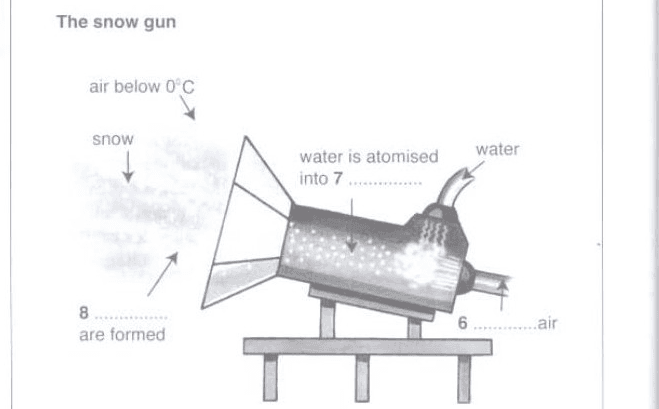
The snow gun
• (6) ………………………… air
• water is atomised into (7) …………………………
• (8) ………………………… are formed
Questions 9–13
Complete the sentences below. Choose NO MORE THAN THREE WORDS from the passage for each answer.
9. Dry snow is used to give slopes a level surface, while wet snow is used to increase the snow ………………………… on busy slopes.
10. To calculate the required snow consistency, the ………………………… of the atmosphere must first be measured.
11. The machinery used in the process of making the snow consumes a lot of ………………………… which is damaging to the environment.
12. Artificial snow is used in agriculture as a type of ………………………… for plants in cold conditions.
13. Artificial snow may also be used in carrying out safety checks on ………………………….
Why are so few tigers man-eaters?
[A] As you leave the Bandhavgarh National Park in central India, there is a notice which shows a huge, placid tiger. The notice says, 'You may not have seen me, but I have seen you.' There are more than a billion people in India and Indian tigers probably see humans every single day of their lives. Tigers can and do kill almost anything they meet in the jungle - they will even attack elephants and rhino. Surely, then, it is a little strange that attacks on humans are not more frequent.
[B] Some people might argue that these attacks were in fact common in the past. British writers of adventure stories, such as Jim Corbett, gave the impression that village life in India in the early years of the twentieth century involved a state of constant siege by man-eating tigers. But they may have overstated the terror spread by tigers. There were also far more tigers around in those days (probably 60,000 in the subcontinent, compared to just 3000 today). So in proportion, attacks appear to have been as rare then as they are today.
[C] It is widely assumed that the constraint is fear; but what exactly are tigers afraid of? Can they really know that we may be even better armed than they are? Surely not. Has the species programmed the experiences of all tigers with humans into its genes to be inherited as instinct? Perhaps. But I think the explanation may be more simple and, in a way, more intriguing.
[D] Since the growth of ethology in the 1950s, we have tried to understand animal behaviour from the animal's point of view. Until the first elegant experiments by pioneers in the field, such as Konrad Lorenz, naturalists wrote about animals as if they were slightly less intelligent humans. Jim Corbett's breathless accounts of his duels with man-eaters in truth tell us more about Jim Corbett than they do about the animals. The principle of ethology, on the other hand, requires us to attempt to think in the same way as the animal we are studying thinks, and to observe every tiny detail of its behaviour without imposing our own human significances on its actions.
[E] I suspect that a tiger's fear of humans lies not in some preprogrammed ancestral logic but in the way he actually perceives us visually. If you try to think like a tiger, a human in a car might appear just to be part of the car, and because tigers don't eat cars the human is safe unless the car is menacing the tiger or its cubs, in which case a brave or enraged tiger may charge. A human on foot is a different sort of puzzle. Imagine a tiger sees a man who is 1.8m tall. A tiger is less than 1m tall but he may be up to 3m long from head to tail. So when a tiger sees the man face on, it might not be unreasonable for him to assume that the man is 6m long. If he met a deer of this size, he might attack the animal by leaping on its back, but when he looks behind the man, he can't see a back. From the front the man is huge, but looked at from the side he all but disappears. This must be very disconcerting. A hunter has to be confident that it can tackle its prey, and no one is confident when they are disconcerted. This is especially true of a solitary hunter such as the tiger and may explain why lions - particularly young lionesses who tend to encourage one another to take risks - are more dangerous than tigers.
[F] If the theory that a tiger is disconcerted to find that a standing human is both very big and yet somehow invisible is correct, the opposite should be true of a squatting human. A squatting human is half the size and presents twice the spread of back, and more closely resembles a medium-sized deer. If tigers were simply frightened of all humans, then a squatting person would be no more attractive as a target than a standing one. This, however, appears not to be the case. Many incidents of attacks on people involve villagers squatting or bending over to cut grass for fodder or building material.
[G] The fact that humans stand upright may therefore not just be something that distinguishes them from nearly all other species, but also a factor that helped them to survive in a dangerous and unpredictable environment.
ethology: the branch of zoology that studies the behaviour of animals in their natural habitats
Questions 14–18
Reading Passage 2 has seven paragraphs labelled A–G. Which paragraph contains the following information?
14. a rejected explanation of why tiger attacks on humans are rare
15. a reason why tiger attacks on humans might be expected to happen more often than they do
16. examples of situations in which humans are more likely to be attacked by tigers
17. a claim about the relative frequency of tiger attacks on humans
18. an explanation of tiger behaviour based on the principles of ethology
Questions 19–23
Do the following statements agree with the information given in Reading Passage 2?
TRUEif the statement agrees with the information
FALSEif the statement contradicts the information
NOT GIVENif there is no information on this
19. Write: TRUE if the statement agrees with the information FALSE if the statement contradicts the information NOT GIVEN if there is no information on this in the passage Tigers in the Bandhavgarh National Park are a protected species.
20. Write: TRUE if the statement agrees with the information FALSE if the statement contradicts the information NOT GIVEN if there is no information on this in the passage Some writers of fiction have exaggerated the danger of tigers to man.
21. Write: TRUE if the statement agrees with the information FALSE if the statement contradicts the information NOT GIVEN if there is no information on this in the passage The fear of humans may be passed down in a tiger's genes.
22. Write: TRUE if the statement agrees with the information FALSE if the statement contradicts the information NOT GIVEN if there is no information on this in the passage Konrad Lorenz claimed that some animals are more intelligent than humans.
23. Write: TRUE if the statement agrees with the information FALSE if the statement contradicts the information NOT GIVEN if there is no information on this in the passage Ethology involves applying principles of human behaviour to animals.
Questions 24–26
Choose the correct answer, A, B, C or D.
24. Why do tigers rarely attack people in cars?
A They have learned that cars are not dangerous.
B They realise that people in cars cannot be harmed.
C They do not think people in cars are living creatures.
D They do not want to put their cubs at risk.
25. The writer says that tigers rarely attack a man who is standing up because
A they are afraid of the man's height.
B they are confused by the man's shape.
C they are puzzled by the man's lack of movement.
D his back appears longer in relation to his height.
26. A human is more vulnerable to tiger attack when squatting because
A he may be unaware of the tiger's approach.
B he cannot easily move his head to see behind him.
C his head becomes a better target for the tiger.
D his back appears longer in relation to his height.
Keep taking the tablets
In the opening pages of Aspirin: The Remarkable Story of a Wonder Drug, Diarmuid Jeffreys describes this little white pill as 'one of the most amazing creations in medical history, a drug so astonishingly versatile that it can relieve headache, ease your aching limbs, lower your temperature and treat some of the deadliest human diseases'.
Its properties have been known for thousands of years. Ancient Egyptian physicians used extracts from the willow tree as an analgesic, or pain killer. Centuries later the Greek physician Hippocrates recommended the bark of the willow tree as a remedy for the pains of childbirth and as a fever reducer. But it wasn't until the eighteenth and nineteenth centuries that salicylates - the chemical found in the willow tree - became the subject of serious scientific investigation. The race was on to identify the active ingredient and to replicate it synthetically. At the end of the nineteenth century a German company, Friedrich Bayer & Co. succeeded in creating a relatively safe and very effective chemical compound, acetylsalicylic acid, which was renamed aspirin.
The late nineteenth century was a fertile period for experimentation, partly because of the hunger among scientists to answer some of the great scientific questions, but also because those questions were within their means to answer. One scientist in a laboratory with some chemicals and a test tube could make significant breakthroughs - whereas today, in order to map the human genome for instance, one needs 'an army of researchers, a bank of computers and millions and millions of dollars'.
But an understanding of the nature of science and scientific inquiry is not enough on its own to explain how society innovates. In the nineteenth century, scientific advance was closely linked to the industrial revolution. This was a period when people frequently had the means, motive and determination to take an idea and turn it into reality. In the case of aspirin that happened piecemeal - a series of minor, often unrelated advances, fertilised by the century's broader economic, medical and scientific developments, that led to one big final breakthrough.
The link between big money and pharmaceutical innovation is also a significant one. Aspirin's continued shelf life was ensured because for the first 70 years of its life, huge amounts of money were put into promoting it as an ordinary everyday analgesic. In the 1970s other analgesics, such as ibuprofen and paracetamol, were entering the market, and the pharmaceutical companies then focused on publicising these new drugs. But just at the same time, discoveries were made regarding the beneficial role of aspirin in preventing heart attacks, strokes and other afflictions. Had it not been for these findings, this pharmaceutical marvel may well have disappeared.
So the relationship between big money and drugs is an odd one. Commercial markets are necessary for developing new products and ensuring that they remain around long enough for scientists to carry out research on them. But the commercial markets are just as likely to kill off certain products when something more attractive comes along. In the case of aspirin, a potential 'wonder drug' was around for over 70 years without anybody investigating the way in which it achieved its effects, because they were making more than enough money out of it as it was. If ibuprofen or paracetamol had entered the market just a decade earlier, aspirin might not be here today. It would be just another forgotten drug that people hadn't bothered to explore.
None of the recent discoveries of aspirin's benefits were made by the big pharmaceutical companies; they were made by scientists working in the public sector. The reason for that is very simple and straightforward, Jeffreys says in his book. 'Drug companies will only pursue research that is going to deliver financial benefits. There's no profit in aspirin any more. It is incredibly inexpensive with tiny profit margins and it has no patent any more, so anyone can produce it.' In fact, there's almost a disincentive for drug companies to further boost the drug, he argues, as it could possibly put them out of business by stopping them from selling their more expensive brands.
So what is the solution to a lack of commercial interest in further exploring the therapeutic benefits of aspirin? More public money going into clinical trials, says Jeffreys. 'If I were the Department of Health, I would say "this is a very inexpensive drug. There may be a lot of other things we could do with it." We should put a lot more money into trying to find out.'
Jeffreys' book - which not only tells the tale of a 'wonder drug' but also explores the nature of innovation and the role of big business, public money and regulation - reminds us why such research is so important.
Questions 27–32
Complete each sentence with the correct ending A–H from the box below.
27. Ancient Egyptian and Greek doctors were aware of
A the discovery of new medical applications.
B the negative effects of publicity.
C the large pharmaceutical companies.
D the industrial revolution.
E the medical uses of a particular tree.
F the limited availability of new drugs.
G the chemical found in the willow tree.
H commercial advertising campaigns.
28. Frederick Bayer & Co were able to reproduce
A the discovery of new medical applications.
B the negative effects of publicity.
C the large pharmaceutical companies.
D the industrial revolution.
E the medical uses of a particular tree.
F the limited availability of new drugs.
G the chemical found in the willow tree.
H commercial advertising campaigns.
29. The development of aspirin was partly due to the effects of
A the discovery of new medical applications.
B the negative effects of publicity.
C the large pharmaceutical companies.
D the industrial revolution.
E the medical uses of a particular tree.
F the limited availability of new drugs.
G the chemical found in the willow tree.
H commercial advertising campaigns.
30. The creation of a market for aspirin as a painkiller was achieved through
A the discovery of new medical applications.
B the negative effects of publicity.
C the large pharmaceutical companies.
D the industrial revolution.
E the medical uses of a particular tree.
F the limited availability of new drugs.
G the chemical found in the willow tree.
H commercial advertising campaigns.
31. Aspirin might have become unavailable without
A the discovery of new medical applications.
B the negative effects of publicity.
C the large pharmaceutical companies.
D the industrial revolution.
E the medical uses of a particular tree.
F the limited availability of new drugs.
G the chemical found in the willow tree.
H commercial advertising campaigns.
32. The way in which aspirin actually worked was not investigated by
A the discovery of new medical applications.
B the negative effects of publicity.
C the large pharmaceutical companies.
D the industrial revolution.
E the medical uses of a particular tree.
F the limited availability of new drugs.
G the chemical found in the willow tree.
H commercial advertising campaigns.
Questions 33–37
Do the following statements agree with the views of the writer in Reading Passage 3?
YESif the statement agrees with the views of the writer
NOif the statement contradicts the views of the writer
NOT GIVENif it is impossible to say what the writer thinks about this
33. Write: YES if the statement agrees with the writer's views NO if the statement contradicts the writer's views NOT GIVEN if it is impossible to say what the writer thinks about this For nineteenth-century scientists, small-scale research was enough to make important discoveries.
34. Write: YES if the statement agrees with the writer's views NO if the statement contradicts the writer's views NOT GIVEN if it is impossible to say what the writer thinks about this The nineteenth-century industrial revolution caused a change in the focus of scientific research.
35. Write: YES if the statement agrees with the writer's views NO if the statement contradicts the writer's views NOT GIVEN if it is impossible to say what the writer thinks about this The development of aspirin in the nineteenth century followed a structured pattern of development.
36. Write: YES if the statement agrees with the writer's views NO if the statement contradicts the writer's views NOT GIVEN if it is impossible to say what the writer thinks about this In the 1970s sales of new analgesic drugs overtook sales of aspirin.
37. Write: YES if the statement agrees with the writer's views NO if the statement contradicts the writer's views NOT GIVEN if it is impossible to say what the writer thinks about this Commercial companies may have both good and bad effects on the availability of pharmaceutical products.
Questions 38–40
Complete the summary below using the list of words A–I below.
List of Words
A useful
B cheap
C state
D international
E major drug companies
F profitable
G commercial
H public sector scientists
I health officials
38. Jeffreys argues that the reason why …………………………
39. did not find out about new uses of aspirin is that aspirin is no longer a …………………………
40. drug. He therefore suggests that there should be ………………………… support for further research into the possible applications of the drug.
Answers
1. ix
2. iii
3. viii
4. i
5. vi
6. compressed
7. tiny droplets
8. ice crystals
9. depth
10. temperature and humidity
11. energy
12. insulation
13. aircraft
14. C
15. A
16. F
17. B
18. E
19. Not Given
20. True
21. True
22. Not Given
23. False
24. They do not think people in cars are living creatures.
25. they are confused by the man's shape.
26. his back appears longer in relation to his height.
27. the medical uses of a particular tree.
28. the chemical found in the willow tree.
29. the industrial revolution.
30. commercial advertising campaigns.
31. the discovery of new medical applications.
32. the large pharmaceutical companies.
33. Yes
34. Not Given
35. No
36. Not Given
37. Yes
38. major drug companies
39. profitable
40. state
Explanations
- 1. ix
- The heading's 'Artificial process' paraphrases 'the snow gun works very differently from a natural weather system' (a man-made mechanism), while 'natural product' paraphrases 'it accomplishes exactly the same thing' and 'will then make snowflakes in the same way as natural snow' — the output is identical to nature's even though the method is not.Common trap: x (Snow formation in nature) belongs to paragraph B, which describes the natural process alone, not the artificial device replicating it.
- 2. iii
- The heading's 'different varieties of snow' generalises the paragraph's specific contrast between 'dry snow' and 'wet snow', and 'the need for' paraphrases the functional reasons given — dry snow gives 'a level surface' for gliding, while wet snow is used 'underneath the dry snow' to build a durable base.Common trap: vii (Converting wet snow to dry snow) is not what happens here — dry and wet snow are used together in layers, not converted from one to the other.
- 3. viii
- The heading's 'new method for calculating' paraphrases 'a central computer system that is connected to weather-reading stations', and 'modifications' generalises the specific act of adjusting 'the proportions of water and air in their snow guns' to suit conditions.Common trap: ii (Modifications to the design of the snow gun) is close, but the paragraph's focus is the new computer-based method of calculating settings, not a redesign of the gun itself.
- 4. i
- The heading's 'ecological costs' generalises the paragraph's concrete list of environmental burdens — water usage, 'energy... to run the large air-compressing pumps', and 'air pollution' from diesel engines — under one umbrella term, while 'considering' paraphrases the act of weighing/detailing these demands.Common trap: iv (Local concern over environmental issues) implies a community reaction, but the paragraph itself only states the ecological costs, not any local concern or protest.
- 5. vi
- The heading's 'applications beyond the ski slopes' generalises the paragraph's specific list of non-skiing uses — 'insulation for winter crops', film-set snow, and aircraft safety 'tests' — into one umbrella category, paraphrasing 'man-made snow has a number of other uses as well'.Common trap: None significant.
- 6. compressed
- The diagram label's blank sits directly before 'air', matching the passage's exact phrase 'compressed air' — the answer is lifted verbatim from 'When the compressed air passes through the hose into the gun, it atomises the water', with no paraphrase needed since the diagram simply reproduces the passage's own term.Common trap: None significant — the answer is directly stated.
- 7. tiny droplets
- The label 'water is atomised into _____' directly echoes the passage's own wording 'it atomises the water... so that the water splits up into tiny droplets' — 'atomised' is the shared verb linking the two, and the blank takes the passage's exact result noun phrase 'tiny droplets'.Common trap: None significant — the answer is directly stated.
- 8. ice crystals
- The label '_____ are formed' paraphrases the passage's 'ice crystals will form' — the diagram simply converts the passage's active verb 'form' into the passive 'are formed', and the blank takes the passage's own noun phrase 'ice crystals' as the subject.Common trap: None significant — the answer is directly stated.
- 9. depth
- The sentence's 'slopes' and 'busy' paraphrase the passage's 'slopes which receive heavy use' — 'busy' is a synonym-generalisation of 'receive heavy use' — and 'increase the snow _____' maps onto 'build up the snow depth', with 'depth' taken directly from the passage's own phrase.Common trap: None significant.
- 10. temperature and humidity
- The sentence's 'calculate the required snow consistency' paraphrases the passage's 'adjust the proportions of water and air... to get the perfect snow consistency', and 'must first be measured' restructures the passage's statement that wetness 'is dependent on the temperature and humidity outside' into an instruction to measure those same two factors first.Common trap: None significant.
- 11. energy
- The sentence's 'the machinery used in the process of making the snow' paraphrases 'the large air-compressing pumps' and 'the diesel engines which run them', and 'consumes a lot of _____ which is damaging to the environment' restructures the passage's 'considerable amounts of energy are needed... [and] cause air pollution' into a single cause-and-effect statement.Common trap: None significant.
- 12. insulation
- The sentence's 'used in agriculture' generalises the passage's specific mention of 'farmers', and '_____ for plants in cold conditions' paraphrases 'insulation for winter crops' almost verbatim, with 'cold conditions' restating 'winter'.Common trap: None significant.
- 13. aircraft
- The sentence's 'carrying out safety checks on _____' paraphrases the passage's 'the tests that aircraft must undergo in order to ensure that they can function safely in extreme conditions' — 'safety checks' is a synonym for 'tests... to ensure... function safely', and the blank supplies the passage's own noun 'aircraft'.Common trap: None significant.
- 14. C
- The question's 'a rejected explanation' paraphrases the passage's dismissal of the fear-based theory — the writer raises the widely-held assumption that 'the constraint is fear' only to reject it with 'Surely not', so 'rejected' captures that explicit dismissal of the assumed explanation.Common trap: None significant.
- 15. A
- The question's 'expected to happen more often' paraphrases the passage's rhetorical conclusion 'it is a little strange that attacks on humans are not more frequent', which follows from the stated facts that tigers 'kill almost anything they meet' and 'see humans every single day' — the passage's specific examples (elephants, rhino, daily exposure) generalise into the question's abstract 'reason'.Common trap: None significant.
- 16. F
- The question's 'situations in which humans are more likely to be attacked' generalises the passage's concrete detail 'villagers squatting or bending over to cut grass for fodder or building material' — the specific activity is the passage's example of the abstract category the question describes.Common trap: None significant.
- 17. B
- The question's 'relative frequency... across time' paraphrases the passage's comparison of past and present tiger populations ('60,000... compared to just 3000 today') leading to the conclusion 'attacks appear to have been as rare then as they are today' — 'in proportion' is restated by the question as 'relative'.Common trap: A (paragraph A) also touches on attack frequency, but it is paragraph B that makes the explicit comparative claim across time.
- 18. E
- The question's 'based on the principles of ethology' paraphrases the passage's method of 'try[ing] to think like a tiger' — this directly enacts the ethological principle (defined in paragraph D) of thinking as the animal thinks rather than imposing human significances, applied here to explain tiger behaviour toward cars and humans.Common trap: D (paragraph D) defines what ethology is and its principles, but it is paragraph E that actually applies those principles to explain tiger behaviour.
- 19. Not Given
- The statement's claim of formal 'protected species' status has no corresponding phrase in the passage — the passage only describes a warning notice at the park exit ('You may not have seen me, but I have seen you'), which establishes tigers are present and watching, not that any conservation/legal protection applies to them.Common trap: A national park setting can suggest protected status, but the passage never confirms this explicitly.
- 20. True
- The statement's 'writers of fiction' paraphrases 'British writers of adventure stories, such as Jim Corbett', and 'exaggerated the danger' paraphrases both 'gave the impression... of constant siege by man-eating tigers' and the writer's own verdict that 'they may have overstated the terror spread by tigers' — 'overstated' is a direct synonym for 'exaggerated'.Common trap: None significant.
- 21. True
- The statement's 'passed down in a tiger's genes' paraphrases the passage's 'programmed the experiences of all tigers with humans into its genes to be inherited as instinct' — 'passed down' restates 'inherited', and the writer's tentative 'Perhaps' confirms this is presented as a live possibility, matching the statement's claim.Common trap: None significant.
- 22. Not Given
- The statement's claim about Lorenz asserting animal superiority has no matching passage content — the phrase 'as if they were slightly less intelligent humans' describes how naturalists before Lorenz's pioneering experiments wrote about animals, a view the passage attributes to earlier writers, not a claim made by Lorenz himself.Common trap: The comparison of animals to 'slightly less intelligent humans' can be mistaken for a claim about relative intelligence, but this describes older naturalists' assumptions, not a claim made by Lorenz.
- 23. False
- The statement's 'applying principles of human behaviour to animals' is the antonym-negation of what the passage says ethology actually requires — 'to attempt to think in the same way as the animal... thinks' and 'without imposing our own human significances on its actions' — so the statement inverts the passage's stated method.Common trap: None significant.
- 24. They do not think people in cars are living creatures.
- The question's 'rarely attack people in cars' paraphrases the passage's 'the human is safe unless the car is menacing', and the correct option's 'do not think people... are living creatures' paraphrases 'might appear just to be part of the car' — the tiger perceptually merges the person with the vehicle, so 'part of the car' becomes 'not a living creature' in the option.Common trap: None significant.
- 25. they are confused by the man's shape.
- The correct option's 'confused by the man's shape' paraphrases the passage's 'From the front the man is huge, but looked at from the side he all but disappears' — the contradictory appearance from different angles is restructured into the single word 'confused', and 'this must be very disconcerting' supports 'confused' over a simpler notion like fear.Common trap: 'his back appears longer in relation to his height' is the correct answer for the squatting-human question (Q26), not this one about a standing man.
- 26. his back appears longer in relation to his height.
- The correct option's 'back appears longer in relation to his height' paraphrases the passage's 'is half the size and presents twice the spread of back' — the halved height and doubled back-spread are restated as a single ratio, explaining why the squatting figure 'more closely resembles a medium-sized deer'.Common trap: None significant.
- 27. the medical uses of a particular tree.
- The correct ending's 'the medical uses of a particular tree' generalises the passage's specific details — 'Ancient Egyptian physicians used extracts from the willow tree as an analgesic' and Hippocrates recommending 'the bark of the willow tree' — into one abstract category, with 'a particular tree' standing in for 'the willow tree'.Common trap: 'the chemical found in the willow tree' (salicylates) is the correct ending for Q28, not this one — ancient doctors used the tree itself, before the chemical was identified.
- 28. the chemical found in the willow tree.
- The sentence stem's 'reproduce' paraphrases the passage's 'succeeded in creating a relatively safe and very effective chemical compound', and the correct ending's 'the chemical found in the willow tree' refers back to 'salicylates - the chemical found in the willow tree' mentioned just before Bayer's synthesis is described.Common trap: 'the medical uses of a particular tree' (Q27) refers to the earlier, pre-scientific era, not Bayer's later chemical synthesis.
- 29. the industrial revolution.
- The sentence stem's 'partly due to the effects of' paraphrases the passage's 'closely linked to', and the correct ending 'the industrial revolution' is lifted directly from the passage sentence naming it as the driver that gave people 'the means, motive and determination to take an idea and turn it into reality'.Common trap: None significant.
- 30. commercial advertising campaigns.
- The sentence stem's 'creation of a market... as a painkiller' paraphrases the passage's 'aspirin's continued shelf life was ensured', and the correct ending 'commercial advertising campaigns' paraphrases 'huge amounts of money were put into promoting it as an ordinary everyday analgesic' — 'promoting' becomes 'advertising campaigns'.Common trap: None significant.
- 31. the discovery of new medical applications.
- The sentence stem's 'might have become unavailable without' paraphrases the passage's conditional 'Had it not been for these findings, this pharmaceutical marvel may well have disappeared', and the correct ending 'the discovery of new medical applications' paraphrases 'discoveries... regarding the beneficial role of aspirin in preventing heart attacks, strokes and other afflictions'.Common trap: None significant.
- 32. the large pharmaceutical companies.
- The sentence stem's 'was not investigated by' paraphrases the passage's negation 'None of the recent discoveries of aspirin's benefits were made by', and the correct ending 'the large pharmaceutical companies' is lifted directly from 'the big pharmaceutical companies' in the same sentence, which contrasts them with 'scientists working in the public sector'.Common trap: None significant.
- 33. Yes
- The statement's 'small-scale research was enough' paraphrases the passage's 'one scientist in a laboratory with some chemicals and a test tube could make significant breakthroughs' — a single person with minimal equipment is restated as 'small-scale', and this is explicitly contrasted with the resource-heavy present day ('an army of researchers, a bank of computers and millions and millions of dollars').Common trap: None significant.
- 34. Not Given
- The statement's 'caused a change in the focus of scientific research' has no equivalent claim in the passage — the passage only says advance was 'closely linked to the industrial revolution' and that the era gave people 'means, motive and determination', which describes enabling conditions for turning ideas into reality, not a redirection of what was researched.Common trap: The close link between science and industry can be mistaken for a claim about a shift in research focus, but no such change of focus is described.
- 35. No
- The statement's 'a structured pattern of development' is the antonym of the passage's explicit description 'that happened piecemeal - a series of minor, often unrelated advances' — 'piecemeal' and 'unrelated' directly negate the idea of a coherent, structured process, making the statement false.Common trap: None significant.
- 36. Not Given
- The statement's 'sales... overtook sales of aspirin' has no matching passage content — the passage only states that new analgesics 'were entering the market' and that companies 'focused on publicising these new drugs', which describes a marketing shift, not a stated comparison of actual sales figures.Common trap: A shift in marketing focus can be mistaken for a claim about sales figures overtaking aspirin, but no such comparison is given.
- 37. Yes
- The statement's 'both good and bad effects' paraphrases the passage's two contrasting clauses — 'necessary for developing new products' (the good effect) and 'just as likely to kill off certain products when something more attractive comes along' (the bad effect) — joined by 'But' in the passage, matching the statement's two-sided claim.Common trap: None significant.
- 38. major drug companies
- The summary's blank refers to who did NOT make the recent discoveries, paraphrasing the passage's 'None of the recent discoveries of aspirin's benefits were made by the big pharmaceutical companies' — the wordList entry 'major drug companies' is a direct synonym-restatement of 'big pharmaceutical companies'.Common trap: 'public sector scientists' is who DID make the discoveries, the opposite of who this blank refers to.
- 39. profitable
- The summary's 'aspirin is no longer a _____' paraphrases the passage's 'There's no profit in aspirin any more' — the wordList answer 'profitable' is the adjective form of 'profit', directly restating why drug companies (who 'only pursue research that is going to deliver financial benefits') have lost interest.Common trap: 'cheap' describes aspirin too, but the specific word used for what aspirin no longer is, in terms of financial incentive, is 'profitable'.
- 40. state
- The summary's '_____ support' paraphrases the passage's 'More public money going into clinical trials' and the suggestion addressed to 'the Department of Health' — the wordList answer 'state' is a synonym for 'public' (i.e. government) funding, as opposed to commercial or international sources.Common trap: 'international' is a plausible-sounding distractor, but the funding the writer calls for is public/state money (Department of Health), not international support.
Comments
Loading comments…