

IELTS Trainer General Training Reading Test 3
3 passages · 40 questions · 60 minutes
Rules for Residents / Blakeville Community College
[[READ: 1–7]]
Pinehaven apartments: Rules for residents: Communal areas
Rooftop area
The rooftop is a shared space for everyone's enjoyment, so please leave it how you find it. If inviting more than five guests from outside the complex, please book a section of the rooftop ahead of time; the booking form is on the door of the utilities room. Please note that barbecues are used on a first-come-first-served basis. Please also leave them as you find them.
We ask that you are considerate of fellow residents and neighbours and keep noise levels down after 9 p.m. on weeknights.
While the janitor looks after the general maintenance of the area, it is not the job of the janitor to clean up after gatherings, so please make sure any garbage is removed from the rooftop and put in the bins on the ground floor.
Any breakage of communal property must be reported immediately and paid for.
The rooftop is closed from 10 p.m. Sunday to Thursday and 12 a.m. on Friday and Saturday.
Laundry
There are six washing machines and two dryers in the laundry. These cannot be booked in advance. If you leave your washing unattended after a cycle, note that it may be removed so others can use the machines.
Please notify the janitor immediately of any maintenance issues with the machines.
Elevators and stairwells
Be aware that our two elevators and three stairwells are communal areas; do not leave any items in these areas for any reason whatsoever. Elevators are in constant use at weekends so special arrangements need to be made if removalists need elevator access. Please contact management 24 hours in advance to reserve one if this is the case. If stairs are to be used when moving furniture, please use the West stairwell as the South stairwell is narrower and the North stairwell needs to be clear in case of emergencies.
[[READ: 8–14]]
Blakeville community college
[A] Barista course
Learn to make every coffee on a café menu. This course comprises eight hours of hands-on classroom delivery. Take our intensive course on Saturday 23 June or join our weekly two-hour sessions on Thursdays at 6:30 p.m.–8:30 p.m.
You'll learn to operate, clean and maintain a range of coffee machines, use a coffee grinder and present coffee like a professional.
Each student has their own machine (max 12 in a class).
Cost: $290 ($10 off each when you book for two students).
[B] Leadlighting and stained glass
Learn the art of glass cutting and leadlighting as you make a project of your choice. Supplies are included in the cost and glass-cutters may be taken home, to be returned the following session. Runs Tuesdays 6:30 p.m.–9:00 p.m. from 24 June–22 July.
Cost: $320
[C] Sewing weekend course
Held over two days on the first weekend of every month (starting 28 June), this course is for those who want to make alterations to their garments or create new clothes and furnishings. Your proficiency will be assessed by the instructor on the first morning, and you will receive instruction based on the stage you are at. Machines and thread will be provided, but please bring your own fabric and pattern.
Cost: $250 for Saturday and Sunday.
[D] Drawing workshop
This course is a bridge for people who already like to draw to get to the next level. You'll be introduced to methods employed by contemporary artists using pencil, charcoal and ink. For the first session, please bring paper, pencil and eraser; you'll also need to purchase ink and charcoal pencils on the night. Held on Wednesday evenings between 7:00 p.m.–9:00 p.m., 25 June–23 July.
Cost: $180 plus incidentals
[E] Bicycle maintenance
A great starting point for those interested in bike care and repair. From fixing a puncture to adjusting brakes and gears, the team from BikeSmart will show you how. Saturday 10 a.m. to 12 p.m., 28 June and 5 July.
Cost: by donation
[F] Budgeting for beginners
This course will show you how to make a budget and stick to it. You'll learn to tailor your savings regime to your circumstances and you'll set and reach financial goals. These workshops run over three nights: Thursday 7:30 p.m.–9:00 p.m., starting 26 June. Bring a friend at no additional cost.
Cost: $90
Questions 1–7
Do the following statements agree with the information given in the passage?
TRUEif the statement agrees with the information
FALSEif the statement contradicts the information
NOT GIVENif there is no information on this
1. Barbecues on the rooftop area must be reserved in advance.
2. Rubbish from rooftop parties must be taken downstairs.
3. The janitor should be notified of any damage to the rooftop area.
4. You may use more than one washing machine at a time.
5. The janitor checks the machines in the laundry regularly.
6. You have to book an elevator if you want to use it to move in or out on a weekend.
7. The South stairwell has the best access for removalists.
Questions 8–14
Look at the six descriptions of courses A–F in the text. For which courses are the following statements true? Write the correct letter, A–F. NB You can use any letter more than once.
Blakeville Community College Courses
A Barista course
B Leadlighting and stained glass
C Sewing weekend course
D Drawing workshop
E Bicycle maintenance
F Budgeting for beginners
8. You have to pay extra for materials.
9. The class is open to students of different levels of ability.
10. Two people can attend for the price of one.
11. You can choose how much you want to pay for the class.
12. It is possible to borrow equipment.
13. You must have some experience in the skill being taught.
14. A one-day course is offered.
Setting Up a Home Office / How to Motivate Your Sales Team
[[READ: 15–20]]
Setting up a home office, a how-to guide
Working from home is now an option in an increasing number of jobs, and many workers enjoy the flexibility this brings. However, not every home is automatically equipped to provide a workspace. Here are some tips for creating a professional home office, whether you are working for an employer or you have your own business:
Establish the basic needs you have for your office. In most cases, you'll need a desk, adjustable chair and computer at least. Then you'll have an idea of how much space you'll need. You'll need a room away from noise and distractions and, if possible, it will be separate from communal areas with a closing door. Even if you don't share your home with others, it's a good idea to have a physical division between your home and work life.
Maintaining a professional office means you'll need to be well-organised. Not only will you require space to spread out and work, you should allocate plenty of room for storage of files and supplies. You might have to store files in another room but, bear in mind that anything you use on a regular basis should be accessible.
Getting the basics right is crucial: quality ergonomic furniture will ultimately save you money on treatment for physical problems caused by bad posture. While it can be tempting to skimp on key pieces and splurge on non-essentials like desk ornaments, it is far more important to have a reliable phone and computer, a fast internet connection and a chair that will support your lower back.
Don't forget to hang a clock on the wall or put one on your desk where you can see it. It's easy to lose track of time when you're working from home and you might find yourself working for hours on end without a break. Conversely, you might feel it's time for a break before it actually is. You'll find you are far more efficient if you can set hours and stick to them. You'll stay more focused and clients will appreciate knowing when you can be reached.
It is stipulated in health and safety policies of most workplaces that a first-aid kit should be provided, and this is best practice in the home office too. Ventilation, whether natural or artificial, must be adequate and the work area should be clear of obstructions.
[[READ: 21–27]]
How to motivate your sales team: a guide for managers
Motivation is one of the most important ingredients of continued sales success over time. As a manager, you need to motivate your people as individuals and also as a team.
The foundation of motivation is trust. If your salespeople don't believe you have their best interests at heart, they won't be driven to put in their best effort at work. Take the time to find out their goals and the challenges they face in pursuing these goals.
The best way to find out what motivates your workers may simply be to ask them. Have them explain to you what management style they respond best to - some people need almost constant guidance while others like to be left to their own devices for most of the time. Ask them about the best times of the day or week to have meetings; although it may not always be possible, accommodate them when you can.
An often-overlooked factor is when and how to give feedback. Some need this - whether positive or negative - on a daily basis, while others would rather it was saved for more formal appraisals.
There are also some very tangible changes that may have an instant effect; these relate to the health and comfort of the workers. Ensure that they have time to recharge on their breaks and, if you can afford it, provide some nutritious, energy-giving snacks in the lunchroom. Some employers offer their workers a free or discounted membership at a gym and report that this pays for itself in healthy, motivated employees.
It's always worth remembering that people are motivated in different ways. The most commonly exploited motivator is money, whether it's a raise, bonus or commission, but that's not the only way of getting the best from your staff. Some thrive on competition, within or between teams. Others need acknowledgement for a job well done. Groups often respond positively to a chance to get out of the work environment, perhaps for social occasions or to attend sports events. Find what works for your sales people.
There are cases when workers are experiencing a slump and are not performing well. They may not rise to the challenge of working towards something they believe to be out of their reach. If this is the case, link their incentive to their improvement, rather than performance as measured against others.
Questions 15–20
Complete the sentences below. Choose ONE WORD ONLY from the text for each answer.
15. Ideally, the office space in your home should be in a ………………………… room.
16. Consider the need for ………………………… as well as workspace.
17. Spend your budget on good equipment rather than unnecessary items, such as ………………………….
18. Ensure a ………………………… is visible from where you will be working.
19. Having regular office hours will be helpful for your ………………………….
20. In terms of health and safety, it is important that there is enough ………………………….
Questions 21–27
Complete the notes below. Choose NO MORE THAN TWO WORDS from the text for each answer.
Motivating staff
General principles:
• motivation can't exist without (21) …………………………
• manager must understand workers' goals, challenges
Ask workers:
• what (22) ………………………… they prefer
• when they want meetings
• how often they need (23) …………………………
Meet physical needs:
• adequate breaks
• healthy food
• access to a (24) …………………………
Examples of motivators:
• money
• (25) ………………………… with colleagues
• praise / recognition
• outings such as parties and (26) …………………………
Poor performers:
• offer rewards based on (27) …………………………
The Wallaby
The wallaby
Wallabies are small to medium-sized marsupials that inhabit the Australian continent and its surrounding islands. The word wallaby comes from the indigenous Australian language.
[A] While the largest wallabies can measure 6 feet from head to tail, as big or bigger than some kangaroos, most species of wallaby are smaller than kangaroos. The smallest are around 12 inches when fully-grown. They have an upright posture supported by two disproportionately large hind legs and feet, small forelimbs and a large thick tail. Wallabies have strong hind legs that enable them to travel at speed; their sizeable Achilles tendons assist them in hopping. Besides hopping, the hind legs can also be used to deliver hard kicks to other wallabies. Their tails are not able to grip but are essential in that they provide balance when a wallaby is stationary or in motion.
Because wallabies are herbivores, they have a large jaw to allow them to chew grass and plants. This accounts for their elongated faces. One distinction between a wallaby and a kangaroo is the teeth: wallabies have flat molars at the back, while kangaroos' back teeth are curved.
[B] Wallabies generally prefer bushy or rugged areas in remote locations of Australia, rather than the open arid plains that kangaroos prefer. Some smaller wallabies, such as pademelons, live in the forest. Often wallabies are named for the type of area where they reside, e.g. shrub wallabies, brush wallabies and rock wallabies.
From 1858 until 1870, about 12 species of marsupial were taken from Australia and liberated in New Zealand, but only the brush-tailed opossum and the wallabies adapted successfully to the new land. Inadequate early accounts of which exact species were introduced and where they were initially taken from, mean that there is still confusion with regards to which species of wallaby are actually present in New Zealand today.
In 1896, the acclaimed Australian painter Frederick McCubbin painted On the wallaby track, showing a family in the bush without a home, the woman with a child on her lap and the man boiling water for tea. The painting's title derives from the Australian colloquial term 'on the wallaby track' describing the wandering rural workers who moved from place to place for work and alluding to the nomadic tendency of wallabies.
[C] In terms of their young, like all marsupials, wallabies are born at an early stage of development. Young wallabies, like young kangaroos, are called a joey. As soon as they are born, they crawl into their mothers' pouches and stay there, generally for around two months. At first, the joey spends varying lengths of time out of the pouch, grazing and acquiring vital survival skills. When it needs to sleep or it feels it is in danger; however, the joey will return to the pouch. In some species, joeys stay in the pouch for up to a year or until the next joey is born. However, for most wallabies the young are thought to be independent by 9 months.
There is significant variation when it comes to the daily habits of wallabies. The larger wallaby species tend to be diurnal (mostly active throughout the day) and live in mobs, or groups, whereas smaller species are generally nocturnal (active at night) and solitary.
[D] There are animals that are native to Australia that have always hunted the wallaby; these include dingoes, wedge-tailed eagles and Tasmanian devils. However, it is species that were brought to Australia by settlers that have posed more danger. Foxes, cats and dogs have all taken their toll on wallaby numbers, as have herbivores like rabbits, sheep, goats and cattle that compete with wallabies for food. However, it is human activity that has had the most impact; land clearing and burning of bushlands have left great numbers of wallabies effectively homeless and without a source of food.
[E] Four species of wallaby have already gone extinct. There are others that are classified as vulnerable or endangered, which means that they face a high or very high risk of extinction in the wild. Measures are being taken to help particular species, including conserving their habitats and breeding them in captivity, so they may be reintroduced into the wild at a later point when conditions are favourable.
While wallabies are considered by some farmers to be a pest, efforts are being made by the Australian Society for Kangaroos to stop farmers culling kangaroos and wallabies. Instead they advocate that they should be captured and relocated.
Questions 28–32
Choose the correct heading for each paragraph from the list of headings below.
List of Headings:
i. How do wallabies interact with other species?
ii. What is being done to protect wallabies?
iii. What are the threats to the wallaby population?
iv. How much contact do wallabies have with their offspring and with each other?
v. What are the distinctive features of wallabies?
vi. How do wallabies behave when in groups?
vii. Where can wallabies be found?
viii. What kinds of wallaby are suited to specific environments?
28. Paragraph A:
29. Paragraph B:
30. Paragraph C:
31. Paragraph D:
32. Paragraph E:
Questions 33–36
Label the diagram below. Choose ONE WORD ONLY from the Reading Passage for each answer.
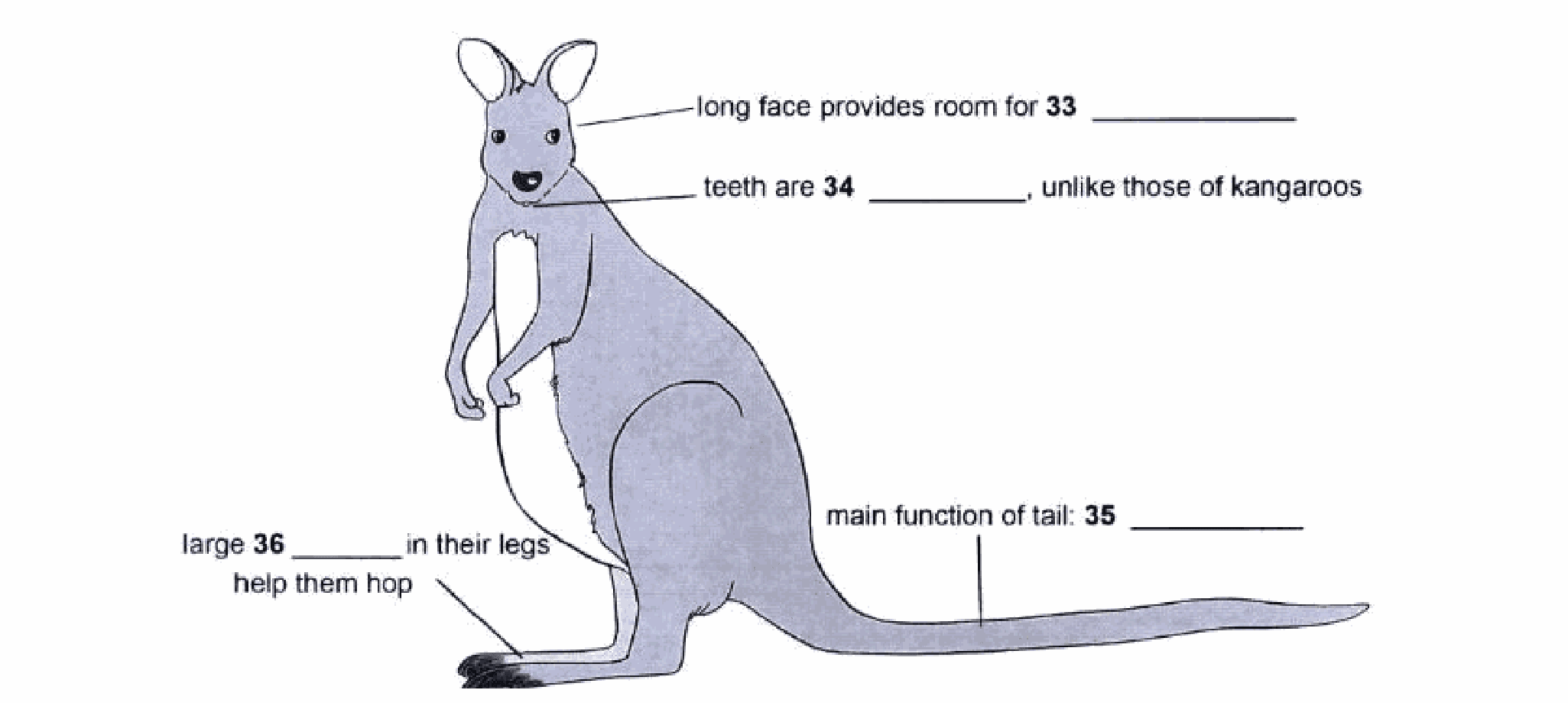
The wallaby
long face provides room for (33) …………………………
teeth are (34) …………………………, unlike those of kangaroos
main function of tail: (35) …………………………
large (36) ………………………… in their legs help them hop
Questions 37–40
Choose the correct letter.
37. Where do wallabies tend to live?
A in places inhabited by similar animals, such as kangaroos
B in areas where bigger species cannot steal their food
C in dry areas with a minimum of vegetation
D in wild places that are far away from humans
38. There is debate about which species of wallaby are present in New Zealand because
A some seem to have disappeared since they were introduced.
B records from the time they were introduced are incomplete.
C they are sometimes mistaken for a type of possum.
D they are shy creatures that avoid human contact.
39. 'On the wallaby track' refers to people who
A travel around without a fixed home.
B live in areas where wallabies can be found.
C follow the trails of wallabies in order to hunt them.
D make their home in a remote part of the country.
40. The greatest danger to the survival of wallabies is
A a predator species that have been introduced to Australia.
B animals that eat vegetation that wallabies need to survive.
C native animals that have increased in numbers.
D destruction of the places where they live.
Answers
1. False
2. True
3. Not Given
4. Not Given
5. Not Given
6. True
7. False
8. D
9. C
10. F
11. E
12. B
13. D
14. A
15. separate
16. storage
17. ornaments
18. clock
19. clients
20. ventilation
21. trust
22. management style
23. feedback
24. gym
25. competition
26. sports events
27. improvement
28. v
29. vii
30. iv
31. iii
32. ii
33. jaw
34. flat
35. balance
36. tendons
37. in wild places that are far away from humans
38. records from the time they were introduced are incomplete.
39. travel around without a fixed home.
40. destruction of the places where they live.
Explanations
- 1. False
- The notice says barbecues are used on a first-come-first-served basis, meaning residents do not need to book them in advance — they are simply available to whoever gets there first.Common trap: Contradiction trap — the rooftop itself can be booked ahead for groups of more than five guests, but this booking requirement applies to reserving rooftop space, not to the barbecues themselves.
- 2. True
- Residents are told to remove any garbage from the rooftop and put it in the bins on the ground floor, which is downstairs from the rooftop.Common trap: None significant — the answer is a direct paraphrase ('ground floor' = 'downstairs').
- 3. Not Given
- The passage states that any breakage of communal property must be reported immediately and paid for, but it never specifies that the janitor is the person who must be told — only that the janitor handles general maintenance and machine issues elsewhere in the notice.Common trap: Unsupported-inference trap — the janitor is mentioned elsewhere in the notice, which might tempt a reader to assume breakages are reported to the janitor too, but this is never stated.
- 4. Not Given
- The notice states how many washing machines and dryers there are and that they cannot be booked in advance, but it never says whether a resident may use more than one machine simultaneously.Common trap: None significant — the passage simply does not address this.
- 5. Not Given
- Residents are told to notify the janitor immediately if there is a maintenance issue, but there is no statement that the janitor performs regular checks of the machines.Common trap: Unsupported-inference trap — being responsible for fixing issues when notified does not mean the janitor proactively checks the machines on a regular basis.
- 6. True
- The notice explains that elevators are in constant use at weekends, so removalists need special arrangements, and residents must contact management 24 hours in advance to reserve an elevator in that case.Common trap: None significant — the answer is directly stated.
- 7. False
- Residents moving furniture are told to use the West stairwell because the South stairwell is narrower, which means the South stairwell is actually less suitable, not the best option.Common trap: Substitution trap — the South stairwell is mentioned as an alternative, but it is explicitly ruled out for removalists because it is narrower; the West stairwell is the recommended one.
- 8. D
- The Drawing workshop description says students need to purchase ink and charcoal pencils on the night, on top of the course cost, which is listed as '$180 plus incidentals'.Common trap: Adjacent-option trap — the Leadlighting course (B) already includes supplies in its cost, the opposite situation, so it is easy to confuse the two.
- 9. C
- The Sewing weekend course description says the instructor assesses each student's proficiency on the first morning and gives instruction based on the stage the student is at, meaning students of different abilities are all catered for.Common trap: Paraphrase trap — 'different levels of ability' is expressed as the instructor tailoring instruction to each student's individual stage.
- 10. F
- The Budgeting for beginners course states you can 'bring a friend at no additional cost', meaning a second person attends without extra payment.Common trap: Adjacent-option trap — the Barista course (A) offers a $10 discount per person when booking for two, which is a reduced price, not a free second place; only F offers a genuinely free second attendee.
- 11. E
- The Bicycle maintenance course lists its cost as 'by donation', meaning participants decide the amount they pay themselves.Common trap: None significant — the answer is the exact phrase used for this course's cost.
- 12. B
- The Leadlighting and stained glass course description says glass-cutters may be taken home and returned the following session, which means equipment can be borrowed.Common trap: Paraphrase trap — 'borrow equipment' is expressed as taking a tool home and returning it the next session, not with the word 'borrow' itself.
- 13. D
- The Drawing workshop is described as being for 'people who already like to draw to get to the next level', implying participants are expected to already have some drawing experience.Common trap: Adjacent-option trap — the Sewing course (C) also assesses students' existing stage, but it explicitly welcomes complete beginners as well as more advanced students; only the Drawing workshop assumes prior experience.
- 14. A
- The Barista course offers an intensive option held entirely on a single day, Saturday 23 June, as an alternative to the weekly two-hour sessions.Common trap: Adjacent-option trap — the Sewing course (C) is held over a weekend (two days), which could be confused with a single-day option; only the Barista course's intensive version is genuinely one day.
- 15. separate
- The guide advises that, if possible, the office should be separate from communal areas with a closing door, i.e. a room that is set apart from shared living spaces.Common trap: None significant — the answer is the exact word used in the passage.
- 16. storage
- The guide states that, besides space to spread out and work, you should allocate plenty of room for storage of files and supplies.Common trap: None significant — the answer is the exact word used in the passage.
- 17. ornaments
- The guide warns against skimping on key pieces and splurging on non-essentials like desk ornaments, recommending the budget instead go towards essentials such as a good phone, computer, internet connection and chair.Common trap: Adjacent-word trap — the full phrase is 'desk ornaments', but only 'ornaments' fits the ONE WORD ONLY limit and completes the sentence grammatically.
- 18. clock
- The guide advises hanging a clock on the wall or putting one on the desk where it can be seen, so it is easy to keep track of time while working.Common trap: None significant — the answer is the exact word used in the passage.
- 19. clients
- The guide says setting and sticking to fixed hours makes you more efficient and focused, and that clients will appreciate knowing when you can be reached.Common trap: None significant — the answer is the exact word used in the passage.
- 20. ventilation
- The guide states that ventilation, whether natural or artificial, must be adequate in the home office.Common trap: None significant — the answer is the exact word used in the passage.
- 21. trust
- The passage states that the foundation of motivation is trust, meaning motivation cannot exist without it.Common trap: None significant — the answer is the exact word used in the passage.
- 22. management style
- The passage says workers should explain what management style they respond best to, such as needing constant guidance or preferring to be left alone.Common trap: None significant — the answer is the exact phrase used in the passage.
- 23. feedback
- The passage identifies when and how to give feedback as an often-overlooked factor, noting some workers want it daily while others prefer it saved for formal appraisals.Common trap: None significant — the answer is the exact word used in the passage.
- 24. gym
- The passage mentions that some employers offer workers a free or discounted gym membership as a way to meet their physical health and comfort needs.Common trap: None significant — the answer is the exact word used in the passage.
- 25. competition
- The passage states that some staff thrive on competition, within or between teams, as a motivator alongside money.Common trap: None significant — the answer is the exact word used in the passage.
- 26. sports events
- The passage says groups often respond positively to a chance to get out of the work environment for social occasions or to attend sports events.Common trap: None significant — the answer is the exact phrase used in the passage.
- 27. improvement
- The passage advises linking a struggling worker's incentive to their improvement rather than to their performance as measured against others.Common trap: None significant — the answer is the exact word used in the passage.
- 28. v
- Section A describes wallabies' physical size, posture, legs, tail and jaw/teeth compared to kangaroos — i.e. their distinctive physical features.Common trap: Adjacent-heading trap — heading (vi), about group behaviour, could tempt a reader expecting social information, but Section A is entirely about physical characteristics.
- 29. vii
- Section B discusses the types of habitat wallabies prefer (bushy or rugged remote areas), their introduction to New Zealand, and the origin of the phrase 'on the wallaby track' — all relating to where wallabies are found.Common trap: Adjacent-heading trap — heading (viii), about specific environments for specific kinds of wallaby, is close in topic, but Section B focuses on general location/habitat rather than matching particular species to particular environments.
- 30. iv
- Section C describes how long joeys stay in the pouch, when they become independent, and whether wallabies live alone or in groups — i.e. contact with offspring and with each other.Common trap: Adjacent-heading trap — heading (vi), about group behaviour, overlaps with the mention of larger species living in mobs, but the section's main focus is the joey/parent relationship, matching heading (iv) more precisely.
- 31. iii
- Section D lists the natural and introduced predators of wallabies and the impact of human land-clearing — i.e. the threats to the wallaby population.Common trap: Adjacent-heading trap — heading (i), about interaction with other species, is a plausible-sounding alternative since predators are other species, but the section's focus is specifically on danger/threat, not general interaction.
- 32. ii
- Section E describes conservation measures such as habitat protection, captive breeding and reintroduction, plus efforts to stop culling — i.e. what is being done to protect wallabies.Common trap: Adjacent-heading trap — heading (iii), about threats, is closely related since the section follows on from the previous discussion of danger, but Section E's actual focus is the protective response, not the threats themselves.
- 33. jaw
- The passage explains that because wallabies are herbivores, they have a large jaw to allow them to chew grass and plants, which accounts for their elongated (long) faces.Common trap: None significant — the answer is the exact word used in the passage.
- 34. flat
- The passage states that wallabies have flat molars at the back, while kangaroos' back teeth are curved, making this a key distinction between the two animals.Common trap: Contrast trap — 'curved' describes kangaroos' teeth, the opposite animal, so a careless reader might wrongly copy that word instead of 'flat'.
- 35. balance
- The passage states that wallabies' tails are not able to grip but are essential in that they provide balance when a wallaby is stationary or in motion.Common trap: Contrast trap — the passage first says the tail cannot grip, which could tempt a reader to (wrongly) write 'grip' instead of the tail's actual function, 'balance'.
- 36. tendons
- The passage states that wallabies' sizeable Achilles tendons assist them in hopping, referring to the tendons in their legs.Common trap: None significant — the answer is the exact word used in the passage.
- 37. in wild places that are far away from humans
- The passage says wallabies generally prefer bushy or rugged areas in remote locations of Australia — i.e. wild places far from human settlement — rather than the open arid plains kangaroos prefer.Common trap: Contrast trap — option C describes kangaroo habitat, not wallaby habitat, so it is easy to pick by mistake.
- 38. records from the time they were introduced are incomplete.
- The passage says inadequate early accounts of which exact species were introduced and where they were initially taken from mean there is still confusion about which species are present in New Zealand today.Common trap: Adjacent-detail trap — the brush-tailed opossum is mentioned in the same sentence as the successfully-adapted species, which could distract towards option C.
- 39. travel around without a fixed home.
- The passage explains the phrase describes wandering rural workers who moved from place to place for work, alluding to the nomadic tendency of wallabies — i.e. people without a fixed home.Common trap: Paraphrase trap — the connection to wallabies is an allusion to their nomadic habits, not a literal description of people interacting with wallabies, which could mislead towards option C.
- 40. destruction of the places where they live.
- The passage states that it is human activity that has had the most impact, with land clearing and burning of bushlands leaving great numbers of wallabies effectively homeless and without a source of food — i.e. destruction of their habitat.Common trap: Two-detail trap — introduced predators and competing herbivores are both mentioned as dangers, but the passage explicitly ranks human habitat destruction as the greatest of the three.
Comments
Loading comments…