

IELTS Trainer 2 General Training Reading Test 5
3 passages · 40 questions · 60 minutes
Healthfast / Taking a holiday in Canada – on a budget
[[READ: 1–7]]
Product recall: Healthfast
[A] Healthfast Vitamins and Wellbeing wishes to inform its retailers and customers that foreign material has been found in some bottles and containers of its vitamins and supplements. These foreign items include sawdust, paint chips and metal shavings.
[B] Batches affected
You will find the batch number printed on the bottom of the jar or container.
Goodnight Formula3 P6617–P6628 Healthfast Diet Support tablets N5990–N5992 Anti-stress Formula DR5938–DR5941
[C] If the batch number has worn off or you have any queries relating to the recall, please call the dedicated hotline on 1800 98887777. Alternatively, our retailers have been briefed and are being regularly updated, so you may enquire at the outlet where the purchase was made.
[D] These products are available nationwide, but reports of faulty items have come from the Sussex Cove area, leading us to believe that they have been tampered with locally. However, in the interests of security, we urge all customers who have products from the list above to return them immediately, either to point of purchase or via post to head office (Freepost SU9877). If you have opened the bottle / container, please inspect and report any irregularities.
[E] Refunds
As the manufacturer, the health and safety of our customers is paramount. We will provide a refund for any unopened bottle or container from the list above, no questions asked. We will be inspecting these in order to continue to ascertain and monitor the situation.
[F] If you have consumed vitamins or supplements from the affected batches, we would be grateful if you could complete the attached survey and report the place of purchase of the product. Please note that our children's supplement range and Sportsboost vitamins have not been affected and do not need to be returned.
[G] Healthfast Vitamins and Wellbeing will pay a reward of up to $20,000 for information leading to the conviction of any person found guilty of tampering with its products. If you have such information, please contact Regina Giese, Customer Relations Manager, Healthfast Vitamins and Wellbeing, at rgiese@healthfast.co.
[[READ: 8–14]]
Taking a holiday in Canada – on a budget
Canada is often considered to be an expensive place to travel because of the climate, vast distances and high cost of domestic travel, but this doesn't have to be the case. Below are some tips to help plan a Canadian trip that won't break the bank.
Getting around
Buses and trains in Canada are reliable but can be expensive and limit where you are able to go. One option for travelling between and within cities is a rideshare scheme. Locals with empty seats in their cars will take you from A to B for a fee.
If you want to hire a car, don't assume you have to go with a big company. There are lesser-known companies that hire out older cars, which are still reliable. Either way, there are savings to be had when you book outside the peak months (May, June and September). Be aware of add-on costs, however. The base rate does not generally include car insurance or unlimited kilometres.
If your dates are flexible, you may make great savings with a campervan relocation deal. These deals come up when a rental company needs a vehicle moved from one office to another one way – for example, Halifax to Montreal. An online search will quickly reveal such opportunities, though not often far in advance.
Activities
National parks offer a great array of choices for those who love breathtaking scenery and outdoor activities. If you like kayaking, paddle boarding or mountain biking, rent the gear outside of national parks for more budget-friendly options. For example, the University of Calgary rent summer and winter camping gear and equipment for outdoor activities. Doing some online research before your trip will save both time and money when you get there.
Food
When going from a big city to the Rocky Mountains, stock up on supplies from a major supermarket first. Most of the larger supermarket chains have many options for prepared food and some will even heat it up for you in the deli section.
Most city parks and campsites have barbecue grills that can be used by anyone. You only need to buy aluminium trays and whatever food you would like to grill.
Questions 1–7
The reading text above has seven sections, A–G. Which section mentions the following information? Write the correct letter, A–G.
1. which exact products are being recalled
2. what the manufacturer will do with returned products
3. who to contact to find out more
4. what to do if you have bought a recalled product but have not used it
5. what the manufacturer is offering for details of the crime
6. where recalled products were sold
7. why the products are being recalled
Questions 8–14
Do the following statements agree with the information given in the passage?
TRUEif the statement agrees with the information
FALSEif the statement contradicts the information
NOT GIVENif there is no information on this
8. Train and bus fares cost the same amount.
9. Fees for hire cars usually cover the cost of insuring the vehicle.
10. Deals for relocating vehicles are only in major cities.
11. Deals to relocate vehicles tend to come up close to the time of departure.
12. National parks are the cheapest option for hiring outdoor equipment.
13. Warm food is available at some supermarkets.
14. Public parks often have facilities for cooking food.
Dealing with customer complaints / Safety gear in the construction industry
[[READ: 15–21]]
Dealing with customer complaints: a guide for Gray's Discount sales staff
An opportunity to improve
While we do our best to provide our customers with top-quality products and service, there will inevitably be occasional complaints. We need to look at these complaints as opportunities to make things right. The vast majority of customers who complain have reasonable grounds for doing so and we should be grateful that they do; the majority of unhappy customers will not make a complaint to us but will instead make it known to approximately ten people, as well as possibly complaining online.
A professional approach
Some complaints can be delivered forcefully and angrily. It is a challenge to remain calm in such situations, but this is what we, as staff, must do. It is worth bearing in mind that we shouldn't turn it into a personal matter; just address the issue at hand. Take a professional approach if a customer becomes agitated and keep your own emotions in check. This does not mean you should allow a customer to become abusive in any way – seek assistance from your manager if this occurs.
Finding out what's wrong
Listen carefully and attentively to what the customer has to say and let them finish. Sometimes people just want to be heard. Ensure you know the exact nature of the problem and show the customer you want to know what happened; the best way of doing this is to ask questions. Before you can present the customer with options for a solution, you need to check with them that you have a clear picture of why they are complaining.
Providing solutions
When the customer has given you all the details, be sure to acknowledge the issue (this does not necessarily mean accepting full blame). If the customer has not opened an item or the item is faulty, give them a replacement if that is what they request. There is no need to have this approved by a manager but note it in the diary in the office and put faulty items in the returns bay. However, if the customer requests a refund, you will need to have this processed by management.
In the case of ongoing or more serious complaints, it may be wise to follow up with a phone call or email to make sure the customer is satisfied with the outcome.
[[READ: 22–27]]
Safety gear in the construction industry – the responsibility of employers and employees
Even in a highly-regulated area of work, accidents can still occur. Safety precautions must be in place to limit these accidents, and enforcing the wearing of safety gear can make the world of difference.
Employers must
- ensure that safety gear (see below) is worn by all workers on site. - provide safety gear that is suitable for the nature of the work being done. - provide safety gear of an appropriate size for each worker. - ensure employees are trained and instructed in how to use / wear safety gear correctly.
Employees must
- wear safety gear in the course of their work on site. - not misuse or intentionally cause damage to safety gear. - inform the employer if safety gear is worn out or damaged.
Head
Hard hats are compulsory at all times on site to shield the head from falling objects and bumps. They also offer protection from rain, direct sun and electric shocks. Hard hats and helmets are available with built-in ventilation for those working underground or in tight spaces.
Eyes
This is a sensitive area, requiring the utmost protection, whether that be goggles or a transparent visor attached to a helmet.
Protection should always be worn when working around smoke, extreme winds or in an area where hazardous chemicals are used or kept.
Body
Reflective safety vests are used to ensure high visibility on site. They may also be flame-retardant and breathable as the situation demands.
Hands
Almost all construction work requires the active use of hands; hence, proper precautions are required to avoid common injuries. Well-fitting safety gloves help protect hands from the most common hazard: lacerations. Other dangers include temperature extremes or anything that causes burns.
Feet
Closed-toe shoes with steel caps are a must to protect against falling objects, dangerous substances and heavy equipment. Rubber soles are also advised as many accidents happen due to slips.
Questions 15–21
Complete the notes below. Choose ONE WORD ONLY from the text for each answer.
Dealing with customer complaints
Background
• Customers usually have good reasons to complain.
• Most dissatisfied customers don't complain to the store but tell around (15) ………………………… others and complain on the internet.
Manner
• Stay calm.
• Remember not to make it (16) ………………………… during conflict.
• Control your (17) ………………………….
Steps
• Listen to the customer.
• Allow the customer to (18) ………………………….
• (19) ………………………… can be used to show you're interested.
• (20) ………………………… your understanding of the complaint.
• Acknowledge the problem.
• Offer a solution – a (21) ………………………… can be given without asking the manager.
• Must ask the manager for other transactions (e.g. refunds).
• Follow up if appropriate.
Questions 22–27
Complete the sentences below. Choose ONE WORD ONLY from the text for each answer.
22. Employers in the construction industry have to make sure that workers have safety gear that is the right ………………………….
23. Head gear may come with ………………………… for enclosed places.
24. Employees working with dangerous ………………………… need to protect their eyes.
25. High …………………………, and therefore safety, is improved by wearing a reflective vest.
26. Burns to the hands occur less frequently than ………………………….
27. ………………………… can be avoided by wearing the proper footwear.
The Comic Store
The Comic Store
The Comic Store in Canterbury, UK, is a specialist bookshop established in 2008 by The Kent Consortium co-founder, Joe Lane. As well as establishing The Comic Store itself, Lane donated dozens of pieces of artwork from his private collection to decorate the walls and provide a permanent exhibition. The 8,000 m² building was designed by the well-known Hungarian architect, Zoltan Nagy.
It contains several display areas and has held many successful temporary exhibitions, some of which have since toured across Europe and internationally.
The Comic Store was formerly called the Cartoon Archive Project (CAP). Kasper Andersen, the curator at the time of the name change, explained that, besides art exhibits, the museum has a manga wing and has branched out into other areas of illustration and video, such as political cartoons, video games and contemporary art. Therefore, the new name was brought in to reflect the shop's move beyond single pieces of art to a wider range of comic-based media and artefacts.
The look and design of the store itself has been controversial with architects and the public debating whether it is beautiful or ugly. There has been much discussion about whether the modern building is in harmony with the surrounding historical buildings. Jade Lane, the sister of the founder who was involved in setting up the store, noted that it was important for the customer's experience to begin before they enter the building.
The front of the building is decorated with large cartoon characters. The structure has many curves and shiny surfaces in various colours and materials, and its appearance has been compared to that of an eye watching the sky. Indeed, Nagy and his team took inspiration for the exterior of the building from the renowned artist Roy Lichtenstein's eye images. The mix of textures and colours used in the design is said to reflect the energy and fluidity of comic art.
The building project made technological advances in its sophisticated use of computer modelling which translated a three-dimensional shape into a geometric language that the project's engineers and builders could understand. The computer coordinates gave precise three-dimensional instructions – a critical point because the project had no straight, ruled surfaces. This resulted in a perfect fit when it was finally assembled which overcame some of the initial design challenges.
The hub of activity at The Comic Store is the presentation area called The Main Event. This space has a soaring ceiling, state-of-the art acoustics and lighting, along with an IMAX screen that is one of the largest in the UK. As well as being a venue for private events, workshops and presentations, it is sometimes open late to the public for experiences such as The Comic Sleepover, where visitors can bring their own cushions and enjoy a series of classic cartoons.
The Comic Store offers a wide variety of exhibitions, comics, books and merchandise for those interested in cartoons. Its largest exhibition to date has been Superheroes Save the Day on the second floor of the store.
This features models of superheroes, such as Spiderman, Dr Who and Wonderwoman, as well as the chance to see authentic comics dating back to the 1930's. Set next to this on the second floor is the DC Thomson exhibition, which pays homage to the famous Dundee design company which created those famous comics The Beano and The Dandy. Visitors can explore photos, cartoons and, if eager to see more, can go to dedicated kiosks to watch videos. Just across from this, The Levels offers an insight into gaming history, featuring the stories of video game developers, designers, coders, composers and critics. Also, on this floor, the Make-believe exhibition showcases items from lands of fantasy, such as a replica of Gandalf the Wizard's staff (stick) from Lord of the Rings, one of the dragon models from Harry Potter and maps from Star Trek.
Besides the exhibitions themselves, there are many dedicated spaces at the Comic Store that are set aside and available to be booked for educational workshops or entertainment purposes. For example, The Hive is a flexible space with a moveable air wall that means it can be subdivided into several rooms.
Seminars are held there, and it can be booked privately, as can the Outdoor Terrace which can be setup for events, offering a pleasant outlook over some of the city's points of interest such as the Cathedral or City Walls.
The Comic Store employs more than 50 people, most – if not all – of whom have experience and training in design, visual art and/or writing. In addition, there are many volunteers who share their knowledge and enthusiasm with visitors. Several internships are also offered every year to those who are hoping for a career in the arts or arts-based retail, but these positions are quite highly sought after so there is a long waiting list. More positions are, however, expected to be created in future as the The Comic Store attracts 50,000 visitors a year.
Questions 28–32
Look at the following statements, Questions 28–32, and the areas of The Comic Store below. Match each statement with the correct part of The Comic Store, A, B, C or D. You may use any letter more than once.
Areas of The Comic Store
A Exterior
B The Main Event
C Outdoor Terrace
D The Hive
28. It has views of Canterbury's landmarks.
29. It can be booked for large parties.
30. The area can be adjusted to create smaller spaces.
31. It hosts film events outside the usual opening hours.
32. Its design was influenced by the shape of a body part.
Questions 33–36
Choose the correct letter.
33. What does the writer say in the first paragraph about the exhibitions at The Comic Store?
A Some of them have been shown in other cities.
B They often reflect the architecture of the building.
C They were commissioned by the store's founder.
D Visitors to The Comic Store are allowed to touch most things on display.
34. The name of the shop was changed to The Comic Store
A as the public did not like the former name.
B because it sounded good and was easier to remember.
C in order to signal a change in the management of the shop.
D to show the shop had a wider focus than its earlier name suggested.
35. What does the writer say in the third paragraph about the construction of The Comic Store?
A The architect chose a construction team he had worked with before.
B The people who built it were helped by the use of computer design.
A famous optician was consulted about the way it looked.
D Engineers found it difficult to make the design a reality.
36. What does the writer say about the staff at The Comic Store?
A high proportion of them are volunteers.
B Many of them have creative backgrounds.
C Employees tend to stay in their jobs for a long time.
D Working as an intern can lead to full-time employment at the shop.
Questions 37–40
Label the map below. Choose ONE WORD ONLY from the text for each answer.
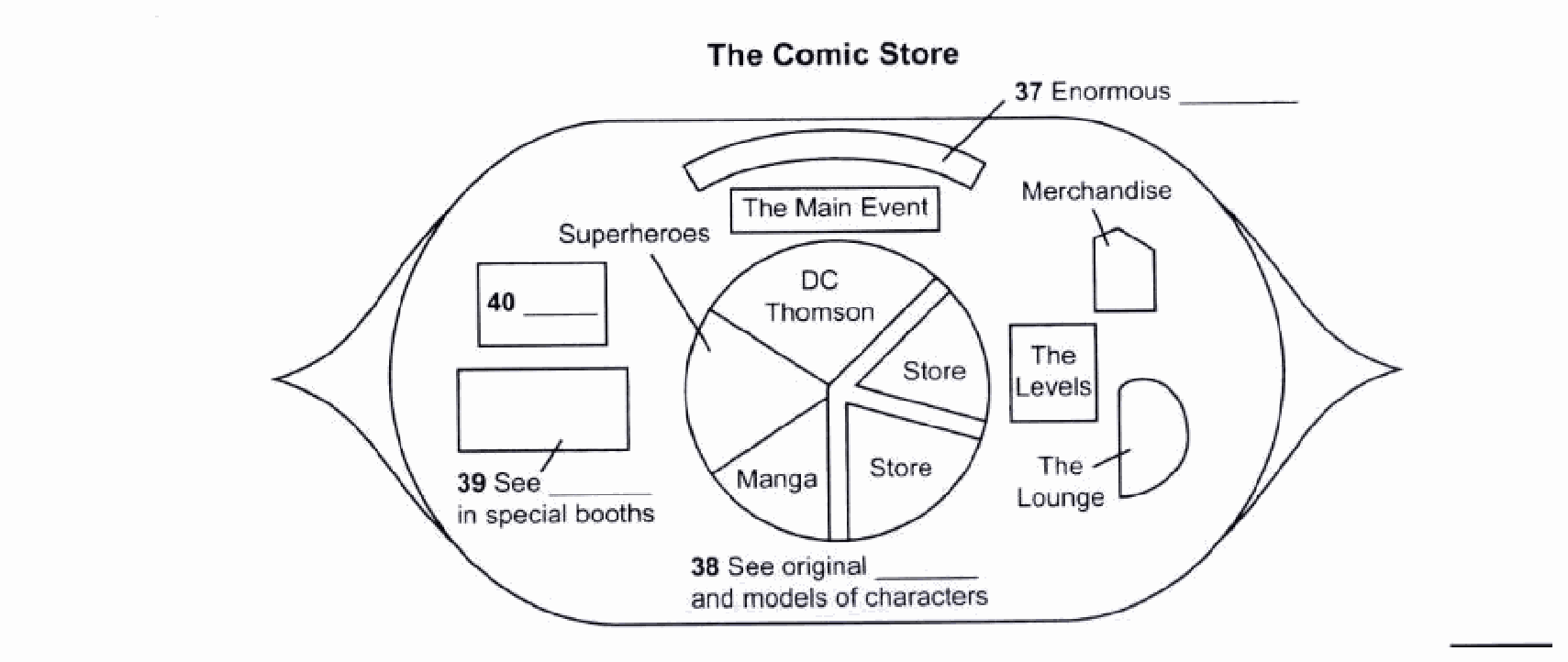
The Comic Store
Enormous (37) …………………………
See original (38) ………………………… and models of characters
See (39) ………………………… in special booths
(40) …………………………
Answers
1. B
2. E
3. C
4. D
5. G
6. D
7. A
8. Not Given
9. False
10. Not Given
11. True
12. False
13. True
14. True
15. 10
16. personal
17. emotions
18. finish
19. questions
20. check
21. replacement
22. size
23. ventilation
24. chemicals
25. visibility
26. lacerations
27. slips
28. C
29. B
30. D
31. B
32. A
33. Some of them have been shown in other cities.
34. to show the shop had a wider focus than its earlier name suggested.
35. The people who built it were helped by the use of computer design.
36. Many of them have creative backgrounds.
37. screen
38. comics
39. videos
40. Make-believe
Explanations
- 1. B
- Section B lists the affected batch numbers (Goodnight Formula3, Healthfast Diet Support tablets, Anti-stress Formula) — i.e. the exact products being recalled.Common trap: None significant — the batch table is the only place the exact affected products are listed.
- 2. E
- Section E (Refunds) states the manufacturer will provide a refund for any unopened item and will be inspecting returned products to monitor the situation.Common trap: Section D also discusses returning products, but only Section E describes what happens to products once they come back (refund + inspection).
- 3. C
- Section C gives the dedicated hotline number and mentions that retailers can also be asked, for customers with queries or a worn-off batch number.Common trap: None significant — the contact details are only given in Section C.
- 4. D
- Section D urges customers to return affected products immediately, whether opened or not, either to the point of purchase or via post to head office.Common trap: Section E is about refunds for unopened items specifically, but the instruction on what a customer should actually do with an unused product (return it) is given in Section D.
- 5. G
- Section G offers a reward of up to $20,000 for information leading to a conviction of whoever tampered with the products.Common trap: None significant — the reward is only mentioned in Section G.
- 6. D
- Section D states the products are available nationwide, though faulty reports have come specifically from the Sussex Cove area.Common trap: A reader might expect the answer in Section A (which describes the problem) rather than Section D, but the sales area is only specified in Section D.
- 7. A
- Section A explains that foreign material — sawdust, paint chips and metal shavings — has been found in the products, which is the reason for the recall.Common trap: None significant — the reason for the recall is only given in Section A.
- 8. Not Given
- The passage says buses and trains 'can be expensive', but never compares the two fares to each other, so it is impossible to say whether they cost the same amount.Common trap: The statement invites a reader to assume a comparison is being made because both are called 'expensive', but no direct fare comparison is ever given.
- 9. False
- The passage directly states that the base rate does not generally include car insurance, which contradicts the statement.Common trap: The general mention of 'savings' on hire cars nearby could tempt a reader into assuming insurance is included, but the text explicitly says the opposite.
- 10. Not Given
- The example given (Halifax to Montreal) involves two cities, but the passage never states that such deals are restricted to major cities only.Common trap: The example route between two named cities could tempt a reader into inferring a 'major cities only' restriction that the text never actually states.
- 11. True
- The passage states that an online search will reveal such opportunities but 'not often far in advance', meaning they tend to appear close to departure time.Common trap: None significant — the answer is directly stated.
- 12. False
- The passage advises renting gear outside national parks for more budget-friendly options, meaning national parks are not the cheapest option.Common trap: A reader might assume national parks, being the site of the activities, would also be the cheapest place to rent gear, but the passage explicitly recommends renting outside them instead.
- 13. True
- The passage states some larger supermarket chains will even heat up prepared food for customers in the deli section.Common trap: None significant — the answer is directly stated.
- 14. True
- The passage states that most city parks and campsites have barbecue grills that anyone can use.Common trap: None significant — the answer is directly stated.
- 15. 10
- The passage states unhappy customers 'will instead make it known to approximately ten people, as well as possibly complaining online.'Common trap: None significant — the number is directly stated.
- 16. personal
- The passage advises staff not to 'turn it into a personal matter; just address the issue at hand.'Common trap: None significant — the answer is directly stated.
- 17. emotions
- The passage instructs staff to 'keep your own emotions in check' when a customer becomes agitated.Common trap: None significant — the answer is directly stated.
- 18. finish
- The passage instructs staff to 'let them finish' when listening to a customer.Common trap: None significant — the answer is directly stated.
- 19. questions
- The passage states that the best way to show interest in what happened is to ask questions.Common trap: None significant — the answer is directly stated.
- 20. check
- The passage instructs staff to 'check with them that you have a clear picture of why they are complaining' before offering a solution.Common trap: None significant — the answer is directly stated.
- 21. replacement
- The passage states that if an item is unopened or faulty, staff can 'give them a replacement' with 'no need to have this approved by a manager.'Common trap: A refund also requires no immediate customer-facing decision, but the passage specifically says refunds (unlike replacements) 'need to have this processed by management.'
- 22. size
- The passage states employers must 'provide safety gear of an appropriate size for each worker.'Common trap: None significant — the answer is directly stated.
- 23. ventilation
- The passage states hard hats and helmets are 'available with built-in ventilation for those working underground or in tight spaces.'Common trap: None significant — the answer is directly stated.
- 24. chemicals
- The passage states eye protection should be worn 'in an area where hazardous chemicals are used or kept.'Common trap: Smoke and extreme winds are also mentioned as reasons for eye protection, but the question specifically asks about a dangerous substance, which matches 'chemicals'.
- 25. visibility
- The passage states reflective safety vests 'are used to ensure high visibility on site.'Common trap: None significant — the answer is directly stated.
- 26. lacerations
- The passage identifies lacerations as 'the most common hazard' to hands, with temperature extremes/burns listed as an additional, less common, danger.Common trap: A reader might expect the more frequent hazard to be burns because it is mentioned second and described vividly, but the passage explicitly names lacerations as 'the most common hazard'.
- 27. slips
- The passage states rubber soles are advised because 'many accidents happen due to slips.'Common trap: None significant — the answer is directly stated.
- 28. C
- The Outdoor Terrace offers 'a pleasant outlook over some of the city's points of interest such as the Cathedral or City Walls' — i.e. views of Canterbury's landmarks.Common trap: None significant — the Outdoor Terrace is the only area explicitly linked to city landmark views.
- 29. B
- The Main Event 'is a venue for private events, workshops and presentations', making it bookable for large gatherings.Common trap: The Hive can also be booked privately, but the passage only describes it being subdivided into several smaller rooms, not hosting large parties, which fits The Main Event's role as a venue for private events instead.
- 30. D
- The Hive 'is a flexible space with a moveable air wall that means it can be subdivided into several rooms.'Common trap: None significant — The Hive is the only area described as adjustable into smaller spaces.
- 31. B
- The Main Event 'is sometimes open late to the public for experiences such as The Comic Sleepover', where visitors watch classic cartoons — a film event outside normal hours.Common trap: None significant — The Main Event is the only area described as hosting late-night film screenings.
- 32. A
- The Exterior's design 'took inspiration ... from the renowned artist Roy Lichtenstein's eye images', and its appearance 'has been compared to that of an eye watching the sky.'Common trap: None significant — only the Exterior is described as being shaped like a body part (an eye).
- 33. Some of them have been shown in other cities.
- The passage states the store 'has held many successful temporary exhibitions, some of which have since toured across Europe and internationally' — i.e. some exhibitions have been shown in other cities.Common trap: Option C confuses the founder's donation of his own artwork (mentioned in the same opening section) with the separate claim about temporary exhibitions touring internationally.
- 34. to show the shop had a wider focus than its earlier name suggested.
- The passage states the new name 'was brought in to reflect the shop's move beyond single pieces of art to a wider range of comic-based media and artefacts.'Common trap: Option C wrongly assumes a name change implies a management change; the passage attributes the explanation to the curator at the time, not to any change of management.
- 35. The people who built it were helped by the use of computer design.
- The passage states computer modelling 'translated a three-dimensional shape into a geometric language that the project's engineers and builders could understand', giving 'precise three-dimensional instructions' and ultimately 'a perfect fit when it was finally assembled.'Common trap: Option D wrongly reverses the outcome: the passage says computer modelling overcame the design's initial challenges, resulting in 'a perfect fit', not ongoing difficulty.
- 36. Many of them have creative backgrounds.
- The passage states most, if not all, of the more than 50 employees 'have experience and training in design, visual art and/or writing' — i.e. creative backgrounds.Common trap: Option A confuses the separately-mentioned volunteers with the paid staff; the passage keeps the two groups distinct ('In addition, there are many volunteers...').
- 37. screen
- The passage describes The Main Event as having 'an IMAX screen that is one of the largest in the UK' — an enormous screen.Common trap: None significant — the screen is the only enormous fixture described in The Main Event.
- 38. comics
- The Superheroes Save the Day exhibition displays models of superheroes as well as 'the chance to see authentic comics dating back to the 1930's.'Common trap: The DC Thomson exhibition next door also displays comic-related material (The Beano, The Dandy), but it is the Superheroes exhibition that is specifically described as showing original/authentic comics alongside character models.
- 39. videos
- The DC Thomson exhibition lets visitors 'go to dedicated kiosks to watch videos' if they want to see more.Common trap: 'Photos' and 'cartoons' are mentioned in the same sentence, but they are viewed on general display, not specifically in the dedicated kiosks/booths, which are for videos.
- 40. Make-believe
- The Make-believe exhibition 'showcases items from lands of fantasy, such as a replica of Gandalf the Wizard's staff ... one of the dragon models from Harry Potter and maps from Star Trek.'Common trap: The Levels (gaming history) is another unlabelled second-floor exhibit mentioned nearby, but only the Make-believe exhibition matches this blank on the map.
Comments
Loading comments…