

IELTS Trainer 2 General Training Reading Test 6
3 passages · 40 questions · 60 minutes
What's on? Sydney's Night Noodle Markets / Tips for managing your time
[[READ: 1–7]] ## What's on? Sydney's Night Noodle Markets
The Night Noodle Markets are returning to Hyde Park, serving up the best street food Sydney has to offer. You'll see old favourites as well as new contenders, and while the focus is still firmly on Asian cuisine, European and South American delicacies also feature.
The usual suspects are back this year, with stalls such as Hoy Pinoy and Mr Bao promising to deliver the delicious fare the city has come to look forward to. Black Star Pastry is also back, by popular demand.
As usual, there will be no shortage of noodle options. Don't miss Taiwanese Noodle House and its brisket noodle soup.
But the market does a lot more than noodles; the much-loved Indu restaurant has a stall serving the South Indian dosa, a crisp pancake. Join the queue for a dosa filled with goat meat and pomegranate or, if you don't eat meat, try the eggplant with bitter melon.
More than just food
The market space called Hyde Park Palms offers plenty of entertainment, from popular DJs to family-friendly live music. Illuminated dragons roam throughout the market until 10 p.m. Check the Noodle Market website for details of the line-up.
Tips:
Come early – the later you arrive, the longer the lines and the more chance of a stall running out of your first choice of dish. Stalls are well-stocked this year, but demand is high for the favourites, so don't be disappointed. The lines for the most popular stalls such as Hoy Pinoy and Indu can be long, but worth the wait.
Beanbags and chairs around tables are the only seating options provided and they can be hard to come by at this busy event – consider bringing your own rug.
If the weather looks suspect, check our website before heading out. As a rule, the market will go ahead unless it is pouring with rain.
It's a cash-free event, so bring your plastic. Put it on your card and don't worry about counting out change.
[[READ: 8–14]] ## Tips for managing your time
[A] To see how you currently manage your time, it's useful to keep a log of everything you do. Start by writing down what you do every 30-minutes for a week – you may be surprised at what you see. Ask yourself when you are the most productive, what you devote most of your time to and how long your routine activities take.
[B] Make a list of everything you need to do. Include everything, large and small, and add to it as you go. At this stage, it isn't necessary to assign priorities and times; just capture your ideas before you forget them.
[C] A long list of things to do is just the first step. Once you've made your list, it's time to prioritise tasks. Put them in order of urgency and how much value it will bring you to have them done. Then you will be better able to allocate the right amount of time to each task.
[D] Remember that scheduling is not only writing down what you have to do, it is also making time for the things you want to do. You should make room for family and friends or pursuing creative interests and sport, just as you would for chores and work / study responsibilities.
[E] Look back at your log and reflect on the times you are most productive – and then schedule your tasks according to their priority and your energy levels.
[F] While using a conventional list on paper might be a good way to get started, you might find software is more helpful. You can get apps to send you reminders, merge your calendar with those of colleagues, as well as helping you delete and prioritise tasks.
[G] Most people find that disorganisation results in poor time management. Clear your home and workspace of clutter that is draining your energy and diverting your concentration. Many people find it useful to have three piles: Keep, Give away and Throw in the rubbish. When a task has been dealt with, file it (either physically or digitally) somewhere you can easily find it again.
Questions 1–7
Do the following statements agree with the information given in the passage?
TRUEif the statement agrees with the information
FALSEif the statement contradicts the information
NOT GIVENif there is no information on this
1. The market specialises in food cooked in an Asian style.
2. This is the first time Black Star Pastry is taking part in the festival.
3. The vegetarian option from Indu is more popular than the meat option.
4. The entertainment starts early in the evening.
5. Hoy Pinoy is one of the busiest stalls at the market.
6. The festival supplies rugs for people to sit on.
7. Stalls at the night market can process payments made by card.
Questions 8–14
The reading text above has seven sections, A–G. Which section mentions the following?
8. why it might be better to use technology
9. how to keep a record of the ways you spend your time
10. why you should mark things in order of importance on your list
11. how to get rid of things that distract you
12. what types of activities you need to plan
13. how to decide when to do a task
14. what to do with work you have completed
Social Media Policy for employees
[[READ: 15–21]] ## Starting a new business: points to consider
Starting a business can mean a huge change in lifestyle and also a large financial commitment. However, it is possible to be ready for this if you are well prepared from the start. We've put together some tips to help you:
Evaluate your idea
You may believe you have a great idea, but you need to ask yourself if the present market demands it; gather and analyse information to establish the feasibility of your business.
Make a plan
Doing this will mean that you clarify goals for the business and what you will do to achieve them. Always be generous in your costing to allow for unforeseen circumstances; it's safest to consider the worst-case scenario.
Business models
You need to select the business structure that is most suitable for your purposes. Take professional advice if you are unsure. Here are some examples:
• sole trader – an individual trading on their own • partnership – a number of people or entities running a business together • company – a legal entity that is separate from its owners
Analyse yourself
Operating a business is not just about being self-employed. There are many questions to ask yourself in order to be sure that running a business is the best option for you, and you need to be honest with yourself from the beginning.
• Why do you want to have your own business? • Do you have the right temperament to deal with challenges and possible setbacks? • Do you have management skills and expertise in the industry? • What are your personal strengths, and, on the flipside, what weaknesses may you need to overcome?
What if...?
You need to consider potential problems before they occur.
• Do you need to have your product patented? You don't want anyone stealing your invention. If it's a new product or process, speak to a patent attorney to make sure your idea is protected. • Who will run the business when you can't? Many small business owners want to do everything themselves, but eventually everyone needs to take holidays and family demands may take them away from the business. Do you have good staff you can trust to keep the business going in your absence? • Will your business be able to withstand emergencies? Check you have insurance that covers you and your business for anything that could possibly go wrong, from theft, to natural disaster, to ill health.
[[READ: 22–27]] ## Hay and Walford Ltd: Social Media Policy for employees
Here at Hay and Walford Ltd, we acknowledge the role social media plays in shaping our public image and the image our clients and associates have of us.
Whether on our official company accounts or workers' individual social media accounts, we encourage all employees to bear in mind that they represent the firm and comments remain on the internet long after they were first made.
Company social media accounts
You do not know the influence a throwaway remark may have. For this reason, please refrain from commenting on any litigation that the company is involved in.
Similarly, anything that is labelled 'for internal use only' is not to be shared in full or in part on social media.
Messages from the CEO are automatically confidential and should not be mentioned in social media posts.
The company's finances are especially sensitive information and must not be shared, commented on or speculated on at all.
If you make an error of fact or wish to review your professional opinion, please take immediate steps to make corrections or delete the post.
Bear in mind that we are bound by regulations relating to copyright. As such, do not share the work of other people or companies without correctly acknowledging them as creators.
To be on the safe side, if you are in any doubt as to whether to put something on our social media accounts, please do not post in the first instance and seek advice from one of the team in Communications about whether the information is sensitive or unsuitable from the company's point of view.
Individual accounts
Even via private accounts, employees can be associated with the company.
If you wish to mention the company but are not an official spokesperson for Hay and Walford Ltd, make it clear what your position in the company is.
Whether discussing company business or not, be aware that comments made by employees that contradict our values of equality and decency can reflect badly on the company. We ask that you always treat other users of social media with respect, whatever the situation.
To the extent that your image on social media is public, it needs to be in line with the professional image that you, and Hay and Walford Ltd, wish to present.
Questions 15–21
Complete the sentences below. Write ONE WORD ONLY from the text for each answer.
15. Before investing in a new business, do research about its ………………………… in the current market.
16. Making a business plan will help you be clear about your ………………………….
17. Choose the ………………………… which best matches how you want to run your business.
18. In terms of your personality, ask yourself if your ………………………… allows you to manage difficult situations.
19. Be aware of any ………………………… you have, as well as the skills and qualities you possess.
20. You may need to look into ways of ensuring the ………………………… of your business idea.
21. You should make sure your plan includes ………………………… to safeguard against problems in future.
Questions 22–27
Complete the notes below. Choose ONE WORD ONLY from the text for each answer.
Hay and Walford's official social media accounts
Never post about:
• (22) ………………………… that is currently taking place.
• matters marked 'for internal use only'.
• anything that relates to the company's (23) ………………………….
• Correct / delete any misinformation immediately.
• Observe the (24) ………………………… of other brands and individuals.
• Consult (25) ………………………… if unsure about appropriacy of post.
Employees' private accounts
If discussing the company:
• must state your role unless you are a company (26) ………………………….
If not discussing company:
• still need to show (27) ………………………….
• Ensure private accounts are consistent with professional image.
The history of kites
[A] The fighter kite is an ancient design that became popular in Asia. While there were some variations, fighter kites tended to be small, flat and diamond-shaped and were flown throughout Asia, including in Japan and India. The main part of this kite was made of paper, while its spine consisted of a piece of tapered bamboo. There was also a rounded, balanced bow. These kites did not have tails, which were thought to affect their manoeuvrability. Most of the line was made of cotton but part of this was covered with an abrasive, which could cut an opponent's line in a competition.
European kites developed later, possibly crafted out of flags. Nowadays there are eight main kinds of kite worldwide: the flat, bowed, box, sled, delta and compound, all of which have frames, and now the parafoil which is somewhat like a parachute, and the rotor which has a spinning vane between two cylinders. Perhaps most significantly, the materials used to build kites remained basically unchanged for hundreds of years, but today the materials that comprise the various components of kites are often synthetic.
[B] In Europe, kites were curiosities at first rather than being part of the culture, but they were soon used as vehicles for discovery and innovation. In 1893, William A Eddy introduced a tailless kite that was in the shape of an elongated diamond. He was interested in the potential kites had for the purposes of meteorology and aerial photography. Besides being responsible for a renewed interest in kite-flying throughout Europe, Eddy's kite was also utilised by the United States Weather Bureau.
In 1752, the American inventor and statesman Benjamin Franklin went out in a thunderstorm with his son to fly a flat kite with a pointed wire. They attached a metal key to the kite's line and watched as it became electrified, both miraculously avoiding electrocution. This proved that lightning was a natural occurrence called electricity, and this experiment led to Franklin inventing the lightning rod, a metallic rod that protects a structure from lightning damage by guiding currents from lightning flashes into the ground.
[C] Kites also contributed greatly to the development of the airplane. The first recorded aircraft with a person inside was British aviator Sir George Cayley's glider in 1853. He used modified kites to test whether his glider idea would work. This was a big step in aviation, as it dispelled the former assumption that an aircraft would need wings that flapped like a bird's.
Around 1900 Orville and Wilbur Wright started using kites to test their ideas for planes. These brothers ran a bicycle shop in Ohio in the United States and were obsessed with aviation. It was the Wright brothers who concentrated on how to control the aircraft, something that had, until then, baffled many other inventors. The Wright brothers made a box kite that was wired in a way that meant the kite could be made to turn. Not long after that, they successfully flew the first manned airplane. Without experiments with kites, modern aircraft would have taken much longer to be developed.
[D] Whatever the design of a kite, in order to fly, it needs to have certain characteristics. Firstly, it needs to be able to lift in the wind and this requires an aerodynamic structure. It also needs to have something that stops it from flying away; this is called a tether. One end of the tether is connected to the kite and the other is usually on a hand-held spool for a person to manage the length of the line. Another necessary component is the bridle, which is two or more lines that are attached to each other at a point and this can be adjusted according to the strength and direction of the wind.
[E] There are three forces that control kite flight; these are lift, gravity and drag. If the wind is stronger than the resistance of the air (drag) and the pull of gravity, the kite should be able to fly. One way in which a kite differs from a plane is that when the kite is fixed (using the tether) so that the wind gives it lift, it maintains what is called 'perpetual stall'. This is essential for a kite to fly but would not be a suitable design for an aeroplane. If a kite is flat, it should have a tail to provide drag so that the nose of the kite is pointing upwards.
Although many people try it, running with a kite is not an effective way to send it into the sky. It is better to start off with two people, one holding the kite and the other with the line unravelled about 30 metres, holding the reel or spool. The bridle of the kite should be facing the person who is not holding it and the breeze should come from behind the kite. If all this has been done, the kite should be launched successfully when the person holding it lets go of it.
Questions 28–32
Choose the correct heading for each paragraph from the list of headings below.
List of Headings:
i. Using kites for scientific research
ii. Types of kite
iii. Factors that determine whether a kite will fly
iv. The beginning of manned flight
v. The popularity of kites throughout the years
vi. Basic features shared by all kites
28. Paragraph A:
29. Paragraph B:
30. Paragraph C:
31. Paragraph D:
32. Paragraph E:
Questions 33–36
Label the diagram below. Choose ONE WORD ONLY from the text for each answer.
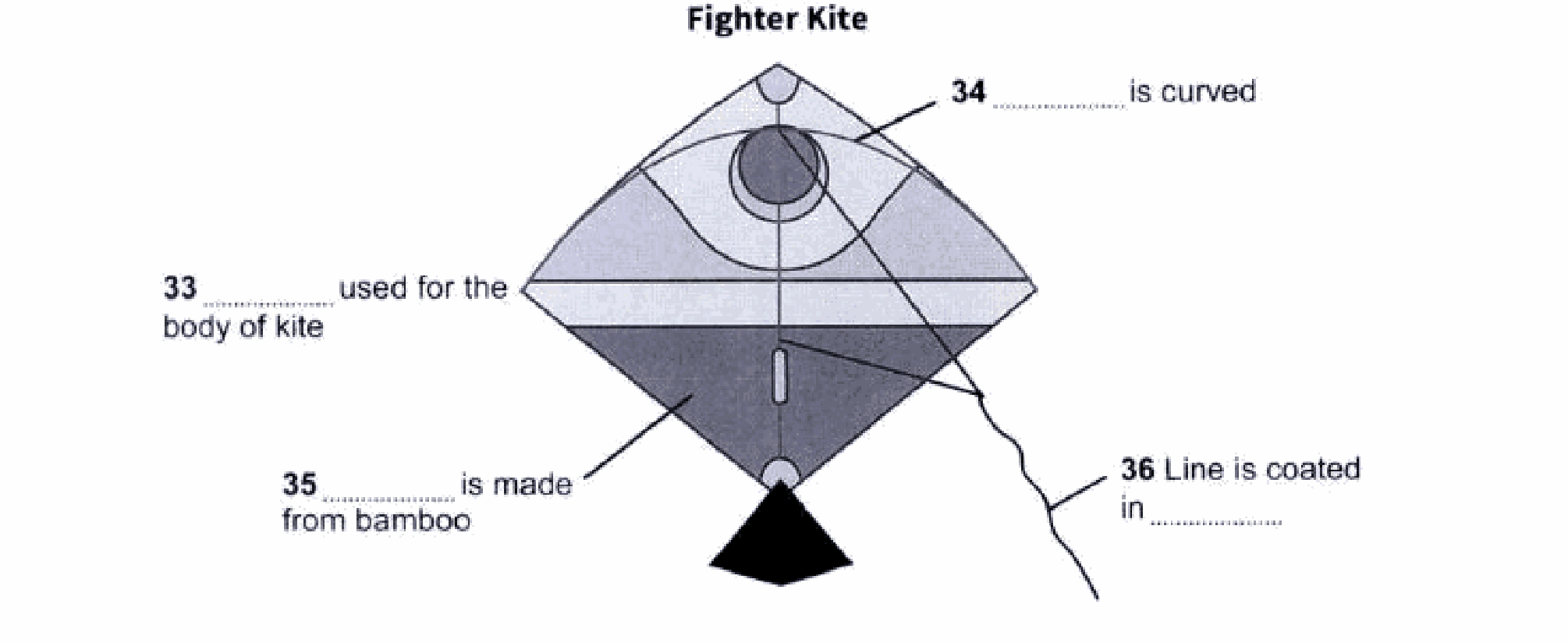
Fighter Kite
• (33) ………………………… used for the body of kite.
• (34) ………………………… is curved.
• (35) ………………………… is made from bamboo.
• Line is coated in (36) ………………………….
Questions 37–40
Choose the correct letter.
37. What is the main difference between kites in the past and modern kites?
A Their parts are made from different substances.
B Modern kites tend to be larger.
C Kites in the past were less sturdy.
D They are used for different purposes.
38. Benjamin Franklin's experience flying a kite in a storm
A led to a useful innovation.
B proved it was not a dangerous thing to do.
C showed that his son's theory was correct.
D was a successful use of a new kind of kite.
39. The Wright Brothers differed from other early aviation engineers in that they
A used kites as models for real planes.
B worked on how to determine the direction of a kite.
C applied what they had learned in their bicycle business to flying.
D made an important discovery by accident.
40. The best way to send a kite into the air is to
A hold the kite and run along with it.
B ensure that the wind blows underneath the kite.
C release the kite at a distance from a person holding the string.
D let the kite fly from a person's hand as it is given more string.
Answers
1. True
2. False
3. Not Given
4. Not Given
5. True
6. False
7. True
8. F
9. A
10. C
11. G
12. D
13. E
14. G
15. feasibility
16. goals
17. structure
18. temperament
19. weaknesses
20. protection
21. insurance
22. litigation
23. finances
24. copyright
25. Communications
26. spokesperson
27. respect
28. ii
29. i
30. iv
31. iii
32. vi
33. Paper
34. Bow
35. Spine
36. abrasive
37. Their parts are made from different substances.
38. led to a useful innovation.
39. worked on how to determine the direction of a kite.
40. release the kite at a distance from a person holding the string.
Explanations
- 1. True
- The passage states that 'while the focus is still firmly on Asian cuisine, European and South American delicacies also feature' — confirming the market's focus is on Asian-style food. Paraphrase: 'specialises in food cooked in an Asian style' = 'the focus is still firmly on Asian cuisine'.Common trap: None significant — the answer is directly stated.
- 2. False
- The passage states 'Black Star Pastry is also back, by popular demand' — 'back' and 'by popular demand' both show the stall has taken part before, contradicting the claim that this is its first time.Common trap: None significant — the answer is directly contradicted.
- 3. Not Given
- The passage mentions both the meat-filled dosa and the eggplant option for non-meat-eaters, but never compares their relative popularity.Common trap: Both options are mentioned side by side, which could tempt a reader into assuming a popularity comparison the passage never makes.
- 4. Not Given
- The passage only states when the illuminated dragons stop ('until 10 p.m.') — it never says what time the entertainment begins.Common trap: The mention of a specific time (10 p.m.) could tempt a reader into assuming a start time is also given, but only the end time is stated.
- 5. True
- The passage states 'the lines for the most popular stalls such as Hoy Pinoy and Indu can be long' — confirming Hoy Pinoy is among the busiest/most popular stalls.Common trap: None significant — the answer is directly stated.
- 6. False
- The passage states seating is limited to beanbags and chairs and advises visitors to 'consider bringing your own rug' — meaning the festival does not supply rugs.Common trap: 'Beanbags and chairs around tables are the only seating options provided' could tempt a reader into overlooking that rugs are explicitly not among the provided options.
- 7. True
- The passage states 'It's a cash-free event, so bring your plastic' — 'plastic' meaning a payment card — confirming stalls accept card payments.Common trap: None significant — the answer is directly stated.
- 8. F
- Section F recommends that using software 'might be a good way' to manage tasks more effectively than a paper list — technology (apps) is presented as a better option. Paraphrase: 'why it might be better to use technology' = 'you might find software is more helpful'.Common trap: None significant — the answer is directly stated.
- 9. A
- Section A advises keeping a log of everything you do, recorded every 30 minutes — a record of how time is spent. Paraphrase: 'keep a record of the ways you spend your time' = 'keep a log of everything you do'.Common trap: None significant — the answer is directly stated.
- 10. C
- Section C explains that prioritising tasks by urgency and value allows you to 'allocate the right amount of time to each task' — the reason for ordering tasks by importance. Paraphrase: 'mark things in order of importance' = 'prioritise tasks. Put them in order of urgency and how much value it will bring'.Common trap: None significant — the answer is directly stated.
- 11. G
- Section G advises clearing clutter 'that is draining your energy and diverting your concentration' — removing distracting things. Paraphrase: 'get rid of things that distract you' = 'Clear your home and workspace of clutter'.Common trap: None significant — the answer is directly stated.
- 12. D
- Section D lists the types of activity to schedule: chores and work/study responsibilities as well as time for 'family and friends or pursuing creative interests and sport'. Paraphrase: 'what types of activities you need to plan' = the list of activity categories in section D.Common trap: None significant — the answer is directly stated.
- 13. E
- Section E advises scheduling tasks 'according to their priority and your energy levels', based on reflecting on when you are most productive — how to decide the timing of a task. Paraphrase: 'how to decide when to do a task' = 'schedule your tasks according to their priority and your energy levels'.Common trap: None significant — the answer is directly stated.
- 14. G
- Section G advises that once 'a task has been dealt with', it should be filed 'somewhere you can easily find it again' — what to do with finished work. Paraphrase: 'work you have completed' = 'a task has been dealt with'.Common trap: Section G is the correct answer for two different questions (11 and 14) — the note explicitly allows a letter to be used more than once.
- 15. feasibility
- The passage advises to 'gather and analyse information to establish the feasibility of your business' — researching whether the market demands it. The missing word is 'feasibility'.Common trap: None significant — the answer is directly stated.
- 16. goals
- The passage states that making a plan 'will mean that you clarify goals for the business'. The missing word is 'goals'.Common trap: None significant — the answer is directly stated.
- 17. structure
- The passage advises to 'select the business structure that is most suitable for your purposes'. The missing word is 'structure'.Common trap: None significant — the answer is directly stated.
- 18. temperament
- The passage asks 'Do you have the right temperament to deal with challenges and possible setbacks?'. The missing word is 'temperament'.Common trap: None significant — the answer is directly stated.
- 19. weaknesses
- The passage asks about personal strengths and, 'on the flipside, what weaknesses may you need to overcome'. The missing word is 'weaknesses'.Common trap: None significant — the answer is directly stated.
- 20. protection
- The passage advises speaking to a patent attorney 'to make sure your idea is protected' — i.e. ensuring its protection. Paraphrase: 'ensuring the protection' = 'to make sure your idea is protected'.Common trap: None significant — the answer is directly stated.
- 21. insurance
- The passage advises to 'Check you have insurance that covers you and your business for anything that could possibly go wrong' — insurance as a safeguard against future problems. The missing word is 'insurance'.Common trap: None significant — the answer is directly stated.
- 22. litigation
- The policy states employees should 'refrain from commenting on any litigation that the company is involved in'. The missing word is 'litigation'.Common trap: None significant — the answer is directly stated.
- 23. finances
- The policy states 'The company's finances are especially sensitive information and must not be shared, commented on or speculated on at all'. The missing word is 'finances'.Common trap: None significant — the answer is directly stated.
- 24. copyright
- The policy states 'we are bound by regulations relating to copyright' and that the work of others must be acknowledged. The missing word is 'copyright'.Common trap: None significant — the answer is directly stated.
- 25. Communications
- The policy advises employees in doubt to 'seek advice from one of the team in Communications'. The missing word is 'Communications'.Common trap: None significant — the answer is directly stated.
- 26. spokesperson
- The policy states that if you mention the company but are not an official spokesperson, you must 'make it clear what your position in the company is'. The missing word is 'spokesperson'.Common trap: None significant — the answer is directly stated.
- 27. respect
- The policy states employees should 'always treat other users of social media with respect, whatever the situation' — even when not discussing the company. The missing word is 'respect'.Common trap: None significant — the answer is directly stated.
- 28. ii
- Paragraph A describes the fighter kite in detail and then lists the eight main kinds of kite worldwide (flat, bowed, box, sled, delta, compound, parafoil, rotor) — a survey of kite types. Paraphrase: 'Types of kite' = the description of the fighter kite plus 'eight main kinds of kite worldwide'.Common trap: The closing sentence about materials changing over time could tempt a reader toward heading v ('popularity ... throughout the years'), but the paragraph's main content is the classification of kite types, not popularity.
- 29. i
- Paragraph B describes Eddy's interest in kites 'for the purposes of meteorology and aerial photography' and Franklin's experiment that proved lightning was electricity — both uses of kites for scientific research. Paraphrase: 'scientific research' = 'meteorology and aerial photography' / the electricity experiment.Common trap: None significant — both examples in the paragraph are clearly scientific investigations.
- 30. iv
- Paragraph C describes Cayley's early glider, then the Wright brothers, who 'successfully flew the first manned airplane' — the beginning of manned flight. Paraphrase: 'the beginning of manned flight' = 'the first recorded aircraft with a person inside' and 'the first manned airplane'.Common trap: None significant — the paragraph is explicitly framed around milestones in manned flight.
- 31. iii
- Paragraph D opens by stating a kite 'needs to have certain characteristics' in order to fly, then lists them (aerodynamic structure, tether, bridle) — factors that determine whether a kite will fly. Paraphrase: 'Factors that determine whether a kite will fly' = 'certain characteristics' needed 'in order to fly'.Common trap: None significant — the paragraph's opening sentence directly matches the heading.
- 32. vi
- Paragraph E explains the three universal forces controlling kite flight (lift, gravity, drag) and the general method for launching any kite — basic features and principles shared by all kites, not any one design. Paraphrase: 'Basic features shared by all kites' = 'three forces that control kite flight' plus the general launching method.Common trap: The heading could be confused with iii ('Factors that determine whether a kite will fly'), but paragraph D covers the structural requirements while paragraph E covers the universal physical forces and launch technique — features common to all kites.
- 33. Paper
- The passage states 'The main part of this kite was made of paper' — the material used for the body of the kite. The missing word is 'Paper'.Common trap: None significant — the answer is directly stated.
- 34. Bow
- The passage states 'There was also a rounded, balanced bow' — the curved part of the kite. The missing word is 'Bow'.Common trap: None significant — the answer is directly stated.
- 35. Spine
- The passage states the kite's 'spine consisted of a piece of tapered bamboo'. The missing word is 'Spine'.Common trap: None significant — the answer is directly stated.
- 36. abrasive
- The passage states part of the line 'was covered with an abrasive, which could cut an opponent's line in a competition'. The missing word is 'abrasive'.Common trap: None significant — the answer is directly stated.
- 37. Their parts are made from different substances.
- The passage states 'the materials used to build kites remained basically unchanged for hundreds of years, but today the materials that comprise the various components of kites are often synthetic' — a change in the substances kites are made from. Paraphrase: 'made from different substances' = 'materials ... are often synthetic' now, versus unchanged materials for 'hundreds of years'.Common trap: None significant — the passage explicitly flags this as the most significant difference.
- 38. led to a useful innovation.
- The passage states the experiment 'led to Franklin inventing the lightning rod, a metallic rod that protects a structure from lightning damage' — a useful invention resulting from the kite flight. Paraphrase: 'led to a useful innovation' = 'led to Franklin inventing the lightning rod'.Common trap: 'both miraculously avoiding electrocution' could tempt a reader toward option B (that it wasn't dangerous), but 'miraculously' signals real danger was involved, not safety.
- 39. worked on how to determine the direction of a kite.
- The passage states 'It was the Wright brothers who concentrated on how to control the aircraft, something that had, until then, baffled many other inventors', achieved via a box kite 'wired in a way that meant the kite could be made to turn'. Paraphrase: 'worked on how to determine the direction of a kite' = 'concentrated on how to control the aircraft' by making the kite 'turn'.Common trap: Option A (using kites as plane models) describes what Cayley also did, which could tempt a reader who misses that the passage frames control/direction, not kite-testing itself, as the Wright brothers' distinguishing achievement.
- 40. release the kite at a distance from a person holding the string.
- The passage recommends two people: one holding the kite, the other with the line unravelled about 30 metres away holding the spool, and the kite 'should be launched successfully when the person holding it lets go of it' — releasing the kite at a distance from the person managing the line. Paraphrase: 'release the kite at a distance from a person holding the string' = the kite-holder lets go while the line-holder is 30 metres away.Common trap: Option A is the passage's own explicitly rejected method ('running with a kite is not an effective way'), a direct distractor for anyone skimming.
Comments
Loading comments…