

Collins IELTS 2 Academic Reading Test 4
3 passages · 40 questions · 60 minutes
Meteor Strikes
On 15 February 2013, just after dawn, the sleepy Russian city of Chelyabinsk was woken by the biggest meteor strike on Earth in over 100 years. Several people videoed the meteor as it crashed through Earth's atmosphere, passing close above the city and giving scientists vital clues as to where it had come from and how it had travelled to Earth. To the people of Chelyabinsk, the meteor shone 30 times brighter than the sun and had 20-30 times more energy than the atomic bomb dropped on Hiroshima. The meteor did not hit the ground, but due to its enormous speed exploded 29.7 kilometres above the ground, producing a bright flash, a cloud of hot dust and gas, many smaller fragments of meteor and a powerful shockwave. The latter was so strong that it knocked people off their feet and blew out the windows of homes, shops and factories. 1,500 people went to hospital with injuries indirectly caused by the strike, but matters could have been far worse if the meteor had made contact with the Earth.
The meteor was not an uncommon rock. From studying videos of the meteor's flight, scientists have concluded that it originated in the asteroid belt located between the orbits of Mars and Jupiter. At the time it entered Earth's atmosphere, it weighed between 12,000 and 13,000 metric tonnes and was 10 metres in diameter. It crashed through the upper atmosphere at around 19 kilometres a second - above 50 times the speed of sound, fracturing at an altitude of between 45 and 50 kilometres. Such events happen on average every 10 or so years, mainly over oceans or unpopulated areas. This time the strike was over a city and observed by many people, reminding us how common these occurrences are.
A meteor strike has several phases. Moving through space, a meteor's temperature can be around -100°C. It travels around 5 kilometres per second until Earth's gravity accelerates it to 17 kilometres a second. It begins to encounter the atmosphere 140 kilometres above the Earth but there is little air resistance until about three seconds later, when it reaches 100 kilometres above the ground. At this point the air becomes dense, causing the meteor to glow as the material on its surface melts. The mix of burning gas and dust creates a fireball as the meteor loses 3 to 6 millimetres of surface mass per second as it is heated to over 1,800°C. The rate of loss of material through heat is so rapid that the core temperature of the meteor is still very low while at the same time a tail of vaporised dust and gas becomes visible. These tails can often be seen for up to 45 minutes and may be followed by a sonic boom as the meteor crashes through the sound barrier. During its flight to the Earth, the meteor slows down by 70 per cent and it is during this period that it may fracture and split. At this point some meteors explode in a violent airburst while others enter dark flight - the period when the meteor slows down so much that it stops burning and it falls to the ground as a cold rock.
The Chelyabinsk airburst left only a few large pieces of the meteor: one rock was recovered near the town of Timiryazevskiy, another fell on a house in Deputatskiy, and the largest piece was found by divers at the bottom of Lake Chebarkul. The meteor was the largest to crash to Earth since 1908, when a meteor exploded over an area near the Tunguska River in Siberia. Although information about the event is scarce, the theory most scientists share is that an asteroid around 36.5 metres in diameter and travelling at 54,000 kilometres per hour entered the atmosphere above Russia. It exploded in an airburst at 28,000 feet, releasing energy equal to about 185 Hiroshima atomic bombs and flattening trees across an area of 800 square miles. Airbursts the size of Tunguska are estimated to occur every 1,200 years on average. But following the Chelyabinsk meteor, scientists now think the risk of similar objects hitting our planet may be ten times greater than thought previously.
Questions 1–6
Complete the table below. Choose NO MORE THAN TWO NUMBERS AND ONE WORD from the passage for each answer.
| Category | The Chelyabinsk meteor strike | The Tunguska meteor strike |
|---|---|---|
| Size | The meteor was 10 metres in diameter. | The meteor was (4) ………………………… metres in diameter. |
| Speed | It travelled (1) ………………………… times faster than the speed of sound. | It entered the atmosphere above Russia at about (5) ………………………… per hour. |
| Altitude | It exploded (2) ………………………… above the Earth's surface. | It exploded 28,000 feet above the Earth's surface. |
| Energy | It released (3) ………………………… times more energy than the Hiroshima atomic bomb. | It released 185 times more energy than the Hiroshima atomic bomb. |
| Frequency | Meteor strikes of this kind occur on average every 10 years. | Meteor strikes of this kind occur on average every (6) ………………………… years. |
Questions 7–13
Label the diagram below.
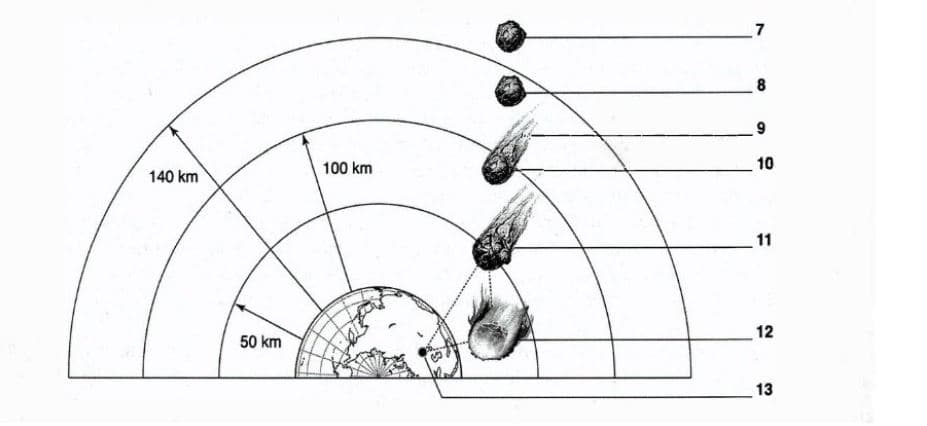
7. Label the diagram below by dragging the correct word or phrase from the box onto each gap.
A vaporisation of dust and gas
B sub-zero temperature
C fracturing
D dark flight or airburst
E mass loss/fireball
F Earth strike
G deceleration
8. Label the diagram below by dragging the correct word or phrase from the box onto each gap.
A vaporisation of dust and gas
B sub-zero temperature
C fracturing
D dark flight or airburst
E mass loss/fireball
F Earth strike
G deceleration
9. Label the diagram below by dragging the correct word or phrase from the box onto each gap.
A vaporisation of dust and gas
B sub-zero temperature
C fracturing
D dark flight or airburst
E mass loss/fireball
F Earth strike
G deceleration
10. Label the diagram below by dragging the correct word or phrase from the box onto each gap.
A vaporisation of dust and gas
B sub-zero temperature
C fracturing
D dark flight or airburst
E mass loss/fireball
F Earth strike
G deceleration
11. Label the diagram below by dragging the correct word or phrase from the box onto each gap.
A vaporisation of dust and gas
B sub-zero temperature
C fracturing
D dark flight or airburst
E mass loss/fireball
F Earth strike
G deceleration
12. Label the diagram below by dragging the correct word or phrase from the box onto each gap.
A vaporisation of dust and gas
B sub-zero temperature
C fracturing
D dark flight or airburst
E mass loss/fireball
F Earth strike
G deceleration
13. Label the diagram below by dragging the correct word or phrase from the box onto each gap.
A vaporisation of dust and gas
B sub-zero temperature
C fracturing
D dark flight or airburst
E mass loss/fireball
F Earth strike
G deceleration
The Real Cost of Recycling
Some years ago, in 2009, the Mayor of London's advisor on waste questioned the efficiency of recycling, making environmentalists very angry. The chief executive of the independent not-for-profit company Waste and Resources Action Programme (WRAP), Dr Liz Goodwin, responded, saying that the advisor's comments were unhelpful to recycling initiatives and that 'WRAP's independent research, carried out by internationally recognised experts, has shown that across the board recycling is the best environmental option'. Dr Goodwin went on to say: 'Around two thirds of households now recycle as a way of life. The message to householders is that recycling is delivering great environmental benefits and there is absolutely no reason for them to stop.'
However, others can see several reasons to stop recycling, calling the UK's recycling schemes a disorganised waste of time. At the moment recycling means ordinary people sorting out their own waste when it could be dealt with more economically, more efficiently and in a more environmentally friendly way. In the past 20 years in the UK, people have accepted their work as unpaid labourers for councils and waste recycling companies. Every week millions of households diligently sort out their plastic bottles from their glass bottles, their cardboard from their paper, and put it into the correct container. The type and colour of container varies significantly throughout the country; in parts of Scotland you can't recycle aluminium foil but in the south of England the council positively want it. This may seem like a small matter, but it does point to the lack of a coherent strategy for waste disposal. The Chartered Institution of Wastes Management certainly thinks that Britain doesn't have a national strategy. More importantly, if we could count the number of hours spent sorting out recyclable waste - 45 minutes each week by one estimate - and then multiply it by the number of households - 24 million - we get a massive 18 million hours spent each week on recycling.
Other places, however, do things differently. In Maryland, USA, a high-tech system for sorting out waste in a plant and recycling it afterwards increased recycling use by 30 per cent, probably because people did not need to spend three quarters of an hour every week sorting out the waste. There are other issues caused by asking people to give their free time to sort out waste. Because most people generally do not want to do this, local authorities have introduced a range of punishments to deal with them. One is to decrease the regularity of waste collection; another is to check people's rubbish bins and fine them if they put the wrong waste in the wrong bin. Putting paper in the wrong recycling bin cost a journalist from Wales £200.
One reason why questioning the efficiency of recycling makes environmentalists uneasy is that recycling may actually have the opposite effect on the environment. When Britain's waste has been collected, it is sent abroad - to Europe or even longer distances to China - for processing. The cost to the environment of transporting the waste around the world is considerable. But there are alternatives. Firstly, simply using less would help. Secondly, the waste could be buried again in landfill sites around the UK. According to Tim Worstall, in Britain we 'dig up some 110 million cubic metres (mcm) of sand, gravel and clay every year; and each year we produce some 100 mcm of waste'. Unfortunately, the European Union is discouraging landfill by fining countries in the EU who landfill too much. The next alternative is incineration - burning the waste to produce energy. Naturally, incineration is controversial, but burning plastic bottles in power stations to generate electricity saves using fossil fuels like gas, oil and coal. Waste heat produced by the process can be distributed to local public buildings and nearby homes. The question is, which is better environmentally: transporting the waste across the world, or using it locally to produce energy?
Recycling is not a new concept: we have done it for years. We have recycled old cars, scrap metal and paper for a long time now. However, the difference between then and now is that we used to recycle when it made economic sense. Today, it is part of our law and it has somehow become a belief that recycling is the only right thing to do whereas there may be better and more environmentally friendly alternatives. Recycling is not the only answer and the discussion should continue.
Questions 14–17
Choose the correct letter, A, B, C or D.
14. Current recycling policies mean that
A taxpayers are working voluntarily to sort waste.
B recycling takes a lot of time.
C we make a profit on recycled products.
D we have to pay too much for recycling.
15. The lack of consistent recycling policies indicates that
A there are many different recycling processes.
B there is no overall plan for dealing with waste.
C recycling is not economical.
D people are not sorting their waste properly.
16. Which of the following is NOT an alternative to recycling?
A burying the waste in the ground
B burning the waste
C conserving what we use
D transporting the waste overseas
17. What is one benefit of incineration?
A The European Union cannot fine the country.
B Fossil fuels are needed to start the process.
C The energy produced can be transported across the country.
D The heat produced can be used to keep some homes warm.
Questions 18–25
Complete the summary below. Choose NO MORE THAN THREE WORDS from the passage for each answer.
18. Recycling is widely regarded as the …………………………
19. for dealing with waste. However, seeing it as the only option ignores the amount of effort it requires and other, possibly better alternatives. It seems that there is no …………………………
20. for waste disposal. Furthermore, sorting our recyclable waste has a hidden cost. In one US state, waste is sorted in …………………………
21. waste plants, but in the UK a(n) …………………………
22. is used to force people to recycle. One method is to make …………………………
23. less frequent; another is to …………………………
24. people who place the wrong waste in bins. Alternative ways of dealing with waste could include burying it in …………………………
25. to replace materials taken out. Another would be ………………………… it for energy.
Question 26
Choose the correct letter, A, B, C or D.
26. What is the best title for the article?
A Why people hate recycling
B Economical alternatives to recycling
C Recycling and the law
D The real cost of recycling
Hello 3D printing, goodbye China
[A] A spectre is haunting the great container ship ports of China, with their highways jammed by lorries and the vast factory estates stretching from the coast of the South China Sea to the mountainous inland provinces. It is the spectre of a revolution led by a quiet, software-driven 3D printer, a machine that can laser up layers of liquid or granular resin or even cell tissue into a finished product. Some 3D printers are huge devices that make complete components such as aircraft parts. Others are small units that could stand next to a desk and create a small plastic prototype. Maplin, the British electronics retailer, said last week it would start selling one for just £700. The Velleman K8200 will allow those who are so inclined to make simple objects — mobile phone covers, perhaps, or toys. 'The only restriction is your imagination. You can make whatever you want,' said Pieter Nartus, export manager at Velleman.
[B] To visionaries in the West, the digital 3D printer promises to disrupt conventional manufacturing and supply chains so radically that advocates compare its impact to the advent of the production line or the internet. In China, whose big factories are thinking of using giant 3D printers for manufacturing, the technology does not seem to pose an immediate threat. 'It is on their horizon but it is not a factor right now,' says a British buying agent who sources plastics in China. However, as Chinese leaders ought to know from their compulsory classes in Karl Marx, control of the means of production is everything. And if 3D printing takes off, production will come back to a place near you.
[C] The implications, economists say, are limitless. No huge factories. No fleets of trucks. No ships. No supply chain. No tariffs. Few middlemen. Orders tailored exactly to demand, so no need for stock and warehouses. Just a printer, raw materials, software and a design. The advantages do not end there. Because the item is 'sintered' - created from a powdered material - to precise settings using a laser, there is no waste such as metal shavings. To customise a product, the user simply changes the software. An operator presses a button and the printer spits out the item.
[D] 'The first implication is that more goods will be manufactured at or closer to their point of purchase or consumption,' said Richard D'Aveni, a professor at Dartmouth College in the USA. Writing in the Harvard Business Review, D'Aveni predicted the elimination of the long supply chain linked to a huge factory staffed by cheap workers and sited on the other side of the world. It may be the most significant, if underplayed, article in that distinguished publication in decades. 'China has grabbed outsourced manufacturing contracts from every mature economy by pushing the mass-manufacturing model to its limit,' he wrote. 'It not only aggregates enough demand to create unprecedented efficiencies of scale but also minimises a key cost: labour. ... Under a model of widely distributed, highly flexible small-scale manufacturing, these daunting advantages become liabilities. No workforce can be paid little enough to make up for the costs of shipping across oceans.'
[E] In the brutal war for margin amid volatile commodities and currencies at the bottom end of the market, where China has carved its niche, the numbers tell their own ominous story. In a world of 3D manufacturing, the classic supply chain makes no commercial sense. 'China won't be a loser in the new era,' D'Aveni argued in the Harvard Business Review. 'It will have a domestic market to serve . . . and its domestic market is huge. But China will have to give up on being the mass-manufacturing powerhouse of the world.'
[F] China, of course, is not sitting still. It is eagerly buying Western 3D printing technology and making its own lightweight machines to sell to consumers. The Ministry of Industry and Information Technology has already allocated £20 million to fund 10 research centres and set up a group of 40 participating companies. So there is no doubt about China's scientific, engineering and intellectual commitment to 3D manufacturing. However, it is a fundamentally different concept in China. To the Chinese, it is an industrial tool to be used in making more things to sell. To Western economies that are hooked on cheap imports with a huge carbon footprint, it could be a means of transformation - perhaps even an agent of de-industrialisation.
Questions 27–32
Reading Passage 3 has six paragraphs, A-F. Which paragraph contains the following information?
27. a change in China's markets
28. the advent of a new technology
29. a description of the new business model
30. a comparison of 3D printing with past innovations
31. China's investments in 3D printing
32. possible future consequences of 3D printing
Questions 33–37
Classify the following as said by A. Pieter Nartus, B. Karl Marx, or C. Richard D'Aveni.
Speakers
A Pieter Nartus
B Karl Marx
C Richard D'Aveni
33. China will not manufacture products for the world in the future.
34. There will be no advantages in efficiencies of scale.
35. Control over how we produce things counts for everything.
36. What we make will be limited only by our imagination.
37. Goods will be made closer to the consumer.
Questions 38–40
Choose the correct letter, A, B, C or D.
38. Which is NOT an advantage of 3D printing?
A You do not need to buy stock.
B You do not need to store materials in large buildings.
C Goods are made from powder.
D There is no waste.
39. How did China achieve industrial growth?
A It had manufacturing contracts.
B It had low labour costs.
C There was high demand for its products from one area.
D The cost of shipping goods across the oceans was not significant.
40. What does the writer think about China's reaction to 3D printing?
A Chinese business leaders do not fully realise the implications.
B China should be investing more in it.
C China should concentrate more on its domestic market.
D The changes will leave China behind.
Answers
1. 50
2. 29.7 kilometres
3. 20-30
4. 36.5
5. 54,000 kilometres
6. 1,200
7. sub-zero temperature
8. deceleration
9. vaporisation of dust and gas
10. mass loss/fireball
11. fracturing
12. dark flight or airburst
13. Earth strike
14. taxpayers are working voluntarily to sort waste.
15. there is no overall plan for dealing with waste.
16. transporting the waste overseas
17. The heat produced can be used to keep some homes warm.
18. best environmental option
19. coherent strategy
20. high-tech
21. range of punishments
22. waste collection
23. fine
24. landfill sites
25. burning
26. The real cost of recycling
27. E
28. A
29. D
30. B
31. F
32. C
33. C
34. C
35. B
36. A
37. C
38. Goods are made from powder.
39. It had low labour costs.
40. Chinese business leaders do not fully realise the implications.
Explanations
- 1. 50
- The passage states the meteor was travelling at around 19 km/s, which is above 50 times the speed of sound. Paraphrase: 'Its speed exceeded the speed of sound by a factor of 50.' Distractor analysis: '19' is the speed in km/s, not the multiple of sound speed; '70' is the percentage deceleration figure mentioned elsewhere.Common trap: Number-confusion trap — several different figures (19, 50, 70) appear nearby, and the wrong one could be picked for this blank.
- 2. 29.7 kilometres
- The meteor exploded 29.7 km above the ground. Paraphrase: 'The explosion occurred at an altitude of 29.7 km.' Distractor analysis: '45 to 50 kilometres' is where it fractured, not where it exploded; '28,000 feet' belongs to the Tunguska event, in a different unit.Common trap: Number-confusion trap — a nearby altitude figure (45-50 km, the fracturing altitude) could be mistaken for the explosion altitude.
- 3. 20-30
- The meteor had 20-30 times the energy of the Hiroshima bomb. Paraphrase: 'Its energy output was between 20 and 30 times that of the atomic bomb.' Distractor analysis: '30' alone is incomplete because the passage gives a range, not a single figure; '185' refers to the separate Tunguska event.Common trap: Incomplete-range trap — picking only one end of the stated range ('30') is tempting but incomplete.
- 4. 36.5
- The Tunguska asteroid is estimated to have been around 36.5 metres in diameter. Paraphrase: 'The diameter of the Tunguska object was approximately 36.5 metres.' Distractor analysis: '10' is the diameter of the Chelyabinsk meteor, not Tunguska; '54,000' is a speed figure, not a size.Common trap: Event-confusion trap — a figure belonging to the Chelyabinsk meteor (10 metres) could be wrongly substituted for the Tunguska figure.
- 5. 54,000 kilometres
- The Tunguska meteor travelled at 54,000 km/h when it entered the atmosphere. Paraphrase: 'Its entry speed was 54,000 kilometres per hour.' Distractor analysis: '19 kilometres' is the Chelyabinsk meteor's speed per second, a different event and a different unit (per second, not per hour).Common trap: Event-confusion trap — the Chelyabinsk meteor's speed figure (19 km/s) could be wrongly substituted for the Tunguska figure.
- 6. 1,200
- Tunguska-sized airbursts occur approximately every 1,200 years on average. Paraphrase: 'Events like Tunguska happen once every 1,200 years on average.' Distractor analysis: '10' is the frequency figure for Chelyabinsk-sized strikes, a different, much smaller event.Common trap: Event-confusion trap — the frequency figure for the smaller Chelyabinsk-type strikes (10 years) could be wrongly substituted here.
- 7. sub-zero temperature
- The topmost point in the diagram, furthest from Earth, marks the meteor's state while still moving through space. The passage states its temperature there can be around -100°C. Paraphrase: 'In the cold of space, the meteor is far below zero.' Distractor analysis: 'deceleration' describes the next stage, once the meteor begins encountering the atmosphere, not this earliest point.Common trap: Sequence-confusion trap — several word-box entries describe different, ordered stages of the same descent, and the wrong stage could be picked for this position.
- 8. deceleration
- This position, near the 140 km mark where the meteor begins to encounter the atmosphere, marks the point at which the meteor starts slowing down. Paraphrase: 'The meteor loses speed dramatically as it meets the atmosphere.' Distractor analysis: 'sub-zero temperature' describes the earlier stage in open space, before atmospheric entry begins.Common trap: Sequence-confusion trap — several word-box entries describe different, ordered stages of the same descent, and the wrong stage could be picked for this position.
- 9. vaporisation of dust and gas
- At this position, near the 100 km mark, a faint tail has begun to form behind the meteor. Paraphrase: 'The glowing trail is created by material turning into gas and dust.' Distractor analysis: 'mass loss/fireball' describes the brighter, more developed burning stage that follows this one.Common trap: Sequence-confusion trap — several word-box entries describe different, ordered stages of the same descent, and the wrong stage could be picked for this position.
- 10. mass loss/fireball
- At this position, around the 100 km mark, the meteor's surface is now visibly burning. The passage describes this as the meteor becoming a fireball while shedding surface material. Paraphrase: 'The meteor becomes a bright fireball and sheds material.' Distractor analysis: 'vaporisation of dust and gas' describes the earlier, fainter tail stage that precedes this brighter fireball stage.Common trap: Sequence-confusion trap — several word-box entries describe different, ordered stages of the same descent, and the wrong stage could be picked for this position.
- 11. fracturing
- At this position, near the 50 km mark, the diagram shows the meteor splitting into a smaller piece. The passage explains that during deceleration the meteor may fracture and split. Paraphrase: 'The meteor breaks into pieces.' Distractor analysis: 'dark flight or airburst' describes the following stage, after fracturing has already occurred.Common trap: Sequence-confusion trap — several word-box entries describe different, ordered stages of the same descent, and the wrong stage could be picked for this position.
- 12. dark flight or airburst
- At this position, close to the ground, the meteor either explodes in an airburst or continues as a cold, dark rock. Paraphrase: 'The meteor either detonates violently or becomes a cold stone falling to Earth.' Distractor analysis: 'fracturing' is the earlier splitting stage that comes before this point.Common trap: Sequence-confusion trap — several word-box entries describe different, ordered stages of the same descent, and the wrong stage could be picked for this position.
- 13. Earth strike
- This final position, at ground level, marks the moment the remaining rock makes contact with the Earth's surface. Paraphrase: 'The meteor makes contact with the Earth's surface.' Distractor analysis: 'dark flight or airburst' is the stage immediately before ground contact, not the impact itself.Common trap: Sequence-confusion trap — several word-box entries describe different, ordered stages of the same descent, and the wrong stage could be picked for this position.
- 14. taxpayers are working voluntarily to sort waste.
- The passage states that ordinary people sort their own waste and have accepted their work as unpaid labourers for councils and waste recycling companies. Paraphrase: 'Householders do the sorting work for free, effectively as unpaid workers.'Common trap: Partial-information trap — option B names a true but secondary consequence rather than what current policy fundamentally means.
- 15. there is no overall plan for dealing with waste.
- The variation in recycling rules across the country points to a lack of a coherent national strategy for waste disposal. Paraphrase: 'Inconsistent local rules reveal there is no unified national waste plan.'Common trap: Symptom-vs-conclusion trap — option A names the symptom (varied processes) rather than the conclusion the passage explicitly draws from it.
- 16. transporting the waste overseas
- Transporting waste overseas is described as the current practice — what happens after collection — not a proposed alternative. The passage's actual alternatives are: using less, landfill, and incineration. Paraphrase: 'Sending waste abroad is the existing problem being discussed, not a proposed solution.'Common trap: Current-practice-vs-alternative trap — option D describes the existing situation being criticised, not one of the genuine alternatives listed.
- 17. The heat produced can be used to keep some homes warm.
- Waste heat produced by incineration can be distributed to local public buildings and nearby homes. Paraphrase: 'The heat generated can warm local buildings and residences.'Common trap: Scope-inflation trap — option C exaggerates a local benefit ('nearby homes') into a nationwide claim.
- 18. best environmental option
- WRAP's research concluded that, across the board, recycling is the best environmental option. Paraphrase: 'It is seen as the most environmentally sound choice available.' Distractor analysis: 'only option' is not the phrase used; the passage's exact wording is 'best environmental option'.Common trap: Word-substitution trap — 'only option' is a plausible but stronger claim than the passage's actual wording.
- 19. coherent strategy
- The passage states there is a lack of a coherent strategy for waste disposal. Paraphrase: 'There is no unified national plan.' Distractor analysis: 'national strategy' is mentioned nearby, but the exact phrase required for this blank is 'coherent strategy'.Common trap: Near-synonym trap — 'national strategy' appears nearby but is not the exact phrase required.
- 20. high-tech
- Maryland uses a high-tech system for sorting waste in a plant. Paraphrase: 'Advanced technology handles the sorting in American plants.' Distractor analysis: 'sorting' names the activity, but the descriptive word required for this blank is 'high-tech'.Common trap: None significant — the answer is directly stated.
- 21. range of punishments
- Local authorities have introduced a range of punishments to make people recycle. Paraphrase: 'Penalties of various kinds are used to compel compliance.' Distractor analysis: 'fines' is only one specific type mentioned later; the general term required here is 'range of punishments'.Common trap: Specific-vs-general trap — 'fines' names one specific punishment type, but the general phrase is required for this blank.
- 22. waste collection
- One punishment is decreasing how often waste is collected. Paraphrase: 'They pick up rubbish less often.' Distractor analysis: 'rubbish collection' is a plausible synonym, but the exact phrase used in the passage is 'waste collection'.Common trap: Synonym trap — a near-synonym is tempting but not the exact passage phrase.
- 23. fine
- Another punishment is to fine people for putting the wrong items in the wrong bin. Paraphrase: 'They impose a financial penalty on offenders.' Distractor analysis: 'penalise' is a plausible synonym, but the exact word used is 'fine'.Common trap: Synonym trap — a near-synonym is tempting but not the exact passage word.
- 24. landfill sites
- Burying waste in landfill sites would replace materials that are dug up, such as sand, gravel and clay. Paraphrase: 'Landfills could be used to return material to the ground.' Distractor analysis: 'landfill' alone is close, but the exact phrase used in the passage is 'landfill sites'.Common trap: Incomplete-phrase trap — the bare word 'landfill' is tempting but the full two-word phrase is required.
- 25. burning
- Incineration — burning the waste — is presented as the alternative that produces energy. Paraphrase: 'Burning waste can generate power.' Distractor analysis: 'incineration' is the name of the process, but the blank asks for the verb form fitting '_____ it for energy', which is 'burning'.Common trap: Part-of-speech trap — 'incineration' (a noun) is tempting but the blank grammatically requires the verb form 'burning'.
- 26. The real cost of recycling
- The article questions the efficiency of recycling, exposes hidden costs (time spent sorting, environmental cost of transporting waste abroad), and weighs up alternatives. Paraphrase: 'The overall theme is uncovering what recycling truly costs, beyond its assumed environmental benefit.'Common trap: Partial-information trap — options B and C each capture only one supporting detail rather than the article's overall theme.
- 27. E
- Paragraph E discusses how China will have to give up being the world's mass-manufacturing powerhouse and focus instead on its domestic market. Paraphrase: 'This paragraph predicts a major shift in China's economic role.' Distractor analysis: other paragraphs discuss technology or implications generally, but E specifically addresses China's market change.Common trap: None significant — the answer is directly supported by unique content.
- 28. A
- Paragraph A introduces 3D printing, describes what it does, and mentions that a consumer printer is now available for sale. Paraphrase: 'This paragraph announces the arrival of 3D printing as a consumer product.' Distractor analysis: other paragraphs discuss consequences or context, but A presents the technology itself.Common trap: None significant — the answer is directly supported by unique content.
- 29. D
- Paragraph D describes the new model of widely distributed, highly flexible small-scale manufacturing that replaces large factories. Paraphrase: 'This section outlines how 3D printing will change the way goods are produced and sold.' Distractor analysis: paragraph C lists implications generally, but D describes the underlying business model in more detail.Common trap: Topic-recurrence trap — C also relates to implications, but D specifically describes the business model itself.
- 30. B
- Paragraph B compares 3D printing's impact to the advent of the production line or the internet. Paraphrase: 'Advocates say this technology is as revolutionary as past industrial milestones.' Distractor analysis: no other paragraph makes this historical comparison.Common trap: None significant — the answer is directly supported by unique content.
- 31. F
- Paragraph F describes China's funding of research centres and companies involved in 3D printing. Paraphrase: 'China is actively investing in the technology.' Distractor analysis: other paragraphs mention China's position more generally, but F details its specific investments.Common trap: None significant — the answer is directly supported by unique content.
- 32. C
- Paragraph C lists the limitless implications: no factories, no trucks, no ships, no supply chain, no tariffs, few middlemen, no need for stock. Paraphrase: 'This section envisions a radically different future for manufacturing and trade.' Distractor analysis: other paragraphs mention specific consequences, but C provides the most comprehensive list.Common trap: None significant — the answer is directly supported by unique content.
- 33. C
- D'Aveni stated that China will have to give up being the world's mass-manufacturing powerhouse. Paraphrase: 'D'Aveni predicts China's role as global factory will end.' Distractor analysis: not A (Nartus spoke about imagination and personal fabrication) or B (Marx is referenced regarding control of production, not China's manufacturing role).Common trap: None significant — the answer is directly stated.
- 34. C
- D'Aveni argues that the huge efficiencies of scale China enjoyed will become liabilities under a small-scale manufacturing model. Paraphrase: 'The old advantages of mass production will disappear.' Distractor analysis: not A or B, since this specific economic argument is D'Aveni's.Common trap: None significant — the answer is directly stated.
- 35. B
- The passage states that Chinese leaders should know from their classes in Karl Marx that control of the means of production is everything. Paraphrase: 'Marx's theory holds that owning the means of production is paramount.' Distractor analysis: not A or C, since this idea is explicitly attributed to Marx.Common trap: None significant — the answer is directly stated.
- 36. A
- Pieter Nartus said the only restriction is your imagination and that you can make whatever you want. Paraphrase: 'Nartus claimed you can create anything you can imagine.' Distractor analysis: not B or C, since this quote is directly attributed to Nartus.Common trap: None significant — the answer is directly stated.
- 37. C
- D'Aveni stated that more goods will be manufactured at or closer to the point of purchase or consumption. Paraphrase: 'D'Aveni said production will move nearer to buyers.' Distractor analysis: not A or B, since this is a direct quote attributed to D'Aveni.Common trap: None significant — the answer is directly stated.
- 38. Goods are made from powder.
- The passage describes the item being 'sintered' — created from a powdered material — as a technical detail of the process, not as a stated advantage in itself. The genuine advantages listed are no need for stock, no warehouses, and no waste. Paraphrase: 'Using powder is how the process works, not a benefit that is claimed for it.'Common trap: Process-vs-benefit trap — a technical detail of how the process works (powder) is presented as if it were itself a claimed advantage.
- 39. It had low labour costs.
- D'Aveni states that China's mass-manufacturing model minimises a key cost: labour. Paraphrase: 'Cheap labour was a major factor in China's industrial success.'Common trap: Cause-vs-consequence trap — option A names a consequence of China's advantage (winning contracts) rather than the underlying cause (low labour costs).
- 40. Chinese business leaders do not fully realise the implications.
- The writer notes that Chinese factories do not see 3D printing as an immediate threat ('it is on their horizon but it is not a factor right now'), then invokes Marx to suggest Chinese leaders should already understand how significant control of production really is. Paraphrase: 'Chinese leaders are underestimating the true significance of the technology.'Common trap: Attribution trap — options C and D restate views from quoted sources (D'Aveni) rather than the writer's own framing of China's reaction.
Comments
Loading comments…