

Collins IELTS 2 Academic Reading Test 1
3 passages · 40 questions · 60 minutes
Mutual harm
[A] In forests and fields all over the world, plants are engaged in a deadly chemical war to suppress other plants and create conditions for their own success. But what if we could learn the secrets of these plants and use them for our own purposes? Would it be possible to use their strategies and weapons to help us improve agriculture by preventing weeds from germinating and encouraging growth in crops? This possibility is leading agricultural researchers to explore the effects plants have on other plants with the aim of applying their findings to farming.
[B] The phenomenon by which an organism produces one or more chemicals that influence the growth, survival and reproduction of other organisms is called allelopathy. These chemicals are a subset of chemicals produced by organisms called secondary metabolites. A plant's primary metabolites are associated with growth and development. Allelochemicals, however, are part of a plant's defence system and have a secondary function in the life of the organism. The term allelopathy comes from the Greek: allelo and pathy meaning 'mutual harm'. The term was first used by the Austrian scientist Hans Molisch in 1937, but people have been noting the negative effects that one plant can have on another for a long time. In 300 BC, the Greek philosopher Theophrastus noticed that pigweed had a negative effect on alfalfa plants. In China, around the first century AD, the author of Shennong Ben Cao Jing described 267 plants that have the ability to kill pests.
[C] Allelopathy can be observed in many aspects of plant ecology. It can affect where certain species of plants grow, the fertility of competitor plants, the natural change of plant communities over time, which plant species are able to dominate a particular area, and the diversity of plants in an area. Plants can release allelopathic chemicals in several ways: their roots can release chemicals directly into the soil, and their bark and leaves can release chemicals into the soil as they rot. Initially, scientists were interested in the negative effects of allelopathic chemicals. Observations of the phenomenon included poor growth of some forest trees, damage to crops, changes in vegetation patterns and, interestingly, the occurrence of weed-free areas. It was also realised that some species could have beneficial effects on agricultural crop plants and the possible application of allelopathy became the subject of research.
[D] Today research is focused on the effects of weeds on crops, the effects of crops on weeds, and how certain crops affect other crops. Agricultural scientists are exploring the use of allelochemicals to regulate growth and to act as natural herbicides, thereby promoting sustainable agriculture by using these natural chemicals as an alternative to man-made chemicals. For example, a small fast-growing tree found in Central America, sometimes called the 'miracle tree', contains a poison that slows the growth of other trees but does not affect its own seeds. Chemicals produced by this tree have been shown to improve the production of rice. Similarly, box elder - another tree - stimulates the growth of bluestem grass, which is a tall prairie grass found in the mid-western United States. Many weeds may use allelopathy to become ecologically successful; a study in China found that 25 out of 33 highly poisonous weeds had significant allelopathic properties.
[E] There may be at least three applications of allelopathy to agriculture. Firstly, the allelopathic properties of wild or cultivated plants may be bred into crop plants through genetic modification or traditional breeding methods to improve the release of desired allelochemicals and thus improve crop yield. Secondly, a plant with strong allelopathic properties could be used to control weeds by planting it in rotation with an agricultural crop and then leaving it to rot and become part of the soil in order to inhibit the growth of weeds. Finally, naturally occurring allelopathic chemicals could be used in combination with man-made chemicals. Boosting the efficiency of man-made herbicides could lead to a reduction in the amount of herbicides used in agriculture, which is better for the environment.
[F] Despite the promising uses of allelopathic chemicals, agricultural scientists are still cautious. Firstly, allelopathic chemicals may break down and disappear in the soil more easily than artificial chemicals. Secondly, allelopathic chemicals may be harmful to plants other than weeds. Thirdly, allelopathic chemicals could persist in the soil for a long time and may affect crops grown in the same field as the allelopathic plants at a later date. Because the effects of allelopathic chemicals are not yet fully known, agricultural scientists will need to continue to study the biological war between plants.
Questions 1–5
Choose the correct heading for each paragraph from the list of headings below.
List of Headings:
i. What are metabolites?
ii. The negative effects of allelopathy
iii. Biological warfare in the plant world
iv. Why we cannot use allelopathic chemicals at present
v. What is allelopathy?
vi. The reasons why plants compete with other plants
vii. The effects of allelopathy and realisation of its possible uses
viii. How could we use allelopathic chemicals in farming?
ix. Specific examples of allelopathic plants
1. Paragraph B:
2. Paragraph C:
3. Paragraph D:
4. Paragraph E:
5. Paragraph F:
Question 6
Choose the correct letter, A, B, C or D.
6. What does the term 'allelopathy' refer to?
A the growth and development of a plant
B the relationship between plants that grow in the same area
C the effects of chemicals produced by a plant on another plant
D a plant's primary metabolic processes
Question 7
Choose the correct letter, A, B or C.
7. Which of the following does allelopathy NOT affect?
A how certain species of plants change the nature of the soil where they grow
B the diversity of plants in an area
C the nutrients present in the soil
Questions 8–9
Choose the correct letter, A, B, C or D.
8. Scientists are mainly interested in
A being able to exploit allelopathy in sustainable farming.
B the beneficial effects of weeds on crops.
C the effect of allelopathy on forests.
D the negative effects of weeds.
9. Which of the following is NOT mentioned in the text?
A a tree which is highly poisonous to weeds
B a tree which makes a type of grass grow better
C a tree which makes rice more productive
D a tree which produces a chemical that affects the growth of other trees
Questions 10–14
Complete the summary of paragraphs E and F below. Choose NO MORE THAN TWO WORDS from the passage for each answer.
10. Scientists can see three potential uses of allelopathic chemicals in farming. Firstly, the ability to produce allelopathic chemicals could be …………………………
11. into agricultural crops; secondly, allelopathic plants could be planted in rotation with the …………………………
12. ; finally, naturally produced chemicals could be combined with …………………………
13. herbicides. However, agriculturalists are still …………………………
14. as allelopathic plants may have negative effects on plants which are not the intended target and the chemicals could remain in the ground for a(n) …………………………, even after the plants themselves have died.
Ordinary treasures
When Andy Warhol, one of the twentieth century's most influential artists, died his four-floor house was so full of items that the only rooms you could walk through were the kitchen and the bedroom. It turned out that Warhol had compulsive hoarding disorder, which is defined as the excessive accumulation of objects and a refusal to throw them away. But Warhol's case is not uncommon; around five per cent of Americans - nearly 15 million people - suffer from compulsive hoarding disorder. This disorder interferes with daily activities such as sleeping and cooking, and in an extreme form it can harm one's health, be a fire risk and even lead to death. Although researchers suspect that the disorder is more widespread in the West, cases of hoarding have been recorded in almost every country.
Twenty years ago, compulsive hoarding disorder was a relatively unexplored psychological phenomenon, often treated as an aspect of obsessive compulsive disorder - the compulsion to repeat a certain action over and over. However, it is now recognised as a separate disorder. Scientists from many disciplines, including psychologists, neurologists and behavioural researchers are looking at gene sequences within hoarders' DNA and scanning their brains to try to understand their behaviour in the hope that they can be helped.
There are several theories for the behaviour. First of all, hoarding appears to run in families and may have genetic causes, with family members often having similar issues. In a study of 219 families, researchers at Johns Hopkins University found that families with two or more hoarding members showed a linkage between hoarding behaviour and chromosome 14 - one of the 23 pairs of chromosomes that make up human DNA. A second theory states that the instinct to hoard may be an evolutionary survival strategy: there are plenty of examples of hoarding in the animal kingdom. The Arctic gray jay hoards around 100,000 berries and insects so that it has enough food for the long winter months. Humans, however, are the only species that take the strategy to extremes, sometimes filling their homes with so many objects that they eventually become uninhabitable.
Recent psychological research, however, emphasises that hoarders do not just collect junk; nor are they lazy or disorganised, even if their homes are chaotic. Many hoarders have normal lives, with regular jobs and normal relationships with friends and family. Cognitively, hoarders tend to be emotional, attaching sentimental value to belongings that other people would discard. They also tend to be intelligent, well educated and more creative than average. However, they can be indecisive and may start several different projects at the same time.
Carol Mathews, a leading researcher into the condition, used magnetic resonance imaging (MRI) to show brain activity in the process of decision making. People with compulsive hoarding disorder display increased activity in an area of the brain related to decision making when asked to organise objects. This increased activity is due to their greater emotional attachment to possessions. In other tests, Mathews found that people with hoarding behaviour had difficulty grouping similar objects and remembering the sequence of things. In effect, people with compulsive hoarding disorder do not categorise objects in the same way as other people, and when they are asked to do so, show an increase in brain activity associated with the decision-making process. It seems that people with hoarding behaviour see and treat objects differently and might have a different appreciation of the physical world. For example, a pile of objects in the middle of a room may be seen as a work of art by a hoarder rather than just a heap of junk.
Treating hoarding effectively may depend upon whether we can identify specific character traits. Dr Monika Eckfield of the University of California, San Francisco, believes there are two different kinds of people with hoarding behaviour. She calls one kind impulsive-acquirers, who buy objects out of excitement and keep them because they are interested in them. The other type are the worried-keepers - the hoarders who acquire items passively and keep them in case they need them in future. Worried-keepers spend more time sorting and organising belongings. While both kinds of hoarders of either gender find it nearly impossible to throw anything away, more men than women belong to the former category whilst more women fall into the worried-keeper group.
Questions 15–19
Do the following statements agree with the information given in Reading Passage 2?
TRUEif the statement agrees with the information
FALSEif the statement contradicts the information
NOT GIVENif there is no information on this
15. People have died as a result of extreme hoarding behavior.
16. Compulsive hoarding disorder is a type of obsessive compulsive disorder.
17. People with compulsive hoarding disorder usually have parents with the same condition.
18. People who take collecting to extremes eventually cannot live in their homes.
19. Hoarders show more activity in parts of the brain associated with the emotions.
Questions 20–25
Classify the following as typical of A. impulsive-acquirer hoarders, B. worried-keeper hoarders, or C. both.
Categories
A impulsive-acquirer hoarders
B worried-keeper hoarders
C both
20. This type of hoarder finds it almost impossible to discard anything.
21. This type of hoarder keeps possessions because he/she finds them interesting.
22. This type of hoarder keeps objects for future use.
23. This type of hoarder buys things because he/she is excited by them.
24. This type of hoarder has a greater tendency to sort objects.
25. This type of hoarder includes more men than women.
Question 26
Choose the correct letter, A, B or C.
26. The writer of the article views people with compulsive hoarding disorder as
A lazy and disorganised.
B abnormal because they cannot lead a normal life.
C having a different perception of physical objects from the majority of people.
Regaining Sight
[A] A major cause of blindness in the industrialised world is age-related macular degeneration (AMD). It affects approximately three million people globally and accounts for around nine per cent of all blindness. These statistics are expected to double by the year 2020 as the world population increases. Scientists have been working on a new treatment for one type of the disease by using stem cells to repair damage to the retina, with positive results. Two women in America, both registered as blind, were given the new treatment and say their vision improved just weeks after they were injected with the stems cells. With such promising results for a condition which previously had no treatment, researchers are positive about the direction of the stem cell treatment.
[B] AMD usually affects the elderly although younger people can also develop a version of the condition. People with AMD typically have dark patches at the centre of their vision - the deterioration takes place over months and years. Although people with AMD do not lose their sight completely, they do lose central vision, which is vital for detailed work and activities like reading and driving, so that leading a normal life can become impossible over time. In the cases of the two American women, one was a graphic artist who began to lose her vision in her twenties. As she lost most of her central vision, she became unable to work, and then eventually it became impossible for her to recognise people or watch TV. The second woman became unable to recognise faces, had to stop driving and in the end could not leave her home.
[C] To understand AMD, we need to understand how our eyes work. Essentially a hollow ball, the eye has a number of layers. The outer layer consists of the white of the eye and the cornea. The cornea is the transparent area in front of the coloured iris and the black pupil at the centre of the iris. The middle layer of the eye includes blood vessels and the iris, which regulates the amount of light entering the eye. Just behind the iris is the lens, which focuses images on the retina, which covers the inside of the eyeball. The retina is the part of the eye that contains photoreceptors - cells that sense light. Nerve fibres from the photoreceptors in the retina join together to form the optic nerve, which then exits the eyeball and transmits visual information to the brain. The photoreceptors are of two types, rods and cones: the rods are sensitive to light intensity and the cones are sensitive to colour. They are mostly concentrated in the part of the retina called the macula. This is only the size of a grain of rice, but it is responsible for our central vision, most of our colour vision and our visual acuity, or sharpness of vision. The photoreceptor cells lie on a thin layer of cells that provide them with nutrients and carry away waste. When these underlying cells die or are damaged, the photoreceptor cells cannot function properly, and this leads to a loss of vision.
[D] Damage to the macula can result from a variety of factors. Age is the main risk factor but smoking also damages blood vessels and the structure of the eye. Smokers are three times more likely to develop AMD, as are people with poor diets. A diet lacking in fruit and vegetables cannot help the body defend itself against free radical molecules which damage cells. Fruit and vegetables contain antioxidants, which protect the body against these free radicals. Finally, people with high blood pressure are one and a half times more likely to contract AMD, as are those people with a family history of the disease.
[E] The new treatment for AMD, developed by Dr Robert Lanza at Advanced Cell Technology, involves changing embryonic stem cells into more specialised eye stem cells and injecting 50,000 of them into the layer of the eye that supports the photoreceptors. A stem cell is a primary cell that has the ability to divide and form specialised cells that perform various functions within the body. First, a single stem cell was taken from a human embryo and grown into a colony of millions of cells. The cells were checked to make sure they were healthy. Then another procedure encouraged the stem cells to develop into the type of cell that forms the layer under the photoreceptor cells. The eye stem cells were injected below the retina through a cut into the eyeball, where they filled in the gaps left by dead and damaged cells and began functioning again.
[F] For the two patients, the results have been stunning. Tests have indicated that healthy cells have grown where the stem cells were injected. The first woman has regained enough vision to be able to cycle. Meanwhile, the second woman can read, cook and go shopping by herself again. The hope is that the treatment could be a way forward for other currently incurable conditions so that other people can lead normal lives again.
Questions 27–32
Reading Passage 3 has six paragraphs, A-F. Which paragraphs contain the following information?
27. the symptoms of AMD
28. details about the treatment process
29. factors that may contribute to AMD
30. the physical causes of AMD
31. potential future uses of stem cell treatment
32. the frequency of occurrence of AMD
Questions 33–35
Label the diagram below.
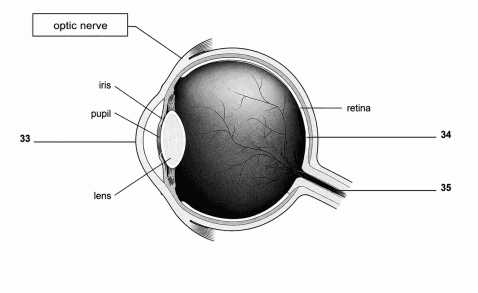
33. Label the diagram below by dragging the correct word or phrase from the box onto each gap.
A macula
B cornea
C optic nerve
34. Label the diagram below by dragging the correct word or phrase from the box onto each gap.
A macula
B cornea
C optic nerve
35. Label the diagram below by dragging the correct word or phrase from the box onto each gap.
A macula
B cornea
C optic nerve
Questions 36–40
Complete the summary below. Choose NO MORE THAN TWO WORDS from the passage for each answer.
36. Age-related macular degeneration (AMD) is one of the main causes of loss of sight in the …………………………
37. . Although AMD can affect …………………………
38. , the majority of sufferers are older. Despite being very small, the macula is essential to our …………………………
39. as well as detailed vision and some colour vision. AMD happens when the cells beneath the …………………………
40. cells are damaged or die. A new treatment to repair the damaged cells involves ………………………… 50,000 stem cells under the retina, after which they regenerate the damaged area.
Answers
1. v
2. vii
3. ix
4. viii
5. iv
6. the effects of chemicals produced by a plant on another plant
7. the nutrients present in the soil
8. being able to exploit allelopathy in sustainable farming.
9. a tree which is highly poisonous to weeds
10. bred
11. agricultural crop
12. man-made
13. cautious
14. long time
15. True
16. False
17. Not Given
18. True
19. Not Given
20. C
21. A
22. B
23. A
24. B
25. A
26. having a different perception of physical objects from the majority of people.
27. B
28. E
29. D
30. C
31. F
32. A
33. cornea
34. macula
35. optic nerve
36. industrialised world
37. younger people
38. central vision
39. photoreceptor
40. injecting
Explanations
- 1. v
- Paragraph B defines allelopathy, explains the origin of the term, and gives its early history. Paraphrase: 'This paragraph introduces and defines the concept of allelopathy itself.' Distractor analysis: i (What are metabolites?) is too narrow — metabolites are mentioned only to explain allelochemicals, not as the paragraph's main topic.Common trap: Partial-information trap — a narrower distractor heading (i) describes only a supporting detail, not the paragraph's overall focus.
- 2. vii
- Paragraph C covers the observed effects of allelopathy (mostly negative at first) and then how scientists realised it could have beneficial uses. Paraphrase: 'This paragraph traces how initial observations of harm led to the realisation that allelopathy could be applied usefully.' Distractor analysis: ii (The negative effects) only covers the first half of the paragraph, not the shift toward realising possible uses.Common trap: Partial-information trap — a narrower distractor heading (ii) covers only the first half of the paragraph's content.
- 3. ix
- Paragraph D gives concrete named examples: the 'miracle tree', box elder and bluestem grass, and the Chinese weed study. Paraphrase: 'This paragraph illustrates allelopathy with specific real-world plant examples.' Distractor analysis: vi (reasons plants compete) is too general — the paragraph's substance is the specific examples, not a general explanation of competition.Common trap: Partial-information trap — a broader distractor heading (vi) describes the general topic rather than this paragraph's specific examples.
- 4. viii
- Paragraph E lists three potential applications of allelopathy in agriculture. Paraphrase: 'This paragraph sets out concrete ways allelopathic chemicals could be put to use in farming.' Distractor analysis: ix (specific examples) describes paragraph D, not the forward-looking applications discussed here.Common trap: Topic-recurrence trap — ix also involves specific plant-related detail, but E discusses applications, not named plant examples.
- 5. iv
- Paragraph F explains why agricultural scientists remain cautious about applying allelopathic chemicals — they break down easily, may harm non-target plants, and can persist in soil. Paraphrase: 'This paragraph lists the reasons allelopathic chemicals cannot yet be used in farming.' Distractor analysis: ii (negative effects) is too broad — F specifically explains barriers to present-day use, not allelopathy's effects in general.Common trap: Partial-information trap — a broader distractor heading (ii) covers general negative effects rather than this paragraph's specific reasons for caution.
- 6. the effects of chemicals produced by a plant on another plant
- The passage defines allelopathy as the phenomenon by which an organism produces chemicals that influence the growth, survival and reproduction of other organisms. Paraphrase: 'Allelopathy is specifically about one plant's chemicals affecting another plant.'Common trap: Definition-swap trap — options A and D describe primary metabolism, which the passage explicitly contrasts with allelopathy.
- 7. the nutrients present in the soil
- The passage lists what allelopathy can affect: where plants grow, the fertility of competitor plants, the change of plant communities, which species dominate an area, and plant diversity — it never mentions soil nutrients specifically. Paraphrase: 'The passage covers several ecological effects of allelopathy, but soil nutrient content is not among them.'Common trap: Not Given trap — the correct answer is the one effect never mentioned, among several genuine effects listed.
- 8. being able to exploit allelopathy in sustainable farming.
- The passage states that agricultural scientists are exploring allelochemicals as natural herbicides and growth regulators to promote sustainable agriculture. Paraphrase: 'The central research goal is applying allelopathy to make farming more sustainable.'Common trap: Historical-vs-current trap — option D describes the historical starting point of research, not its present main focus.
- 9. a tree which is highly poisonous to weeds
- The passage mentions the 'miracle tree' (which affects rice and other trees) and box elder (which stimulates bluestem grass growth), but no tree is described as poisonous specifically to weeds — the poisonous weeds mentioned are weeds themselves, not affected by a tree. Paraphrase: 'Two trees and their effects are described, but no tree is said to poison weeds.'Common trap: Fabricated-detail trap — option A combines two separate true details (a poisonous tree, and weeds having allelopathic properties) into one false claim not stated in the passage.
- 10. bred
- The passage states that allelopathic properties may be bred into crop plants through genetic modification or traditional breeding. Paraphrase: 'The trait itself could be introduced into crops through breeding.' Distractor analysis: 'introduced' or 'engineered' are plausible synonyms but the exact word used is 'bred'.Common trap: Synonym trap — near-synonyms are tempting but not the exact passage word.
- 11. agricultural crop
- The passage explains that an allelopathic plant could be planted in rotation with an agricultural crop, then left to rot to inhibit weed growth. Paraphrase: 'The allelopathic plant is rotated with a farmed crop as a weed-control method.' Distractor analysis: 'crop plants' is close but the exact wording is 'agricultural crop'.Common trap: None significant — the answer is directly stated.
- 12. man-made
- The passage states naturally occurring allelopathic chemicals could be used in combination with man-made chemicals. Paraphrase: 'The natural chemicals could be paired with artificial, human-produced herbicides.' Distractor analysis: 'artificial' is a synonym, but the exact term used is 'man-made'.Common trap: Synonym trap — 'artificial' is a near-synonym but not the exact passage word.
- 13. cautious
- The passage states that despite promising uses, agricultural scientists are still cautious about allelopathic chemicals. Paraphrase: 'Scientists remain wary of fully adopting these chemicals yet.' Distractor analysis: 'careful' or 'hesitant' are plausible synonyms, but the exact passage word is 'cautious'.Common trap: Synonym trap — near-synonyms are tempting but not the exact passage word.
- 14. long time
- The passage states allelopathic chemicals could persist in the soil for a long time, potentially affecting later crops. Paraphrase: 'The chemicals may remain active in the soil for an extended period.' Distractor analysis: 'while' alone is too vague; the exact phrase in the passage is 'long time'.Common trap: None significant — the answer is directly stated.
- 15. True
- The passage states that in an extreme form, the disorder can harm one's health, be a fire risk and even lead to death. Paraphrase: 'In its most severe cases, hoarding can be fatal.' Distractor analysis: False would contradict this direct statement; Not Given would apply if death weren't mentioned, but it is explicitly listed as a possible outcome.Common trap: None significant — the answer is directly stated.
- 16. False
- The passage says hoarding was once treated as an aspect of obsessive compulsive disorder in the past, but it is now recognised as a separate disorder. Paraphrase: 'Hoarding used to be classified under OCD, but current understanding treats it as its own distinct condition.' Distractor analysis: True would ignore the reclassification stated in the passage; Not Given would apply if the relationship weren't addressed, but it is directly clarified.Common trap: Outdated-information trap — the statement reflects an old classification the passage explicitly says has changed.
- 17. Not Given
- The passage says hoarding appears to run in families and may have genetic causes, with family members often having similar issues, but it never specifically states that a hoarder's parents usually also have the condition. Paraphrase: 'A genetic/family link is mentioned generally, but no claim is made specifically about parents.' Distractor analysis: True would require a specific statement about parents; False would require a contradiction — neither is present.Common trap: Not Given trap — a specific relationship (parents) is assumed from a more general family-linkage statement.
- 18. True
- The passage states that humans take the hoarding strategy to extremes, sometimes filling their homes with so many objects that they eventually become uninhabitable. Paraphrase: 'In extreme cases, the accumulation of objects makes a home impossible to actually live in.' Distractor analysis: False would contradict this direct statement; the claim is explicitly supported.Common trap: None significant — the answer is directly stated.
- 19. Not Given
- The passage states hoarders show increased activity in an area of the brain related to decision making, and that this is due to their emotional attachment to possessions — but it never states that the increased activity occurs specifically in an area associated with emotions. Paraphrase: 'The extra brain activity is in the decision-making region, and emotional attachment is given as the reason for it, not the location of the activity.' Distractor analysis: True would require the passage to name an emotion-related brain area directly; it names a decision-making area instead.Common trap: Cause-vs-location trap — 'emotional attachment' is given as the cause of the activity, not the brain region where the activity occurs.
- 20. C
- The passage states that both kinds of hoarders, of either gender, find it nearly impossible to throw anything away. Paraphrase: 'This difficulty applies equally to both categories of hoarder.' Distractor analysis: not A or B alone, since the passage explicitly says 'both kinds'.Common trap: None significant — the answer is directly stated.
- 21. A
- Impulsive-acquirers buy objects out of excitement and keep them because they are interested in them. Paraphrase: 'This group holds on to items specifically because those items fascinate them.' Distractor analysis: worried-keepers acquire items passively for possible future use, not because of interest.Common trap: None significant — the answer is directly stated.
- 22. B
- Worried-keepers acquire items passively and keep them in case they need them in future. Paraphrase: 'This group holds on to things out of concern they might be needed later.' Distractor analysis: impulsive-acquirers keep items because of present interest and excitement, not anticipated future need.Common trap: None significant — the answer is directly stated.
- 23. A
- Impulsive-acquirers buy objects out of excitement. Paraphrase: 'This group is driven to purchase items by the thrill of acquiring them.' Distractor analysis: worried-keepers acquire items passively, not out of excitement.Common trap: None significant — the answer is directly stated.
- 24. B
- The passage states that worried-keepers spend more time sorting and organising belongings than impulsive-acquirers. Paraphrase: 'This group is more inclined to organise and categorise their possessions.' Distractor analysis: impulsive-acquirers are not described as spending extra time sorting.Common trap: None significant — the answer is directly stated.
- 25. A
- The passage states that more men than women belong to the impulsive-acquirer category, while more women fall into the worried-keeper group. Paraphrase: 'Men outnumber women specifically among impulsive-acquirers.' Distractor analysis: the worried-keeper group is stated to have more women, the opposite pattern.Common trap: Reversed-truth trap — the gender pattern for the other category (worried-keepers) is the opposite of what is being asked.
- 26. having a different perception of physical objects from the majority of people.
- The passage concludes that hoarders see and treat objects differently and might have a different appreciation of the physical world, giving the example of a pile of objects being seen as art rather than junk. Paraphrase: 'The writer frames hoarders as perceiving the physical world differently, not as simply careless or unable to function.'Common trap: Reversed-truth trap — options A and B directly contradict statements made earlier in the passage.
- 27. B
- Paragraph B describes the symptoms of AMD: dark patches in central vision, gradual deterioration, and loss of the ability to do detailed work, read or drive. Paraphrase: 'This paragraph outlines what having AMD actually looks and feels like for a patient.' Distractor analysis: paragraph A gives statistics and an introduction, not the symptoms themselves.Common trap: None significant — the answer is directly supported by unique content.
- 28. E
- Paragraph E details the step-by-step stem cell treatment process: extracting a stem cell, growing a colony, converting cells, and injecting them beneath the retina. Paraphrase: 'This paragraph walks through exactly how the treatment is prepared and administered.' Distractor analysis: paragraph F reports the treatment's results, not the process itself.Common trap: Topic-recurrence trap — F also discusses the treatment, but describes outcomes rather than the process.
- 29. D
- Paragraph D lists risk factors for AMD: age, smoking, poor diet, high blood pressure, and family history. Paraphrase: 'This paragraph explains what increases a person's likelihood of developing AMD.' Distractor analysis: paragraph C explains the physical/biological cause of vision loss (damaged underlying cells), which is distinct from the contributing risk factors listed in D.Common trap: Topic-recurrence trap — C also relates to causes, but at the cellular level rather than risk factors.
- 30. C
- Paragraph C explains the biological mechanism: when the cells beneath the photoreceptors die or are damaged, the photoreceptors cannot function properly, causing vision loss. Paraphrase: 'This paragraph explains the cellular process that physically causes vision to deteriorate.' Distractor analysis: paragraph D discusses risk factors that make this cellular damage more likely, not the direct physical cause itself.Common trap: Topic-recurrence trap — D also relates to causes, but lists external/lifestyle risk factors rather than the direct physical mechanism.
- 31. F
- Paragraph F ends by stating the hope that the treatment could be a way forward for other currently incurable conditions. Paraphrase: 'The final paragraph looks ahead to broader applications of this stem cell approach beyond AMD.' Distractor analysis: paragraph E describes the treatment as applied to AMD specifically, not its potential future use for other conditions.Common trap: None significant — the answer is directly supported by unique content.
- 32. A
- Paragraph A gives statistics on how common AMD is: three million people affected globally, nine per cent of all blindness, and a figure expected to double by 2020. Paraphrase: 'This paragraph quantifies how widespread AMD is.' Distractor analysis: paragraph B discusses individual patient symptoms, not overall statistical frequency.Common trap: None significant — the answer is directly supported by unique content.
- 33. cornea
- The blank sits at the front of the eyeball, at the transparent area in front of the iris. The passage identifies this as the cornea. Paraphrase: 'The clear outer covering at the front of the eye, in front of the coloured iris, is the cornea.' Distractor analysis: 'macula' is inside the eye at the back of the retina, not at the front; 'optic nerve' exits at the back of the eyeball, not the front.Common trap: Role-confusion trap — several word-box entries describe plausible but different parts of the eye's structure.
- 34. macula
- The blank sits within the retina at the back of the eyeball, marking the small central spot responsible for sharp, central and colour vision. Paraphrase: 'The tiny but crucial region concentrated with photoreceptors, inside the retina, is the macula.' Distractor analysis: 'cornea' is at the front of the eye, not inside the retina; 'optic nerve' is the bundle of fibres exiting the eyeball, not a spot within the retina.Common trap: Role-confusion trap — several word-box entries describe plausible but different parts of the eye's structure.
- 35. optic nerve
- The blank sits where the bundle of nerve fibres exits the back of the eyeball, carrying visual information to the brain. Paraphrase: 'The bundle of fibres leaving the back of the eye and heading to the brain is the optic nerve.' Distractor analysis: 'cornea' is at the front of the eye; 'macula' is a spot within the retina, not the exiting nerve bundle.Common trap: Role-confusion trap — several word-box entries describe plausible but different parts of the eye's structure.
- 36. industrialised world
- The passage opens by stating that AMD is a major cause of blindness in the industrialised world. Paraphrase: 'AMD is described as a leading cause of blindness specifically in developed nations.' Distractor analysis: 'developed countries' is a plausible paraphrase but the exact wording required is 'industrialised world'.Common trap: Synonym trap — a close paraphrase is tempting but not the exact passage wording.
- 37. younger people
- The passage states that although AMD usually affects the elderly, younger people can also develop a version of the condition. Paraphrase: 'While mostly an older person's condition, AMD is not exclusive to the elderly.' Distractor analysis: 'young people' alone is close but the exact phrase used is 'younger people'.Common trap: None significant — the answer is directly stated.
- 38. central vision
- The passage states that despite its small size, the macula is responsible for central vision, most colour vision and visual acuity. Paraphrase: 'This tiny structure provides our sharp, central sight.' Distractor analysis: 'visual acuity' is also mentioned but the blank specifically pairs with 'as well as detailed vision', matching 'central vision' as the first-listed function.Common trap: Multiple-candidate trap — the sentence lists three functions of the macula, and the wrong one could be picked for this blank.
- 39. photoreceptor
- The passage explains that when the cells underlying the photoreceptor cells die or are damaged, the photoreceptor cells cannot function properly. Paraphrase: 'Loss of vision occurs when the support cells beneath the light-sensing photoreceptor cells fail.' Distractor analysis: 'rod' or 'cone' are types of photoreceptor mentioned elsewhere, but the exact word required here is 'photoreceptor'.Common trap: Specific-vs-general trap — 'rod' or 'cone' name specific photoreceptor types rather than the general term required.
- 40. injecting
- The passage describes the treatment as involving injecting 50,000 specialised eye stem cells into the layer of the eye supporting the photoreceptors. Paraphrase: 'The procedure works by putting the stem cells into place with an injection.' Distractor analysis: 'transplanting' or 'inserting' are plausible synonyms, but the exact passage word is 'injecting'.Common trap: Synonym trap — near-synonyms are tempting but not the exact passage word.
Comments
Loading comments…