

Collins IELTS 1 Academic Reading Test 4
3 passages · 40 questions · 60 minutes
Raining Ice
In May 2012, disaster struck a mountainous region of China's Gansu province. 40 people were killed and 29,300 people evacuated when a brief but extremely violent hailstone storm swept across Min County. Houses collapsed, roads were blocked and crops were destroyed. The extreme weather also affected the power supply and communications in the region. When you consider that hailstones can reach sizeable proportions, the damage they can cause is understandable. The world's largest hailstone was found after a storm in South Dakota and measured 20.5 cm in diameter with a 47 cm circumference - this was after melting caused it to lose 5 cm from its original size. Apart from China and the US, other parts of the world that frequently suffer from hailstorm damage include Russia, India and northern Italy.
Hail is a form of solid precipitation created within cumulonimbus clouds. Cumulonimbus clouds are caused by heating from below and cooling from above. As the earth is heated during the day by the sun, air close to the ground becomes warmer. Hot air is less dense than cold air and therefore lighter so it rises and, as it does so, it becomes cooler. The warm air reaches a cold point called the condensation level where the water vapor condenses and turns back to a liquid form. As the warm air rises to the condensation level, it becomes less able to keep its moisture and condenses into large clouds, which are often called thunderheads. The process of condensation releases heat into the surrounding air making the air rise even faster and release more moisture. These huge clouds are complex systems in their own right, containing large amounts of energy resulting in updrafts and downdrafts - vertical winds that can reach speeds over 176 km per hour and help in the formation of hail.
Hail grows in the thunderhead's main updraft where most of the cloud is 'supercooled' water: water that is still liquid even though its temperature is below 0°C. This water will stay in liquid form until it encounters something on which to freeze. There are other particles within the cloud - small frozen raindrops or soft ice particles - called graupel. When the supercooled water hits the graupel, it freezes around it, creating a hailstone. However, this is just the start of the hailstone's journey. A hailstone's eventual size depends upon the intensity of the storm in which it is born. To form a golf ball-sized hailstone requires over ten billion supercooled drops of water and a time span of between five and 10 minutes. This accumulation of additional ice is a process called accretion and takes place in areas of the cloud rich in supercooled water. Accretion takes place in two ways, resulting in two distinguishable kinds of hailstone. In the first process, strong updrafts, which lift the top of the cloud into part of the atmosphere known as the troposphere, take the hailstone through the supercooled layer where it accretes ice, making it heavy enough to fall back through the cloud. On falling, it encounters other strong updrafts, which take it back though the supercooled layer where it grows and falls again. An updraft of 35-55 km per hour will form small hailstones; hailstones that are 5 cm in diameter require updrafts of 88 kph and hailstones that are 12 cm in diameter need updrafts of 160 kph to grow. The other process involves the hailstone falling slowly through a layer of the cloud rich in supercooled water.
The first process results in hailstones with concentric layers usually alternating between clear and cloudy ice, indicating how it was produced. The opaque layer forms when supercooled water drops freeze quickly onto the growing hailstone and trap tiny air bubbles inside the ice giving it a milky appearance. The next layer - the transparent layer - forms when larger drops of supercooled liquid water hit the hailstone. Here the freezing process is slower, allowing air bubbles to escape and clear ice to form. Hailstones showing little of this layering may have been subject to the second process of formation. Instead of being pushed up through the cumulonimbus by updrafts and pulled back through by gravity several times, these hailstones simply fall slowly through the cloud gathering mass as they drop.
The interior of a cumulonimbus cloud is a place of extreme violence. As the hailstones rise and fall, they collide with each other. The result of this can be their breaking up or the formation of large irregular shaped hailstones. Hailstones are categorised according to their size. The Tornado and Storm Research Organisation classifies hailstones according to their destructive power, ranging from H0 - hard hail composed of hailstones of 5 mm in diameter, which do not cause damage - through H5 storms, destructive enough to damage glass, roofs and injure people, to the most severe - H10 or 'super hailstorms', which cause extensive structural damage and can fatally injure people caught out in the open.
The rate at which they fall varies but can be faster than 160 kph for larger hailstones as they become too heavy for the updraft to support or if a downdraft catches them and blows them violently back to earth. It is estimated that between 40 and 70% of hailstones never reach the earth, melting instead inside the cloud, colliding with and smashing into smaller pieces on their way through the air, or melting in the atmosphere to fall as rain.
Questions 1–8
Do the following statements agree with the information given in Reading Passage 1?
TRUEif the statement agrees with the information
FALSEif the statement contradicts the information
NOT GIVENif there is no information on this
1. Hailstone storms last a long time and cause considerable damage.
2. The world's largest hailstone had lost volume before it was found.
3. Cumulonimbus clouds hold significant quantities of energy.
4. Cumulonimbus clouds are called 'thunderheads' because they are the cause of thunder and lightning storms.
5. Water always turns to ice when it is under 0°C.
6. A slow freezing rate creates clear ice.
7. Hailstones are classified according to their destructive power.
8. Many hailstones stay within the cloud and do not reach the ground.
Questions 9–16
Label the diagram below.
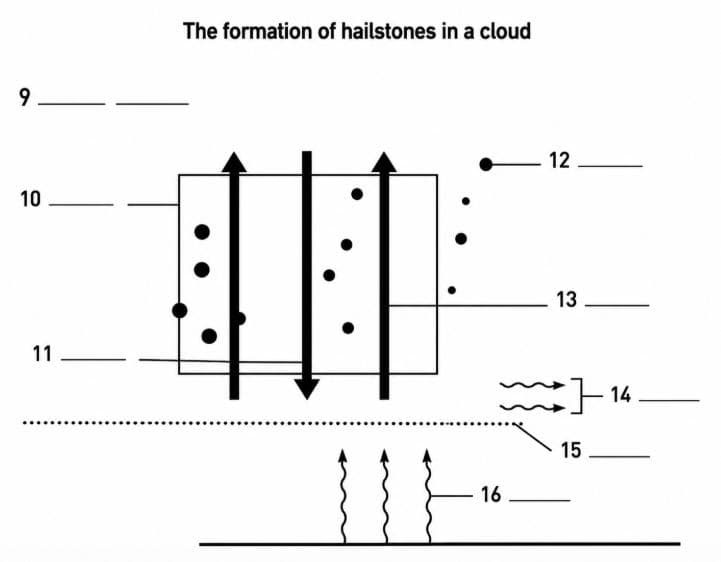
9. Label the diagram below by dragging the correct word or phrase from the box onto each gap.
A graupel
B updraft
C condensation level
D accretion
E heat released into atmosphere
F downdraft
G warm air
H supercooled area
10. Label the diagram below by dragging the correct word or phrase from the box onto each gap.
A graupel
B updraft
C condensation level
D accretion
E heat released into atmosphere
F downdraft
G warm air
H supercooled area
11. Label the diagram below by dragging the correct word or phrase from the box onto each gap.
A graupel
B updraft
C condensation level
D accretion
E heat released into atmosphere
F downdraft
G warm air
H supercooled area
12. Label the diagram below by dragging the correct word or phrase from the box onto each gap.
A graupel
B updraft
C condensation level
D accretion
E heat released into atmosphere
F downdraft
G warm air
H supercooled area
13. Label the diagram below by dragging the correct word or phrase from the box onto each gap.
A graupel
B updraft
C condensation level
D accretion
E heat released into atmosphere
F downdraft
G warm air
H supercooled area
14. Label the diagram below by dragging the correct word or phrase from the box onto each gap.
A graupel
B updraft
C condensation level
D accretion
E heat released into atmosphere
F downdraft
G warm air
H supercooled area
15. Label the diagram below by dragging the correct word or phrase from the box onto each gap.
A graupel
B updraft
C condensation level
D accretion
E heat released into atmosphere
F downdraft
G warm air
H supercooled area
16. Label the diagram below by dragging the correct word or phrase from the box onto each gap.
A graupel
B updraft
C condensation level
D accretion
E heat released into atmosphere
F downdraft
G warm air
H supercooled area
Twisted Light
[A] Why is your mobile phone or wireless signal so slow? If you ask your service provider, they'll tell you that it's the bandwidth. We're running out of signal space on the wireless spectrum. All wireless communications travel through radio or optical frequencies: your TV or radio programmes, your GPS device that helps you find your way, your mobile and smartphone, laptop and wirelessly connected PC. The demands from users and industry on a limited resource, the wireless spectrum, are growing daily and are closely regulated. The reason is that two users cannot use the same signal: think about radio stations, which have to operate on different frequencies otherwise they cause interference with each other. Likewise mobile phone operators cannot transit over the same frequency in the same market at the same time. Government-controlled agencies grant licences to use the wireless spectrum but if a wireless company wants to add more spectrum to its service to boost its capacity, it's likely to be disappointed as there isn't much more available. What is needed is a way of pushing more data through the same amount of bandwidth.
[B] Now scientists may have found a way of manipulating light waves to carry more information: potentially enough for users to be able to download a film onto a smartphone in a single second. By twisting light waves, scientists could possibly transmit data at speeds of 2.56 terabits per second: that's 85,000 times faster than the 30 megabits per second currently possible. To put it another way, this is the same as transmitting 70 DVDs through the air in about a second. Researchers based in America, China, Israel and Pakistan have built on previous research from Sweden, which negates the need for more bandwidth by making better use of the spectrum. The basis of the research is to manipulate the properties of light.
[C] One property of light is wavelength: lasers, radio waves, microwaves are simply different wavelengths of light. Light is made up of photons and photons have two other properties that define a beam of light: spin angular momentum and orbital angular momentum. A good way of thinking about how photons travel is to think of the orbit of a planet: it spins around on its axis (spin angular momentum), and at the same time the planet is also revolving around the sun (orbital angular momentum). The latter force means that light can be twisted around its axis of travel to take the shape of a spiral or a corkscrew. At the centre of the spiral the light waves cancel each other out, leaving darkness in the middle, called an optical vortex. When light travels, it is formed into a spiral shape and it can be manipulated. There are infinite possibilities for ways in which the photon can be made to spiral: clockwise, counterclockwise, tight spirals or loose ones. Each of these spiral states can be uniquely identified but, more importantly for wireless communication, the spirals can be wrapped up within each other - or multiplexed - into a single beam. The beam can be transmitted and unwound at the receiving end to get the data streams back out again, essentially doubling or trebling or even quadrupling the bandwidth.
[D] Scientists have been twisting light since the 1970s, and the spin angular momentum of waves is already manipulated in standard wireless communication. For years, Bo Thide of the Swedish Institute of Space Physics theorised that the orbital angular momentum could be used to create the spiral signal or as Thide calls it a 'radio vortex'. Then in an experiment in Venice, his team transmitted two signals simultaneously on the same frequency over a distance of 442 metres. Following on from this, researchers in America, China, Israel and Pakistan, led by Alan Wilner, twisted together eight light data streams, each stream with its own level of orbital angular momentum twist. One of the streams was transmitted as a thin stream while the others were transmitted around the outside. The data beam was then sent to a receiver and untwisted to recover the data.
[E] The achievement is very exciting for developers of wireless network technology as the useful spectrum of frequencies is largely used up. The orbital angular momentum model would allow for an infinite number of data transmissions without taking up any more of the spectrum. There is a problem, however: researchers can only transmit the data stream one metre, which is an insignificant distance for communication purposes. The short transmission range is due to turbulence in the atmosphere, which disrupts the signal as the light hits air molecules. But the scientists are planning to be able to send the beam considerably further. One idea is to create links every kilometre to extend the network. Another is to build high-speed satellite communication links where the atmospheric problems would not affect the signal. Another possibility is to adapt the technology for fibre-optic use, the way data is currently transmitted over the Internet. Unfortunately, at this point standard fibre-optic cables are not capable of carrying multichannel signals and fibre-optic cables that can carry the signal experience problems of interference between channels as they carry data with high bit-rates.
[F] Nevertheless, exploiting the orbital angular momentum gives scientists options that could lead to significant increases in data transfer; even a modest increase in the existing data transfer rate is worthwhile. Furthermore, very often technology is pulled along by innovative research so a novel solution to carrying the data-rich signal may not be far behind.
Questions 17–22
Reading Passage 2 has six paragraphs, A-F. Which paragraph contains the following information?
17. changing light waves to increase capacity
18. a practical demonstration of the new technology
19. use of the wireless spectrum needing to be monitored closely
20. overcoming the problem of the short range of the new signal
21. improvements in data transmission possibly leading to technological breakthroughs
22. the prospect of saving people a lot of time
Questions 23–27
Complete the summary using the list of words, A-I, below.
List of Words
A bandwidth
B atmospheric interference
C fibre-optic
D light waves
E multiplexing
F data streams
G novel
H wireless spectrum
I spirals
23. The wireless spectrum is a limited resource and users are demanding more …………………………
24. . Scientists are looking at ways of manipulating …………………………
25. to transmit more data. The technique used is to create …………………………
26. that can be wrapped up together. The experiment shows that transmission speed is reduced by …………………………
27. but scientists hope that ………………………… cable technology will catch up with the research breakthrough.
Sinking Cities
Looking across the Bund towards Pudong across the Huangpu River in Shanghai, you will see an array of modern world-beating skyscrapers. In contrast, behind you are the magnificent buildings from the nineteenth century. Standing on the high tourist promenade that runs the length of the waterfront, you may also notice that the level of the river is quite a bit higher than that of the buildings on the Bund. It isn't because the river has risen higher than usual due to rainfall; no - Shanghai is sinking. It is an unfortunate problem that Shanghai shares with several other major financial and industrial centres and it is caused by factors most of the cities have in common. Included in the list are New York, Bangkok, Houston and Mexico City, all either built on shaky foundations or low-lying land that is now threatened by rising sea levels.
New York and Bangkok are victims of bad luck. The effect of global warming on the sea levels means that these cities may drown in the oceans that brought them such importance and prosperity. Scientists believe that sea levels in the New York area are expected to rise about twice as quickly as in the rest of the world. The position of the city - situated where the Hudson River flows into the Atlantic Ocean - already puts America's most densely populated city at a higher risk of flooding. But the impact of tropical storms and rising tides poses more dangers than just flooding. Beaches in the area will be swept away followed by the surrounding wetlands eventually becoming part of the sea; surrounding river estuaries will see an increase in the salt levels in the fresh water. All of this will affect the ecosystems in New York's immediate area and damage developments along the coast. Bangkok too will fall victim to rising sea levels. Also situated on swamplands next to a river, the Chao Phraya, the city is about 50 kilometres north of the Gulf of Thailand. The city is likely to face increasingly severe tropical storms crossing from the Bay as well as threats from coastal erosion and shifting clay soil. It seems unlikely that Bangkok will save itself from drowning under the waters of the Pacific, which are predicted to rise by between 19 and 29 cm by 2050.
Other cities are sinking due to bad planning rather than bad luck. The fourth largest city in America is Houston but it has been built on shaky foundations - and these are now giving way. Houston was literally built on a foundation of sand up to several kilometres deep and loosely packed clay from river deposits formed from the erosion of the Rocky Mountains. In addition to poor foundation materials, Houston has an estimated 300 fault lines running through it. Using GPS data from 24 measuring points throughout the country between 1995 to 2005 a research team were able to monitor the area of subsidence and found an area of Houston measuring 30 kilometres squared was sinking very fast - up to 5 centimetres per year. The reason for the subsidence is quite straightforward: the withdrawal of water from deep beneath the surface. Areas of Houston where water extraction has been stopped have stopped sinking. Similarly, parts of Mexico City are subsiding rapidly due to poor foundations - some areas of the city are sinking up to 20 centimetres a year. The city is built on a dry lake bed in the valley of Mexico, and the council has condemned fifty structures since 2006 because of leaning, and approximately 5,000 homes and buildings are unstable. Some of the heaviest buildings, like the Palace of Fine Arts, have sunk more than three metres over the past one hundred years and its original ground floor is now the basement. Again the reason is the depletion of the water reserve lying under the city. But in this case there is a complicating factor: a vast complex of drains was built under the city to protect it from flooding by water running from the surrounding mountains. As the city sinks, so do the drains and the wastewater they were supposed to carry away is finding its way back to the city. And it's not only water mains and drains that have been affected; as the city sinks the subway network is subsiding with it.
Back in Shanghai, the same problem is causing the city of 13 million people and ultra-modern skyline to sink beneath the waterline of the Huang Pu River. Originally a small fishing village built on swamplands surrounding the mouth of the Yangtze River, Shanghai's population has swollen to around 13 million people. The expansion has been sustained by taking water from wells drilled into the aquifer under the city and by constructing massive skyscrapers. According to China Central Television, Shanghai has sunk up to three metres since the early 1990s mainly due to depletion of underground water but also because of the weight of high-rise buildings situated on areas with soft soil. As a partial solution to the problem, Shanghai is trying to reverse the sinking by pumping 5.2 billion gallons of water a year into the water table with some success - so far the city has risen by almost 11.5 cm.
Questions 28–35
Complete the table below. Choose NO MORE THAN THREE WORDS from the passage for each answer.
| City | Situated | Cause of sinking | Effect |
|---|---|---|---|
| New York | where the Hudson meets the Atlantic | the effect of (28) ………………………… and rising tides | increased chance of (29) ………………………… |
| Bangkok | on swamps near the Gulf of Thailand | increasingly damaging storms, (30) ………………………… and moving soil | a rise in the level of the Pacific of up to (31) ………………………… by 2050 |
| Mexico City | on a (32) ………………………… that has dried out | using up the (33) ………………………… beneath the city | wastewater drains and subway affected |
| Shanghai | on wetlands around the (34) ………………………… of the Yangtze River | wells drilled into aquifer and building (35) ………………………… | sunk up to 3 metres |
Questions 36–40
Choose the correct letter, A, B, C or D.
36. The thing that may strike you when you are standing on Shanghai's tourist promenade is
A the contrasting styles of the buildings.
B its height.
C that the river is higher than the buildings behind the promenade.
D that it runs the length of the waterfront.
37. Which of the following is NOT a predicted effect on New York?
A wetlands becoming part of the ocean
B beaches being lost
C developments along the coastline
D the increasing saltiness of river mouths
38. Houston has been built on
A shallow sand.
B material from the Rocky Mountains.
C volcanic fault lines.
D accurate GPS measurements.
39. The sinking in Houston
A affects the whole city equally.
B is due to water use and the weight of the buildings.
C has completely stopped.
D was measured using historical data.
40. Which of the following is NOT true of Mexico City's drains?
A They were built to defend the city from flooding.
B They run back to the surrounding mountains.
C They are sinking with the city.
D They are carrying wastewater back to the city instead of away from it.
Answers
1. False
2. True
3. True
4. Not Given
5. False
6. True
7. False
8. True
9. supercooled area
10. accretion
11. downdraft
12. graupel
13. updraft
14. heat released into atmosphere
15. condensation level
16. warm air
17. C
18. D
19. A
20. E
21. F
22. B
23. wireless spectrum
24. spirals
25. multiplexing
26. atmospheric interference
27. fibre-optic
28. tropical storms
29. flooding
30. coastal erosion
31. 29 cm
32. lake bed
33. water reserve
34. mouth
35. massive skyscrapers
36. that the river is higher than the buildings behind the promenade.
37. developments along the coastline
38. material from the Rocky Mountains.
39. was measured using historical data.
40. They run back to the surrounding mountains.
Explanations
- 1. False
- The passage explicitly describes the hailstorm in China as 'brief' (short), contradicting 'last a long time'. It does cause damage, but the duration claim is wrong. Paraphrase: 'The storm was very short, not lengthy, though it did cause destruction.' Distractor analysis: True would require the storm to be long-lasting; Not Given would apply if duration weren't mentioned, but it is clearly stated as brief.Common trap: Reversed-truth trap — the statement contradicts the passage's explicit word 'brief'.
- 2. True
- The passage states that the measured size was after melting had already caused it to lose 5 cm from its original size. Paraphrase: 'The hailstone had shrunk by 5 cm due to melting before anyone measured it.' Distractor analysis: False would contradict the melting loss; Not Given would apply if there were no mention of loss, but it is clearly stated.Common trap: None significant — the answer is directly stated.
- 3. True
- The passage describes these clouds as containing 'large amounts of energy', which is synonymous with significant quantities. Paraphrase: 'These clouds are powerful systems packed with energy.' Distractor analysis: False would mean they have little energy; Not Given would apply if not mentioned, but it is explicitly stated.Common trap: None significant — the answer is directly stated.
- 4. Not Given
- The passage mentions that cumulonimbus clouds are 'often called thunderheads', but it does not explain why they are called that — it never says they cause thunder and lightning. Paraphrase: 'The text gives the alternative name but does not provide the reason for it.' Distractor analysis: True would require a stated causal link; False would require a different reason to be given — neither happens.Common trap: Not Given trap — a plausible-sounding reason for the name is never actually stated.
- 5. False
- The passage explains that supercooled water remains liquid even below 0°C until it finds a particle to freeze on — so water does not always freeze at sub-zero temperatures. Paraphrase: 'Water can stay liquid below freezing point, so the statement is an overgeneralisation.' Distractor analysis: True would ignore the supercooled exception; Not Given would apply if not mentioned, but it is directly contradicted.Common trap: Absolute-language trap — 'always' overstates what the passage actually describes.
- 6. True
- The passage explicitly states that slower freezing allows air bubbles to escape, resulting in clear (transparent) ice. Paraphrase: 'When freezing happens gradually, the ice becomes see-through because air bubbles can leave.' Distractor analysis: False would contradict the clear-ice formation; Not Given would apply if not mentioned, but it is directly stated.Common trap: None significant — the answer is directly stated.
- 7. False
- The passage says hailstones are categorised according to size, not destructive power — it is the separate TORRO scale that uses destructive power, but the general categorisation stated first is by size. Paraphrase: 'The classification mentioned first is based on how big they are, not how much damage they cause.' Distractor analysis: Not Given would apply if classification weren't mentioned at all, but the passage explicitly says 'according to their size'.Common trap: Word-substitution trap — 'destructive power' swaps in a different basis for classification than the one explicitly stated first ('size').
- 8. True
- The passage states that between 40 and 70% of hailstones never reach the earth — i.e. many stay in the cloud or break up before landing. Paraphrase: 'A large proportion of hailstones melt or break up before hitting the ground.' Distractor analysis: False would contradict the percentage; Not Given would apply if not mentioned, but it is explicitly stated.Common trap: None significant — the answer is directly stated.
- 9. supercooled area
- The diagram shows the upper part of the cloud where hail forms. The passage states that hail grows in the main updraft where most of the cloud is supercooled water. Paraphrase: 'The region with water below freezing but still liquid is the supercooled area, and that's where hailstones develop.' Distractor analysis: 'accretion' is the growth process itself, not the location; 'updraft' is the wind, not the area.Common trap: Role-confusion trap — several word-box entries describe plausible but different roles (a location vs. a process vs. a wind) in the same diagram.
- 10. accretion
- The passage defines the accumulation of additional ice as 'accretion'. Paraphrase: 'The build-up of layers of ice on the hailstone is given a specific name — accretion.' Distractor analysis: 'graupel' is the initial particle, not the process; 'updraft' is the wind that moves the hailstone, not the growth process.Common trap: Role-confusion trap — several word-box entries describe plausible but different roles in the same diagram.
- 11. downdraft
- The passage mentions both updrafts and downdrafts — vertical winds. Downdrafts blow downward, carrying hailstones to the ground. Paraphrase: 'The downward-moving wind that can force hailstones violently back to earth is called a downdraft.' Distractor analysis: 'updraft' is the upward wind, the opposite direction; 'warm air' is the rising air before it forms the cloud, not the downward wind inside it.Common trap: Role-confusion trap — 'updraft' names the opposite-direction wind within the same diagram.
- 12. graupel
- The passage describes graupel as small frozen raindrops or soft ice particles that act as the core for hailstone formation. Paraphrase: 'Tiny icy particles called graupel provide the surface on which supercooled water freezes to start a hailstone.' Distractor analysis: 'accretion' is the growth process, not the particle itself; 'supercooled area' is the surrounding environment, not the particle.Common trap: Role-confusion trap — several word-box entries describe plausible but different roles in the same diagram.
- 13. updraft
- Updrafts are the vertical winds that lift the hailstone up through the supercooled layer. Paraphrase: 'The rising current of air that pushes the hailstone upward and allows it to grow is the updraft.' Distractor analysis: 'downdraft' is the downward wind, the opposite direction; 'warm air' is the initial rising air before cloud formation, not the specific wind inside the cloud.Common trap: Role-confusion trap — 'downdraft' names the opposite-direction wind within the same diagram.
- 14. heat released into atmosphere
- The passage explains that condensation releases heat into the surrounding air. Paraphrase: 'When water vapour condenses, it releases thermal energy into the atmosphere, making the air rise faster.' Distractor analysis: 'condensation level' is the altitude where condensation occurs, not the heat itself.Common trap: Role-confusion trap — 'condensation level' names a related but distinct concept (a location, not the heat itself).
- 15. condensation level
- The condensation level is the cold point where water vapour condenses back into liquid. Paraphrase: 'The specific height in the atmosphere where cooling causes vapour to turn into water is called the condensation level.' Distractor analysis: 'warm air' is the rising air below this level; 'supercooled area' is the freezing region higher up, not the condensation point itself.Common trap: Role-confusion trap — several word-box entries describe plausible but different vertical zones of the same cloud.
- 16. warm air
- The process starts with air close to the ground becoming warmer and rising. Paraphrase: 'Hot, less dense air near the earth's surface rises upward.' Distractor analysis: 'updraft' is the wind within the cloud higher up, not the initial warm air rising from the ground.Common trap: Role-confusion trap — 'updraft' names a related but higher-altitude wind in the same diagram.
- 17. C
- Paragraph C explains how manipulating the orbital angular momentum of light creates spirals that can be multiplexed to multiply bandwidth. Paraphrase: 'By twisting light into spiral shapes, we can pack more data streams into the same beam, effectively increasing capacity.' Distractor analysis: paragraph B mentions the potential speed increase as a headline figure, but C explains the actual mechanism of changing light waves.Common trap: Topic-recurrence trap — B also discusses the speed benefit, but only C explains the mechanism of manipulation.
- 18. D
- Paragraph D describes actual experiments — Thide's test in Venice and Wilner's test with eight streams. Paraphrase: 'This paragraph reports on real-world tests of the twisted-light technology.' Distractor analysis: no other paragraph gives experimental results, only theory or future plans.Common trap: None significant — the answer is directly supported by unique content.
- 19. A
- Paragraph A states that the wireless spectrum is limited and closely regulated. Paraphrase: 'The spectrum is a scarce resource and its use is strictly controlled by authorities.' Distractor analysis: other paragraphs discuss solutions to the shortage, not the regulatory issue itself.Common trap: None significant — the answer is directly supported by unique content.
- 20. E
- Paragraph E identifies the problem (1 metre range due to atmospheric turbulence) and then lists proposed solutions: links every kilometre, satellite links, or fibre-optic adaptation. Paraphrase: 'This paragraph addresses the transmission-distance limitation and offers ways to extend it.' Distractor analysis: no other paragraph discusses solving the distance problem.Common trap: None significant — the answer is directly supported by unique content.
- 21. F
- Paragraph F suggests that innovative research often drives technology forward, and a novel solution may soon emerge. Paraphrase: 'Breakthroughs in transmission could spur further technological advances.' Distractor analysis: other paragraphs focus on the existing technology and its problems, not on future knock-on breakthroughs.Common trap: None significant — the answer is directly supported by unique content.
- 22. B
- Paragraph B mentions that the new technology could allow users to download a film onto a smartphone in a single second — a huge time saving. Paraphrase: 'This speed would drastically reduce download times, saving people hours.' Distractor analysis: other paragraphs discuss technical aspects, not the direct user time-saving benefit.Common trap: None significant — the answer is directly supported by unique content.
- 23. wireless spectrum
- The summary says users want more of the scarce resource itself. Paraphrase: 'People are asking for additional spectrum capacity because the existing amount is insufficient.' Distractor analysis: 'bandwidth' is a close alternative, but the passage frames the shortage specifically in terms of the spectrum being a limited resource.Common trap: Near-synonym trap — 'bandwidth' is a plausible but less exact match for the resource being demanded.
- 24. spirals
- Paragraph C explains that photons can be made to spiral in many different states — clockwise, counterclockwise, tight or loose — and manipulating these spiral states is the basis for transmitting more data. Paraphrase: 'The specific property being manipulated is the shape of the light's spiral twist.' Distractor analysis: 'light waves' is the broader category, but the object actually manipulated to boost capacity is the spiral state.Common trap: Broad-category trap — 'light waves' names the general category rather than the specific property manipulated.
- 25. multiplexing
- The passage names the technique of wrapping several spiral data streams together into one beam 'multiplexing'. Paraphrase: 'The method used is multiplexing, which combines multiple spiral signals into a single beam.' Distractor analysis: 'spirals' is the object being multiplexed, not the name of the technique itself.Common trap: Object-vs-technique trap — 'spirals' names what is wrapped, not the wrapping technique.
- 26. atmospheric interference
- The short transmission range — and so the practical usefulness of the transmission speed — is limited by turbulence in the atmosphere disrupting the signal. Paraphrase: 'The atmosphere disrupts the signal, limiting its travel distance.' Distractor analysis: 'fibre-optic' is a proposed solution, not a cause of the problem.Common trap: Solution-vs-problem trap — 'fibre-optic' describes a proposed fix, not the cause of reduced range.
- 27. fibre-optic
- The passage mentions adapting the technology for fibre-optic use, but standard fibre-optic cables cannot yet carry the multichannel signals. Paraphrase: 'They hope fibre-optic cable technology will advance to support this new capability.' Distractor analysis: 'novel' is an adjective describing a possible future solution, not a type of cable.Common trap: Part-of-speech trap — 'novel' is grammatically tempting but is an adjective, not the cable type required.
- 28. tropical storms
- The passage states that the impact of tropical storms and rising tides poses dangers to New York beyond just flooding. Paraphrase: 'The combination of severe storms and higher tides is causing problems.' Distractor analysis: 'rising tides' is already given in the row text, so the missing cause is 'tropical storms'.Common trap: None significant — the answer is directly stated.
- 29. flooding
- The city's location already puts it at higher risk of flooding, before the additional effects of storms and tides are even considered. Paraphrase: 'New York is more prone to flooding due to its location.' Distractor analysis: 'erosion' is a threat mentioned for Bangkok, not the risk stated for New York.Common trap: City-confusion trap — a risk mentioned for a different city (Bangkok's erosion) could be wrongly substituted here.
- 30. coastal erosion
- The passage lists three threats to Bangkok: severe storms, coastal erosion, and shifting clay soil. Paraphrase: 'Bangkok faces damaging storms, erosion of the coast, and soil movement.' Distractor analysis: 'shifting clay soil' is already given in the row text as 'moving soil', so the missing item is 'coastal erosion'.Common trap: None significant — the answer is directly stated.
- 31. 29 cm
- The Pacific is predicted to rise by between 19 and 29 cm; the table asks for the figure 'up to', which is the maximum of the range. Paraphrase: 'By 2050, the sea level could increase by as much as 29 centimetres.' Distractor analysis: '19 cm' is the minimum of the range, not the 'up to' maximum requested.Common trap: Range-confusion trap — the lower bound of the range (19 cm) is a tempting but incorrect answer for an 'up to' maximum.
- 32. lake bed
- The passage states that Mexico City is built on a dry lake bed. Paraphrase: 'Mexico City stands on the former bed of a lake that is now dry.' Distractor analysis: 'swamplands' describes Shanghai's and Bangkok's setting, not Mexico City's.Common trap: City-confusion trap — 'swamplands', used for other cities in the passage, could be wrongly substituted here.
- 33. water reserve
- The depletion of the underground water reserve is given as the reason for Mexico City's subsidence. Paraphrase: 'They are draining the water stored below the city.' Distractor analysis: 'aquifer' is the term used for Shanghai's water source, not Mexico City's stated cause.Common trap: City-confusion trap — 'aquifer', used for Shanghai later in the passage, could be wrongly substituted here.
- 34. mouth
- Shanghai was originally built on swamplands surrounding the mouth of the Yangtze River. Paraphrase: 'The city is located near the river's outlet to the sea.' Distractor analysis: 'Bund' is a waterfront promenade in Shanghai, not a river feature, and is unrelated to this blank.Common trap: None significant — the answer is directly stated.
- 35. massive skyscrapers
- The sinking is caused by both water extraction and the construction of massive skyscrapers. Paraphrase: 'Pumping groundwater and erecting huge skyscrapers have contributed to subsidence.' Distractor analysis: 'high-rise buildings' is a close paraphrase used elsewhere in the passage, but the exact wording required here is 'massive skyscrapers'.Common trap: Synonym trap — 'high-rise buildings' (used later in the passage) is a near-synonym but not the exact wording required.
- 36. that the river is higher than the buildings behind the promenade.
- The opening paragraph says you may notice that the river level is quite a bit higher than the buildings on the Bund. Paraphrase: 'The striking observation is the unusual sight of the water level being above the structures behind the walkway.'Common trap: Partial-information trap — options A and D name true but minor details rather than the paragraph's central observation.
- 37. developments along the coastline
- The passage says rising seas will damage developments along the coast — the developments themselves are what gets damaged, not a predicted effect in their own right, unlike the other three options which are all direct predicted changes. Paraphrase: 'The predicted outcomes include loss of beaches, conversion of wetlands to sea, and saltier estuaries — but coastal developments are the objects affected, not an effect themselves.'Common trap: Category-confusion trap — 'developments' is the object being damaged, easily mistaken for a predicted effect like the other three options.
- 38. material from the Rocky Mountains.
- Houston's foundation is sand and loosely packed clay formed from erosion of the Rocky Mountains. Paraphrase: 'The ground under Houston is made of deposits washed down from the Rockies.'Common trap: Fabricated-detail trap — options A, C and D each introduce a detail not supported, or contradicted, by the passage.
- 39. was measured using historical data.
- The research team used GPS data from 1995 to 2005 — past records — to monitor subsidence. Paraphrase: 'The subsidence was tracked using earlier GPS records.'Common trap: City-confusion trap — option B mixes in the cause given for Shanghai (building weight), not Houston.
- 40. They run back to the surrounding mountains.
- The drains were built to protect the city from water running down from the surrounding mountains, but the drains themselves do not run back to the mountains — they run through and under the city. Paraphrase: 'The drains are designed to carry water away from the city, not to run back up to the mountains.'Common trap: Fabricated-detail trap — option B invents a detail (drains running back to the mountains) that the passage never states.
Comments
Loading comments…