

Collins IELTS 1 Academic Reading Test 2
3 passages · 40 questions · 60 minutes
Legumes
[A] The health benefit of legumes has been widely known for centuries. Also known as pulses or, more commonly, beans, they belong to an extremely large category of vegetables containing over 13,000 species. Only grains supply more calories and protein to the world's population. Today, agricultural researchers and scientists are experimenting with varieties of legumes that are easier to harvest, more resistant to disease and yield better crops.
[B] Beans are often referred to as 'the poor person's meat' but this label is unfair - considering the health benefits of legumes, they should really be called 'the healthy alternative to meat'. Beans contain a rich and varied supply of nutritional substances, which are vital for keeping in good health. Diets rich in beans are used to help with a variety of health issues including lowering cholesterol levels, improving blood sugar control in diabetics, reducing the risk of many cancers, lowering the risk of heart disease and lowering blood pressure. Beans are a good source of protein but are often considered to be an 'incomplete' protein as they lack the essential amino acids that we need to complete our diet. Foods from animals (meat, fish, eggs, dairy products), on the other hand, contain protein and amino acids. However, many cultures combine beans with grains to form a complete protein that is a high-quality substitute for meat - rice and soy in Japan, corn and beans in Mexico, rice and lentils in the Middle East. Beans are also a good source of fibre, giving the consumer between 5 and 8.6 grams of fibre per 100 grams eaten. Fibre is an important ingredient in a healthy diet with great benefits to our digestive system and in reducing cholesterol levels, which in turn reduces our risk of heart disease. Fibre also helps us to feel full and control our appetite.
[C] Why is it important to substitute meat as much as possible? First of all because of the health implications - red meat in particular has a high fat content. Secondly, antibiotics and other chemicals are used in the raising of poultry and cattle. Thirdly, the cost to the environment is much greater in raising cattle than it is in growing crops. To produce a kilogram of beef, farmers need to feed the cow 15 kilograms of grain and a further 30 kilograms of forage.
[D] Little wonder then that legumes have been used from ancient times. According to Trevor Brice in Life and Society in the Hittite World, the Hittites, an ancient people living in Anatolia from the eighteenth century BC, ate a wide variety of legumes including peas, beans, faba beans, chickpeas and lentils. And in ancient Egypt, Ramses II is known to have offered 11,998 jars of beans to the god of the Nile. Archaeologists have found the remains of legumes on land beneath Lake Assad in Syria dating back to 8,000 BC and, astonishingly, a 4,000-year-old lentil seed found during an excavation in Turkey has been germinated, allowing scientists to compare the ancient variety with the organic and genetically engineered varieties of today. Professor Nejat Bilgen from Dumlupinar University, who led the archaeological team, said that the lentils were found in a container dating from the Bronze age. The plant grown from the ancient lentil was found to be 'pretty weak' in comparison with modern varieties.
[E] Modern agricultural research has tended to focus on grain production, breeding new varieties of wheat and other crops rather than improving the varieties of legumes, which can suffer from low yields and unstable harvests. For this reason, farmers started to abandon them in favour of more dependable crops, which had had the benefits of scientific improvement. Recently, scientists have returned to legumes to identify desirable characteristics such as height, good crop production and resistance to pests in order to cross different plants with each other and produce a new, improved variety. Using traditional breeding methods agricultural scientists are transforming the faba bean into a variety that is easier to grow. Traditional varieties are undependable as they rely on insects to pollinate them. But faba bean types that can self-fertilise naturally were discovered and this gene is being bred into new varieties. Other faba bean varieties have been found that produce higher yields or shorter crops. Faba bean plants tend to grow tall and fall over in the field making them difficult to harvest mechanically so breeding plants that are 50% shorter means they are more stable. Unlike the traditional plants, the new faba bean plants end in a flower - this means that more of the plant's energy is transformed into producing beans instead of unusable foliage.
[F] With the new varieties, farmers in some regions are achieving a marked rise in production - between 10 to 20% improvement. Scientists have also managed to develop a commercial faba bean able to resist the parasitic weed Orobanche, which has been known to destroy whole fields of the crop. The future of legumes and the farmers who grow them is becoming brighter. Legumes are an important source of nourishment for humans and also for the soil: the beans take nitrogen directly from the atmosphere and fix it into the soil to provide nutrients for other crops and save the farmer the cost of artificial fertiliser. Making legumes a profitable crop for the future may prove an essential factor in feeding growing populations.
Questions 1–5
Choose the correct heading for each paragraph from the list of headings below.
List of Headings:
i. Improvements to faba bean farming
ii. Increasing productivity to secure the future of legume farming
iii. The importance of legumes
iv. The nutritional value of legumes
v. The effect of farming on the environment
vi. Legumes in the diet of ancient peoples
vii. The importance of reducing meat consumption
viii. Archaeological discoveries
ix. Legumes as a provider of protein
1. Paragraph A:
2. Paragraph B:
3. Paragraph C:
4. Paragraph D:
5. Paragraph F:
Questions 6–11
Do the following statements agree with the information given in the passage?
TRUEif the statement agrees with the information
FALSEif the statement contradicts the information
NOT GIVENif there is no information on this
6. Legumes are second to grain in providing people with calories and protein.
7. Beans can help to cure heart disease.
8. Antibiotics are used when farming animals for food.
9. Scientists have the opportunity to see how similar modern and ancient lentil plants are.
10. Agricultural scientists are making the faba bean easier to grow in dry areas.
11. New varieties of faba bean can destroy parasitic weeds.
Question 12
Choose the correct letter A, B or C.
12. What is the best title for Reading Passage 1?
A The health benefits of beans and pulses
B Diet in ancient times
C Agricultural scientists give legumes a new lease of life
What Is Dyscalculia?
When you look at the morning newspaper or check a news webpage, numbers are everywhere: the date is 12th September; it's 16°C in London; England lose 2-1 at football; the time is 12.30. But for people with dyscalculia, dealing with numbers presents a particular everyday difficulty. Dyscalculia is a learning difficulty in mathematics. It was originally uncovered by Kosc - a Czech researcher - after research into damage to parts of the brain involved in mathematical cognition. Dyscalculia can have two causes: brain damage or 'acquired dyscalculia' and developmental dyscalculia - or dyscalculia from birth. Whichever the cause, dyscalculia has three features: problems with mathematics; problems with mathematics only, not other areas of learning; and the assumption that these problems are rooted in brain activity.
Unlike dyslexia - difficulties with words - dyscalculia has been relatively little studied until recently. Very little is known about its causes, prevalence or how to treat it. Estimates indicate that between 3% and 6% of the population could be affected. The figures refer to children who only have difficulties with maths but have good or excellent performance in other areas of learning. People with dyscalculia have difficulty with the most basic aspects of numbers and mathematics, but this does not mean that the person affected has difficulty with higher mathematical reasoning or arithmetic. In fact, the evidence from brain-damaged dyscalculic people shows that an individual might suffer dyscalculia but can even show great ability in abstract mathematical reasoning.
Dyscalculia appears to be related to an ability shared between humans and many other animals. This is called 'subitizing' and is the capacity to count the number of objects by briefly looking at them. Subitizing seems to be an innate skill present in humans from birth and is a useful survival skill for humans and animals: there is a big advantage in being able to count how many predators or prey there are. Experiments with babies show that we are able to count at a very early age: if a baby sees a doll put behind a screen then another doll is also put behind the screen, the baby expects to see two dolls when the screen is removed. Babies will look longer at things they didn't expect to see, so if the screen is removed and the baby sees only one doll or three dolls, they stare at this unexpected sight longer, proving our ability to count from infancy. Dyscalculia could be explained by the lack of this innate capability. Genetic causes could include known genetic disorders such as Fragile X syndrome. However, as well as genetic factors, there could also be environmental causes such as drinking alcohol during pregnancy, which can result in underdevelopment of the brain.
There are many signs of dyscalculia including some well established and some less well researched. There are a number of symptoms that we are relatively certain of. Firstly, counting: whilst dyscalculic children can learn the sequence of numbers - 1, 2, 3, 4, 5, etc - they have difficulty counting backwards or forwards, particularly in twos or threes. Secondly, they find learning and remembering number facts difficult and often lack confidence even when they have the right answer. They can't use rules correctly either; for instance they may know that 4 + 2 = 6 but not be able to see that 2 + 4 = 6 or understand the concept of addition. Thirdly, they have problems with numbers with zeros and don't understand that the numerals 10, 100 and 1,000 are the same as the words ten, one hundred and one thousand. Fourthly, dyscalculic children may not be good at using money or telling the time. Concepts of speed or temperature may be difficult for them to fully understand. Finally, they may have problems in understanding directions or in following a map.
Diagnosing and treating dyscalculia is not straightforward as there are many reasons for being bad at maths including poor teaching, lack of motivation and inability to concentrate for long periods of time. An important result of present research will be to improve our methods for identifying children with dyscalculia. The treatment of the problem, however, is a different matter. Many people think that, because the cause of dyscalculia is in the brain, it can't be treated. But this is a misunderstanding. Every time we learn a new fact or skill, our brain changes. Furthermore, if we practise a new skill extensively the brain changes considerably. This is related to a property of the brain called 'plasticity', which simply means the ability of the brain to develop and change, particularly during childhood. Dyscalculia could be treated by experiences at home, providing an environment that encourages children to count. Schools could pay more attention to making sure children understand basic mathematical concepts before dealing with more advanced ideas; they should, for example, avoid teaching the division of fractions before ensuring children have understood the concept of division. Teaching maths through a multi-sensory approach using speech, sound, writing and reading simultaneously has been shown to be a good approach. Finally, maths should be taught in short blocks of time and lessons should build on what was taught previously.
Questions 13–16
Complete the sentences below. Write NO MORE THAN TWO WORDS from the passage for each answer.
13. A person with dyscalculia cannot solve basic ………………………… problems.
14. The condition was first discovered by a researcher investigating ………………………… to the brain.
15. Dyscalculia can be caused by injury to the brain or it can be present ………………………….
16. Other aspects of ………………………… are not affected by dyscalculia.
Questions 17–22
Do the following statements agree with the information given in the passage?
TRUEif the statement agrees with the information
FALSEif the statement contradicts the information
NOT GIVENif there is no information on this
17. There is not much information on how many people have dyscalculia.
18. People with dyscalculia are not able to do advanced maths.
19. Subitizing means knowing how many things there are by counting them.
20. Experiments show that babies are able to count to four.
21. One explanation is that people with dyscalculia have not inherited a common ability.
22. Drinking alcohol may be linked to the development of dyscalculia.
Questions 23–29
Classify the following as typical of category A, B, C or D.
Categories
A reasons for being bad at maths
B plasticity
C symptoms of dyscalculia
D treatments for dyscalculia
23. limiting maths teaching to short periods
24. being unmotivated to learn
25. the brain developing, especially when young
26. not associating words about figures with numbers
27. needing practice at telling the time
28. using all the senses when doing maths
29. poor concentration for longer lengths of time
Crowdmapping
One of the most exciting mass movements today is crowdmapping: sharing data collectively to produce a visualisation on a map giving almost-instant information on current events. Crowdmapping produces a picture of events on the ground as they happen by taking text messages and social media feeds together with geographic data to distribute real-time, interactive information on events such as revolutions, wars, humanitarian crises and natural disasters. This new application of social networking can bring fresh insights into events, which can be nearly impossible to cover through traditional methods of journalism where individuals report into a central newsroom. It has the additional advantage of mapping longer-term trends that fall in and out of the news.
Technologies like mobile phones and the world wide web have made it possible for those people caught up in a war or natural disaster to broadcast information from the affected area and for this information to be collected in a way that emergency aid services can use and act on. In a disaster situation the most current information is essential because the needs of, for example, flood victims change minute by minute. It enables response organisations to get an understanding of a crisis situation quickly (thus it is sometimes called crisis mapping), give targeted aid to people most in need and form a network of reliable reporters on the ground to check information going to the live updated map. When an emergency situation arises, a small army of volunteers comes together to collect incoming information and put it on the map. Some of the information comes from official sources such as the United Nations, but the most powerful aspect of data collection is the ability to pull information from Twitter posts, emails and text messages. Once this information is available, volunteers collaborate via the Internet to put data on to a map, which is updated every second to build a comprehensive picture of the scale and severity of the disaster. Volunteers from all over the world translate the messages coming in from the disaster zone into English and plot the information on the live interactive map.
One of the originators of crowdmapping is Ushahidi. The developers of crowdmapping software began the project in Kenya to map reports of violence after a controversial election result in 2008. Later, in 2010 in Haiti, a similar approach of collectively sharing information to help emergency services deal with the situation was adopted. A small team released a free phone number - 4636 - to allow victims of the 7.0-magnitude earthquake to text their requests for medical aid, water and shelter. Over 1,000 workers and volunteers around the globe, contacted via Facebook, translated the messages, mostly in Haitian Creole. They then prioritised and geolocated the requests for help via crowdmapping software. Through this service, emergency response teams were able to save the lives of hundreds of people and send food, water and medicine to tens of thousands. The success of Project 4636 led to the development of crowdmapping when dealing with critical and even non-critical situations.
Most recently, crowdmapping has been used to track violent activity in warzones and areas with uprisings. In one country, when the people rose up against their leader, the United Nations monitored the escalating violence via a crowdmap to provide them with information on what was happening in the country. In another country, rebel fighters reported people who were missing, killed or arrested according to eyewitnesses. Other uses for the software have included the Danish people's attempt to map the extent of CCTV surveillance in their country. Since the project began, 2,220 CCTV cameras have been photographed and verified by journalists. However, not all attempts at crowdmapping have been successful. The attempt to map an uprising in one country was cut short when the authorities took the country offline and, when the Internet was brought back, the crowdmap had been forgotten.
There are other downsides to crowdmapping. According to George Chamales, there are security challenges: it must be ensured that the system stays operational and that the information collated is not misused. Firstly, the lead crowdmap tends to be the one that is set up first and has the most users. Unfortunately, the organisation behind the first crowdmap may not be the best one to manage the complex process of collecting and managing the data. Secondly, there are several platforms for producing crowdmaps including commercial products and open-source projects like Ushahidi. Some have even been developed for a particular crisis such as the nuclear meltdown in Fukushima - all of these have their own disadvantages: commercial software may need to patch bugs in the programme; open source software may overlook security in favour of functionality. The information collected needs to come from trustworthy sources, which are then relied on for more reports; this may make the person sending the report a potential target in war situations. Finally, there is the human element in processing the information, relying on thousands of volunteers to translate, categorise and prioritise the information. There is an obvious risk in giving strangers access to messages generated in dangerous circumstances: messages may be deleted and the sender's identity may be compromised.
While the introduction of any new technology has flaws, George Chamales believes that crowdmapping cannot afford to go through the same maturation as other technologies: the risks to people using it in hostile political situations are too great and could lead to them being arrested or killed. Furthermore, over time the technology may be labelled as dangerous, leading organisations to shun an extremely useful instrument. The answer, Chamales believes, can be found in developing standards through collaboration between IT security experts and the crowdmapping movement. New challenges and issues will arise with each crisis mapped by the people affected, but George Chamales thinks that establishing security standards would be a good starting point to allow this valuable new form of networking to evolve.
Questions 30–34
Label the diagram below.
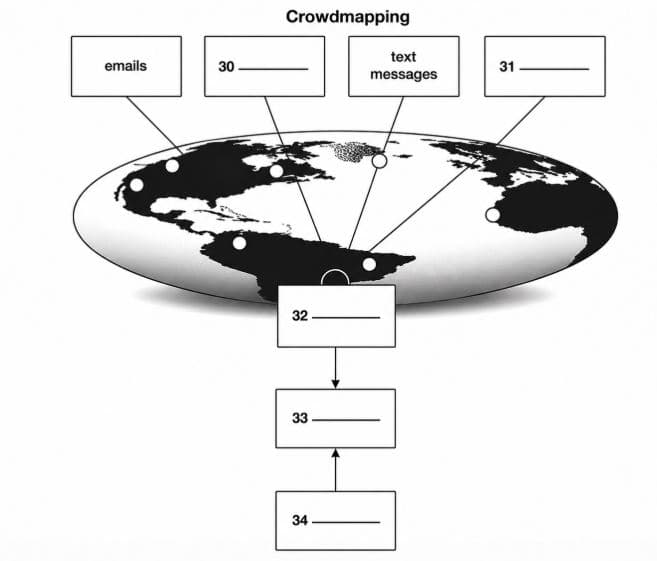
30. Label the diagram below by dragging the correct word or phrase from the box onto each gap.
A interactive map
B social media feeds
C emergency services
D volunteers collect and translate
E official sources
31. Label the diagram below by dragging the correct word or phrase from the box onto each gap.
A interactive map
B social media feeds
C emergency services
D volunteers collect and translate
E official sources
32. Label the diagram below by dragging the correct word or phrase from the box onto each gap.
A interactive map
B social media feeds
C emergency services
D volunteers collect and translate
E official sources
33. Label the diagram below by dragging the correct word or phrase from the box onto each gap.
A interactive map
B social media feeds
C emergency services
D volunteers collect and translate
E official sources
34. Label the diagram below by dragging the correct word or phrase from the box onto each gap.
A interactive map
B social media feeds
C emergency services
D volunteers collect and translate
E official sources
Questions 35–40
Choose the correct letter, A, B, C or D.
35. Crowdmapping aims to produce data on
A historical and future patterns of behaviour.
B political events.
C interactive maps.
D events after earthquakes only.
36. Crowdmapping allows emergency services to
A contact journalists.
B help everyone who needs it.
C check information online.
D act quickly in specific areas.
37. The operation relies heavily on
A a project in Kenya.
B a small team.
C people translating messages.
D emergency response teams.
38. The fourth paragraph contains examples of crowdmapping in
A countries with no internet access.
B countries with dangerous governments.
C countries with uprisings and wars.
D countries with a large number of volunteers.
39. Which is NOT a disadvantage of crowdmapping?
A the inability of some organisations to handle the data effectively
B unreliable information
C security being compromised
D computer crashes
40. What is the best way to deal with the problems associated with this new technology?
A wait for problems to be resolved
B arrest people using it incorrectly
C agree common practices to make crowdmapping secure
D change the process when new problems arise
Answers
1. iii
2. iv
3. vii
4. viii
5. ii
6. True
7. False
8. True
9. True
10. Not Given
11. False
12. Agricultural scientists give legumes a new lease of life
13. mathematical
14. damage
15. from birth
16. learning
17. True
18. False
19. False
20. Not Given
21. True
22. True
23. D
24. A
25. B
26. C
27. C
28. D
29. A
30. social media feeds
31. official sources
32. volunteers collect and translate
33. interactive map
34. emergency services
35. historical and future patterns of behaviour.
36. act quickly in specific areas.
37. people translating messages.
38. countries with uprisings and wars.
39. computer crashes
40. agree common practices to make crowdmapping secure
Explanations
- 1. iii
- Paragraph A introduces legumes by stating their long-known health benefits, their huge number of species, and their global significance — they are second only to grains in providing calories and protein. It also mentions that scientists are working to improve them. Paraphrase: 'This paragraph establishes why legumes matter globally: they are a major food source and are now the subject of agricultural research.' Distractor analysis: ix (Legumes as a provider of protein) is too narrow — the paragraph mentions calories and overall importance, not just protein; iv (The nutritional value) is the focus of paragraph B, not A; i (Improvements to faba bean) appears later in E and F.Common trap: Partial-information trap — several distractor headings describe only one detail from the paragraph, not its overall focus.
- 2. iv
- Paragraph B details the specific nutrients found in beans: protein, amino acids (when combined with grains), fibre, and their effects on cholesterol, blood sugar, and heart health. Paraphrase: 'This section is a thorough breakdown of the health-giving components of beans and what they do for the body.' Distractor analysis: iii (The importance of legumes) is too general — B is specifically about nutritional content; ix (Legumes as a provider of protein) covers only one aspect, since fibre and other benefits are also covered.Common trap: Partial-information trap — several distractor headings describe only one detail from the paragraph, not its overall focus.
- 3. vii
- Paragraph C gives three clear reasons to eat less meat: health (fat), chemicals (antibiotics), and environmental damage (grain/forage needed to produce beef). Paraphrase: 'This paragraph argues that we should replace meat with legumes for health, chemical, and ecological reasons.' Distractor analysis: v (The effect of farming on the environment) covers only one of the three reasons — the paragraph covers health and chemicals too; iv (Nutritional value) is paragraph B's topic.Common trap: Partial-information trap — several distractor headings describe only one detail from the paragraph, not its overall focus.
- 4. viii
- Paragraph D centres on the physical evidence dug up by archaeologists — legume remains found beneath Lake Assad in Syria and a germinated 4,000-year-old lentil seed excavated in Turkey by Professor Nejat Bilgen's team. Paraphrase: 'This paragraph is built around what archaeologists have physically unearthed and what that evidence reveals.' Distractor analysis: vi (Legumes in the diet of ancient peoples) covers only the opening sentences about the Hittites and Ramses II — the bulk of the paragraph is about the archaeological finds and what scientists learned from them; iii (Importance) is about current importance, but this paragraph is historical.Common trap: Partial-information trap — several distractor headings describe only one detail from the paragraph, not its overall focus.
- 5. ii
- Paragraph F describes how new varieties have raised yields (10-20% improvement) and made legumes more profitable, which is essential for feeding growing populations. Paraphrase: 'The final paragraph looks forward: better crop performance will make legume farming sustainable and help meet future food demands.' Distractor analysis: i (Improvements to faba bean farming) — paragraph F mentions faba beans but is broader, covering overall productivity and future security; v (Effect of farming on environment) is not the main point.Common trap: Partial-information trap — several distractor headings describe only one detail from the paragraph, not its overall focus.
- 6. True
- The passage states that only grains surpass legumes in supplying calories and protein worldwide — meaning legumes rank second. Paraphrase: 'In terms of global food supply, grains are number one, and legumes are number two for both calories and protein.' Distractor analysis: False would contradict the clear 'only grains' statement; Not Given would apply if no ranking was mentioned, but it is explicitly given.Common trap: None significant — the answer is directly stated.
- 7. False
- The passage says beans lower the risk of heart disease, not that they cure it. Cure implies complete elimination of an existing disease, which is not claimed. Paraphrase: 'Beans are beneficial for heart health by reducing the chance of developing heart problems, but they are not presented as a cure.' Distractor analysis: True would require the word 'cure' or an equivalent; Not Given would apply if the effect wasn't mentioned, but it is — the wording is different.Common trap: Word-substitution trap — the statement swaps in a stronger/different word ('cure', 'destroy') than the passage actually uses.
- 8. True
- The passage explicitly lists antibiotics among the chemicals used in raising poultry and cattle. Paraphrase: 'The text confirms that farmers give antibiotics to livestock raised for meat.' Distractor analysis: False would contradict this direct statement; Not Given is not applicable because it is clearly stated.Common trap: None significant — the answer is directly stated.
- 9. True
- A 4,000-year-old lentil seed was germinated, allowing scientists to compare the ancient plant with modern varieties. Paraphrase: 'Because an ancient seed grew into a plant, researchers can directly contrast its characteristics with today's organic and genetically engineered lentils.' Distractor analysis: False would contradict the germination fact; Not Given would apply if the comparison was not mentioned, but it is explicitly stated.Common trap: None significant — the answer is directly stated.
- 10. Not Given
- The passage discusses making faba beans easier to grow by introducing self-fertilisation and shorter stems, but it never mentions dry areas or drought resistance. Paraphrase: 'The improvements described relate to pollination and height, not to water availability.' Distractor analysis: True would require a statement about dry conditions; False would require a contradiction — neither exists.Common trap: Not Given trap — a plausible-sounding detail (dry areas) is never actually stated.
- 11. False
- Scientists developed a faba bean that can resist the parasitic weed Orobanche, not destroy it. Resistance means the weed cannot harm the plant, but the plant does not actively kill the weed. Paraphrase: 'The new variety withstands the weed, but it does not eliminate it.' Distractor analysis: True would require 'destroy' or 'eliminate'; Not Given would apply if the effect wasn't mentioned, but the ability to resist is mentioned, which contradicts 'destroy'.Common trap: Word-substitution trap — the statement swaps in a stronger/different word ('cure', 'destroy') than the passage actually uses.
- 12. Agricultural scientists give legumes a new lease of life
- While the passage mentions health benefits and ancient history, the main thread is the shift from neglecting legumes to modern scientific improvement (breeding, higher yields, resistance) to secure their future. Paraphrase: 'The overall message is that legumes, once abandoned for more reliable crops, are now being revived by agricultural research to become a sustainable food source for the future.'Common trap: Partial-information trap — options A and B each describe only one paragraph's topic, not the passage's overall arc.
- 13. mathematical
- The passage states that dyscalculia is a learning difficulty in mathematics, and it involves problems with the most basic aspects of numbers. Paraphrase: 'Individuals with this condition struggle with the foundational level of maths, not just advanced topics.' Distractor analysis: 'number' is close, but the passage's own phrasing about mathematics fits the gap as 'mathematical'.Common trap: None significant — the answer is directly stated.
- 14. damage
- Kosc uncovered dyscalculia through research into brain injury. Paraphrase: 'The initial identification came from studying what happens when parts of the brain are harmed.' Distractor analysis: 'injury' is a synonym, but the exact word in the passage is 'damage'.Common trap: None significant — the answer is directly stated.
- 15. from birth
- The passage distinguishes between acquired (from injury) and developmental (present from birth). Paraphrase: 'The condition has two origins: one is brain damage, the other is being born with it.' Distractor analysis: 'inherited' is not used; the text says 'from birth'.Common trap: None significant — the answer is directly stated.
- 16. learning
- One of the defining features is that the difficulty is specific to mathematics and does not impact other learning areas. Paraphrase: 'The problem is confined to maths; other subjects and types of learning remain intact.' Distractor analysis: 'education' or 'study' are not the exact words; the passage uses 'learning'.Common trap: None significant — the answer is directly stated.
- 17. True
- The passage explicitly says that very little is known about its prevalence (how common it is). Paraphrase: 'The extent of the condition in the population is still largely unknown.' Distractor analysis: False would require clear prevalence data, which is not given; Not Given would apply if prevalence wasn't mentioned, but it is mentioned as being unknown.Common trap: None significant — the answer is directly stated.
- 18. False
- The passage contradicts this by stating that people with dyscalculia can show great ability in abstract mathematical reasoning. Paraphrase: 'Having dyscalculia does not mean one cannot handle higher-level maths; in fact, some are quite skilled at it.' Distractor analysis: True would ignore the explicit counter-evidence in the passage.Common trap: Reversed-truth trap — the statement contradicts the passage's explicit counter-evidence or definition.
- 19. False
- Subitizing is defined as the capacity to count by briefly looking, not by deliberate counting. Paraphrase: 'It is instantaneous perception of quantity, not a step-by-step counting process.' Distractor analysis: True would misrepresent the definition given in the passage.Common trap: Reversed-truth trap — the statement contradicts the passage's explicit counter-evidence or definition.
- 20. Not Given
- The experiment with babies shows they can detect a difference between one, two, or three dolls, but it never mentions counting to four. Paraphrase: 'The passage gives examples with up to three dolls, but it does not state a specific maximum number like four.' Distractor analysis: True would require a statement about counting to four; False would require a contradiction, and neither exists.Common trap: Not Given trap — a specific number (four) is never actually stated, only implied by proximity to similar figures.
- 21. True
- The passage suggests dyscalculia may be explained by a lack of the innate subitizing ability, which is shared by humans and animals. Paraphrase: 'The condition could be due to missing an inborn skill that normally comes naturally.' Distractor analysis: False would contradict the 'lack' statement; Not Given is not appropriate because the explanation is clearly given.Common trap: None significant — the answer is directly stated.
- 22. True
- The passage lists environmental causes, including drinking alcohol during pregnancy, which can affect brain development. Paraphrase: 'Maternal alcohol consumption is mentioned as a possible environmental factor that could lead to dyscalculia.' Distractor analysis: False would mean alcohol is ruled out; Not Given would apply if not mentioned, but it is explicitly mentioned.Common trap: None significant — the answer is directly stated.
- 23. D
- The passage advises that maths should be taught in short blocks of time as a treatment approach. Paraphrase: 'A recommended strategy is to keep lessons brief.' Distractor analysis: not a symptom (C), not a reason for bad maths (A), not plasticity (B).Common trap: Category-confusion trap — several distractor categories describe superficially similar ideas about maths difficulty.
- 24. A
- Lack of motivation is listed as one of the causes of poor maths performance that are not dyscalculia. Paraphrase: 'Poor motivation is one of the alternative explanations for struggling with maths.' Distractor analysis: not a symptom of dyscalculia (C), not a treatment (D).Common trap: Category-confusion trap — several distractor categories describe superficially similar ideas about maths difficulty.
- 25. B
- This describes the brain's property of changing and developing, known as plasticity. Paraphrase: 'The brain's ability to grow and adapt, particularly in childhood, is called plasticity.' Distractor analysis: not a treatment (D) or symptom (C).Common trap: Category-confusion trap — several distractor categories describe superficially similar ideas about maths difficulty.
- 26. C
- One symptom is that dyscalculic children do not understand that numerals and number words represent the same value. Paraphrase: 'They fail to link the written symbols (10, 100) with the spoken words (ten, one hundred).' Distractor analysis: not a reason (A) or treatment (D).Common trap: Category-confusion trap — several distractor categories describe superficially similar ideas about maths difficulty.
- 27. C
- Difficulties with telling time are listed as a symptom. Paraphrase: 'Being poor at reading clocks is a characteristic sign of dyscalculia.' Distractor analysis: the passage does not frame this as a treatment (D) or reason (A).Common trap: Category-confusion trap — several distractor categories describe superficially similar ideas about maths difficulty.
- 28. D
- A multi-sensory approach (speech, sound, writing, reading) is recommended as a teaching method. Paraphrase: 'One effective intervention is to engage multiple senses simultaneously during maths instruction.' Distractor analysis: not a symptom (C).Common trap: Category-confusion trap — several distractor categories describe superficially similar ideas about maths difficulty.
- 29. A
- Inability to concentrate for long periods is listed as another non-dyscalculia reason for poor maths. Paraphrase: 'Difficulty sustaining attention is one of the many factors that can make someone bad at maths, but it is not dyscalculia itself.' Distractor analysis: not a symptom of dyscalculia (C) or treatment (D).Common trap: Category-confusion trap — several distractor categories describe superficially similar ideas about maths difficulty.
- 30. social media feeds
- The diagram shows the inputs to the crowdmapping process. The passage says crowdmapping takes text messages and social media feeds. Paraphrase: 'One of the key data sources is posts from social media platforms.' Distractor analysis: official sources (E) is another input, but this position corresponds to the first-mentioned source, social media feeds.Common trap: Role-confusion trap — several word-box entries describe plausible but different roles in the same process (input vs. processing vs. output vs. end user).
- 31. official sources
- The passage mentions official sources like the UN as another source of information. Paraphrase: 'In addition to public messages, information also comes from established organisations.' Distractor analysis: emergency services (C) are users of the map, not input sources.Common trap: Role-confusion trap — several word-box entries describe plausible but different roles in the same process (input vs. processing vs. output vs. end user).
- 32. volunteers collect and translate
- After information is received, volunteers gather it and translate it (e.g. from Haitian Creole). Paraphrase: 'A team of helpers sorts the incoming data and converts it into a common language for mapping.' Distractor analysis: interactive map (A) is the output, not the processing step.Common trap: Role-confusion trap — several word-box entries describe plausible but different roles in the same process (input vs. processing vs. output vs. end user).
- 33. interactive map
- The final product is a live, interactive map that is updated continuously. Paraphrase: 'All the processed information is displayed on a real-time, clickable map.' Distractor analysis: emergency services (C) use the output but are not the output itself.Common trap: Role-confusion trap — several word-box entries describe plausible but different roles in the same process (input vs. processing vs. output vs. end user).
- 34. emergency services
- The map is used by aid organisations to respond effectively. Paraphrase: 'The beneficiaries of the map are the relief teams who act on the information.' Distractor analysis: official sources (E) are input providers, not end users.Common trap: Role-confusion trap — several word-box entries describe plausible but different roles in the same process (input vs. processing vs. output vs. end user).
- 35. historical and future patterns of behaviour.
- The passage states that crowdmapping not only covers current events but also longer-term trends. Paraphrase: 'Beyond immediate crises, it can trace developments over time that are not always in the news.'Common trap: Partial-information trap — options B–D each name a single example rather than the overall aim.
- 36. act quickly in specific areas.
- It gives a rapid understanding of a crisis, enabling targeted aid to the most needy locations. Paraphrase: 'It helps responders get a fast overview and direct resources exactly where they are needed.'Common trap: Absolute-language trap — option B overstates the passage's claim.
- 37. people translating messages.
- The human element of translation, categorisation, and prioritisation is critical and involves thousands of volunteers. Paraphrase: 'The system depends on a large number of volunteers who translate and sort the incoming data.'Common trap: None significant — the answer is directly stated.
- 38. countries with uprisings and wars.
- Paragraph four describes use in a country with an uprising against a leader and in another where rebel fighters reported casualties. Paraphrase: 'The examples given in this paragraph are from conflict zones and popular revolts.'Common trap: Partial-information trap — option A latches onto a minor detail mentioned later in the same paragraph.
- 39. computer crashes
- The passage lists several disadvantages: poor management, unreliable sources, security risks, and identity compromise — but it never mentions computer crashes. Paraphrase: 'The drawbacks discussed include organisational issues, trust in sources, and safety risks, but technical failures like system crashes are not mentioned.'Common trap: Not Given trap — the correct answer is the one disadvantage never mentioned, among several that are.
- 40. agree common practices to make crowdmapping secure
- George Chamales argues for developing standards through collaboration between IT security experts and the crowdmapping community. Paraphrase: 'The solution is to establish shared protocols and security guidelines.'Common trap: None significant — the answer is directly stated.
Comments
Loading comments…