

Official Practice Material 1 Listening Test 2
4 parts · 40 questions · 30 minutes
Booking theatre tickets by phone
Questions 1–10
Complete the form below. Write ONE WORD AND/OR A NUMBER for each answer.
THEATRE ROYAL PLYMOUTH
Booking Form
Example – Performance: The Impostor
Date: Saturday (1) …………………………
Time: (2) …………………………
Tickets: three adults and one child
Seats in: the (3) …………………………
Seat row/number(s): A21 to (4) …………………………
Method of delivery: post
Total payment: £39
Card details:
Type: (5) …………………………
Number: (6) …………………………
Name: Mr J. (7) …………………………
Address: (8) ………………………… Street
London (9) …………………………
Additional requests: put on the mailing list
book (10) …………………………
Plan of a rock festival site
Questions 11–17
Label the plan of the rock festival site below. Choose SEVEN answers from the box and write the correct letter, A–I, next to Questions 11–17.
List of Options
A art exhibition
B band entrance
C car park
D craft fair
E exhibitors' entrance
F fringe stage
G lock-up garages
H main stage
I restaurant
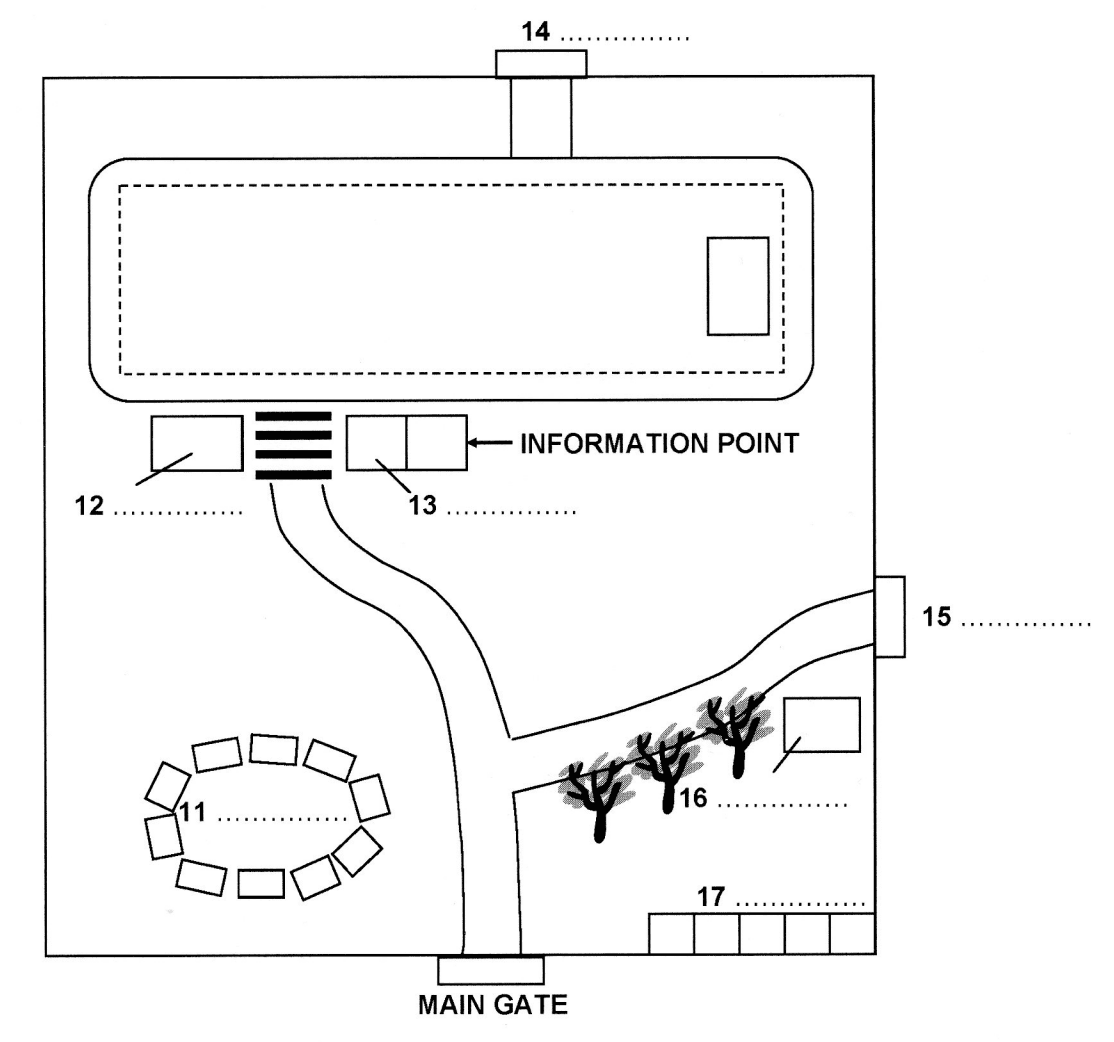
11. the area marked 11 on the plan
12. the area marked 12 on the plan
13. the area marked 13 on the plan
14. the area marked 14 on the plan
15. the area marked 15 on the plan
16. the area marked 16 on the plan
17. the area marked 17 on the plan
Questions 18–20
Complete the sentences below. Write NO MORE THAN TWO WORDS for each answer.
To show you are an official visitor, you have to wear the (18) ………………………… provided.
Cars blocking paths could prevent access by (19) ………………………… in an emergency.
To reclaim items from storage, you must show your (20) ………………………… .
Choosing courses and planning a dissertation
Questions 21–23
Choose THREE letters, A–G.
21. Which THREE factors does Marco's tutor advise him to consider when selecting a course?
A possibility of specialisation
B relevance to future career
C personal interest
D organisation of course
E assessment methods
F range of topics
G reputation of lecturer
22. Which THREE factors does Marco's tutor advise him to consider when selecting a course?
A possibility of specialisation
B relevance to future career
C personal interest
D organisation of course
E assessment methods
F range of topics
G reputation of lecturer
23. Which THREE factors does Marco's tutor advise him to consider when selecting a course?
A possibility of specialisation
B relevance to future career
C personal interest
D organisation of course
E assessment methods
F range of topics
G reputation of lecturer
Questions 24–27
Choose the correct letter, A, B or C.
24. Why does Marco's tutor advise him to avoid the Team Management course?
A It will repeat work that Marco has already done.
B It is intended for students at a lower level than Marco.
C It may take too much time to do well.
25. Why does Marco want to do a dissertation?
A He thinks it will help his future career.
B He would like to do a detailed study.
C He has already done some work for it.
26. What does Marco's tutor think about the dissertation outline?
A The topic is too narrow to be useful.
B The available data may be unsuitable.
C The research plan is too complicated.
27. What does Marco decide to do about his dissertation?
A contact potential interviewees
B change to another topic
C discuss it with Professor Briggs
Questions 28–30
Complete the sentences below. Write NO MORE THAN TWO WORDS for each answer.
A first draft of the dissertation should be completed by the end of (28) ………………………… .
The dissertation should be registered with the (29) ………………………… of the department.
Marco should get a copy of the statistics software from the (30) ………………………… .
Research on the tiger shark
Questions 31–33
Complete the notes below. Write ONE WORD ONLY for each answer.
The Tiger Shark
Origin of name: its dark bands
Size: 6.5 metres (maximum)
Preferred habitat: near to the (31) …………………………
Typical food: other sea creatures but also (32) ………………………… produced by humans
Raine Island area: studies show tiger sharks are mainly found here during the (33) ………………………… (when turtles are nesting)
Questions 34–38
Complete the flow-chart below. Write ONE WORD ONLY for each answer.
Shark Tagging Process
Pieces of (34) ………………………… were attached to lines as bait.
↓
The lines were (35) ………………………… regularly.
↓
The hooked shark was brought to the (36) ………………………… and secured.
↓
The shark was measured and tagged, and tissue removed for research.
↓
Larger sharks: an acoustic tag was fitted or a (37) ………………………… was attached.
↓
The shark was (38) ………………………… and could be tracked.
Questions 39–40
Choose the correct letter, A, B or C.
39. The purpose of the research was to understand the tiger sharks'
A reproductive patterns.
B migration patterns.
C feeding patterns.
40. Observations showed that, in general, tiger sharks
A change depths frequently.
B usually avoid the surface of the water.
C often spend long periods on the ocean floor.
Answers
1. 26th
2. 7:00
3. circle
4. A24
5. Mastercard
6. 3290 5876 4401 2899
7. Whitton
8. 42 South
9. SW2 5GE
10. headphones
11. D
12. F
13. I
14. B
15. E
16. A
17. G
18. arm band
19. an ambulance
20. yellow ticket
21. relevance to future career
22. organisation of course
23. range of topics
24. It will repeat work that Marco has already done.
25. He would like to do a detailed study.
26. The research plan is too complicated.
27. contact potential interviewees
28. March
29. secretary
30. computer office
31. coast
32. garbage
33. summer
34. fish
35. checked
36. boat
37. camera
38. released
39. migration patterns.
40. change depths frequently.
Explanations
- 1. 26th
- The 25th (Friday) is fully booked, so the man asks for 'the following day' and the clerk confirms 'The 26th? Yes, that's OK.' The form already prints Saturday.Common trap: The first date given (the 25th) is refused — the answer is the corrected date.
- 2. 7:00
- 'We've got two performances on that day, one at 3.30 and one at 7' — the man asks for 'the later one', which is 7.Common trap: Two times are offered together; only 'the later one' identifies which is wanted.
- 3. circle
- After hearing both prices the man asks about the view from the circle and then says 'we'll go for those then' about the front seats in the circle.Common trap: The stalls are described first and in more detail, but they are rejected on price.
- 4. A24
- 'That's seats A 21 to 24 then' — four seats for four people, ending at 24.Common trap: A21 is already printed, so writing 21 or the whole range scores nothing.
- 5. Mastercard
- Asked 'What kind of card is it? Visa? Switch?' the man answers 'Mastercard.'Common trap: Two card names are suggested by the clerk before the real answer is given.
- 6. 3290 5876 4401 2899
- 'It's 3290 5876 4401 2899' — the clerk reads back '28 double 9' to confirm the last group.Common trap: 'Double 9' in the read-back has to be converted to 99, not written as spoken.
- 7. Whitton
- 'It's Mr J Whitton - W-H-I-double T-O-N' — 'double T' gives Whitton, and the final letter is confirmed as N.Common trap: The clerk queries N versus M, which tempts the spelling 'Whittom'.
- 8. 42 South
- 'Yes. It's 42 South Street' — 'Street' is already printed on the form.Common trap: The clerk guesses Plymouth for the city; the man corrects her to London.
- 9. SW2 5GE
- 'And the post code? M: It's SW2 5GE.'Common trap: Letter/number strings are read quickly — SW2 and 5GE must both be captured.
- 10. headphones
- 'One of our group is hard of hearing and I've heard that you can supply special headphones' — the clerk replies 'I'll book those for you now.'Common trap: The mailing list is the other request and is already printed above the gap.
- 11. D
- 'we've set the stalls just inside the gate on the left, in a circle' — the ring of stalls just inside the main gate is the craft fair.Common trap: The circle of small boxes on the plan has to be matched to 'stalls ... in a circle'.
- 12. F
- 'On the left of the steps is the Fringe Stage' — 12 is the building to the left of the steps.Common trap: Left/right orientation is given from the main gate, not from the reader's own viewpoint.
- 13. I
- 'On the opposite side of the steps is a restaurant, and adjoining that is the main festival information point' — the information point is already labelled on the plan, so 13 is the restaurant beside it.Common trap: Both halves of the building are described in one sentence; only the restaurant half is unlabelled on the plan.
- 14. B
- 'The entrance for the rock bands is on the far side' — 14 is the gate at the top of the plan, the far side of the stadium from the main gate.Common trap: The main stage is named in the same sentence but is the unnumbered rectangle inside the stadium.
- 15. E
- 'you can see a third gate for exhibitors opening onto a side path' — 15 is the gate on the right-hand edge of the plan.Common trap: 'A third gate' has to be counted against the main gate and the band entrance already placed.
- 16. A
- 'A little way down the path, before you get to the trees, is the building where the Art Exhibition's being housed.'Common trap: 'Before you get to the trees' fixes the building on the plan — direction of travel matters.
- 17. G
- 'there's just one more building marked on your plan - quite near the main gate. It's divided into lock-up garages.'Common trap: The row of small compartments at the bottom right could be mistaken for a car park.
- 18. arm band
- 'an arm band to indicate that you are an official visitor' — exactly the wording of the question.Common trap: The yellow badge is listed in the same welcome pack and is also worn, but it is not the proof of official status.
- 19. an ambulance
- 'if there's an emergency and access for an ambulance is blocked, the situation will become not just annoying but also dangerous'.Common trap: The blocked vehicles are the cause, not the thing being blocked.
- 20. yellow ticket
- 'You'll be issued with a yellow ticket to reclaim your property'.Common trap: The red parking tickets are mentioned in the same breath and the speaker warns about mixing them up.
- 21. relevance to future career
- The tutor gives three pieces of advice: choose what you can use in a job, keep to a wide variety of subjects, and look at how the course is made up (seminars and tutorials as well as lectures).Common trap: Personal interest, specialisation and lecturer reputation are all raised in the conversation — each one is then rejected by the tutor.
- 22. organisation of course
- The tutor gives three pieces of advice: choose what you can use in a job, keep to a wide variety of subjects, and look at how the course is made up (seminars and tutorials as well as lectures).Common trap: Personal interest, specialisation and lecturer reputation are all raised in the conversation — each one is then rejected by the tutor.
- 23. range of topics
- The tutor gives three pieces of advice: choose what you can use in a job, keep to a wide variety of subjects, and look at how the course is made up (seminars and tutorials as well as lectures).Common trap: Personal interest, specialisation and lecturer reputation are all raised in the conversation — each one is then rejected by the tutor.
- 24. It will repeat work that Marco has already done.
- 'Team Management overlaps with the Introduction to Management course you took in your first year' — overlaps = repeats work already done.Common trap: Time IS mentioned, but as a consequence of the overlap rather than the reason to avoid the course.
- 25. He would like to do a detailed study.
- 'I'm keen to investigate something in depth, instead of just skating across the surface' — in depth = a detailed study.Common trap: The career idea is named by Marco himself, but as the argument against his choice.
- 26. The research plan is too complicated.
- 'the way you've organised it seems unnecessarily complex' — the organisation, i.e. the research plan, is too complicated.Common trap: Both 'data' and 'narrow' appear in the very next sentence, but with the opposite meaning to the options.
- 27. contact potential interviewees
- 'I was thinking of trying to persuade finance managers from three or four companies to let me ask them about their company finances' — and the tutor says 'Well go ahead then. I could give you some names.'Common trap: Both wrong options are stated aloud — one as a past event, one as a conditional fallback.
- 28. March
- 'you should aim to finish the first draft by the end of March'.Common trap: Two deadlines in one sentence — May is the final submission, not the first draft.
- 29. secretary
- 'it's internal to this department, so you just need to let the secretary know'.Common trap: Marco guesses the Registrar's department and is corrected in the very next line.
- 30. computer office
- 'If I were you, I'd drop in to the computer office and ask them for a copy.'Common trap: 'Statistics' and 'software' are both in the question stem, so the answer is the place, not the thing.
- 31. coast
- 'it is most often found along the coast, rather than the open sea' — 'most often found' = preferred habitat.Common trap: 'Temperate and tropical seas' is the overall range, not the preferred habitat.
- 32. garbage
- 'it's not uncommon to find garbage in its stomach ... where there is a lot of human activity' — garbage is the human-produced food.Common trap: The list of prey is already covered by 'other sea creatures' on the page.
- 33. summer
- 'there is a large population of tiger sharks present in the summer, during the turtle nesting season'.Common trap: Winter is named in the next sentence, but that is when the sharks are absent.
- 34. fish
- 'Early in the morning, we baited lines with large bits of fish and set them in place' — bits of fish = pieces of fish.Common trap: 'Bait' is already printed in the step, so copying 'baited' scores nothing.
- 35. checked
- 'These lines were then checked every three or four hours' — every three or four hours = regularly.Common trap: 'Replaced' is the passive verb in the next sentence and applies to the baits, not the lines.
- 36. boat
- 'it was pulled in close to the boat and secured' — pulled in close to = brought to.Common trap: 'Secured' is already printed, so the gap must be the noun that follows 'to the'.
- 37. camera
- 'while on other large sharks we attached a camera to the dorsal fin, to enable us to study the behaviour and habitat use of the sharks'.Common trap: The acoustic tag is the alternative already printed in the step — the gap needs the other device.
- 38. released
- 'After this, the shark was released, and we were able to follow its movements' — follow its movements = could be tracked.Common trap: ONE WORD ONLY — 'set free' or 'let go' would be over the limit.
- 39. migration patterns.
- 'what we hoped to do in this project was to see exactly what factors affected the migration patterns of tiger sharks'.Common trap: Food and reproduction are both named in the same sentence, but as candidate causes of migration.
- 40. change depths frequently.
- 'tiger sharks move back and forth between the ocean floor and the surface quite often' — moving between floor and surface often = changing depth frequently.Common trap: The individual findings about Natalie contradict the general pattern given in the next paragraph.
Audio transcripts
Part 1 — Booking theatre tickets by phone
F: Hello, Theatre Royal Plymouth. M: Oh hello - I'd like to make a booking, please. F: Yes. What is it you want to see? M: The Impostor. F: Right. And which day did you want to come? M: Friday the 25th. F: Just a moment and I'll check availability on the computer. Oh, sorry, we're fully booked for that performance. M: Oh dear. What about the following day then? F: The 26th? Yes, that's OK. We've got two performances on that day, one at 3.30 and one at 7. Which would you prefer? M: Oh, the later one, please. F: How many people? M: Well, there are four of us. F: Are there any concessions, any children? M: I'm not sure. My daughters are 15 and 12. Do they get concessions? F: Only the 12-year-old I'm afraid. So that's one child and three adults. Any idea where you'd like to sit? Stalls or circle? M: Er ... F: Tickets for the stalls are a bit more expensive - £12 for adults and £8.50 for children. The circle costs £10.50 and £6.50. M: Do you get a good view from the circle? F: Oh, yes. And in fact we've got some seats left at the front, if you'd like those. M: Right, we'll go for those then. F: Right. That's seats A 21 to 24 then. They're very good seats. M: That sounds fine. F: So let's see. That comes to £38 altogether for the tickets. How do you want to collect them? Shall I put them in the post? They'd be sent today by first class mail, and there'd be an additional charge of £1 to cover postage and administration. Or do you want to get them from the box office yourself? M: Oh yes. Could you send them please? F: No problem. That'll be £39 altogether. Could I just take your card details? What kind of card is it? Visa? Switch? M: Mastercard. F: OK. And the number? M: It's 3290 5876 4401 2899. F: 28 double 9. OK. And the name on the card please? M: It's Mr J Whitton - W-H-I-double T-O-N. F: N for 'never' or M for 'mother'? M: N for 'never'. F: Thank you. And now, I've nearly finished, but I just need your address and post code. M: Yes. It's 42 South Street. F: OK. Is that Plymouth? M: London. F: And the post code? M: It's SW2 5GE. F: That's fine then. The tickets should be with you tomorrow. Is there anything else I can do for you? M: Yes. I was wondering if I could get regular information about what's on. F: Certainly. I can just add your name to our mailing list. Would that be OK? M: That would be very good. Yes please. Oh, and there is something else, sorry. One of our group is hard of hearing and I've heard that you can supply special headphones. F: That's right. As long as you tell us in advance, we can always do that. I'll book those for you now, and you can just collect them from the box office before the show. M: Thanks very much for your help. F: No problem. Thank you for calling. M: Thank you. Bye.
Part 2 — Plan of a rock festival site
Good evening, everyone! I'm glad you could all make this planning meeting for what promises to be the biggest and most colourful free rock festival ever held in the south-east! So whether you're a performer, a craft exhibitor or an artist, we all extend a big welcome to you. Could we turn first to the plan so I can familiarise you with the layout of the site - which as you know is an old football stadium - we're really lucky to have so much space this year. You can see the main gate at the bottom of the plan - have you found it? - that's where most visitors will enter. It's also the entrance for those taking part in the craft fair: we've set the stalls just inside the gate on the left, in a circle. If you walk straight ahead from the gate along the path without turning right, you'll come to some steps up to the football stadium. On the left of the steps is the Fringe Stage. This is for alternative artistes - they include folk singers, poets and other acts which are more suited to a smaller stage - and they should also enter by the main gate. On the opposite side of the steps is a restaurant, and adjoining that is the main festival information point. Here you can get extra programmes and up-to-the-minute information about events, and you can discuss any last-minute problems - although we hope everything will be running smoothly when the festival opens. Right, coming back to the plan, you go up the stairs to the stadium. The entrance for the rock bands is on the far side, and on your right is the main stage, which will have powerful illumination and amplification throughout the weekend. There will probably be TV vehicles adjacent - that's in this area only - for recording purposes. If you look at the outside of the plan, you can see a third gate for exhibitors opening onto a side path. A little way down the path, before you get to the trees, is the building where the Art Exhibition's being housed. Then finally there's just one more building marked on your plan - quite near the main gate. It's divided into lock-up garages. So I hope you now feel quite familiar with the main festival area. We also hope that you'll have received your welcome pack. In it, you should find two parking tickets for yourself and anyone assisting you, an arm band to indicate that you are an official visitor, one of our brilliant yellow badges with the new festival logo, a festival programme, and several sheets of information that we'd ask you to study carefully before the event. Please could you note that all setting up of stalls, displays and so on should be completed by 9.30 a.m. and that unfortunately we won't be able to allow any vehicles to enter the festival area after that time. Yes, it's a big site - but even a few vehicles parked in the wrong place can block the paths. With crowds of people - and we are expecting several thousand - this can merely be a nuisance; but if there's an emergency and access for an ambulance is blocked, the situation will become not just annoying but also dangerous. And don't forget it could be your mother or your child who needs help. Several exhibitors and craftspeople have asked us if any provision can be made for overnight storage of tables, chairs and display items rather than having to take them home and bring them again. We're pleased to say that a limited amount of space has been made available in the building near the main gate. You'll be issued with a yellow ticket to reclaim your property - similar to the red parking tickets, so do check you bring the right one! - but please understand that this is entirely at your own risk as we can take no responsibility for items lost or damaged. I think that's all I have to say at this point but thank you all for your attention!
Part 3 — Choosing courses and planning a dissertation
T: Hi Marco, come in. M: Thanks. I've got a bit stuck trying to select courses for next semester. Could you help me, please? T: Of course. Sit down. First of all, most people just go for the areas of business that they're interested in, but - even if something doesn't look very stimulating - it's important that you can use it once you get a job. It's not much good choosing areas that aren't going to be helpful later on. M: Right. I want to go into management, so I'll need to think about that. And should I start specialising in a particular area yet? T: I don't think that's wise, at this stage. It's better to aim for a wide variety of subjects, especially as management covers so many possibilities. You shouldn't be limiting your choices for later on. M: Yes I see. T: You should also look at how the course is made up - will you have regular seminars and tutorials, for example, as well as lectures? M: OK. Some of the lecturers are quite big names in their fields, aren't they? Should I aim to go to their courses? T: Well remember that the lecturers who aren't well-known may still be very good teachers! I'd say we have a consistently high standard of teaching in this department, so you don't need to worry about it. M: Good. Well that's a great help. T: Now last time we met, you mentioned doing Team Management, didn't you? M: That's right. I'm still quite keen on the idea. T: The trouble is that because of changes in the content of various courses, Team Management overlaps with the Introduction to Management course you took in your first year. So what you'd learn from it would be too little for the amount of time you'd have to spend on it. M: I'll drop that idea, then. Have you had a chance to look at the outline I wrote for my finance dissertation? I left it in your pigeonhole last week. T: Yes. Why exactly do you want to write a dissertation, instead of taking the finance modules? It'll be pretty demanding. M: Well, I'm quite prepared to do the extra work, because I'm keen to investigate something in depth, instead of just skating across the surface. I realise that a broader knowledge base may be more useful to my career, but I'm really keen to do this. T: Right. Well I had a quick look through your outline, and the first thing that struck me was that you'll have to be careful how you set about it, as the way you've organised it seems unnecessarily complex. The data that you want to collect and analyse is potentially valuable, but you'll need to narrow down the subject matter to make the whole thing manageable. M: OK, I'll have another look at it. I was talking to Professor Briggs about it yesterday, and I got some more ideas then. For part of the dissertation I was thinking of trying to persuade finance managers from three or four companies to let me ask them about their company finances. If not I think I'll have to change to another topic. T: Well go ahead then. I could give you some names. M: Thanks. T: Now let's talk about practicalities. Your dissertation must be finalised by the end of May, so you should aim to finish the first draft by the end of March. Is that feasible? M: Yes, it shouldn't be a problem. I'll need to register for the dissertation, won't I? Is that with the Registrar's department? T: No, it's internal to this department, so you just need to let the secretary know. Do that as soon as you're sure you're going to write the dissertation. M: OK. T: Then to analyse your statistics, you're going to need some suitable software. If I were you, I'd drop in to the computer office and ask them for a copy. M: Right. So if I revise my outline, can I ...
Part 4 — Research on the tiger shark
Good morning, everyone. Today, I'm going to talk about the research project I've been involved in on the tiger shark. First of all, some background information. The tiger shark, also known as the leopard shark, is often thought to have got its name from its aggressive nature, but in actual fact, it's called that because it has dark bands similar to those on a tiger's body. It is a huge creature growing up to lengths of six and a half metres. It can be found just about everywhere throughout the world's temperate and tropical seas, but it is most often found along the coast, rather than the open sea. In terms of feeding, tiger sharks tend to be most active at night and are solitary hunters. Their preferred prey includes other sharks, turtles, seabirds and dolphins, to name but a few. However, it's not uncommon to find garbage in its stomach. This is because it tends to feed in areas such as harbours and river inlets, where there is a lot of human activity. Now to the project itself. We are particularly interested in some studies that had been done in the Raine Island area. Observations here have shown that there is a large population of tiger sharks present in the summer, during the turtle nesting season. However, during the winter months the sharks disappear - so we decided to do some of our own research there. The first step was to tag a number of sharks so that we could follow their movements. To do this, we first needed to catch the sharks. Early in the morning, we baited lines with large bits of fish and set them in place. These lines were then checked every three or four hours. If no sharks were caught, the baits were replaced. Once a shark had been caught on one of the baited hooks, it was pulled in close to the boat and secured so that we could carry out a number of brief activities to aid our research. This usually took no more than about ten minutes and was carried out as carefully as possible to minimise any stress to the shark. Each of the tiger sharks that we caught was measured and fitted with an identification tag and also a small amount of tissue was taken for genetic studies. For some larger sharks over three metres long, we also inserted into the belly a special acoustic tag capable of sending satellite signals, while on other large sharks we attached a camera to the dorsal fin, to enable us to study the behaviour and habitat use of the sharks. After this, the shark was released, and we were able to follow its movements. So what was the purpose of all this tagging? Well, while we were already familiar with some aspects of the tiger sharks' behaviour and food sources, what we hoped to do in this project was to see exactly what factors affected the migration patterns of tiger sharks and whether it was in fact food, weather and reproductive needs. These are some of our findings: On February 21st a large female shark, whom we named Natalie, was attracted to our research boat at the northern tip of Raine Island and fitted with one of the satellite tags I've just mentioned. No transmissions were received from Natalie between April 2nd and April 29th indicating that she didn't surface to feed during this period. The area in which she was last reported is very shallow, suggesting that she may have changed her feeding preferences during this period to focus on prey found on the sea floor. We also made a number of other discoveries thanks to the various transmitters we used. It seems that tiger sharks move back and forth between the ocean floor and the surface quite often. This may help the sharks conserve energy while they swim, but it probably also helps them hunt, since this movement back and forth maximises its chances of not being detected by its prey until the last minute. So far our findings have not been conclusive. However, we have gained some very interesting insights into the behaviour of tiger sharks and are now hoping to develop our research further.
Comments
Loading comments…