

Barron's IELTS 1 Listening Test 1
4 parts · 40 questions · 30 minutes
Enquiry about language classes
Questions 1–4
Complete the schedule below. Write NO MORE THAN THREE WORDS for each answer.
Globetrotters Language School
Class Schedule
Chinese
Level: Advanced
Days: (1) ………………………… evenings
Japanese
Level: (2) …………………………
Days: Tuesday and Thursday mornings
Level: (3) …………………………
Days: Monday, Wednesday, and Friday mornings
French
Level: Intermediate
Days: Friday (4) …………………………
Questions 5–8
Complete the information below. Write NO MORE THAN ONE NUMBER for each answer.
Tuition Information
| One week | $ (5) ………………………… |
|---|---|
| Four weeks | $ (6) ………………………… |
| Six weeks | $ (7) ………………………… |
| Twelve weeks | $ (8) ………………………… |
Questions 9–10
Complete the sentences below. Write NO MORE THAN THREE WORDS for each answer.
9. • Students can register for a class by visiting ………………………… .
10. • ………………………… is in charge of student registration.
Tour of the city shopping district
Questions 11–15
Label the map below. Write the correct letter, A–I, next to Questions 11–15.
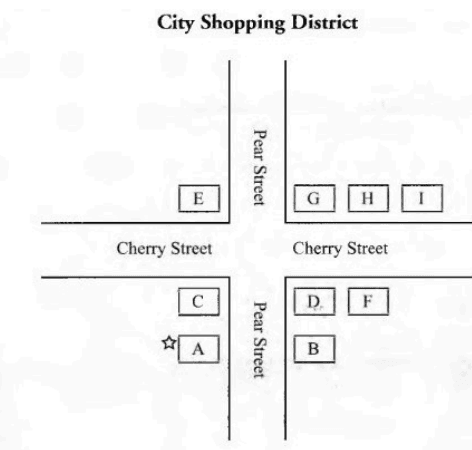
11. Harbor View Bookstore
12. Pear Café
13. Souvenir Store
14. Art Gallery
15. Harbor Park
Questions 16–20
Complete the sentences below. Write ONE WORD ONLY for each answer.
16. • The park was built in ………………………… .
17. • A ………………………… stands in the center of the park.
18. • Take the path through the ………………………… .
19. • In the middle of the garden is a ………………………… .
20. • A ………………………… takes you down to the harbor and a view of the boats.
Using the City Archives
Questions 21–24
Complete the information about the archives. Write NO MORE THAN THREE WORDS AND/OR A NUMBER for each answer.
Welcome to City Archives
The following people may use the archives:
• University students with a valid (21) …………………………
• City residents with payment of (22) …………………………
• All others: Special permission from the director is required.
Hours:
Days: (23) …………………………
Hours: 9:30 A.M. until (24) ………………………… P.M.
Questions 25–30
What can be found on each floor of the archives building? Write the correct letter, A–G next to Questions 25–30.
Contents
A nineteenth-century documents
B maps
C personal papers
D photographs
E books about the city
F newspapers
G information about the woolen mill
25. basement
26. ground floor
27. second floor
28. third floor
29. fourth floor
30. fifth floor
Wind power
Questions 31–33
Complete the notes below. Write NO MORE THAN TWO WORDS for each answer.
Historical Uses of Wind Power
| Ancient China | Windmills were used to (31) ………………………… |
|---|---|
| Ancient Persia | Farmers used wind power to (32) ………………………… |
| The Netherlands | People used windmills to (33) ………………………… |
Questions 34–40
Complete the chart below. Write NO MORE THAN TWO WORDS for each answer.
Wind Power
| Advantages | Unlike oil and coal, wind power does not cause (34) ………………………… | There are limited supplies of oil and coal, but wind is a (35) ………………………… | It (36) ………………………… to generate electricity with the wind. | Wind turbines do not take up much land. | — |
|---|---|---|---|---|---|
| Disadvantages | The cost of the initial investment is high. | The (37) ………………………… of the wind is not constant. | Wind turbines are usually located far from (38) ………………………… | Wind turbines may spoil (39) ………………………… | Wind turbines create as much (40) ………………………… as a high-speed car. |
Answers
1. Wednesday and Friday
2. intermediate
3. beginning
4. mornings
5. 125
6. 410
7. 175
8. 1,050
9. the school office
10. Mr. Lindsay
11. A
12. C
13. F
14. H
15. I
16. 1876
17. statue
18. woods
19. fountain
20. staircase
21. identification card
22. an annual fee
23. Tuesday, Sunday
24. 8:30
25. D
26. A
27. F
28. B
29. G
30. C
31. pump water
32. grind grain
33. drain lakes
34. pollution
35. renewable resource
36. costs less
37. strength
38. cities
39. scenery
40. noise
Explanations
- 1. Wednesday and Friday
- 'We offer an advanced Chinese class, but it meets on Wednesday and Friday evenings.' The Chinese class is the advanced one, so these are its days.Common trap: Rejected-option trap – the man immediately rules this class out because he works evenings, so a student following his choice rather than the schedule may skip the days entirely.
- 2. intermediate
- 'We have beginning Japanese on Tuesday and Thursday mornings, no wait, that's intermediate Japanese.' The speaker corrects herself, so the Tuesday/Thursday class is intermediate.Common trap: Self-correction trap – 'beginning' is said first and withdrawn mid-sentence with 'no wait'; only the corrected level counts.
- 3. beginning
- 'Well then, are you free Monday, Wednesday, and Friday mornings? That's when the beginning Japanese classes meet.'Common trap: Adjacent-class trap – the intermediate French slot is named in the same breath; 'intermediate' belongs to French, not to this Japanese row.
- 4. mornings
- 'We also have intermediate French on Friday mornings.'Common trap: Time-of-day trap – a Friday afternoon class is mentioned soon after, but that is intermediate Japanese, not French.
- 5. 125
- 'Or, you could pay for one week at a time, at $125 a week.'Common trap: Paired-figure trap – the four-week and one-week prices are read out in one turn, in the reverse order to the table's rows.
- 6. 410
- 'If it's hard for you to pay that much, you could sign up for just four weeks of class and pay $410.'Common trap: Paired-figure trap – shares one sentence with Q5, so the two prices must be split between the right rows.
- 7. 175
- 'For a six-week course, the cost would be $175.'Common trap: Out-of-order trap – the six-week price is quoted first in the conversation but sits third in the table.
- 8. 1,050
- 'For example, pay for your beginning and intermediate classes now and you'll get twelve weeks of class for just $1,050.'Common trap: Conditional-offer trap – the twelve-week price only applies if two levels are booked together, and the man declines it, so it is easy to discard as 'not the answer'.
- 9. the school office
- 'What you'll need to do is visit the school office today or tomorrow.' Phone registration is explicitly refused.Common trap: Near-miss trap – the website is also somewhere you 'visit', but only to download the form; registration itself has to be done in the office.
- 10. Mr. Lindsay
- 'When you arrive, ask for Mr. Lindsay. He's in charge of student registration.' The spelling is confirmed: 'Mr. Lindsay, spelled L-I-N-D-S-A-Y.'Common trap: Spelling trap – the name is spelt out only after the man asks 'Mr. who?', so a student who stops listening at the first mention risks 'Lindsey'.
- 11. A
- 'Let's start our tour here on Pear Street where the star is. This star marks the Harbor View Bookstore.' The star on the map is beside box A.Common trap: Landmark trap – the City Library opposite is described in more detail than the bookstore itself, tempting the box across Pear Street (C).
- 12. C
- 'Now, moving up Pear from the bookstore toward Cherry, the next building on the left is the Pear Cafe. You'll notice it's right on the corner of Pear and Cherry streets.' Moving up from A, the corner box on that side is C.Common trap: Viewpoint trap – what is described next is the view FROM the cafe across Cherry Street (E), not the cafe's own position.
- 13. F
- 'Continuing down Cherry Street, the next building on the right after Caldwell's is the souvenir shop.' Caldwell's is on the opposite corner (D), so the next one along is F.Common trap: Anchor trap – the store is located relative to Caldwell's, which is itself only located a sentence earlier and is not one of the answers.
- 14. H
- 'Now, we cross Cherry Street and we're at the art gallery, one building down from the corner.' Crossing Cherry from F puts the tour on the G–H–I side; 'one building down from the corner' is H.Common trap: Off-by-one trap – 'one building down from the corner' rules out the corner box G; only the count separates the two.
- 15. I
- 'Let's keep going down Cherry Street toward the harbor. On the left, right after the gallery, is Harbor Park.' The next box after H is I.Common trap: Chained-reference trap – the park is placed relative to the gallery, so an error on Q14 carries straight through to this one.
- 16. 1876
- 'Captain Jones designed the park himself, and it was built in 1876.'Common trap: Number trap – another figure (the 1:30 departure) is given in the same talk; only the build year fits this sentence.
- 17. statue
- 'Exactly in the center of the park a statue of Captain Jones was erected, and it's still standing there today.'Common trap: Word-limit trap – 'ONE WORD ONLY', so 'statue of Jones' or 'Jones statue' is over the limit.
- 18. woods
- 'After viewing the statue, you can follow the path that goes through the woods just behind.'Common trap: Second-path trap – a different path (along the water) is described at the end of the talk; this sentence is about the one behind the statue.
- 19. fountain
- 'It will lead you to a lovely garden, in the middle of which is a fountain.'Common trap: Two-centres trap – Q17 also asks what is 'in the center'; that one is the park, this one the garden.
- 20. staircase
- 'There, you'll find a wooden staircase, which will take you down to the harbor. You might enjoy the view of the boats from there.'Common trap: Word-limit trap – the talk says 'a wooden staircase', but only one word is allowed.
- 21. identification card
- 'All you need to do is show your university identification card and you can use the archives at no charge, as long as your ID card is current, of course.' The word 'valid' in the notes matches 'current'.Common trap: Paraphrase trap – 'valid' in the notes is 'current' in the talk, so the cue word to listen for is not repeated.
- 22. an annual fee
- 'City residents pay an annual fee, but students can use the archives for free.'Common trap: Wrong-group trap – the free access applies to students, not to city residents; the sentence contrasts the two in one breath.
- 23. Tuesday, Sunday
- 'We're open all weekend; actually the only day we're closed is Monday. So you can come any day, Tuesday through Sunday.'Common trap: Negative-information trap – 'Monday through Friday' is the student's class timetable and Monday is the closing day, so both tempt the wrong span.
- 24. 8:30
- 'Yes, we're open from 9:30 in the morning until 8:30 in the evening.'Common trap: Paired-figure trap – 9:30 is already printed in the notes, so writing it again wastes the mark; the closing time is the second figure.
- 25. D
- 'Yes, we store all the photographs in the basement.'Common trap: Overlapping-collection trap – the photographs are nineteenth-century, which tempts option A (nineteenth-century documents).
- 26. A
- 'Now, if you're interested in seeing documents from the nineteenth century, those are right here on the ground floor.'Common trap: Same-century trap – the basement photographs are also nineteenth-century; only the word 'documents' separates this floor from that one.
- 27. F
- 'No, all the newspapers from the earliest ones, in the eighteenth century, up to the current time, are on the second floor.'Common trap: Rejected-guess trap – the student first asks whether newspapers are with the ground-floor documents and is told 'No'.
- 28. B
- 'Oh, I see you have a whole room devoted to maps.' – 'Yes, on the third floor.'Common trap: Word-echo trap – 'map' is used a moment earlier for the handout the librarian gives out, not for the collection.
- 29. G
- 'What's this on the fourth floor—Ogden's Woolen Mill?' The Ogden heirs funded 'an entire floor to information about the history of the mill'.Common trap: Family-vs-mill trap – the student immediately asks about Ogden photographs and personal papers, which are on other floors entirely.
- 30. C
- 'The personal papers would be on the fifth floor, where we keep all the personal papers of famous residents of our city.'Common trap: Split-answer trap – the same reply sends the photographs back to the basement and the papers to the fifth floor.
- 31. pump water
- 'In ancient China, farmers used a rudimentary sort of windmill to pump water.'Common trap: Cross-row trap – the Netherlands entry also involves moving water, so the two water uses must be kept apart.
- 32. grind grain
- 'In Persia, for example, farmers used wind-powered mills to grind their grain.'Common trap: Word-limit trap – the talk says 'grind their grain'; the possessive has to be dropped to stay within two words.
- 33. drain lakes
- 'They used windmills to drain lakes, thereby creating more land for farming.'Common trap: Purpose-vs-action trap – creating farmland is the result; the chart asks what the windmills were used to do.
- 34. pollution
- 'One of the biggest problems with using fuels such as oil and coal is pollution. Wind power, on the other hand, is clean. It causes no pollution and therefore doesn't contribute to global warming.'Common trap: Consequence trap – 'global warming' follows in the same sentence, but the chart's 'does not cause' matches 'causes no pollution'.
- 35. renewable resource
- 'Another great advantage of wind power is that it's a renewable resource. Oil and coal reserves are limited, but we'll never run out of wind.'Common trap: Order trap – the chart states the limited-supply half first and the talk states it second, so the cue arrives after the answer.
- 36. costs less
- 'Using the wind to generate electricity costs less, much less, than running other types of generators.'Common trap: Word-limit trap – 'costs less, much less' is how it is said; only the first two words fit the cell.
- 37. strength
- 'Another issue is reliability. Wind doesn't blow at a constant strength.'Common trap: Heading-vs-detail trap – 'reliability' names the problem, but the chart's 'is not constant' points to the noun in the next sentence.
- 38. cities
- 'Wind turbines usually have to be located in rural areas where the land is open. Their distance from cities, where the most electricity is needed, is another issue.'Common trap: Inverted-statement trap – the talk says where turbines ARE (rural areas); the chart asks what they are far FROM.
- 39. scenery
- 'Rural residents often feel that the beautiful local scenery is spoiled by the sight of the wind turbines.'Common trap: Passive-to-active trap – the talk says the scenery 'is spoiled by' the turbines; the chart flips it to 'turbines may spoil ___'.
- 40. noise
- 'In addition, wind turbines aren't quiet. In fact, one wind turbine can produce as much noise as a car traveling at highway speeds.'Common trap: Category trap – the noise is introduced as a 'sort of pollution', which repeats the Q34 answer word.
Audio transcripts
Part 1 — Enquiry about language classes
Narrator: You will hear a number of different recordings, and you will have to answer questions on what you will hear. There will be time for you to read the instructions and questions, and you will have a chance to check your work. All the recordings will be played once only. The test is in four sections. Write all of your answers on the test pages. At the end of the test you will be given ten minutes to transfer your answers to an answer sheet. Now turn to Section 1 on page 5. Section 1. You will hear a man asking for information about language classes over the phone. First you have some time to look at Questions 1 to 4 on page 5. You will see that there is an example that has been done for you. On this occasion only, the conversation relating to this will be played first. Woman: Good morning. Globetrotters Language School. How may I help you? Man: Yes, I was wondering if you could give me some information on language classes. Narrator: The woman answers the phone, "Globetrotters Language School," so the word Globetrotters has been written at the top of the form. Now we shall begin. You should answer the questions as you listen, because you will not hear the recording a second time. Listen carefully and answer Questions 1 to 4. Woman: Good morning. Globetrotters Language School. How may I help you? Man: Yes, I was wondering if you could give me some information on language classes. Woman: Certainly. What language are you interested in studying? Man: Well, that's the thing. I'm interested in learning Japanese, but I'd also like to improve my Chinese. I don't know which to study right now. Woman: Maybe the class schedule will help you decide. Did you want to study in the morning, afternoon, or evening? Man: I work in the evenings, so mornings or afternoons would be best. Woman: Then that decides it for you. We offer an advanced Chinese class, but it meets on Wednesday and Friday evenings. Man: I couldn't do that. When do the Japanese classes meet? Woman: We have beginning Japanese on Tuesday and Thursday mornings, no wait, that's intermediate Japanese. Which level do you want? Advanced? Man: No, beginning. Definitely. I know some Chinese and some French, but I'm a real beginner with Japanese. Woman: Well then, are you free Monday, Wednesday, and Friday mornings? That's when the beginning Japanese classes meet. We also have intermediate French on Friday mornings. Man: I could do those mornings, but I'd prefer afternoon. Don't you have anything in the afternoon? Woman: We have intermediate Japanese class on Wednesday and Friday afternoons. Man: I really need a beginner class. So I'll take the morning Japanese class. Could you give me an idea of the cost? What would be the tuition for the Japanese class? Narrator: Before you hear the rest of the conversation, you have some time to look at Questions 5 to 10 on page 5. Now listen and answer questions 5 to 10. Woman: The beginning-level classes meet three times a week, so they cost a bit more than the other levels. For a six-week course, the cost would be $175. Man: That's a bit steep. Woman: If it's hard for you to pay that much, you could sign up for just four weeks of class and pay $410. Or, you could pay for one week at a time, at $125 a week. Man: That comes out to be much more expensive once you add up all the weeks. Woman: That's true. You can save money by registering for two levels together. For example, pay for your beginning and intermediate classes now and you'll get twelve weeks of class for just $1,050. Man: That's not a bad deal, but I can't come up with that much money at once. I'll just pay for the six-week course. Woman: Fine. That class begins next week, so you need to register right away. Man: Can't I register over the phone? Woman: No, I'm sorry, we don't take phone registrations. What you'll need to do is visit the school office today or tomorrow. Bring a check for the tuition and a photo ID. Man: Is that all? Woman: Yes, we'll give you a registration form to complete, or you can save time by visiting our website and downloading the form there. Complete it and bring it into the office with your check. Man: Great. I'll stop by this afternoon. Woman: Fine. When you arrive, ask for Mr. Lindsay. He's in charge of student registration. Man: I'm sorry, Mr. who? Woman: Mr. Lindsay, spelled L-I-N-D-S-A-Y. Man: Thank you for your help. Woman: Thank you. We'll look forward to seeing you in class. Narrator: That is the end of Section 1. You now have half a minute to check your answers.
Part 2 — Tour of the city shopping district
Narrator: Now turn to Section 2 on page 6. Section 2. You will hear a tour guide giving information about a shopping district. First, you have some time to look at Questions 11 to 15 on page 6. As you listen to the first part of the talk, answer Questions 11 to 15. Tour guide: This afternoon we'll visit the city's shopping district. Several blocks in the area are closed to car traffic, and I know you'll enjoy walking around there. I'd like to give you an overview of the district now since you'll be on your own once we get there. You'll see on this map here that the shopping district consists of two streets—Pear Street, which runs north and south, and Cherry Street, which crosses Pear Street right here. Let's start our tour here on Pear Street where the star is. This star marks the Harbor View Bookstore. It's very popular among locals as well as tourists. You can buy a range of books of local interest as well as a variety of magazines and newspapers. It's directly across the street from the City Library, which is also worth a visit. It's in one of the oldest buildings in the city and contains, among other things, an interesting collection of rare books. Now, moving up Pear from the bookstore toward Cherry, the next building on the left is the Pear Cafe. You'll notice it's right on the corner of Pear and Cherry streets. It's a great place to relax while enjoying a delicious cup of coffee or tea. You can talk with friends or read quietly. They have a variety of books and magazines available. From the windows of the cafe, you can look right across Cherry Street for a lovely view of City Gardens. It's a rather small garden, but it contains a variety of exotic plants and flowers. Let's leave the cafe and cross Pear Street. On the opposite corner, we're at Caldwell's Clothing Store, which you might also want to visit. They sell both men's and women's fashions from countries around the world. Continuing down Cherry Street, the next building on the right after Caldwell's is the souvenir shop. Stop in here to get maps and books about the local area, as well as T-shirts and postcards with pictures of the city. Now, we cross Cherry Street and we're at the art gallery, one building down from the corner. Here you can see and, of course, purchase many fine paintings and sculptures by local artists. Let's keep going down Cherry Street toward the harbor. On the left, right after the gallery, is Harbor Park. It's a lovely place, and it's certainly worth spending some time there. Narrator: Before you hear the rest of the talk, you have some time to look at questions 16 to 20 on page 7. Now listen and answer questions 16 to 20. Harbor Park was built on land donated to the city by Captain Jones, a lifelong resident of this city. Captain Jones designed the park himself, and it was built in 1876. Exactly in the center of the park a statue of Captain Jones was erected, and it's still standing there today. It shows Captain Jones on the bow of his ship. After viewing the statue, you can follow the path that goes through the woods just behind. It will lead you to a lovely garden, in the middle of which is a fountain. This is a nice place to enjoy a few quiet moments. If you still feel like walking, continue on to the far end of the garden. There, you'll find a wooden staircase, which will take you down to the harbor. You might enjoy the view of the boats from there. There's also a walking path along the water, which will eventually bring you back up to Cherry Street. You can see that there's plenty to do in this part of the city. The bus leaves at 1:30. Narrator: That is the end of Section 2. You now have half a minute to check your answers.
Part 3 — Using the City Archives
Narrator: Now turn to Section 3 on page 7. Section 3. You will hear a conversation between a university student and a librarian about using the City Archives. First, you have some time to look at Questions 21 to 24 on page 7. As you listen to the first part of the conversation, answer Questions 21 to 24. Student: Hello. I was wondering if you could give me some information about using the archives. Librarian: I'd be happy to. Are you a resident of the city? Student: Actually, I live just outside the city, but I study at the university downtown. Librarian: That's fine. All you need to do is show your university identification card and you can use the archives at no charge, as long as your ID card is current, of course. Student: Yes, it's valid. So I don't have to pay anything? Librarian: No. City residents pay an annual fee, but students can use the archives for free. Everyone else needs to get special permission from the director, but that doesn't apply to you, of course. Student: Oh, good. I was also wondering about the schedule. I have classes every day, Monday through Friday, and I also have a part-time job, so I could really only use the archives on weekends. Librarian: That's not a problem at all. We're open all weekend; actually the only day we're closed is Monday. So you can come any day, Tuesday through Sunday. Student: Are you open in the evenings? Librarian: Yes, we're open from 9:30 in the morning until 8:30 in the evening. Student: That will fit my schedule well. Narrator: Before you hear the rest of the conversation, you have some time to look at Questions 25 to 30 on page 8. Now listen and answer Questions 25 to 30. Librarian: Is there something else I can help you with? Student: Yes. One thing I'll be needing to see for one of my class projects is old photographs. Do you have photographs of the city in the nineteenth century that I could look at? Librarian: Yes, we store all the photographs in the basement. Those stairs over there will take you down to the photography collection. Just tell the librarian there what you're interested in, and he'll help you. Student: Those would be nineteenth-century photographs? Librarian: Yes, the entire collection is there. Now, if you're interested in seeing documents from the nineteenth century, those are right here on the ground floor. Student: I would like to see some of those documents. Does that collection include newspapers, too? Librarian: No, all the newspapers from the earliest ones, in the eighteenth century, up to the current time, are on the second floor. Here, let me just give you this map of the archives, and you'll be able to find whatever it is you need. Student: Thank you. Oh, I see you have a whole room devoted to maps. Librarian: Yes, on the third floor. Student: That's great because one thing I need to do is look at how the city has developed over time. Librarian: I'm sure you'll find a lot of helpful information there. Of course, some of the maps are several centuries old, so generally visitors are only allowed to see photographic reproductions of them. Student: That shouldn't be a problem. What's this on the fourth floor—Ogden's Woolen Mill? Librarian: As I'm sure you know, Ogden's Woolen Mill was the major entity responsible for the growth of this city in the nineteenth century. The Ogden heirs gave money for the archives to devote an entire floor to information about the history of the mill. Student: Will I be able to find information about the Ogden family there—photographs, personal papers, things like that? Librarian: Probably the family photographs are stored downstairs in the photography collection. The personal papers would be on the fifth floor, where we keep all the personal papers of famous residents of our city. Student: Thank you so much for your help. I'll be able to do a lot of my research here. Narrator: That is the end of Section 3. You now have half a minute to check your answers.
Part 4 — Wind power
Narrator: Now turn to Section 4 on page 8. Section 4. You will hear a lecture about wind energy. First, you have some time to look at Questions 31 to 33 on page 8. Now listen carefully and answer Questions 31 to 33. Lecturer: With the rising cost of fossil fuels, there's a great deal of interest these days in developing alternative sources of energy. Today, I'd like to talk about one of these—wind power. In the past couple of decades, there's been an upsurge of interest in using the wind as a source of energy, but the idea isn't new at all. People have been harnessing the power of the wind for centuries, ever since ancient peoples first used sailboats. In ancient China, farmers used a rudimentary sort of windmill to pump water. Wind power was used in other parts of the ancient world, as well. In Persia, for example, farmers used wind-powered mills to grind their grain. During the Middle Ages in the Netherlands, people went back to the ancient idea of using the power of the wind to move water. They used windmills to drain lakes, thereby creating more land for farming. Narrator: Before you hear the rest of the talk, you have some time to look at Questions 34 to 40 on page 9. Now listen carefully and answer Questions 34 to 40. Lecturer: At present, people around the world are using the wind to generate electricity, some old methods, some new. Is this the solution to our modern energy problems? Well, as with anything, there are both advantages and disadvantages to using wind power. Let's take a look at some of the reasons to use wind power. One of the biggest problems with using fuels such as oil and coal is pollution. Wind power, on the other hand, is clean. It causes no pollution and therefore doesn't contribute to global warming. Another great advantage of wind power is that it's a renewable resource. Oil and coal reserves are limited, but we'll never run out of wind. Economics is another reason to use wind power. Using the wind to generate electricity costs less, much less, than running other types of generators. In addition, since wind turbines don't take up much land, the land around them can be used for other purposes, such as farming. There are disadvantages, however. Even though generating electricity with wind is relatively inexpensive, the technology isn't cheap. The initial costs of setting up wind turbines can be quite high. Another issue is reliability. Wind doesn't blow at a constant strength. Therefore, at times, a lot of electricity can be produced while at others there may be little or none. Wind turbines usually have to be located in rural areas where the land is open. Their distance from cities, where the most electricity is needed, is another issue. Although wind is considered to be a clean source of energy, wind turbines cause their own sort of pollution. Wind turbines are usually placed in high, open areas, where they're easy to be seen. Rural residents often feel that the beautiful local scenery is spoiled by the sight of the wind turbines. In addition, wind turbines aren't quiet. In fact, one wind turbine can produce as much noise as a car traveling at highway speeds. Narrator: That is the end of Section 4. You now have half a minute to check your answers. You will now have ten minutes to transfer your answers to the listening answer sheet.
Comments
Loading comments…