

Barron's IELTS 1 Listening Test 3
4 parts · 40 questions · 30 minutes
Grandview Hotel reservation
Questions 1–4
Complete the form below. Write NO MORE THAN TWO WORDS AND/OR A NUMBER for each answer.
Grandview Hotel Reservation Form
Arrival date: (1) ………………………… 13th. Number of nights: 2
Number of guests: (2) …………………………
Guest name: Roxanne (3) …………………………
Credit card number (4) …………………………
Questions 5–7
Choose THREE letters, A–G.
5. Which THREE places will the caller visit?
A art museum
B science museum
C shopping mall
D monument
E post office
F restaurant
G park
6. Which THREE places will the caller visit?
A art museum
B science museum
C shopping mall
D monument
E post office
F restaurant
G park
7. Which THREE places will the caller visit?
A art museum
B science museum
C shopping mall
D monument
E post office
F restaurant
G park
Questions 8–10
Choose the correct letter, A, B, or C.
8. When will the caller arrive at the airport?
A In the morning
B In the afternoon
C At night
9. How will the caller get to the hotel?
A Subway
B Bus
C Taxi
10. What time does the hotel front desk close?
A 10:00
B 12:00
C 2:00
City Tours bus tour information
Questions 11–12
Complete the information below. Write ONE NUMBER for each answer.
City Tours Fare Information
Adult All-Day Pass: $ (11) …………………………
Children ages 5–12 All-Day Pass: $ (12) …………………………
Children under age 5: Free
Questions 13–15
Label the map below. Write NO MORE THAN TWO WORDS for each answer.
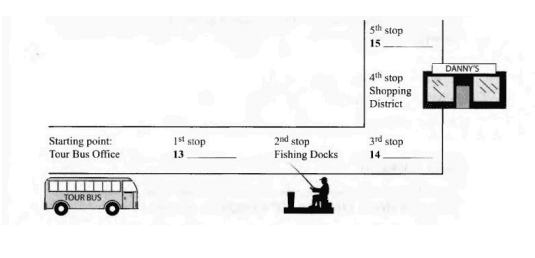
1st stop: (13) …………………………
3rd stop: (14) …………………………
5th stop: (15) …………………………
Questions 16–20
Complete the chart below. Write NO MORE THAN ONE WORD for each answer.
| Place | Activity |
|---|---|
| First stop | Enjoy the (16) ………………………… of the bay |
| Second stop | Look at the (17) ………………………… |
| Third stop | (18) ………………………… fish. |
| Fourth stop | Purchase (19) ………………………… |
| Fifth stop | Visit the (20) ………………………… |
Planning a research project
Questions 21–23
Answer the questions below. Write NO MORE THAN THREE WORDS AND/OR A NUMBER for each answer.
21. When is the research project due? …………………………
22. Where will the students conduct the interviews? …………………………
23. How many interviews will they complete all together? …………………………
Questions 24–30
Complete the outline showing the steps the students will take to complete their projects. Write NO MORE THAN THREE WORDS for each answer.
Steps to complete the research project
A. Read (24) …………………………
B. design the (25) …………………………
C. Get professor's (26) …………………………
D. (27) …………………………
E. Get together to (28) …………………………
F. Prepare (29) …………………………
G. Give (30) …………………………
The life of Louisa May Alcott
Questions 31–40
Complete the timeline below. Write NO MORE THAN THREE WORDS AND/OR A NUMBER for each answer.
In 1832, Alcott was (31) …………………………
In her teens, Alcott worked to (32) …………………………
At age 17, Alcott wrote (33) …………………………
In (34) …………………………, Alcott enlisted as an army nurse.
(35) …………………………, Alcott published her letters in a book called Hospital Sketches.
In (36) …………………………, Alcott returned from her trip to Europe.
In (37) …………………………, Alcott published Little Women.
In 1879, (38) ………………………… died.
In (39) …………………………, Alcott set up a home for her family in Boston.
In 1888, Alcott (40) ………………………….
Answers
1. February
2. one
3. Wilson
4. 2336189872
5. shopping mall
6. restaurant
7. park
8. At night
9. Subway
10. 2:00
11. 18
12. 9
13. Hill Park
14. Bay Bridge
15. Green Street
16. view
17. boats
18. eat
19. baskets
20. theater
21. in three weeks
22. a shopping mall
23. thirty
24. a government study
25. questionnaire
26. approval
27. conduct interviews
28. analyze results
29. charts
30. class presentation
31. born
32. support her family
33. the first novel
34. 1862
35. after the war
36. 1866
37. 1868
38. May
39. 1882
40. died
Explanations
- 1. February
- The caller books 'Wednesday night and Thursday night' and the receptionist reads the dates back to confirm them: 'So, that's February 13th and 14th.' The form already prints '13th', so only the month is missing.Common trap: Day-vs-date trap — the caller only gives weekdays ('Wednesday night and Thursday night'); the month comes from the receptionist's read-back, and the printed '13th' rules out writing a day name here.
- 2. one
- Asked 'And how many guests will there be?', the caller answers 'Just me' — one guest.Common trap: Adjacent-number trap — the form already shows 'Number of nights: 2' (Wednesday plus Thursday), so a student who carries that 2 across writes the wrong figure; the guest count is 'Just me'.
- 3. Wilson
- 'It's Roxanne Wilson. W-i-l-s-o-n.' The first name is already printed on the form, so the surname is what is needed, and it is spelled out letter by letter.Common trap: Spelling trap — the surname is spelled out immediately after being said, which is the confirmation to write down; 'Roxanne' is already on the form.
- 4. 2336189872
- 'It's 2336189872.' The receptionist then repeats only the last four digits as a check.Common trap: Partial read-back trap — only '9872' is repeated, so a student waiting for a confirmation before writing catches the last four digits instead of the full number.
- 5. shopping mall
- The caller accepts three suggestions — the shopping mall ('Fabulous'), the nearby restaurant for lunch, and a walk in the park afterwards. The art museum is refused, the science museum is shut for the winter, and Monument Square and the post office are only landmarks on the way to the mall.Common trap: Suggestion-vs-acceptance trap — seven places are named, but only three are ones she agrees to go to; the rest are refused, closed, or mentioned only as directions.
- 6. restaurant
- The caller accepts three suggestions — the shopping mall ('Fabulous'), the nearby restaurant for lunch, and a walk in the park afterwards. The art museum is refused, the science museum is shut for the winter, and Monument Square and the post office are only landmarks on the way to the mall.Common trap: Suggestion-vs-acceptance trap — seven places are named, but only three are ones she agrees to go to; the rest are refused, closed, or mentioned only as directions.
- 7. park
- The caller accepts three suggestions — the shopping mall ('Fabulous'), the nearby restaurant for lunch, and a walk in the park afterwards. The art museum is refused, the science museum is shut for the winter, and Monument Square and the post office are only landmarks on the way to the mall.Common trap: Suggestion-vs-acceptance trap — seven places are named, but only three are ones she agrees to go to; the rest are refused, closed, or mentioned only as directions.
- 8. At night
- 'I'll be arriving quite late, after 10 P.M.' — that is night, which is also why she assumes she may need a taxi.Common trap: Wrong-time-reference trap — 'Friday morning' is said earlier in the call, but it refers to her free time before departure, not to her arrival.
- 9. Subway
- She expects to need a taxi because of the late hour, but once she is told 'The subway runs until midnight' she says 'Oh, good. Then I'll do that.'Common trap: Changed-mind trap — the taxi is the caller's own first assumption and the bus is mentioned as an option; the decision only comes after she hears the subway's closing time.
- 10. 2:00
- 'Oh, yes. The front desk stays open until two.'Common trap: Three-times trap — 10 P.M., midnight and two o'clock are all said within a few lines, each attached to a different thing (arrival, subway, front desk).
- 11. 18
- 'The all-day bus pass costs $18 for adults.'Common trap: Figure-pair trap — the adult fare is given as a number but the child fare immediately after is given as a fraction, so the two must be kept apart.
- 12. 9
- 'Children between the ages of five and twelve pay half the adult fare' — half of $18 is $9.Common trap: Calculation trap — the child fare is never spoken as a figure; it has to be worked out as half of the $18 adult fare. The ages 'five and twelve' are also numbers in the same sentence.
- 13. Hill Park
- 'From the starting point here at the tour bus office, the bus goes to the first stop, Hill Park.'Common trap: Order trap — the tour bus office is the starting point, not the first stop; the stops are then named in order, so each label has to be matched to its position on the route.
- 14. Bay Bridge
- 'Following that, the bus goes on to the third stop, Bay Bridge, located at the foot of the bridge which crosses the bay.'Common trap: Sequence-word trap — 'the next stop' (the fishing docks) is the second stop and is already printed on the map; the third stop is only introduced by 'Following that'.
- 15. Green Street
- 'The fourth stop is in the shopping district, then the fifth and last stop is at Green Street.'Common trap: Same-sentence trap — the fourth stop (already printed on the map) and the fifth stop are named in one breath, so the second half of the sentence is the one that counts.
- 16. view
- 'At the first stop, you can enjoy a spectacular view of the bay, the city, and especially of the fishing docks, which are located at the foot of the hill.'Common trap: Adjective trap — 'spectacular' sits directly before the answer, but only ONE WORD is allowed and the chart needs the noun that goes with 'of the bay'.
- 17. boats
- 'At the second stop, you can walk around and look at the boats.'Common trap: Following-detail trap — fish is mentioned in the very next sentence at the same stop, but what you 'look at' is the boats; the fish is what is for sale.
- 18. eat
- 'You can eat fresh fish here prepared in the traditional local way.' The chart line reads '_____ fish', so the missing word is the verb.Common trap: Paraphrase trap — 'restaurants' and 'a lunch stop' come first and tempt answers like 'buy' or 'lunch'; the chart wants the verb actually used with 'fish'.
- 19. baskets
- 'Don't miss the opportunity to purchase some of our city's famous handmade baskets.'Common trap: Category trap — the next sentence calls them 'souvenirs', a general word; the chart needs the specific item, and 'handmade' would break the ONE WORD limit.
- 20. theater
- 'Finally, at the last stop on the tour, you can visit one of the oldest buildings in our city, the theater.'Common trap: Contents-vs-building trap — the plays, musicals and film festival are what happens inside; the chart asks what you visit, which is the building itself.
- 21. in three weeks
- 'We'd better start planning our research project, because we don't have much time left before it's due.' — 'I know, only three more weeks.'Common trap: Understatement trap — the deadline is never given as a date, only as the time remaining, and the reply 'Is that all? I thought we had more time than that' can pull attention away from the figure.
- 22. a shopping mall
- 'We haven't decided anything definitely yet, but I think the shopping mall would be a better place. We'd get more of a variety of shoppers there.' — 'Yes, that's a good point. So, let's do that.'Common trap: Rejected-suggestion trap — the department store is raised first as a half-remembered plan and then dropped; the agreed venue is the shopping mall.
- 23. thirty
- 'How many interviews did the professor say we had to complete?' — 'She said at least thirty.'Common trap: Split-figure trap — fifteen is each student's share; the question asks for the total 'all together', which is thirty.
- 24. a government study
- 'Well, we have to do some reading first, don't we? Didn't we say we were going to compare our results to the results of a government study?'Common trap: Order trap — designing the questionnaire is proposed first but corrected straight away ('we have to do some reading first'), so the reading is step A.
- 25. questionnaire
- 'Yes, so we'd better read that first and then design our questionnaire.'Common trap: Sequence trap — one sentence contains both the reading and the designing; the outline line needs what is designed, not what is read.
- 26. approval
- 'The professor said she had to approve our questionnaire first, before we actually conducted the interviews.' — confirmed by 'So we'll get her approval and then conduct the interviews.'Common trap: Word-form trap — the transcript uses the verb 'approve'; the outline line 'Get professor's _____' needs the noun form.
- 27. conduct interviews
- 'Oh, right. So we'll get her approval and then conduct the interviews.'Common trap: Detail trap — Saturday is when the interviews happen, not the step itself; the outline wants the action.
- 28. analyze results
- 'And let's also plan to get together the next day to analyze the results.'Common trap: Reason-vs-action trap — 'while everything's fresh in our minds' explains why they meet the next day; the outline needs what they meet to do.
- 29. charts
- 'Well, I think the obvious thing is to prepare some charts showing our results and how they compare with the government study.'Common trap: Length trap — the sentence runs on into 'and how they compare with the government study'; only THREE WORDS are allowed, so the comparison clause has to be dropped.
- 30. class presentation
- 'And then that's it. All that will be left to do is give the class presentation.'Common trap: Verb-form trap — the idea appears earlier as 'present our results to the class'; this line begins with 'Give', so the noun phrase 'class presentation' is what fits.
- 31. born
- 'She was born in 1832, the daughter of Bronson Alcott, who was one of the founders of the Transcendentalist Movement.'Common trap: Following-clause trap — the same sentence goes straight on to her father and his movement; the 1832 entry is only her birth.
- 32. support her family
- 'As a teenager, she worked to support her family by taking on a variety of low-paying jobs, including teacher, seamstress, and household servant.'Common trap: List trap — three job titles follow in the same sentence; the timeline asks what she worked to do, not which jobs she took.
- 33. the first novel
- 'She wrote her first novel when she was just seventeen years old; although, it wasn't published until many years after her death. It was called The Inheritance.'Common trap: Write-vs-publish trap — the sentence immediately contrasts writing with publication; this entry is about what she wrote at seventeen.
- 34. 1862
- 'In 1861, the Civil War broke out. Alcott worked as a volunteer, sewing uniforms and bandages for soldiers. The following year, she enlisted as an army nurse.' The year following 1861 is 1862.Common trap: Relative-date trap — the year is never spoken; only 1861 is, and the enlistment is 'the following year', so it has to be worked out.
- 35. after the war
- 'After the war, she turned the letters into a book, which was published under the title Hospital Sketches.'Common trap: Two-time-frames trap — the letters were written during the war at the hospital; only the book came afterwards, so the time phrase attaches to the publication.
- 36. 1866
- 'When she returned home from Europe in 1866, she found her family still in financial difficulty and in need of money, so she went back to writing.'Common trap: Vague-lead-in trap — the Europe trip is introduced as 'around this same time' with no year at all; the date only arrives with the return home.
- 37. 1868
- 'Her big break came in 1868 with the publication of her first novel for girls, Little Women.'Common trap: Similar-figures trap — several publication years are given across the talk; this line is about Little Women itself, not its sequels.
- 38. May
- 'In 1878, her youngest sister, May, got married. A year later, May died after giving birth to a daughter.' A year after 1878 is 1879.Common trap: Wrong-person trap — several family members and their fates are listed; 1879 belongs to May, while the father's stroke is 1882.
- 39. 1882
- 'In 1882, Bronson Alcott suffered a stroke. Soon after that, Louisa Alcott set up a house for him, her niece, her sister Anna, and Anna's two sons in Boston.'Common trap: Cause-and-effect trap — the year is attached to the father's stroke; the move to Boston follows 'soon after that', so the same year is the one to write.
- 40. died
- 'She died in March of 1888 at the age of 55.'Common trap: Next-sentence trap — the burial is stated immediately afterwards with no year of its own; the 1888 entry is her death.
Audio transcripts
Part 1 — Grandview Hotel reservation
Good afternoon. Grandview Hotel.
Yes, hello. I, uh, I'm planning to spend a few days in your city next week, and I'd like to, uh, make a reservation.
Of course. When did you want to stay here?
Next week. Wednesday night and Thursday night.
So, that's February 13th and 14th.
Yes, that's right.
And how many guests will there be?
Just me. So, do you have a room available?
Yes, we do. I'll just need to take some of your information. May I have your name, please?
Oh, right, yes. It's Roxanne Wilson. W-i-l-s-o-n.
Thank you, Ms. Wilson. And may I have your credit card number?
It's 2336189872.
...9872. Got it. All right, Ms. Wilson, I have your reservation confirmed. Can I help you with anything else?
Well, yes. I was wondering, since I'll have a couple of free hours Friday morning before I leave, is there anything interesting to see close to the hotel?
Do you like museums? The art museum's very close by.
I love museums, but not art. Can't stand it. I've heard your city has a very interesting science museum, though.
Yes, but unfortunately it's closed in the winter. Are you interested in shopping?
Sure, I love shopping. Are there any good stores nearby?
Yes. We have a large shopping mall just two bus stops away. You take the bus to Monument Square, and it's just half a block from there. Just look for the post office, and you'll see the mall entrance next to it.
Fabulous. What about lunch? I hear your city has good restaurants.
Yes. There's a nice restaurant very near. It's just across the street from the park.
Sounds good. I can have lunch, then walk in the park afterwards. I have one more question. What's the best way to get to the hotel from the airport?
Subway is the fastest, of course. There are buses, but they're quite slow.
I'll be arriving quite late, after 10 P.M. I thought I might have to take a taxi.
The subway runs until midnight.
Oh, good. Then I'll do that. Will there be someone at the hotel front desk that late?
Oh, yes. The front desk stays open until two.
Part 2 — City Tours bus tour information
Thank you for choosing City Tours. The reason so many people choose our tours when visiting this city is because you can design your tour to suit your own interests. Your all-day pass entitles you to board our bus at any stop and stay as long as you like at each place. The all-day bus pass costs $18 for adults. Children between the ages of five and twelve pay half the adult fare, and children under five ride for free. Our buses run every hour on the half hour, starting at 8:30 A.M.
Our most popular tour is the Center City Tour, which goes to all the major attractions in the center of the city. From the starting point here at the tour bus office, the bus goes to the first stop, Hill Park. As you may guess, this park is located at the top of a small hill. The next stop is the fishing docks. Following that, the bus goes on to the third stop, Bay Bridge, located at the foot of the bridge which crosses the bay. The fourth stop is in the shopping district, then the fifth and last stop is at Green Street.
There are many interesting things to do and see on the Center City Tour. At the first stop, you can enjoy a spectacular view of the bay, the city, and especially of the fishing docks, which are located at the foot of the hill. At the second stop, you can walk around and look at the boats. Fresh fish from the bay is also for sale here, since this is the place where the fishermen bring in their catch. The next stop is where some of the city's finest seafood restaurants are located, so you might want to plan a lunch stop here. You can eat fresh fish here prepared in the traditional local way. The fourth stop is, of course, where you can do your shopping. Don't miss the opportunity to purchase some of our city's famous handmade baskets. You'll want to take several home as souvenirs of your visit to our city. Finally, at the last stop on the tour, you can visit one of the oldest buildings in our city, the theater. This building was built over 400 years ago and is still used today as a place to see plays, musicals, and other performances, as well as our annual film festival.
Part 3 — Planning a research project
We'd better start planning our research project, because we don't have much time left before it's due.
I know, only three more weeks.
Is that all? I thought we had more time than that. Well, let's get to work, then.
OK, so we agreed we're going to interview shoppers about their spending habits. Did we decide to conduct our interviews at the department store?
We haven't decided anything definitely yet, but I think the shopping mall would be a better place. We'd get more of a variety of shoppers there.
Yes, that's a good point. So, let's do that. How many interviews did the professor say we had to complete?
She said at least thirty. That sounds like a lot, doesn't it?
Yes, but if we divide it up between the two of us, that's just fifteen each. That's not so bad.
OK, so I guess we'd better start designing our questionnaire.
Well, we have to do some reading first, don't we? Didn't we say we were going to compare our results to the results of a government study?
Right, the government study about how the economic crisis has changed people's spending habits. We want to see if we get similar results.
Yes, so we'd better read that first and then design our questionnaire. Then I guess we'll be ready to go out and interview shoppers.
No. Don't you remember? The professor said she had to approve our questionnaire first, before we actually conducted the interviews.
Oh, right. So we'll get her approval and then conduct the interviews. I think a Saturday would be the best day for the interviews, because everyone's out shopping then.
Right. We'll do it on a Saturday, then.
And let's also plan to get together the next day to analyze the results. It's best to do that while everything's fresh in our minds. Don't you think?
Sure. That sounds like a good idea. OK, so then we're going to have to present our results to the class. Do you have any ideas for that? It's an important part of our grade, so I think we should plan it well.
Well, I think the obvious thing is to prepare some charts showing our results and how they compare with the government study. That will help make the information a lot clearer to the class.
Right. OK, so we'll draw up some charts of the results.
And then that's it. All that will be left to do is give the class presentation. Do you think we can be ready on time?
I sure hope so. Let's get started now.
Part 4 — The life of Louisa May Alcott
Good afternoon. Today, I'd like to continue our discussion of the lives of prominent American writers by talking about Louisa May Alcott, one of the best-known nineteenth-century writers. Alcott is known for her moralistic girl's novels, but she was a much more serious individual than those novels might lead one to believe. She was born in 1832, the daughter of Bronson Alcott, who was one of the founders of the Transcendentalist Movement. Bronson Alcott was a philosopher but not a provider, and the family lived close to poverty. From an early age, Louisa was determined to find a way to improve her family's economic situation. As a teenager, she worked to support her family by taking on a variety of low-paying jobs, including teacher, seamstress, and household servant. Alcott also started writing when she was young. She wrote her first novel when she was just seventeen years old; although, it wasn't published until many years after her death. It was called The Inheritance.
In 1861, the Civil War broke out. Alcott worked as a volunteer, sewing uniforms and bandages for soldiers. The following year, she enlisted as an army nurse. She spent the war years in Washington, nursing wounded soldiers at a military hospital. While working at the hospital, she wrote many letters to her family at home in Massachusetts. After the war, she turned the letters into a book, which was published under the title Hospital Sketches. She also wrote numerous romantic stories, which she sold to magazines.
Around this same time, she was offered the opportunity to travel to Europe as the companion to an invalid. When she returned home from Europe in 1866, she found her family still in financial difficulty and in need of money, so she went back to writing. Her big break came in 1868 with the publication of her first novel for girls, Little Women. The novel achieved instant success, and the public wanted more. From then on, Alcott supported herself and her family by writing novels for girls. It wasn't the writing she had dreamed of doing, but it earned her a good income.
Alcott took care of her family for the rest of her life. In 1878, her youngest sister, May, got married. A year later, May died after giving birth to a daughter. Louisa Alcott raised her sister's orphaned child. In 1882, Bronson Alcott suffered a stroke. Soon after that, Louisa Alcott set up a house for him, her niece, her sister Anna, and Anna's two sons in Boston. Her mother was no longer living by this time. Alcott was still writing novels for girls, including two sequels to Little Women: Little Men and Jo's Boys. The latter was published in 1886.
Louisa Alcott had suffered poor health ever since she contracted typhoid fever while working as a war nurse. She died in March of 1888 at the age of 55. She was buried in Concord, Massachusetts.
Comments
Loading comments…