

IELTS Trainer 2 Listening Test 6
4 parts · 40 questions · 30 minutes
Enquiring about tours at a tourist information office
Questions 1–10
Complete the table below. Write ONE WORD ONLY AND/OR A NUMBER for each answer.
Kingstown tours
| Name of tour | Price | Main activities | Other information |
|---|---|---|---|
| Cave Explorers | (Example) $93 | go in a small (1) ………………………… to the other side of the lake. Explore the caves | minimum age of (2) ………………………… years |
| Silver Fjord | $220 | travel by (3) ………………………… to the fjord. At Easten go for a (3) ………………………… . Cruise on the fjord | see mountains and a large (5) ………………………… . Eat a barbecue lunch. See marine life such as seals and (5) ………………………… |
| High Country | $105 | visit a historic home. Lunch is in the (7) ………………………… . In the afternoon visit a (7) ………………………… | this tour has excellent reviews |
| Zipline | $75 | travel on a zipline above an old (9) ………………………… | reach speeds of (10) ………………………… miles per hour |
A guide's introduction to a living museum
Questions 11–15
Choose the correct letter, A, B or C.
11. In the early 1800s most land in Willford was
A occupied by houses.
B used for farming.
C covered in trees.
12. What happened in 1830 in Willford?
A Ships started to be built nearby.
B The first trains arrived in the town.
C Valuable substances were found underground.
13. By the 1870s Willford was most famous for making
A various metal objects.
B all types of clothing.
C plates and cups.
14. What does the guide say about visitors to the museum these days?
A 900 visitors enter on a typical day.
B 7,600 visitors arrive every week.
C 300,000 visitors come each year.
15. The museum is also sometimes used
A as a location for filming.
B for business conferences.
C by people getting married.
Questions 16–20
Label the map below. Write the correct letter, A–H, next to Questions 16–20. Willford Living Museum.
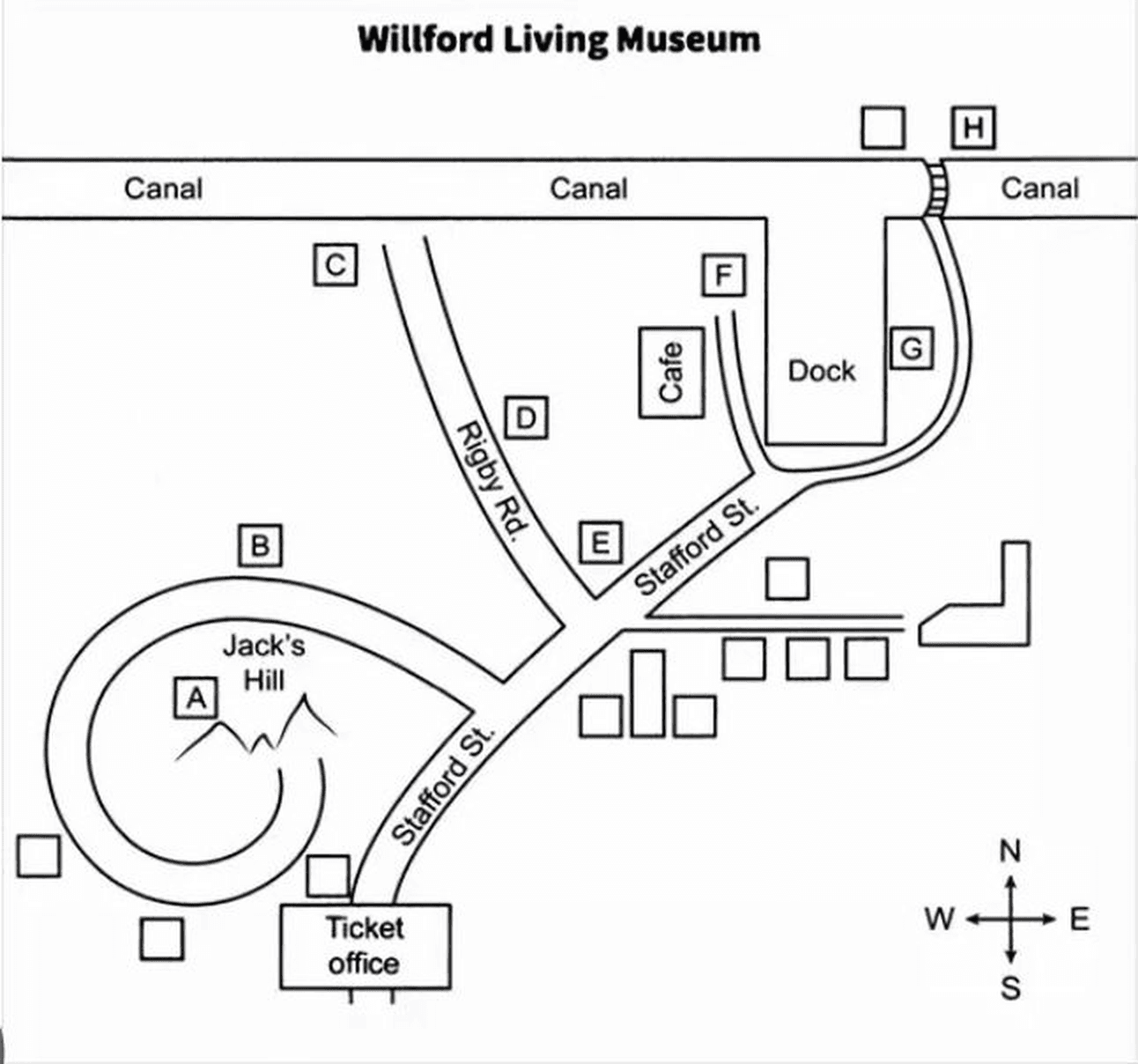
16. Old bakery
17. Doctor's surgery
18. Cooper's Cottage
19. Stables
20. Old school
Two students discussing market research
Questions 21–22
Choose TWO letters, A–E. According to the students, what are the TWO most important benefits of market research?
21. Benefit (lower letter)
A Selecting the best advertising
B Reducing the levels of risk
C Building confidence among employees
D Saving money in the long run
E Identifying new opportunities
22. Benefit (higher letter)
A Selecting the best advertising
B Reducing the levels of risk
C Building confidence among employees
D Saving money in the long run
E Identifying new opportunities
Questions 23–24
Choose TWO letters, A–E. Which do the students agree are TWO valid criticisms of market research?
23. Valid criticism (lower letter)
A It does not reveal any new information.
B Its benefits are hard to measure.
C It takes too much time to carry out.
D It makes use of too much specialist language.
E Its findings are sometimes wrong.
24. Valid criticism (higher letter)
A It does not reveal any new information.
B Its benefits are hard to measure.
C It takes too much time to carry out.
D It makes use of too much specialist language.
E Its findings are sometimes wrong.
Questions 25–26
Choose TWO letters, A–E. The students are surprised by the success of which TWO sources of information?
25. Surprising source (lower letter)
A face-to-face communication
B official government statistics
C the media and social media
D online surveys of public opinion
E filming customers as they shop
26. Surprising source (higher letter)
A face-to-face communication
B official government statistics
C the media and social media
D online surveys of public opinion
E filming customers as they shop
Questions 27–30
Complete the flow-chart below. Choose FOUR answers from the box: written records / online studies / specific questions / individual responsibility / proper planning / regular meetings
Market Research Using a Business's Own Resources
Begin with staff education to maximise the chances of success.
↓
Give staff examples of (27) ………………………… that will be helpful every day.
↓
The BQR Group says that staff should make use of (28) ………………………… each week.
↓
Having (29) ………………………… is motivating for staff, according to Business Guide.
↓
Provide detailed feedback about any changes that you decide to make
↓
Allow staff to have (30) ………………………… to ensure continued participation.
A presentation on drinking water
Questions 31–37
Complete the notes below. Write ONE WORD ONLY for each answer.
Drinking Water
Introduction
• Drinking water is essential for human life.
• The '8 glasses a day' rule is a myth, except for the (31) ………………………… .
Some effects of water on the body
• Drinking before (32) ………………………… may assist weight loss.
• Dr Amaldi's study shows that water speeds up (33) …………………………
• A US research study showed that dehydrated bodies cannot control (34) ………………………… so well
• There is no evidence that drinking water results in better (35) …………………………
The brain
• Women who drank lots of water had fewer (36) …………………………
• Men suffered more (37) ………………………… with insufficient water.
Questions 38–40
Complete the summary below. Write ONE WORD ONLY for each answer.
38. Drinking too much water is not a common problem. Australian research has shown that people have difficulty ………………………… when they have drunk enough.
39. But occasionally people have become sick from too much water, particularly groups of ………………………… .
40. This may be because they have high levels of ………………………… in their blood. The best advice is to drink when you are thirsty.
Answers
1. train
2. 5
3. coach
4. walk
5. waterfall
6. whales
7. garden
8. farm
9. forest
10. 43
11. used for farming.
12. Valuable substances were found underground.
13. various metal objects.
14. 300,000 visitors come each year.
15. as a location for filming.
16. C
17. F
18. A
19. H
20. E
21. Reducing the levels of risk
22. Saving money in the long run
23. It makes use of too much specialist language.
24. Its findings are sometimes wrong.
25. face-to-face communication
26. the media and social media
27. specific questions
28. written records
29. regular meetings
30. individual responsibility
31. elderly
32. meals
33. digestion
34. temperature
35. skin
36. headaches
37. anxiety
38. swallowing
39. athletes
40. salt
Explanations
- 1. train
- 'it's the little train that runs along the shore of the lake.'Common trap: She guesses a boat and is corrected.
- 2. 5
- 'children must be 5 or older to go in the caves.'Common trap: Her own children's ages are given first.
- 3. coach
- 'On this tour you go in a coach. It's about a 2-hour drive.'Common trap: Flying is suggested and ruled out as too expensive.
- 4. walk
- 'That's to take a walk, is it?' – 'Yes, there's a nice path by the river.'Common trap: The activity is named by the caller and confirmed, not stated outright.
- 5. waterfall
- 'you also cruise past a huge waterfall, which is another highlight of the day.'Common trap: 'Huge' has to be matched to 'large'; the mountains are already in the note.
- 6. whales
- 'if you're lucky there will be whales as well.'Common trap: Dolphins are asked about and ruled out; seals are already in the note.
- 7. garden
- 'No, at this time of year it'll be the garden, which is really pretty.'Common trap: Inside the house is suggested and rejected.
- 8. farm
- 'You go up and have a look around the farm - it's just close to the house.'Common trap: The city is mentioned as where visitors come from, not where they go.
- 9. forest
- 'below you, you've got this amazing, ancient forest.' – 'That's right.'Common trap: 'Ancient' has to be matched to 'old'.
- 10. 43
- 'in miles per hour it's about 43.'Common trap: The speed is given in kilometres first, then converted to miles.
- 11. used for farming.
- 'this whole area was a place where local people kept animals or grew crops - those were the only economic activities.'Common trap: Both wrong options are stated as things that were NOT the case.
- 12. Valuable substances were found underground.
- 'The discovery of rich deposits of coal and other minerals opened up many commercial possibilities.'Common trap: Three developments are listed, each with its own date.
- 13. various metal objects.
- 'what Willford was best known for, was manufacturing all sorts of tools, machinery and other items out of iron and steel.'Common trap: 'Most famous for' – textiles succeeded but on a small scale, and pottery failed.
- 14. 300,000 visitors come each year.
- 'They now stand at 300,000 per year and we anticipate further growth.'Common trap: An opening-weekend figure and a cumulative total are both given nearby.
- 15. as a location for filming.
- 'those making movies and television shows often come to the museum because it makes a great set for historical scenes.'Common trap: Weddings are a future possibility, not a current use.
- 16. C
- 'walk up Stafford Street. And then turn into Rigby Road. Walk down Rigby Road ... the old bakery is right next to the canal.'Common trap: 'Right next to the canal' picks out C from the other Rigby Road buildings.
- 17. F
- 'Walk up Stafford Street, until you reach the dock. You see the cafe. Walk past that, and the doctor's surgery is just there.'Common trap: The cafe is already labelled on the map and is the landmark to pass.
- 18. A
- 'The road curves round to the west, then south, as it climbs Jack's Hill ... Cooper's Cottage is right on the summit of Jack's hill.'Common trap: 'Right on the summit' separates A from the houses passed on the way up.
- 19. H
- 'walk up Stafford Street to the dock, and turn right. Walk round the dock till you get to the canal. Then cross the bridge over the canal to reach the stables.'Common trap: Crossing the bridge puts the stables on the far side of the canal.
- 20. E
- 'The old school is right on the corner of Stafford Street and Rigby Road.'Common trap: The junction of the two named roads fixes it precisely.
- 21. Reducing the levels of risk
- The two benefits they agree on are minimising the chance of things going wrong, and the eventual financial return.Common trap: Advertising and new markets are both raised and then downgraded.
- 22. Saving money in the long run
- 'The sums you invest in market research, you'll see a return on that eventually' – 'That's it exactly. Great point.'Common trap: 'Too many of those working in business take a short-term view' underlines the long-run point.
- 23. It makes use of too much specialist language.
- Only two criticisms are accepted by both: the jargon, and the unreliability of findings. Three others are each dismissed.Common trap: Three criticisms are raised and explicitly judged invalid.
- 24. Its findings are sometimes wrong.
- 'The results of a lot of market research are just unreliable' – 'Yes, that's a good point.'Common trap: The measurability complaint sounds similar but is rejected as a criticism of businesses.
- 25. face-to-face communication
- They are surprised by talking to consumers directly, and by how much can be learned from news and social media.Common trap: In-store cameras are explicitly called well documented, so no surprise.
- 26. the media and social media
- 'I hadn't thought it could be that simple.' – 'No, me neither.'Common trap: Government data is mentioned in between, but draws no surprise.
- 27. specific questions
- 'What, precisely, should they ask customers in order to get valuable information? Show staff the sorts of things they can ask on a daily basis.'Common trap: 'What, precisely, should they ask' has to be matched to 'specific questions'.
- 28. written records
- 'staff need to keep an account of what the customers are saying ... every Friday, they should add to the document.'Common trap: The format is explicitly said not to matter, so 'online studies' is wrong.
- 29. regular meetings
- 'Business Guide's approach is to get your staff together round a table as frequently as possible to discuss their findings.'Common trap: Stella guesses planning ahead, which is the wrong box entry.
- 30. individual responsibility
- 'this is the idea of delegating, so that each staff member is accountable for market research in one area of the business.'Common trap: 'Each staff member is accountable' has to be matched to 'individual responsibility'.
- 31. elderly
- 'The only group for whom the rule is useful seems to be the elderly, because they don't always feel thirsty.'Common trap: 'The only group for whom the rule is useful' has to be matched to 'except for'.
- 32. meals
- 'subjects who drank a lot of water, and then had their meals, lost more weight.'Common trap: Night time and waking up are both claims with no research behind them.
- 33. digestion
- 'it seems to increase the rate at which digestion takes place.'Common trap: 'Increase the rate at which' has to be matched to 'speeds up'.
- 34. temperature
- 'when a subject was low on water, their body's ability to regulate its own temperature was compromised.'Common trap: 'Regulate' has to be matched to 'control'.
- 35. skin
- 'I could find no evidence at all to support the idea that hydration improves or enhances the skin in any specific way.'Common trap: The note keeps the negative framing of the recording.
- 36. headaches
- 'the less hydrated group were affected more frequently by headaches compared to those who drank more water.'Common trap: The recording says the less hydrated had MORE; the note reverses it to 'fewer'.
- 37. anxiety
- 'the subjects in this group reported increased feelings of anxiety when dehydrated.'Common trap: The first study was female and about headaches; this one is male.
- 38. swallowing
- 'when subjects were fully hydrated, they actually found swallowing problematic.'Common trap: 'Found problematic' has to be matched to 'have difficulty'.
- 39. athletes
- 'there are recorded instances of illness among athletes who have been encouraged to drink a lot.'Common trap: 'For example' in the recording matches 'particularly' in the summary.
- 40. salt
- 'the make-up of their blood has changed and it now contains such a high proportion of salt that they suffer an adverse effect.'Common trap: The medical term is given first, before the plain explanation.
Audio transcripts
Part 1 — Enquiring about tours at a tourist information office
David: Morning. Kingstown tourist information. This is David speaking. How can I help you? Woman: Oh, hi. Look, I'm coming to Kingstown on holiday and wondered if you could give me some information about tours. David: Yes, of course. Is there anything particular you're interested in? Woman: Well, I heard there was a glow worm tour. David: Yes indeed. It's $93 and lasts for 3 hours. Woman: And what are the main activities? David: Well, the first thing is travelling to the other side of the lake. Woman: You mean by boat? David: No, it's the little train that runs along the shore of the lake. It's very popular. Woman: Oh, my children will love that. David: And that's how you get round to the caves. This is where the glow worms live. So you spend some time exploring the caves and looking at the remarkable lights and patterns given off by the worms in the dark. Woman: That does sound interesting. And, any other information? David: Oh, just one thing. How old are your children? Woman: Er, 7 and 10. Why? David: No, that's OK. It's just that children must be 5 or older to go in the caves. Otherwise they might get scared in the dark. But yours will be fine. Woman: OK, well that's one to think about. And what about Silver Fjord - that's so famous, we'd like to go there. David: Well, a day trip costs $220. Woman: And how do we travel down to the fjord - fly? David: That's a lot more expensive I'm afraid. On this tour you go in a coach. It's about a 2-hour drive, through fantastic scenery. Woman: Do we get a break? I think my children might get a bit bored. David: Yes, you stop at Easten. Woman: That's to take a walk, is it? David: Yes, there's a nice path by the river. You stop in Easten for half an hour, so there's plenty of time. Woman: That sounds nice. David: So, then you get down to Silver Fjord. And you really spend most of the day going for a cruise on the fjord. It's spectacular mountain scenery. And you also cruise past a huge waterfall, which is another highlight of the day. Woman: Well, that does sound amazing. And should we bring our own food, or is lunch provided? David: No, lunch is included. It's a barbecue on the boat. Woman: And what about marine life? David: Yes, you'll definitely see seals. Woman: Dolphins? David: No, not in that part of the country. But if you're lucky there will be whales as well. Woman: Oh, well, my kids would absolutely love that. David: Then another popular option is the High Country tour. That's $105. Woman: Oh, I heard about this. You visit a historic home, don't you? David: Yes, that's right. And they serve you lunch. Woman: Is that actually inside the house? David: No, at this time of year it'll be the garden, which is really pretty. Woman: Oh, I like the sound of that. David: Yes, it's a really great meal apparently. Woman: And what about in the afternoon? David: You go up and have a look around the farm - it's just close to the house. So if you're from the city, it's a chance to really see what life is like here. The High Country tour gets excellent reviews from visitors. Woman: Great. So then what about the zipline? My children really want to do that. How much is it? David: The zipline is $75. Woman: And is it safe? David: Absolutely. You are suspended from the wire in a special harness. And then you just glide down the wire. Woman: My friend said that below you, you've got this amazing, ancient forest. David: That's right. And it's really special to see it from above. Not something we do very often, if you think about it. Woman: No, I suppose that's true. And, I mean, how fast do you go? David: Hang on, I've got the information here - 68 kilometres an hour. Woman: That doesn't mean much to me. What's that in miles? David: Er, oh yes, it's here, in miles per hour it's about 43. Woman: Wow, my kids will definitely want to do that. OK, well, look, I'll just talk it over with my husband and...
Part 2 — A guide's introduction to a living museum
Guide: Well good morning everyone and a warm welcome to the Willford Living Museum. Before you look around, I'd like to tell you a bit about the history of Willford, and the purpose of the museum. Well, if we go back to the early 1800s, Willford was very different to what you see today. At that time, the forests had already been cut down. But there were no large urban settlements here, just a few small villages, and this whole area was a place where local people kept animals or grew crops - those were the only economic activities. But then in 1830, something happened in Willford that transformed the area. The discovery of rich deposits of coal and other minerals opened up many commercial possibilities. Mines were built, so these deposits could be brought to the surface. Then a canal was constructed, so that canal boats could transport the minerals to other regions. Finally, a railway was built through Willford in the 1850s, creating many new opportunities. By the 1870s, Willford had become an important manufacturing centre. A few factories successfully produced fabrics from cotton and wool. However, what Willford was best known for, was manufacturing all sorts of tools, machinery and other items out of iron and steel. The attempt to set up a pottery industry here, however, making items for the home out of clay, was never really a success. So, for the next hundred years or so, Willford was a thriving industrial region. However, by the 1970s, the old industries here were in decline. Much of the land at this site wasn't being used. So the local council decided to set up a 'living' museum here. The idea was for visitors to be able to walk around and visit the sorts of factories, shops, homes and schools that were once found here. When the museum first opened in 1976, 2000 visitors came on the first weekend alone. Since then, visitor numbers have just grown and grown. They now stand at 300,000 per year and we anticipate further growth in the years to come. In fact, just recently we welcomed our 9 millionth visitor, which was an exciting day for us. As well as our regular visitors, the museum has a number of other uses. We work closely with universities, whose staff consult the range of documents and artefacts we hold here. As well as that, those making movies and television shows often come to the museum because it makes a great set for historical scenes. There's even a possibility in future we may open up the museum for weddings and other private events. Guide: OK, so if you take out your maps, I'll just point out a few places you might like to visit. So right now, we're standing in the ticket office, at the bottom of your maps. So, one place I'd recommend is the old bakery. This is a typical bakery from this area, from about 100 years ago. To get there from the ticket office, walk up Stafford Street. And then turn into Rigby Road. Walk down Rigby Road, there are a few interesting places along the way, and the old bakery is right next to the canal. Another interesting place is the doctor's surgery. This was moved here, brick by brick, and rebuilt on the museum site. Walk up Stafford Street, until you reach the dock. You see the cafe. Walk past that, and the doctor's surgery is just there. Cooper's Cottage is also fascinating - a worker's cottage from the 19th century. Walk up Stafford Street and take the first turning on the left. The road curves round to the west, then south, as it climbs Jack's Hill. You'll pass a few little houses on the way up, and Cooper's Cottage is right on the summit of Jack's hill. The stables are also great. This is where they kept all the horses. Again, walk up Stafford Street to the dock, and turn right. Walk round the dock till you get to the canal. Then cross the bridge over the canal to reach the stables. Also, be sure to visit the old school. So, walk north-east up through the museum. And it's not too far. The old school is right on the corner of Stafford Street and Rigby Road. Now one other thing...
Part 3 — Two students discussing market research
Stella: Hi Nathan. Shall we compare ideas for our assignment on market research? Nathan: Good idea. So first in the assignment, I think we should explain what 'market research' is. One definition I found was this - gathering information about consumers' needs and preferences. Stella: I like that, nice and clear. So then, we need to establish the benefits of market research. Why do it? I read that many business people think it's about finding the next market they can exploit. But it's more complex than that. Nathan: I agree. To me, it's about unpredictability. Markets can change unexpectedly. But if you've done research, you can minimise the chance that something will go wrong in your own business. Stella: That's a really significant point. You may also learn the most effective means of promoting your business. Nathan: But that depends on the business. It's not a general advantage. Stella: No, you're right. But I do think, the sums you invest in market research, you'll see a return on that eventually. Nathan: That's it exactly. Great point. The trouble is, too many of those working in business take a short-term view. Stella: OK, so there are benefits. But there are criticisms of market research, as well. We should acknowledge that in the assignment. Nathan: But some criticisms are more valid than others. Stella: Like? Nathan: Well, apparently some managers say they're just too busy. But that's a poor excuse. Stella: Maybe they think they already know everything they need to know? Nathan: Maybe they do, but that's an issue with them, not with market research. Stella: OK, fair enough. But I read an interesting study out of the USA showing that the results of a lot of market research are just unreliable. The supposed developments identified by the research never occur. Nathan: Yes, that's a good point. Then, another question is, can businesses actually see if market research is working? I mean, is it possible for a business to say categorically that increased profits resulted from market research? Stella: But that's a criticism of how businesses are structured, not research itself. Nathan: Yeah OK. Though you've got to admit, market researchers love jargon. These are examples from one report I read - 'psychographics', 'coolhunting' and 'asynchronous research'. Some people are bound to be put off by these terms. Stella: Yes, that's a reasonable complaint. Nathan: So, what about sources of information for market research? Which sources of information work best? I mean, we all know that putting cameras in stores tells us a lot about consumer behaviour. Stella: Yes, that's well documented. But I read that managers can learn a lot about social trends just by doing really obvious things, like keeping up with the news on TV, radio and digital networking sites. I hadn't thought it could be that simple. Nathan: No, me neither. Then there's a lot of data put out by bodies like the national census and the civil service. That can be helpful. Stella: Maybe, but it depends on the business. What I hadn't expected, though, was the evidence showing that talking to consumers directly about their preferences really works. Nathan: Yeah, I was a bit taken aback when I read that. But apparently, it's more effective than internet questionnaires and polls. Stella: I think people are less likely to be honest in questionnaires. Nathan: All right. So, if a business wants to use its own resources for market research, what's the process? Stella: Good question. Let's think about a company that isn't using outside consultants, but doing it internally. Then I think the first step is staff education. You've got to get all employees committed, to maximise the chances of success. Nathan: Agreed. Then, you need to show staff examples of what they can do every day. Stella: You mean in their interactions with customers? Nathan: Yes. What, precisely, should they ask customers in order to get valuable information? Show staff the sorts of things they can ask on a daily basis. Stella: OK. And next, I was reading an article by the BQR Group. Apparently, staff need to keep an account of what the customers are saying. Nathan: You mean on computer, or by hand? Stella: The format doesn't matter. But, say, every Friday, they should add to the document. So they build up a picture of customer opinions, and the insights aren't lost. Nathan: Good point. Right, next, I read about ways of motivating staff. Business Guide magazine had a report on the importance of maintaining motivation. Stella: So, what, by looking ahead and deciding what to do next? Nathan: Well, in fact, Business Guide's approach is to get your staff together round a table as frequently as possible to discuss their findings. Stella: That sounds like a good approach. Next, you need to provide detailed feedback about any changes you decide. So everyone can see the outcomes of the research. Nathan: Nice idea. Then you have to ensure continued participation by the staff. You want market research to be ongoing, not just a one-off. Stella: Oh, this is the idea of delegating, so that each staff member is accountable for market research in one area of the business. Nathan: Yeah, exactly. And then another aspect of this is...
Part 4 — A presentation on drinking water
Student: Hi everyone. My presentation today is looking at drinking water. Now, we know that water is a vital nutrient for human life. But exactly how much of it do we need to drink? Well, today I'm going to review some of the research. So, for example, there's a common idea that we should drink 8 glasses of water every day. But researchers say that the 8-glasses-a-day rule is a myth. Some people might need more than 8 glasses, some a lot less. The only group for whom the rule is useful seems to be the elderly, because they don't always feel thirsty, even when their bodies are actually short of water. So for them 8 glasses a day might be a good rough guide. OK, let's look next at what effects water has on the body. One issue of interest is weight loss. And there are lots of theories about this. It's been claimed that dieters should drink more at night time, or drink when they first wake up, but there's no research to back this up. But actually, there is some evidence from studies to show that subjects who drank a lot of water, and then had their meals, lost more weight. But that may only be because the water filled them up and reduced their appetites. I also read some of the research done by Dr Amaldi, who's looked in depth at this whole issue of drinking water. And one of his studies does support the common claim that water is good for the stomach. In particular, it seems to increase the rate at which digestion takes place, which overall has a number of health benefits. Another interesting study I read about took place in the US. And this one was investigating the effects of dehydration - that is, not having enough water in the body. And what the US study indicated was that when a subject was low on water, their body's ability to regulate its own temperature was compromised, compared to a properly hydrated subject. Now there's another frequent claim about water that I was interested in looking into. But in my reading anyway I could find no evidence at all to support the idea that hydration improves or enhances the skin in any specific way. So that claim may be a bit of a myth as well. Another interesting aspect of this concerns the brain. And I read about a couple of research studies investigating how water intake may affect brain function. In the first study, the research subjects were female. And the less hydrated group were affected more frequently by headaches compared to those who drank more water. In the second study, the research subjects were all male. And this time, a lack of water in the body was associated with a number of findings. In particular, the subjects in this group reported increased feelings of anxiety when dehydrated. So, in summary we can see that, yes, there are some health benefits from drinking plenty of water. But in many of these studies, the benefit was quite small. And it's probably true that in general, on the internet and so on, the benefits of drinking lots of water are overstated. But what about the opposite - can you drink too much water? Well, it's possible, but it's not a common problem. Actually, the human body kind of prevents us drinking too much. Australian researchers discovered that when subjects were fully hydrated, they actually found swallowing problematic - their bodies just wouldn't allow it so easily. So that's an interesting finding. It is true that people do occasionally become sick from drinking too much water, although it is rare. So, I mean, there are recorded instances of illness among athletes who have been encouraged to drink a lot, for example. According to doctors, people who have drunk too much water, too quickly, have become what's called 'hyponatremic'. Basically, this means that the make-up of their blood has changed and it now contains such a high proportion of salt that they suffer an adverse effect. But it's very rare for this sort of hyponatremia to be a dangerous condition. So, based on the reading I've done, the best advice is to trust your body. Drink water when you're thirsty, but you probably don't need to drink more often than that.
Comments
Loading comments…