

IELTS Trainer 2 Listening Test 1
4 parts · 40 questions · 30 minutes
Enquiring about art classes at a community centre
Questions 1–10
Complete the table below. Write ONE WORD AND/OR A NUMBER for each answer.
Art classes at Bramley Community Centre
| Class | Things to bring | Fees / Timetable | Tutor |
|---|---|---|---|
| (Example) 'Movement and light': painting in the style of French impressionists | a set of (1) ………………………… is essential | The cost is $ (2) ………………………… for two terms. Monday evenings 6-8 p.m., Room 15 | A local artist called Steve (3) ………………………… |
| 'Clay Basics': using the pottery wheel to make several _____ | an old (5) ………………………… would be a good idea | The cost is $180 per term. Every (6) ………………………… 6.30-8.30 p.m., Room 3 | Theresa Clark – her work is displayed in the community centre |
| 'Sketching Architecture': drawing old buildings, starting with the _____ | people usually take a fold-up chair and a (8) ………………………… | The cost is $160 per term. Fridays 11-1 p.m., meet at the corner of Victoria Street and (9) ………………………… Road | Annie Li. Annie's cell phone number: (10) ………………………… |
A briefing on a renovated factory complex
Questions 11–12
Choose TWO letters, A–E. Which TWO things will employees need to do during their first week in their new office space?
11. Task (lower letter)
A find out about safety procedures
B collect a new form of identification
C move boxes containing documents
D make a note of any problem that occurs
E learn about new company technology
12. Task (higher letter)
A find out about safety procedures
B collect a new form of identification
C move boxes containing documents
D make a note of any problem that occurs
E learn about new company technology
Questions 13–14
Choose TWO letters, A–E. Which TWO steps have the company taken to improve the physical environment of employees' offices?
13. Improvement (lower letter)
A provided comfortable seating
B installed a new heating system
C used attractive materials
D enlarged people's working space
E replaced the old type of lights
14. Improvement (higher letter)
A provided comfortable seating
B installed a new heating system
C used attractive materials
D enlarged people's working space
E replaced the old type of lights
Questions 15–20
Label the plan below. Write the correct letter, A–I, next to Questions 15–20. Plan of the renovated factory complex.
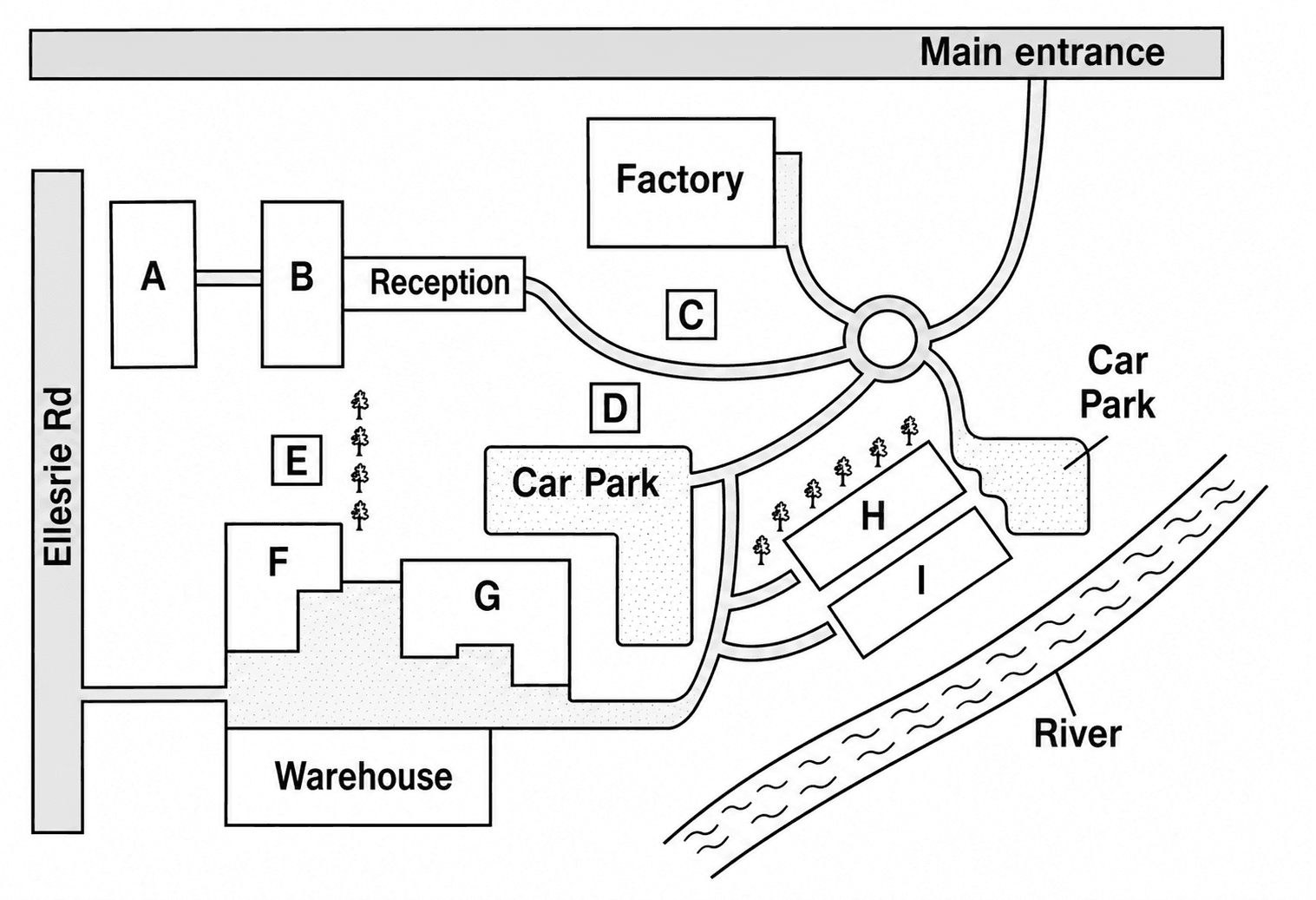
15. Conference centre
16. New office space
17. Stores
18. Finance
19. Café
20. IT Department
Two students discussing vitamin supplements
Questions 21–26
Complete the flow-chart below. Choose SIX answers from the box: lifestyle changes / famous people / scientific findings / industrial processes / poor diet / effective packaging / toxic substances / processed foods / alarming images
History of vitamin supplements
Prior to 1900s: physical weakness is thought to be caused by (21) …………………………
↓
Early 1900s: research shows a link between (22) ………………………… and sickness
↓
1930s: governments become concerned about the popularity of (23) …………………………
↓
1940s: (24) ………………………… convince housewives to buy vitamin supplements
↓
1950s: (25) ………………………… make vitamin supplements more accessible to consumers
↓
1960s to present day: vitamin supplement sales continue to rise because of (26) …………………………
Questions 27–30
Choose the correct letter, A, B or C.
27. Sam believes that more Australians are taking vitamin supplements because they
A want to have control of their own health.
B are advised to by local health authorities.
C have benefitted from competition amongst manufacturers.
28. Lucy is concerned that the US vitamin supplements industry is not required to
A follow the guidelines produced by a government agency.
B list all the possible side effects of taking vitamins.
C provide evidence that their products are effective.
29. When discussing the Danish experiment, Lucy and Sam conclude that vitamin supplements
A are best used for preventing minor illnesses.
B are not fully understood by researchers.
C are harmful if taken in large amounts.
30. Lucy and Sam agree that stricter regulation of the vitamin supplement industry
A would only lead to a slight decrease in sales.
B might be necessary for some types of vitamin.
C may not be welcome by all consumers.
A talk on insect extinction
Questions 31–36
Complete the notes below. Write NO MORE THAN TWO WORDS for each answer.
Insect Extinction in the 21st Century
The reasons why insect populations are declining
• In Europe, important plants are no longer found in fields or (31) ………………………… .
• In the Amazon rainforest, (32) ………………………… might be the cause of butterfly and beetle loss.
• Globally, pesticides are affecting the spatial skills and (33) ………………………… of bees.
The consequences of declining insect populations
• Insects are an essential part of the (34) ………………………… in all places apart from Antarctica.
• Crop production will fall dramatically.
• Researchers can't discover any new (35) ………………………… based on plants.
The possible ways to prevent insect extinction
• Governments must restrict the sale of pesticides.
• People must reduce their consumption of (36) ………………………… .
Questions 37–40
Complete the sentences below. Write ONE WORD ONLY for each answer.
Sand from the Antioch Dunes was used to make (37) ………………………… for houses in the early 1900s.
The metalmark butterfly requires one type of Antioch Dunes plant for its (38) ………………………… .
In recent years (39) ………………………… has led to the loss of wildlife in the Antioch Dunes.
The Antioch Dunes project shows how (40) ………………………… does not always require much land.
Answers
1. brushes
2. 285
3. Ramdhanie
4. bowls
5. shirt
6. Thursday
7. library
8. sandwich
9. Station
10. 021 785 6361
11. find out about safety procedures
12. learn about new company technology
13. provided comfortable seating
14. used attractive materials
15. I
16. B
17. F
18. C
19. E
20. D
21. toxic substances
22. poor diet
23. processed foods
24. alarming images
25. industrial processes
26. famous people
27. want to have control of their own health.
28. provide evidence that their products are effective.
29. are not fully understood by researchers.
30. may not be welcome by all consumers.
31. gardens
32. climate change
33. memory
34. food chain
35. medicine
36. meat
37. bricks
38. eggs
39. fire
40. conservation
Explanations
- 1. brushes
- 'What you'd need to do is get yourself some brushes - I'd suggest a range of them, you know, in different sizes.'Common trap: 'A range of them, in different sizes' has to be matched to 'a set of'.
- 2. 285
- 'if you sign up for two terms, it actually works out cheaper' – '$285.'Common trap: The one-term price is given first; the table asks for two terms.
- 3. Ramdhanie
- 'He's a local artist ... Steve Ramdhanie' – spelled R-A-M-D-H-A-N-I-E.Common trap: An unusual surname, confirmed only by the spelling.
- 4. bowls
- 'in the first term, you'd just be producing two or three bowls.'Common trap: A vase is raised by the caller and ruled out.
- 5. shirt
- 'Well, I have a shirt like that that I could use. I'd just roll up the sleeves.'Common trap: The manager only says 'something old'; the caller names the garment.
- 6. Thursday
- 'the class runs on Wednesdays ... Oh hang on, I've got that wrong.' – 'It's on a Thursday, isn't it?' – 'Yes, my mistake.'Common trap: Wednesday is stated first and then corrected.
- 7. library
- 'I think you begin by drawing the library. There's a good view of it from the park.'Common trap: The caller guesses the old post office; the manager names the library.
- 8. sandwich
- 'the people who do the class - they tend to make a sandwich for themselves, and bring that along.'Common trap: The fold-up chair is already printed in the table.
- 9. Station
- 'they meet each other at the top of Victoria Street, at the Station Road end.'Common trap: Victoria Street is already printed; the answer is the second road.
- 10. 021 785 6361
- 'It's 021 785 6361. Just text her if there's a problem.'Common trap: A long number read out in three groups.
- 11. find out about safety procedures
- The two tasks are attending a fire-safety session and watching the training video for the new operating system.Common trap: New passes and moving files are both raised and explicitly ruled out.
- 12. learn about new company technology
- 'View a training video for the operating system we're now using.'Common trap: The reporting-back on Friday sounds like option D but concerns the week generally.
- 13. provided comfortable seating
- The two improvements are the adjustable chairs and the coloured glass panels replacing dividing walls.Common trap: Windows, insulation and project rooms are all improvements too, but none matches the options.
- 14. used attractive materials
- 'Replaced some dividing walls with coloured glass panels. They look great.'Common trap: Brighter offices come from bigger windows, not from new lights.
- 15. I
- 'in the lower half of your plan, on the right, there are two long buildings that are parallel to each other. The conference centre is the one with a view of the river.'Common trap: Two parallel buildings – only the one nearer the river is correct.
- 16. B
- 'we've done is move the office space further away from the road - into the building that directly joins on to Reception.'Common trap: The old office building beside Ellerslie Road is described first.
- 17. F
- 'if you were going to enter the factory complex from the Ellerslie Road entrance, Stores would be the building immediately on your left.'Common trap: The direction depends on entering from Ellerslie Road, not the main entrance.
- 18. C
- 'there's the road that goes from the roundabout directly to reception ... the Finance building is about halfway along that road. On the plan, the factory's just above it.'Common trap: Two landmarks are needed – halfway along that road, with the factory above.
- 19. E
- 'whereas before you looked straight from the cafe onto the large car park, now there's a line of trees separating them.'Common trap: The cafe has not moved, so the clue is the new line of trees beside it.
- 20. D
- 'It's that square building you see right in the centre of the plan - one of the closest buildings to the larger car park.'Common trap: 'The larger car park' distinguishes it from the smaller one on the right.
- 21. toxic substances
- 'Or they'd been in contact with something poisonous or harmful. Something they'd handled or eaten.'Common trap: An infection is the other pre-1900s explanation, but is not in the box.
- 22. poor diet
- 'people who basically lived off corn - they were getting ill because they weren't eating anything else', and white-rice eaters got beriberi.Common trap: The identification of vitamins is the consequence, not the link.
- 23. processed foods
- 'everyone was suddenly buying canned fruit, artificial butter, meat in tins ... It became very common.'Common trap: The foods are listed by example; the box needs the category.
- 24. alarming images
- 'they showed pictures of rats in a laboratory before and after they were given vitamins. The before pictures showed the rats looking very sick.'Common trap: Exaggerated claims are words; the box option is about the pictures.
- 25. industrial processes
- 'manufacturers had discovered how to produce vitamins artificially and in enormous quantities in their factories.'Common trap: 'In their factories, in enormous quantities' has to be matched to industrial processes.
- 26. famous people
- 'They used movie stars to say how effective the supplements were' – 'Celebrity endorsement really seems to work.'Common trap: 'Movie stars' and 'celebrity endorsement' both point to the same box entry.
- 27. want to have control of their own health.
- 'many Australians are just taking a more active approach to staying well. They don't want to rely on their doctor for everything.'Common trap: Two alternative explanations are floated and dismissed.
- 28. provide evidence that their products are effective.
- 'the industry is under no obligation to prove that their supplements actually work. I don't think that's right.'Common trap: A government agency is named, which pulls towards option A.
- 29. are not fully understood by researchers.
- 'That's not to say that scientists now know everything about vitamins' – 'investigations and long-term trials need to continue.'Common trap: 'High dose' suggests harm, but the finding is only that it made no difference.
- 30. may not be welcome by all consumers.
- 'No one likes being told what they can or can't buy' – 'people would protest.' – 'They certainly would.'Common trap: A specific vitamin is named, which pulls towards option B.
- 31. gardens
- 'The gardens that people have nowadays don't always contain the kind of plant that insects need.'Common trap: Fields are already printed in the note; the second place is gardens.
- 32. climate change
- 'They put this down to climate change, rather than say, the fragmentation of habitat.'Common trap: Habitat fragmentation is named in the same sentence as the rejected explanation.
- 33. memory
- 'it impacts on their spatial skills ... and also their memory. This means that they cannot remember how to get back to their hive.'Common trap: Spatial skills are already printed; the answer follows a long parenthesis.
- 34. food chain
- 'Pretty much everywhere on the planet, with the exception of Antarctica, insects are at the bottom of the food chain.'Common trap: 'With the exception of' has to be matched to 'apart from'.
- 35. medicine
- 'scientists are now studying plants to find out whether they might be a source of medicine in the future.'Common trap: The note is negative ('can't discover'); the recording states the lost opportunity.
- 36. meat
- 'If we cut down on how much meat we ate, some of the land now used for grazing could be turned back into insect-friendly environments.'Common trap: 'Cut down on how much we ate' has to be matched to 'reduce their consumption of'.
- 37. bricks
- 'because they needed to build houses, they removed tons and tons of the sand and turned it into bricks.'Common trap: The sand is the raw material; the answer is what it became.
- 38. eggs
- 'It was on this plant that it laid its eggs, so yes, you can see why the buckwheat was important.'Common trap: The plant's name is given first; the note asks what it is needed for.
- 39. fire
- 'In the last decade, a significant number of butterflies and plants have been destroyed in the Antioch Dunes by fire.'Common trap: Visitor numbers are the response to the fires, not the cause.
- 40. conservation
- 'when we think about the concept of conservation we often assume we need to set aside a large amount of it ... But in this case, relatively little land was required.'Common trap: The final sentence adds a condition, which can distract from the key noun.
Audio transcripts
Part 1 — Enquiring about art classes at a community centre
Manager: Bramley Community Centre. How can I help? Woman: Oh hi. I'm calling about the art classes that the centre offers. I had a quick look at your website. I think one of the classes is called something like 'Movement and Light'? Manager: That's right. The focus is on painting in the style of the French Impressionists. Woman: Yes, I saw that in the description. But I've got a few questions if you don't mind. Manager: Sure, go ahead. Woman: Well, do I need to bring anything to the class? Or is everything supplied? Manager: Not quite. What you'd need to do is get yourself some brushes - I'd suggest a range of them, you know, in different sizes. Woman: All right. Yes, I guess it would make sense to bring your own. I'll make a note of that. Manager: And you know what the fee for the class is? Woman: For one term - it's $170 isn't it? Manager: That's right. But if you sign up for two terms, it actually works out cheaper. Woman: How much would that be? Manager: $285. And we do find that a lot of people sign up for a couple of terms - it's such a great class. Woman: OK, I'll give it some thought. And that's on Monday evenings, isn't it? Manager: Yes, from 6p.m. to 8p.m. In room 15. Woman: And who's the tutor? Manager: The tutor? He's a local artist. You might have heard of him. Steve Ramdhanie. Woman: Oh possibly. How do you spell that surname? Manager: It's R-A-M-D-H-A-N-I-E. Got that? Woman: Yes, thanks. Now, you've also got a class called 'Clay Basics'. It's a pottery class, right? Manager: Yes, that's right. Woman: Do we get to use a pottery wheel? Manager: Yes you do. Woman: Oh great. But we'd be making something simple, I hope. I can't imagine producing a vase or anything with a handle. Manager: No, in the first term, you'd just be producing two or three bowls. That means learning how to shape and glaze them. Woman: Sounds great. I guess it would be a bit of a messy activity. You wouldn't want to wear your smart clothes, would you? Manager: Best not to. I'd recommend wearing something old - that you didn't mind getting dirty. Woman: Well, I have a shirt like that that I could use. I'd just roll up the sleeves, I guess. Manager: And the fee for that class is $180 per term. Woman: All right. Manager: And the class runs on Wednesdays, 6.30 to 8.30p.m. Oh hang on, I've got that wrong. Woman: It's on a Thursday, isn't it? Manager: Yes, my mistake. What else can I tell you? Oh yes, the tutor's name is Theresa Clark. Her works on display in reception here. Woman: Oh great. I'll have a look. Manager: Yeah, if you've got time. Woman: Um, now the other class I thought looked interesting was 'Sketching Architecture'. Manager: Oh, yes. For that one everyone goes down to the local park, because it's surrounded by so many beautiful old buildings. Woman: Oh, right. Like the old post office. Manager: Well, I think you begin by drawing the library. There's a good view of it from the park, I believe. Woman: OK, nice. Actually, come to think of it, I think I've seen the sketching class down in the park when I've driven past. Don't they all take a fold-up chair with them? Manager: I believe so. Woman: Is there anything else I ought to know? Manager: Well, the people who do the class - they tend to make a sandwich for themselves, and bring that along. So, I'd recommend you do that too. Woman: Good idea. I get grumpy when I'm hungry. Manager: All right, that's $160 per term for that class, and it's on Fridays, from 11 a.m. till 1. Woman: So, if the classes are in the park - that's quite a big area. Where do we actually meet? Manager: Good point. Everyone usually heads along just before 11a.m., and they meet each other at the top of Victoria Street, at the Station Road end. Woman: So, on the corner? Great. And the tutor is ...? Manager: Annie Li. Woman: You know what, I'll have to think about the other two, but I'd definitely like to enrol for Annie's class. I'm happy to pay now. Manager: In that case, you're going to need Annie's cell phone number in case you're running late or the class gets cancelled. Woman: I see. OK, what's the number, please? Manager: It's 021 785 6361. Just text her if there's a problem. Now, how would you like to pay? We can...
Part 2 — A briefing on a renovated factory complex
Manager: Good afternoon. First of all, I want to say thank you for your patience for the last six months. As you know, all the office staff had to move to temporary offices while the renovation work at the factory complex was taking place. But finally that work is finished, and everyone can return to the factory complex, and their new office space. We're hoping everything will go smoothly but - there's a couple of things we'll need you to do during your first week back. You'll be pleased to know that your files and folders have been placed at your desk, so there's no need for you to go hunting around for any records. Um, a couple of people have asked whether their old pass will still work at the security gate - or will they need to get their photo done and update their personal details. I can assure you that the old pass will still get you through the gate. No problem. Once you've had a chance to settle in to the new offices, please take the time to view a training video for the operating system we're now using. We think it's going to manage all our programmes far more efficiently. Obviously, the sooner you can get this done, the better. Also for next week, because the renovations have meant a complete redesign of some of the company's buildings, you'll need to attend a session on things like - what to do if you hear the fire alarm go off, and where to meet if you have to evacuate the buildings. We'll let you know as soon as we have a definite time for that. It's going to be a busy week for everyone, but hopefully the kind of challenge that can help bring the team together. We'll make a time for you to report back to me on Friday. All right, we've also taken some steps to improve the physical environment in your offices. Bigger windows mean that the offices are a lot brighter - and that's better for your eyes. Inside we've replaced some dividing walls with coloured glass panels. They look great. We've also invested in some adjustable chairs. You can lower or raise them to whatever height feels right for you. What else? We've now got some quality insulation in the ceilings and walls that'll make everything a lot warmer. Also - another thing - we've set aside several rooms for project work. That will allow a team to get together around the same table. We feel that more opportunities for face-to-face discussion will benefit the whole company. So, when you... Manager: OK, so let's look at a plan of the factory complex, and see how it's changed. You can see that the main entrance is at the top of the map, Ellerslie Road is on the left-hand side, and the warehouse is at the bottom. OK, let's start with one of the new buildings - the conference centre, perhaps. If you look at the lower half of your plan, on the right, there are two long buildings that are parallel to each other. The conference centre is the one with a view of the river. Hopefully that's something visitors to the factory complex will appreciate - especially on a sunny day when it's clear outside. Now, what about the new office space? As you know, the offices used to be in that large building right alongside Ellerslie Road, and that could get a bit noisy at times. So what we've done is move the office space further away from the road - into the building that directly joins on to Reception. This should mean employees can benefit from a quieter working environment, as well as the other improvements I mentioned earlier. We also decided to move the Stores building, so it could be a lot closer to the warehouse. So now, if you were going to enter the factory complex from the Ellerslie Road entrance, Stores would be the building immediately on your left. The warehouse staff have already commented that having the Stores here is much more convenient. Yes, I'm sure it's going to save a lot of time. Finance was another building that had to be relocated. They just didn't have enough space before. So, you can see the main entrance on the plan. right? And below that is the roundabout. Then there's the road that goes from the roundabout directly to reception. Well, the Finance building is about halfway along that road. On the plan, the factory's just above it. The cafe, just so you know, is in the same place as before. It's not ideally located for the factory workers, that's true, but it's not too far if you're heading down from Reception, or up from the warehouse. But what we've done is try to make the environment a bit more pleasant. So, whereas before you looked straight from the cafe onto the large car park, now there's a line of trees separating them. I think you'll agree that this was a good decision - putting in the trees, I mean. It was also necessary to relocate the IT department. Of course, for some of their work, they can do it remotely, but from time to time, the IT people do need to visit the different buildings around the factory complex. For that reason, we've given the IT department a more central location. It's that square building you see right in the centre of the plan - one of the closest buildings to the larger car park. Something I'd like to say about ...
Part 3 — Two students discussing vitamin supplements
Lecturer: OK, we've looked at the history of vitamin supplements and thought about why people take them. We've also considered the reasons why some health professionals are critical of the vitamin supplement industry. Now work with a partner and discuss the key issues. Lucy: Sam, shall we work together? Sam: Sure. Let's go over the history. Lucy: Well, before the 1900s, when someone became weak and tired, and it wasn't clear why, doctors assumed they were suffering from an infection - like a virus. Sam: Or they'd been in contact with something poisonous or harmful. Something they'd handled or eaten. Doctors had no other explanation for it. Lucy: But in the early 1900s, that changed. That researcher in the US - Joseph Goldberger, - he realised people who basically lived off corn - they were getting ill because they weren't eating anything else. Sam: Exactly. And other researchers were realising the same thing. Like, in places where people only ate white rice - they were suffering from a disease called beriberi. Lucy: So the researchers concluded that there must be something missing - that the stuff some people were eating had no nutritional value. And from there, researchers began to identify vitamins - like A and B - for the first time. Sam: A huge scientific breakthrough. Lucy: So doctors, the public, everyone got to hear about vitamins - first that they existed, and second, you needed them to be healthy. Sam: But it was governments that were really worried about vitamin deficiency. Certainly in the US and in the UK, at least. Lucy: What do you mean? Sam: Well, in the 1930s those governments were worried about people's general health, because everyone was suddenly buying canned fruit, artificial butter, meat in tins...that kind of thing. It became very common. And so newspapers were featuring lots of government reports about how serious this was. Lucy: I see. Sam: And then, some people saw a business opportunity. Lucy: Naturally. Sam: In the 1940s, companies started making and selling vitamin supplements in bottles. And they decided the easiest way to market them was to target housewives. Lucy: Why was that? Because housewives were responsible for keeping families healthy? Sam: I'd say so. In the weekly magazines housewives read, the companies made exaggerated claims about what the supplements could do, and they showed pictures of rats in a laboratory before and after they were given vitamins. The 'before' pictures showed the rats looking very sick. Lucy: So they scared the housewives into buying their product. Sam: Apparently. Lucy: But vitamins were still expensive, weren't they? It wasn't until the 1950s that more people could afford to buy them. Sam: Why was that? Lucy: Well manufacturers had discovered how to produce vitamins artificially and in enormous quantities in their factories. Sam: I suppose that's what goes on with any product. It starts expensive until manufacturers adapt their technology. Were there any developments in the 1960s? Lucy: Companies changed their promotional strategy to increase their sales. They used movie stars to say how effective the supplements were. Sam: That's still true today. Celebrity endorsement really seems to work. Someone on the TV says vitamins have made them healthier and immediately more consumers go out and buy them. Lucy: So apparently the number of Australians taking vitamin supplements has doubled in the last decade. Sam: Incredible. I suppose so many fitness-related articles recommend them. Lucy: I wouldn't say that that's the reason. According to the research I read, many Australians are just taking a more active approach to staying well. They don't want to rely on their doctor for everything, so they're turning to vitamins. They can take those themselves and feel they're doing something positive. So it doesn't have anything to do with the fact the price has dropped because so many companies are making supplements. Sam: I doubt it. Even people in lower socio-economic groups are buying them, apparently. Lucy: Most of my own research has been about the US vitamin supplement industry. Did you know the industry is under no obligation to prove that their supplements actually work. I don't think that's right. Sam: How do you mean? Lucy: Well, in the US, the Food and Drug Administration department regards vitamin supplements as a food. With medicine - manufacturers have to demonstrate that their products really can improve people's health, before they go on sale. Sam: But you said vitamins are classed as a food. Lucy: Yes, so the industry can sell whatever vitamin supplements they like, you know: 'This one will improve your brain function' - even if there's nothing to support their claims. Sam: That Danish experiment - thousands of people took part in that. Lucy: Yes, the scientists wanted to see if high doses of vitamins really could prevent medical problems like heart disease. Or just reduce the chances of people getting a simple cold. Sam: But the 'high dose' people were just as likely to get sick as the people not taking any vitamins. That's not to say that scientists now know everything about vitamins. Lucy: No. Like you say, investigations and long-term trials need to continue before they can be certain about what taking vitamin supplements can actually achieve. Sam: But in the meantime, do we need stricter regulation of the supplement industry? Do you think people would stop buying and taking vitamins if they were told it's a waste of time? Lucy: Hardly. No one likes being told what they can or can't buy... especially where health is concerned. Sam: Fair enough. I guess if the government made it harder to get certain products, like say, fish oil with vitamin D, people would protest. Lucy: They certainly would. What I think is that...
Part 4 — A talk on insect extinction
Student: So today I'm going to be talking about the way that different insect species are being threatened. In other words, the reasons why some insect populations are declining - and might even become extinct in the 21st century. I'll also talk about the consequences - if extinction occurs - and some possible ways to prevent that. Let's start with the reasons. First of all, when we look at what's going on in Europe, we can see a huge decline in certain species of insect. This is partly because farmers no longer allow certain plants to grow in their fields. But farmers are not entirely to blame. The gardens that people have nowadays don't always contain the kind of plant that insects need. So perhaps we need to rethink what we're putting there. In more tropical regions of the world, for example, the Amazon rainforest, scientists have noticed that the number of beetle and butterfly species also appears to be diminishing. They put this down to climate change, rather than say, the fragmentation of habitat - but more research has to be done. And then, there's the use of pesticide, and of course, this happens everywhere in the world. Pesticide is designed to kill a range of insects that farmers don't like, but it also kills bees, which they need. Pesticide might not kill bees directly, but we know that it impacts on their spatial skills - meaning they cannot make sense of what they see around them - and also their memory. This means that they cannot remember how to get back to their hive. So why worry about whether insects become extinct? Well, the consequences would obviously be terrible not just for them, but for us. Pretty much everywhere on the planet, with the exception of Antarctica, insects are at the bottom of the food chain. They're absolutely vital, because if there were no insects, there would also be no birds or lizards or mammals. Then there's the role that insects play in crop production. We use them to pollinate our fruit and vegetables, and it would be impossible to manage without them. It's also worth remembering that scientists are now studying plants to find out whether they might be a source of medicine in the future. If these plants disappear because of insect extinction, that would be another lost opportunity. So, there's some possible ways we could prevent insect extinction, some more controversial than others. I think it's a given that governments have to do something about the sale of pesticides; in fact, some countries have already passed laws to ban certain products. That's a good move forward. But ordinary people can also make a difference. If we cut down on how much meat we ate, some of the land now used for grazing could be turned back into insect-friendly environments. I'd like to finish with a positive story. There's a place in California called the Antioch Dunes. In the 1900s, people looked at the dunes and the sand that formed them and thought 'that sand is a great raw material'. And because they needed to build houses, they removed tons and tons of the sand and turned it into bricks. It wasn't really until the 1960s that biologists suddenly realised that the Antioch Dunes had actually been home to some unique species of plant and insect. But by this time, there was only one species of butterfly left. The metalmark butterfly. And a major problem for the metalmark was that it required a certain plant to survive - something called the naked-stem buckwheat. It was on this plant that it laid its eggs, so yes, you can see why the buckwheat was important. Well, in the end, the only way that the biologists could get the buckwheat to start growing properly was to replace the sand. That was a great first step, but the metalmark butterfly is still endangered. In the last decade, a significant number of butterflies and plants have been destroyed in the Antioch Dunes by fire. So now, the biologists are limiting the number of visitors who can wander around the dunes. That's fair enough, I think. All right, the final point I want to make about the project to restore the Antioch Dunes area is to do with how much land is required: when we think about the concept of conservation we often assume we need to set aside a large amount of it. And that might be true for some large species. But in this case, relatively little land was required. But the important thing is to leave it undisturbed. OK...
Comments
Loading comments…