

IELTS Trainer 2 Listening Test 4
4 parts · 40 questions · 30 minutes
Hiring transport on an island
Questions 1–10
Complete the notes below. Write NO MORE THAN TWO WORDS AND/OR A NUMBER for each answer.
Island Transport
Motor scooter
• $ (1) ………………………… per day
• fun to ride
• they provide helmets and (2) …………………………
• don't ride on (3) ………………………… Road
Economy car – $87.80 per day
• four doors, five passengers
• can drive on all the roads and to (4) ………………………… for a swim
• no (5) ………………………… in the Economy car
E-Bike
• $ (6) ………………………… per day
• battery is not very (7) …………………………
• a quality bike with two good (8) …………………………
• a map and (9) ………………………… are provided
• no (10) ………………………… is needed
An open day at a community garden
Questions 11–15
Choose the correct letter, A, B or C.
11. What was recently discovered at this site?
A a written text about the area
B various tools used for farming
C some drawings showing the garden
12. This location is good for gardening because
A the weather is warm.
B there is enough water.
C it is protected from the wind.
13. In 1860, what was built on this site?
A a medical centre
B a type of factory
C a base for soldiers
14. Today, the fruit and vegetables from the gardens
A are sold to businesses in the area.
B are given to certain local people.
C are used by those who work in the garden.
15. The local college now uses the gardens
A as a location for scientific research.
B for educating the wider community.
C to teach its students gardening skills.
Questions 16–20
Label the map below. Write the correct letter, A–H, next to Questions 16–20. The Community Garden.
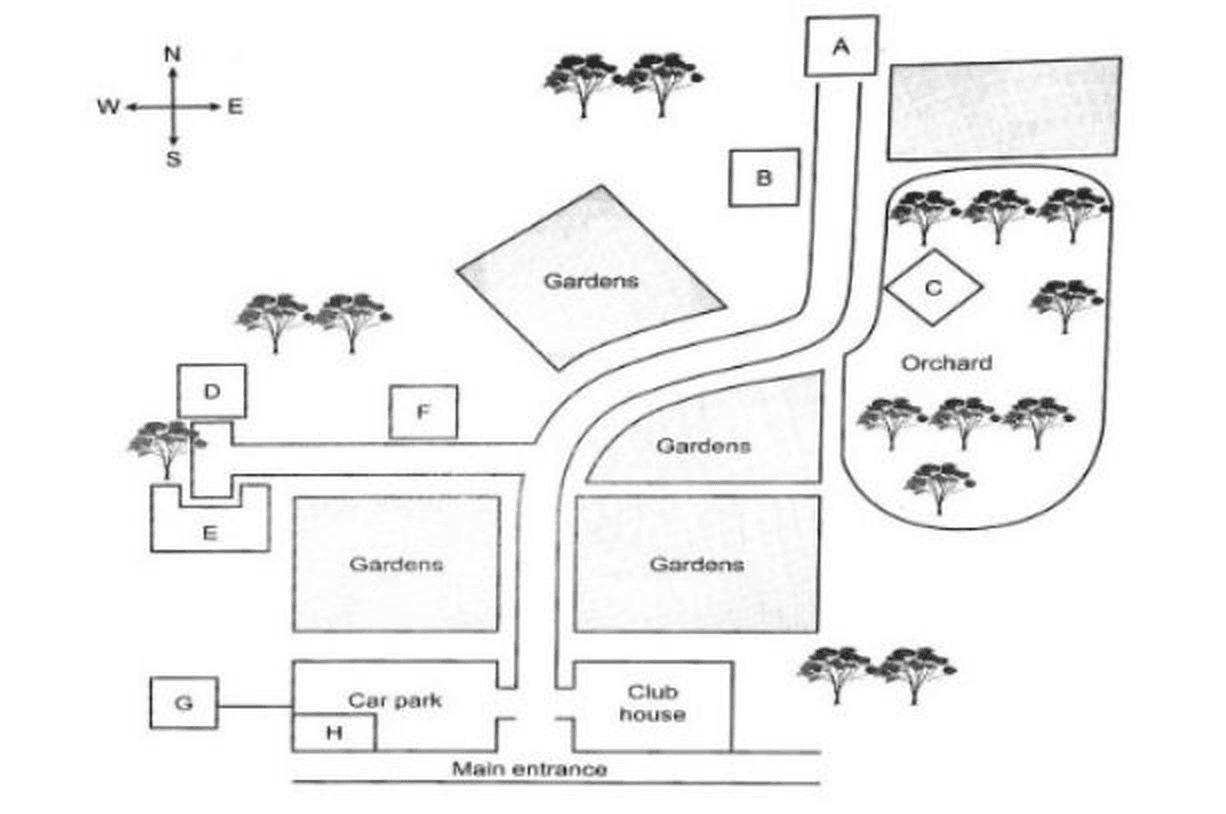
16. worm farms
17. seed store
18. machinery shed
19. compost heaps
20. drying room
Two students planning a presentation on games in therapy
Questions 21–25
Write the correct letter, A, B or C, next to Questions 21–25.
21. According to Alya and Jason, Dr Franklin showed that video games have
A been used in therapy for a long time.
B only a limited number of uses in therapy.
C been accepted by most doctors working in therapy.
22. According to the students, what is the biggest advantage of games in therapy?
A Some injuries occur less frequently.
B Costs are lower than other treatments.
C Patients work harder at the exercises.
23. When discussing the Singapore study, the students disagree about
A the purpose of the research.
B the methodology used in the research.
C the conclusions reached by the researchers.
24. What impresses the students about the anxiety research?
A the variety of games that were used
B results were confirmed in another study
C both patients and their families benefitted
25. The students agree that the Rhode Island research
A provided reliable evidence.
B has received widespread publicity.
C has been criticised by some academics.
Questions 26–30
What opinion do the students express about each research study? Choose FIVE answers from the box and write the correct letter, A–G, next to Questions 26–30.
List of Options
A the finding may disappoint some businesses
B the finding contradicts other research
C the finding is relevant in particular countries
D the finding is not believable
E the finding is supported by various studies
F the finding is not a surprise
G the finding will become increasingly important
26. surgeon study
27. vision study
28. sport study
29. ageing study
30. career study
A talk on traditional Polynesian navigation
Questions 31–40
Complete the notes below. Write ONE WORD ONLY for each answer.
Traditional Polynesian Navigation
Introduction
• the islands of Polynesia are in the Pacific Ocean
• the Polynesian peoples originally migrated from (31) ………………………… to the Pacific islands
• European explorers were impressed that Polynesian canoes were (32) ………………………… than European ships
Equipment on ocean-going canoes
• paddles were used for (33) …………………………
• sails were made from the pandanus plant
• warm clothes were made from the (34) ………………………… of the paper mulberry tree
How Polynesians navigated at sea
• they did not have the magnetic compass
• they remembered where stars rose and set by making up detailed (35) …………………………
• when it was cloudy, they found the direction by using (36) …………………………
Finding new islands
• they could identify certain (37) ………………………… that only live near land
• close to land, they could read changes in the sea's (38) …………………………
Recent history
• in 1976 the canoe Hokule'a sailed from Hawaii to Tahiti without (39) …………………………
• now replica traditional canoes have sailed across the Pacific and around the world
• as well as sailing, these voyages have created fresh interest in Polynesian culture, music and (40) …………………………
Answers
1. 49.99
2. gloves
3. Battenburg
4. Green Bay
5. air conditioning
6. 52.20
7. heavy
8. brakes
9. lock
10. licence
11. various tools used for farming
12. there is enough water.
13. a medical centre
14. are given to certain local people.
15. to teach its students gardening skills.
16. F
17. C
18. G
19. E
20. A
21. been used in therapy for a long time.
22. Patients work harder at the exercises.
23. the methodology used in the research.
24. both patients and their families benefitted
25. provided reliable evidence.
26. F
27. B
28. D
29. G
30. E
31. Asia
32. faster
33. steering
34. bark
35. songs
36. waves
37. birds
38. colour
39. instruments
40. language
Explanations
- 1. 49.99
- 'Daily, it's $49.99. That includes a full tank of petrol.'Common trap: The hourly rate is given first, in the previous turn.
- 2. gloves
- 'Yes of course, all sizes. We can also let you have gloves as well.'Common trap: Helmets are already printed in the note; the extra item is gloves.
- 3. Battenburg
- 'you can't ride on Battenburg Road' – spelled out B-A-T-T-E-N-B-U-R-G.Common trap: The name is only confirmed by the spelling after she asks.
- 4. Green Bay
- 'if you'd like to go for a swim, you can drive right down to Green Bay, which visitors love.'Common trap: The place name comes at the end of a long sentence about the roads.
- 5. air conditioning
- 'Does the car have air conditioning?' – 'Not that model, no.'Common trap: The bigger cars do have it – the note is about the Economy car.
- 6. 52.20
- 'Normally they're $59 per day, but I can offer you a discounted rate at the moment of $52.20.'Common trap: The standard price is given immediately before the discounted one.
- 7. heavy
- 'On some E-Bikes, the battery is really heavy, but on these bikes it's nice and light.'Common trap: The note is phrased negatively ('not very'), so the answer is the opposite of 'light'.
- 8. brakes
- 'Well made with high quality brakes both front and back.'Common trap: 'Both front and back' has to be matched to 'two'.
- 9. lock
- 'What about a lock?' – 'Yup, one of those as well, with each bike.'Common trap: GPS is asked about first and refused; the map is already in the note.
- 10. licence
- 'another big advantage is that you don't have to have a licence for this type of vehicle.'Common trap: 'You don't have to have' has to be matched to 'is needed'.
- 11. various tools used for farming
- 'we found some ancient implements, like spades and forks, for digging. They were buried in the earth.'Common trap: Documents and a diagram are both mentioned, but neither is the discovery.
- 12. there is enough water.
- 'The great thing, though, is the stream that runs through the valley, so we can irrigate the gardens even through long, dry summers.'Common trap: 'The great thing, though' marks the real reason after two near-misses.
- 13. a medical centre
- 'the City Infirmary was constructed on this site, so this is where doctors and surgeons worked.'Common trap: The military camp is raised and then explicitly ruled out.
- 14. are given to certain local people.
- 'they donate what they grow to families in this neighbourhood who are struggling financially.'Common trap: Selling to businesses is described, then denied.
- 15. to teach its students gardening skills.
- 'undergraduates enrolled on the college's horticulture course have a class here, to learn about their subject first hand.'Common trap: 'Now' rules out the community workshops, which are only planned.
- 16. F
- 'from the main entrance, head north ... Just before the path curves round to the right, there's a turning on the left. Go down there and the worm farms are inside the first building you come to.'Common trap: 'The first building you come to' separates F from D and E further along.
- 17. C
- 'Follow the path around the edge of the orchard - but don't go too far. The seed store is actually located inside the orchard.'Common trap: 'Actually located inside the orchard' rules out the buildings on its edge.
- 18. G
- 'From the main entrance, just go into the car park and walk right to the end. You'll see a little path heading out to the west - it's down there.'Common trap: 'Heading out to the west' puts it beyond the car park, not inside it.
- 19. E
- 'take the first turning on the left. Go to the end of that path. The compost heaps are built in the shape of a letter U.'Common trap: The U shape is the clue that separates E from D on the same path.
- 20. A
- 'walk up through the gardens till you come to the orchard. Keep heading north and the drying room is right at the very end of that path.'Common trap: 'Right at the very end ... as far as you can go' puts it at the top of the map.
- 21. been used in therapy for a long time.
- 'since the 1990s, therapists have been experimenting with games' – 'Dr Franklin illustrated that this has been going on for many years.'Common trap: The uptake among professionals is raised but never answered.
- 22. Patients work harder at the exercises.
- 'the games are really motivating. People are much more prepared to spend hours on rehabilitation' – 'That's the most important benefit.'Common trap: Cost is proposed and dismissed; injuries go up, not down.
- 23. the methodology used in the research.
- They disagree over whether the subjects played together in a room or online – that is the method, not the aim or the findings.Common trap: Purpose and conclusion are both stated with agreement, on either side of the disagreement.
- 24. both patients and their families benefitted
- 'Better for the children, but also better for the parents. That's what I like about this.'Common trap: Confirmation by other research is what is still missing, not what impressed them.
- 25. provided reliable evidence.
- 'This study has supplied valid proof as to why games work this way' – 'that's a good point.'Common trap: Jason first dismisses it as merely repeating earlier work.
- 26. F
- 'games are obviously going to improve hand to eye coordination' – 'Yeah, I guess it's predictable.'Common trap: 'Predictable' is the word that marks it as no surprise.
- 27. B
- 'there are also studies showing a link between electronic screens and eye damage.'Common trap: 'Controversial' is the summary; the reason is the conflicting research.
- 28. D
- 'Well, I doubt that's really true.' – 'Seems highly unlikely to me.'Common trap: The company is mentioned, but the opinion is about believability.
- 29. G
- 'And that's going to be more and more significant as the population ages.'Common trap: The remark about manufacturers points at option A, but it is good news, not disappointment.
- 30. E
- 'And there's been quite a lot of previous research to back that up, too.'Common trap: 'Previous research to back that up' has to be matched to 'supported by various studies'.
- 31. Asia
- 'the Polynesians began their journeys in Asia and from there migrated eastwards to the Pacific islands.'Common trap: The Americas is the old, rejected theory.
- 32. faster
- 'European ships were much stronger, but the indigenous vessels were considerably faster under sail.'Common trap: 'Stronger' belongs to the European ships, in the same sentence.
- 33. steering
- 'the paddles were positioned at the back of the canoe to make steering the vessel possible.'Common trap: Propulsion is explicitly ruled out first.
- 34. bark
- 'the paper mulberry tree ... its bark was remarkably flexible and was used in the manufacture of clothing.'Common trap: Wool and cotton are named only to say they were unavailable.
- 35. songs
- 'the navigators had created long and complicated songs to help them recall all the information they needed.'Common trap: 'Long and complicated' has to be matched to 'detailed'.
- 36. waves
- 'they still knew which way to sail the canoe by studying the waves, which usually came from predictable directions.'Common trap: The stars are what fails in cloud, not the answer.
- 37. birds
- 'The navigators were experts at recognising those particular birds whose habitat was the open ocean, and those that lived close to islands.'Common trap: The same sentence also describes open-ocean birds, which do not indicate land.
- 38. colour
- 'The temperature of the water is constant in that part of the Pacific but its colour could vary in the proximity of land.'Common trap: Temperature is named first, as the thing that does NOT change.
- 39. instruments
- 'all the navigation was done using the techniques I've outlined today - the crew did not use modern instruments on the voyage.'Common trap: 'Did not use' has to be matched to 'without'.
- 40. language
- 'Another aspect of this has been the teaching of Polynesian languages, some of which were in danger of dying out.'Common trap: Culture and music are already printed in the note.
Audio transcripts
Part 1 — Hiring transport on an island
Brian: Good morning. Island Transport company, this is Brian speaking. Jenny: Morning. This is Jenny Cartwright here. I'm visiting the island next week and I want to hire some form of transport. Brian: No problem, Jenny. Island Transport can offer a range of different vehicles to hire. So, um, the first option is a motor scooter - they're very popular. Jenny: Oh right. And how much do they cost to hire? Brian: Well, you can hire them by the hour or by the day. Per hour, it's $15.50 Jenny: And what about for a day? Brian: Daily, it's $49.99. That includes a full tank of petrol, but you need to fill it up before you bring it back. Jenny: Is a scooter a good way to get around the island? Brian: Oh yes, it's a lot of fun. Visitors really enjoy it. Jenny: Do you provide helmets? Brian: Yes of course, all sizes. We can also let you have gloves as well - it's not a bad idea. Jenny: Oh yes, I hadn't thought of that. Brian: The only thing is with the scooters, you have to keep to sealed roads. That means you can't ride on Battenburg Road - so you can't visit the far end of the island. Jenny: Sorry, I didn't catch the name of the road. Could you spell it? Brian: Sure, it's spelt: B-A-T-T-E-N-B-U-R-G. But there are still plenty of other places you can explore on a scooter. Jenny: OK. And what about a car? Brian: Yes, we've got a range of cars. Jenny: Well, there's four of us. But if we do go for the car option, we'd be happy with a very small, basic one. Brian: An 'economy car' would be $87.80 per day. That's for a four-door car, it can take five passengers. Jenny: Right, OK. Brian: And a car is the best way to see the whole island. You can drive on all the roads. And if you'd like to go for a swim, you can drive right down to Green Bay, which visitors love. Jenny: Well, a car is definitely something to consider. It's certainly a good price, if we split it between the four of us. Brian: Exactly. Jenny: Only thing is, it's pretty hot at this time of year. Does the car have air conditioning? Brian: Not that model, no. You'd need one of our bigger cars if you want that. Jenny: Well, maybe it doesn't matter. Brian: The other option to consider is an E-Bike. These are very popular - like a normal bicycle, but with electric power to help you along. Jenny: How much are they? Brian: Normally they're $59 per day, but I can offer you a discounted rate at the moment of $52.20 Jenny: Oh, OK. Brian: To be honest, a lot of our customers these days prefer E-Bikes to motor scooters, because they're so quiet and peaceful. On some E-Bikes, the battery is really heavy, but on these bikes it's nice and light. Jenny: I've never ridden an E-Bike before. How difficult is it? Brian: Not difficult at all. You'll find they are very easy to handle. Like I say, just like a normal pedal bike really, but you don't have to do too much work. Which is a good thing because the island is quite hilly. These are good quality bikes too. Well made with high quality brakes both front and back, so you won't have any problems. Jenny: Well, that does sound like a lot of fun. Do they come with GPS? Brian: No, but we can provide you with a map. Jenny: What about a lock? Brian: Yup, one of those as well, with each bike, so you can leave it securely if you want to. Jenny: I think my friends will like the idea of an E-Bike. A good compromise. Brian: Like I say, they're very popular these days. And another big advantage is that you don't have to have a licence for this type of vehicle. Jenny: Well, let me discuss it with my friends and I'll get back to you. Brian: No problem. Thanks for your...
Part 2 — An open day at a community garden
Man: Well, good morning everyone and welcome to this open day at the community garden. Our garden belongs to the local community and, as you'll see, what we grow here is mostly fruit, and different kinds of vegetables. First, I'll tell you some background information. Well, recently we made an interesting discovery at the garden. Before, we didn't know much about the history of this site. We only had a few documents and records. Then we found some ancient implements, like spades and forks, for digging. They were buried in the earth. Experts say these are at least 1000 years old. So people have been using this land for growing produce for a long time. There are some photographs of these implements in the club house, as well as a diagram of what we think the garden might have looked like, if you want to look later. So, why was this location so good for gardening? As you can see, we're in a slight valley. And storms blow very hard up this valley, which can be a problem. But being in a valley, we get good freezing frosts here in winter, which gardeners like because it kills the bugs. The great thing, though, is the stream that runs through the valley, so we can irrigate the gardens even through long, dry summers. Now what we do know is that in 1860, gardening stopped here. This was a time of rapid development in this area. And on that date, the City Infirmary was constructed on this site, so this is where doctors and surgeons worked to take care of the health needs of the growing population. Also, many new houses were put up for people who commuted into the city each day to work. There was even talk of a new military camp, although that never happened in the end. Then in the 1980s, the old buildings here were removed. And this land again became a productive garden. Today, these gardens produce large quantities of fruit and vegetables. Each plot of land is worked by a volunteer member of the garden, and they donate what they grow to families in this neighbourhood who are struggling financially. Occasionally we're approached by local businesses and restaurants wanting to buy our organic produce, but we just don't have enough. We also have a good relationship with the local college. In fact, several of the academics there are members of the garden. Each week, undergraduates enrolled on the college's horticulture course have a class here, to learn about their subject first hand. And in future the college hopes to hold workshops here, to help local people establish vegetable gardens at home. Man: OK, now I'll just point out a few places of interest around the gardens. So, can you all look at your maps please? OK, so we're now standing at the main entrance to the gardens, outside the club house. So, you might be interested in our worm farms. This is where we make fertiliser. To get there, from the main entrance, head north. You'll pass gardens on either side of the path. Just before the path curves round to the right, there's a turning on the left. Go down there and the worm farms are inside the first building you come to. It's also worth visiting our seed store. Again, head north and follow the path as it curves round to the right through the gardens. You'll come to the orchard. Follow the path around the edge of the orchard - but don't go too far. The seed store is actually located inside the orchard - a very pretty spot. Now the machinery shed might interest some of you. From the main entrance, just go into the car park and walk right to the end. You'll see a little path heading out to the west - it's down there. Our compost heaps are also pretty impressive. So, head north from the main entrance, go past the first gardens and take the first turning on the left. Go to the end of that path. The compost heaps are built in the shape of a letter 'U'. The drying room is also interesting. This is where we dry fruit, to preserve it. To see how it's done, walk up through the gardens till you come to the orchard. Keep heading north and the drying room is right at the very end of that path - as far as you can go. Now one other thing I'll mention...
Part 3 — Two students planning a presentation on games in therapy
Alya: Well, Jason, shall we do some planning for our joint presentation? Jason: Yeah, let's compare the reading we've been doing. Did you read that article by Dr Franklin? Alya: Yes, the use of games in therapy. Jason: So, we'll need to explain what kind of therapy' he's talking about. Alya: OK, so it's treating people after accidents or illnesses - rebuilding their body strength. Jason: Exactly. And Dr Franklin sees huge potential for games. Alya: But he made the point that this isn't new. Really, since the 1990s, therapists have been experimenting with games. Jason: Yeah, I agree, Dr Franklin illustrated that this has been going on for many years, it's not a sudden breakthrough. Alya: I was hoping he'd give some idea about how many health professionals now employ games in therapy. Jason: He doesn't really address that, does he? Alya: OK, so, what's the biggest advantage of games in therapy? Jason: Well, most games are played in virtual reality. So the patient is moving their arms and legs, exercising their body. Alya: So I guess it's quite cheap, then? Jason: Yeah, but so are conventional exercises. I don't think that's an issue. Alya: No, OK. But I read that the games are really motivating. People are much more prepared to spend hours on rehabilitation, when a game's involved. Jason: I think you're right. That's the most important benefit. In fact, I read some people actually get so caught up in the game they hurt themselves, and the therapists have to slow them down. Alya: Then, did you read about the Singapore study? Jason: Yeah, I started. They were investigating whether people actually made more friends by playing games, right? Alya: That's right. They got a group of teenagers and over-60s together for 30 minutes a day playing video games. Jason: But the subjects weren't all in the same place. They were playing online. Alya: No, they were all together in a room. That's how the experiment was conducted. Jason: We should check, I'm sure it was online. Alya: You'll find I'm right. But anyway, the study found a real social benefit to game playing. Jason: Mmm, interesting. So many people say that games are solitary. Alya: Well, the Singapore study showed that players develop empathy for each other and bond over games. Jason: A good point to make in the presentation. Then, I also had a look at the 'anxiety study'. Alya: I haven't seen that one. Jason: Well, they experimented with children waiting to see a doctor. Some were allowed to play games and some weren't. Alya: Was there a particular type of game? Jason: Well, just simple ones on hand held devices. And they found that the children who played games experienced considerably less stress and anxiety. Games distract the mind - that's the theory. Alya: Better for the children, but also better for the parents. That's what I like about this. Jason: Yeah good point - it reduces the stress for everybody. There just needs to be some additional research to support the finding. Alya: We should also mention the Rhode Island research. Jason: Maybe. But the finding just reinforced what's been shown in earlier studies - that people can be distracted from their bad habits, like eating junk food, or drinking fizzy drinks, by playing games. Alya: But no-one had used MRI scans before. And the brain scans showed that games activate the same reward centres in the brain as the drinks or junk food. This study has supplied valid proof as to why games work this way. Jason: Actually, that's a good point. And many people would probably like to know about that. Alya: So, then in the presentation, we need some more research findings. Jason: Well, I read an interesting study about surgeons. It was in the USA. And it found that surgeons perform better when they play video games in their free time. Alya: That makes sense. I mean, games are obviously going to improve hand to eye coordination. Jason: Yeah, I guess it's predictable. Still interesting, though. Alya: Absolutely. Challenges the idea that games are just a waste of time. Then there was a study about vision and eyesight. Apparently, games may actually improve vision. Game players in the study could see differences in grey colours more effectively. Jason: That's odd, though, isn't it, because there are also studies showing a link between electronic screens and eye damage. Alya: Yeah, it's certainly controversial. Jason: I also read a study about sports. There's a company that makes video games which are supposed to encourage physical exercise. The idea is, you play the sport first in the game, and then you're more likely to do it for real. And the study, apparently, confirmed it. Alya: Well, I doubt that's really true. Jason: I know. Seems highly unlikely to me. Maybe just a marketing tactic by the company. Alya: The study about ageing was a good one. Scientists in Germany found that games have a positive influence on older people by keeping their brains active. Jason: And that's going to be more and more significant as the population ages. Good news for game manufacturers! Alya: I also read that games can actually help your career. The problem-solving, decision-making and leadership that are developed in some games can actually make you more effective in the workplace. Jason: And there's been quite a lot of previous research to back that up, too. Interesting. Alya: Then another...
Part 4 — A talk on traditional Polynesian navigation
Student: Hi everyone. Today I'm going to be talking about traditional Polynesian navigation and voyaging. Now, in case you don't know, the islands of Polynesia are in the Pacific Ocean and include Hawaii, Tahiti and Samoa. All of these islands were originally uninhabited by humans. And for many years there was a debate about where the Polynesian people had migrated from. It was once suggested that they came from the Americas. However, that debate has been settled. Today, anthropologists recognise that the Polynesians began their journeys in Asia and from there migrated eastwards to the Pacific islands. It's believed all the Polynesian islands had been settled by the 13th century. When European explorers arrived in the Pacific in the 17th and 18th centuries, they were impressed by the local canoes. European ships were much stronger, but the indigenous vessels were considerably faster when under sail. What we now know is that Polynesians sailed across open ocean - out of sight of land - long before this occurred elsewhere. And to make these voyages possible, they built remarkable ocean-going canoes. The canoes had two hulls - so are sometimes called 'catamarans'. They were equipped with large paddles, but these were not a form of propulsion. Instead the paddles were positioned at the back of the canoe to make steering the vessel possible. All these ocean-going canoes had sails. Polynesian sails were triangular in shape and made from the 'pandanus' plant, which grows on nearly all Pacific islands. It was also necessary to make warm clothing, as even in tropical waters people could get cold on long voyages. Materials like wool and cotton were unknown to Polynesians. However, the paper mulberry tree grows on most Pacific islands and its bark was remarkably flexible and was used in the manufacture of clothing. Next we come to the issue of navigation at sea. How did Polynesians find their way, once they were out of sight of land? We know that they did not have the magnetic compass, which told other navigators which direction was north. But the Polynesian navigators understood where numerous stars rose and set on the horizon. And using this, they could identify 32 different directions. However, this information about the stars was extremely complex and therefore remembering it all was a challenge. So the navigators had created long and complicated songs to help them recall all the information they needed. Using the stars to navigate was effective - so long as the sky was clear. But when it was cloudy, the navigators couldn't see the stars. How did they find direction then? Well, they still knew which way to sail the canoe by studying the waves, which usually came from predictable directions in the Pacific at different times of the year. Sometimes they were sailing between islands they had visited before. But very often they were trying to find new islands. How did they know that land was nearby, just over the horizon? Well, there were various techniques. The navigators were experts at recognising those particular birds whose habitat was the open ocean, and those that lived close to islands. So this was one way they knew that land wasn't far away. They were also skilled at noticing changes to the sea itself. The temperature of the water is constant in that part of the Pacific but its colour could vary in the proximity of land, and that was something else that they were able to detect. Well, as technology developed, traditional voyaging all but died out. The Polynesian peoples travelled by steam ship and later aeroplane, like everyone else. However, in recent history, there has been renewed interest in traditional voyaging. It began in 1976 when a new canoe named Hokule'a was built as a replica of traditional Polynesian vessels. This canoe was sailed from Hawai'i to Tahiti, a distance of more than 4000 kilometres across open ocean. And all the navigation was done using the techniques I've outlined today - the crew did not use modern instruments on the voyage. Since then there has been a remarkable renaissance of traditional voyaging. Numerous canoes have been built in different Polynesian countries, which have sailed to almost every part of the Pacific. And the Hokule'a has now completed a 3-year circumnavigation of the world. As well as sailing, these voyages have sparked renewed interest among Polynesians in learning about their traditional cultures. The canoes themselves operate as floating classrooms teaching young people about, for example, the music their ancestors once enjoyed. Another aspect of this has been the teaching of Polynesian languages, some of which were in danger of dying out. Now one thing I'd like to add is...
Comments
Loading comments…