

IELTS Trainer 1 Listening Test 6
4 parts · 40 questions · 30 minutes
Enquiring at a tourist office about hostels
Questions 1–10
Complete the table below. Write ONE WORD AND/OR A NUMBER for each answer.
Hostels
| Name | Location | Cost of double room | Notes |
|---|---|---|---|
| Hostelling International | West End (Example: 10 minutes from downtown by bus) | $50 per night but only $ (1) ………………………… for members | Membership card offers discount on entry to (2) ………………………… . Internet access costs $3 per (2) ………………………… |
| _____ Hostel | Near beach. Two-minute walk to (5) ………………………… | $62. Meals extra but only available in (6) ………………………… | Was built as a hotel in (7) ………………………… . Can hire (7) ………………………… from hostel |
| Backpackers Hostel | In (9) ………………………… district | $45 plus $5 for breakfast | A (10) ………………………… on every floor for guests to use |
An audio guide to a public library
Questions 11–15
Label the map below. Choose FIVE answers from the box and write the correct letter, A–H, next to Questions 11–15.
List of Options
A biography
B fiction
C magazines
D newspapers
E non-fiction
F photocopiers
G reference books
H study area
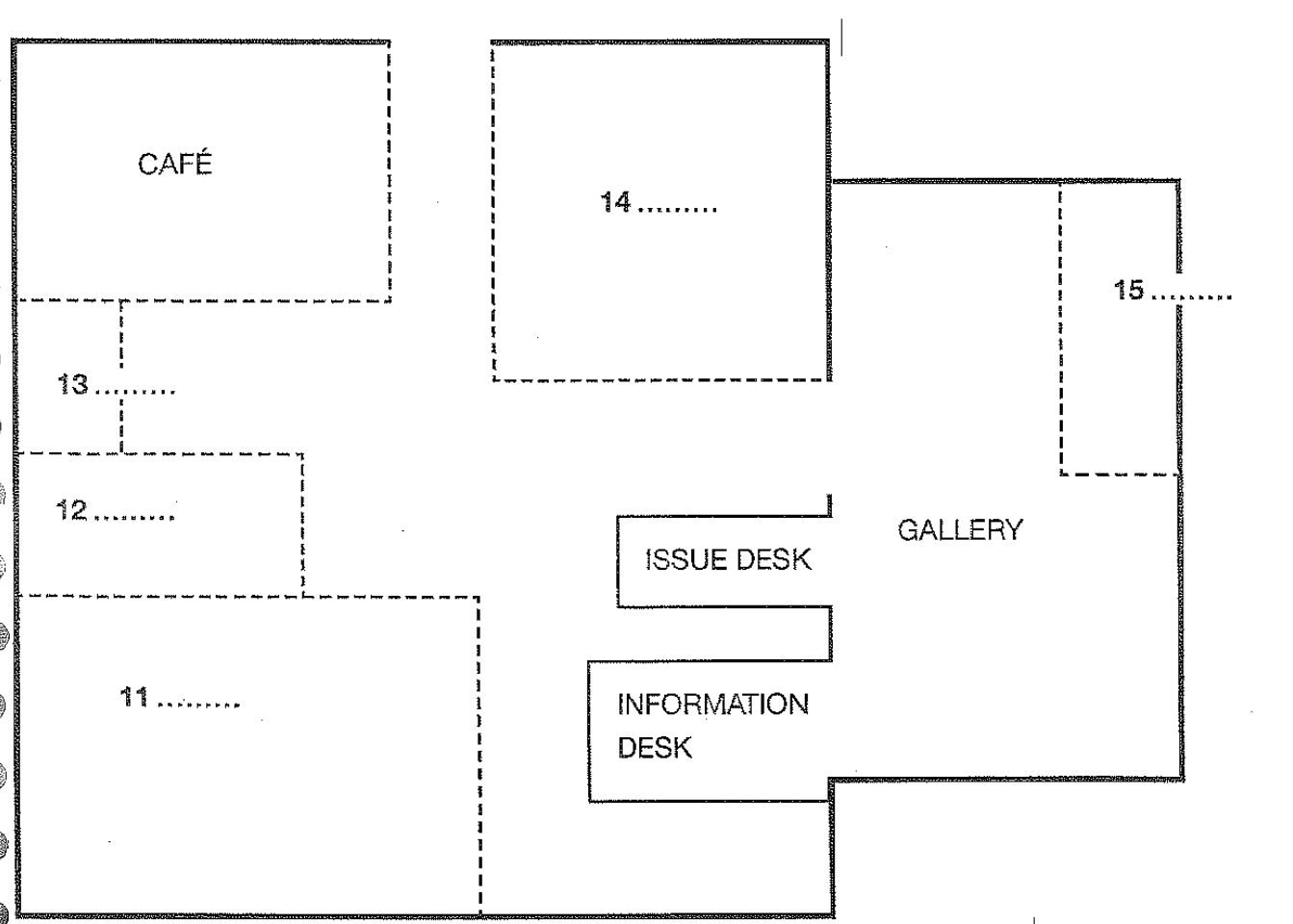
11. the area marked 11 on the plan
12. the area marked 12 on the plan
13. the area marked 13 on the plan
14. the area marked 14 on the plan
15. the area marked 15 on the plan
Questions 16–20
Choose the correct letter, A, B or C.
16. After two years, library members have to
A show proof of their current address.
B pay for a new membership card.
C bring a passport or identity card into the library.
17. What happens if you reserve a book?
A It will be available after five days.
B You can collect it a week later.
C You will be contacted when it is available.
18. Which materials can be borrowed for one week only?
A some reference books
B CD-ROMs
C children's DVDs
19. On which day does the library stay open later than it used to?
A Wednesday
B Saturday
C Sunday
20. Large bags should be left on the
A first floor.
B second floor.
C third floor.
Tutor feedback on a presentation about apples
Questions 21–25
Choose the correct letter, A, B or C.
21. Why did Anita and Lee choose to talk about John Chapman?
A He was Lee's childhood hero.
B They wanted to talk about the USA.
C He was relevant to the topic of their studies.
22. Where did the students record their sources of information?
A on their laptops
B on a handout
C on a database
23. The tutor claims she does not understand whether
A apples grew in America before Europeans arrived.
B the Native Americans had always eaten apples.
C American apples were first bred in Europe.
24. The tutor says the audience was particularly interested to hear about
A grafting techniques in ancient China.
B the cultivation of apples in Kazakhstan.
C the spread of apples along the Silk Route.
25. How will Anita and Lee present their follow-up work?
A on the department website
B as a paper
C as a poster
Questions 26–30
What do Lee and Anita agree about their presentation skills with their tutor? Write the correct letter, A, B or C, next to Questions 26–30.
List of Options
A excellent
B acceptable
C poor
26. use of equipment
27. handling software
28. timing of sections
29. design of handout
30. clarity of speech
A lecture on experiments into the sense of taste
Questions 31–40
Complete the table below. Write NO MORE THAN ONE WORD for each answer.
Experiments on the sense of taste
| Procedure | Result | Cause |
|---|---|---|
| more yellow added to green colour of _____ | subjects believed extra (32) ………………………… added to drink | brain influenced by product presentation |
| gum chewed until it is _____ then again with sugar | mint flavour (34) ………………………… | sweetness necessary for mintiness |
| same drink tasted cold and at room temperature | (35) ………………………… drink seems sweeter | temperature affects sweetness |
| crisps eaten in rooms which were _____ | with louder crunch, subjects believed crisps taste (37) ………………………… | sound affects taste perceptions |
| variety of cheese sauces prepared | subjects believed some sauces tasted less strong | (38) ………………………… affects taste perceptions |
| two different flavoured _____ tasted together | subjects still tasted (40) ………………………… when no longer there | brain is filling the taste 'gap' |
Answers
1. 41
2. museums
3. hour
4. Elliscoat
5. ferry
6. summer
7. 1887
8. scooter
9. entertainment
10. kitchen
11. B
12. H
13. C
14. E
15. A
16. show proof of their current address.
17. You will be contacted when it is available.
18. children's DVDs
19. Saturday
20. second floor.
21. He was relevant to the topic of their studies.
22. on a handout
23. apples grew in America before Europeans arrived.
24. the spread of apples along the Silk Route.
25. on the department website
26. A
27. B
28. C
29. B
30. A
31. cans
32. lime
33. tasteless
34. returns
35. warm
36. soundproof
37. fresher
38. texture
39. liquids
40. strawberry
Explanations
- 1. 41
- 'if they become members of Hostelling International, the price comes down to $41 a night.'Common trap: Four dollar amounts in three sentences – dormitory, double room, member rate and the membership fee.
- 2. museums
- 'If they become members, will they get cheaper entrance tickets to museums?' – 'Oh, yes.'Common trap: Activities and hire discounts are offered first; the woman rejects them.
- 3. hour
- 'It's $1 for 15 minutes and $3 for an hour.'Common trap: Two internet rates are given; the table already prints the $3 one.
- 4. Elliscoat
- 'There's Elliscoat Hostel' – spelled out E-L-L-I-S-C-O-A-T.Common trap: An unfamiliar name that only the spelling can confirm.
- 5. ferry
- 'if they want to go to Dragon Island it only takes a couple of minutes to walk down to the ferry.'Common trap: The beach is already printed in the table; the walk is to the ferry.
- 6. summer
- 'because it isn't very busy in the winter, they only cook in summer.'Common trap: Winter is named first, as the season they do NOT cook.
- 7. 1887
- 'There's been a hotel there since 1887 when it was first built.'Common trap: 1985 is when it became a hostel, not when it was built as a hotel.
- 8. scooter
- 'The hostel actually has scooters for hire at a very good price.'Common trap: Cycling and walking are named as the slower alternatives.
- 9. entertainment
- 'It's in a side street in the entertainment district.'Common trap: 'Side street' comes first and can be mistaken for the answer.
- 10. kitchen
- 'on each floor in this hostel there's a kitchen for residents to cook in.'Common trap: The cafe is mentioned first, but only to say there isn't one.
- 11. B
- 'shelves of books in the left-hand corner. This is where you will find a large number of novels and short stories' – novels and short stories = fiction.Common trap: 'Fiction' is never said here – you must recognise novels and short stories.
- 12. H
- 'The next area, directly opposite the issue desk, is a section where people can study.'Common trap: Reference books and computers are named in the same breath but are on the next floor.
- 13. C
- 'you can also take magazines into the cafe ... You will find these on the racks to the left of the cafe.'Common trap: Newspapers are in the cafe itself; only the magazines have their own racks.
- 14. E
- 'the next largest is non-fiction which is in the corner of this floor opposite the cafe.'Common trap: Fiction is named first in the same sentence but was already placed at 11.
- 15. A
- 'To one side of the issue desk is a door leading onto a gallery ... It also houses the biography section.'Common trap: Fiction and non-fiction are both named in the gallery description.
- 16. show proof of their current address.
- 'all readers are required to go to the desk with a document that has their name and current address on it.'Common trap: 'A document' is deliberately vague – it is the address that matters.
- 17. You will be contacted when it is available.
- 'we notify you by phone or email when the item is available to be picked up.'Common trap: The five days is the collection window, offered right after the answer.
- 18. children's DVDs
- 'DVDs, both children's and adults', can only be borrowed for up to seven days.'Common trap: 'Seven days' has to be matched to 'one week'.
- 19. Saturday
- 'we will close at 7 instead of 5.30 on Saturdays' – later than before.Common trap: All three days are covered in one sentence; only Saturday's closing time moves later.
- 20. second floor.
- 'There are lockers beside the reference area on the second floor where you can deposit them.'Common trap: The third floor is named first as the place bags are banned.
- 21. He was relevant to the topic of their studies.
- 'when we were looking into the area of domesticated species of plants for our presentation, we realised that the introduction of the apple with the settlers in the US would be a good case study.'Common trap: The childhood story belongs to Anita, and Lee only 'remembered Chapman'.
- 22. on a handout
- 'We've put them on the back of the handout we gave everyone at the end.'Common trap: The tutor mentions laptops in the very next turn, about a different point.
- 23. apples grew in America before Europeans arrived.
- 'What your listeners wanted to understand was whether there were apples in the US before the Europeans started to live there ... I don't think you were very clear about species already there.'Common trap: Lee's answer about European breeding comes right after the tutor's question.
- 24. the spread of apples along the Silk Route.
- 'I saw most members of your audience start to take notes - was when you discussed how the apple genes spread via the Silk Route into Europe.'Common trap: Kazakhstan appears in the same sentence, and China in the next turn.
- 25. on the department website
- 'I think it would be enough to use the website' – and the tutor agrees, ruling out the poster.Common trap: Anita proposes all three; the decision is made by Lee and the tutor.
- 26. A
- 'You both managed the hardware, I mean the projector and things, very well indeed.'Common trap: 'Very well indeed' is the strongest praise in the section.
- 27. B
- Maps came out the wrong way up, but 'you sorted out the problem very quickly ... so it wasn't a big problem' – acceptable rather than excellent.Common trap: It went wrong, but the recovery keeps it out of the 'poor' band.
- 28. C
- 'sticking to the time limit for each part of our presentation is something we didn't manage at all.'Common trap: 'Didn't manage at all' is the only outright negative verdict.
- 29. B
- 'the handout was perfectly adequate for a seminar like this' – adequate, with references still to fix.Common trap: 'Perfectly adequate' sounds like praise but sits in the middle band.
- 30. A
- 'no one had any problem hearing or understanding either of you ... your talk was a model that the others can follow.'Common trap: 'A model that the others can follow' is the clearest 'excellent' verdict.
- 31. cans
- 'The green colour of some cans was altered by the addition of yellow, so they were a brighter green.'Common trap: The drink itself is not what changed colour – the packaging did.
- 32. lime
- 'they stated that there was more lime in the drink if it was in the ones with the new colour.'Common trap: Only the perceived flavour changed; the drink was identical.
- 33. tasteless
- 'if you ask people to chew up to the point where it becomes tasteless, and then ask them to eat a little sugar and continue chewing'.Common trap: 'Loses its minty flavour' says the same thing in the previous sentence.
- 34. returns
- 'what happens is that the original mintiness actually returns because it is the sweetness which is needed to make the mintiness perceptible.'Common trap: The Cause column already gives the sweetness explanation, so the gap needs the verb.
- 35. warm
- 'The warm drink is too sweet to be refreshing.'Common trap: The chilled version tastes better, but the warm one tastes sweeter.
- 36. soundproof
- 'Subjects were put into soundproof rooms and given batches of crisps to eat.'Common trap: The room description comes before the crisps, easy to miss.
- 37. fresher
- 'if the sound level was louder or higher frequency they reported that the crisps were actually fresher.'Common trap: The crisps did not change – only the reported taste did.
- 38. texture
- 'the thing that was influencing the subjects' judgement about the flavour of the sauces was the texture of each one.'Common trap: 'Touch' is the sense being tested; the table wants the property that varied.
- 39. liquids
- 'the testers could drip two liquids onto them simultaneously, one strawberry flavoured and one sugar flavoured.'Common trap: The flavours are named, but the gap needs what was dripped.
- 40. strawberry
- 'they continued to think they could taste strawberry even after it was taken away.'Common trap: Removing the sweetness had the opposite effect, and is described first.
Audio transcripts
Part 1 — Enquiring at a tourist office about hostels
Man: Good morning. Can I help you? Woman: I hope so! I have a friend in Spain and her two daughters are coming to the city to study for a month. So I thought the Tourist Information Centre was the best place to ask about hostels. Can you recommend any? Man: Of course. Ah, I usually suggest one of the Hostelling International places. HI West End is a big hostel in a residential area, but it's only ten minutes from downtown (Example) if you take a bus. It's really popular. Woman: OK. Sounds good! I need to know how much it costs. The girls want a double room to themselves. They don't want to share with other people. Man: That makes it more expensive. The price is under $30 for a bed in a dormitory but they'll be paying $50 a night. But if they become members of Hostelling International, the price comes down to $41 a night. Membership costs $35. Woman: Right. Man: And membership offers them benefits too on all kinds of activities. Woman: Ah, what kind of things? Man: Oh, er, skydiving and white-water rafting. Things like that. Woman: Mm, I don't think they're interested in that kind of thing. If they become members, will they get cheaper entrance tickets to museums? Man: Oh, yes and also discounts on bicycle and car hire. Woman: OK. It's probably worth it. Is the hostel very noisy? They're coming here to do some studying. Man: Ah, I think it is quite noisy as it's a really big hostel. And if they want to use the Internet this hostel still makes a charge unfortunately. It's $1 for 15 minutes and $3 for an hour. Woman: Mm ... it might not be ideal for them. What else can you recommend? Is there anything in a quiet area? Man: There's Elliscoat Hostel. Woman: Mm, how do you spell that? Man: E-L-L-I-S-C-O-A-T. Woman: I've never heard that name before. And where is that? Man: It's on the beach looking over the bay. Here, look on the map. It's quiet but not far from Dragon Island - there's plenty going on there in the evening. Woman: Oh, that's a nice area. And if they want to go to Dragon Island it only takes a couple of minutes to walk down to the ferry. So how much is a room there? Man: It's in such a nice spot that the rooms are a bit more expensive. They're $62. Woman: Does that include any meals? Man: Unfortunately not. It is possible to buy meals in the hostel at a reasonable price but because it isn't very busy in the winter, they only cook in summer. Woman: Oh, I think I know the place you mean. It's an old building, isn't it? Man: Yes, it's well known as it's one of the oldest in the city. There's been a hotel there since 1887 when it was first built. It was turned into a hostel in 1985 and they've invested a lot of money restoring it inside. Woman: Mm, they'd like that but I'm just looking on the map at where their college is - it's right in the centre. It is a bit far for them from there. Man: The hostel actually has scooters for hire at a very good price. So they could do that. Er, it would be quicker than cycling or walking to the centre. Woman: Mm, it is a bit expensive ... But it sounds like the best one so far unless there's something a bit cheaper? Man: OK. Er, well, what about the Backpackers Hostel? That's not so expensive. It's in a side street in the entertainment district. They wouldn't need to go far to find everything they want - they could walk everywhere. And it's very reasonable. Only $45 and another $5 if they want to have breakfast. Woman: Mm, but what about other meals? Man: There's no cafe but on each floor in this hostel there's a kitchen for residents to cook in. I'm not sure how well equipped they are but it should be fine for basic meals. Woman: Well, that's really very helpful. I'll pass all this information on now. Man: Do ask your friends to ring me if they need to know anything else. Woman: I will. Thank you.
Part 2 — An audio guide to a public library
Welcome to the Selmore Public Library which has just been reopened after major refurbishment. This tour will introduce you to the building and its services. At any time you can stop the tour. We enter by the cafe and our tour begins at the issue desk. If you stand between the information desk and the issue desk and look at the opposite wall, you will see shelves of books in the left-hand corner. This is where you will find a large number of novels and short stories. They are arranged alphabetically. If you're looking for something in particular and it's not on the shelf you can reserve it. The next area, directly opposite the issue desk, is a section where people can study. The library provides computers for users free of charge on the next floor beside the reference books but this area is for people to use their own laptops. You should ask for the internet passcode at the information desk. In the right-hand corner of this floor there is a cafe. A selection of daily newspapers is always available there but you can also take magazines into the cafe to read while you have a drink. You will find these on the racks to the left of the cafe and there is a large selection. They are for reference only and cannot be borrowed but you are welcome to photocopy any articles of interest. We ask you to return them when you have finished. You are not allowed to take fiction or any other books from the shelves into the cafe. Next to the cafe is the exit door leading to the stairs and escalator to the other floors. The largest collection of books in the library is fiction and the next largest is non-fiction which is in the corner of this floor opposite the cafe. These can all be borrowed as opposed to the reference books on the next floor, most of which cannot be taken out of the library - but they can be photocopied. There are several photocopiers available for this purpose downstairs in the basement. To one side of the issue desk is a door leading onto a gallery. This was added to the library as a public space where talks are given once a week on a Saturday by visiting authors of both fiction and non-fiction. It also houses the biography section. There are notices advertising the talks in the study area. Any books that you want to borrow should be taken to the issue desk. Before we leave this floor I will give you some information about using the library. There are also helpful notices by the information desk. To join the library and take books out, you need a membership card. Take your passport or identity card, as well as proof of your home address, to the information desk and you will be issued with a card. After a period of two years, all readers are required to go to the desk with a document that has their name and current address on it so the library can keep up-to-date records of where people are living. There's no need to show a passport again and there is no charge for this but any lost cards are charged at 5. If you can't find the book you want on the shelves, you can reserve it. If it's in another library in the city, we can usually get it for you within a week. If someone else has borrowed it, it can take a few weeks. Either way, we notify you by phone or email when the item is available to be picked up. We will hold it for you for five days. Books can be borrowed for fourteen days and can be renewed for a further two weeks. Children's books also have a two-week borrowing period. The same system exists for CD-ROMs and CDs but DVDs, both children's and adults', can only be borrowed for up to seven days. It isn't possible to renew them. Some reference books can be borrowed but normally only for one day, so 24 hours. The library opening hours have been changed slightly. Instead of opening late on Wednesday evenings till 8pm, we will be closing at 6, as on other weekdays, but we will close at 7 instead of 5.30 on Saturdays and - a new development - we are going to open on Sunday mornings from next month - 9 to 1. We are closed on public holidays and notices are posted in the library about these. Before you go upstairs, please note that if you are going to the exhibition area on the third floor, large bags are not allowed. There are lockers beside the reference area on the second floor where you can deposit them. If you need change, you can get that from the information desk on the first floor. Now press 'pause' and proceed to the second floor. When you reach the top of the stairs press 'play'.
Part 3 — Tutor feedback on a presentation about apples
Tutor: Well, Anita and Lee. That was an interesting presentation you made about John Chapman. There are a few points I'd like to run through before you write it up. One thing which you didn't explain was why you decided to do a presentation on this man who spread apple varieties across the US? Anita: Well, ages ago, we were chatting about stuff we'd read as children, and I told Lee the Johnny Appleseed story - I had these American story books when I was small. Then when we were looking into the area of domesticated species of plants for our presentation, we realised that the introduction of the apple with the settlers in the US would be a good case study ... Lee: And I remembered Chapman, so we looked up the real guy behind the legend. Tutor: Right. I think that would have made a good intro. Anita: I thought it was too personal. Tutor: Just a couple of minutes would have drawn your listeners in. Anyway. Now a more serious point. You didn't mention the sources of some of your information. Lee: We used some books and journal articles and did an internet search and found some good sites. Anita: We've put them on the back of the handout we gave everyone at the end. Tutor: Ah, let me see. Oh, here it is. Johnny Appleseed: Man and Myth, 1967. Well, the thing is, you really have to make this explicit when you talk. And anything you show, data you project from your laptop, etc., you must have the source on it. Anita: Right, OK. Tutor: At least you have got it all documented. I was a bit concerned about that. Anita: Sorry. Tutor: Anyway. Now, the content of your talk. What your listeners wanted to understand was whether there were apples in the US before the Europeans started to live there. You told us the early settlers had brought young apple trees but that few of them had thrived because the climate was harsh, but what about native species? I don't think you were very clear about species already there. Lee: Um, according to what I've read, there were some crab apples, but that was all. Everything that people now think of as traditional American apples, were species that the Europeans either introduced or bred by chance. Anita: Because they tended to sow seeds rather than use grafting. Tutor: Yes, quite. But what to me was fascinating - and I saw most members of your audience start to take notes - was when you discussed how the apple genes spread via the Silk Route into Europe from the wild apple woods of Kazakhstan. Lee: Yes, well, I'd like to have said more about the development of grafting in ancient China, as a way of producing predictable varieties. It was so early in history! Tutor: But it's the natural development of the original wild apple into new species that people wanted more about. Which says a lot for your presentation. You enthused your audience! So, now we need to discuss the form your follow-up work will take. Are you going to produce a paper? Or are you thinking of putting it all up on the department website? Anita: Um, I felt we could do both. And we could do a poster of some of the data. But Lee wasn't sure. Lee: No, I think it would be enough to use the website. We can offer a link to our email for queries. That would save time and trees! Tutor: I think Lee's right. A poster would be nice, but it'd take too much time. Anita: OK. Tutor: Now I just want to give you a few pointers about the techniques of your presentation. Mostly it was good, but there are a few things you need to bear in mind next time you do one. You both managed the hardware, I mean the projector and things, very well indeed, which is always a great help. Anita: Good. Lee: Thanks. Tutor: You'd obviously checked it out carefully. Lee: Yes. But unfortunately we hadn't finished our maps when we did the practice on my computer at home, that's why there were some the wrong way up. Anita: We didn't realise the software on the laptop was a bit different from the one I have. Tutor: But you sorted out the problem very quickly and didn't let it fluster you, so it wasn't a big problem. We could all read the map when we needed to. Anita: So it was OK, but we could have done better, we realise. Tutor: Mm. There was a bit at the end where I felt something didn't go as you'd planned - am I right? Lee: We had a few maps which we ended up leaving out, because we needed to get on to our conclusions. Anita: Yes, it took longer to explain the technical aspects of grafting than we'd expected. Lee: So sticking to the time limit for each part of our presentation is something we didn't manage at all. Which means we've definitely got to improve before we do another one. Anita: Yes. Tutor: Apart from that, well, the handout was perfectly adequate for a seminar like this, it gave all the key information, and of course, now I realise the sources are listed at the back. But you need to do those references in the correct format, as footnotes in future. Anita: OK. Lee: Yes, sorry, we will. Tutor: And finally, other students will be presenting projects later in the course. I shall be reminding them how well you both spoke and that no one had any problem hearing or understanding either of you. In that respect your talk was a model that the others can follow. Lee: Oh, thank you. Anita: Yes, thanks very much. This feedback has been very helpful. Tutor: Well done, both of you. See you in a fortnight. Anita and Lee: Bye. Thanks.
Part 4 — A lecture on experiments into the sense of taste
Lecturer: This morning I'm going to describe for you a few of the kinds of experiments that have been used to investigate the sense of taste, which is now recognised as being a far more complex and important area of neurological science than was previously believed by most people. The results of some of these experiments can be quite fun and I shall suggest that you may want to choose one or two to try out in groups before having a go at designing a new experimental procedure of your own and trying to pinpoint the cause of your findings. The first one concerns a marketing exercise by a soft drinks company. The green colour of some cans was altered by the addition of yellow, so they were a brighter green. Then test subjects were asked what they thought about the flavour of the drink in the new-style cans, and they stated that there was more lime in the drink if it was in the ones with the new colour. This was because the brain picks up cues from the way the product is presented, as well as the product itself, which trigger taste sensations. Before food was packaged, humans used colour to gauge the ripeness of fruit, for example. Next there's the old problem with chewing gum. Everyone knows that after a few minutes' chewing it loses its minty flavour. However, if you ask people to chew up to the point where it becomes tasteless, and then ask them to eat a little sugar and continue chewing, to most people's surprise, what happens is that the original mintiness actually returns because it is the sweetness which is needed to make the mintiness perceptible. So combinations of flavours can be significant, as the brain needs one of them in order to recognise the other. Another experiment demonstrates something we've all done. Drink half a fizzy drink straight from the fridge and then leave it at room temperature for a while. Take a sip and you may well decide you don't like it. The warm drink is too sweet to be refreshing. So put the rest back in the fridge until it's chilled again. Now try it. Much better. Of course the sweetness doesn't change, it is our perception, because how sweet it tastes depends on the temperature. The extent to which the drink is sweetened is less evident if the drink has been cooled. Another interesting result has been derived from experiments with sound. One of these involved eating crisps. Subjects were put into soundproof rooms and given batches of crisps to eat. As they ate, the sound of crunching which they made as they ate the crisps was played back to them. This was adjusted so that they sometimes heard the crunching as louder, or, at other times, more high-frequency sounds were audible in the sound feedback that accompanied their eating. Fascinatingly, if the sound level was louder or higher frequency they reported that the crisps were actually fresher. Of course, the crisps were in fact the same every time! So, it was clear that the level and quality of what they were hearing was influencing their taste perceptions. So, we've looked briefly at colour, at complementary flavours, at temperature and sound. It seems that all the senses are working together here, but what about the sense of touch? A number of experiments have been done in this area. If you take, for instance, cheese sauce and prepare different versions, some thicker and some thinner, but without any alteration in the strength of flavour, what do you think the subjects perceive? Yup, if the sauce is thicker, they'll say the cheesy flavour is less strong. It was clear that the thing that was influencing the subjects' judgement about the flavour of the sauces was the texture of each one. Now, this result is important for dietitians as well as marketing executives. Lastly, another variation on the two flavours theme. This concerns the capacity of the brain for bridging a sensory gap. The subjects in this experiment stuck out their tongues so that the testers could drip two liquids onto them simultaneously, one strawberry flavoured and one sugar flavoured. The testers then took away each flavour in turn. When the sweetness was taken away, the subjects reported they could hardly taste anything, but they continued to think they could taste strawberry even after it was taken away! So that taste gap was filled. Well, that's just a quick look at some of the examples in the current literature. The references will be in the handout you'll get at the end of the session. Now let's see about trying a few of them for ourselves.
Comments
Loading comments…