

IELTS Trainer 1 Listening Test 1
4 parts · 40 questions · 30 minutes
A phone call about a cycling holiday in Austria
Questions 1–10
Complete the notes below. Write NO MORE THAN TWO WORDS AND/OR A NUMBER for each answer.
Cycling holiday in Austria
• Holiday begins on (1) ………………………….
• No more than (2) ………………………… people in cycling group.
• Each day, group cycles (3) ………………………… on average.
• Some of the hotels have a (4) ………………………….
• Holiday costs £ (5) ………………………… per person without flights.
• All food included except (6) ………………………….
• Essential to bring a (7) ………………………….
• Discount possible on equipment at www. (8) ………………………… .com
• Possible that the (9) ………………………… may change.
• Guided tour of a (10) ………………………… is arranged.
A radio talk about local food and restaurants
Questions 11–14
Choose the correct letter, A, B or C.
11. The market is now situated
A under a car park.
B beside the cathedral.
C near the river.
12. On only one day a week the market sells
A antique furniture.
B local produce.
C hand-made items.
13. The area is well known for
A ice cream.
B a cake.
C a fish dish.
14. What change has taken place in the harbour area?
A Fish can now be bought from the fishermen.
B The restaurants have moved to a different part.
C There are fewer restaurants than there used to be.
Questions 15–20
Which advantage is mentioned for each of the following restaurants? Choose SIX answers from the box and write the correct letter, A–H, next to Questions 15–20.
List of Options
A the decoration
B easy parking
C entertainment
D excellent service
E good value
F good views
G quiet location
H wide menu
15. Merrivales
16. The Lobster Pot
17. Elliots
18. The Cabin
19. The Olive Tree
20. The Old School Restaurant
Three media studies students planning a film
Questions 21–26
Complete the flow-chart below. Choose SIX answers from the box: actors / furniture / background noise / costumes / local council / equipment / shooting schedule / understudies / shopowners
FILM PROJECT
visit locations and discuss (21) …………………………
↓
contact the (22) ………………………… about roadworks
↓
plan the (23) …………………………
↓
hold auditions and recheck availability of the (24) …………………………
↓
choose the (25) ………………………… from the volunteers
↓
rehearse
↓
collect (26) ………………………… and organise food and transport
Questions 27–30
Choose the correct letter for each question.
List of Options
A lights
B fixed camera
C mirror
D torches
E wooden screen
F bike
G large box
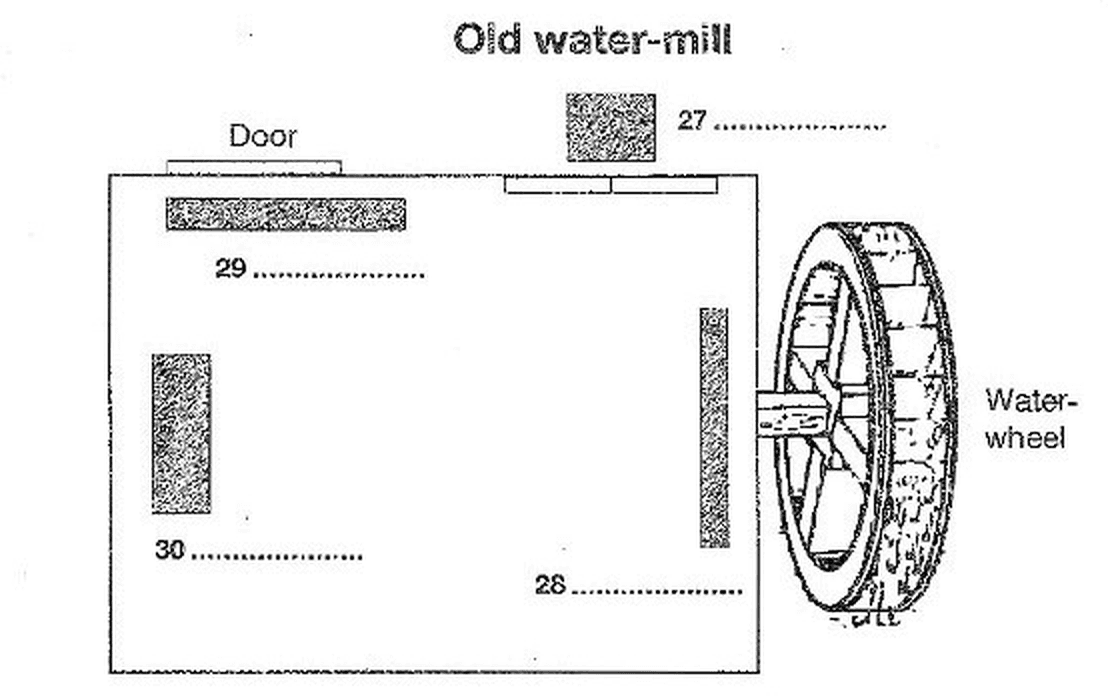
27. Questions 27–30: Label the diagram below. Choose four answers from the box and write the correct letter, A–G, next to Questions 27–30. Old water-mill.
28. Questions 27–30: Label the diagram below. Choose four answers from the box and write the correct letter, A–G, next to Questions 27–30. Old water-mill.
29. Questions 27–30: Label the diagram below. Choose four answers from the box and write the correct letter, A–G, next to Questions 27–30. Old water-mill.
30. Questions 27–30: Label the diagram below. Choose four answers from the box and write the correct letter, A–G, next to Questions 27–30. Old water-mill.
A lecture about exotic pests
Questions 31–40
Complete the table below. Write NO MORE THAN TWO WORDS for each answer.
EXOTIC PESTS
| Origin | Name | New habitat | Notes |
|---|---|---|---|
| Australia | red-backed spider | New Zealand and Japan | even on island in middle of (31) ………………………… |
| England | rabbit | Australia | 800 years ago: imported into England to be used for (32) ………………………… |
| America | fire ants | (33) ………………………… in Brisbane | imported by chance |
| Australia | (34) ………………………… | Scotland | deliberately introduced in order to improve (35) ………………………… (not effective) |
| New Zealand | flatworm | (36) ………………………… Europe | accidental introduction inside imported (37) ………………………… |
| Japan | (38) ………………………… | Australian coastal waters | some advantages |
| Australia | budgerigar | urban areas of south-east (39) ………………………… | smaller flocks because of arrival of (40) ………………………… in recent years |
Answers
1. 17th April
2. 16
3. 45 km
4. swimming pool
5. 1,013
6. snacks
7. cycle helmet
8. ballantyne
9. route
10. theatre
11. under a car park.
12. hand-made items.
13. a cake.
14. The restaurants have moved to a different part.
15. D
16. H
17. F
18. G
19. C
20. A
21. background noise
22. local council
23. shooting schedule
24. actors
25. understudies
26. furniture
27. B
28. A
29. E
30. G
31. Atlantic
32. food
33. gardens
34. earthworm
35. soil
36. north-west
37. plant pots
38. seaweed
39. United States
40. competitors
Explanations
- 1. 17th April
- The man gives the dates of the 10-day April trip: it starts on the 17th of April. The 27th is the finishing date and the 10th of April is when the woman can leave work, so neither is the start.Common trap: Three dates in a row – start, finish and the woman's own availability.
- 2. 16
- 'The maximum number is 16' matches 'no more than'. 12 are booked and the woman's party makes 14 – neither is the maximum.Common trap: Three numbers spoken together; only the maximum answers the question.
- 3. 45 km
- The woman checks the website figure of 45km a day and the man confirms 'That's correct'. 35km and 50km are the daily minimum and maximum, not the average.Common trap: 'on average' – the other two distances are the range, not the average.
- 4. swimming pool
- 'There is a swimming pool in a few of the hotels' – 'a few' paraphrases 'some'. The gym is explicitly ruled out, and restaurants and en-suite facilities are in all of them, not some.Common trap: Negative distractor – the gym is mentioned immediately afterwards but is not available.
- 5. 1,013
- £1,177 is the price including flights; once the woman says she will book her own flights the price drops to £1,013, which is the price 'without flights'.Common trap: Two prices – the first one quoted includes flights.
- 6. snacks
- Breakfast, a packed lunch and dinner are all included; only 'any snacks you buy then are extra'.Common trap: A list of included meals surrounds the one item that is excluded.
- 7. cycle helmet
- 'We won't allow you to cycle unless you bring a helmet' = it is essential to bring one. The lock, bell, lights and pannier all come with the bike, so they need not be brought.Common trap: Several pieces of equipment are listed, but only one has to be brought by the rider.
- 8. ballantyne
- The website address is spelled out: B-A double L-A-N-T-Y-N-E, i.e. ballantyne.Common trap: Spelling with 'double L' – must be written as two letters.
- 9. route
- 'we do reserve the right to make some alterations to the route if the weather is bad' – 'alterations' paraphrases 'may change'.Common trap: The weather is what may cause the change, not the thing that changes.
- 10. theatre
- 'there's a guide who'll take you round the building' refers to the theatre in Grein. Castles and museums can be visited, but 'We don't have any other tours arranged'.Common trap: Castles and museums are mentioned, but no guided tour is arranged for them.
- 11. under a car park.
- 'it found a home beneath the multi-storey car park where it still is' – 'where it still is' shows this is the present site. The cathedral was the original site and the river is both a past site and the planned future one.Common trap: Three locations across past, present and future – only 'now' counts.
- 12. hand-made items.
- Sunday is the one day with a different market 'where craftspeople sell what they have made'. Local produce is on sale Tuesday to Saturday, and the antique furniture stall runs 'during the week'.Common trap: 'only one day a week' – the other two goods are on sale on several days.
- 13. a cake.
- 'What we do have is an apple cake that isn't really made anywhere else.' The fish is good but 'there isn't one particular dish that stands out', and the ice cream is one cafe's accompaniment, not the local speciality.Common trap: The expected answer (fish) is raised and then rejected.
- 14. The restaurants have moved to a different part.
- 'that part was redeveloped and the restaurants had to relocate to the other end' – a move, i.e. a change. Buying fish from the fishermen is not new, and there are now more restaurants, not fewer.Common trap: Two true statements about the harbour that are not changes.
- 15. D
- 'The friendly staff offer very attentive service' – attentive, friendly staff = excellent service.Common trap: The live music belongs to nearby cafes, not to Merrivales, and the sea view is explicitly denied.
- 16. H
- 'It serves a huge range of fish and seafood as well as vegetarian and meat dishes so there's something for everyone' = a wide menu.Common trap: Price is mentioned, but as a drawback – not 'good value'.
- 17. F
- 'It's on the twentieth floor... you can see most of the city spread out from there' = good views.Common trap: Service is mentioned but negatively – you may have to wait.
- 18. G
- 'it's very peaceful, a good place to relax away from the traffic' = a quiet location.Common trap: Parking is mentioned, but it is difficult, not easy; and it is 'not cheap', so not good value.
- 19. C
- 'the wooden floors resound with live music and dancing which is certainly worth going for' = entertainment.Common trap: Service is mentioned, but it can be slow.
- 20. A
- 'The use of mirrors, plants and the colours on the walls makes you feel as though you're in a large garden' = the decoration.Common trap: The menu is mentioned, but it is small – the opposite of 'wide menu'.
- 21. background noise
- 'We need to talk about the levels of background noise so we know they're all going to be reasonable places to film' – 'talk about' = discuss.Common trap: Shopowners and equipment are both mentioned around the location visit, but neither is what is discussed there.
- 22. local council
- 'The local council have to be informed about things like that so you can find out from them.'Common trap: The word 'roadworks' is spoken several lines before the council is named.
- 23. shooting schedule
- 'We need to prepare the shooting schedule, day by day' – 'prepare' = plan.Common trap: The script is mentioned in the same sentence but is already written.
- 24. actors
- After the audition they contact people with the exact dates to 'make really sure they are free' – and 'often the actors are all enthusiastic but then... you find they've got exams'.Common trap: Understudies are also people who are contacted, but they come later, from the volunteers.
- 25. understudies
- 'We can select the understudies once the main roles have been confirmed' – chosen from 'other volunteers who were OK'.Common trap: The main parts are offered first – only the understudies come from the remaining volunteers.
- 26. furniture
- 'My family has agreed to lend us some pieces of furniture which we need, so we'll go and fetch those' – 'fetch' = collect. Costumes are explicitly not needed.Common trap: Costumes are mentioned first, but only to say they are not needed.
- 27. B
- 'fix one camera outside by the window next to the door, to film through the window' – position 27 is outside the building, beside the window. The other camera is handheld and inside, so it is not marked on the plan.Common trap: Two cameras and a rejected mirror – only the fixed camera is outside.
- 28. A
- 'all we'll need is lights on the inside, next to the wall behind the wheel' – position 28 is on the inside wall nearest the water-wheel.Common trap: Torches are also a light source, but they are carried by the actors, not fixed to a wall.
- 29. E
- 'we'll have an old screen made of wood just inside the door' – position 29 is on the inside of the wall containing the door.Common trap: 'screen made of wood' has to be matched to 'wooden screen' in the box.
- 30. G
- 'There's a huge box on the floor against the wall farthest from the wheel' – position 30 is on the left-hand wall, the one away from the water-wheel.Common trap: The bike is in the same stretch of speech but is outside, approaching the mill.
- 31. Atlantic
- Tristan da Cunha is described as 'a remote island, thousands of miles from anywhere, way out in the middle of the Atlantic'.Common trap: New Zealand and Japan are already given in the table as the habitat.
- 32. food
- Rabbits were brought to England from continental Europe eight centuries earlier 'because they were regarded as a luxury food source'.Common trap: Fur is mentioned in the same sentence but was not the reason for importing them.
- 33. gardens
- 'Their huge nests can now be found in gardens in the city of Brisbane.'Common trap: The word 'Brisbane' is already printed in the table, so the missing word comes just before it.
- 34. earthworm
- 'in 1975 an Australian species of earthworm was deliberately introduced to the northern hemisphere, in Scotland'.Common trap: The New Zealand flatworm appears in the next row – don't confuse the two worms.
- 35. soil
- 'The aim was that they would be more effective than native species, but in fact they don't do more for the soil condition than the smaller locals.'Common trap: The aim (soil condition) is expressed inside the sentence saying it failed.
- 36. north-west
- 'This is a most unwelcome newcomer in these regions of north-west Europe.'Common trap: Individual countries are named first; the table needs the region.
- 37. plant pots
- 'it was actually carried in the plant pots containing exotic ornamental shrubs'.Common trap: 'exotic ornamental shrubs' is what the pots contained, not what carried the flatworm.
- 38. seaweed
- 'It's a delicious but very fast-spreading seaweed' – the Japanese arrival in Australian coastal waters.Common trap: The habitat (Australian coastal waters) is already given – the gap is the name.
- 39. United States
- 'these flocks of budgerigars have been getting very numerous in the south-east of the United States, particularly in residential areas'.Common trap: 'south-east' is already printed in the table.
- 40. competitors
- 'The fact that they are smaller is thought to be due to the fact that new competitors for their habitat have arrived from other places.'Common trap: The cause comes after the effect – the flocks shrinking is mentioned first.
Audio transcripts
Part 1 — A phone call about a cycling holiday in Austria
Man: 'Holidays for You'. Sean speaking. Can I help you? Woman: Oh hi. I've been looking at your website. Um, I'm interested in a cycling holiday in Austria in April. Man: Ah! We have two trips in April - one lasts fourteen days and the other ten days. Woman: Mm ... I think the 10-day trip is better. So let's see. I've got a calendar here. What are the dates? Man: Well, that trip is in the middle of the month. It starts on the 17th of April and it finishes on the 27th. Woman: That suits me. I can't leave work before the 10th of April. Man: Let me see if there are any spaces. Is it just for yourself? Woman: Myself and my sister - so two of us. Man: Um, yes. We have spaces. Woman: Is it a big group? Man: At the moment there are 12 people booked on this trip and with you two that will be 14. The maximum number is 16 so it's almost fully booked. We can't go over that because it's hard to keep a larger group together. Woman: I need to check that I'm fit enough for this but the distances look OK. The website says we'll ride approximately 45km a day. Is that right? Man: That's correct and I've got the exact distances here. It really depends on which part of the trip. Some days are only 35km and some are more. But you'll never have to cycle more than 50km in one day. Woman: Oh, OK. I can manage that. And we stay in hotels? Man: Yes. They all have restaurants and the rooms have en-suite facilities. Woman: And do they have pools? It's how I relax after a long day. Man: There is a swimming pool in a few of the hotels but none of them has a gym. Woman: I don't think we'll need a gym after all that cycling! I'd better find out how much the holiday costs before I get too excited. Man: Including flights it's £1,177 for one person. Woman: Oh, we'll book our own flights on the Internet. Man: Ah, that's just £1,013 then. And we can book insurance for you if you want. Woman: Mm ... and which meals are included in that price? Man: Well, er, breakfast of course. And the hotels will provide you with a packed lunch each day. We do stop during the afternoon in a village somewhere for a rest, so any snacks you buy then are extra. Then dinner will be in the hotel every evening and that's included in the price of the holiday. Woman: And you provide the bicycles of course. What else? Man: A lock and a bell come with the bike as well as lights, although you shouldn't need to cycle in the dark. There's a small bag, or pannier, on the front of the bike, where you can put the things you want to take with you during the day like water or fruit. But we won't allow you to cycle unless you bring a helmet. We don't provide these locally because, like walking boots on a walking holiday, it's really important it fits properly. Woman: OK. Man: If there's any special gear you need for your holiday, we recommend a particular website and you can get a discount by quoting your booking reference. Woman: Great. What is it? Man: It's www.ballantyne.com. That's all one word, and I'll spell it for you: www dot B-A double L-A-N-T-Y-N-E dot com. Woman: Good. I've got that down. I've been looking at your website while we've been talking. I see we cycle along the river Danube? Man: Yes, it's one of Europe's most well-known areas for cycling. Woman: It looks fascinating - lots of beautiful countryside and things to see. Man: I should warn you that we do reserve the right to make some alterations to the route if the weather is bad. Some of the tracks sometimes get very muddy. Woman: OK. Well, hopefully it won't rain too much! I know we stop in towns and villages but do we get a chance to look around? Because I'm really interested in history. Man: Oh yes, you get opportunities to explore. Is there something in particular you want to see? Woman: There's a theatre in a town called Grein. A friend of mine went there last year and said it was amazing. Man: Let's see. Um, ah yes, there's a guide who'll take you round the building. We don't have any other tours arranged but you can visit several castles and museums on the holiday. Woman: Well, thank you for all that information. I'd like to book that then. Man: Right. Well, I'll just ...
Part 2 — A radio talk about local food and restaurants
Announcer: And now we have our 'Know your town' section where we look at what's on offer in our area. Today John Munroe is going to tell us about local food and eating out. John. John: Well, most of us buy our food in supermarkets these days but we're very lucky having a wonderful market here. It was originally on the piece of land in front of the cathedral but at the beginning of the twentieth century it was moved to a site by the river. When the new shopping centre was built in the 1960s, it found a home beneath the multi-storey car park where it still is, but there are plans to move it back to its previous home by the river. The market is now open six days a week. On Tuesday to Saturday you can buy fresh fruit and vegetables, meat and cheese from the area, as well as a whole range of imported produce. But if you come on a Sunday, you'll find a different market, where craftspeople sell what they have made - things like bags, cards, clothes. During the week there are a few stalls selling more everyday utensils like saucepans and cleaning products alongside the fruit and vegetables - as well as one new stall selling antique furniture which is proving to be very popular. People often ask what our local dish is. As we're by the sea, they expect it to be some kind of fish recipe. Our fish is good of course but there isn't one particular dish that stands out. What we do have is an apple cake that isn't really made anywhere else. There's a new cafe in the High Street: Barton's, which bakes them fresh every morning and serves them with delicious home-made ice cream in a choice of flavours. Now, the harbour is obviously the place to buy fresh fish. Every morning there's a stall where local fishermen sell a selection of the day's catch before the rest goes to London or abroad. They've been doing that for as long as anyone can remember of course, but the harbour itself looks very different from a few years ago. Most of the restaurants used to be at the far end, but that part was redeveloped and the restaurants had to relocate to the other end. Many of them are simply the old ones in new premises but a couple of new ones have opened recently so there's a good range now both in the harbour and the town itself. I'm now going to give you my 'Top Six Places to Eat' in different parts of the town. So Number 1 for me is Merrivales, which is in one of the busiest parts of the town leading down to the harbour. It's in a side street so it doesn't look out over the water but it's very close, so you can take a walk after your meal and find one of the cafes with live music. At Merrivales you can enjoy delicious fresh fish and seafood. The friendly staff offer very attentive service and a really enjoyable evening. The Lobster Pot is on the main road going down to the harbour so it also misses out on the sea view, but the food makes up for that. It serves a huge range of fish and seafood as well as vegetarian and meat dishes so there's something for everyone. Prices are from mid-range to fairly expensive so it's really only for a special occasion. Elliotts is in the city centre and is a very upmarket restaurant in the evening but during the day it serves lunch and coffee. It's on the twentieth floor above some offices and it's a great place to sit for a while as you can see most of the city spread out from there. It does get very busy though and you may have to wait to be served. Not far from the city centre is The Cabin which is on the canal bank. You can't park your car there - it's a fifteen-minute walk from the nearest car park - but it's very peaceful, a good place to relax away from the traffic. It's not cheap but it's an ideal place for a long lunch. The Olive Tree is a family-run restaurant in the city centre offering beautifully prepared Greek dishes. It's well known locally and very popular. Service can be slow when it's busy as all the food is freshly made. There's plenty of room and on Friday and Saturday nights, the wooden floors resound with live music and dancing which is certainly worth going for. The last place I want to recommend has only just opened in a converted school building. The Old School Restaurant has been very cleverly renovated. The use of mirrors, plants and the colours on the walls makes you feel as though you're in a large garden instead of the city centre. There are only a few dishes on the menu but they change every day. So Tanya, I ...
Part 3 — Three media studies students planning a film
Reza: Hi Mike. Mike: Hi Reza, this is Helen. Helen: Hello! Mike: We're really pleased you've agreed to join us on this film project. Helen: Yes, your experience is going to be so useful. Reza: Well, I hope so. It's the technical side I know best - lighting, sound and stuff. Mike: But you think the script is OK? Reza: Yes, I think it's great! Um, have you decided where you're going to shoot? Helen: Well, there's the water-mill scene at the end. And we've thought about some locations in town we can use. They're behind the shopping mall and on a couple of residential streets. And in an empty shop on campus. It means we don't have to worry about getting permission from a shopowner. Mike: So do you think we should go to all the locations with you? Reza: It would be a good idea. We need to talk about the levels of background noise so we know they're all going to be reasonable places to film. Mike: But the sounds of traffic will make it more natural. Helen: I think Reza means things like aeroplanes, trains and so on that would mean we have to stop filming. Reza: Exactly. And also I'll make notes for myself about what lighting I'm going to need. I think the university department has a good range of equipment, but I'll need to make a list for each location for my own reference. Anyway, once we've had a look round, you can do the roadworks check. Mike: What do you mean? Reza: You need to find out about building work or roadworks. Because you could start filming one day and come back in the morning to find one of the roads has been dug up! The local council have to be informed about things like that so you can find out from them. Mike: OK. Then I think we need to work from the script and put together a list of all the scenes and decide which ones we're going to film when. We need to prepare the shooting schedule, day by day. Reza: You're right. Then when you know how long filming is going to last, you can tell everyone when they're needed. Helen: OK, so as soon as we can, we'll audition, and then when we contact people to offer them parts we can send the exact dates and make really sure they are free. Because often the actors are all enthusiastic but then when you try to pin them down about whether they're really free at that time, you find they've got exams or something, or they're off to a festival just before and you have to rush about looking for replacements. Mike: Then, we need people who can take over the main parts if one of our stars falls ill or something. Reza: Yes, I agree. So offer the main parts to the people we really want, and then look at other volunteers who were OK. Helen: Yes. We can select the understudies once the main roles have been confirmed. So, once we've got that sorted and we've held all the rehearsals of the main scenes, we'll be ready to start filming. Reza: Yes, that sounds good. Anything else? Mike: Er, well, just housekeeping, really. We don't actually need costumes because actors will wear their own clothes. My family has agreed to lend us some pieces of furniture which we need, so we'll go and fetch those the weekend before we start. Helen: We'll provide food and drink during shooting so I'm going to borrow some cool-boxes. Mike: And I've got a little van. Most of the locations are within walking distance of the halls of residence anyway. The only one further away is the water-mill. Reza: Ah, yes, can you tell me about that? Mike: Um, OK. Er, hang on a minute, I'll get my notes. There's a plan in them. Mike: Here's the mill. You see, basically you have a vertical water-wheel which was used to power the grinding stones. Reza: Mm, it sounds really interesting. Will we film inside? Helen: Yes. That's where the final scene between the girl and the man takes place. Our plan is to fix one camera outside by the window next to the door, to film through the window, and then have another handheld camera inside the mill. That means we can get two views of the same scene. We were going to do something using a mirror, but we decided that would be too complicated. Mike: Yes, by doing it that way, all we'll need is lights on the inside, next to the wall behind the wheel which can shine across to the opposite wall. Reza: Hmm. Will that give enough light? Helen: I think so, because the scene is in the evening; it shouldn't be too bright. The actors will be carrying torches too. Mike: And we'll have an old screen made of wood just inside the door, because it's a new door and it'll look wrong. The lights won't shine directly on it so it'll be fine. Reza: So you won't actually show the door open? Mike: No. There's a huge box on the floor against the wall farthest from the wheel. We'll see the girl approaching the mill on her bike. Then we see through the window and the man is inside looking at it, then the next shot is the girl, in the room with him, opening the box. Reza: So it'll be a mysterious ending! Well, I think it's going to be a great project. Mike: Good. Helen: Thanks!
Part 4 — A lecture about exotic pests
Lecturer: Good afternoon. I want this afternoon as an introduction to our ecology module to offer examples of exotic pests - non-native animals or plants which are, or may be, causing problems - which might prove a fruitful topic for seminar papers later in the term. People and products are criss-crossing the world as never before, and on these new global highways, plants and animals are travelling too. Exotic plants and animals are turning up in Antarctica and on the most remote islands on Earth. For example, the Australian red-backed spider - it's made its way to countries fairly near home, such as New Zealand and Japan, as some of you may know - well, it's also been found on Tristan da Cunha, which is a remote island, thousands of miles from anywhere, way out in the middle of the Atlantic. Now, another famous animal invader in the other direction, so to speak, from England to Australia in the southern hemisphere, is the rabbit. This was in 1830 and it might seem less of a threat, but it became an extraordinarily destructive pest. The fact that rabbits increased so rapidly is perhaps more understandable when we remind ourselves that they had originally been introduced to England from continental Europe eight centuries earlier. This was because they were regarded as a luxury food source, and in spite of having warm fur, they probably originated on the hot dry plains of Spain, which of course explains why they thrive in the climate of Australia. A much less cuddly example of a pest introduced to Australia, this time from America, is fire ants. These are increasing and spreading very fast. Their huge nests can now be found in gardens in the city of Brisbane and they are costing the Australian government a great deal of money in control measures. These were an accidental introduction, rather than a deliberate one, brought to Australia, probably in horticultural imports or in mud on second-hand machinery. As a biologist and conservationist, I have become increasingly concerned about these matters. Exotic invasions are irreversible and deserve to be taken more seriously even when they aren't particularly damaging. For example, something that is not necessarily a major disaster compared to other ecological experiments: in 1975 an Australian species of earthworm was deliberately introduced to the northern hemisphere, in Scotland, because they were bigger than the natives. The aim was that they would be more effective than native species, but in fact they don't do more for the soil condition than the smaller locals which they displace. Although they don't do a lot of harm, as far as we know up to now, this will probably prove to have been a mistake. A much more serious case, also in Scotland, as well as other countries, along with the latest victim, Iceland, is the New Zealand flatworm. This is a most unwelcome newcomer in these regions of north-west Europe. Basically, this flatworm came into these countries by accident. It's now been realised that it was actually carried in the plant pots containing exotic ornamental shrubs and so on, and as it eats local earthworms, and doesn't benefit the local ecology in any way, it is a real pest. Next, there's a further instance, this time in the water and it's come from Japan. It's a delicious but very fast-spreading seaweed and is one of many exotic species, large and small, in the seas covering the rocks around Australia. Unfortunately, it is replacing indigenous seaweeds and permanently altering the ecosystem. However, to look at the situation from a business point of view - it is now being harvested and exported, dried, back to Japan, its original home, where it's particularly popular. So sometimes we may find accidental benefits from apparently harmful arrivals. Well, you could say that world ecology is now going the same way as popular culture. Global music and fashions, food and drinks are taking over from local ones in every land. And in ecosystems, we find vigorous exotic invaders overwhelming native species and natural habitats. But can we find any examples of invaders which appear to be a problem and then find that in fact they may not be such a big issue after all? We might take as an example a native of Australia, the budgerigar, the most common pet parrot in the world, of course. Because there have been many escapes over the years, it is now to be found flying about in feral flocks where the climate suits it. So, these flocks of budgerigars have been getting very numerous in the south-east of the United States, particularly in residential areas. People have been getting quite worried about this, but it has been observed that the size of the flocks has diminished somewhat recently. The fact that they are smaller is thought to be due to the fact that new competitors for their habitat have arrived from other places. That's the last example for now. What I'd like you to consider is this: Is the planet Earth moving towards a one-world ecosystem? How far would it be a wholly bad development?
Comments
Loading comments…