

IELTS Trainer 1 Listening Test 2
4 parts · 40 questions · 30 minutes
A recruitment agency interview for a nanny job
Questions 1–6
Complete the form below. Write NO MORE THAN TWO WORDS for each answer.
PRIME RECRUITMENT – Employee record
Example Surname: Riley
Email: (1) ………………………… @worldnet.com
Nationality: (2) …………………………
Reference (professional)
Name: John Keen
Job: manager of (3) …………………………
Reference (personal)
Name: Eileen Dorsini
Job: (4) …………………………
Special qualifications
current (5) ………………………… certificate
certificate of competence in (6) …………………………
Questions 7–10
Complete the table below. Write NO MORE THAN ONE WORD for each answer.
PRIME RECRUITMENT CHILDCARE VACANCIES
| Location | Name | Children | Special requirements |
|---|---|---|---|
| London | Benton | girl and boy | be keen on (7) ………………………… |
| near Oxford | Granger | (8) ………………………… boys | be animal-lover |
| _____ | Campbell | four girls | be willing to (10) ………………………… when camping |
A tour of a new sports and leisure facility
Questions 11–12
Choose TWO letters, A–E. Which TWO sources of funding helped build the facility?
11. Funding source (lower letter)
A the central government
B local government
C a multinational company
D a national company
E city residents
12. Funding source (higher letter)
A the central government
B local government
C a multinational company
D a national company
E city residents
Questions 13–14
Choose TWO letters, A–E. Which TWO pre-existing features of the site are now part of the new facilities?
13. Pre-existing feature (lower letter)
A football stadium
B playing fields
C passenger hall
D control tower
E aircraft hangars
14. Pre-existing feature (higher letter)
A football stadium
B playing fields
C passenger hall
D control tower
E aircraft hangars
Questions 15–20
Label the map below. Write the correct letter, A–H, next to Questions 15–20. Cityscope Sports and Leisure.
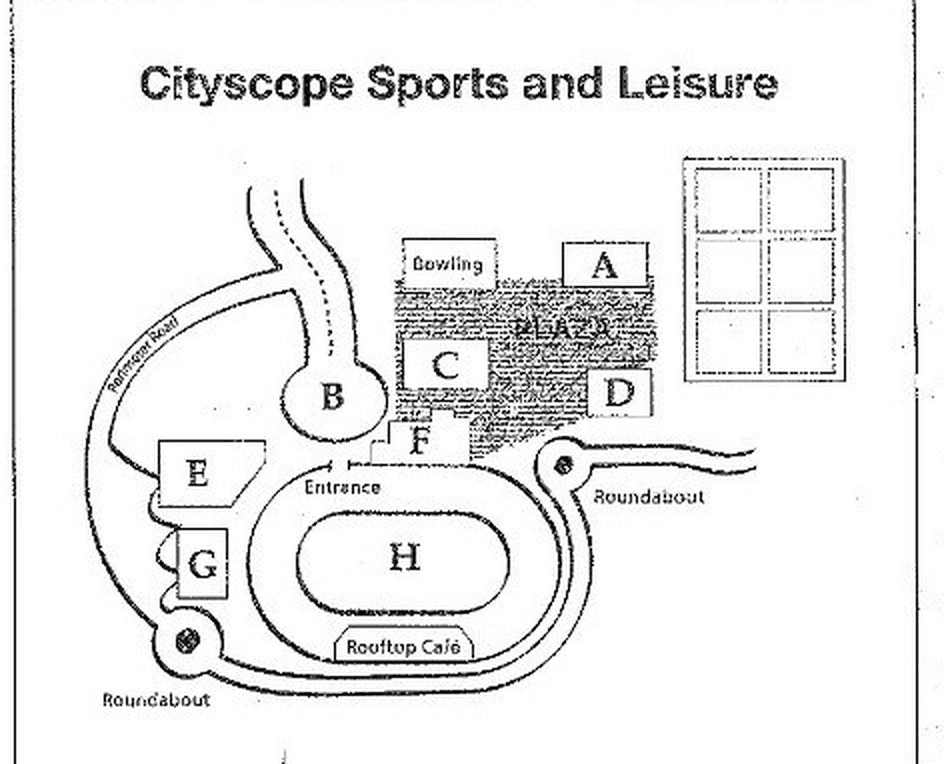
15. hotel
16. transport hub
17. cinema
18. fitness centre
19. shops
20. restaurant
Two students discussing a business studies course
Questions 21–25
Choose the correct letter, A, B or C.
21. What is Chloe concerned about?
A her knowledge of maths
B her ability to write essays
C her lack of business experience
22. Which of the following does Ivan feel he has improved?
A his computer skills
B his presentation skills
C his time management
23. What does Chloe especially like about the course?
A She won't have to do a final examination.
B She can spend time working in a business.
C She can study a foreign language.
24. Ivan is pleased that the university is going to have
A more lecture rooms.
B a larger library.
C more courses.
25. What does Ivan advise Chloe to do?
A contact his tutor
B read about some other universities
C visit the university
Questions 26–30
What does Chloe decide about the following subjects? Write the correct letter, A, B or C, next to Questions 26–30.
List of Options
A She will study it.
B She won't study it.
C She might study it.
26. Public relations
27. Marketing
28. Taxation
29. Human resources
30. Information systems
A talk on the history of weather forecasting
Questions 31–35
Complete the notes below. Write NO MORE THAN TWO WORDS for each answer.
History of weather forecasting
Early methods
Almanacs connected the weather with the positions of different (31) ………………………… at particular times.
Invention of weather instruments
A hygrometer showed levels of (32) ………………………… (Nicholas Cusa 1450)
Temperature variations first measured by a thermometer containing (33) ………………………… (Galileo Galilei 1593)
A barometer indicated air pressure (Evangelista Torricelli 1643)
Transmitting weather information
The use of the (34) ………………………… allowed information to be passed around the world.
Daily (35) ………………………… were produced by the French from 1863.
Questions 36–40
Complete the sentences below. Write NO MORE THAN TWO WORDS for each answer.
Weather observation stations are found mostly at (36) ………………………… around the country.
Satellite images use the colour orange to show (37) ………………………….
The satellites give so much detail that meteorologists can distinguish a particular (38) ………………………….
Information about the upper atmosphere is sent from instruments attached to a (39) ………………………….
Radar is particularly useful for following the movement of (40) ………………………….
Answers
1. edwinari
2. New Zealander
3. play centre
4. professor
5. first aid
6. sailing
7. sport
8. twin
9. Scotland
10. cook
11. a national company
12. city residents
13. playing fields
14. passenger hall
15. E
16. B
17. A
18. D
19. F
20. C
21. her ability to write essays
22. his time management
23. She won't have to do a final examination.
24. more courses.
25. contact his tutor
26. C
27. A
28. A
29. B
30. C
31. planets
32. humidity
33. water
34. telegraph
35. maps
36. airports
37. dry air
38. cloud
39. balloon
40. hurricanes
Explanations
- 1. edwinari
- Edwina gives 'Edwina like my name then R-I, the first two letters of my surname', and Clive reads it back as E-D-W-I-N-A-R-I – one word, edwinari.Common trap: The address is built from a name plus initials, then confirmed by spelling.
- 2. New Zealander
- Clive guesses Australia and Edwina corrects him: 'Actually, I'm a New Zealander.'Common trap: The wrong nationality is offered first and then corrected.
- 3. play centre
- 'Here's one from John Keen, who was the manager at the play centre in Wellington.'Common trap: A later job (waitressing) is mentioned, but the reference is from the play centre.
- 4. professor
- 'Eileen Dorsini. She's a professor.' Her earlier jobs – primary school teacher back home – are not her present job.Common trap: Her past job is described immediately after her current one.
- 5. first aid
- 'I've got an up-to-date first aid certificate' – 'up-to-date' = current.Common trap: Clive suggests life-saving and music; the driving licence is dismissed as 'not special'.
- 6. sailing
- 'I've got a sailing qualification, it's a certificate of competence.'Common trap: 'Yachtswoman' is Clive's word for it – the form needs the word she used.
- 7. sport
- 'what they mainly want is someone with an interest in sport' – 'an interest in' = 'be keen on'.Common trap: The food allergy is mentioned first but is not the special requirement.
- 8. twin
- 'So, they have twin boys of five, who are a bit of a handful' – twin boys means two boys.Common trap: 'of five' is their age, not the number of children.
- 9. Scotland
- 'I don't think I told you they live in Scotland' – the Campbells' location.Common trap: The island and the city flat are both theirs, but the Location column wants the country.
- 10. cook
- 'They particularly wanted someone who would be prepared to cook when they go camping on the island.'Common trap: Edwina's reply talks about 'doing the food' – the form needs the verb Clive used.
- 11. a national company
- The money that actually built it came from a national transport company and from local fundraising by city residents. The multinational and both levels of government all withdrew.Common trap: The three expected funders are all listed first, then all pull out.
- 12. city residents
- 'We managed to get all the rest from local fundraising ... a true sense of local ownership here' – the city's residents.Common trap: 'Local business' and 'local fundraising' sound alike but only one actually paid.
- 13. playing fields
- The playing fields survive as the outdoor pitches, and the 1930s passenger hall is now the cafe. Everything else on the old site was demolished.Common trap: The tower and hangars are described in detail before being ruled out.
- 14. passenger hall
- 'The cafe is in the original 1930s passenger hall' – kept from the old airport.Common trap: The old football stadium is still standing but is not part of this site.
- 15. E
- 'On our left ... The closest one is the business centre ... and next to the business centre the bigger building is the hotel.' Looking left from the rooftop cafe, the hotel is the further of the two buildings beyond the stadium.Common trap: Two adjacent buildings – the business centre is named first, the hotel is the second.
- 16. B
- 'immediately in front of the entrance, that circular open space at the end of the road is the transport hub.'Common trap: The car park is explicitly off the map.
- 17. A
- 'with the cinema in the building furthest away from us, next to the pitches, then there's the ten-pin bowling between the cinema and the road.'Common trap: The bowling is already labelled on the map – use it to fix the cinema's side.
- 18. D
- 'Near the far end of the perimeter road and between the mini-roundabout and the pitches – there's our fitness centre.'Common trap: An earlier, rejected location for the fitness centre is mentioned in Part 2's opening.
- 19. F
- 'joined on to the stadium, next to the entrance, is a range of small shops which all specialise in sports equipment.'Common trap: 'joined on to the stadium' – the shops touch the stadium, unlike the free-standing buildings.
- 20. C
- 'just in front of the bowling is our lovely restaurant ... that building on the plaza between us and the bowling.'Common trap: The rooftop cafe is where the group is standing, not a building to label.
- 21. her ability to write essays
- 'it's been a while since I've sat down and put my ideas into an essay. I was never that good at it and I'm not sure I can do it now.'Common trap: Her two strengths are stated in the same breath as the one worry.
- 22. his time management
- 'I was hopeless at getting them in by the deadline and I was always late for lectures, so I had to work hard at that and I tend to be early now' – a change for the better.Common trap: Three skills are discussed; only one is described as having got better.
- 23. She won't have to do a final examination.
- 'What really appeals to me, though, is the idea of being assessed throughout the year ... instead of everything being decided in an exam at the end.'Common trap: Both wrong options are raised by Chloe herself and then dismissed.
- 24. more courses.
- 'The university's expanding all the time and there are lots of new courses coming next year' – the only future change he welcomes.Common trap: 'going to have' – the library change has already happened and the lecture rooms are only a wish.
- 25. contact his tutor
- 'But you could email my tutor - I know he'd be happy to answer any questions.'Common trap: A visit is Chloe's own suggestion and Ivan talks her out of it.
- 26. C
- 'I need to find out a bit more about it first before I decide' – undecided.Common trap: She sounds dismissive at first, but stops short of ruling it out.
- 27. A
- 'that would be a definite for me' – she will study it, despite Ivan's poor opinion of the tutor.Common trap: Ivan's negative verdict comes first; Chloe's own decision is positive.
- 28. A
- 'that will be a good option for me because I enjoy working with figures ... it'll be good to have an understanding of taxation.'Common trap: 'I don't want to be an accountant' is a rejection of the career, not the course.
- 29. B
- 'I don't think I've got the right personality so I'd give that one a miss.'Common trap: It is introduced as the most popular course, which pulls towards A.
- 30. C
- 'sounds useful, but I'll have to look at some of the other possibilities first' – still undecided.Common trap: 'compulsory' applies to the structure of business, not to information systems.
- 31. planets
- 'Their predictions relied heavily on making links between the weather and where the planets were in the sky on certain days.'Common trap: The moon is mentioned as a separate, second method.
- 32. humidity
- 'Nicholas Cusa, a German mathematician, designed a hygrometer which told people how much humidity there was in the air.'Common trap: The wool and the scales are how it worked, not what it measured.
- 33. water
- 'It wasn't like a modern-day thermometer because it had water inside it instead of mercury.'Common trap: Mercury belongs to Fahrenheit's later thermometer, not Galileo's.
- 34. telegraph
- 'it wasn't possible for them to share their information until the electric telegraph became more widespread.'Common trap: The instruments themselves are discussed in the same sentence – the gap is the means of transmission.
- 35. maps
- 'In 1863, France started publishing weather maps each day.'Common trap: 'Forecasts' appear in the preceding sentence; the French produced maps.
- 36. airports
- 'They are nearly all based at airports although a few are in urban centres' – 'nearly all' = mostly.Common trap: Urban centres are the minority, offered straight after the answer.
- 37. dry air
- 'Orange represents dry air and bright blue shows moisture levels in the atmosphere.'Common trap: Two colours and two meanings in one sentence.
- 38. cloud
- 'it's possible for us to make out an individual cloud and follow it as it moves across the landscape' – 'make out an individual' = distinguish a particular.Common trap: The 22,000-mile figure is a tempting number but not the answer.
- 39. balloon
- 'A radiosonde is a box containing a package of equipment and it hangs from a balloon which is filled with gas.'Common trap: 'Radiosonde' names the instruments themselves, not what they hang from.
- 40. hurricanes
- 'it is one method for detecting and monitoring the progress of hurricanes' – 'monitoring the progress' = following the movement.Common trap: Aircraft are the last thing mentioned, but they use radar rather than being tracked.
Audio transcripts
Part 1 — A recruitment agency interview for a nanny job
Clive: Hello, Edwina, is it? Have a seat. Edwina: Yes, Edwina. Thanks. I'm looking for a job as a nanny. I like working with children. I talked to you yesterday? Clive: Oh, yes. Well, we covered most of the ground on the phone yesterday. I've got a form I need to complete for my records. So, you're Edwina Riley, and how should we contact you? Edwina: By email, I check it regularly. Clive: What's the address? Edwina: It's Edwina like my name then R-I, the first two letters of my surname, at worldnet dot com. Clive: E-D-W-I-N-A-R-I at worldnet dot com? Edwina: Yes. Clive: Good. And you're from Australia? Edwina: Actually, I'm a New Zealander. Clive: Oh, I'm sorry. I bet it's really irritating being told you're an Australian. Like Canadians being asked what part of the States they're from. Edwina: I'm used to it. It happens to us all the time. Clive: And now, you said on the phone that you could bring me some references? One from someone who's known you in a professional capacity and one personal one? Edwina: Ah, yeah. Here's one from John Keen, who was the manager at the play centre in Wellington where I worked for three years after I left school. It's got all his contact details on. Clive: Thank you. So this was your last employer? Edwina: Yes, apart from a bit of waitressing recently, but that was just temporary. I'm sure John will answer any questions if you contact him. Clive: We do run checks, yes. And a personal reference? Edwina: Ah, you can contact the friend of my mother's I'm staying with here in London: Eileen Dorsini. She's a professor. She's known me all my life because she used to be our neighbour back home when she was a primary school teacher there. Now she's working here at the Institute of Education. Clive: Oh good! Edwina: I've got her contact details here for you. Clive: Thanks. I think I have some jobs to suit you. Oh, do you have any practical qualifications, by the way? Life-saving, music, anything? Edwina: Um, I've got an up-to-date first aid certificate. I did a course when I was working. Clive: That's good. First aid. Anything else? Edwina: Well, I've got a driving licence, as I told you on the phone. But that's not special, you said, almost everyone needs that really. I've got a sailing qualification, it's a certificate of competence. Clive: So you're a yachtswoman? Edwina: I love sailing. Clive: Well, I'll note you have a certificate. Hmm. Clive: Now, as I mentioned yesterday, there are three families and the job description is much the same for all of them, as I explained. There are a few other things you need to know. Anyway, the first family's here in London. Edwina: Yes, I did make a few notes. London, er, that's the Bentons? With two children? Clive: Yes. That's right, a girl of three and her brother who's eight. The little boy has a quite serious food allergy. Did you learn about things like that on your course? Edwina: Oh, well, I know what to do if someone has an allergic reaction. Clive: Good, but what they mainly want is someone with an interest in sport, as that's the kind of family they are. Edwina: Oh that's OK. I'll enjoy that. Clive: Good. Now the next people are in the country, near Oxford. Edwina: Oh yeah, the Grangers? Clive: So, they have twin boys of five, who are a bit of a handful, I suspect, but it's a lovely place, quite a grand house, and the family is extremely welcoming. They keep horses. Do you ride? Edwina: I did when I was younger. I like animals generally. Clive: Well, 'animal-lover' was their special request, so you'd be fine there. The last family ... Edwina: Yes? Clive: I don't think I told you they live in Scotland. Edwina: Really? What's their name? Clive: Campbell. Edwina: Oh, yes. And they have four girls under ten? Clive: That's it. They have a lovely city flat, and they own a small island. Edwina: Wow! Clive: Actually, you might get on with them very well. They particularly wanted someone who would be prepared to cook when they go camping on the island. Edwina: Camping would really suit me and I'm used to taking my turn doing the food. But it is a long way from London. Clive: Mm. Yeah, well, you can think about it. Um, then as soon as I've checked your references, we can arrange for you to talk to all of the families. Edwina: Right. Thanks very much! Clive: Thank you! I'll email you as soon as I can.
Part 2 — A tour of a new sports and leisure facility
Guide: Ladies and gentlemen, I'm very pleased to be able to welcome you to 'Cityscape', our lovely modern sports and leisure facility. I've brought you up to the rooftop cafe on top of the stadium so that you can enjoy the view while I explain briefly what we have here and point out to you the major features of the site. Then we'll go round and have a look at ground level. We're extremely proud of this new facility. You see, when the project was first discussed, we expected that a multinational company would give us half our funding and the central government grant would make up most of the rest, with a smaller contribution from local business. Well, we'd got quite far into the planning stage when the multinational pulled out and both central and local government decided they couldn't afford anything, so we ended up with a beautiful project, a small amount of sponsorship promised by local organisations and nothing else. We thought we'd never build it, but at the last moment, we had an amazing donation of several million pounds from a national transport company, and that got us going again and we managed to get all the rest from local fundraising. There's hardly a street in the city that hasn't made its contribution one way or another, so there's a true sense of local ownership here. So, this is what we got. We wanted a new stadium because the 1950s football stadium is on the other side of town and is shortly due to be pulled down and built over. This site was the old airport with some playing fields on one side of it and a few buildings from the 1930s when the airfield first opened. So we were able to plan a new stadium with plenty of room for all the things people wanted. The playing fields have been upgraded and refenced so they are now a set of top-quality outdoor pitches for amateur football, hockey and so on. We have both sports and other entertainments here. We want to encourage all kinds of people onto the site and hope some of them may come to use the cinema or the cafe and end up trying the fitness centre. These are all grouped together; the cafe is in the original 1930s passenger hall and the architects have managed to retain some of the elegant style of the building. The other buildings, like the control tower, which would have made a great feature, and the aircraft hangars which we had hoped might house the fitness centre, were unfortunately not structurally sound enough to preserve. So everything else is newly built, opened in 2010. Right, now if you'd like to gather a little closer to the window I'll point out the various buildings. We're at the highest point of the stadium here in the rooftop cafe, on the opposite side to the main entrance doors. On our left, you can see two buildings just beyond the end of the stadium. The closest one is the business centre, used for meetings and conferences, and so on, which provides a good source of revenue for the upkeep of the sports facilities; and next to the business centre the bigger building is the hotel which is rented from us by an independent company. As you see, they are served by the perimeter road which runs round threequarters of the site. Now, coming round to the front of the building, immediately in front of the entrance, that circular open space at the end of the road is the transport hub. From here, there are buses and a monorail link to the free car park, about ten minutes from here, but you can't see that. There's also a large secure cycle park. Oh, and disabled parking, of course. People find it's very convenient and it keeps the site virtually car-free. OK. Now if you look as far as you can over to the right, beyond the buildings, you can see our outdoor pitches, which I mentioned earlier. Between the pitches and the entrance is a little kind of pedestrian plaza .. are you with me? OK, with the cinema in the building furthest away from us, next to the pitches, then there's the ten-pin bowling between the cinema and the road. Near the far end of the perimeter road and between the mini-roundabout and the pitches - there's our fitness centre, with all kinds of equipment, and a small pool, and changing rooms for teams using the pitches. Then, joined on to the stadium, next to the entrance, is a range of small shops which all specialise in sports equipment, clothes, shoes. They sell toys and so on as well, all that sort of thing. They seem to be doing well! As you see, the service road goes right round, but we keep the traffic and the pedestrians well apart, so it's all very relaxed round the plaza, popular with families. And just in front of the bowling is our lovely restaurant. You can see it from here - it's that building on the plaza between us and the bowling. It's open all day and in the evenings. There's quite a queue there at weekends, I'm pleased to say. So, now you've got the layout, we can go and have a closer look at everything.
Part 3 — Two students discussing a business studies course
Chloe: Oh, hi Ivan. Ivan: Oh, hi Chloe. Chloe: I'm glad I bumped into you because I've been looking at this prospectus about courses at the university. I'm thinking of doing a business studies degree. Isn't that what you're doing? Ivan: Yes, I'm about to start my third year. I think you'd enjoy it. Is there something on the course that you're not sure about? Chloe: Well, you know I've been working for a publisher for the last four years as a production assistant ... Ivan: That will be really valuable experience because a lot of people go to university straight from school and don't have that kind of background. Chloe: Yeah, I know and I'm used to dealing with figures and percentages and things, but it's been a while since I've sat down and put my ideas into an essay. I was never that good at it and I'm not sure I can do it now. Ivan: But you did OK at school, so I'm sure you'll soon get into it again. I was worried about different things when I started, like if I'd be able to use all the computer programs, but you only really need the basics. You have to do a lot of presentations and I thought that would be hard, but we'd actually had such a lot of practice at school it was fine. Chloe: But did you find writing essays easy? Ivan: It was OK but I was hopeless at getting them in by the deadline and I was always late for lectures, so I had to work hard at that and I tend to be early now. Chloe: It's good that you've sorted yourself out before you go and get a job or you might not have it very long! I think the course looks really interesting. Ivan: It is and it also gave me the chance to spend six months working in a local business last year. Chloe: That's not so important for me unless I could go abroad to use my foreign languages but that doesn't seem to be on offer, which is a shame. What really appeals to me, though, is the idea of being assessed throughout the year. I think that's a much more productive way of learning instead of everything being decided in an exam at the end. Ivan: It's good for people like you who are hard-working all year round. You'll be spending all your time in the library. They've just expanded it too. Chloe: That's good. Ivan: Well, yes and no. They've made the study area bigger but it means they've taken some of the magazines and periodicals away, so I think it was better as it was. The university's expanding all the time and there are lots of new courses coming next year. Chloe: Well, that's great news, isn't it? It means the college will have a better reputation as more people will hear about it, so that's good for us. Ivan: Mm, I agree but they really need to add more lecture rooms as we often have lectures in tiny rooms. Chloe: Well, you obviously think overall it's a good place to do a degree. I should probably go and have a look round. Ivan: Well, it's holidays now and there's not much going on there. Chloe: Oh, so it's probably not worth going in now. Ivan: But you could email my tutor - I know he'd be happy to answer any questions. I can give you his email address. I looked at quite a lot of other universities and read loads of prospectuses but I thought this one was the best. Chloe: I was a bit unsure about all the different subjects you can choose on this course. Ivan: Well, I can tell you a bit about them. There are some subjects you have to do and some that you can choose. The most interesting course I've done is public relations. Chloe: From what I've read it doesn't look very demanding - some of it is really just common sense. Ivan: But it will be really useful if you want to go into marketing or advertising. Chloe: That's true, but I need to find out a bit more about it first before I decide - if it will really help me. It's difficult to tell from the prospectus. Ivan: But you are interested in marketing? Chloe: Oh, yes. Ivan: Well, you can choose a marketing course. I wasn't very impressed with that course actually. The tutor didn't make it very interesting. Chloe: Mm, it's good to put on your CV that you've done a marketing course, though, so that would be a definite for me and maybe I'd get a different tutor. What other courses did you choose? Ivan: I'm doing taxation as I was thinking of training to be an accountant but I'm not sure now. Chloe: Oh, that will be a good option for me because I enjoy working with figures. Although I don't want to be an accountant, it'll be good to have an understanding of taxation, especially if I ever run my own business. Ivan: Then there's the most popular course, which is human resources and a lot of people seem to get jobs in that field. Chloe: My friend works in human resources and she's really good at it, but I don't think I've got the right personality so I'd give that one a miss. I'm more interested in how businesses actually work - the structure. Ivan: That's a compulsory course - the structure of business - but you might find information systems helpful. Chloe: Is that kind of computer programs? Ivan: Some of it is, but also databases, project management, and other things. Chloe: Oh, sounds useful, but I'll have to look at some of the other possibilities first. You know, Ivan, this course sounds as though it would suit me. I'm going to apply. Ivan: Great! If there's anything else you want to ask me, you've got my number. Chloe: Thanks!
Part 4 — A talk on the history of weather forecasting
I work for the National Weather Service and as part of your course on weather patterns, I've been asked to talk to you about how we predict the weather. We're so used to switching on our TVs and getting an up-to-date weather forecast at any time of day or night that we probably forget that this level of sophistication has only been achieved in the last few decades and weather forecasting is actually an ancient art. So I want to start by looking back into history. The earliest weather forecasts appeared in the 1500s in almanacs, which were lists of information produced every year. Their predictions relied heavily on making links between the weather and where the planets were in the sky on certain days. In addition, predictions were often based on information like if the fourth night after a new moon was clear, good weather was expected to follow. But once basic weather instruments were invented, things slowly started to change. In the mid-fifteenth century, a man called Nicholas Cusa, a German mathematician, designed a hygrometer which told people how much humidity there was in the air. To do this, Cusa put some sheep's wool on a set of scales and then monitored the change in the wool's weight according to the air conditions. A piece of equipment we all know and use is the thermometer. Changes in temperature couldn't really be measured until the Italian Galileo Galilei invented his thermometer in 1593. It wasn't like a modern-day thermometer because it had water inside it instead of mercury. In fact, it wasn't until 1714 that Gabriel Fahrenheit invented the first mercury thermometer. In 1643 another Italian called Evangelista Torricelli invented the first barometer which measured atmospheric pressure. This was another big step forward in more accurate weather predicting. As time went on, during the seventeenth, eighteenth and nineteenth centuries, all these meteorological instruments were improved and developed and people in different countries began to record measurements relating to their local weather. However, in those days it was very difficult to send records from one part of the world to another so it wasn't possible for them to share their information until the electric telegraph became more widespread. This meant that weather observations could be sent on a regular basis to and from different countries. By the 1860s, therefore, weather forecasts were becoming more common and accurate because they were based on observations taken at the same time over a wide area. In 1863, France started publishing weather maps each day. This hadn't been done before, and other nations soon followed. So that was the start of national weather forecasting and I'll now tell you how we at the National Weather Centre get the information we need to produce a forecast. Even today, one of the most important methods we use is observations which tell us what the weather is doing right now. Observation reports are sent automatically from equipment at a number of weather stations in different parts of the country. They are nearly all based at airports although a few are in urban centres. The equipment senses temperature, humidity, pressure and wind speed direction. Meteorologists also rely really heavily on satellites which send images to our computer screens. What we see on our screens is bright colours. Orange represents dry air and bright blue shows moisture levels in the atmosphere. The satellites are located 22,000 miles above the surface of the Earth and it's amazing that despite that distance it's possible for us to make out an individual cloud and follow it as it moves across the landscape. In addition to collecting data from the ground, we need to know what's happening in the upper levels of the atmosphere. So a couple of times a day from many sites across the country, we send radiosondes into the air. A radiosonde is a box containing a package of equipment and it hangs from a balloon which is filled with gas. Data is transmitted back to the weather station. Finally, radar. This was first used over 150 years ago and still is. New advances are being made all the time and it is one method for detecting and monitoring the progress of hurricanes. Crucial information is shown by different colours representing speed and direction. Radar is also used by aircraft, of course. All this information from different sources is put into computer models which are like massive computer programs. Sometimes they all give us the same story and sometimes we have to use our own experience to decide which is showing the most accurate forecast which we then pass on to you. So I hope next time you watch the weather forecast, you'll think about how we meteorologists spend our time. And maybe I've persuaded some of you to study meteorology in more depth.
Comments
Loading comments…