

IELTS Trainer 1 Listening Test 5
4 parts · 40 questions · 30 minutes
Enquiring about car hire in Sydney
Questions 1–10
Complete the notes below. Write NO MORE THAN TWO WORDS AND/OR A NUMBER for each answer.
Costwise Car Hire
Example Number of offices in Sydney: 3
Booking reference number: (1) …………………………
Office just by (2) ………………………… terminal.
Opening hours: (3) ………………………… to 6.15 p.m.
After-hours charge: $ (4) …………………………
Cheapest model of car available: (5) …………………………
Information needed when booking: (6) ………………………… number
Length of hire period: (7) …………………………
Reduce cost by driving under (8) ………………………… km per week.
Insurance does not cover: (9) …………………………
After hours put keys in box near the office on the (10) ………………………….
A talk on hotel-group jobs and recruitment
Questions 11–15
The following are essential requirements for which jobs? Write the correct letter, A, B or C, next to Questions 11–15.
List of Options
A foreign languages
B willingness to travel abroad
C professional qualification
11. conference organiser
12. catering manager
13. housekeeper
14. fitness centre staff
15. reservations assistant
Questions 16–20
Choose FIVE answers from the box: CV / names of referees / work permit / recruitment seminar / evidence of qualifications / conditions of employment / initial interview
INTERNATIONAL FINEST GROUP RECRUITMENT PROCEDURES
register interest in working for International Finest Group
↓
receive personal code and check (16) …………………………
↓
download application form
↓
send in form and attach (17) …………………………
↓
receive reply and confirm (18) …………………………
↓
send in (19) …………………………
↓
attend (20) …………………………
A tutorial on a roof-garden design project
Questions 21–22
Choose TWO letters, A–E. Which TWO possible objections to a roof garden are discussed?
21. Objection (lower letter)
A problems of access
B the cost of construction
C the time needed to install it
D who will look after it
E how to support the weight of it
22. Objection (higher letter)
A problems of access
B the cost of construction
C the time needed to install it
D who will look after it
E how to support the weight of it
Questions 23–24
Choose TWO letters, A–E. Which TWO recent developments in roof-garden building are mentioned?
23. Recent development (lower letter)
A waterproof barrier materials
B drainage systems
C tank designs
D lightweight construction materials
E watering systems
24. Recent development (higher letter)
A waterproof barrier materials
B drainage systems
C tank designs
D lightweight construction materials
E watering systems
Questions 25–30
Label the diagram below. Write the correct letter, A–H, next to Questions 25–30. Light installation.
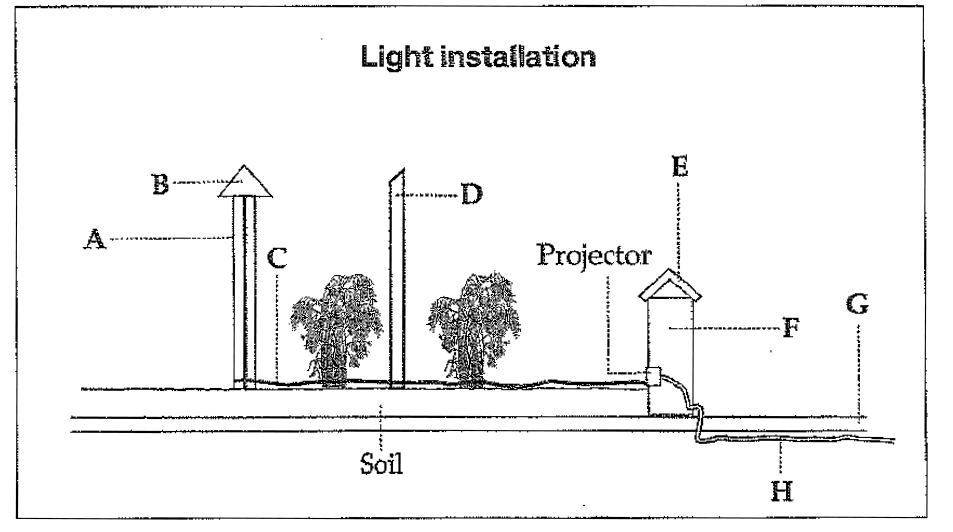
25. wall
26. electric wire
27. fibre optic cable
28. wooden post
29. glass cap
30. acrylic rod
A presentation on the Argus system and sand collecting
Questions 31–36
Complete the notes below. Write NO MORE THAN TWO WORDS for each answer.
The Argus system
Developed by Rob Holman in N. Carolina with other researchers.
Research is vital for understanding of (31) …………………………
Matches information from under the water with information from a (32) …………………………
According to S. Jeffress Williams, useful because can make observations during a (33) …………………………
Dr Holman's sand collection
Dr H. has samples from every (34) …………………………
Used in teaching students of (35) …………………………
e.g. US East Coast display:
grains from south are small, light-coloured and (36) ………………………… in shape
Questions 37–40
Complete the flow-chart below. Write NO MORE THAN THREE WORDS for each answer.
Taking samples when travelling
to dig sand, a plastic or metal (37) ………………………… is ideal
↓
store in plastic bags
↓
write date and place, using a (38) …………………………
↓
## After reaching home
↓
log samples, noting location, including which part of beach
↓
dry sample on (39) …………………………
↓
transfer to container
↓
add at least one (40) ………………………… immediately
Answers
1. 743002
2. international
3. 6.45
4. 30
5. Echo
6. credit card
7. seven days
8. 1,000
9. luggage
10. pavement
11. A
12. C
13. B
14. C
15. A
16. conditions of employment
17. CV
18. initial interview
19. evidence of qualifications
20. recruitment seminar
21. the cost of construction
22. who will look after it
23. waterproof barrier materials
24. watering systems
25. F
26. H
27. C
28. D
29. B
30. A
31. beach erosion
32. camera
33. storm
34. continent
35. geology
36. rounded
37. spoon
38. permanent marker
39. newspaper
40. label
Explanations
- 1. 743002
- 'I mean the one you got from me when we booked your flights. I have it here - 743002.'Common trap: The hire company's phone number is read out just before the reference.
- 2. international
- 'It's immediately outside the international terminal.'Common trap: He names the domestic terminal in the question; the answer corrects him.
- 3. 6.45
- 'they open at quarter to seven' – quarter to seven = 6.45.Common trap: 'Quarter to seven' must be converted, and his landing time is another clock time.
- 4. 30
- 'if you arrange it in advance, they can wait for you. You do have to pay an extra $30 for that, though.'Common trap: Three dollar amounts appear within a few lines.
- 5. Echo
- 'the best value should be under $60 a day with luck. That would be the Echo' – spelled out E-C-H-O.Common trap: The name is spelled out only after he asks 'Sorry?'.
- 6. credit card
- 'they do need your credit card number when you book'.Common trap: The driving licence is needed at collection, not at booking.
- 7. seven days
- 'I'm in Sydney for seven days ... I'll keep it for the whole week.'Common trap: The days he will actually drive are fewer than the hire period.
- 8. 1,000
- 'you get quite a big discount if you do less than 1,000 kilometres in the week.'Common trap: 'Less than' must be matched to 'under'.
- 9. luggage
- 'it doesn't cover anything except the car ... your luggage isn't insured, even if it's out of sight, locked in the boot.'Common trap: The insurance is described as included and good value just before the exclusion.
- 10. pavement
- 'There's a secure box just outside the office on the pavement. You just drop the keys in there.'Common trap: He guesses 'through the door' and is corrected.
- 11. A
- 'good communication and organisational skills with a good level of fluency in at least one European and one non-European language'.Common trap: 'International conferences' suggests travel, but the post is London-based.
- 12. C
- 'young managers, who already have the relevant business qualifications - no training on the job here'.Common trap: 'Many parts of the world' describes where chefs come from, not travel.
- 13. B
- 'which could be anywhere in our European, Middle Eastern or Far Eastern hotels, so you must be prepared to hop on a plane at five minutes' notice.'Common trap: Personal qualities are listed first; none of them is the essential requirement asked for.
- 14. C
- 'A diploma in sports science would be the minimum requirement here.'Common trap: Appearance and manner are called necessary, but the qualification is the requirement.
- 15. A
- 'If you have fluency and some keyboard skills in, for example, Spanish, or any Far Eastern languages'.Common trap: Overseas experience is preferred, but the post itself is 'in the office here'.
- 16. conditions of employment
- 'you get access to the Human Resources website, where you should make sure you understand the legal terms and conditions which apply to all our employees.'Common trap: The work permit is a precondition of the first step, not this one.
- 17. CV
- 'download the application form - fill it in and send it back along with your CV.'Common trap: 'Along with' has to be matched to 'attach'.
- 18. initial interview
- 'there will be in that automated response a list of times for an initial interview ... You confirm by email which of the time slots will suit you.'Common trap: What is confirmed is the interview slot, not the reply itself.
- 19. evidence of qualifications
- 'at that point we'll ask for any evidence of qualifications required ... which you have to send certified copies of'.Common trap: The referees are contacted by the company – the applicant does not send their names.
- 20. recruitment seminar
- 'participate in a one-day recruitment seminar, which involves a number of group and individual activities'.Common trap: The head-office visit is described first, in the same sentence.
- 21. the cost of construction
- The tutor raises two objections a supermarket would make: the initial cost of building it, and who would maintain it.Common trap: Access and weight are both discussed, but as design decisions rather than objections.
- 22. who will look after it
- 'Supermarkets don't normally employ gardeners' – the maintenance objection.Common trap: The student's community-garden answer follows immediately and can be mistaken for the objection.
- 23. waterproof barrier materials
- Only two things are described as new: the barrier fabric ('nowadays that is very good') and the automatic watering systems ('the latest ones').Common trap: Drainage, tanks and wood are each explicitly called long-established or traditional.
- 24. watering systems
- 'have them linked to modern automatic watering systems ... the latest ones definitely work very well.'Common trap: The tanks in the same sentence are 'conventional' – only the link to the watering system is new.
- 25. F
- 'You have this low wall on the right?' – 'Yes, that's it ... a wooden wall, using reclaimed timbers, with an angled ceramic top surface.'Common trap: The tutor confirms the wall is 'on the right' before it is described.
- 26. H
- 'the heavy duty electric wiring comes up through the floor just outside the planted area and into the wall.'Common trap: The projector is separately labelled on the diagram, so it is not an option.
- 27. C
- 'The fibre optic goes across the surface of the soil in the planting area.'Common trap: The cable is first mentioned at the projector before its position is given.
- 28. D
- 'the cable goes past a wooden post which is between the shrubs, and can be a support for them as they grow bigger'.Common trap: 'Between the shrubs' locates it in the middle of the planted area.
- 29. B
- 'the light beam is carried up to the top of each element and illuminates a kind of conical glass cap' – and the student confirms 'Yes.'Common trap: 'Conical' matches the triangular shape drawn at the top of the element.
- 30. A
- 'No, it's a slender acrylic rod, er, like the stem of a flower or mushroom, which the cable runs up inside of.'Common trap: The tutor guesses 'a wall' and is corrected.
- 31. beach erosion
- 'This research is critical to the study of beach erosion in places where the coastline is being worn away.'Common trap: 'Critical to the study of' has to be matched to 'vital for understanding of'.
- 32. camera
- 'The system correlates the data from under the water with what Dr Holman gets from his fixed camera.'Common trap: The pier and the photography technique both follow in the same sentence.
- 33. storm
- 'A lot of these take place when there is a storm or at other times when it is difficult to have people out on the beach making observations.'Common trap: The quotation is long and the answer sits in its final sentence.
- 34. continent
- 'the collection includes sand from each continent, including Antarctica' – 'each' = every.Common trap: The number of samples is given just before.
- 35. geology
- 'it's mainly geology students at the university who study his collection'.Common trap: Geologists send him sand; geology students are the ones who study it.
- 36. rounded
- 'the grains are fine and rounded because most of the time sand is not stationary on the beach.'Common trap: 'Fine' and 'lighter' are already given in the note; only the shape word is missing.
- 37. spoon
- 'One really handy thing for digging sand, especially if it's hard or frozen, is a spoon.'Common trap: Both materials are already printed in the flow-chart step.
- 38. permanent marker
- 'you need to record the location and date on the bag, so you must also have a permanent marker with you'.Common trap: 'Permanent' is easy to drop, but it is part of the answer.
- 39. newspaper
- 'you can just air it out on layers of newspaper, which is suitably absorbent.'Common trap: The speaker stresses that no apparatus is needed before naming the newspaper.
- 40. label
- 'you must stick an identification label on straight away. Some people put one inside as well' – hence 'at least one'.Common trap: The optional second label explains 'at least one' but is not the answer.
Audio transcripts
Part 1 — Enquiring about car hire in Sydney
Woman: Hello, how can I help you? Man: Hi. I'm Carlton Mackay, and you booked me some flights recently, to Australia - and some internal ones? Woman: Oh, yes, Mr Mackay, I remember you now, of course. Man: Well, I find I'm going to need car hire while I'm in Sydney after all. I think you said you could recommend a good-value company? Woman: Yes, that's right. Costwise Cars. They're very good and don't charge lots of extras. They have three offices in the Sydney area, including one office right at the airport. Man: So, I'll just book it online? Woman: Yes, you can book online but you should have their phone number too, just in case. Man: Mm, of course. Woman: That's 1800 705 639. It's on the website. And you can get a discount if you quote your booking reference from us. Man: Oh, what's that? Woman: I mean the one you got from me when we booked your flights. I have it here - 743002. Man: Oh, thanks. I guess I've got it at home, but I'll write it down again in case. A discount is good. So where exactly is the office? I'll be coming to the domestic terminal from Melbourne. Woman: It's immediately outside the international terminal. Man: OK. And, another thing I want to check is, will they be open when I arrive? Or is it just office hours? Woman: Mm... they open at quarter to seven and close at 6.15 in the evening. So, let's see, you're due to land at ten past six. By the time you've collected your bags and so on, which will take a little while, they won't be open, but if you arrange it in advance, they can wait for you. You do have to pay an extra $30 for that, though. Man: OK. Well, I'm staying near the airport the first night, so I could go back in the morning and save a day's hire? Woman: Yes, that'd be better. That'd save you about $50. Man: Do you know what kind of cars they have? Woman: Quite a variety, I think. Er, the best value should be under $60 a day with luck. That would be the 'Echo', I guess. Man: Sorry? Woman: E-C-H-O, like when your voice bounces back? Man: I suppose I have to book online before I leave? Woman: Mm, that's the best way. Er, they won't deduct any charges until you finish with the car, but they do need your credit card number when you book and of course they'll want to see your driving licence when you collect. How long will you need it? Man: I'm in Sydney for seven days. I'll only actually need to use it on three or four of those days, I hope, but I'll keep it for the whole week. I guess it's going to be a few hundred dollars. Can you suggest anything I can do to keep the cost down? Woman: Oh, you get quite a big discount if you do less than 1,000 kilometres in the week. Man: Oh, that's good. I don't suppose I will be driving that far, actually. Woman: But, oh, yes, the other thing I should mention is the insurance. It's included in the price. Man: Oh, that is good value then. Woman: Yes, but what you must remember is that it doesn't cover anything except the car, so you must be careful not to leave anything at all in it when you park because your luggage isn't insured, even if it's out of sight, locked in the boot. Man: Yeah, well, I think my travel policy will cover that actually. Woman: Good! Man: OK. And can I return the car outside office hours? My flight home is very early in the morning. Can I put the keys through the door, or something? Woman: There's a secure box just outside the office on the pavement. You just drop the keys in there. Man: Oh, good. Woman: And one other thing: you should remember to buy petrol before you leave it. If you don't drop the car back with a full tank you get charged to fill it. I recommend you go to a supermarket before you go out to the airport. Man: Thanks for the tip! Woman: Not at all. Do call in again if there's anything else I can help with. Man: I will. Many thanks.
Part 2 — A talk on hotel-group jobs and recruitment
Speaker: Good morning. It's a great pleasure to be here in London and to see so many people interested in working in hotels. We in the International Finest Group of hotels are very proud of our business and we are always on the lookout for quality recruits in every department. Now, I'm going to outline some of the areas of work where we are currently recruiting and the essential skills or qualifications for them, then I'll run through our recruitment procedure. OK? At the moment we're looking for a number of people for administrative posts in different parts of the world and also some roles which involve a lot of travelling. One of our main business streams is hosting special events for other businesses. If you have good communication and organisational skills with a good level of fluency in at least one European and one non-European language, I'd suggest you think about becoming part of the team which sets up these events for all our centres. This would mean being based full-time in our London office. The work ranges from setting up small meetings a few days ahead to organising international conferences two years in advance, so there's plenty of variety. Some of the conferences we run have as many as a thousand delegates, so it's quite challenging. Then there are some posts available for professionals in the catering field. Chefs we can find; it seems this is a popular career choice in many parts of the world as in the UK these days, in spite of the exacting standards, but people to manage catering departments need more than a love of producing quality food. We're after really energetic and totally efficient young managers, who already have the relevant business qualifications - no training on the job here - and they must share the team's determination to make everything run smoothly at any time of the day or night. Or, if you are the type of person who enjoys a challenge, what about becoming one of our relief housekeepers? You'll be a good people person, well organised, and supremely flexible. As well as covering UK holidays, maternity and paternity leave, there will be times when you have to fill a key post when someone's sick, which could be anywhere in our European, Middle Eastern or Far Eastern hotels, so you must be prepared to hop on a plane at five minutes' notice. The International Finest brand name attracts visitors from all over the world and on all kinds of business and leisure trips. Our swimming pools and gyms need to be run by people with the highest standards of customer service. You don't have to be a great athlete, but smart appearance and a pleasant manner are necessary. A diploma in sports science would be the minimum requirement here. Lastly, I'd just like to mention that the main London office has another vacancy. Most bookings come online, especially from the Far East for people coming to Europe. If you have fluency and some keyboard skills in, for example, Spanish, or any Far Eastern languages, either having taken a degree, or preferably from having lived and worked overseas, you might be just the person we're looking for to deal with email bookings and queries in the office here. A flexible attitude to working hours is also important as you may have to come in outside normal office hours. So that's an overview of the kind of jobs, now how to get them! First of all, provided you have a UK work permit, you can go online and register an interest in working for us. By return, you'll receive a unique applicant's code, which is your personal identification number and which we'll use in all communications. Along with that you get access to the Human Resources website, where you should make sure you understand the legal terms and conditions which apply to all our employees. That's also where you can then download the application form - fill it in and send it back along with your CV. You'll know within 48 hours whether you're being considered as you get an automated response. Sorry if it's a bit impersonal, but at least it's quick. Hopefully, if we like the sound of you, there will be in that automated response a list of times for an initial interview which will take place by telephone during the following week. You confirm by email which of the time slots will suit you. Provided the interview is satisfactory, at that point we'll ask for any evidence of qualifications required, which might be your degree or diploma certificate or so on, which you have to send certified copies of, and we contact your referees. The last thing you have to do is you come along and have a look round the International Finest Group head office, get to know some of our team in Human Resources face to face, and participate in a one-day recruitment seminar, which involves a number of group and individual activities along with other potential employees. Then, with luck, we'll offer you a job! So, I hope you like the sound of joining our organisation.
Part 3 — A tutorial on a roof-garden design project
Tutor: So, let's hear what you're doing for your next project. Student: I've decided to design a roof garden for a supermarket. I've been looking at some on the web and I think that a garden on top of a building is the up-and-coming thing. Tutor: OK. So you've done a bit of reading already? What benefits would there be for the client? Why do you think a supermarket chain would be willing to meet the expense of construction? You do realise that would be the first thing they raise. Student: Yes, I know. But I'd explain that in spite of the initially high expense, they would save that much in approximately five years. Well, I'd have to do sums, I mean calculate specifically ... Tutor: Yes, how would the saving come about? Student: Mainly through lower heating and aircon bills. The extra insulation offered by having a layer of living plants in the soil would make a huge difference. Tutor: OK. But they might feel the expense of maintenance would be an issue. After all, supermarkets don't normally employ gardeners. Student: What I thought was, if they made it a community garden, rather than a simple low-maintenance green roof ... Tutor: So there'd be public access? Student: Oh, yes! Then there'd be a sense of ownership in the local community and people could take responsibility for it, instead of the supermarket paying a commercial company, and it'd really boost their public relations. Tutor: That's a good point. And have you been looking into how roof gardens are built nowadays? Student: I'm still exploring that, but if I take advantage of the latest technologies for roof gardens, it shouldn't be too difficult. But in any case, you have to use lightweight materials. Tutor: But that's a matter of making the right choices. You can even use quite traditional ones such as wood for the planting areas. Student: Yes, that's what I thought. It'll look good and it isn't too heavy. Tutor: But for the basic construction, the issue you have to address first is the material used between the building and the garden. Student: You mean the barrier fabric, which ensures there's no chance of rainwater leaking down into the building? Tutor: Yes, nowadays that is very good, and quite easily sourced. Student: Then on the other hand, there's the business of water within the roof garden itself. Tutor: You mean drainage? That's an important feature of the construction in any roof design. Student: Yes, but I think most drainage issues have been well understood for quite a long time. Tutor: OK, but another thing is with plants in an exposed situation, you usually need to find ways to optimise rainfall. Student: Yes, because rainwater is best for the garden, if you can store it for when it's needed. What I've been looking at are some buildings which use fairly conventional storage tanks, the kind that have been in use for decades, but have them linked to modern automatic watering systems. Tutor: Sounds complicated! Student: It's less so in practice than it sounds, I think. I've been researching them and actually the latest ones definitely work very well and they can be electronically regulated to suit the local microclimate. Tutor: Mmm, that sounds interesting. You seem to have been doing some thorough research! Make sure you reference all your sources when you write it up. Student: Yes, sure. Um, there's one more aspect I'd just like to run past you, if there's time? I want to include a light feature in the design. Tutor: Of course. Student: I've got a sketch here. Tutor: Let's have a look then. Student: Well, I was really impressed by something I saw on a roof in Cornwall and I'd like to design something similar. Um, you have an area of planting, and I'm thinking of installing this lighting in an area filled with low-growing evergreen shrubs. Tutor: Mmm. You'd have to have lights and things well away from anywhere children might be. But I can see this could be very effective, if a bit complicated. How would it work? On this drawing, this is a section view? You have this low wall on the right? Student: Yes, that's it. This is just one element and these areas would be repeated all round the planted area. I think this will probably be a wooden wall, using reclaimed timbers, with an angled ceramic top surface. Tutor: Perhaps even ridge tiles like they use on roofs? Student: Oh, yes, that'd be just the sort of thing. And that'd make it weatherproof. Um, and then the heavy duty electric wiring comes up through the floor just outside the planted area and into the wall. Then it's brought through to a projector low in the side of the wall, and that sends a beam of light along the fibre optic cable. Tutor: So there's no electricity in the actual lights. The fibre optic goes across the surface of the soil in the planting area. Student: Yes, that's the beauty of it. The shrubs will soon grow to cover it up, of course, and then the cable goes past a wooden post which is between the shrubs, and can be a support for them as they grow bigger, and then runs up into each element of the installation. Tutor: So the light beam is carried up to the top of each element and illuminates a kind of conical glass cap? I see! Is that the bit which would glow in the dark? Student: Yes. Tutor: And what's the cap supported on? Is it a wall? Student: No, it's a slender acrylic rod, er, like the stem of a flower or mushroom, which the cable runs up inside of. Tutor: Well, I'll be interested to see the final drawings. Student: Thank you! I'm looking forward to putting it all together.
Part 4 — A presentation on the Argus system and sand collecting
Student: First, I would like to tell you how the Argus computerised photography system has helped marine researchers. Then I shall talk a bit about sand collecting. Well, Argus is the system Doctor Rob Holman developed when he was working at a research pier on the coast of North Carolina, about 20 years ago. This pier stretches out over the water, and it's the longest research pier in the world, with an observation tower on the end of it. The researchers there make precise measurements of how the sand moves about under the waves. This research is critical to the study of beach erosion in places where the coastline is being worn away. The Argus system helps to solve the difficulties encountered by these researchers. The system correlates the data from under the water with what Dr Holman gets from his fixed camera, which is mounted above the water on the pier and uses time-lapse photography. Some of Doctor Holman's results have changed the way people understand how sand moves. To quote S. Jeffress Williams, a coastal geologist with the United States Geological Survey, the system is 'a critical piece of new technology' and 'The Argus system allows us to quantify and document visually the changes to the coast on a variety of different time frames. A lot of these take place when there is a storm or at other times when it is difficult to have people out on the beach making observations and taking measurements.' Up to now Argus installations have been installed in places in Oregon, California, Hawaii, England, the Netherlands, Australia, New Zealand, Spain, Italy and Brazil, as well as in North Carolina. Now I'd like to introduce Dr Holman's sand collection. He started collecting sand in the 1980s, and he still collects it now, even though he has around a thousand samples. They come from his travels and from geologists and amateurs all over the world - and the collection includes sand from each continent, including Antarctica. People send him sand in envelopes, plastic bags, paper towels and all sorts! Each is stored in a glass jar, which Dr Holman labels by latitude and longitude of its origin, as well as he can work them out - sometimes the information is a bit sketchy! Anyway, it's mainly geology students at the university who study his collection, and they can learn a lot from it. For instance, one set of tubes displays sand from the East Coast of the US. So you can see that the sand gets lighter and finer from north to south. By the time a grain of sand eventually washes up on a beach in Florida at the southern end of that journey, it has been battered by waves for a long time so the grains are fine and rounded because most of the time sand is not stationary on the beach. OK, so if you'd like to collect sand and maybe even send some to Dr Holman, how should you go about it? Well, the list of equipment is very short and easy to find, but you should keep a supply when you're travelling, as you never know when you'll come across an interesting sand sample. One really handy thing for digging sand, especially if it's hard or frozen, is a spoon. It's perfect for that. If you're travelling by air it'll have to be plastic, but metal is preferable, as plastic tends to break. You need something to put the samples in that is damp-proof and easy to carry. You can just use plastic bags, but you need to record the location and date on the bag, so you must also have a permanent marker with you, because you can never assume you will remember where you gathered a sample from later on and you don't want it to rub off before you get home. And that's about all you need in the field to collect sand. When you get home, your samples should be logged in a notebook or computer. You need to note the location and be really specific as to exactly whereabouts on the beach you gathered your sample - low tide mark, under cliff area, etc. Then, you store your sample. You want to keep everything in good condition and avoid contamination. So first you make absolutely sure that each sample is perfectly dry. You don't need any complicated apparatus for this, you can just air it out on layers of newspaper, which is suitably absorbent. Most people find that's the best way. Then, lastly, but this is really important, before there can be any chance of confusing this latest sample with another, you put it in a clean small bag or a jar, and you must stick an identification label on straight away. Some people put one inside as well in case the outer label falls off, but that's up to you. Well, that's about all you need to know to get started as a sand collector. Any questions?
Comments
Loading comments…