

Cambridge IELTS 7 Listening Test 4
4 parts · 40 questions · 30 minutes
A homestay application
Questions 1–6
Complete the form below. Write NO MORE THAN THREE WORDS AND/OR A NUMBER for each answer.
HOMESTAY APPLICATION
Example — Surname: Yuichini
First name: (1) …………………………
Sex: female
Nationality: Japanese
Age: 28 years
Passport number: (2) …………………………
Present address: Room 21C, Willow College
Length of homestay: approx (3) …………………………
Course enrolled in: (4) …………………………
Family preferences: no (5) …………………………
no objection to (6) …………………………
Questions 7–10
Answer the questions below. Write NO MORE THAN TWO WORDS for each answer.
7. What does the student particularly like to eat? …………………………
8. What sport does the student play? …………………………
9. What mode of transport does the student prefer? …………………………
10. When will the student find out her homestay address? …………………………
A guided tour of Bicentennial Park
Questions 11–14
Choose the correct letter, A, B or C.
11. What kind of tour is Sally leading?
A a bus tour
B a train tour
C a walking tour
12. The original buildings on the site were
A houses
B industrial buildings
C shops
13. The local residents wanted to use the site for
A leisure
B apartment blocks
C a sports centre
14. The Tower is at the centre of the
A nature reserve
B formal gardens
C Bicentennial Park
Questions 15–17
Label the plan below. Write NO MORE THAN TWO WORDS for each answer.
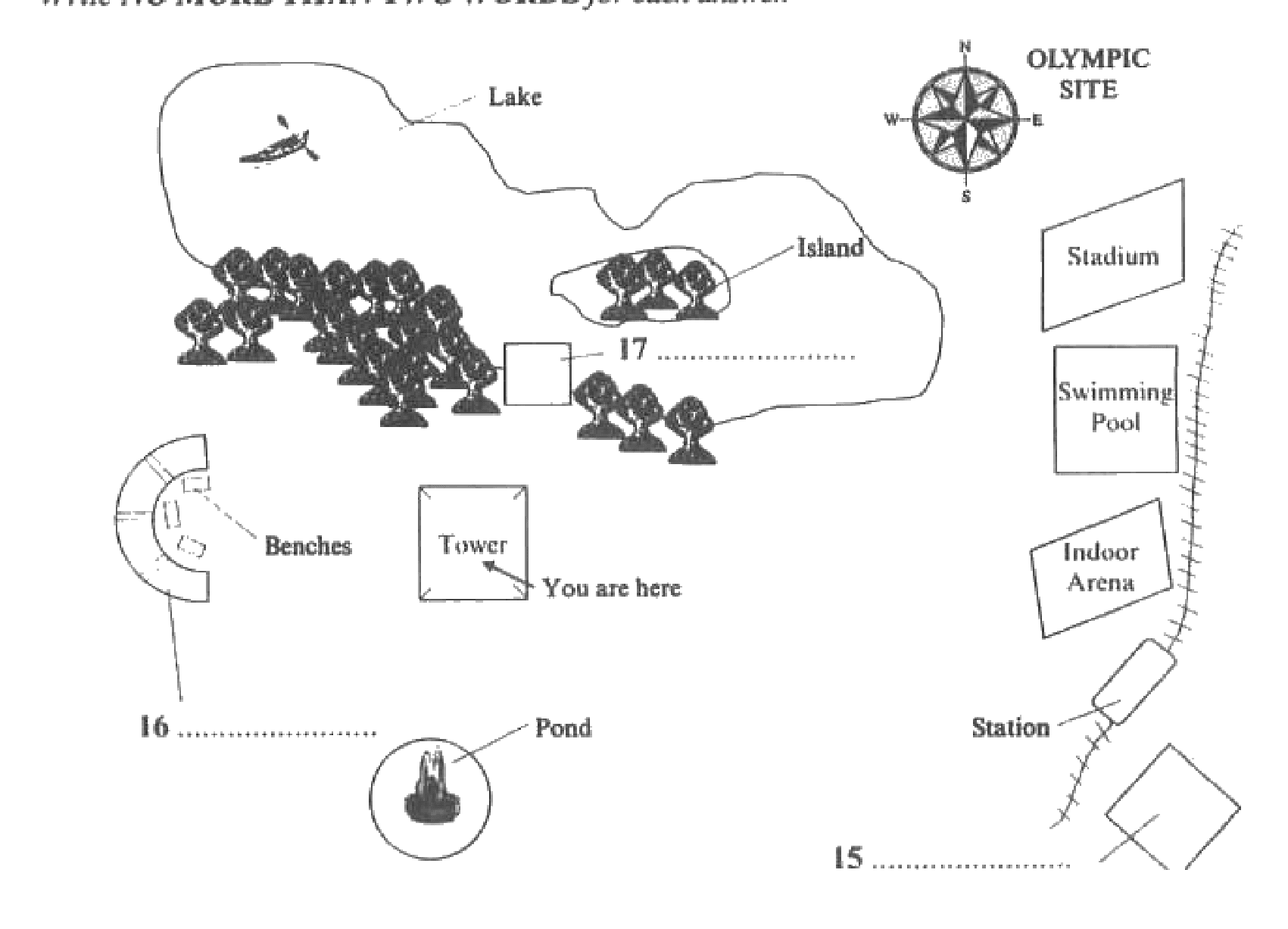
15 (east, by the Olympic site): (15) …………………………
16 (west of The Tower, by the benches): (16) …………………………
17 (north, through the trees by the lake): (17) …………………………
Questions 18–20
Complete the table below. Write NO MORE THAN TWO WORDS for each answer.
| Area | Facility | Activity |
|---|---|---|
| The Mangroves | boardwalk | (18) ………………………… |
| Frog Pond | outdoor classroom | (19) ………………………… |
| The Waterbird Refuge | (20) ………………………… | bird watching |
Two students planning a geography presentation
Questions 21–22
Complete the sentences below. Write NO MORE THAN ONE WORD AND/OR A NUMBER for each answer.
21. The presentation will last 15 minutes. There will be ………………………… minutes for questions.
22. The presentation will not be ………………………….
Questions 23–26
What do the students decide about each topic for the geography presentation? Choose the correct letter, A, B or C, next to Questions 23–26.
Decision
A They will definitely include this topic.
B They might include this topic.
C They will not include this topic.
23. Geographical Location
24. Economy
25. Overview of Education System
26. Role of English Language
Questions 27–30
Complete the table below. Write NO MORE THAN TWO WORDS for each answer.
| Information/visual aid | Where from? |
|---|---|
| Overhead projector | the (27) ………………………… |
| Map of West Africa | the (28) ………………………… |
| Map of the islands | a tourist brochure |
| Literacy figures | the (29) ………………………… |
| _____ on school places | as above |
A lecture on monosodium glutamate
Questions 31–33
Choose the correct letter, A, B or C.
31. The speaker says the main topic of the lecture is
A the history of monosodium glutamate.
B the way monosodium glutamate works.
C where monosodium glutamate is used.
32. In 1908, scientists in Japan
A made monosodium glutamate.
B began using kombu.
C identified glutamate.
33. What change occurred in the manufacture of glutamate in 1956?
A It began to be manufactured on a large scale.
B The Japanese began extracting it from natural sources.
C It became much more expensive to produce.
Questions 34–40
Complete the notes below. Write NO MORE THAN TWO WORDS for each answer.
Monosodium Glutamate (MSG)
MSG contains
– glutamate (78.2%)
– sodium (12.2%)
– (34) ………………………… (9.6%)
Glutamate is found in foods that contain protein such as (35) …………………………
and (36) ………………………… .
MSG is used in foods in many different parts of the world.
In 1908 Kikunae Ikeda discovered a (37) ………………………… .
Our ability to detect glutamate makes sense because it is so (38) ………………………… naturally.
John Prescott suggests that:
– sweetness tells us that a food contains carbohydrates.
– (39) ………………………… tells us that a food contains toxins.
– sourness tells us that a food is spoiled.
– saltiness tells us that a food contains (40) ………………………… .
Answers
1. Keiko
2. JO6337
3. 4 months
4. Advanced English Studies
5. children
6. pets
7. seafood
8. tennis
9. trains
10. this afternoon
11. a walking tour
12. industrial buildings
13. leisure
14. formal gardens
15. car park
16. rose garden
17. café
18. cycling
19. biology lesson
20. viewing shelter
21. 5
22. assessed
23. A
24. B
25. A
26. C
27. media room
28. resources room
29. embassy
30. statistics
31. the way monosodium glutamate works.
32. identified glutamate.
33. It began to be manufactured on a large scale.
34. water
35. meat
36. cheese
37. fifth taste
38. common
39. bitterness
40. minerals
Explanations
- 1. Keiko
- 'OFFICER: And your first name? STUDENT: It's Keiko. K-E-I-K-O.' The first name is spelled out.Common trap: Yuichini is given first but is the surname, already printed as the example.
- 2. JO6337
- 'Okay... your passport number is JO 6337...' The officer reads the number back from the passport.Common trap: '21C' and '28' are nearby numbers belonging to the room and the age.
- 3. 4 months
- 'How long are you planning on staying with homestay? STUDENT: About four months... longer if I like it.' 'About' matches the printed 'approx'.Common trap: 'Twenty weeks' and 'five-week course' are said shortly afterwards, but they describe the course, not the homestay.
- 4. Advanced English Studies
- 'Well, I've enrolled for twenty weeks in the... um... Advanced English Studies because I need help with my writing.'Common trap: 'Twenty weeks' opens the same sentence and is the length, not the name of the course.
- 5. children
- 'I prefer... I mean I like young children, but I'd like to be with older people... you know... adults, someone around my age.' She would rather not have children in the family.Common trap: 'I like young children' comes first, but 'but I'd like to be with older people' is the actual preference.
- 6. pets
- 'OFFICER: Okay, and what about pets? STUDENT: I am a veterinarian so that's fine... the more the better.' Being a vet, she has no objection to pets.Common trap: 'Veterinarian' is her job, given as the reason — the thing she has no objection to is pets.
- 7. seafood
- 'No, I am not a vegetarian... but I don't eat a lot of meat... I really like seafood.' 'Really like' matches 'particularly like'.Common trap: 'Meat' is in the same sentence but is the thing she does not eat much of.
- 8. tennis
- 'Yes, I joined the handball team, but I didn't like that... so I stopped playing. Now I play tennis on the weekend with my friends.'Common trap: Handball is named first but she says 'I stopped playing' — it is the sport she no longer plays.
- 9. trains
- 'I like catching the train... they are much faster.' She contrasts the train favourably with the buses, which 'are always late'.Common trap: Buses are mentioned first, but she says 'they are always late' — the preferred mode is the train.
- 10. this afternoon
- 'Listen, leave it with me... I'll check my records and I'll give you details this afternoon.'Common trap: No day of the week is given — the details come the same afternoon.
- 11. a walking tour
- 'I hope that you're all wearing your most comfortable shoes and that you can keep up the pace. So let's get under way on our tour around this wonderful park.' Comfortable shoes and keeping up the pace mean the group is walking.Common trap: Trains and a station are mentioned later in the talk, but they belong to the Olympic site seen from The Tower, not to Sally's tour.
- 12. industrial buildings
- 'There used to be a lot of factories in this area until the 1960s... most of the exciting park space all around you was originally warehouses and storehouses.' Factories, warehouses and storehouses are industrial buildings.Common trap: Housing is discussed in the next paragraph, but as a development that was proposed later and rejected — not as the original buildings.
- 13. leisure
- 'If the land was to be cleaned up, they wanted to use the site for recreation. Residents wanted open space for outdoor activities, rather than housing or even an indoor sports complex.' Recreation and outdoor activities = leisure.Common trap: Both distractors appear in the same sentence, each introduced by 'rather than' — they are what the residents did NOT want.
- 14. formal gardens
- 'The tall blue-and-white building in front of us is called The Tower and is the centre point for the formal gardens.'Common trap: The previous sentence names both areas of Bicentennial Park — the nature reserve and the formal park — so the wrong half is easy to pick.
- 15. car park
- 'Out to the east, the large buildings about a kilometre away are on the Olympic site... The Olympic site has its own station to encourage the use of public transport. There is also a car park, but it only holds a limited number of cars.'Common trap: The station is named in the same breath, but it is already labelled on the plan.
- 16. rose garden
- 'And around to the west, you can relax and sit on a bench to smell the flowers in the rose garden.' The benches are already marked on the plan, and the feature to the west is the rose garden.Common trap: The ornamental pond is described just before, but that is 'out here to the south' and is already labelled.
- 17. café
- 'You can hire rowing boats at the boat shed, which you can't see from here, but if you look through the trees, you can see the café, which has lovely views across the water.'Common trap: The boat shed is named first in the same sentence but is explicitly 'which you can't see from here', so it cannot be the labelled building.
- 18. cycling
- 'You'd think that people would come here to look at the unusual plant life of the area, but in fact it's more often used for cycling and is very popular with the local clubs.'Common trap: Looking at the unusual plant life is offered first and then contradicted by 'but in fact'.
- 19. biology lesson
- 'Just next to it we have our outdoor classroom, a favourite spot for school parties. The area is now most often used by primary schools for biology lessons.'Common trap: 'School parties' is mentioned first but is who uses it, not the activity.
- 20. viewing shelter
- 'This area is in a sheltered part of the estuary, that's why the park's viewing shelter is a favourite spot for bird watchers who can use it to spy through binoculars.'Common trap: 'Binoculars' and 'black swans' are nearby, but the facility asked for is the viewing shelter.
- 21. 5
- 'Well... it'll be fifteen minutes per presentation. And five minutes for questions.' Fifteen minutes is already printed, so the question time is five minutes.Common trap: 'Three per hour' and 'about twenty minutes' are both floated first and corrected by Trevor.
- 22. assessed
- 'JULIE: And is this one going to be assessed? TREVOR: No... not this time round... because it's the first one.'Common trap: 'The first one' explains why, and could be written instead of the missing word.
- 23. A
- 'But I think we ought to say something about the geographical location... cos not a lot of people know where the islands are. JULIE: Yes... OK... I'll take notes, shall I?' Julie agrees at once and writes it down, so it is definitely in (A).Common trap: The historical background is rejected in the turn immediately before, so it is easy to carry that 'no' over to this topic.
- 24. B
- 'TREVOR: Look... let's think about that one later shall we? Let's see how we're doing for time.' The decision is postponed, so it might be included (B).Common trap: 'Dr White said we shouldn't go into that sort of detail' sounds like a firm no, but Julie argues back and Trevor defers the decision.
- 25. A
- 'TREVOR: Then we ought to give an overview of the whole education system... JULIE: OK... so... general overview of education.' Julie adds it to her notes, so it is definitely in (A).Common trap: The economy discussion interrupts between Trevor's proposal and Julie writing it down, which can make the decision look unresolved.
- 26. C
- 'TREVOR: Of course... and then the role of English language. JULIE: Nope... that goes in the Language Policy Seminar... don't you remember? TREVOR: Are you sure? JULIE: Positive.' It is ruled out (C).Common trap: Trevor's 'Of course' at the start suggests agreement, but Julie flatly rejects the topic and confirms it with 'Positive'.
- 27. media room
- 'TREVOR: Well, the most important thing is the overhead projector. JULIE: No problem... we'll get that from the media room... must remember to book it.'Common trap: The Resources Room is named a few turns later, but that is where the West Africa map comes from.
- 28. resources room
- 'Well, the West African one is no problem... There's one in the Resources Room.'Common trap: The map of the islands comes from the tourist brochure, which is already printed in the next row.
- 29. embassy
- 'TREVOR: Literacy rates. JULIE: Yes, and school places. TREVOR: How about the encyclopaedia? JULIE: Nah... not up-to-date enough! TREVOR: Mmm... why don't we call the embassy?'Common trap: The encyclopaedia is suggested first for exactly this information but rejected as 'not up-to-date enough'.
- 30. statistics
- 'We also need statistics... on several different things... We can find out statistics on school places from them as well.' The row label is the statistics on school places.Common trap: 'School places' is already printed in the row label; the missing word is what is wanted about them.
- 31. the way monosodium glutamate works.
- 'Today I am going to explore why it is so popular in these cuisines and, more importantly, how does it enhance the flavour of food?' 'More importantly' marks how MSG works as the main topic.Common trap: The history from 1908 to 1956 and the countries where MSG is used both take up large parts of the lecture, but the speaker flags the mechanism as the main point.
- 32. identified glutamate.
- 'But it wasn't until 1908 that the ingredient in kombu which was responsible for the improvement in flavour was actually discovered to be glutamate by scientists working there.' The discovery in 1908 was the identification of glutamate.Common trap: Kombu is named in the same sentence, but the Japanese had used it 'for many thousands of years', not from 1908.
- 33. It began to be manufactured on a large scale.
- 'It was in 1956 that the speed of the process was improved, and industrial production increased dramatically and still continues to increase to this day.' Industrial production increasing dramatically = manufacture on a large scale.Common trap: The previous sentence says the earlier method was 'slow and expensive' — 1956 made it faster and cheaper, so C reverses the change.
- 34. water
- 'Monosodium Glutamate contains seventy-eight point two per cent glutamate, twelve point two per cent sodium and nine point six per cent water.'Common trap: Glutamate and sodium are read out first in the same sentence but are already printed with their percentages.
- 35. meat
- 'Glutamate is an amino acid that can be found naturally in all protein-containing foods, erm, so this includes food such as meat and cheese.' The first example given is meat.Common trap: 'Amino acid' and 'protein' are in the same sentence but describe what glutamate is, not the example foods.
- 36. cheese
- '...so this includes food such as meat and cheese.' The second example given is cheese.Common trap: Only two foods are named; taking 'protein' or 'amino acid' from the same sentence is the trap.
- 37. fifth taste
- 'Well, in 1908, Kikunae Ikeda identified a fifth taste.' The four Western tastes have just been listed, so what Ikeda added was a fifth taste.Common trap: 'Sweet, sour, bitter and salt' are listed immediately before as the four already-known tastes.
- 38. common
- 'It does make perfect evolutionary sense that we should have the ability to detect or taste glutamate because it is the amino acid which is most common in natural foods.'Common trap: 'Natural foods' at the end of the sentence corresponds to the printed 'naturally' after the gap.
- 39. bitterness
- 'Bitterness, he says, alerts us of toxins in the food, while sourness warns us of spoilage and saltiness signals the presence of minerals.'Common trap: All four tastes appear in one sentence; sourness (spoilage) and saltiness (minerals) are the other two lines of the note.
- 40. minerals
- '...while sourness warns us of spoilage and saltiness signals the presence of minerals.' 'Signals the presence of' is paraphrased as 'tells us that a food contains'.Common trap: Toxins and spoilage belong to bitterness and sourness, printed on the other lines.
Audio transcripts
Part 1 — A homestay application
OFFICER: Yes, what can I do for you?
STUDENT: My friend is in homestay ... and she really enjoys it ... so I'd like to join a family as well.
OFFICER: Okay, so let me get some details. What's your name?
STUDENT: My name is Keiko Yuichini.
OFFICER: Could you spell your family name for me?
STUDENT: It's ... Yuichini, that's Y-U-I-C-H-I-N-I.
OFFICER: And your first name?
STUDENT: It's Keiko. K-E-I-K-O.
OFFICER: That's Keiko Yuichini ... okay ... and you're female. And your nationality?
STUDENT: I'm Japanese.
OFFICER: Right and could I see your passport, please?
STUDENT: Here it is ...
OFFICER: Okay ... your passport number is JO 6337 ... And you're how old?
STUDENT: I'm twenty-eight years old.
OFFICER: Now, you live at one of the colleges ... which one?
STUDENT: Willow College, umm ... Room 21C
OFFICER: Right, 21C Willow College, and how long are you planning on staying with homestay?
STUDENT: About four months .. longer if I like it ....
OFFICER: And what course are you enrolled in?
STUDENT: Well, I've enrolled for twenty weeks in the ... um ... Advanced English Studies because I need help with my writing ... and I'm nearly at the end of my first five-week course.
OFFICER: Okay ... Do you have any preference for a family with children or without children?
STUDENT: I prefer ... I mean I like young children, but I'd like to be with older people ... you know ... adults . someone around my age.
OFFICER: Okay, and what about pets?
STUDENT: I am a veterinarian so that's fine ... the more the better.
OFFICER: All right, now what about you? Are you a vegetarian or do you have any special food requirements?
STUDENT: No, I am not a vegetarian ... but I don't eat a lot of meat ... I really like seafood.
OFFICER: And what are your hobbies?
STUDENT: I like reading and going to the movies.
OFFICER: Do you play any sports?
STUDENT: Yes, I joined the handball team, but I didn't like that ... so I stopped playing. Now I play tennis on the weekend with my friends ...
OFFICER: All right, let's see, name, age, now the location. Are you familiar with the public transport system?
STUDENT: No ...I'm not really because I have been living on campus .... I've been to the city a few times on the bus, but they are always late.
OFFICER: What about the trains?
STUDENT: I like catching the train ... they are much faster ...
OFFICER: Now, let me go check on the computer and see who I've got ... Listen, leave it with me ... I'll check my records and I'll give you details this afternoon.
STUDENT: Thank you for helping me ...
OFFICER: It's a pleasure. Bye.
STUDENT: Bye.
Part 2 — A guided tour of Bicentennial Park
Welcome to all of you ... can everybody see and hear me? ... Good ... I'm Sally, your guide for this tour of the Bicentennial Park ... I hope that you're all wearing your most comfortable shoes and that you can keep up the pace. So let's get under way on our tour around this wonderful park.
I'll start today with some general background information. There used to be a lot of factories in this area until the 1960s. Creating the park required the demolition of lots of derelict buildings on the site, so most of the exciting park space all around you was originally warehouses and storehouses.
The idea of building a public park here was first discussed when a property developer proposed a high-rise housing development, but the local community wasn't happy. If the land was to be cleaned up, they wanted to use the site for recreation. Residents wanted open space for outdoor activities, rather than housing or even an indoor sports complex.
Now to the Bicentennial Park itself. It has two areas, a nature reserve and a formal park with man-made features and gardens. The tall blue-and-white building in front of us is called The Tower and is the centre point for the formal gardens. It stands twelve metres high, so follow me up the stairs to where we can take advantage of the fantastic views.
Well, here we are at the top of The Tower, and we're going to look at the view from each direction. Out to the east, the large buildings about a kilometre away are on the Olympic site. There's an indoor arena for gymnastics, a stadium for track and field and a swimming pool for races and synchronised swimming and also diving. If you look carefully down there, you can see the train lines. The Olympic site has its own station to encourage the use of public transport. There is also a car park, but it only holds a limited number of cars.
The formal park has some specially-created water features. If you look out here to the south, you can see a circular ornamental pond.
And around to the west, you can relax and sit on a bench to smell the flowers in the rose garden, and finally up to the north, if you look in front of you now, there's a lake with a small island in the centre, you can hire rowing boats at the boat shed, which you can't see from here, but if you look through the trees, you can see the cafe, which has lovely views across the water. Ok, let's climb down now. We will go now and have a look at the nature reserve section of the park, which has opened up natural wetland to the public.
The Mangroves have been made more accessible to visitors by the boardwalk built during the park's upgrade. You'd think that people would come here to look at the unusual plant life of the area, but in fact it's more often used for cycling and is very popular with the local clubs.
This is the far end of the park and over there you can see the Frog Pond, a natural feature here long before the park was designed. Just next to it we have our outdoor classroom, a favourite spot for school parties. The area is now most often used by primary schools for biology lessons.
And finally let's pass by the Waterbird Refuge. This area is in a sheltered part of the estuary, that's why the park's viewing shelter is a favourite spot for bird watchers who can use it to spy through binoculars. You can watch a variety of water birds, but most visitors expect to see black swans when they come to the shelter. You might spot one yourself right now!
Well, here we are back at our starting point, the Visitor Centre.
Part 3 — Two students planning a geography presentation
JULIE: Remind me, Trevor ... how long is the presentation?
TREVOR: Dr White said three per hour.
JULIE: So about twenty minutes?
TREVOR: Well... it'll be fifteen minutes per presentation. And five minutes for questions.
JULIE: And is this one going to be assessed?
TREVOR: No .... not this time round ... because it's the first one ... you know. Good news.
JULIE: Well, Trevor, what are we going to include?
TREVOR: Well ... Do you think we ought to give some historical background?
JULIE: Oh no ... definitely not ... we won't have time!
TREVOR: OK ... but I think we ought to say something about the geographical location ... cos not a lot of people know where the islands are ....
JULIE: Yes ... OK ... I'll take notes, shall I?
TREVOR: Yeah, that'll be a help ...
JULIE: So ... geographical location ...
TREVOR: Then we ought to give an overview of the whole education system.
JULIE: Shouldn't we say something about the economy ... you know agricultural produce ... minerals and so forth?
TREVOR: Well ... Dr White said we shouldn't go into that sort of detail.
JULIE: But it's pretty important when you think about it ... you know because it does influence the education system ...
TREVOR: Look ... let's think about that one later shall we? Let's see how we're doing for time ...
JULIE: OK ... so ... general overview of education
TREVOR: Of course ... and then the role of English language ...
JULIE: Nope .... that goes in the Language Policy Seminar .... don't you remember?
TREVOR: Are you sure?
JULIE: Positive.
TREVOR: All right .... so those are the topics we're going to be... to be covering ..
JULIE: We need to think about what to prepare ... Dr White said he wanted us to use plenty of visuals and things and we might as well try them out when we're not being assessed .
TREVOR: Well, the most important thing is the overhead projector ...
JULIE: No problem .... we'll get that from the media room ... must remember to book it ...
TREVOR: Well ... we'll need a map of course.
JULIE: Probably two ... one of the islands .... large scale.
TREVOR: And one of West Africa.
JULIE: Well, the West African one is no problem ... There's one in the Resources Room.
TREVOR: Oh yeah, of course, the resources room; the islands are going to be more of a problem.
JULIE: Tell you what ... there's a very clear map of Santiago in that tourist brochure I showed you last week. Don't you remember it?
TREVOR: Oh yeah ... that's right; we can just use the tourist brochure.
JULIE: We also need statistics ... on several different things.
TREVOR: Literacy rates.
JULIE: Yes, and school places.
TREVOR: How about the encyclopaedia?
JULIE: Nah ... not up-to-date enough!
TREVOR: Mmm ... why don't we call the embassy?
JULIE: Oh ... someone's enthusiastic!
TREVOR: Well...if something's worth doing ....
JULIE: I know ... it's worth doing well ... OK.
TREVOR: We can find out statistics on school places from them as well.
JULIE: Might as well.
TREVOR: Look, Julie, it's almost time for our tutorials .... we can meet again on Monday ... but we need to prepare some stuff before then ...
Part 4 — A lecture on monosodium glutamate
In today's lecture, I'm going to talk about Monosodium Glutamate, or MSG, as it's more commonly known. Now, MSG as you probably know, is a flavour enhancer which is used particularly in Chinese and Japanese cooking. Today I am going to explore why it is so popular in these cuisines and, more importantly, how does it enhance the flavour of food?
The main reason why MSG is more commonly used in Japanese meals is tradition. For many thousands of years the Japanese have incorporated a type of seaweed known as kombu in their cooking, as they discovered it had the ability to make food taste better. But it wasn't until 1908 that the ingredient in kombu which was responsible for the improvement in flavour was actually discovered to be glutamate by scientists working there.
From 1908 until 1956, glutamate was produced commercially in Japan by a very slow and expensive means of extraction. It was in 1956 that the speed of the process was improved, and industrial production increased dramatically and still continues to increase to this day. In fact, hundreds of thousands of tonnes of MSG are produced all over the world today.
So what exactly is MSG? Well, Monosodium Glutamate contains seventy-eight point two per cent glutamate, twelve point two per cent sodium and nine point six per cent water. Glutamate is an amino acid that can be found naturally in all protein-containing foods, erm, so this includes food such as meat and cheese.
It is widely known that Chinese and Japanese food contains MSG but many people don't seem to be aware that it is also used in foods in other parts of the world. For example it is found in commercially made Italian pizzas, in American fast food and in Britain MSG is used in things like potato crisps.
So, how exactly does MSG work? Well, in the Western world, we commonly talk of four 'tastes', and I'm sure you're all familiar with the concepts of sweet, sour, bitter and salt. Well, in 1908, Kikunae Ikeda identified a fifth 'taste'. And it is thought that MSG intensifies this naturally occurring 'taste' in some food. It does make perfect evolutionary sense that we should have the ability to detect or taste glutamate because it is the amino acid which is most common in natural foods.
John Prescott, an associate professor at the University of Chicago, suggests that this fifth taste serves a purpose just as the other tastes do. He suggests that it signals to us the presence of protein in food, in the same way that sweetness indicates that a food contains energy-giving carbohydrates. Bitterness, he says, alerts us of toxins in the food, while sourness warns us of spoilage and saltiness signals the presence of minerals.
So, what else do we know about this fifth taste ...
Comments
Loading comments…