

Cambridge IELTS 7 Listening Test 2
4 parts · 40 questions · 30 minutes
A car insurance enquiry
Questions 1–10
Complete the form below. Write NO MORE THAN THREE WORDS AND/OR A NUMBER for each answer.
CAR INSURANCE
Example — Name: Patrick Jones
Address: (1) ………………………… , Greendale
Contact number: 730453
Occupation: (2) …………………………
Size of car engine: 1200cc
Type of car:
Manufacturer: Hewton
Model: (3) …………………………
Year: 1997
Previous insurance company: (4) …………………………
Any insurance claims in the last five years? Yes [✓] No [ ]
If yes, give brief details:
Car was (5) ………………………… in 1999
Name(s) of other driver(s):
Simon (6) …………………………
Relationship to main driver: (7) …………………………
Uses of car:
– social
– (8) …………………………
Start date: 31 January
Recommended Insurance arrangement
Name of company: (9) …………………………
Annual cost: $ (10) …………………………
A recorded tourist information line
Questions 11–12
Label the map below. Write NO MORE THAN TWO WORDS for each answer.
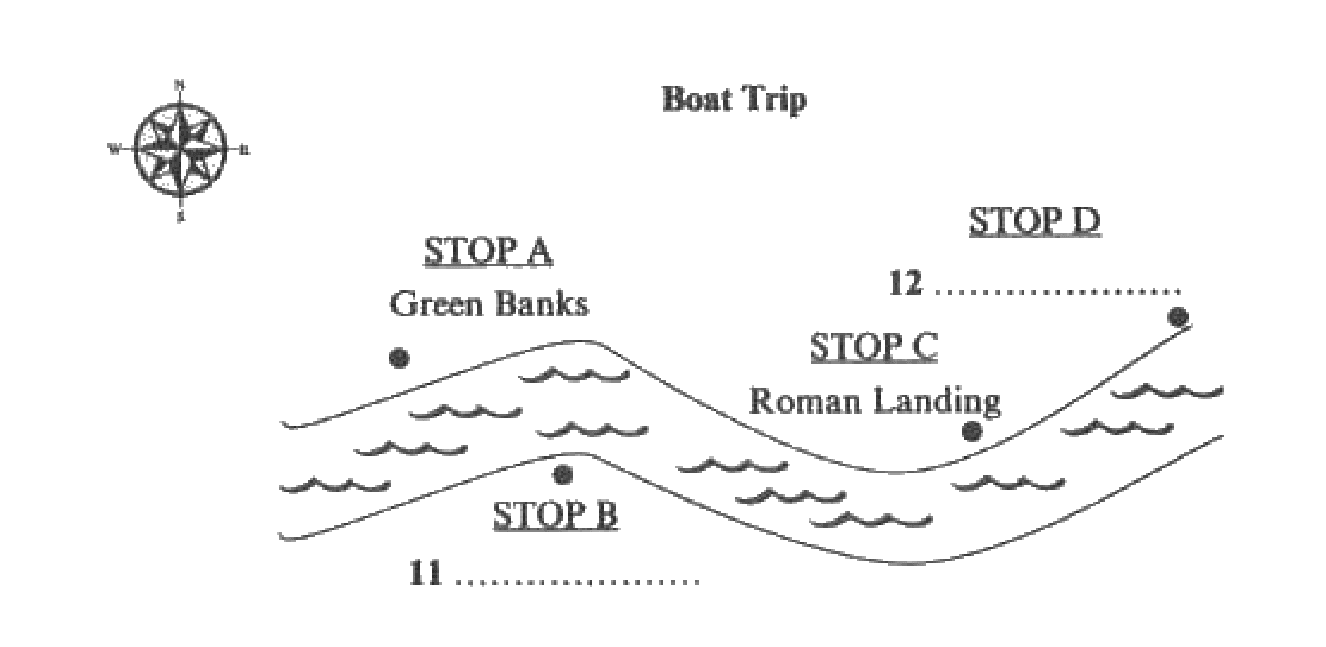
STOP B: (11) …………………………
STOP D: (12) …………………………
Questions 13–18
Complete the table below. Write NO MORE THAN TWO WORDS AND/OR A NUMBER for each answer.
| Attraction | Further Information | |
|---|---|---|
| STOP A: Main Booking Office: First boat: 8 a.m. Last boat: _____ p.m. | Palace | • has lovely (14) ………………………… |
| STOP B: | (15) ………………………… | • has good (16) ………………………… of city centre |
| STOP C: | Museum | • bookshop specialising in the (17) ………………………… of the local area |
| STOP D: | Entertainment Complex | • (18) ………………………… cinema • bowling alley • video games arcade |
Questions 19–20
Answer the questions below. Write NO MORE THAN THREE WORDS AND/OR A NUMBER for each answer.
19. How often do the Top Bus Company tours run? …………………………
20. Where can you catch a Number One Sightseeing Tour from? …………………………
An interview about the Antarctic Centre and the Antarctic Treaty
Questions 21–26
Choose the correct letter, A, B or C.
21. The Antarctic Centre was established in Christchurch because
A New Zealand is a member of the Antarctic Treaty.
B Christchurch is geographically well positioned.
C the climate of Christchurch is suitable.
22. One role of the Antarctic Centre is to
A provide expeditions with suitable equipment.
B provide researchers with financial assistance.
C ensure that research is internationally relevant.
23. The purpose of the Visitors' Centre is to
A provide accommodation.
B run training sessions.
C show people what Antarctica is like.
24. Dr Merrywhether says that Antarctica is
A unlike any other country.
B extremely beautiful.
C too cold for tourists.
25. According to Dr Merrywhether, Antarctica is very cold because
A of the shape of the continent.
B it is surrounded by a frozen sea.
C it is an extremely dry continent.
26. Dr Merrywhether thinks Antarctica was part of another continent because
A he has done his own research in the area.
B there is geological evidence of this.
C it is very close to South America.
Questions 27–28
Complete the table below. Write ONE WORD AND/OR TWO NUMBERS for each answer.
| Date | Event |
|---|---|
| 1870 | Polar Research meeting |
| _____ to _____ | 1st International Polar Year |
| 1957 | Antarctic Treaty was proposed |
| 1959 | Antarctic Treaty was (28) ………………………… |
Questions 29–30
Choose TWO letters, A–E. Which TWO achievements of the Antarctic Treaty are mentioned by the speakers?
29. Achievement selection (lower letter)
A no military use
B animals protected
C historic sites preserved
D no nuclear testing
E fishing rights protected
30. Achievement selection (higher letter)
A no military use
B animals protected
C historic sites preserved
D no nuclear testing
E fishing rights protected
A student talk on left- and right-handedness in sport
Questions 31–35
Choose the correct letter, A, B or C.
31. Anita first felt the Matthews article was of value when she realised
A how it would help her difficulties with left-handedness.
B the relevance of connections he made with music.
C the impressive size of his research project.
32. Anita feels that the findings on handedness will be of value in
A helping sportspeople identify their weaknesses.
B aiding sportspeople as they plan tactics for each game.
C developing suitable training programmes for sportspeople.
33. Anita feels that most sports coaches
A know nothing about the influence of handedness.
B focus on the wrong aspects of performance.
C underestimate what science has to offer sport.
34. A German study showed there was greater 'mixed handedness' in musicians who
A started playing instruments in early youth.
B play a string instrument such as the violin.
C practise a great deal on their instrument.
35. Studies on ape behaviour show that
A apes which always use the same hand to get food are most successful.
B apes have the same proportion of left- and right-handers as humans.
C more apes are left-handed than right-handed.
Questions 36–40
Complete the table below. Write ONE WORD AND/OR A NUMBER for each answer.
| Sport | Best laterality | Comments |
|---|---|---|
| Hockey | mixed laterality | • hockey stick has to be used in (36) ………………………… • mixed-handed players found to be much more (36) ………………………… than others |
| Tennis | single laterality | • gives a larger relevant field of (38) ………………………… • cross-lateral players make (38) ………………………… too late |
| Gymnastics | cross laterality | • gymnasts' (40) ………………………… is important for performances |
Answers
1. 27 Bank Road
2. dentist
3. Sable
4. Northern Star
5. stolen
6. Paynter
7. brother-in-law
8. travel to work
9. Red Flag
10. 450
11. City Bridge
12. Newtown
13. 6.30
14. gardens
15. Restaurant
16. views
17. history
18. 7-screen
19. every 20 minutes
20. Central Station
21. Christchurch is geographically well positioned.
22. provide expeditions with suitable equipment.
23. show people what Antarctica is like.
24. extremely beautiful.
25. of the shape of the continent.
26. there is geological evidence of this.
27. 1882 to 1883
28. signed
29. no military use
30. no nuclear testing
31. the impressive size of his research project.
32. aiding sportspeople as they plan tactics for each game.
33. underestimate what science has to offer sport.
34. started playing instruments in early youth.
35. apes which always use the same hand to get food are most successful.
36. 2 directions
37. confident
38. vision
39. corrections
40. balance
Explanations
- 1. 27 Bank Road
- 'MAN: It's 27 Bank Road. WOMAN: 27 Bank Road. Is that in Greendale? MAN: Yes.' The woman repeats the address back, confirming it.Common trap: Greendale is already printed on the form — it is the town, not the part of the address that is missing.
- 2. dentist
- 'WOMAN: And could I ask what your occupation is? MAN: Dentist.' The occupation is given as a one-word answer.Common trap: The phone number 730453 is given in the turn immediately before, and belongs to the line already filled in.
- 3. Sable
- 'MAN: It's a Hewton Sable. WOMAN: Could you spell the model name please? MAN: Yes... S-A-B-L-E.' Hewton is the manufacturer, Sable the model, and the spelling confirms it.Common trap: Hewton is said first in the same sentence, but the form already prints it as the Manufacturer.
- 4. Northern Star
- 'WOMAN: Right... we need to know the name of the company. MAN: Yes... it was Northern Star.' The previous insurer is named directly.Common trap: Red Flag is also an insurance company in this conversation, but that is the one recommended at the end, not the previous insurer.
- 5. stolen
- 'WOMAN: And what was the problem? MAN: It was stolen... but...' The single claim, made in 1999, was for theft.Common trap: The year 1999 is already printed on the form; the missing word is what happened to the car.
- 6. Paynter
- 'MAN: Simon Paynter. WOMAN: Could you spell the surname please? MAN: P-A-Y-N-T-E-R.' The surname is spelled out.Common trap: Painter is the obvious mis-spelling — the letters given are P-A-Y-N-T-E-R.
- 7. brother-in-law
- 'WOMAN: And what relationship is he to you? MAN: He's my brother-in-law.'Common trap: 'Brother' alone would be wrong — the relationship given is brother-in-law.
- 8. travel to work
- 'WOMAN: Social use (murmuring). Will you be using it to travel to work? MAN: Yes... sometimes.' Social use is already printed, so the second use is travel to work.Common trap: 'Social use' is repeated in the same turn but is already printed on the form above the gap.
- 9. Red Flag
- 'I'm getting a couple of quotes coming up on the computer now... and the best bet looks like being with a company called Red Flag.'Common trap: Northern Star is the previous insurer, already recorded higher up the form.
- 10. 450
- 'WOMAN: And that comes out at $450 per year...' The annual cost is $450.Common trap: The dollar sign is already printed, so only the number is needed.
- 11. City Bridge
- 'There are four main stopping points - from west to east: stop A Green Banks, stop B City Bridge, stop C Roman Landing and stop D Newtown.' Stop B is City Bridge.Common trap: All four stops are listed in one breath, west to east — taking the wrong item from the list is the trap.
- 12. Newtown
- '...stop C Roman Landing and stop D Newtown.' Stop D, the furthest point east, is Newtown.Common trap: Stops A and C are already labelled on the map, so only B and D are missing; the list is spoken quickly and in order.
- 13. 6.30
- 'The first boat leaves at 8 a.m. and the last one at 6.30 p.m.' The 8 a.m. first boat is already printed, so the gap is the last boat's time.Common trap: 8 a.m. is in the same sentence but is already printed on the form as the first boat.
- 14. gardens
- 'At Stop A, if you have time, you can visit the fine 16th century palace here built for the king with its beautiful formal gardens.' 'Beautiful' is paraphrased as 'lovely'.Common trap: '16th century' and 'built for the king' are in the same sentence and describe the palace itself, which is already printed.
- 15. Restaurant
- 'Stop B Why don't you visit Tower Restaurant with its wide range of refreshments?' The attraction at Stop B is the (Tower) Restaurant.Common trap: 'Refreshments' follows immediately and can be written instead of the name of the attraction.
- 16. views
- 'This is a place where you can sit and enjoy the wonderful views over the old commercial and banking centre of the city.' The 'old commercial and banking centre' is the city centre.Common trap: 'Commercial and banking centre' is a paraphrase of 'city centre', which is already printed after the gap.
- 17. history
- 'There's an interactive Museum to visit here with a large shop which has a good range of local history books.' The shop specialises in the history of the local area.Common trap: 'Museum' is in the same sentence but is already printed as the attraction for Stop C.
- 18. 7-screen
- 'The most exciting place to visit is the new Entertainment Complex with seven-screen cinema, bowling alley and video games arcade.'Common trap: The bowling alley and video games arcade are in the same list but are already printed below the gap.
- 19. every 20 minutes
- 'Tours leave from 8.30 a.m. every 20 minutes.' The frequency asked for is every 20 minutes.Common trap: The Number One Sightseeing Tour, described just afterwards, runs 'every five to six minutes' — a different company.
- 20. Central Station
- 'Buses depart from Central Station every five to six minutes from about 9 a.m.' The Number One tour leaves from Central Station.Common trap: Central Station, Castle Hill and Long Walk are all listed as departure points — but for the Top Bus Company; only Central Station is given for Number One.
- 21. Christchurch is geographically well positioned.
- 'Well actually New Zealand is the second closest country to Antarctica and Christchurch is often used on Antarctic expeditions.' Being the second closest country is a statement about geographical position.Common trap: The interviewer's own question offers the climate, and the doctor's 'Well actually' signals that he is correcting that suggestion.
- 22. provide expeditions with suitable equipment.
- 'The centre contains a clothing warehouse where expeditions are supplied with suitable clothing for the extreme conditions.' Supplying suitable clothing is providing expeditions with suitable equipment.Common trap: The centre 'houses research programmes' for several countries, which sounds international, but that is not described as ensuring research is internationally relevant.
- 23. show people what Antarctica is like.
- 'Since very few people will ever experience the Antarctic first hand, the visitors' centre aims to recreate the atmosphere of Antarctica.' Recreating the atmosphere is showing people what Antarctica is like.Common trap: 'A mock camp site where you can... imagine yourself sleeping there' tempts A, but it is a display, not real accommodation.
- 24. extremely beautiful.
- 'Each time I'm struck by the awesome beauty of the place. It's magnificent but you can really only visit it in the summer months.' Awesome beauty and magnificent = extremely beautiful.Common trap: 'You can really only visit it in the summer months' and 'the coldest place on earth' tempt C, but visiting is possible, so it is not too cold for tourists.
- 25. of the shape of the continent.
- 'Antarctica is a land mass shaped like a dome, with the result that the winds blow down the slopes at speeds of up to 150 km an hour and that's what makes it so cold.' The dome shape causes the winds, which cause the cold.Common trap: 'A frozen sea' in the same sentence describes the North Pole, not Antarctica, and dryness is raised afterwards as a separate fact.
- 26. there is geological evidence of this.
- '...because fossils and rocks have been discovered in Antarctica which are the same as those found in places such as Africa and Australia.' Fossils and rocks are geological evidence.Common trap: He has been to the South Pole 'on a number of occasions', which tempts A, but the reason he gives is the fossil and rock evidence.
- 27. 1882 to 1883
- 'DOCTOR: Over two years from 1882 to 1883.' The First International Polar Year ran from 1882 to 1883.Common trap: 1870 (the Polar Research meeting) and 1957/1959 are already printed in the table; only the two years of the Polar Year are missing.
- 28. signed
- 'But it wasn't until the 1950s that the idea of an international treaty was proposed. And in 1959 the Treaty was actually signed.'Common trap: 'Proposed' is in the same sentence but belongs to the 1957 row, which is already printed.
- 29. no military use
- 'Well, firstly it means that the continent is reserved for peaceful use... not as important as Article 5, which prohibits any nuclear explosions or waste disposal.' The two achievements named are peaceful use (no military use, A) and the ban on nuclear explosions (no nuclear testing, D).Common trap: Only two achievements are actually named. Animals, historic sites and fishing are plausible Antarctic topics but are never mentioned in the interview.
- 30. no nuclear testing
- 'Well, firstly it means that the continent is reserved for peaceful use... not as important as Article 5, which prohibits any nuclear explosions or waste disposal.' The two achievements named are peaceful use (no military use, A) and the ban on nuclear explosions (no nuclear testing, D).Common trap: Only two achievements are actually named. Animals, historic sites and fishing are plausible Antarctic topics but are never mentioned in the interview.
- 31. the impressive size of his research project.
- 'But what I soon became struck by was the sheer volume of both observation and investigation he had done in many different sports and I felt persuaded that what he had to say would be of real interest.' The sheer volume of research is the impressive size of the project.Common trap: She says the section on music 'almost put me off from reading further', so B is the opposite of what she felt.
- 32. aiding sportspeople as they plan tactics for each game.
- 'I think Matthews' findings will be beneficial, not so much in helping sportspeople to work on their weaker side, but more that they can help them identify the most suitable strategies to use in a given game.' Strategies for a given game = tactics for each game.Common trap: 'Their weaker side' appears in the same sentence but is explicitly downplayed by 'not so much'.
- 33. underestimate what science has to offer sport.
- 'Although most trainers know how important handedness is, at present they are rather reluctant to make use of the insights scientists like Matthews can give, which I think is rather short-sighted.' Being reluctant to use scientific insights is underestimating what science offers.Common trap: The sentence opens with 'Although most trainers know how important handedness is', which directly rules out A.
- 34. started playing instruments in early youth.
- 'Also those who started younger were more mixed-handed.' Starting younger = started playing in early youth.Common trap: String players are named in the previous clause but 'strongly favoured one hand' — the opposite of mixed-handedness.
- 35. apes which always use the same hand to get food are most successful.
- 'Studies showed that apes consistently using the same hand fished out 30% more ants than those varying between the two.' Consistently using one hand produces more food, so those apes are most successful.Common trap: The previous sentence gives the proportions — apes are about equal, humans about 85% right-handed — which rules out B rather than supporting it.
- 36. 2 directions
- 'This is because a hockey stick must be deployed in two directions - it would be a drawback to have hand or eye favouring one side.'Common trap: 'One side' ends the same sentence, but it describes the drawback, not how the stick is used.
- 37. confident
- 'An interesting finding is that mixed-handed hockey players were significantly more confident than their single-handed counterparts.'Common trap: 'Significantly' sits between 'more' and the answer word and can be written by mistake.
- 38. vision
- 'This means that there is a bigger area of vision on the side where most of the action occurs.' 'Bigger area' is paraphrased as 'larger relevant field'.Common trap: 'Action' ends the same sentence and can be copied instead of the field being described.
- 39. corrections
- 'It means that they can only make corrections much later... and often the damage has been done by then.' 'Much later' matches 'too late'.Common trap: 'Damage' appears in the same sentence but is the consequence, not what the players make.
- 40. balance
- 'The predominant reason for this is because it aids balance - which is of course absolutely central to performance in this sport.' 'Absolutely central to performance' matches 'is important for performances'.Common trap: 'Performance' is in the same sentence but is already printed after the gap.
Audio transcripts
Part 1 — A car insurance enquiry
WOMAN: Hello ... motor insurance department ...
MAN: Oh hello ... I'd like to ask about insurance for my car.
WOMAN: Yes, of course. I'll just take a few details. What's your name?
MAN: Patrick Jones.
WOMAN: And your address?
MAN: It's 27 Bank Road.
WOMAN: 27 Bank Road. Is that in Greendale?
MAN: Yes.
WOMAN: And what's your daytime phone number?
MAN: My work number is 730453.
WOMAN: And could I ask what your occupation is?
MAN: Dentist.
WOMAN: OK ... now a few details about your car ... What size is the engine?
MAN: It's 1200 ccs.
WOMAN: Thank you ... and the make and model?
MAN: It's a Hewton Sable.
WOMAN: Could you spell the model name please?
MAN: Yes ... S-A-B-L-E.
WOMAN: Ah yes ... thanks. And when was it made?
MAN: 1997.
WOMAN: Lovely ... right ... I presume you've had a previous insurer?
MAN: Yes.
WOMAN: Right ... we need to know the name of the company.
MAN: Yes ... it was Northern Star.
WOMAN: Thank you, and have you made any insurance claims in the last five years?
MAN: Yes ... one in 1999.
WOMAN: And what was the problem?
MAN: It was stolen ... but ...
WOMAN: That's fine, Mr Jones .. that's all we need to know at the moment ..
WOMAN: And will there be any other named drivers?
MAN: Just the one.
WOMAN: And his name?
MAN: Simon Paynter.
WOMAN: Could you spell the surname please?
MAN: P-A-Y-N-T-E-R.
WOMAN: OK thank you ... And what relationship is he to you?
MAN: He's my brother-in-law.
WOMAN: And what will you or Mr Paynter be using the car for?
MAN: Well... mainly for social use ...
WOMAN: Social use (murmuring). Will you be using it to travel to work?
MAN: Yes ... sometimes.
WOMAN...... Anything else?
MAN: No. That's it ...
WOMAN: And finally ... when would you like to start the insurance?
MAN: I'll need it from the 31st of January.
WOMAN: Right ... Mr Jones ... I'm getting a couple of quotes coming up on the computer now ... and the best bet looks like being with a company called Red Flag.
MAN: Yeah.
WOMAN: And that comes out at $450 per year ...
MAN: Well... that seems OK ...it's quite a bit lower than I've been paying up to now ..
WOMAN: Great ... so would you like me to go ahead with that?
MAN: Sure .... why not?
WOMAN: How would you like to pay?
Part 2 — A recorded tourist information line
Thank you for calling the Tourist Line. There are many different ways of getting round the city and we'd like to suggest some you may not have thought of.
How about a city trip by boat? There are four main stopping points - from west to east: stop A Green Banks, stop B City Bridge, stop C Roman Landing and stop D Newtown.
You can find the main booking office at stop A.
The first boat leaves at 8 a.m. and the last one at 6.30 p.m. There are also many attractions you can visit along the river. At Stop A, if you have time, you can visit the fine 16th century palace here built for the king with its beautiful formal gardens. It's very near the booking office. Now you can enjoy every corner of this superb residence.
Stop B Why don't you visit Tower Restaurant with its wide range of refreshments? This is a place where you can sit and enjoy the wonderful views over the old commercial and banking centre of the city.
Stop C is the area where, in the first century AD, invading soldiers crossed the river; this was much shallower than it is now. That's why this area is called Roman Landing. There's an interactive Museum to visit here with a large shop which has a good range of local history books.
At the furthest point of the trip, stop D, the most exciting place to visit is the new Entertainment Complex with seven-screen cinema, bowling alley and video games arcade.
Besides the boat tours, there are city buses. Two companies offer special services:
The Top Bus Company runs all its tours with a live commentary in English. Tours leave from 8.30 a.m. every 20 minutes. There are departures from Central Station, Castle Hill and Long Walk. This is a hop-on hop-off service and tickets are valid for 24 hours. For further details call Top Bus on 0208 9447810.
The Number One Sightseeing Tour is available with a commentary in eight languages. Buses depart from Central Station every five to six minutes from about 9 a.m. with the last bus at around 7 p.m. There are also Number One services with an English-speaking ...
Part 3 — An interview about the Antarctic Centre and the Antarctic Treaty
INTERVIEWER: We're pleased to welcome Dr Martin Merrywhether of the Antarctic Centre in Christchurch, New Zealand who has come along to talk to us today about the role of the Centre and the Antarctic Treaty.
INTERVIEWER: Now my first question is about the choice of location for the centre. Why Christchurch? Was it because of the climate?
DOCTOR: Well actually New Zealand is the second closest country to Antarctica and Christchurch is often used on Antarctic expeditions.
INTERVIEWER: Right, so it's because of where we are ... coupled with our historical role. So tell us - what is the main purpose of the centre?
DOCTOR: Well ... we have two complementary roles. One is as a scientific base for expeditions and research and the other is as an information centre.
INTERVIEWER: Tell us something about the role as a scientific base.
DOCTOR: We're able to provide information about what scientists should take with them to the South Pole - for example, the centre contains a clothing warehouse where expeditions are supplied with suitable clothing for the extreme conditions.
INTERVIEWER: I suppose you need a bit more than your normal winter coat!
DOCTOR: Yes, exactly and then there's also the specialist library and mapping services.
INTERVIEWER: Right. And which countries are actually located at the centre?
DOCTOR: Well ... the centre houses research programmes for New Zealand, for The United States as well as for Italy ... there's even a US post office at the American airforce base here.
INTERVIEWER: Really? And what does the visitor's centre offer?
DOCTOR: Well, since very few people will ever experience the Antarctic first hand, the visitors' centre aims to recreate the atmosphere of Antarctica. There's a mock camp site where you can see inside an Antarctic tent and imagine yourself sleeping there. And the centre also acts as a showcase for the unique international co-operation which exists in Antarctica today.
INTERVIEWER: What is it actually like at the South Pole? I know you've been there on a number of occasions.
DOCTOR: Yes, I have and each time I'm struck by the awesome beauty of the place. It's magnificent but you can really only visit it in the summer months.
INTERVIEWER: October to March.
DOCTOR: Yes, because it's completely dark for four months of the year (pause) ... and in addition it has to be the coldest place on earth.
INTERVIEWER: Colder than the North Pole? Why's that?
DOCTOR: Well, unlike the North Pole, which is actually a frozen sea, Antarctica is a land mass shaped like a dome, with the result that the winds blow down the slopes at speeds of up to 150 km an hour and that's what makes it so cold. And one other interesting thing is that Antarctica is the driest continent on earth, surprisingly, and so you have to drink large amounts of water when you're there.
INTERVIEWER: How old is Antarctica?
DOCTOR: We're pretty sure it was part of a larger land mass but it broke away from the rest of the continent 170 million years ago.
INTERVIEWER: How can you be certain of this?
DOCTOR: ... because fossils and rocks have been discovered in Antarctica which are the same as those found in places such as Africa and Australia.
INTERVIEWER: Amazing ... To think that it was once attached to Africa ...
INTERVIEWER: Now let's just have a look at the Antarctic Treaty. How far back does the idea of an international treaty go?
DOCTOR: Well, as far back as the 19th century, when eleven nations organised an international event.
INTERVIEWER: When was that exactly?
DOCTOR: In 1870. And it was called the Polar Research Meeting. And then, not long after that, they organised something called the First International Polar Year.
INTERVIEWER: And that took place when exactly?
DOCTOR: Over two years from 1882 to 1883. But it wasn't until the 1950s that the idea of an international treaty was proposed. And in 1959 the Treaty was actually signed.
INTERVIEWER: What do you see as the main achievements of the treaty?
DOCTOR: Well, firstly it means that the continent is reserved for peaceful use.
INTERVIEWER: That's Article 1, isn't it?
DOCTOR: Yes ...
INTERVIEWER: That's important since the territory belongs to everyone.
DOCTOR: Yes but not as important as Article 5, which prohibits any nuclear explosions or waste disposal.
INTERVIEWER: Which is marvellous. Well, I'm afraid we're going to have to stop there because I'm afraid we've run out of time. Thanks for coming along today and telling us all about the centre and its work.
Part 4 — A student talk on left- and right-handedness in sport
My topic is handedness - whether in different sports it is better to be left- or right-sided or whether a more balanced approach is more successful. I'm left-handed myself and I actually didn't see any relevance to my own life when I happened to start reading an article by a sports psychologist called Peter Matthews. He spent the first part of the article talking about handedness in music instead of sport, which I have to say almost put me off from reading further. But what I soon became struck by was the sheer volume of both observation and investigation he had done in many different sports and I felt persuaded that what he had to say would be of real interest. I think Matthews' findings will be beneficial, not so much in helping sportspeople to work on their weaker side, but more that they can help them identify the most suitable strategies to use in a given game. Although most trainers know how important handedness is, at present they are rather reluctant to make use of the insights scientists like Matthews can give, which I think is rather short-sighted because focusing on individual flexibility is only part of the story.
Anyway, back to the article.
Matthews found a German study which looked at what he called 'mixed-handedness', that is, the capacity to use both left and right hands equally. It looked at mixed-handedness in 40 musicians on a variety of instruments. Researchers examined a number of variables, e.g. type of instrument played, regularity of practice undertaken and length of time playing instrument ... and found the following: keyboard players had high levels of mixed-handedness, whereas string players like cellists and violinists strongly favoured one hand. Also those who started younger were more mixed-handed.
Matthews also reports studies of handedness in apes. Apes get a large proportion of their food by 'fishing' ants from ant hills. The studies show that apes, like humans, show handedness - though for them right- and left-handedness is about equal, whereas about 85% of humans are right-handed. Studies showed that apes consistently using the same hand fished out 30% more ants than those varying between the two.
Matthews started researching several different sports and found different types of handedness in each. By the way, he uses 'handedness' to refer to the dominant side for feet and eyes as well as hands. Anyway, his team measured the hand, feet and eyes of 2,611 players and found that there were really three main types of laterality: mixed - you work equally well on both sides - both hand and eye; single - you tend to favour one side but both hand and eye favour the same side; and cross-laterality - a player's hands and eyes favour only one side but they are opposite sides. Let's start with hockey. Matthews found that it was best to be mixed-handed - this is because a hockey stick must be deployed in two directions - it would be a drawback to have hand or eye favouring one side. An interesting finding is that mixed-handed hockey players were significantly more confident than their single-handed counterparts. Things are slightly different in racket sports like tennis. Here the important thing is to have the dominant hand and eye on the one side. This means that there is a bigger area of vision on the side where most of the action occurs. If a player is cross lateral the racket is invisible from the dominant eye for much of the swing. It means that they can only make corrections much later ... and often the damage has been done by then.
And moving to a rather different type of sport which involves large but precise movements - gymnastics. It's been found that cross hand-eye favouring is best. The predominant reason for this is because it aids balance - which is of course absolutely central to performance in this sport.
Comments
Loading comments…