

Cambridge IELTS 6 Listening Test 3
4 parts · 40 questions · 30 minutes
Opening a bank account
Questions 1–10
Complete the form below. Write NO MORE THAN ONE WORD OR A NUMBER for each answer.
OPENING A BANK ACCOUNT
| Example | Answer |
|---|---|
| Application for a | Current bank account |
| Type of current account: | The (1) ………………………… account |
| Full name of applicant: | Pieter Henes |
| Date of birth: | (2) ………………………… |
| Joint account holder(s): | No |
| Current address: | (3) ………………………… Exeter |
| Time at current address: | (4) ………………………… |
| Previous address: | Rielsdorf 2, Utrecht, Holland |
| Telephone: | Work (5) ………………………… Home 796431 |
| Occupation: | (6) ………………………… |
| Identity (security): | Name of his (7) ………………………… : Siti |
| Opening sum: | £ (8) ………………………… |
| Statement: | Every (9) ………………………… |
| Requests: | Supply information about the bank's (10) ………………………… service |
A guided tour of a house and gardens
Questions 11–13
THE HISTORY OF ROSEWOOD HOUSE. Choose the correct letter, A, B or C.
11. When the writer Sebastian George first saw Rosewood House, he
A thought he might rent it
B felt it was too expensive for him
C was unsure whether to buy it
12. Before buying the house, George had
A experienced severe family problems
B struggled to become a successful author
C suffered a serious illness
13. According to the speaker, George viewed Rosewood House as
A a rich source of material for his books
B a way to escape from his work
C a typical building of the region
Questions 14–17
Label the map below. Write the correct letters, A–J, next to Questions 14–17.
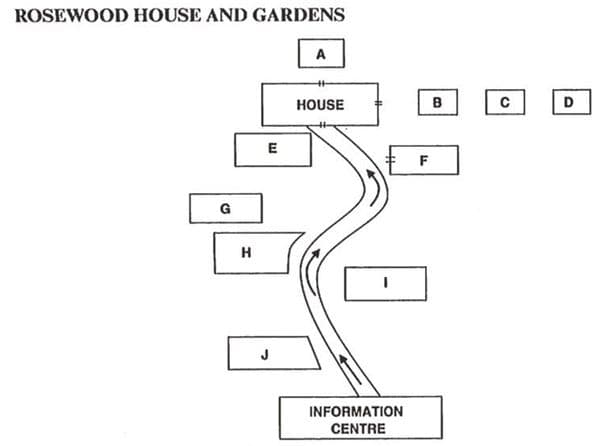
14. Pear Alley
15. Mulberry Garden
16. Shop
17. Tea Room
Questions 18–20
Complete the sentences below. Write ONE WORD ONLY for each answer.
18. • You can walk through the ………………………… that goes along the river bank.
19. • You can go over the ………………………… and then into a wooded area.
20. • On your way back, you could also go up to the ………………………… .
Two students planning a marketing assignment
Questions 21–24
Complete the sentences below. Write NO MORE THAN THREE WORDS OR A NUMBER for each answer.
21. • For their assignment, the students must investigate one part of the ………………………… .
22. • The method the students must use to collect data is ………………………… .
23. • In total, the students must interview ………………………… people.
24. • Jack thinks the music preferences of ………………………… listeners are similar.
Questions 25–30
Complete the notes below. Write NO MORE THAN TWO WORDS for each answer.
MARKETING SURVEY: MUSIC PREFERENCES
Age group of interviewee
• 25 or under
• 45 or over
Music preferences
• Pop
• (25) …………………………
• Folk
• Easy listening
• (26) …………………………
Medium for listening to music
• Radio
• CD
• TV
• (27) …………………………
Source of music
• Music shops
• (28) …………………………
• Internet
Places for listening to music
• Disco
• Pub
• (29) …………………………
• Concert Hall
• (30) …………………………
A lecture on Neolithic Ireland
Questions 31–34
IRELAND IN THE NEOLITHIC PERIOD. Choose the correct letter, A, B or C.
31. According to the speaker, it is not clear
A when the farming economy was introduced to Ireland
B why people began to farm in Ireland
C where the early Irish farmers came from
32. What point does the speaker make about breeding animals in Neolithic Ireland?
A Their numbers must have been above a certain level
B They were under threat from wild animals
C Some species died out during this period
33. What does the speaker say about the transportation of animals?
A Livestock would have limited the distance the farmers could sail
B Neolithic boats were too primitive to have been used
C Probably only a few breeding animals were imported
34. What is the main evidence for cereal crops in Neolithic Ireland?
A the remains of burnt grain in pots
B the marks left on pots by grains
C the patterns painted on the surface of pots
Questions 35–40
Complete the sentences below. Write NO MORE THAN TWO WORDS for each answer.
STONE TOOLS
• Ploughs could either have been pulled by (35) ………………………… or by cattle.
• The farmers needed homes which were permanent dwellings.
• In the final stages of axe-making, (36) ………………………… and (36) ………………………… were necessary for grinding and polishing.
• Irish axes were exported from Ireland to (37) ………………………… and England.
POTTERY MAKING
• The colonizers used clay to make pots.
• The (38) ………………………… of the pots was often polished to make them watertight.
• Clay from (39) ………………………… areas was generally used.
• Decoration was only put around the (40) ………………………… of the earliest pots.
Answers
1. Select
2. 27-1-1973
3. 15 Riverside
4. 2 weeks
5. 616295
6. engineer
7. mother
8. 2,000
9. month
10. internet
11. was unsure whether to buy it
12. experienced severe family problems
13. a typical building of the region
14. H
15. F
16. B
17. D
18. field
19. footbridge
20. viewpoint
21. entertainment industry
22. telephone interviews
23. 30
24. male and female
25. jazz
26. classical
27. concerts
28. department stores
29. club
30. opera house
31. where the early Irish farmers came from
32. Their numbers must have been above a certain level
33. Livestock would have limited the distance the farmers could sail
34. the marks left on pots by grains
35. people
36. water and sand
37. Scotland
38. outside
39. local
40. tops
Explanations
- 1. Select
- 'I've decided on the one called Select.' Of the different current accounts in the leaflet, Pieter chooses the Select account.Common trap: 'current account' and 'deposit account' are discussed just before, but 'Current' is already given as the example answer.
- 2. 27-1-1973
- 'The twenty-seventh of the first, nineteen seventy-three.' — 27 January 1973.Common trap: The month is given as an ordinal ('the first') rather than by name, so it is easy to write 27 as the month.
- 3. 15 Riverside
- '15 Riverside.' — and the woman confirms it is 'all one word', in Exeter.Common trap: 'Rielsdorf 2, Utrecht' comes shortly afterwards, but that is the previous address, already printed on the form.
- 4. 2 weeks
- 'Ah, just two weeks actually.' He has been at the current address for two weeks.Common trap: 'more than two years' is offered by the clerk and 'a month ago' follows immediately — neither is how long he has been at this address.
- 5. 616295
- He first says 606295, then corrects himself: 'Oh, no sorry, six-one-six.' The work number is 616295.Common trap: The first three digits are corrected mid-turn, and the home number (796431) is already printed on the line below.
- 6. engineer
- 'I'm an engineer by profession.' The clerk agrees to put that: 'I think I'll put that then. It's shorter!'Common trap: 'project manager' is said first but is explicitly 'not my main job' — and it is also two words, breaking the ONE WORD limit.
- 7. mother
- Pieter suggests his wife's name; the clerk replies 'Mother's might be better. It's less likely to be known.' Siti is his mother's name.Common trap: Pieter proposes 'my wife's first name' one turn earlier, and it is rejected by the clerk.
- 8. 2,000
- 'Well, I'm going to transfer £2,000 from my Dutch account, just till I get paid.' The opening sum is £2,000.Common trap: 'a minimum sum of £50' and 'about £75' are named in the immediately preceding turn — those are the bank's rules, not his deposit.
- 9. month
- 'Can I have them sent, um, once a month?' — 'Yes, that's fine.' Statements are monthly.Common trap: 'Some people like them weekly' is the clerk's suggestion, which Pieter rejects as 'too often'.
- 10. internet
- 'I was thinking of registering for your internet service at some stage.' — 'Would you like me to send you information about that?' — 'Please, yes.'Common trap: 'insurance, loans, anything like that' are offered at the very end, but Pieter declines information about those.
- 11. was unsure whether to buy it
- 'He bought the house in 1902 although he had first seen it two years earlier. At that time the owners let it out to a tenant because George was too slow making up his mind to buy it.' Being 'too slow making up his mind' = he was unsure.Common trap: 'let it out to a tenant' in the same sentence points at renting — but George is not the tenant.
- 12. experienced severe family problems
- 'He was no longer on speaking terms with his brother and had been devastated by the death at the age of seven of his elder daughter, Josephine.' A family rift and a bereavement are severe family problems.Common trap: The talk stresses his writing career in the very same paragraph, which makes B sound plausible until you hear 'His professional success was enormous'.
- 13. a typical building of the region
- 'George regarded Rosewood as a pure example of a traditional country house of this part of England...' A pure example of a traditional house of that part of England = typical of the region.Common trap: 'their escape to privacy and quiet' follows immediately and matches option B word for word, but the escape is the family's, not an escape from writing.
- 14. H
- 'As you go further down the path... as you go round the first sharp corner you will find, to your left, an area where different types of pear tree have been planted as well as some lovely flowers, and this is known as Pear Alley.' It is on the left, just after the first sharp corner.Common trap: The kitchen garden is named in the same sentence but is on the RIGHT — left/right and 'first corner' vs 'second corner' are what separate the options here.
- 15. F
- 'Follow the path round the second corner and on your right you will see the entrance to the Mulberry Garden with its 500-year-old tree.' It is on the right, after the second corner.Common trap: The greenhouse is described as 'next to this' (Pear Alley) immediately before, so it is easy to shift one place along the path.
- 16. B
- '...leave the house by the side entrance, where you will find our shop, which is situated between the house and the garage...' The shop sits between the house and the garage.Common trap: The same long sentence names the house, the side entrance and the garage — only 'between the house and the garage' fixes the position.
- 17. D
- '...so why don't you visit the tea room on the far side of the garage?' The tea room is beyond the garage.Common trap: The shop is also located relative to the garage one sentence earlier — 'between' versus 'on the far side of' is the whole difference.
- 18. field
- 'You cross the field which spreads along the banks of the river.' The field runs along the river bank.Common trap: 'woodland' and 'trees' come shortly afterwards, but those are past the footbridge, not along the bank.
- 19. footbridge
- 'Spend a minute or two watching the water pass by underneath as you cross the footbridge, and then continue along the River Walk through the woodland.' The footbridge comes before the woodland.Common trap: 'water mill' appears a little later and is also a river structure, but it is at the end of the walk, not before the woods.
- 20. viewpoint
- '...when you return from the mill take the first turning on your left and climb up to the viewpoint.' The viewpoint is the climb on the way back.Common trap: 'stunning views of the surrounding countryside' is said just before, which tempts 'views' rather than the place name 'viewpoint'.
- 21. entertainment industry
- 'Well, it says here we have to look at one area of the entertainment industry.' One area/part of the entertainment industry.Common trap: The five branches (music, cinema, theatre, sport, eating out) are listed straight afterwards — those are the choices within the industry, not the answer.
- 22. telephone interviews
- 'Well actually, it looks like we don't have a choice. We have to do telephone interviews.' The method is fixed, not chosen.Common trap: Lucy lists three possible methods (mailed questionnaire, face-to-face interviews, observations) in the previous turn — all are rejected.
- 23. 30
- '...it looks like we have to interview fifteen for each group.' — 'That's thirty altogether then.' Two groups of fifteen = 30 in total.Common trap: 'fifteen' is said twice — once per group and once as each student's share — but the sentence asks for the total.
- 24. male and female
- Lucy suggests comparing 'Male and female?' and Jack rejects it: 'Most of my female friends like the same music as me.' So he thinks male and female tastes are alike.Common trap: 'different age groups' ends the same turn — but that is what Jack thinks WILL differ, the opposite of what the sentence asks.
- 25. jazz
- 'OK. Let's have pop, jazz, folk, easy listening ... What else?' Jazz is the second item in Jack's list, between pop and folk.Common trap: Four genres are read out in one quick list; only the second one is missing from the printed notes.
- 26. classical
- 'Well, we should include classical. Some people like it, you know.' Classical is added after Jack's four-genre list.Common trap: It is added by the other speaker, after 'What else?', so it is easy to miss while still writing the earlier list.
- 27. concerts
- 'What about concerts? You know, in pubs and halls.' — 'Oh yeah, we should include live music of course.' Concerts is the fourth medium.Common trap: 'pubs and halls' in the same breath belong to the later 'places for listening' section further down the notes.
- 28. department stores
- 'You mean like, do they buy it in music shops, or department stores?' Department stores is the second source, between music shops and the Internet.Common trap: 'music shops' opens the same sentence but is already printed; 'the Internet' closes the list and is also already printed.
- 29. club
- 'OK. Let's say disco, pub, club, concert hall ...' Club is the third venue, between pub and concert hall.Common trap: Four venues are listed at speed and two of them (disco, concert hall) are already printed, so the list must be tracked in order.
- 30. opera house
- 'Or opera house! And I guess we should include karaoke bars.' Opera house is added after concert hall.Common trap: 'karaoke bars' is suggested in the very same turn but is then dropped — 'Not many of them in this city!' ... 'We'll leave that out then.'
- 31. where the early Irish farmers came from
- 'Now, there are several hypotheses about the origins of the first Neolithic settlers in Ireland, but most of these contain problems.' The unresolved question is their origin — England and continental Europe are both problematic.Common trap: The period is stated immediately before, so a student half-listening can attach 'not clear' to the date rather than the origin.
- 32. Their numbers must have been above a certain level
- '...if the level of breeding stock falls below about three hundred females, the future of the species locally is at risk. So we must assume that... the number of breeding sheep would have considerably exceeded three hundred.' Numbers had to stay above a threshold.Common trap: 'the native wild species' and 'the future of the species locally is at risk' both appear nearby, feeding options B and C.
- 33. Livestock would have limited the distance the farmers could sail
- 'But this method would have severely restricted the range of the colonising fleets. The sheer volume of animal transport necessary means it's unlikely that this livestock could have been brought from anywhere further than England.' Carrying livestock limited how far they could sail.Common trap: 'skin-covered boats' sounds primitive, which makes B tempting, but the speaker never doubts they were used.
- 34. the marks left on pots by grains
- 'The main evidence for their presence consists of impressions on pottery, where a cereal grain accidentally became embedded in the surface of a pot before it was fired.' The evidence is the impression, not the grain.Common trap: 'destroyed by the firing' is said one sentence later and can be misheard as burnt grain surviving in the pot.
- 35. people
- 'The body of the plough would have been of wood and could have been drawn by people, but it's also likely that cattle were used.' Drawn by = pulled by people.Common trap: 'cattle' is in the same sentence but is already printed as the alternative; 'wood' and 'stone blade' describe the plough itself.
- 36. water and sand
- '...after the axe had been chipped into shape, they needed water and sand for grinding and polishing...' Both water and sand were needed, which is why the final stage happened at coastal sites.Common trap: 'a high mountainside' closes the same sentence but is where the work could NOT be done; the quarries themselves are ruled out as the site of manufacture.
- 37. Scotland
- 'Now it's clear that these Neolithic axes were transported all over Ireland, as well as to Scotland and the south of England.' Scotland and England were the export destinations.Common trap: The very next sentence reverses the direction — English axes found IN Ireland — so the flow of trade must be tracked carefully.
- 38. outside
- 'After firing, the outside was often polished. This would have helped the pots to retain water, as they weren't glazed.' Polishing the outside made them hold water.Common trap: 'hollowing it until the walls were the right thickness' comes just before — the walls are part of the making, not what was polished.
- 39. local
- 'Now we know that the clay used usually came from local sources, which suggests that manufacture was on a fairly small scale.' Local sources = local areas.Common trap: 'Neolithic sites' ends the same sentence, but that is where the fragments are found, not where the clay came from.
- 40. tops
- 'At first this looked like a series of stitches and was just around the tops of the pots.' The earliest decoration was confined to the tops.Common trap: 'a series of stitches' describes what the decoration looked like, and later pots had decoration 'all over' — only the earliest are asked about.
Audio transcripts
Part 1 — Opening a bank account
PIETER: Good morning. I'd like to open a bank account, please. WOMAN: Certainly. If you'd like to take a seat, I'll just get some details from you. It won't take long. PIETER: Thanks. WOMAN: Is it a current account or a deposit account you wanted? PIETER: A current account. WOMAN: Right. I've got the application form here then. We have different types - I see you've got our leaflet there. PIETER: I've decided on the one called 'Select.' WOMAN: Right, that's fine, so, first of all, can I have your full name please? PIETER: Yes, it's Pieter Henes. That's P-I-E-T-E-R. WOMAN: Is it H-E-double N-E-S? PIETER: Uh, only one N actually. It's a less common spelling of the name. WOMAN: Oh, right. OK. And what's your date of birth please? PIETER: The twenty-seventh of the first, nineteen seventy-three. WOMAN: Right. And will this be a joint account? PIETER: No, just myself. WOMAN: OK, fine. And where are you living, Mr Henes? PIETER: 15 Riverside. WOMAN: Is that all one word? PIETER: Yes. WOMAN: Exeter? PIETER: Yes. WOMAN: How long have you been at your present address? Er, is it more than two years? PIETER: Ah, just two weeks actually. I only arrived in the country a month ago. I'm from Holland. WOMAN: Oh, that's fine. But we normally ask for a previous address in that case. PIETER: Oh yes, well, it's Rielsdorf 2. That's R-I-E-L-S-D-O-R-F 2, Utrecht. WOMAN: Holland. OK. Thank you. Do you have a daytime telephone number? PIETER: Yes, I think the number at my office is six-oh-six-two-nine-five. Um, just a minute, I'd better check. Oh, no sorry, six-one-six. I'm not used to it yet. Would you like my home number too? WOMAN: Yes please. PIETER: It's seven-nine-six-four-three-one. WOMAN: Are they both local numbers? PIETER: Yes. WOMAN: Right. And your occupation? PIETER: Well, I'm in Britain as a project manager, but that's not my main job. I'm an engineer by profession. WOMAN: I see. I think I'll put that then. It's shorter! Now we usually ask for a piece of information which we can use to check your identity, for security reasons. You know, if you phone us. PIETER: Like, erm, my wife's first name? WOMAN: Mother's might be better. It's less likely to be known. PIETER: OK. Hers is Siti. WOMAN: Siti? PIETER: Yes, S-I-T-I. It's Indonesian. WOMAN: Fine. And how much would you like to open your account with? We usually ask for a minimum sum of £50. That's about £75. PIETER: Well, I'm going to transfer £2,000 from my Dutch account, just till I get paid. In fact, I wanted to ask you about that. What's the best way to do it? WOMAN: It depends which bank you're with. PIETER: It's the Fransen Bank in Utrecht. WOMAN: OK, fine. I'll check that in a minute. If we have links with them we can do a direct transfer. But it's not a big problem either way. Um, let's see. How often would you like to receive statements? PIETER: I haven't really thought. Um, what's the usual thing? WOMAN: It's up to you. Some people like them weekly. PIETER: Oh, no, that's too often. Can I have them sent, um, once a month? WOMAN: Yes, that's fine. Is there anything else? PIETER: I was thinking of registering for your internet service at some stage. WOMAN: Oh, yes. Would you like me to send you information about that? PIETER: Please, yes. WOMAN: And would you like to receive information about the bank's other services - insurance, loans, anything like that? PIETER: Hmm, I don't think so, thanks. WOMAN: That's OK then. And one last thing, if you agree...
Part 2 — A guided tour of a house and gardens
Welcome, everybody, to the lovely house and gardens of Rosewood, once the home of the famous writer, Sebastian George. He bought the house in 1902 although he had first seen it two years earlier. At that time the owners let it out to a tenant because George was too slow making up his mind to buy it. When it came back on the market, there was no hesitation and he bought it immediately, for £9,300, even though the house had no bathroom, no running water upstairs, and no electricity. When he came here, he'd been married for ten years. During that time, he'd become one of the most famous writers in the English-speaking world. His professional success was enormous, but his personal life wasn't as successful. He was no longer on speaking terms with his brother and had been devastated by the death at the age of seven of his elder daughter, Josephine. Moving to Rosewood allowed the family to start a new life. George regarded Rosewood as a pure example of a traditional country house of this part of England and did some of his most successful writing here. The house and its grounds became the family haven and their escape to privacy and quiet. The walls, and the mullioned windows were built of the local sandstone, the tiles on the roofs and the bricks of the chimney stack were baked from local clay, and the wooden structures inside came from oak trees which grow around here. Now, please look at the map I've given you of the house and gardens. We're here at the Information Centre. Follow the path marked with the arrow and the first area you come to is the orchard on your left. As you go further down the path, there's the kitchen garden on the right and as you go round the first sharp corner you will find, to your left, an area where different types of pear tree have been planted as well as some lovely flowers, and this is known as Pear Alley - designed by George himself. Next to this is the greenhouse where some exotic plants and fruits are grown. Follow the path round the second corner and on your right you will see the entrance to the Mulberry Garden with its 500-year-old tree. Past the Mulberry Garden, follow the path until you reach the front of the house. I suggest you spend a good hour wandering around this lovely building. A guide takes visitor groups round every two hours. If you would like to purchase any of George's books or other souvenirs, then leave the house by the side entrance, where you will find our shop, which is situated between the house and the garage which contains the magnificent old Rolls-Royce car which used to belong to George. I expect by this time you may also be in need of a rest and some refreshment. Most visitors are, so why don't you visit the tea room on the far side of the garage? If you have time, there is a lovely walk down towards the River Dudwell. For me, this is the best part of the estate. This isn't on the map but it is all clearly signposted. You cross the field which spreads along the banks of the river. In spring, this area is well worth a visit. Spend a minute or two watching the water pass by underneath as you cross the footbridge, and then continue along the River Walk through the woodland. On a hot summer's day the trees along this path provide welcome shade. Eventually you come to the water mill which used to provide the electricity for the house - only about four hours every evening - in George's time. And, finally, for those of you who would like to see stunning views of the surrounding countryside and who are a little bit more energetic, when you return from the mill take the first turning on your left and climb up to the viewpoint. You won't regret it. Enjoy your visit!
Part 3 — Two students planning a marketing assignment
JACK: Lucy, we really need to get working on this marketing assignment. We've only got five weeks left to the end of term to design it, carry it out, and then write up the results. LUCY: Sure. Well, let's get started right now. Let's go over the instructions. What exactly do we have to do? JACK: Well, it says here we have to look at one area of the entertainment industry. There's a list of the different types. LUCY: What are they? JACK: Music, cinema, theatre, sport, and eating out. LUCY: Is that all? JACK: Looks like it. LUCY: So we choose one branch of the industry and then we look at how two different groups of people use it? Is that right? JACK: Yes. LUCY: And do we have to use any particular method to get our data? Can we mail out a questionnaire, or do face-to-face interviews, or maybe even observations? JACK: Well actually, it looks like we don't have a choice. We have to do telephone interviews. LUCY: OK, so at least we don't have to waste time deciding between the different methods. JACK: Yeah, that's right. Oh, and the other requirement is the number of interviewees. LUCY: Not too many, I hope. Ten? Twenty? JACK: Well, we have to do two groups, remember, and it looks like we have to interview fifteen for each group. LUCY: That's thirty altogether then. It's going to take ages. JACK: Yes, but remember we're working on this together, so we'll only have to do fifteen each. LUCY: OK, so those are all the requirements? JACK: Yes, looks like it. LUCY: So, first, which area are we going to choose? My preference would be cinema, since that's where I spend most of my money. JACK: Hmm, I don't think that's such a good idea. I don't think there are huge differences in the market there. I mean you get young and old, male and female, rich and poor all going to the same movies. LUCY: Yeah, maybe you're right. Let's make it music then. JACK: Right. So, what two groups will we compare and contrast? LUCY: Male and female? JACK: No. Most of my female friends like the same music as me. Different age groups would be much more likely to show up differences, I think. LUCY: Yeah, I suppose you're right again. I'll take some notes, shall I? So ... Age Groups. Well. What do you think? Maybe twenty-five or under for one group, and forty-five or over for the other group? That should show up differences. JACK: Right. LUCY: OK. Next. How about the kind of music they like - let's give them some choices and then we can just tick boxes. JACK: OK. Let's have pop, jazz, folk, easy listening ... What else? LUCY: Well, we should include classical. Some people like it, you know. JACK: OK. OK. And then we should have how they listen to music. LUCY: The medium. Right. Let's include radio, CD - and then I guess there's TV. JACK: What about concerts? You know, in pubs and halls. LUCY: Oh yeah, we should include live music of course. JACK: OK, we're on a roll now! Next point could be about where they actually get their music. LUCY: You mean like, do they buy it in music shops, or department stores? JACK: Yes, or download it from the Internet. LUCY: Right. That could be for recorded music. Then we need another section for live music. Where do they go for that? JACK: OK. Let's say disco, pub, club, concert hall ... LUCY: Or opera house! And I guess we should include karaoke bars. JACK: Not many of them in this city! LUCY: OK. We'll leave that out then. So, what's left to do? JACK: That's it. Well, now we can make a time-scale for doing it.
Part 4 — A lecture on Neolithic Ireland
Good morning everyone. Last week we were looking at the hunter-gatherers in Ireland, across the Irish Sea from England. Today, we're going to move on to the period between four and six thousand years ago, known as the Neolithic period, which is when a total farming economy was introduced in Ireland. Now, there are several hypotheses about the origins of the first Neolithic settlers in Ireland, but most of these contain problems. For instance, there are considerable archaeological difficulties about the theory that they came from England. The evidence doesn't really add up. But there are even greater practical problems about the theory that they came directly from continental Europe. For one thing, it's not clear just how sufficient numbers of men and women could have been transported to Ireland to establish a viable population. As you know, the hunter-gatherer economy which existed beforehand was based on small scattered groups. The farming economy would almost certainly have required much larger communities to do all the work needed to plant and tend sufficient crops to sustain them through the year. The early farmers kept various animals, including cattle and sheep. There's also evidence of pigs, but it is possible that these could have been descended from the native wild species. Now, we know from modern farming that if the level of breeding stock falls below about three hundred females, the future of the species locally is at risk. So we must assume that from the beginnings of Neolithic farming the number of breeding sheep would have considerably exceeded three hundred, and the national cattle herd must have been of a similar size. The question is how these were brought to the area and where they came from. It's usually suggested that the Neolithic settlers used skin-covered boats to transport livestock. But this method would have severely restricted the range of the colonising fleets. The sheer volume of animal transport necessary means it's unlikely that this livestock could have been brought from anywhere further than England. What about crops? Well, two main cereal crops were introduced to Ireland during this time: wheat and barley, both in several varieties. The main evidence for their presence consists of impressions on pottery, where a cereal grain accidentally became embedded in the surface of a pot before it was fired. The grain itself was destroyed by the firing, but it left an impression on the pot which could be studied and identified by botanists. Let's turn our attention now to the farming technology available at that time. Before the cereal crops could be planted, it would have been necessary to clear the forest and to break the ground by ploughing. The stone blade of a plough has been discovered during excavation in County Mayo in western Ireland. The body of the plough would have been of wood and could have been drawn by people, but it's also likely that cattle were used. Now, the cultivation of crops and the husbandry of livestock brought about changes in people's lifestyle such as the type of shelters they made. For one thing, instead of moving from place to place they needed permanent dwellings. The stone axes used to chop down trees to make these dwellings were far superior to any that the Stone Age hunter-gatherers used. To make the axes, sources of suitable stone had to be found and systematically exploited. These so-called 'axe factories' were really quarries rather than factories, as the manufacture of the axes wasn't regularly performed on the quarry site. However, after the axe had been chipped into shape, they needed water and sand for grinding and polishing, so a high mountainside wouldn't have been an appropriate place for this. So this final stage of the manufacture must have been carried out close to water and sure enough, there's ample evidence of this at coastal sites. Now it's clear that these Neolithic axes were transported all over Ireland, as well as to Scotland and the south of England. It's not really surprising that axes from 'axe factories' in England have also been found in Ireland. At the very least, this indicates that there was a link between the two islands during that period. One of the most useful innovations of the colonisers was pottery making, which was quite unknown to Irish hunter-gatherers. The pottery was probably made by shaping clay into a ball with the hand, and then hollowing it until the walls were the right thickness. After firing, the outside was often polished. This would have helped the pots to retain water, as they weren't glazed. Now we know that the clay used usually came from local sources, which suggests that manufacture was on a fairly small scale, even though thousands of fragments are usually found at Neolithic sites. In the course of time decoration began to appear. At first this looked like a series of stitches and was just around the tops of the pots. This could have been an imitation of earlier vessels which were made of leather sewn onto wood. Then eventually pots with decoration all over ...
Comments
Loading comments…