

Cambridge IELTS 20 Listening Test 3
4 parts · 40 questions · 30 minutes
A phone call about furniture rental companies
Questions 1–10
Complete the table below. Write ONE WORD AND/OR A NUMBER for each answer.
| Name of company | Information about costs | Additional notes |
|---|---|---|
| Peak Rentals | Prices range from $105 to $(1) ………………………… per room per month. | The furniture is very (2) ………………………… / Delivers in 1–2 days / Special offer: free (2) ………………………… with every living room set |
| _____ and Oliver | Mid-range prices / 12% monthly fee for (5) ………………………… | Also offers a cleaning service |
| Larch Furniture | Offers cheapest prices for renting furniture and (6) ………………………… items | Must have own (7) ………………………… / Minimum contract length: six months |
| _____ Rentals | See the (9) ………………………… for the most up-to-date prices | (10) ………………………… are allowed within 7 days of delivery |
A talk at the Bidcaster archaeological dig
Questions 11–16
Choose the correct letter, A, B or C.
11. Who was responsible for starting the community project?
A the castle owners
B a national charity
C the local council
12. How was the gold coin found?
A Heavy rain had removed some of the soil.
B The ground was dug up by wild rabbits.
A person with a metal detector searched the area.
13. What led the archaeologists to believe there was an ancient village on this site?
A the lucky discovery of old records
B the bases of several structures visible in the grass
C the unusual stones found near the castle
14. What are the team still hoping to find?
A everyday pottery
B animal bones
C pieces of jewellery
15. What was found on the other side of the river to the castle?
A the remains of a large palace
B the outline of fields
C a number of small huts
16. What do the team plan to do after work ends this summer?
A prepare a display for a museum
B take part in a television programme
C start to organise school visits
Questions 17–20
Label the map below. Write the correct letter, A–G, next to Questions 17–20. Bidcaster Archaeological Dig.
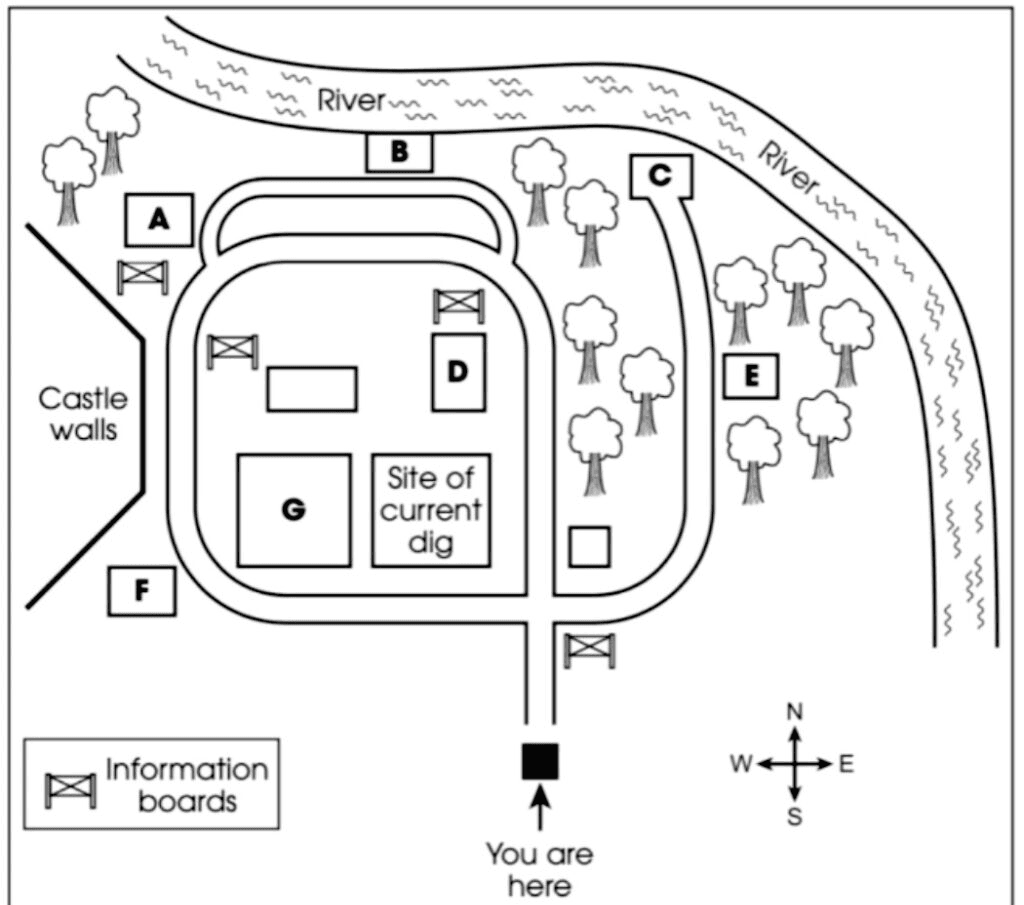
17. bridge foundations
18. rubbish pit
19. meeting hall
20. fish pond
Two students discussing a project on theatre programmes
Questions 21–26
Choose the correct letter, A, B or C.
21. Finn was pleased to discover that their topic
A was not familiar to their module leader.
B had not been chosen by other students.
C did not prove to be difficult to research.
22. Maya says a mistaken belief about theatre programmes is that
A theatres pay companies to produce them.
B few theatre-goers buy them nowadays.
C they contain far more adverts than previously.
23. Finn was surprised that, in early British theatre, programmes
A were difficult for audiences to obtain.
B were given out free of charge.
C were seen as a kind of contract.
24. Maya feels their project should include an explanation of why companies of actors
A promoted their own plays.
B performed plays outdoors.
C had to tour with their plays.
25. Finn and Maya both think that, compared to nineteenth-century programmes, those from the eighteenth century
A were more original.
B were more colourful.
C were more informative.
26. Maya doesn't fully understand why, in the twentieth century,
A very few theatre programmes were printed in the USA.
B British theatre programmes failed to develop for so long.
C theatre programmes in Britain copied fashions from the USA.
Questions 27–30
What comment is made about the programme for each of the following shows? Choose FOUR answers from the box and write the correct letter, A–F, next to Questions 27–30.
Comments about programmes
A Its origin is somewhat controversial.
B It is historically significant for a country.
C It was effective at attracting audiences.
D It is included in a recent project.
E It contains insights into the show.
F It resembles an artwork.
27. Ruy Blas
28. Man of La Mancha
29. The Tragedy of Jane Shore
30. The Sailors' Festival
A lecture on inclusive design
Questions 31–40
Complete the notes below. Write ONE WORD ONLY for each answer.
Inclusive design
Definition
• Designing products that can be accessed by a diverse range of people without the need for any (31) …………………………
• Not the same as universal design: that is design for everyone, including catering for people with (32) ………………………… problems.
Examples of inclusive design
• (33) ………………………… which are adjustable, avoiding back or neck problems
• (34) ………………………… in public toilets which are easier to use
• To assist the elderly:
– designers avoid using (35) ………………………… in interfaces
– people can make commands using a mouse, keyboard or their (36) …………………………
Impact of non-inclusive designs
• Access
– Loss of independence for disabled people.
• Safety
– Seatbelts are especially problematic for (37) ………………………… women.
– PPE jackets are often unsuitable because of the size of women's (38) …………………………
– PPE for female (39) ………………………… officers dealing with emergencies is the worst.
• Comfort in the workplace
– The (40) ………………………… in offices is often too low for women.
Answers
1. 239
2. modern
3. lamp
4. Aaron
5. damage
6. electronic
7. insurance
8. Space
9. app
10. exchanges
11. a national charity
12. Heavy rain had removed some of the soil.
13. the lucky discovery of old records
14. pieces of jewellery
15. the outline of fields
16. start to organise school visits
17. B
18. A
19. G
20. E
21. had not been chosen by other students.
22. theatres pay companies to produce them.
23. were seen as a kind of contract.
24. promoted their own plays.
25. were more informative.
26. British theatre programmes failed to develop for so long.
27. F
28. E
29. B
30. D
31. adaptation
32. cognitive
33. desks
34. taps
35. blue
36. voice
37. pregnant
38. shoulders
39. police
40. temperature
Explanations
- 1. 239
- 'It says the monthly price per room starts at $105 and goes up to $239.'Common trap: $105 is already printed in the table, so the answer is the upper figure in the same sentence.
- 2. modern
- 'People have mentioned that the furniture from Peak Rentals is more modern than any of the other companies.'Common trap: The delivery time is in the same turn and is already printed in the table, so both facts arrive together.
- 3. lamp
- 'If you rent living room furniture … you'll also get a lamp at no extra cost.'Common trap: Chairs and a TV table are listed first as what the living room set contains, not as the free gift.
- 4. Aaron
- 'Then you could try Aaron and Oliver.' … 'Aaron, double A-R-O-N.'Common trap: The spelling is given as 'double A' rather than letter by letter, which is easy to mishear as a single A.
- 5. damage
- 'They charge an extra 12 every month in case of damage.'Common trap: The cleaning service is mentioned two turns later and is the other extra the company offers.
- 6. electronic
- 'It has the lowest prices in town. That's for both furniture and also electronic equipment.'Common trap: 'Equipment' follows the answer, and the table's word is 'items' — so the adjective, not the noun, is what is needed.
- 7. insurance
- 'First of all you have to take out insurance on the furniture and you need to organize that yourself.'Common trap: 'Contract' comes next and is already printed in the table's minimum-length line.
- 8. Space
- 'It's called Space Rentals, and it's located very near to the house.'Common trap: The name arrives inside an interruption, straight after a discussion of contract lengths and the 12-month house rental.
- 9. app
- 'I don't have any information about their charges, so it's best to use their app to find out what it would cost you.'Common trap: Peak Rentals' brochure was the source of prices earlier, which makes a printed source the expected answer here.
- 10. exchanges
- 'If you don't like the furniture once it's delivered, you can request exchanges, as long as you do that within a week of receiving it.'Common trap: The table says '7 days' while the recording says 'within a week', so the time phrase does not confirm the answer directly.
- 11. a national charity
- 'I was asked to join the project by NHA, a charity which sets up projects like this up and down the country.'Common trap: The council and the castle owners are both named in the same two sentences, one as his employer and one as the host.
- 12. Heavy rain had removed some of the soil.
- 'Here, a walker found it on the ground after a rainstorm washed away some of the earth and sand.'Common trap: Both wrong options are described first as the usual ways coins are found; 'Here' is the single word that switches to this case.
- 13. the lucky discovery of old records
- 'Just by chance, the team found some old maps and documents in our library, which showed 500-year-old drawings of ruined buildings.'Common trap: The same sentence mentions the grassy area and the castle's stone walls, so both wrong options have words in the citation itself.
- 14. pieces of jewellery
- 'Normally you'd expect to find brooches and other jewellery, but we're still waiting to uncover any such items.'Common trap: Pots and bones are named on either side of the answer, both as things already recovered.
- 15. the outline of fields
- 'No other houses or huts so far, but we can see the borders of an ancient field system.'Common trap: Huts are ruled out in the first half of the same sentence, and the palace is raised and withdrawn in the next one.
- 16. start to organise school visits
- 'In the meantime, we're putting on a series of guided tours for school groups this autumn.'Common trap: The TV documentary and the museum both follow, but one is in the past and the other is still uncertain.
- 17. B
- 'Take the main path ahead of you, go straight on, and keep going till the path bends to the left. You'll see a smaller track leading off to the right. Follow that to take you to the river, where the divers are.'Common trap: The route ends at the river, and C also sits on a track leading towards the water — only the left bend separates them.
- 18. A
- 'This is very near the castle walls in the north-west corner of the site.'Common trap: F is also beside the castle walls, but in the south-west corner — the compass rose is the only way to separate them.
- 19. G
- 'It is the largest structure in the central area of the site next to the current excavation area.'Common trap: D is also inside the central area, but the clue is size plus being next to the marked site of the current dig.
- 20. E
- 'You turn right at the first information board you come to and follow the path into the trees. Before you come out of the trees, you'll see it on your right.'Common trap: It opens by saying ponds are normally beside a river, which points further east than the answer actually is.
- 21. had not been chosen by other students.
- 'I'm glad we picked this subject. No one else on the course is doing the same as us.'Common trap: The difficulty of research and the convener's interest are both in the same sentence, on either side of the answer.
- 22. theatres pay companies to produce them.
- 'Contrary to what many people think, theatres don't hire people to do the programmes. In fact, companies buy the rights to publish programmes on the theatre's behalf.'Common trap: Advertising space is mentioned in the very next clause, which makes the adverts option feel like part of the same point.
- 23. were seen as a kind of contract.
- If the named actor did not appear, 'people accused the theatre of breaking their agreement with the audience'.Common trap: 'They would demand refunds' follows immediately and puts money in the frame, which suits the free-of-charge option.
- 24. promoted their own plays.
- Because many people were illiterate, actors 'would parade around the streets in their costumes, beating drums and announcing their upcoming performances'.Common trap: 'When a company of actors arrived in a town' opens the sentence and makes touring look like the point.
- 25. were more informative.
- '18th century programmes were superior because they told the theatregoers so many things, including about the actors.' Maya: 'And about the writer, the plot and sometimes the history of the play.'Common trap: Colour and variety of design are both attributed to the nineteenth century in the two lines before, so the comparison runs the other way.
- 26. British theatre programmes failed to develop for so long.
- 'After the war they didn't go back to being more than one sheet or change in any way for over 25 years. I know there were paper shortages after the war, but only for five or ten years.'Common trap: The USA is discussed just before as the country where nothing changed, which can attach the puzzle to the wrong place.
- 27. F
- 'The programme looks very decorative.' 'Good enough to put in a frame on the wall. The images are just beautiful.'Common trap: 'Never heard of that' opens the exchange, which suggests something obscure or disputed rather than beautiful.
- 28. E
- 'It contains articles written by members of the theatre company, so we can learn how the production was created and the thoughts and feelings of the cast.'Common trap: Finn explicitly rules out the pictures — 'not because of the pictures' — which is the artwork option in the box.
- 29. B
- 'It's said to be the earliest surviving document to have been printed on Australia's first printing press.'Common trap: 'It's said to be' hints at doubt, which makes the controversial-origin option tempting; and the programme is now in a museum, not a project.
- 30. D
- 'It comes from the British Library's digitised collection of programmes that was started a few years ago.'Common trap: The library setting sounds like the historically-significant option, and the 200,000 figure draws attention away from 'started a few years ago'.
- 31. adaptation
- 'Making sure products are accessible, so that as many different types of people as possible can use them, without any type of adaptation having to be made to the original design.'Common trap: The sentence is long and the answer is the very last idea in it, after 'accessible' and 'different types of people'.
- 32. cognitive
- 'Universal design aims to make products that work for everyone and that includes considering the needs of people who have cognitive difficulties.'Common trap: 'Difficulties' in the recording becomes 'problems' in the note, so the noun does not confirm you are in the right place.
- 33. desks
- 'It is common to see desks which can be adjusted to suit people of different heights or for wheelchair users.'Common trap: The back and neck problems are only mentioned in the following sentence, as what happens when the desks are absent.
- 34. taps
- 'Taps that you activate by sensor require no pressing or twisting movements … easier for people with dexterity or mobility issues.'Common trap: 'Sensor' is the striking word in the sentence, and hotels, airports and offices all come before the answer.
- 35. blue
- 'We also become worse at distinguishing between similar colours, in particular shades of blue, which is why software designers rarely create interfaces with this colour.'Common trap: The answer is named before the consequence, and the clause about interfaces refers back to it only as 'this colour'.
- 36. voice
- 'So voice access is now a routine way of making commands.'Common trap: The mouse and keyboard are already printed in the note and are mentioned as things people struggle with, immediately before the answer.
- 37. pregnant
- 'This has safety implications for all women, particularly those who are pregnant, as the seatbelts worn by the dummy are not adapted to accommodate them.'Common trap: The crash-test dummy 'based on an average-sized male' dominates the sentence before, and the seatbelt detail comes after the answer.
- 38. shoulders
- 'Women can be tall and still have much smaller shoulders than the average man.'Common trap: Jackets 'designed for a small man' are described just before, which makes overall size seem to be the issue.
- 39. police
- 'This problem was worst in the emergency services. particularly the police.'Common trap: 'Emergency services' is already covered by the note's 'dealing with emergencies', so the answer is the two-word afterthought that follows.
- 40. temperature
- 'There is a standard setting for air conditioning to be at a temperature of 21 degrees designed to suit men.'Common trap: 'Air conditioning' is repeated throughout the passage and is the obvious noun, but the note needs what is set too low, not what sets it.
Audio transcripts
Part 1 — A phone call about furniture rental companies
MAN Good morning WOMAN Hi, this is Michelin Meyer. I'm renting your house on Archwood Avenue. I'm due to move in next week. MAN Oh, yes. Hello, Ms. Meyer. What can I do for you? WOMAN When I viewed the house, I told you I'll most probably need to rent some furniture, at least until I know whether my temporary work contract is going to be made permanent. MAN Yes, of course. I remember. And I said I could give you some information about furniture rental companies in the city. WOMAN That's right. MAN Well, the biggest company is called Peak Rentals. I've recommended them to other people and have always heard positive reports about them. WOMAN Could you give me an idea of their costs? MAN Sure. I actually have one of their brochures here. It says the monthly price per room starts at $105 and goes up to $239. That depends on which rooms you need furniture for, of course. WOMAN Sure. It's just to get a general idea of how much it's going to cost. And you said you had some positive feedback about this company? MAN Yes. People have mentioned that the furniture from Peak Rentals is more modern than any of the other companies. And also, once you place an order, the furniture will be delivered to you in just one or two days. WOMAN That would be really helpful. MAN Oh, and the brochure says that there's a special offer at the moment. If you rent living room furniture, I believe that's a set of chairs and a TV table, you'll also get a lamp at no extra cost. WOMAN Okay, but you know, that price range you gave is more than I was hoping to pay. MAN Then you could try Aaron and Oliver. WOMAN Sorry, what and Oliver? MAN Aaron, double A-R-O-N WOMAN OK, are they cheaper MAN I say they are a mid company But if you chose them you need to be aware that they charge an extra 12 every month in case of damage WOMAN Oh, I see. I'd have to do the math carefully then. MAN Right. But one helpful thing is that they also do cleaning for customers. WOMAN For the furniture? MAN For the house. WOMAN Oh, I see. I probably won't need that. Now listen and answer questions 6 to 10. MAN There's another company called Larch Furniture. It's quite new, and it has the lowest prices in town. That's for both furniture and also electronic equipment. WOMAN Well, that would be good. I'm not bringing much with me, and I won't have much time to go shopping after I start my job. MAN There are two things you need to know about large furniture. First of all you have to take out insurance on the furniture and you need to organize that yourself WOMAN That wouldn't be too hard. MAN Also you can take out a contract for less than six months but I figure that might not be a problem for you. You're renting the house for 12 months after all, aren't you? WOMAN Yes, okay. Well, I... MAN Sorry to interrupt. I just thought of another furniture rental company. It's called Space Rentals, and it's located very near to the house. WOMAN Okay. MAN I don't have any information about their charges, so it's best to use their app to find out what it would cost you to use them. WOMAN Okay, thanks. I'll do that. MAN One good thing about that company is that if you don't like the furniture once it's delivered, you can request exchanges, as long as you do that within a week of receiving it. WOMAN That sounds really great. Okay, well, thanks very much. That's so helpful
Part 2 — A talk at the Bidcaster archaeological dig
Hello, I'm Hayden. I'm one of the archaeologists investigating the site here at Bidcuster. This is the third summer for this community project, and most of the people digging here are volunteers. I'm a full-time archaeologist for the town council, but I was asked to join the project by NHA, a charity which sets up projects like this up and down the country. As you can see, we're next to Bidcaster Castle, which is great because the owners let us use their facilities. So, how did we get to where we are today? Many archaeology projects happen when an ancient object is found, and in our case that object was a gold coin. Coins are often found by people using metal detectors to look for things buried in the ground or coins are uncovered when wild animals like rabbits have been digging tunnels. Here, a walker found it on the ground after a rainstorm washed away some of the earth and sand. When the story of the gold coin hit the news, Peter Swift, an amateur historian, contacted me to say he believed there had been a village on this site, centuries before the castle was built. Just by chance, the team found some old maps and documents in our library, which showed 500-year-old drawings of ruined buildings on the grassy area between the outer stone walls of the castle and the river. We knew then we were onto something. Over the three summers the team has been here, we've found the remains of several buildings, and more broken pots than you can count. Normally you'd expect to find brooches and other jewellery, but we're still waiting to uncover any such items. The people who once lived here were skilled at making tools from animal bones, as you'll see when you visit the exhibition. Besides the discovery of the village, we've also found evidence of human activity on the other side of the river. No other houses or huts so far, but we can see the borders of an ancient field system. At one point we found a long wall and thought it was an ancient palace, but it turned out to be a modern wall. This summer's work will end soon, but we'll be back next summer. In the meantime, we're putting on a series of guided tours for school groups this autumn. Oh, and maybe you saw the TV documentary about our project. That suggests the objects we've found are going to the town's museum, but we don't know that for sure yet. Before you hear the rest of the talk you have some time to look at questions 17 to 20 Now listen and answer questions 17 to 20. When you enter the site, please make sure you keep to the paths at all times. There are a few other things, the highlights of the site if you like, that I want to mention. Take a look at the map. Our present location is marked at the bottom. This year, we've identified the foundations of an ancient bridge, and it's really exciting today because a team of divers are in the river searching for lost objects. To reach the bridge, take the main path ahead of you, go straight on, and keep going till the path bends to the left. You'll see a smaller track leading off to the right. Follow that to take you to the river, where the divers are. You might be interested to see the rubbish pit. This is very near the castle walls in the north-west corner of the site. It actually dates to the time of the castle and not the ancient village. We found oyster shells and fish bones, and we assumed they were thrown from the castle kitchen above. One area we excavated in the first summer uncovered the site of a meeting hall. We knew it was an important building because it had two rows of post holes, deep enough to support a large roof. It is the largest structure in the central area of the site next to the current excavation area. Last year we discovered a fish pond in the ancient village. Normally these were beside a river. The pond here is further away, but it's possible the river has moved slightly. Anyway, to get there from here, you turn right at the first information board you come to and follow the path into the trees. Before you come out of the trees, you'll see it on your right. If you reach the river, you've gone too far. So, does anyone have...
Part 3 — Two students discussing a project on theatre programmes
MAYA So, Finn, I've done as much as I can for our project on theatre programmes. How's your research coming along? FINN OK, Maya. I didn't know theatre programmes are called playbills in the USA till I started looking into the topic. Even though I struggled to find many useful websites, I'm glad we picked this subject. No one else on the course is doing the same as us, although it is one of the research areas of the module convener. MAYA That might actually put some people off. FINN I suppose so. Anyway I hadn't realised there are actually companies specialising in creating theatre programmes MAYA Yes they are quite common nowadays. Contrary to what many people think, theatres don’t hire people to do the programmes. In fact, companies buy the rights to publish programmes on the theatre's behalf and then make their money selling advertising space within the programme booklet. FINN It must be easier for theatres to do it that way. MAYA Yes. FINN I remember reading something about programmes in early British theatre. It said that the cast was always very important. MAYA Yeah, audiences were very familiar with leading actors and big names would draw huge crowds. FINN But I hadn't realised that if the programme named a famous actor, that's who the public expected to perform. And if that didn't happen, people accused the theatre of breaking their agreement with the audience. They would demand refunds and if they didn't get them, there were riots. MAYA Outrageous! That'd never happen now. FINN No, people are too polite, even when they're disappointed if the star of the show misses a performance. MAYA We should definitely include that information about early audiences in our project. I also think it's important to mention that lots of ordinary people at that time were illiterate, so theatre programmes were of limited value in advertising plays. When a company of actors arrived in a town, they'd parade around the streets in their costumes, beating drums and announcing their upcoming performances. FINN Interesting. I couldn't imagine that happening now either. MAYA There's also an interesting comparison to make between 18th and 19th century programmes. FINN Wasn't it in the 19th century that theatre programmes started to resemble programs today MAYA Yes and unlike programs from the 18th century they always used colour FINN And there was a greater variety of designs. But personally I think 18th century programmes were superior because they told the theatregoers so many things, including about the actors. MAYA And about the writer, the plot and sometimes the history of the play. FINN That's right. What should we say about theatre programmes in the 20th century? MAYA I reckon the most important thing is the dramatic change they underwent during World War II. FINN When the government imposed restrictions on the use of paper. MAYA Yeah, but that was only in the UK. In the USA, programmes, or rather playbills, continued to be published in the same format. FINN While here in the UK, programmes became merely a single sheet of paper folded to create four pages for text. MAYA What I don't really get is that after the war they didn't go back to being more than one sheet or change in any way for over 25 years. I know there were paper shortages after the war, but only for five or ten years. FINN Strange. Before you hear the rest of the discussion, you have some time to look at questions 27 to 30. Now listen and answer questions 27 to 30. MAYA I got some pictures of programmes we could include on the slides for our presentation. FINN I found a couple too Maya. Let go through and see what we think MAYA Um oh this is an old one for a play called Ruey Blass FINN Never heard of that. But the programme looks very decorative. MAYA Good enough to put in a frame on the wall. The images are just beautiful. Finn, what did you find? FINN I've got some pages from a programme for Man of La Mancha. I thought this was a good programme to show, not because of the pictures, but because it contains articles written by members of the theatre company, so we can learn how the production was created and the thoughts and feelings of the cast. MAYA Good. I've got a copy of a programme that's now in a museum. It's for The Tragedy of Jane Shore and it's said to be the earliest surviving document to have been printed on Australia's first printing press FINN Fantastic! MAYA Another programme to talk about is for The Sailors Festival. It comes from the British Library's digitised collection of programmes that was started a few years ago. It already comprises over 200,000 programmes which is amazing! FINN Huh. Wish I'd known about it while I was doing my research.
Part 4 — A lecture on inclusive design
It's only relatively recently that designers have become aware of the need to be inclusive when designing products. But what does that mean exactly? Well, it simply means designing products that span economic, social and cultural barriers. It means making sure products are accessible, so that as many different types of people as possible can use them, without any type of adaptation having to be made to the original design. Inclusive design is often linked with universal design, although they are not quite the same thing. Universal design aims to make products that work for everyone and that includes considering the needs of people who have cognitive difficulties, which can present quite a challenge. Today examples of successful inclusive design can be seen all around us. In workplaces it is common to see desks which can be adjusted to suit people of different heights or for wheelchair users This still isn't always the case, however, and is one reason why office workers often suffer from back or neck problems. You'll find another example in the public toilets of countless hotels, airports and offices. Taps that you activate by sensor require no pressing or twisting movements. These are not only more hygienic, they're also easier for people with dexterity or mobility issues. The tech industry has been criticised in the past for focusing too much on young consumers, but this is changing. Many products are now designed with the elderly in mind. For example, it's well known that vision declines with age and that we also become worse at distinguishing between similar colours, in particular shades of blue, which is why software designers rarely create interfaces with this colour. Motor skills also decline with age and some people have difficulty doing everyday things like picking up a cup or opening a door. This can also affect their ability to use a mouse or keyboard. So voice access is now a routine way of making commands. It's worth looking at the problems non-inclusive designs cause when not enough consideration is given to a range of users, as it can have a serious impact on people's lives. Access is one obvious example because it has such a huge impact on disabled people's independence. Not being able to access public transport because buses or trains are not wheelchair means many disabled people can go out unless someone goes with them. Safety is another issue. Inexplicably, most cars are still crash-tested using a dummy based on an average-sized male. This has safety implications for all women, particularly those who are pregnant, as the seatbelts worn by the dummy are not adapted to accommodate them. Over the past 100 years, workplaces in the UK have, on the whole, become considerably safer. Employers are legally required to provide well-maintained personal protective equipment, or PPE, anything from goggles to full bodysuits, to workers who need it, free of charge. But most PPE is designed to fit men. A recent report found that employers often think that when it comes to female workers, all they need to do to comply with this legal requirement is to buy jackets, for example, designed for a small man. The problem with this is that women can be tall and still have much smaller shoulders than the average man. Ill-fitting PPE such as high-vis jackets, vests and body armour can put women at risk. The report found that 95% of women said that their PPE often hampered their work and that this problem was worst in the emergency services. particularly the police. Another problem is related to comfort at work. A very common scenario in offices in summertime is to see women wrapped in blankets or wearing sweaters while the air conditioning is on high. Meanwhile, the men are in shorts and T-shirts. This is due to differences in metabolic rates for men and women. There is a standard setting for air conditioning to be at a temperature of 21 degrees designed to suit men and in most modern offices it is not possible to turn the air conditioning up or down. This means that many offices which mainly employ women are wasting energy by having the air conditioning set too high. As you can see from the examples I've just mentioned, there are serious consequences for designs which don't consider the needs of all users.
Comments
Loading comments…