

IELTS Trainer 1 Academic Reading Test 3
3 passages · 40 questions · 60 minutes
Seed vault guards resources for the future
About 1,000 km from the North Pole, Svalbard is one of the most remote places on earth. For this reason, it is the site of a vault that will safeguard a priceless component of our common heritage – the seeds of our staple crops. Here, seeds from the world's most vital food crops will be locked away for hundreds or even thousands of years. If something goes wrong in the world, the vault will provide the means to restore farming. We, or our descendants, will not have to retread thousands of years of agriculture from scratch.
Deep in the vault at the end of a long tunnel, are three storage vaults which are lined with insulated panels to help maintain the cold temperatures. Electronic transmitters linked to a satellite system monitor temperature, etc. and pass the information back to the appropriate authorities at Longyearbyen and the Nordic Gene Bank which provide the technical information for managing the seed vaults. The seeds are placed in sealed boxes and stored on shelves in the vaults. The minimal moisture level and low temperature ensure low metabolic activity. The remote location, as well as the rugged structure, provide unparalleled security for the world's agricultural heritage.
The three vaults are buried deep in the hillside. To reach them, it is necessary to proceed down a long and surprisingly large corridor. At 93.3 metres in length, it connects the 26-metre long entrance building to the three vaults, each of which extends a further 27 metres into the mountain. Towards the end of this tunnel, after about 80 metres, there are several small rooms on the right-hand side. One is a transformer room to which only the power company officials have access – this houses the equipment needed to transform the incoming electrical current down to 220 volts. A second is an electrical room housing controls for the compressor and other equipment. The other room is an office which can be heated to provide comfortable working conditions for those who will make an inventory of the samples in and out of the vault.
Anyone seeking access to the seeds has to pass through four locked doors: the heavy steel entrance doors, a second door approximately 90 metres down the tunnel and finally the two keyed doors separated by an airlock, from which it is possible to proceed directly into the seed vaults. Keys are coded to allow access to different levels of the facility.
A work of art will make the vault visible for miles around. The vault entrance is filled with highly reflective sheets of steel and mirrors which form an installation acting as a beacon. It reflects polar light in the summer months, while in the winter, a network of 200 fibre-optic cables will give the piece a muted greenish-turquoise and white light.
Cary Fowler, the mastermind behind the vault, stands inside the echoing cavern. For him, this is the culmination of nearly 30 years of work. 'It's an insurance policy,' he explains, 'a very cheap insurance policy when you consider what we're insuring – the earth's biological diversity.'
Seeds are being brought here from all over the world, from seed banks created by governments, universities and private institutions. Soon, there will be seed varieties from at least 100 crops in the Svalbard vault – extending to examples of all of the 1.5 million known crop seed varieties in the world. If any more are unearthed, either in the wild or found in obscure collections, they can be added, too – the vault has room for at least 4.5 million samples.
Inside the entrance area it is more than 10° C below freezing, but in the chambers where the seeds are kept, refrigerators push down the temperature even further, to –18° C. At this temperature, which will be kept constant to stop the seeds germinating or rotting, the wheat seeds will remain viable for an estimated 1,700 years, the barley for 2,000 years and the sorghum for 20,000 years.
Svalbard's Arctic conditions will keep the seeds cold. In order to maintain the temperature at a constant –10° C to –20° C, the cold Arctic air will be drawn into the vault during the winter, automatically and without human intervention. The surrounding rock will maintain the temperature requirements during the extremely cold season and, during warmer periods, refrigeration equipment will engage. Looking out across the snow-covered mountains of Svalbard, it is hard not to feel respect for the 2,300 or so people who live here, mainly in Longyearbyen, a village a few miles away. There are three months without light in winter.
Svalbard is intended as the seed bank of last resort. Each sample is made up of a few hundred seeds, sealed inside a watertight package which will never be tampered with while it is in the vault. The packages of seeds remain the property of the collections they have come from. Svalbard will disburse samples 'only if all the other seeds in other collections around the world are gone,' explains Fowler. If seeds do have to be given out, those who receive them are expected to germinate them and generate new samples, to be returned to the vault.
Questions 1–6
Label the diagram below. Choose NO MORE THAN TWO WORDS OR A NUMBER from the passage for each answer.
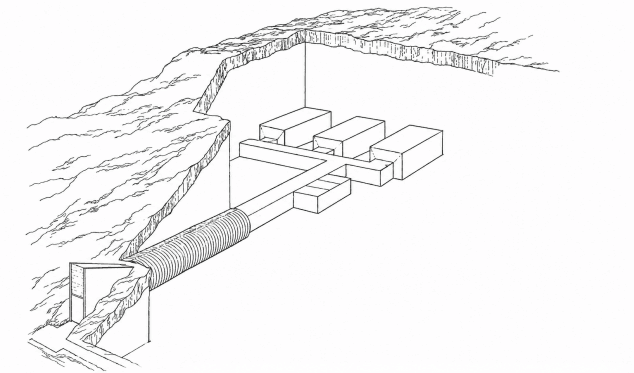
The Svalbard Vault
The installation in the entrance consists of (1) ………………………… and metal panels which maximise natural light.
A tunnel, which is (2) ………………………… long, connects the entrance building to the vault.
Seeds are processed in the (3) ………………………… before they go into the vault.
The (4) ………………………… is reduced as it enters the vault.
The entrance to the seed vault itself is protected with doors with (5) ………………………… between them.
The seeds are conserved by the cold and lack of (6) ………………………….
Questions 7–13
Do the following statements agree with the information given in the passage?
TRUEif the statement agrees with the information
FALSEif the statement contradicts the information
NOT GIVENif there is no information on this
7. The vault has the capacity to accommodate undiscovered types of seed at a later date.
8. There are different levels of refrigeration according to the kinds of seeds stored.
9. During winter, the flow of air entering the vault is regularly monitored by staff.
10. There is a back-up refrigeration system ready to be switched on if the present one fails.
11. The people who work at Svalbard are mainly locals.
12. Once a seed package is in the vault, it remains unopened.
13. If seeds are sent from Svalbard to other banks, there is an obligation for the recipient to send replacements back.
What Cookbooks Really Teach Us
[A] Shelves bend under their weight of cookery books. Even a medium-sized bookshop contains many more recipes than one person could hope to cook in a lifetime. Although the recipes in one book are often similar to those in another, their presentation varies wildly, from an array of vegetarian cookbooks to instructions on cooking the food that historical figures might have eaten. The reason for this abundance is that cookbooks promise to bring about a kind of domestic transformation for the user. The daily routine can be put to one side and they liberate the user, if only temporarily. To follow their instructions is to turn a task which has to be performed every day into an engaging, romantic process. Cookbooks also provide an opportunity to delve into distant cultures without having to turn up at an airport to get there.
[B] The first Western cookbook appeared just over 1,600 years ago. De re coquinaria (it means 'concerning cookery') is attributed to a Roman gourmet named Apicius. It is probably a compilation of Roman and Greek recipes, some or all of them drawn from manuscripts that were later lost. The editor was sloppy, allowing several duplicated recipes to sneak in. Yet Apicius's book set the tone of cookery advice in Europe for more than a thousand years. As a cookbook it is unsatisfactory with very basic instructions. Joseph Vebling, a chef who translated Apicius in the 1930s, suggested the author had been obscure on purpose, in case his secrets leaked out.
[C] But a more likely reason is that Apicius's recipes were written by and for professional cooks, who could follow their shorthand. This situation continued for hundreds of years. There was no order to cookbooks: a cake recipe might be followed by a mutton one. But then, they were not written for careful study. Before the 19th century few educated people cooked for themselves. The wealthiest employed literate chefs; others presumably read recipes to their servants. Such cooks would have been capable of creating dishes from the vaguest of instructions.
[D] The invention of printing might have been expected to lead to greater clarity but at first the reverse was true. As words acquired commercial value, plagiarism exploded. Recipes were distorted through reproduction. A recipe for boiled capon in The Good Huswives Jewell, printed in 1596, advised the cook to add three or four dates. By 1653, when the recipe was given by a different author in A Book of Fruits & Flowers, the cook was told to set the dish aside for three or four days.
[E] The dominant theme in 16th and 17th century cookbooks was order. Books combined recipes and household advice, on the assumption that a well-made dish, a well-ordered larder and well-disciplined children were equally important. Cookbooks thus became a symbol of dependability in chaotic times. They hardly seem to have been affected by the English civil war or the revolutions in America and France.
[F] In the 1850s Isabella Beeton published The Book of Household Management. Like earlier cookery writers she plagiarised freely, lifting not just recipes but philosophical observations from other books. If Beeton's recipes were not wholly new, though, the way in which she presented them certainly was. She explains when the chief ingredients are most likely to be in season, how long the dish will take to prepare and even how much it is likely to cost. Beeton's recipes were well suited to her times. Two centuries earlier, an understanding of rural ways had been so widespread that one writer could advise cooks to heat water until it was a little hotter than milk comes from a cow. By the 1850s Britain was industrialising. The growing urban middle class needed details, and Beeton provided them in full.
[G] In France, cookbooks were fast becoming even more systematic. Compared with Britain, France had produced few books written for the ordinary householder by the end of the 19th century. The most celebrated French cookbooks were written by superstar chefs who had a clear sense of codifying a unified approach to sophisticated French cooking. The 5,000 recipes in Auguste Escoffier's Le Guide Culinaire (The Culinary Guide), published in 1902, might as well have been written in stone, given the book's reputation among French chefs, many of whom still consider it the definitive reference book.
[H] What Escoffier did for French cooking, Fannie Farmer did for American home cooking. She not only synthesised American cuisine; she elevated it to the status of science. 'Progress in civilisation has been accompanied by progress in cookery,' she breezily announced in The Boston Cooking-School Cook Book, before launching into a collection of recipes that sometimes resembles a book of chemistry experiments. She was occasionally over-fussy. She explained that currants should be picked between June 28th and July 3rd, but not when it is raining. But in the main her book is reassuringly authoritative. Its recipes are short, with no unnecessary chat and no unnecessary spices.
[I] In 1950 Mediterranean Food by Elizabeth David launched a revolution in cooking advice in Britain. In some ways Mediterranean Food recalled even older cookbooks but the smells and noises that filled David's books were not mere decoration for her recipes. They were the point of her books. When she began to write, many ingredients were not widely available or affordable. She understood this, acknowledging in a later edition of one of her books that 'even if people could not very often make the dishes here described, it was stimulating to think about them.' David's books were not so much cooking manuals as guides to the kind of food people might well wish to eat.
Questions 14–16
Complete the summary below. Choose NO MORE THAN TWO WORDS from the passage for each answer.
14. Why are there so many cookery books? There are a great number more cookery books published than is really necessary and it is their …………………………
15. Why are there so many cookery books? which makes them differ from each other. There are such large numbers because they offer people an escape from their …………………………
16. Why are there so many cookery books? and some give the user the chance to inform themselves about other ………………………….
Questions 17–21
Reading Passage 2 has nine paragraphs, A–I. Which paragraph contains the following information? Write the correct letter, A–I. You may use any letter more than once.
17. cookery books providing a sense of stability during periods of unrest
18. details in recipes being altered as they were passed on
19. knowledge which was in danger of disappearing
20. the negative effect on cookery books of a new development
21. a period when there was no need for cookery books to be precise
Questions 22–26
Look at the following statements and list of books below. Match each statement with the correct book, A–E.
List of cookery books
A . De re coquinaria
B . The Book of Household Management
C . Le Guide Culinaire
D . The Boston Cooking-School Cook Book
E . Mediterranean Food
22. Its recipes were easy to follow despite the writer's attention to detail.
23. Its writer may have deliberately avoided passing on details.
24. It appealed to ambitious ideas people have about cooking.
25. Its writer used ideas from other books but added additional related information.
26. It put into print ideas which are still respected today.
Is there more to video games than people realise?
Many people who spend a lot of time playing video games insist that they have helped them in areas like confidence-building, presentation skills and debating. Yet this way of thinking about video games can be found almost nowhere within the mainstream media, which still tend to treat games as an odd mix of the slightly menacing and the alien. This lack of awareness has become increasingly inappropriate, as video games and the culture that surrounds them have become very big business indeed.
Recently, the British government released the Byron report into the effects of electronic media on children. Its conclusions set out a clear, rational basis for exploring the regulation of video games. The ensuing debate, however, has descended into the same old squabbling between partisan factions: the preachers of mental and moral decline, and the innovative game designers. In between are the gamers, busily buying and playing while nonsense is talked over their heads.
Susan Greenfield, renowned neuroscientist, outlines her concerns in a new book. Every individual's mind is the product of a brain that has been personalised by the sum total of their experiences; with an increasing quantity of our experiences from very early childhood taking place 'on screen' rather than in the world, there is potentially a profound shift in the way children's minds work. She suggests that the fast-paced, second-hand experiences created by video games and the internet may inculcate a worldview that is less empathetic, more risk-taking and less contemplative than what we tend to think of as healthy.
Greenfield's prose is full of mixed metaphors and self-contradictions and is perhaps the worst enemy of her attempts to persuade. This is unfortunate, because however much technophiles may snort, she is articulating widely held fears that have a basis in fact. Unlike even their immediate antecedents, the latest electronic media are at once domestic and work-related, their mobility blurring the boundaries between these spaces, and video games are at their forefront. A generational divide has opened that is in many ways more profound than the equivalent shifts associated with radio or television, more alienating for those unfamiliar with new technologies, more absorbing for those who are. So how do our lawmakers regulate something that is too fluid to be fully comprehended or controlled?
Adam Martin, a lead programmer for an online games developer, says: 'Computer games teach and people don't even notice they're being taught.' But isn't the kind of learning that goes on in games rather narrow? 'A large part of the addictiveness of games does come from the fact that as you play you are mastering a set of challenges. But humanity's larger understanding of the world comes primarily through communication and experimentation, through answering the question "What if?" Games excel at teaching this too.'
Steven Johnson's thesis is not that electronic games constitute a great, popular art, but that the mean level of mass culture has been demanding steadily more intellectual engagement from consumers. Games, he points out, generate satisfaction via the complexity of their virtual worlds, not by their robotic predictability. Testing the nature and limits of the laws of such imaginary worlds has more in common with scientific methods than with a pointless addiction, while the complexity of the problems children encounter within games exceeds that of anything they might find at school.
Greenfield argues that there are ways of thinking that playing video games simply cannot teach. She has a point. We should never forget, for instance, the unique ability of books to engage and expand the human imagination, and to give us the means of more fully expressing our situations in the world. Intriguingly, the video games industry is now growing in ways that have more in common with an old-fashioned world of companionable pastimes than with a cyber-future of lonely, isolated obsessions. Games in which friends and relations gather round a console to compete at activities are growing in popularity. The agenda is increasingly being set by the concerns of mainstream consumers – what they consider acceptable for their children, what they want to play at parties and across generations.
These trends embody a familiar but important truth: games are human products, and lie within our control. This doesn't mean we yet control or understand them fully, but it should remind us that there is nothing inevitable or incomprehensible about them. No matter how deeply it may be felt, instinctive fear is an inappropriate response to technology of any kind.
So far, the dire predictions many traditionalists have made about the 'death' of old-fashioned narratives and imaginative thought at the hands of video games cannot be upheld. Television and cinema may be suffering, economically, at the hands of interactive media. But literacy standards have failed to decline. Young people still enjoy sport, going out and listening to music. And most research – including a recent $1.5m study funded by the US government – suggests that even pre-teens are not in the habit of blurring game worlds and real worlds.
The sheer pace and scale of the changes we face, however, leave little room for complacency. Richard Bartle, a British writer and game researcher, says 'Times change: accept it; embrace it.' Just as, today, we have no living memories of a time before radio, we will soon live in a world in which no one living experienced growing up without computers. It is for this reason that we must try to examine what we stand to lose and gain, before it is too late.
Questions 27–32
Do the following statements agree with the views of the writer?
YESif the statement agrees with the views of the writer
NOif the statement contradicts the views of the writer
NOT GIVENif it is impossible to say what the writer thinks about this
27. Much media comment ignores the impact that video games can have on many people's lives.
28. The publication of the Byron Report was followed by a worthwhile discussion between those for and against video games.
29. Susan Greenfield's way of writing has become more complex over the years.
30. It is likely that video games will take over the role of certain kinds of books in the future.
31. More sociable games are being brought out to satisfy the demands of the buying public.
32. Being afraid of technological advances is a justifiable reaction.
Questions 33–37
Choose the correct letter.
33. According to the writer, what view about video games does Susan Greenfield put forward in her new book?
A They are exposing a child to an adult view of the world too soon.
B Children become easily frightened by some of the situations in them.
C They are changing the way children's view of the world develops.
D Children don't learn from them because they are too repetitive.
34. According to the writer, what problems are faced when regulating video games?
A The widespread and ever-changing use of games makes it difficult for lawmakers to control them.
B The appeal of the games to a younger generation isn't really understood by many lawmakers.
C The lawmakers try to apply the same rules to the games as they did to radio and television.
D Many lawmakers feel it is too late for the regulations to have much effect on the use of games.
35. What main point does Adam Martin make about video games?
A People are learning how to avoid becoming addicted to them.
B They enable people to learn without being aware of it happening.
C They satisfy a need for people to compete with each other.
D People learn a narrow range of skills but they are still useful.
36. Which of the following does Steven Johnson disagree with?
A the opinion that video games offer educational benefits to the user
B the attitude that video games are often labelled as predictable and undemanding
C the idea that children's logic is tested more by video games than at school
D the suggestion that video games can be compared to scientific procedures
37. Which of the following is the most suitable subtitle for Reading Passage 3?
A debate about the effects of video games on other forms of technology.
B An examination of the opinions of young people about video games.
A discussion of whether attitudes towards video games are outdated.
D An analysis of the principles behind the historical development of video games.
Questions 38–40
Complete each sentence with the correct ending, A–E, below.
38. There is little evidence for the traditionalists' prediction that
A young people have no problem separating their own lives from the ones they play on the screen.
B levels of reading ability will continue to drop significantly.
C new advances in technology have to be absorbed into our lives.
D games cannot provide preparation for the skills needed in real life.
E young people will continue to play video games despite warnings against doing so.
39. A recent study by the US government found that
A young people have no problem separating their own lives from the ones they play on the screen.
B levels of reading ability will continue to drop significantly.
C new advances in technology have to be absorbed into our lives.
D games cannot provide preparation for the skills needed in real life.
E young people will continue to play video games despite warnings against doing so.
40. Richard Bartle suggests that it is important for people to accept the fact that
A young people have no problem separating their own lives from the ones they play on the screen.
B levels of reading ability will continue to drop significantly.
C new advances in technology have to be absorbed into our lives.
D games cannot provide preparation for the skills needed in real life.
E young people will continue to play video games despite warnings against doing so.
Answers
1. mirrors
2. 93.3 metres
3. office
4. current
5. an airlock
6. moisture
7. True
8. False
9. False
10. Not Given
11. Not Given
12. True
13. True
14. presentation
15. daily routine
16. cultures
17. E
18. D
19. F
20. D
21. C
22. D
23. A
24. E
25. B
26. C
27. Yes
28. No
29. Not Given
30. Not Given
31. Yes
32. No
33. They are changing the way children's view of the world develops.
34. The widespread and ever-changing use of games makes it difficult for lawmakers to control them.
35. They enable people to learn without being aware of it happening.
36. the attitude that video games are often labelled as predictable and undemanding
37. A discussion of whether attitudes towards video games are outdated.
38. levels of reading ability will continue to drop significantly.
39. young people have no problem separating their own lives from the ones they play on the screen.
40. new advances in technology have to be absorbed into our lives.
Explanations
- 1. mirrors
- The diagram label says the entrance installation has '_____ and metal panels'. The passage states the entrance is 'filled with highly reflective sheets of steel and mirrors which form an installation'. The missing word is 'mirrors' (the sheets of steel are the 'metal panels' already named in the label).Common trap: 'sheets of steel' is a distractor already covered by 'metal panels' in the label itself; 'fibre-optic cables' is also a distractor — those provide artificial light in winter, not the reflection of natural/polar light.
- 2. 93.3 metres
- The label says the tunnel connecting entrance to vault is '_____ long'. The passage states 'At 93.3 metres in length, it connects the ... entrance building to the three vaults'. The missing answer is '93.3 metres'.Common trap: '26 metres' (entrance building length) and '27 metres' (vault extension) are nearby distractor figures describing different parts of the structure, not the connecting tunnel itself.
- 3. office
- The label says seeds are processed in the '_____' before entering the vault. The passage states 'the other room is an office' used by those 'who will make an inventory of the samples in and out of the vault' — i.e. where seed processing/inventory happens. The missing word is 'office'.Common trap: 'transformer room' and 'electrical room' are nearby distractors — these house electrical equipment, not the inventory/processing work.
- 4. current
- The label says the '_____ is reduced as it enters the vault'. The passage states the transformer room's equipment is 'needed to transform the incoming electrical current down to 220 volts' — i.e. reduce it. The missing word is 'current' (electrical current).Common trap: None significant — the answer is directly stated.
- 5. an airlock
- The label says the seed vault's doors have '_____ between them'. The passage states 'the two keyed doors separated by an airlock' lead directly into the seed vaults. The missing words are 'an airlock'.Common trap: None significant — the answer is directly stated.
- 6. moisture
- The label says seeds are conserved by cold and lack of '_____'. The passage states 'the minimal moisture level and low temperature ensure low metabolic activity' — i.e. cold and dryness preserve the seeds. The missing word is 'moisture'.Common trap: None significant — the answer is directly stated.
- 7. True
- The passage states 'if any more are unearthed ... they can be added, too – the vault has room for at least 4.5 million samples'. Paraphrase: 'undiscovered types of seed at a later date' = seeds 'unearthed' later; 'has the capacity to accommodate' = 'has room for'.Common trap: None significant — the answer is directly stated.
- 8. False
- The statement claims different seeds get different refrigeration levels. The passage instead says all seeds are kept at the same temperature, 'which will be kept constant' — only their viability duration differs, not their storage temperature.Common trap: The differing viability figures (1,700 / 2,000 / 20,000 years) for different seeds could tempt a reader into assuming different refrigeration levels, but the temperature itself is explicitly 'kept constant' for all.
- 9. False
- The statement claims staff regularly monitor winter air flow. The passage instead says cold air enters 'automatically and without human intervention' — i.e. no staff monitoring is involved. Paraphrase: 'without human intervention' contradicts 'regularly monitored by staff'.Common trap: None significant — the answer is directly stated.
- 10. Not Given
- The passage describes refrigeration equipment engaging 'during warmer periods', but it only describes one refrigeration system — there is no mention of a separate back-up system for failure scenarios.Common trap: The mention of refrigeration 'engaging' during warmer periods could tempt a reader into assuming a distinct back-up system, but only one system (which switches on seasonally) is described.
- 11. Not Given
- The passage describes '2,300 or so people who live' near Svalbard, but never states that the vault's workers are drawn mainly from this local population.Common trap: The mention of local residents could tempt a reader into assuming they are also the vault's workforce, but the passage only discusses where people live, not who staffs the vault.
- 12. True
- The passage states each sample is 'sealed inside a watertight package which will never be tampered with while it is in the vault' — i.e. it stays unopened. Paraphrase: 'remains unopened' = 'never be tampered with'.Common trap: None significant — the answer is directly stated.
- 13. True
- The passage states recipients of dispensed seeds 'are expected to germinate them and generate new samples, to be returned to the vault' — an obligation to send replacements back. Paraphrase: 'obligation ... to send replacements back' = 'expected to ... generate new samples, to be returned to the vault'.Common trap: None significant — the answer is directly stated.
- 14. presentation
- The summary says it is books' '_____ which makes them differ from each other'. The passage states 'their presentation varies wildly'. The missing word is 'presentation'.Common trap: None significant — the answer is directly stated.
- 15. daily routine
- The summary says cookbooks 'offer people an escape from their _____'. The passage states 'the daily routine can be put to one side and they liberate the user'. The missing words are 'daily routine'.Common trap: None significant — the answer is directly stated.
- 16. cultures
- The summary says cookbooks give users the chance to learn about other '_____'. The passage states they 'provide an opportunity to delve into distant cultures'. The missing word is 'cultures'.Common trap: None significant — the answer is directly stated.
- 17. E
- Paragraph E states cookbooks 'became a symbol of dependability in chaotic times', unaffected by wars/revolutions. Paraphrase: 'a sense of stability during periods of unrest' = 'a symbol of dependability in chaotic times'.Common trap: None significant — the answer is directly stated.
- 18. D
- Paragraph D states 'recipes were distorted through reproduction', illustrated by the dates-versus-days example. Paraphrase: 'details ... being altered as they were passed on' = 'distorted through reproduction'.Common trap: None significant — the answer is directly stated.
- 19. F
- Paragraph F contrasts widespread rural knowledge 'two centuries earlier' with an industrialising 1850s Britain whose urban middle class 'needed details' — implying the old rural understanding was fading and needed to be written down before it disappeared. Paraphrase: 'knowledge ... in danger of disappearing' = the widespread rural understanding no longer assumable once Britain 'industrialising'.Common trap: None significant among the correct choice — this is the only paragraph discussing knowledge becoming less widespread.
- 20. D
- Paragraph D states the invention of printing (a new development) was expected to improve clarity but 'at first the reverse was true' — a negative effect. Paraphrase: 'negative effect ... of a new development' = printing's clarity-reversing effect.Common trap: None significant — the answer is directly stated.
- 21. C
- Paragraph C explains cookbooks 'were not written for careful study' because skilled cooks 'would have been capable of creating dishes from the vaguest of instructions' — no need for precision. Paraphrase: 'no need for cookery books to be precise' = capable cooks needing only 'the vaguest of instructions'.Common trap: None significant — the answer is directly stated.
- 22. D
- Despite Fannie Farmer's fussy attention to detail (e.g. exact currant-picking dates), her recipes were 'short, with no unnecessary chat and no unnecessary spices' — easy to follow. Paraphrase: 'easy to follow despite ... attention to detail' = 'reassuringly authoritative ... short, with no unnecessary chat'.Common trap: None significant — directly attributed to Farmer's book by the surrounding text.
- 23. A
- Vebling suggested Apicius 'had been obscure on purpose, in case his secrets leaked out' — deliberately withholding detail. Paraphrase: 'may have deliberately avoided passing on details' = 'obscure on purpose'.Common trap: None significant — directly attributed to Apicius's book (De re coquinaria).
- 24. E
- David's Mediterranean Food is described as 'guides to the kind of food people might well wish to eat' — appealing to aspiration rather than practical, affordable cooking. Paraphrase: 'ambitious ideas people have about cooking' = 'the kind of food people might well wish to eat'.Common trap: None significant — directly attributed to David's book.
- 25. B
- Beeton's recipes 'were not wholly new' (borrowed), but she added new presentational details — seasonality, preparation time, cost. Paraphrase: 'used ideas from other books but added additional related information' = 'not wholly new ... she explains when ... in season, how long ... and even how much it is likely to cost'.Common trap: None significant — directly attributed to Beeton's book.
- 26. C
- Escoffier's Le Guide Culinaire is 'still consider[ed] ... the definitive reference book' by many French chefs today. Paraphrase: 'ideas which are still respected today' = 'still consider it the definitive reference book'.Common trap: None significant — directly attributed to Escoffier's book.
- 27. Yes
- The writer says the positive view of video games' impact 'can be found almost nowhere within the mainstream media' — i.e. media commentary largely ignores it. Paraphrase: 'much media comment ignores the impact' = 'can be found almost nowhere within the mainstream media'.Common trap: None significant — the answer is directly stated.
- 28. No
- The writer describes the debate following the report as 'descended into the same old squabbling between partisan factions' — the opposite of 'worthwhile discussion'. Paraphrase: 'squabbling' contradicts 'worthwhile discussion'.Common trap: None significant — the answer is directly stated.
- 29. Not Given
- The writer criticises Greenfield's prose as containing 'mixed metaphors and self-contradictions', but never compares this to how she wrote in the past or discusses any change over time.Common trap: The criticism of her current writing style could tempt a reader into assuming a change/trend is being described, but no comparison across time is made.
- 30. Not Given
- The writer affirms books' 'unique ability ... to engage and expand the human imagination', but never suggests or predicts that video games will replace or take over this role.Common trap: The passage's overall discussion of video games' growing importance could tempt a reader into assuming a books-replacement prediction, but no such claim is made.
- 31. Yes
- The writer states social, group-console games 'are growing in popularity' and that 'the agenda is increasingly being set by the concerns of mainstream consumers'. Paraphrase: 'more sociable games ... to satisfy the demands of the buying public' = 'games in which friends and relations gather round a console ... growing in popularity ... set by the concerns of mainstream consumers'.Common trap: None significant — the answer is directly stated.
- 32. No
- The writer explicitly states 'instinctive fear is an inappropriate response to technology of any kind' — the opposite of 'justifiable'. Paraphrase: 'inappropriate' contradicts 'justifiable'.Common trap: None significant — the answer is directly stated.
- 33. They are changing the way children's view of the world develops.
- Greenfield argues video games may cause 'a profound shift in the way children's minds work', shaping a different, less empathetic and less contemplative worldview. Paraphrase: 'changing the way children's view of the world develops' = 'a profound shift in the way children's minds work'.Common trap: Option B describes a plausible-sounding but unmentioned concern (fear), while the actual argument concerns cognitive/worldview development, not emotional fright.
- 34. The widespread and ever-changing use of games makes it difficult for lawmakers to control them.
- The writer poses the rhetorical question of 'how ... lawmakers regulate something that is too fluid to be fully comprehended or controlled' — highlighting the difficulty of regulating something constantly changing and widespread. Paraphrase: 'widespread and ever-changing' = 'too fluid to be fully comprehended or controlled'.Common trap: Option C misapplies the radio/television comparison, which is about the scale of the generational divide, not about lawmakers reusing old rules.
- 35. They enable people to learn without being aware of it happening.
- Martin's central claim is that 'computer games teach and people don't even notice they're being taught' — learning happens invisibly to the player. Paraphrase: 'enable people to learn without being aware of it happening' = 'teach and people don't even notice'.Common trap: Option D wrongly attributes the writer's own skeptical framing ('isn't the kind of learning ... rather narrow?') to Martin's actual view, when Martin argues the opposite — that games teach broadly.
- 36. the attitude that video games are often labelled as predictable and undemanding
- Johnson argues games succeed 'via the complexity of their virtual worlds, not by their robotic predictability' — directly rejecting the common label of games as merely predictable/repetitive ('robotic predictability').Common trap: Options A, C and D all describe positions Johnson actually holds (agrees with), making them tempting but incorrect as answers to a 'disagrees with' question.
- 37. A discussion of whether attitudes towards video games are outdated.
- Throughout the passage, the writer contrasts outdated fear-based attitudes (mainstream media treating games as 'menacing and ... alien', traditionalist 'dire predictions') with evidence that these fears are unfounded, concluding society must adapt to change. Paraphrase: 'whether attitudes towards video games are outdated' = the passage's central contrast between old fears and current reality.Common trap: Option A picks up on 'technology' vocabulary but the passage doesn't compare video games' impact on other technologies, only on entertainment/behaviour more broadly.
- 38. levels of reading ability will continue to drop significantly.
- The writer states traditionalist 'dire predictions' about the decline of narrative/imaginative thought 'cannot be upheld', and specifically notes 'literacy standards have failed to decline'. Paraphrase: 'little evidence for ... prediction that levels of reading ability will continue to drop' = 'literacy standards have failed to decline'.Common trap: 'games cannot provide preparation for the skills needed in real life' is a distractor topically related to traditionalist fears, but the specific evidence given (literacy standards) matches the reading-ability ending, not a real-life-skills claim.
- 39. young people have no problem separating their own lives from the ones they play on the screen.
- The US-government-funded study found 'even pre-teens are not in the habit of blurring game worlds and real worlds'. Paraphrase: 'no problem separating their own lives from the ones they play on the screen' = 'not in the habit of blurring game worlds and real worlds'.Common trap: None significant — the finding is directly attributed to the study.
- 40. new advances in technology have to be absorbed into our lives.
- Bartle's advice — 'Times change: accept it; embrace it' — urges accepting ongoing technological change as part of life. Paraphrase: 'new advances in technology have to be absorbed into our lives' = 'Times change: accept it; embrace it'.Common trap: None significant — the recommendation is directly attributed to Bartle.
Comments
Loading comments…