

IELTS Trainer 1 Academic Reading Test 1
3 passages · 40 questions · 60 minutes
Walking with dinosaurs
**Peter L. Falkingham and his colleagues at Manchester University are developing techniques which look set to revolutionise our understanding of how dinosaurs and other extinct animals behaved.**
The media image of palaeontologists who study prehistoric life is often of field workers camped in the desert in the hot sun, carefully picking away at the rock surrounding a large dinosaur bone. But Peter Falkingham has done little of that for a while now. Instead, he devotes himself to his computer. Not because he has become inundated with paperwork, but because he is a new kind of palaeontologist: a computational palaeontologist.
What few people may consider is that uncovering a skeleton, or discovering a new species, is where the research begins, not where it ends. What we really want to understand is how the extinct animals and plants behaved in their natural habitats. Drs Bill Sellers and Phil Manning from the University of Manchester use a 'genetic algorithm' – a kind of computer code that can change itself and 'evolve' – to explore how extinct animals like dinosaurs, and our own early ancestors, walked and stalked.
The fossilised bones of a complete dinosaur skeleton can tell scientists a lot about the animal, but they do not make up the complete picture and the computer can try to fill the gap. The computer model is given a digitised skeleton, and the locations of known muscles. The model then randomly activates the muscles. This, perhaps unsurprisingly, results almost without fail in the animal falling on its face. So the computer alters the activation pattern and tries again ... usually to similar effect. The modelled 'dinosaurs' quickly 'evolve'. If there is any improvement, the computer discards the old pattern and adopts the new one as the base for alteration. Eventually, the muscle activation pattern evolves a stable way of moving, the best possible solution is reached, and the dinosaur can walk, run, chase or graze. Assuming natural selection evolves the best possible solution too, the modelled animal should be moving in a manner similar to its now-extinct counterpart. And indeed, using the same method for living animals (humans, emu and ostriches) similar top speeds were achieved on the computer as in reality. By comparing their cyberspace results with real measurements of living species, the Manchester team of palaeontologists can be confident in the results computed showing how extinct prehistoric animals such as dinosaurs moved.
The Manchester University team have used the computer simulations to produce a model of a giant meat-eating dinosaur. It is called an acrocanthosaurus which literally means 'high spined lizard' because of the spines which run along its backbone. It is not really known why they are there but scientists have speculated they could have supported a hump that stored fat and water reserves. There are also those who believe that the spines acted as a support for a sail. Of these, one half think it was used as a display and could be flushed with blood and the other half think it was used as a temperature-regulating device. It may have been a mixture of the two. The skull seems out of proportion with its thick, heavy body because it is so narrow and the jaws are delicate and fine. The feet are also worthy of note as they look surprisingly small in contrast to the animal as a whole. It has a deep broad tail and powerful leg muscles to aid locomotion. It walked on its back legs and its front legs were much shorter with powerful claws.
Falkingham himself is investigating fossilised tracks, or footprints, using computer simulations to help analyse how extinct animals moved. Modern-day trackers who study the habitats of wild animals can tell you what animal made a track, whether that animal was walking or running, sometimes even the sex of the animal. But a fossil track poses a more considerable challenge to interpret in the same way. A crucial consideration is knowing what the environment including the mud, or sediment, upon which the animal walked was like millions of years ago when the track was made. Experiments can answer these questions but the number of variables is staggering. To physically recreate each scenario with a box of mud is extremely time-consuming and difficult to repeat accurately. This is where computer simulation comes in.
Falkingham uses computational techniques to model a volume of mud and control the moisture content, consistency, and other conditions to simulate the mud of prehistoric times. A footprint is then made in the digital mud by a virtual foot. This footprint can be chopped up and viewed from any angle and stress values can be extracted and calculated from inside it. By running hundreds of these simulations simultaneously on supercomputers, Falkingham can start to understand what types of footprint would be expected if an animal moved in a certain way over a given kind of ground. Looking at the variation in the virtual tracks, researchers can make sense of fossil tracks with greater confidence.
The application of computational techniques in palaeontology is becoming more prevalent every year. As computer power continues to increase, the range of problems that can be tackled and questions that can be answered will only expand.
Questions 1–6
Do the following statements agree with the information given in the passage?
TRUEif the statement agrees with the information
FALSEif the statement contradicts the information
NOT GIVENif there is no information on this
1. In his study of prehistoric life, Peter Falkingham rarely spends time on outdoor research these days.
2. Several attempts are usually needed before the computer model of a dinosaur used by Sellers and Manning manages to stay upright.
3. When the Sellers and Manning computer model was used for people, it showed them moving faster than they are physically able to.
4. Some palaeontologists have expressed reservations about the conclusions reached by the Manchester team concerning the movement of dinosaurs.
5. An experienced tracker can analyse fossil footprints as easily as those made by live animals.
6. Research carried out into the composition of prehistoric mud has been found to be inaccurate.
Questions 7–9
Label the diagram below. Choose NO MORE THAN ONE WORD from the passage for each answer.
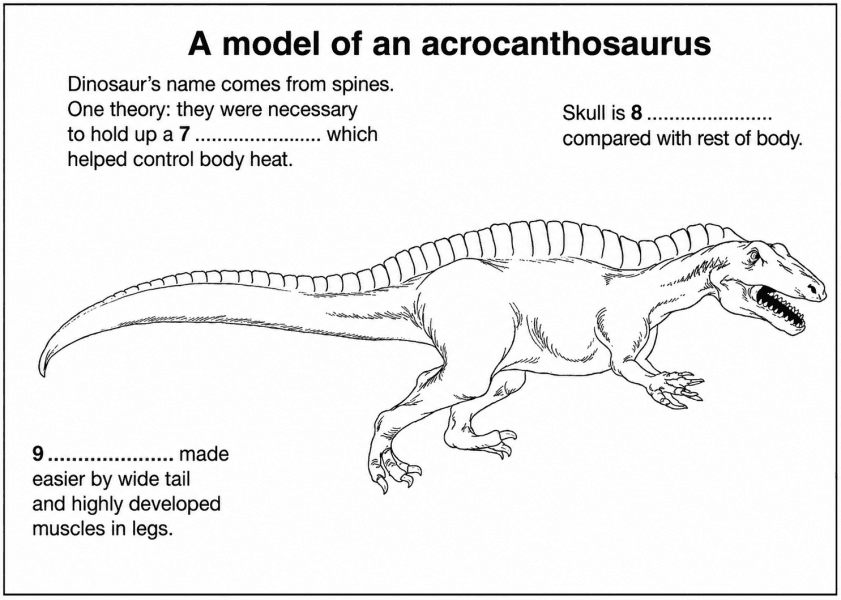
One theory: they were necessary to hold up a (7) ………………………… which helped control body heat.
Skull is (8) ………………………… compared with rest of body.
(9) ………………………… made easier by wide tail and highly developed muscles in legs.
Questions 10–13
Complete the flow-chart below. Write NO MORE THAN TWO WORDS for each answer.
Peter Falkingham's computer model
Mud is simulated with attention to its texture and thickness and how much (10) ………………………… it contains.
↓
Levels of (11) ………………………… are measured within the footprint.
↓
Multiple simulations relate footprints to different types of (12) ………………………….
↓
More accurate interpretation of (13) ………………………… is possible.
or are they?
[A] Can robots advance so far that they become the ultimate threat to our existence? Some scientists say no, and dismiss the very idea of Artificial Intelligence. The human brain, they argue, is the most complicated system ever created, and any machine designed to reproduce human thought is bound to fail. Physicist Roger Penrose of Oxford University and others believe that machines are physically incapable of human thought. Colin McGinn of Rutgers University backs this up when he says that Artificial Intelligence is like sheep trying to do complicated psychoanalysis. They just don't have the conceptual equipment they need in their limited brains.
[B] Artificial Intelligence, or AI, is different from most technologies in that scientists still understand very little about how intelligence works. Physicists have a good understanding of Newtonian mechanics and the quantum theory of atoms and molecules, whereas the basic laws of intelligence remain a mystery. But a sizeable number of mathematicians and computer scientists, who are specialists in the area, are optimistic about the possibilities. To them it is only a matter of time before a thinking machine walks out of the laboratory. Over the years, various problems have impeded all efforts to create robots. To attack these difficulties, researchers tried to use the 'top-down approach', using a computer in an attempt to program all the essential rules onto a single disc. By inserting this into a machine, it would then become self-aware and attain human-like intelligence.
[C] In the 1950s and 1960s great progress was made, but the shortcomings of these prototype robots soon became clear. They were huge and took hours to navigate across a room. Meanwhile, a fruit fly, with a brain containing only a fraction of the computing power, can effortlessly navigate in three dimensions. Our brains, like the fruit fly's, unconsciously recognise what we see by performing countless calculations. This unconscious awareness of patterns is exactly what computers are missing. The second problem is robots' lack of common sense. Humans know that water is wet and that mothers are older than their daughters. But there is no mathematics that can express these truths. Children learn the intuitive laws of biology and physics by interacting with the real world. Robots know only what has been programmed into them.
[D] Because of the limitations of the top-down approach to Artificial Intelligence, attempts have been made to use a 'bottom-up' approach instead – that is, to try to imitate evolution and the way a baby learns. Rodney Brooks was the director of MIT's Artificial Intelligence laboratory, famous for its lumbering 'top-down' walking robots. He changed the course of research when he explored the unorthodox idea of tiny 'insectoid' robots that learned to walk by bumping into things instead of computing mathematically the precise position of their feet. Today many of the descendants of Brooks' insectoid robots are on Mars gathering data for NASA (The National Aeronautics and Space Administration), running across the dusty landscape of the planet. For all their successes in mimicking the behaviour of insects, however, robots using neural networks have performed miserably when their programmers have tried to duplicate in them the behaviour of higher organisms such as mammals. MIT's Marvin Minsky summarises the problems of AI: 'The history of AI is sort of funny because the first real accomplishments were beautiful things, like a machine that could do well in a maths course. But then we started to try to make machines that could answer questions about simple children's stories. There's no machine today that can do that.'
[E] There are people who believe that eventually there will be a combination between the top-down and bottom-up, which may provide the key to Artificial Intelligence. As adults, we blend the two approaches. It has been suggested that our emotions represent the quality that most distinguishes us as human, that it is impossible for machines ever to have emotions. Computer expert Hans Moravec thinks that in the future robots will be programmed with emotions such as fear to protect themselves so that they can signal to humans when their batteries are running low, for example. Emotions are vital in decision-making. People who have suffered a certain kind of brain injury lose the ability to experience emotions and become unable to make decisions. Without emotions to guide them, they debate endlessly over their options. Moravec points out that as robots become more intelligent and are able to make choices, they could likewise become paralysed with indecision. To aid them, robots of the future might need to have emotions hardwired into their brains.
[F] There is no universal consensus as to whether machines can be conscious, or even, in human terms, what consciousness means. Minsky suggests the thinking process in our brain is not localised but spread out, with different centres competing with one another at any given time. Consciousness may then be viewed as a sequence of thoughts and images issuing from these different, smaller 'minds', each one competing for our attention. Robots might eventually attain a 'silicon consciousness'. Robots, in fact, might one day embody an architecture for thinking and processing information that is different from ours – but also indistinguishable. If that happens, the question of whether they really 'understand' becomes largely irrelevant. A robot that has perfect mastery of syntax, for all practical purposes, understands what is being said.
Questions 14–20
Reading Passage 2 has six paragraphs, A–F. Which paragraph contains the following information? Write the correct letter, A–F. You may use any letter more than once.
14. an insect that proves the superiority of natural intelligence over Artificial Intelligence
15. robots being able to benefit from their mistakes
16. many researchers not being put off believing that Artificial Intelligence will eventually be developed
17. an innovative approach that is having limited success
18. the possibility of creating Artificial Intelligence being doubted by some academics
19. no generally accepted agreement of what our brains do
20. robots not being able to extend their intelligence in the same way as humans
Questions 21–23
Look at the following people and the list of statements below. Match each person with the correct statement, A–E. Write the correct letter, A–E.
List of statements
A . Artificial Intelligence may require something equivalent to feelings in order to succeed.
B . Different kinds of people use different parts of the brain.
C . Tests involving fiction have defeated Artificial Intelligence so far.
D . People have intellectual capacities which do not exist in computers.
E . People have no reason to be frightened of robots.
21. Colin McGinn
22. Marvin Minsky
23. Hans Moravec
Questions 24–26
Complete the summary below. Choose ONE WORD ONLY from the passage for each answer.
24. When will we have a thinking machine? Despite some advances, the early robots had certain weaknesses. They were given the information they needed on a ………………………….
25. This was known as the 'top-down' approach and enabled them to do certain tasks but they were unable to recognise ………………………….
26. Nor did they have any intuition or ability to make decisions based on experience. Rodney Brooks tried a different approach. Robots similar to those invented by Brooks are to be found on ………………………… where they are collecting information.
Endangered languages
Worried about the loss of rainforests and the ozone layer? Well, neither of those is doing any worse than a large majority of the 6,000 to 7,000 languages that remain in use on Earth. One half of the survivors will almost certainly be gone by 2050, while 40% more will probably be well on their way out. In their place, almost all humans will speak one of a handful of megalanguages – Mandarin, English, Spanish.
Linguists know what causes languages to disappear, but less often remarked is what happens on the way to disappearance: languages' vocabularies, grammars and expressive potential all diminish as one language is replaced by another. 'Say a community goes over from speaking a traditional Aboriginal language to speaking a creole', says Australian Nick Evans, a leading authority on Aboriginal languages, 'you leave behind a language where there's very fine vocabulary for the landscape. All that is gone in a creole. You've just got a few words like "gum tree" or whatever. As speakers become less able to express the wealth of knowledge that has filled ancestors' lives with meaning over millennia, it's no wonder that communities tend to become demoralised.'
If the losses are so huge, why are relatively few linguists combating the situation? Australian linguists, at least, have achieved a great deal in terms of preserving traditional languages. Australian governments began in the 1970s to support an initiative that has resulted in good documentation of most of the 130 remaining Aboriginal languages. In England, another Australian, Peter Austin, has directed one of the world's most active efforts to limit language loss, at the University of London. Austin heads a programme that has trained many documentary linguists in England as well as in language-loss hotspots such as West Africa and South America.
At linguistics meetings in the US, where the endangered-language issue has of late been something of a flavour of the month, there is growing evidence that not all approaches to the preservation of languages will be particularly helpful. Some linguists are boasting, for example, of more and more sophisticated means of capturing languages: digital recording and storage, and internet and mobile phone technologies. But these are encouraging the 'quick dash' style of recording trip: fly in, switch on digital recorder, fly home, download to hard drive, and store gathered material for future research. That's not quite what some endangered-language specialists have been seeking for more than 30 years. Most loud and untiring has been Michael Krauss, of the University of Alaska. He has often complained that linguists are playing with non-essentials while most of their raw data is disappearing.
Who is to blame? That prominent linguist Noam Chomsky, say Krauss and many others. Or, more precisely, they blame those linguists who have been obsessed with his approaches. Linguists who go out into communities to study, document and describe languages, argue that theoretical linguists, who draw conclusions about how languages work, have had so much influence that linguists has largely ignored the continuing disappearance of languages.
Chomsky, from his post at the Massachusetts Institute of Technology, has been the great man of theoretical linguistics for far longer than he has been known as a political commentator. His landmark work of 1957 argues that all languages exhibit certain universal grammatical features, encoded in the human mind. American linguists, in particular, have focused largely on theoretical concerns ever since, even while doubts have mounted about Chomsky's universals.
Austin and Co. are in no doubt that because languages are unique, even if they do tend to have common underlying features, creating dictionaries and grammars requires prolonged and dedicated work. This requires that documentary linguists observe not only languages' structural subtleties, but also related social, historical and political factors. Such work calls for persistent funding of field scientists who may sometimes have to venture into harsh and even hazardous places. Once there, they may face difficulties such as community suspicion. As Nick Evans says, a community who speak an endangered language may have reasons to doubt or even oppose efforts to preserve it. They may have seen support and funding for such work come and go. They may have given up using the language with their children, believing they will benefit from speaking a more widely understood one.
Plenty of students continue to be drawn to the intellectual thrill of linguistics field work. That's all the more reason to clear away barriers, contend Evans, Austin and others. The highest barrier, they agree, is that the linguistics profession's emphasis on theory gradually wears down the enthusiasm of linguists who work in communities. Chomsky disagrees. He has recently begun to speak in support of language preservation. But his linguistic, as opposed to humanitarian, argument is, let's say, unsentimental: the loss of a language, he states, 'is much more of a tragedy for linguists whose interests are mostly theoretical, like me, than for linguists who focus on describing specific languages, since it means the permanent loss of the most relevant data for general theoretical work'. At the moment, few institutions award doctorates for such work, and that's the way it should be, he reasons. In linguistics, as in every other discipline, he believes that good descriptive work requires thorough theoretical understanding and should also contribute to building new theory. But that's precisely what documentation does, objects Evans. The process of immersion in a language, to extract, analyse and sum it up, deserves a PhD because it is 'the most demanding intellectual task a linguist can engage in'.
Questions 27–32
Do the following statements agree with the views of the writer?
YESif the statement agrees with the views of the writer
NOif the statement contradicts the views of the writer
NOT GIVENif it is impossible to say what the writer thinks about this
27. By 2050 only a small number of languages will be flourishing.
28. Australian academics' efforts to record existing Aboriginal languages have been too limited.
29. The use of technology in language research is proving unsatisfactory in some respects.
30. Chomsky's political views have overshadowed his academic work.
31. Documentary linguistics studies require long-term financial support.
32. Chomsky's attitude to disappearing languages is too emotional.
Questions 33–36
Choose the correct letter.
33. The writer mentions rainforests and the ozone layer
A because he believes anxiety about environmental issues is unfounded.
B to demonstrate that academics in different disciplines share the same problems.
C because they exemplify what is wrong with the attitudes of some academics.
D to make the point that the public should be equally concerned about languages.
34. What does Nick Evans say about speakers of a creole?
A They lose the ability to express ideas which are part of their culture.
B Older and younger members of the community have difficulty communicating.
C They express their ideas more clearly and concisely than most people.
D Accessing practical information causes problems for them.
35. What is similar about West Africa and South America, from the linguist's point of view?
A The English language is widely used by academics and teachers.
B The documentary linguists who work there were trained by Australians.
C Local languages are disappearing rapidly in both places.
D There are now only a few undocumented languages there.
36. Michael Krauss has frequently pointed out that
A linguists are failing to record languages before they die out.
B linguists have made poor use of improvements in technology.
C linguistics has declined in popularity as an academic subject.
D linguistics departments are underfunded in most universities.
Questions 37–40
Complete each sentence with the correct ending. Choose the correct answer and move it into the gap.
37. Linguists like Peter Austin believe that every language is unique
A even though it is in danger of disappearing.
B provided that it has a strong basis in theory.
C although it may share certain universal characteristics.
D because there is a practical advantage to it.
E so long as the drawbacks are clearly understood.
F in spite of the prevalence of theoretical linguistics.
G until they realise what is involved.
38. Nick Evans suggests a community may resist attempts to save its language
A even though it is in danger of disappearing.
B provided that it has a strong basis in theory.
C although it may share certain universal characteristics.
D because there is a practical advantage to it.
E so long as the drawbacks are clearly understood.
F in spite of the prevalence of theoretical linguistics.
G until they realise what is involved.
39. Many young researchers are interested in doing practical research
A even though it is in danger of disappearing.
B provided that it has a strong basis in theory.
C although it may share certain universal characteristics.
D because there is a practical advantage to it.
E so long as the drawbacks are clearly understood.
F in spite of the prevalence of theoretical linguistics.
G until they realise what is involved.
40. Chomsky supports work in descriptive linguistics
A even though it is in danger of disappearing.
B provided that it has a strong basis in theory.
C although it may share certain universal characteristics.
D because there is a practical advantage to it.
E so long as the drawbacks are clearly understood.
F in spite of the prevalence of theoretical linguistics.
G until they realise what is involved.
Answers
1. True
2. True
3. False
4. Not Given
5. False
6. Not Given
7. sail
8. narrow
9. locomotion
10. moisture
11. stress
12. ground
13. fossil tracks
14. C
15. D
16. B
17. D
18. A
19. F
20. C
21. D
22. C
23. A
24. disc
25. patterns
26. Mars
27. Yes
28. No
29. Yes
30. Not Given
31. Yes
32. No
33. because they exemplify what is wrong with the attitudes of some academics.
34. They lose the ability to express ideas which are part of their culture.
35. Local languages are disappearing rapidly in both places.
36. linguists are failing to record languages before they die out.
37. although it may share certain universal characteristics.
38. even though it is in danger of disappearing.
39. in spite of the prevalence of theoretical linguistics.
40. provided that it has a strong basis in theory.
Explanations
- 1. True
- The statement says Falkingham 'rarely spends time on outdoor research these days'. The passage first describes the stereotypical image of palaeontologists as 'field workers camped in the desert in the hot sun, carefully picking away at the rock', then says 'But Peter Falkingham has done little of that for a while now' — 'that' referring back to this outdoor fieldwork. Paraphrase: 'rarely spends time on outdoor research' = 'has done little of that ... for a while now'.Common trap: Requires tracking the reference 'that' back to the outdoor fieldwork described in the previous sentence rather than reading the sentence in isolation.
- 2. True
- The statement says 'several attempts are usually needed' before the model 'manages to stay upright'. The passage explains the model 'results almost without fail in the animal falling on its face', after which 'the computer alters the activation pattern and tries again ... usually to similar effect' — implying repeated failed attempts before eventual success. Paraphrase: 'several attempts are usually needed' = 'tries again ... usually to similar effect' (repeated failure); 'stay upright' = opposite of 'falling on its face'.Common trap: None significant — the repeated-failure process is directly described, though the reader must infer 'several attempts' from the repetition implied by 'tries again ... usually to similar effect'.
- 3. False
- The statement claims the model showed humans moving 'faster than they are physically able to'. The passage instead states that 'similar top speeds were achieved on the computer as in reality' — i.e. the model matched real-world human speeds, not exceeded them. Paraphrase: 'similar top speeds ... as in reality' contradicts 'faster than they are physically able to'.Common trap: Distorts a matching-result statement ('similar ... as in reality') into an exceeding-result claim ('faster than ... able to').
- 4. Not Given
- The statement claims 'some palaeontologists have expressed reservations' about the Manchester team's conclusions. The passage only states that the Manchester team itself 'can be confident in the results computed' — there is no mention anywhere of other palaeontologists doubting or criticising these conclusions.Common trap: None — confidence is expressed by the team, but no outside criticism is mentioned at all, so there is no basis to confirm or deny the statement.
- 5. False
- The statement claims analysing fossil footprints is 'as easy' as analysing live-animal tracks. The passage says modern trackers can readily identify facts from tracks of living animals, then explicitly contrasts this: 'But a fossil track poses a more considerable challenge to interpret in the same way.' Paraphrase: 'more considerable challenge' contradicts 'as easily as'.Common trap: Tempts the reader to assume tracking skill transfers equally to fossils, when the passage explicitly says fossil tracks are harder.
- 6. Not Given
- The statement claims research into prehistoric mud composition 'has been found to be inaccurate'. The passage describes Falkingham's simulation of mud properties (moisture, consistency) but never evaluates the accuracy of this or any other research into mud composition.Common trap: None — the passage describes the method used but makes no accuracy judgement, so there is no basis to confirm or deny the statement.
- 7. sail
- The label says the spines held up 'a _____ which helped control body heat'. The passage states 'the spines acted as a support for a sail' and 'the other half think it was used as a temperature-regulating device'. Paraphrase: 'helped control body heat' = 'temperature-regulating device'; the structure held up is 'a sail'.Common trap: 'hump' is a nearby distractor — the hump is said to have 'stored fat and water reserves', not regulated temperature; that role belongs to the sail.
- 8. narrow
- The label says the skull is '_____ compared with rest of body'. The passage states the skull 'seems out of proportion with its thick, heavy body because it is so narrow'. Paraphrase: 'compared with rest of body' = 'out of proportion with its thick, heavy body'; the missing word is 'narrow'.Common trap: 'thick' and 'heavy' describe the body, not the skull — a reader could wrongly copy one of those instead of 'narrow'.
- 9. locomotion
- The label says '_____ made easier by wide tail and highly developed muscles in legs'. The passage states 'It has a deep broad tail and powerful leg muscles to aid locomotion'. Paraphrase: 'made easier by' = 'to aid'; 'wide tail' = 'deep broad tail'; 'highly developed muscles in legs' = 'powerful leg muscles'; the missing word is 'locomotion'.Common trap: None significant — the answer is directly stated.
- 10. moisture
- The step says mud is simulated with attention to 'how much _____ it contains'. The passage states Falkingham controls 'the moisture content, consistency, and other conditions to simulate the mud'. Paraphrase: 'texture and thickness' = 'consistency'; the missing word is 'moisture'.Common trap: None significant — the answer is directly stated.
- 11. stress
- The step says 'Levels of _____ are measured within the footprint'. The passage states 'stress values can be extracted and calculated from inside it'. Paraphrase: 'levels of ... are measured' = 'values can be extracted and calculated'; the missing word is 'stress'.Common trap: None significant — the answer is directly stated.
- 12. ground
- The step says simulations relate footprints to 'different types of _____'. The passage states Falkingham can understand footprint types produced 'over a given kind of ground'. Paraphrase: 'multiple simulations' = 'hundreds of these simulations'; 'different types of' = 'a given kind of'; the missing word is 'ground'.Common trap: 'tracks' is a nearby distractor word but means the same as 'footprints', not the surface they are made on.
- 13. fossil tracks
- The step says 'more accurate interpretation of _____ is possible'. The passage states researchers 'can make sense of fossil tracks with greater confidence'. Paraphrase: 'more accurate interpretation ... is possible' = 'make sense of ... with greater confidence'; the missing words are 'fossil tracks'.Common trap: 'virtual tracks' is a nearby distractor — those are the simulated tracks used for comparison, not what is ultimately being interpreted with greater confidence.
- 14. C
- The paragraph contrasts a fruit fly's tiny brain with huge, slow early robots, showing natural intelligence outperforming Artificial Intelligence at navigation. Paraphrase: 'an insect that proves the superiority of natural intelligence' = the fruit fly example, 'with a brain containing only a fraction of the computing power, can effortlessly navigate in three dimensions'.Common trap: Paragraph D also discusses robots copying insect behaviour, but it does not name a specific insect proving natural intelligence is superior.
- 15. D
- The paragraph describes Brooks' insectoid robots learning to walk 'by bumping into things' — i.e. learning from their own mistakes rather than being pre-programmed. Paraphrase: 'benefit from their mistakes' = 'learned to walk by bumping into things'.Common trap: Other paragraphs mention robots' limitations and successes but none specifically describe learning through trial-and-error mistakes.
- 16. B
- The paragraph states many specialists remain 'optimistic about the possibilities' and believe a thinking machine is inevitable. Paraphrase: 'many researchers not being put off' = 'a sizeable number ... are optimistic'; 'will eventually be developed' = 'it is only a matter of time before a thinking machine walks out of the laboratory'.Common trap: Paragraph A describes researchers who doubt AI is possible — the opposite view — which could mislead a hasty reader.
- 17. D
- The paragraph presents Brooks' 'unorthodox' bottom-up approach as innovative, notes its real success (robots on Mars), but also its limits ('performed miserably' at mimicking mammals). Paraphrase: 'innovative approach' = the unorthodox insectoid-robot idea; 'having limited success' = successes with insects but failure with higher organisms.Common trap: Paragraph C also describes a limited-success approach (early top-down robots), but that is a past, largely abandoned method, not one still 'having' ongoing success today.
- 18. A
- The paragraph opens by questioning whether AI can ever be a real threat, then cites named academics (Penrose, McGinn) who doubt it is possible at all. Paraphrase: 'doubted by some academics' = 'Roger Penrose ... and others believe that machines are physically incapable of human thought'.Common trap: Paragraphs B, E and F all discuss AI's eventual development positively, and D describes past technical problems rather than academic doubt about the possibility itself.
- 19. F
- The paragraph opens by stating there is 'no universal consensus ... what consciousness means'. Paraphrase: 'no generally accepted agreement' = 'no universal consensus'; 'what our brains do' = 'what consciousness means'.Common trap: Paragraph B says 'the basic laws of intelligence remain a mystery', which is about intelligence being unexplained, not about disagreement over what the brain/consciousness does.
- 20. C
- The paragraph contrasts how children learn intuitively from the real world with robots, which 'know only what has been programmed into them' — i.e. robots cannot extend their knowledge the way humans do. Paraphrase: 'not being able to extend their intelligence' = 'know only what has been programmed into them'.Common trap: Paragraph D is about robots failing to copy higher-mammal behaviour, which is a different limitation from being unable to extend their own intelligence.
- 21. D
- McGinn compares AI to 'sheep trying to do complicated psychoanalysis' because machines 'don't have the conceptual equipment' humans have. Paraphrase: 'intellectual capacities which do not exist in computers' = 'conceptual equipment they need' that machines lack.Common trap: Option A (emotions) is a distractor associated with Moravec, not McGinn, who is talking about conceptual/intellectual capacity, not feelings.
- 22. C
- Minsky states that although early AI could handle maths, 'there's no machine today' that can answer questions about 'simple children's stories' — i.e. AI has so far failed tests involving fiction/stories. Paraphrase: 'tests involving fiction' = 'questions about simple children's stories'; 'defeated ... so far' = 'there's no machine today that can do that'.Common trap: Option B (different parts of the brain) is a distractor drawn from Minsky's separate comment elsewhere about the brain's thinking process, not about children's-story tests.
- 23. A
- Moravec argues robots will need 'emotions hardwired into their brains' to avoid becoming 'paralysed with indecision' when making choices. Paraphrase: 'something equivalent to feelings in order to succeed' = 'emotions hardwired into their brains' so robots can function/decide.Common trap: Option E (no reason to fear robots) is a distractor — Moravec discusses robots being programmed with fear themselves, not humans' fear of robots.
- 24. disc
- The summary says early robots 'were given the information they needed on a _____'. The passage describes the 'top-down approach': programming 'all the essential rules onto a single disc' which was then inserted into the machine. Paraphrase: 'given the information ... on a _____' = 'program all the essential rules onto a single disc'; the missing word is 'disc'.Common trap: 'computer' is a distractor — the computer is used to create/program the disc, but the information itself is stored and inserted via the disc, not the computer.
- 25. patterns
- The summary says early top-down robots 'were unable to recognise _____'. The passage states 'this unconscious awareness of patterns is exactly what computers are missing'. Paraphrase: 'unable to recognise' = 'awareness ... is exactly what computers are missing'; the missing word is 'patterns'.Common trap: 'common sense' is a distractor from the same paragraph, but it refers to a separate second problem (not being able to recognise), and is two words, so cannot fit 'ONE WORD ONLY'.
- 26. Mars
- The summary says robots similar to Brooks' are 'to be found on _____ where they are collecting information'. The passage states 'many of the descendants of Brooks' insectoid robots are on Mars gathering data for NASA'. Paraphrase: 'robots similar to those invented by Brooks' = 'descendants of Brooks' insectoid robots'; 'collecting information' = 'gathering data'; the missing word is 'Mars'.Common trap: 'NASA' is a distractor — that is the organisation the data is gathered for, not the location where the robots physically are.
- 27. Yes
- The writer states half of surviving languages 'will almost certainly be gone by 2050' and 40% more will be 'on their way out', leaving 'almost all humans' speaking just 'a handful of megalanguages'. Paraphrase: 'only a small number of languages will be flourishing' = 'a handful of megalanguages' will dominate while most others disappear or decline.Common trap: None significant — the writer's view is directly stated through the statistics given.
- 28. No
- The statement claims Australian efforts have been 'too limited'. The writer instead praises them: they 'have achieved a great deal' and produced 'good documentation of most of the 130 remaining Aboriginal languages'. Paraphrase: 'good documentation of most' contradicts 'too limited'.Common trap: The rhetorical question 'why are relatively few linguists combating the situation?' precedes this and could wrongly suggest criticism of Australians specifically, but the writer immediately exempts them with 'at least'.
- 29. Yes
- The writer says growing evidence shows 'not all approaches ... will be particularly helpful', then gives digital recording/internet/mobile technologies as the example, explaining they encourage a shallow 'quick dash' style of research. Paraphrase: 'proving unsatisfactory in some respects' = 'not all approaches ... will be particularly helpful' / encourages the inadequate 'quick dash' style.Common trap: None significant — the writer's negative assessment of over-reliance on these technologies is directly stated, though it requires reading beyond just the list of technologies to the following sentence.
- 30. Not Given
- The statement claims Chomsky's political views have 'overshadowed' (been more prominent than) his academic work. The passage only compares how long he has held each reputation ('for far longer than he has been known as a political commentator') — it does not say one has overshadowed or eclipsed the other in importance or fame.Common trap: The comparison of durations ('far longer') could be mistaken for a comparison of prominence, but the writer never states that the political persona has overshadowed the academic one.
- 31. Yes
- The writer states documentary linguistics 'calls for persistent funding of field scientists'. Paraphrase: 'require long-term financial support' = 'calls for persistent funding'.Common trap: None significant — the answer is directly stated.
- 32. No
- The statement claims Chomsky's attitude is 'too emotional'. The writer explicitly describes his argument as 'unsentimental' — the opposite of emotional — framing language loss in terms of lost theoretical data rather than humanitarian feeling. Paraphrase: 'unsentimental' contradicts 'too emotional'.Common trap: Chomsky has 'recently begun to speak in support of language preservation', which might suggest emotional investment, but the writer immediately clarifies his reasoning is 'unsentimental'.
- 33. because they exemplify what is wrong with the attitudes of some academics.
- The writer opens with these two well-known environmental concerns only to say language loss is at least as severe, implicitly criticising the fact that language loss receives far less attention/concern than these issues despite being comparably serious. This sets up the article's argument that academics and the public focus on the wrong things. Paraphrase: 'exemplify what is wrong with the attitudes of some academics' = using familiar, well-funded concerns (rainforests, ozone) as a contrast to draw attention to the neglected, comparably severe issue of language loss.Common trap: Distractors: A wrongly assumes the writer dismisses environmental concern (he does not call it 'unfounded', just compares it); B wrongly claims a shared-problems point between disciplines, which isn't made; D is close but describes public concern rather than the writer's actual rhetorical purpose of drawing a comparison to highlight neglect.
- 34. They lose the ability to express ideas which are part of their culture.
- Evans says a creole loses the 'fine vocabulary for the landscape' of the original language, leaving only a 'few words', so speakers 'become less able to express the wealth of knowledge that has filled ancestors' lives with meaning'. Paraphrase: 'lose the ability to express ideas which are part of their culture' = 'less able to express the wealth of knowledge that has filled ancestors' lives with meaning'.Common trap: Distractors: B (older/younger communication difficulty) and D (accessing practical information) are not mentioned; C reverses the meaning — the creole expresses ideas less clearly, not more.
- 35. Local languages are disappearing rapidly in both places.
- Both places are described as 'language-loss hotspots' — areas experiencing severe, rapid language loss, which is why Austin's programme trains documentary linguists there. Paraphrase: 'local languages are disappearing rapidly in both places' = 'language-loss hotspots'.Common trap: Distractors: A (English use by academics/teachers) and D (few undocumented languages) are not stated; B overstates the text — it says linguists were trained 'in England as well as' these hotspots, not that all hotspot linguists were trained by Australians.
- 36. linguists are failing to record languages before they die out.
- Krauss 'has often complained that linguists are playing with non-essentials [technology] while most of their raw data [languages] is disappearing' — i.e. linguists are not documenting/recording languages fast enough before they vanish. Paraphrase: 'failing to record languages before they die out' = 'playing with non-essentials while ... raw data is disappearing'.Common trap: Distractors: B is close but inverts blame — Krauss criticises the misuse/overemphasis of technology as a distraction, not technology use itself being poor; C and D (declining popularity, underfunded departments) are not mentioned.
- 37. although it may share certain universal characteristics.
- Austin (and colleagues) are 'in no doubt that ... languages are unique, even if they do tend to have common underlying features'. Paraphrase: 'unique ... although it may share certain universal characteristics' = 'unique, even if they do tend to have common underlying features'.Common trap: 'because there is a practical advantage to it' wrongly supplies a reason for uniqueness rather than the concession the sentence actually makes.
- 38. even though it is in danger of disappearing.
- Evans says a community speaking 'an endangered language' (i.e. one 'in danger of disappearing') 'may have reasons to doubt or even oppose efforts to preserve it'. Paraphrase: 'resist attempts to save its language' = 'oppose efforts to preserve it'; 'even though it is in danger of disappearing' = the language being 'endangered'.Common trap: 'until they realise what is involved' wrongly implies the community's opposition is due to ignorance that will later be corrected, which is not stated — the passage instead gives concrete reasons (funding coming and go, wanting children to speak a wider language) for their doubt.
- 39. in spite of the prevalence of theoretical linguistics.
- Students remain 'drawn to the intellectual thrill of linguistics field work' (practical research) despite the field's 'highest barrier': the profession's 'emphasis on theory' which 'wears down the enthusiasm' of field linguists. Paraphrase: 'in spite of the prevalence of theoretical linguistics' = 'in spite of' the profession's 'emphasis on theory'.Common trap: 'until they realise what is involved' wrongly suggests students' interest is naive and will fade once they learn the difficulties, which is not the point being made — the point is that interest persists despite the theory-focused barrier.
- 40. provided that it has a strong basis in theory.
- Chomsky believes 'good descriptive work requires thorough theoretical understanding and should also contribute to building new theory' — i.e. he supports descriptive work only on condition it is grounded in theory. Paraphrase: 'provided that it has a strong basis in theory' = 'requires thorough theoretical understanding'.Common trap: 'in spite of the prevalence of theoretical linguistics' wrongly casts theory as an obstacle for Chomsky, when in fact he sees strong theoretical grounding as a requirement/condition for good descriptive work, not something to be overcome.
Comments
Loading comments…