

Road to IELTS 1 Listening Test 5
4 parts · 40 questions · 30 minutes
Harry’s Hire Company
Questions 1–10
Complete the notes below. Write NO MORE THAN TWO WORDS AND / OR A NUMBER for each answer.
Harry’s Hire Company
Example – Hire for: birthday party
Equipment Hire:
Day and date of event: (1) ………………………… November
Number attending event: (2) …………………………
Rental:
• 5 dozen dinner plates, bowls
• 5 dozen sets of (3) …………………………
• 40 plastic (4) …………………………
• 4 dozen each small / medium glasses
• six (5) …………………………
Costings:
• Weekend Package: 5 p.m. Fri – 10 a.m. Mon: $1600 + tax
• (6) ………………………… Package: 5 p.m. Sat – 10 a.m. Mon: $1350 + tax
• (7) …………………………: $50 (within 10 km)
• Breakage Insurance: $60
Replacement costs:
• plates, bowls – $3.55 per item
• small glasses – $ (8) ………………………… per item
• medium glasses – $4.40 per item
Customer Details:
Full name: (9) …………………………
Address: 28B Sandstone Close, Martinsborough
Contact number: 084 (10) …………………………
Cave tour in Vietnam
Questions 11–15
Match the creatures to their behaviour. Write the correct letter, A, B, C or D next to each description.
Creatures
A swifts
B bats
C cockroaches
D centipedes
11. feed on the guardrail beside the path
12. are dangerous to people
13. collect in large groups
14. fly only at night
15. live on the roof of the cave
Questions 16–17
Answer the questions below. Write ONE WORD ONLY for each answer.
16. What is the guano from the caves used for?
17. What are the birds’ nests from the cave used for?
Questions 18–20
Complete the sentences below. Write NO MORE THAN TWO WORDS for each answer.
In the cave, you should:
• carry a (18) …………………………
• wear a (19) ………………………… and a hat
• keep to the (20) ………………………… at all times
Planning a school field trip
Questions 21–23
Choose ONE letter, A, B, or C.
21. Mary has been called in for a meeting because:
A she has been working too hard
B she has offered to lead an activity
C she is going on a training programme
22. The most important part of planning a field trip is:
A to organise activities for everyone
B to know about the official rules for field trips
C to think about and plan for problems
23. Leaders must develop:
A a tailored trip plan
B an adventure activities plan
C a hazard management plan
Questions 24–25
Complete the sentences below. Write NO MORE THAN TWO WORDS for each answer.
24. Mary’s plan must consider …………………………, such as local rain or wind, the land and the party members.
25. Mary’s plan does not need to consider things such as tropical storms or serious illnesses, which are known as ………………………….
Questions 26–30
Complete the notes below. Write NO MORE THAN TWO WORDS for each answer.
FIELD TRIP PLAN
FIELD TRIP PLAN:
WEATHER:
• everyone needs warm clothing and a (26) …………………………
ACTIVITIES
• hiking – first aid kit, map and a (27) …………………………
• avoid routes where an avalanche, mudslide or (28) ………………………… is possible
GROUP MEMBERS
• think about the fitness and (29) ………………………… of the group
• do not allow (30) ………………………… to be responsible for transport.
Cochlear implants
Questions 31–34
Label the diagrams below. Write NO MORE THAN TWO WORDS for each answer.
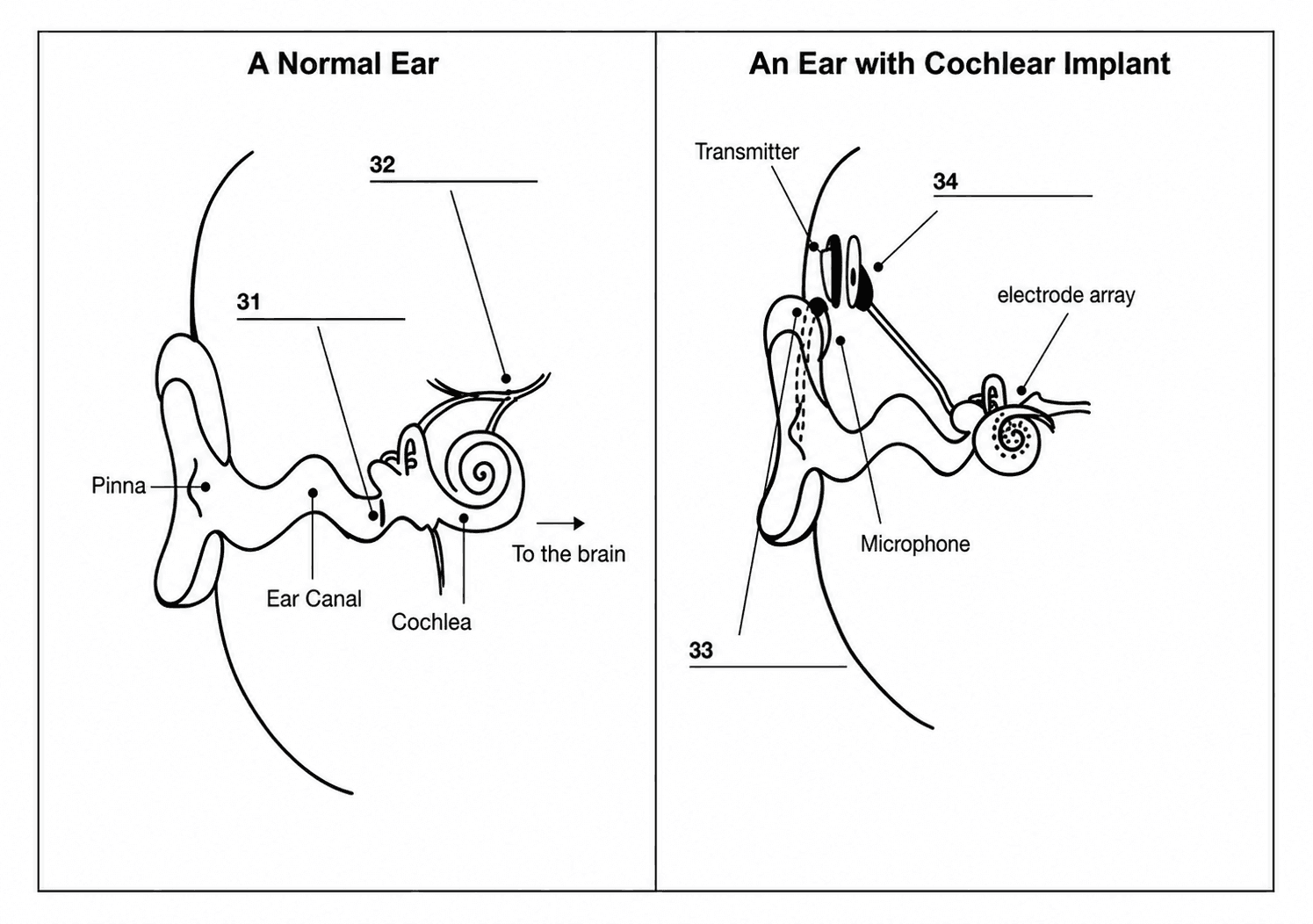
(31) …………………………
(32) …………………………
(33) …………………………
(34) …………………………
Questions 35–40
Complete the summary below. Write NO MORE THAN TWO WORDS for each answer.
35. Hearing aids ………………………… normal sounds, so they are good for mild hearing loss but not for severe loss.
36. Cochlear implants help some people a lot, but do not work so well for everyone. The brain gets different ………………………… from an implant, so users must relearn how to hear.
37. Cochlear implants are not a cure. Users need ongoing training in …………………………, lip-reading and sign language.
38. The surgery can damage nerves. It may also destroy any …………………………; in such cases, those users cannot go back to using a hearing aid.
39. The most important factor for selecting users is the ………………………… of their deafness, and also age and previous speaking ability.
40. Finally, the condition of the nerve cells in the cochlea is a factor, because ………………………… can damage these cells.
Answers
1. Saturday 25th
2. 55
3. knives and forks
4. garden chairs
5. ice buckets
6. same-day
7. home delivery
8. 3.50
9. Susan Millins
10. 3987695
11. C
12. D
13. B
14. B
15. A
16. fertiliser
17. soup
18. working light
19. waterproof jacket
20. marked trails
21. she has offered to lead an activity
22. to think about and plan for problems
23. a hazard management plan
24. significant factors
25. unlikely events
26. raincoat
27. compass
28. flash flood
29. experience
30. student drivers
31. ear drum
32. auditory nerve
33. speech processor
34. receiver
35. amplify
36. sound signals
37. speech therapy
38. natural hearing
39. duration
40. disease
Explanations
- 1. Saturday 25th
- The birthday itself is the 22nd, the clerk guesses the 18th, and she corrects him: 'I meant the following Saturday, the 25th.'Common trap: Three dates in a row – the 22nd (the actual birthday) and the 18th (the clerk's wrong guess) both come first.
- 2. 55
- 'We were planning to have about 40 people, but … it went up to 60 at one stage … I think it’s back to 55 now. Yes, that’s right.'Common trap: Number drift – 40 and 60 are both said before the confirmed figure.
- 3. knives and forks
- 'I suppose 5 dozen of everything, oh and knives and forks too, 5 dozen sets' – the plates and bowls are already printed on the line above.Common trap: Afterthought – the item is added with 'oh and … too' after the main list, and cooking equipment is ruled out straight afterwards.
- 4. garden chairs
- 'the most popular ones are just those stackable plastic garden chairs' / 'Yes, the plastic ones look great. Maybe 40 of those.'Common trap: Rejected alternative – folding wooden chairs are offered first, and tables are ruled out in the same exchange.
- 5. ice buckets
- 'Oh, I know, what about six ice buckets, for keeping the drinks cold?'Common trap: Nearby item ruled out – the punch bowl is mentioned immediately before and is being supplied by the caterers.
- 6. same-day
- 'you can collect the equipment on the day of the party before 5 p.m., and drop off on the Monday before 10 a.m., and that will be thirteen hundred and fifty dollars plus tax. That’s called the same-day package.'Common trap: Name comes last – the times and price are given first, and 'small and medium price packages' are mentioned right afterwards.
- 7. home delivery
- 'if you want us to drop off and pick up at your house, there is an extra home delivery charge of $50, provided you live within 10 km of here'.Common trap: Two charges in a row – the $60 breakage insurance follows immediately and is already printed on the next line.
- 8. 3.50
- 'tableware is $3.55 a piece, small glasses are $3.50 and medium glasses are $4.40'.Common trap: Near-identical figures – $3.55 (tableware) and $3.50 (small glasses) differ by five cents and are said one after the other; both other prices are already printed.
- 9. Susan Millins
- 'Oh, it’s Susan Millins.' / 'Um … Is that Miller?' / 'No, it’s M-I-L-L-I-N-S'.Common trap: Sound-alike surname – 'Miller' is offered by the clerk and rejected.
- 10. 3987695
- 'the phone number is 084 – 398 – 7695'. The 084 prefix is already printed.Common trap: Number cluster – the '10 km' radius and the '28B' address number are both nearby, and the digits are read in three groups.
- 11. C
- 'The guardrails along the trails are covered with these droppings, and this makes a feast for the cockroaches' – 'makes a feast for' = 'feed on'.Common trap: Droppings mentioned for several creatures – the guano comes from the birds and bats, but only the cockroaches eat it off the rails.
- 12. D
- 'Please, please do not try to pick one up though; these centipedes have a very nasty poisonous bite.'Common trap: Explicit reassurance elsewhere – the cockroaches are said to be startling but harmless: 'They will not harm you'.
- 13. B
- 'They will be clustered high up against the walls – maybe a hundred or two hundred together' – said of the dwarf bats.Common trap: Two 'hundred' references – the millipedes have 'a hundred or so closely packed legs' and the bamboo poles 'go a full hundred metres'.
- 14. B
- 'They sleep all day until they all leave the cave in a massive flock on their nightly hunt for flying insects' – the bats. The swifts are explicitly ruled out: 'they do not hunt at night'.Common trap: Near-miss timing – the swifts also fly out 'at dusk', but 'they tend to return before it is pitch black outside, and they do not hunt at night'.
- 15. A
- 'The swifts make nests, usually higher up on the ceiling of the cave' – 'ceiling' = 'roof'.Common trap: Both fly high – the bats are also 'high up', but against the walls, not the ceiling.
- 16. fertiliser
- 'The guano is very valuable as fertiliser, and so it’s collected each year'.Common trap: Word limit – ONE WORD ONLY, so 'as fertiliser for crops' or similar will not do.
- 17. soup
- 'These are even more valuable than the guano, as they are the main ingredient in bird’s nest soup.'Common trap: Reference back – 'These' refers to the swifts' nests two sentences earlier, and the bamboo poles are described in between.
- 18. working light
- 'that’s why I insisted that you bring a working light – please check that it shines brightly, and ensure that you stay together with others who have a good torch'.Common trap: Contrary advice nearby – 'It is best to turn your torches off if you can see well' follows, which can suggest the light is optional.
- 19. waterproof jacket
- 'It is a good idea to put your waterproof jacket on now … and of course, your hat or hood also keeps you safe from animal droppings.' The hat is already printed.Common trap: Wrong reason given first – 'The walls may be wet but that is not the main reason for the jacket'.
- 20. marked trails
- 'You absolutely must follow the marked trails' – 'follow' = 'keep to'.Common trap: Guardrails distractor – the rails are described in the same paragraph, but you are told NOT to use them as handholds.
- 21. she has offered to lead an activity
- The tutor's opening thanks names the reason directly: she volunteered to run the field trip project.Common trap: Everything in one speech – 'busy day studying' and 'training' both appear in the same opening turn as the real reason.
- 22. to think about and plan for problems
- 'but your main job is' marks the priority, and the two distractors are downgraded on either side of it.Common trap: Downgraded distractors – activities are what she is told to stop focusing on, and the regulations are called 'just a guideline'.
- 23. a hazard management plan
- All three phrases occur within a few lines; only the last is named as the document the leader creates.Common trap: Three plan-like phrases in a row – 'tailored', 'adventure trip' and 'hazard management plan' are all spoken in the same short turn.
- 24. significant factors
- Mary lists 'heavy rain, or high winds … and any dangers in the terrain' and the tutor names them: 'we call those the significant factors … and another important one is the make-up of your group'.Common trap: Label supplied after the examples – the term is given only once, in response to the student's list.
- 25. unlikely events
- 'There are some kinds of hazard you won’t need to think about at all: things like hurricanes, earthquakes, radioactivity, or major diseases such as cancer. The official name for those is unlikely events.'Common trap: Paraphrased examples – the sentence says 'tropical storms' and 'serious illnesses' where the transcript says 'hurricanes' and 'major diseases such as cancer'.
- 26. raincoat
- 'people can get into trouble in the hills if they don’t bring extra layers of clothes and a jacket … Oh … and a raincoat, too, of course.' The 'extra layers' are the warm clothing already printed.Common trap: Afterthought – 'jacket' is said first and belongs with the warm clothing; the raincoat is added as a separate item.
- 27. compass
- 'for hiking of course we need a first aid kit. Oh … and a decent topographic map of the area … Ah … and I suppose a compass, too.' The kit and map are already printed.Common trap: Long digression – a stretch about map-reading, rivers and contour lines separates the map from the compass.
- 28. flash flood
- 'the trouble you can get into where there’s a possibility of an avalanche or a mudslide … or a flash flood, if you’re anywhere near rivers'. The first two hazards are already printed.Common trap: Long hazard list – falling 2.5 metres, tides and high waves are all named in the same sentence before the three-item run.
- 29. experience
- 'You need to take into account the physical strength and experience of the party as a whole' – 'physical strength' = 'fitness', 'the party' = 'the group'.Common trap: Paired nouns – the printed 'fitness' paraphrases 'physical strength', so only the second noun is missing.
- 30. student drivers
- 'don’t use inexperienced volunteers, and don’t allow student drivers to bring their own cars, or to drive anyone else’s car'.Common trap: Two prohibitions in one sentence – 'inexperienced volunteers' comes first but is not the transport rule.
- 31. ear drum
- 'sounds … are then channelled through the ear canal to the eardrum, where they are transformed into mechanical vibrations'. Label 31 points to the structure at the inner end of the ear canal.Common trap: Printed neighbours – pinna, ear canal and cochlea are all already labelled on the diagram.
- 32. auditory nerve
- 'The inner ear cells transfer this information to the auditory nerve, and thence to the brain' – label 32 points to the pathway leaving the cochlea, above the printed 'To the brain' arrow.Common trap: Adjacent printed label – 'To the brain' is already on the diagram, so the answer is the nerve, not the brain.
- 33. speech processor
- 'The first, external part, behind the ear itself, is the microphone and, at the back of this, you can see its associated speech processor, which is a tiny computer.' Microphone and transmitter are both already printed on the diagram.Common trap: Three external parts – microphone and transmitter are named in the same passage and are already labelled.
- 34. receiver
- 'just under the skin, directly behind the transmitter, is a surgically-implanted receiver'. Label 34 points to the component behind the transmitter.Common trap: Positional description – the transmitter and the electrode array are both already labelled, and the receiver sits between them in the description.
- 35. amplify
- 'In cases of mild hearing loss, hearing aids can be very helpful. They simply amplify the normal sound waves as they travel down the ear canal. However, they generally cannot overcome severe hearing difficulties.'Common trap: Verb form – the summary needs the plain verb, and 'make soft sounds louder' from the earlier ear description is a tempting paraphrase.
- 36. sound signals
- 'The sound signals that the brain receives from an implant are quite different from normal ones, and this means that the user has to relearn how to hear.'Common trap: Word limit – 'magic bullet' and 'robotic' surround the answer, and the two-word noun phrase is easy to shorten wrongly.
- 37. speech therapy
- 'The user must learn to reinterpret sounds, and will likely need to augment this with speech therapy … they still need to learn to lip-read and to use sign language.' The other two items are already printed.Common trap: Three-item list – lip-reading and sign language are printed, but they are said after the answer, not before.
- 38. natural hearing
- 'the surgery may remove any natural hearing that the deaf person still retains. This takes away the possibility of using a hearing aid should the implant not be effective.'Common trap: Two surgical risks – 'damage to facial nerves' is stated first and is already covered by the printed sentence.
- 39. duration
- 'The most significant one appears to be the duration of the deafness, and … those who have been deaf for a long time generally have lower success rates.'Common trap: Ranked factors – age at onset and prior speech are named as the second factor and are already printed in the summary.
- 40. disease
- 'recent research is exploring how the spiral ganglion, or nerve cells are affected by disease' – 'affected by' = 'damaged by'.Common trap: Technical term nearby – 'spiral ganglion' is the name of the cells, not the cause of the damage.
Audio transcripts
Part 1 — Harry’s Hire Company
MAN: Hello, welcome to Harry’s Hire Company. How can I help you? WOMAN: Oh, hi, yes, I’ve come in to find out about renting stuff for a 21st birthday party. MAN: Yes, of course … First of all, what date is the party? WOMAN: It’s next Saturday. That was the closest we could get to the actual birthday, which is the 22nd of November. Gosh, it’s hard to believe it was 21 years ago, seems like yesterday … MAN: So, the 18th of November? WOMAN: No, sorry, I meant the following Saturday, the 25th. MAN: OK, we have just about everything here; tableware, marquees … you name it, we rent it! What size of event are we talking about here? WOMAN: Yes, that’s a good question. We were planning to have about 40 people, but you know how these things grow and it went up to 60 at one stage … umm … I think it’s back to 55 now. Yes, that’s right. It was all getting a bit out of hand. MAN: Ok, and what kind of catering and entertainment are you having? We can help with entertainment hire, too, you know, if you need microphones or a sound system. WOMAN: Oh, that’s good! We’ve booked a catering company, and they’re providing a meal. It’s nothing elaborate, just finger food snacks and then a simple buffet meal, so we’ll need all the usual dinner plates and bowls … I suppose 5 dozen of everything, oh and knives and forks too, 5 dozen sets. We won’t need any cooking equipment, because the caterers will do that, and they’re providing tea and coffee as well. MAN: I see, and do you need any tables or chairs. WOMAN: Well, not tables, because we wouldn’t have room for them, but I suppose some extra chairs might come in handy. What type do you have? MAN: Come over here and I’ll show you. We have a couple of different kinds. We do have folding wooden ones, like these, but the most popular ones are just those stackable plastic garden chairs, we rent a lot of those… WOMAN: Yes, the plastic ones look great. Maybe 40 of those. MAN: Ok … I’m making a list here as we speak. Was there anything else? Oh, do you want small or medium glasses? People generally want both sizes. WOMAN: Yep, better get both kinds. Four dozen of each. Umm … and what else? The caterers are supplying a punch bowl, so that’s OK. Oh, I know, what about six ice buckets, for keeping the drinks cold? We’re providing all the drinks, because I have a friend who is helping us with that. Umm … I suppose this is going to get very expensive. MAN: Well, let’s talk about our packages and rental deals. Firstly … what day do you want to collect the equipment? WOMAN: Oh, I’m not sure. Does that make a difference to the price? MAN: Well … the weekend package deal is to pick up after 5 p.m. on Friday, and drop off before 10 a.m. on Monday. That will be sixteen hundred dollars plus tax. If you want to save a bit of money, you can collect the equipment on the day of the party before 5 p.m., and drop off on the Monday before 10 a.m., and that will be thirteen hundred and fifty dollars plus tax. That’s called the same-day package. Your party numbers come between our small and medium price packages, I’m afraid, so in fact you could rent a few extra of everything for the same price. WOMAN: I see. Well, we’re not inviting more guests! I think we have quite enough already … umm … are there any other hidden charges with those packages? MAN: No, not really. But if you want us to drop off and pick up at your house, there is an extra home delivery charge of $50, provided you live within 10 km of here. Oh, and if you want to take out breakage insurance, that’s a $60 flat fee. Otherwise, you pay for every item you break, at the replacement cost. WOMAN: Wow, so how much is that then? I bet that soon adds up. MAN: Well, yes, it does a bit. Let’s see … tableware is $3.55 a piece, small glasses are $3.50 and medium glasses are $4.40. Oh, and if you break a chair, they’re expensive: $15 each, and you’d be surprised what happens when the party gets going! WOMAN: Yes, insurance sounds like a good idea, and I think I’ll take the weekend package deal, thanks, it’s much more convenient, isn’t it? And not much more expensive. MAN: OK, so let’s take a few details then. Your name? WOMAN: Oh, it’s Susan Millins. MAN: Um … Is that Miller? WOMAN: No, it’s M-I-L-L-I-N-S MAN: Right. And your address please? WOMAN: 28B Sandstone Close, Martinsborough MAN: And just to confirm the order; the medium-size party weekend package with breakage insurance, and did you want to collect this yourself? WOMAN: Yes, thank you. I do live within 10 km, but I don’t want to pay any extra charges. I’ll get my son to help me. MAN: OK, we’ll need an emergency contact number, just in case anything goes wrong. Oh, and credit card details, of course. WOMAN: Oh, yes, of course, the phone number is 084 – 398 – 7695 MAN: OK, thank you, and now the credit card …
Part 2 — Cave tour in Vietnam
GUIDE: Good morning, everyone. Welcome to our visit to one of the most famous caves in Vietnam. As you know, this cave is famous for its wildlife, and one of the creatures you will observe in here is the small cave cockroach. They live mostly on the bird and bat droppings that are so plentiful in the caves. The guardrails along the trails are covered with these droppings, and this makes a feast for the cockroaches, so be careful where you put your hands. They will not harm you, but it can be a shock if you touch them! Once you are in one of the main caves, look out for the green centipedes. They will not be on the trail but can often be seen on the wall close by. They feed on other insects and are fascinating to look at because of their colour, and, of course, their many legs. Please, please do not try to pick one up though; these centipedes have a very nasty poisonous bite. There are also deep red millipedes. These have a fully rounded shape, and they look like a streamlined elongated train with a hundred or so closely packed legs extending right and left. When you get to the large high caves, you should look right up above you for the swifts and bats. The bats in this cave are mostly a type of dwarf bat, which are common in this part of the world. They will be clustered high up against the walls – maybe a hundred or two hundred together. They look like shadows high on the walls of the cave. They are likely to be very quiet right now, but because there are so many of them together you will have no difficulty identifying them. They sleep all day until they all leave the cave in a massive flock on their nightly hunt for flying insects. The swifts are the creatures you can see flying around during the day, especially if they have young ones to feed. They can navigate in the darkness here, and will fly outside in ones and twos at dusk to catch small winged insects like mosquitoes. However they tend to return before it is pitch black outside, and they do not hunt at night. The swifts make nests, usually higher up on the ceiling of the cave. The paths tend to run around the edges of the large caves. Mostly this is because the centre is a mound of guano – the bird and bat droppings. This is also the source of the strong smell inside the caves. You may not like this smell, but the locals know its economic value. They have harvested the products of these caves for centuries. The guano is very valuable as fertiliser, and so it’s collected each year, once the young birds have grown and the swifts have abandoned their nests. The guano is not the only valuable by-product of the wildlife here. As you travel through the caves, you will notice some bamboo structures. These very flimsy looking sets of poles that go a full hundred metres, right up to the roof, are what the locals climb up to gather the swift’s nests. These are even more valuable than the guano, as they are the main ingredient in bird’s nest soup. Before you begin, it’s time for some safety instructions. As you probably know, this is a huge limestone cave that goes about one kilometre back into the hills and in places it’s a hundred metres in height and three hundred metres wide. There is no need to crawl around in here as you do in other caves, but it is dark inside, of course … that’s why I insisted that you bring a working light – please check that it shines brightly, and ensure that you stay together with others who have a good torch. In one of the larger areas of the cave, the roof is pierced so some sunlight will get through. It is best to turn your torches off if you can see well, and save your batteries. It is a good idea to put your waterproof jacket on now. The walls may be wet but that is not the main reason for the jacket. The bats and birds do excrete, and they are above you, so just in case … and of course, your hat or hood also keeps you safe from animal droppings. It’s not advisable to use the guardrails as handholds. There are lots of droppings on those rails, and don’t forget the cockroaches! You absolutely must follow the marked trails. The guardrails on either side are put there so that you cannot mistake them. We take no responsibility for your safety if you go over or under the rails into other cave areas. Keep your torches shining on the path whenever you are moving, just to be sure of your footing, and don’t try to go too fast. You might trip, and you will certainly miss some of the fascinating wildlife in the cave. Now it’s time to begin the tour …
Part 3 — Planning a school field trip
STUDENT: Hello, Mr Hadstone. Is this the right time for our meeting? TUTOR: Yes, it is. Thanks for coming in at such a late hour, Mary. I know you’ve had a busy day studying and will be keen to get home … and thanks for volunteering to run this project. It’s going to help you develop and practise skills needed by teachers today. Field trips are getting more and more a part of school life, so as a student of education it’ll be wonderful training for you. It’s really a great opportunity. STUDENT: We did loads of field trips at school, so I’ve got a good idea of what sort of things we could do. TUTOR: Hmm, I expect so, but we’re here to go through the basics of planning one, and the trip leader carries a load of responsibility. Right now, you’re focusing on activities, but your main job is to consider the dangers, and come up with ways of countering or avoiding them. There are lots of government regulations you won’t have been aware of on your school trips, but they are just a guideline for your own planning … some of those school trips you went on would have been pretty adventurous, right? STUDENT: Yeah. TUTOR: OK, and your plan needs to be tailored to the kind of trip you’re doing. On a well-planned and successfully led adventure trip, we don’t often hear of problems … even though sometimes there’s bad weather, for example, that a school party has managed to combat. That’s because the leader created a well thought out hazard management plan. STUDENT: Oh, I thought I’d just be taking my mates out on a trek – now it’s all paperwork! TUTOR: Yes, well, that’s why I called you in. We’ll work on this together over the next few days – I just wanted to give you a heads-up on what you’ll need to think about. There are some aspects that every trip needs to consider. What do you think they might be? STUDENT: Uh … well … heavy rain, or high winds, I guess, and any dangers in the terrain … TUTOR: Yes, we call those the significant factors … and another important one is the make-up of your group. But, you don’t need to go overboard. There are some kinds of hazard you won’t need to think about at all: things like hurricanes, earthquakes, radioactivity, or major diseases such as cancer. The official name for those is unlikely events, because they almost certainly won’t happen. TUTOR: OK, so let’s consider the hazards seen as most likely on a field trip into the countryside. Weather causes real problems – overexposure to the sun or the cold – even the wind can have a big impact. And, of course, the weather can change very suddenly and without warning. STUDENT: Yes, people can get into trouble in the hills if they don’t bring extra layers of clothes and a jacket – even if they start walking on a hot day. Oh … and a raincoat, too, of course. Umm … what’s next then? TUTOR: Well, let’s think about possible activities and what you might need. STUDENT: Yes, OK … Well, for hiking of course we need a first aid kit. Oh … and a decent topographic map of the area. And we need to make sure that more than one person can read it. I’ve run into lots of difficulties in the past with people who can’t identify even major features, like rivers. And some people have no idea about contour lines. Ah … and I suppose a compass, too. TUTOR: You’d need to list those. Then there are things that may be obvious, but must be written down and considered seriously. For example, if there’s a possibility of falling more than 2.5 meters, that’s considered life threatening, and I’m sure you would be aware of problems near the sea, like tides or high waves – and the trouble you can get into where there’s a possibility of an avalanche or a mudslide … or a flash flood, if you’re anywhere near rivers. STUDENT: Yes, well, I was thinking of an adventurous route for this trip … you know, that’s always more fun, and it’s such a cool feeling when you’ve achieved something really difficult. TUTOR: Yes, OK, but then you need to consider who’s going to be in your party … don’t go and plan things that are beyond the reach of most people, or you’re asking for trouble. You need to take into account the physical strength and experience of the party as a whole. When you make your groups, make sure there’s at least one person in each one who’s been hiking a few times before. STUDENT: Wow, there’s a lot to write down, isn’t there? I’m really keen to get started now. TUTOR: Well, good, because there’s a lot more detail to consider. For now, I’ll just mention two more of the common hazards for high school trips, in particular. STUDENT: Yes? TUTOR: The Ministry of Education website says – don’t use inexperienced volunteers, and don’t allow student drivers to bring their own cars, or to drive anyone else’s car, for that matter. STUDENT: Well … now I really have something to think about! Thanks, Mr Hadstone.
Part 4 — Cochlear implants
LECTURER: The topic for today’s lecture is cochlear implants, which are a relatively new form of technology for assisting people who are profoundly deaf. First, let’s revise how normal hearing works. If you look at image 1, you will remember that the ear has three sections. The outer ear, or pinna, picks up sounds, which are then channelled through the ear canal to the eardrum, where they are transformed into mechanical vibrations. These are sent to the cochlea, or inner ear. Inside this snail-shaped tube, there are sensory hearing cells that have a variety of functions. The outer hair cells make soft sounds louder, and reduce the volume of louder sounds. The inner ear cells transfer this information to the auditory nerve, and thence to the brain, which interprets the input as sounds. This sophisticated and sensitive process allows us to process a huge variety of auditory input. For those who are profoundly deaf, the system functions poorly or not at all, and the brain does not receive the input it needs to process and interpret sounds. Image 2 shows how a cochlear implant works. You can see that the implant has three main parts. The first, external part, behind the ear itself, is the microphone and, at the back of this, you can see its associated speech processor, which is a tiny computer. This analyses and digitises sounds and sends them to the transmitter, which is worn on the head. Those sounds need to be converted into electrical impulses so that they can be sent to the cochlea. If you look carefully at the image, you can see that just under the skin, directly behind the transmitter, is a surgically-implanted receiver. This receives the sounds from the transmitter. It converts these sounds into electrical impulses, which are sent directly to an electrode array that is implanted inside the cochlea itself, thus completely bypassing the ear canal. As you have seen, a cochlear implant does not operate in the same way as the ear, nor, in fact, as a hearing aid. In cases of mild hearing loss, hearing aids can be very helpful. They simply amplify the normal sound waves as they travel down the ear canal. However, they generally cannot overcome severe hearing difficulties, and this is where cochlear implants come into play. So, what are the pros and cons of using a cochlear implant? Well, firstly, cochlear implants can deliver significant improvements in hearing for some users, and some people report dramatic improvements in the perception of individual words and sentences over the weeks and months after an implant. However a cochlear implant is not a magic bullet that works equally well for all users. The sound signals that the brain receives from an implant are quite different from normal ones, and this means that the user has to relearn how to hear. Many users report that speech sounds robotic after a cochlear implant, and the degree to which people can adjust to this new kind of hearing varies hugely with each user and situation. It is important to understand that a cochlear implant is not a cure for deafness, and that the user is still deaf. Especially for a child, an implant is a long-term commitment, involving lengthy and intensive training. The user must learn to reinterpret sounds, and will likely need to augment this with speech therapy, so that people in the community can easily communicate with them. The implants work much better in quiet situations than in noisy ones, so they still need to learn to lip-read and to use sign language. The surgery itself is not without risk, though it has greatly improved since it was first performed, and there is some possibility of damage to facial nerves. Another disadvantage of a cochlear implant, is that the surgery may remove any natural hearing that the deaf person still retains. This takes away the possibility of using a hearing aid should the implant not be effective. For this reason, many users have implant surgery performed on only one ear, the one with the least natural hearing. So, who is best suited to receiving an implant? Many factors impact on this decision. The most significant one appears to be the duration of the deafness, and, as you would expect, those who have been deaf for a long time generally have lower success rates. The second, related factor is how old the patient was when they became deaf, and maybe more significantly, whether they had learned to speak before they became deaf. Those who become deaf post-lingually generally have better outcomes. Another factor is the health and structure of the cochlea, and how many nerve cells the user retains. This is related to the cause of the hearing loss, and recent research is exploring how the spiral ganglion, or nerve cells are affected by disease. OK, let’s now move on to discuss the long-term prognosis for …
Comments
Loading comments…