

Road to IELTS 1 Listening Test 3
4 parts · 40 questions · 30 minutes
Second-hand bedroom furniture
Questions 1–5
Complete the notes below. Write NO MORE THAN ONE WORD AND/OR A NUMBER for each answer.
Second-hand Bedroom Furniture for Sale
Example: Number of items for sale: three
Bedside tables
Construction: wood
Colour: (1) …………………………
Drawers: two (in each table)
handles made of (2) …………………………
Height: (3) ………………………… cm
Condition: (4) …………………………
Price: (5) ………………………… (for both)
Questions 6–10
Complete the notes below. Write NO MORE THAN ONE WORD AND/OR A NUMBER for each answer.
Dressing table
Drawers: five (two are (6) …………………………)
Width: (7) …………………………
Mirrors: three: one large, two small (all (8) …………………………)
Condition: good
Price: (9) …………………………
Seller’s details
Name: Carolyn Kline
Address: 19 (10) ………………………… Road
Sports Super Centre tour
Questions 11–17
Label the plan below. Write the correct letter, A–J.
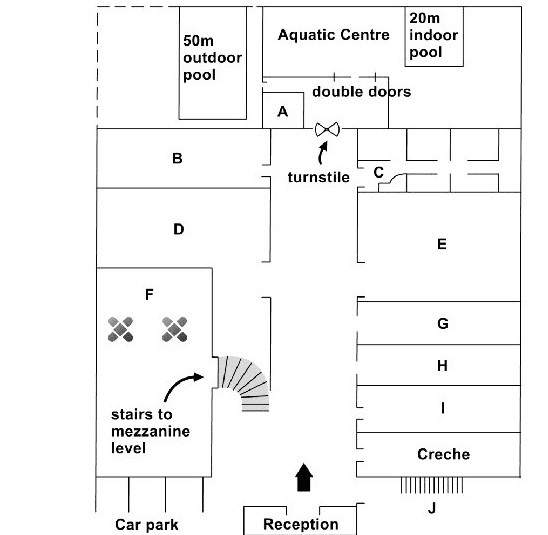
11. Administration office
12. Sports medicine clinic
13. Bike racks
14. Café
15. Conference room
16. Men’s locker room
17. Pool shop
Question 18
Choose the correct letter, A, B or C.
18. The sports centre is open on public holidays from
A 7 a.m. to 5 p.m.
B 5 a.m. to 7 p.m.
C 5 a.m. to 9 p.m.
Questions 19–20
Choose TWO letters, A–E. Which TWO services are covered by the membership fee?
19. Service covered (lower letter)
A Personal training
B Swim squads
C Childminding
D Programme design
E Tennis lessons
20. Service covered (higher letter)
A Personal training
B Swim squads
C Childminding
D Programme design
E Tennis lessons
Publishing an article in a journal
Questions 21–25
Complete the notes below. Write NO MORE THAN TWO WORDS for each answer.
Part One – Checklist:
• Write an (21) ………………………… – keep it brief.
• List relevant (22) ………………………….
• Have two academic advisors read over your (23) ………………………….
• Choose the journal you want to submit to.
• Apply the journal’s (24) ………………………… to your article.
• Sign the (25) ………………………….
Questions 26–30
Complete the flow-chart below. Write NO MORE THAN TWO WORDS for each answer.
Part Two – Process
Submit (26) …………………………
↓
Check e-mail for (27) ………………………… of submission
↓
(28) …………………………
↓
Acceptance or (29) …………………………
↓
Conditional acceptance or Revise & resubmit
↓
Revise & send back with a (30) …………………………
Soil science and organic farming
Questions 31–33
Complete the summary below. Write NO MORE THAN TWO WORDS for each answer.
31. If soil is healthy, it is a ………………………… teeming with life such as worms, fungi and bacteria.
32. If plants are grown in poor soil, they will lack ………………………… and human health will suffer.
33. Plants are nourished by organic matter, ………………………… and other essential elements which are broken down by insects and other organisms in a synergistic relationship.
Questions 34–36
Label the diagram below. Write NO MORE THAN TWO WORDS for each answer.
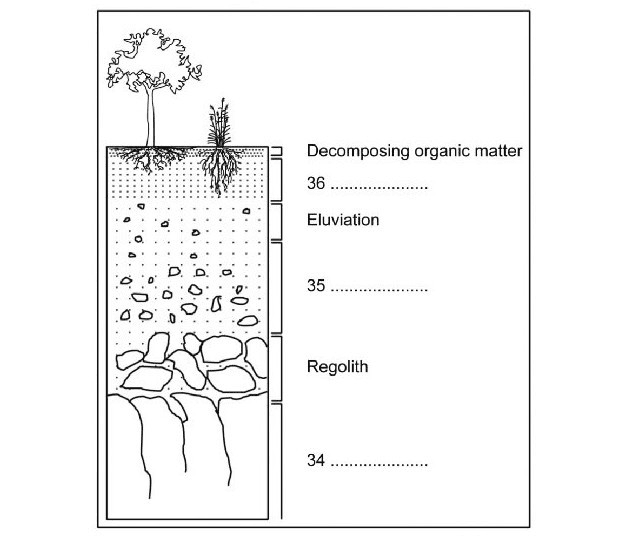
Layers of Soil
(34) …………………………
(35) …………………………
(36) …………………………
Question 37
Complete the notes below. Write NO MORE THAN TWO WORDS for each answer.
Problems:
• Erosion
• (37) ………………………… from various sources, including chemical fertilisers
Questions 38–40
Complete the notes below. Write NO MORE THAN TWO WORDS for each answer.
| Conventional farming methods | Organic farming methods |
|---|---|
| • monoculture | • crop rotation |
| • synthetic fertiliser & chemicals used for _____ | • covering crops |
| • genetically-modified seeds | • use of insects as natural (40) ………………………… |
| • pesticide & fungicide sprayed on crops after picking | • addition of manure & green waste |
| • no need for documentation of _____ | — |
Answers
1. cream
2. brass
3. 65
4. perfect
5. £30
6. deep
7. 1.25 metres
8. adjustable
9. £50
10. Domain
11. H
12. C
13. J
14. F
15. B
16. I
17. A
18. 7 a.m. to 5 p.m.
19. Programme design
20. Tennis lessons
21. abstract
22. key words
23. final draft
24. style guide
25. copyright form
26. manuscript
27. confirmation
28. peer review
29. rejection
30. cover letter
31. living entity
32. nutrients
33. minerals
34. bedrock
35. subsoil
36. topsoil
37. pollution
38. pest control
39. production practices
40. predator
Explanations
- 1. cream
- 'they’re made of wood – but the wood has been painted, it’s not brown anymore, it’s been painted cream'. 'wood' is already printed as the construction, so the gap is the paint colour.Common trap: Colour correction – 'brown' is named first and explicitly withdrawn.
- 2. brass
- 'the drawers have square brass handles' – 'brass' is the material; 'square' is the shape.Common trap: Adjective pile-up – 'square' comes first and describes shape, not material.
- 3. 65
- The man asks specifically 'how tall they are' and is told '65 centimetres high and 45 centimetres deep'.Common trap: Three dimensions – 50 cm (width) and 45 cm (depth) are both given nearby; only the height is wanted.
- 4. perfect
- 'They’re in perfect condition – there isn’t a mark on them'.Common trap: Adjacent adjective – the finish being 'much better than you’d normally expect' follows and could be mistaken for the condition word.
- 5. £30
- 'fifteen pounds each would be a fair price, but I’ve decided that I’ll only sell them together, as a pair, so that means the price is thirty pounds all up.' The note asks for the price 'for both'.Common trap: Per-item vs pair – 'fifteen pounds each' is stated first and is the price for one table only.
- 6. deep
- 'Five altogether. Um … the bottom two drawers hold more as they’re deep.' The number five is already printed.Common trap: Position-vs-property – 'bottom' describes where they are, not what makes them different in the note.
- 7. 1.25 metres
- Asked 'how wide is it?', she answers 'it’s … ah, 1.25 metres across'.Common trap: Approximation first – the man guesses 'a metre and a half' and she says 'just under' before giving the figure.
- 8. adjustable
- 'It has three mirrors – you know … a central one and a narrower one on each side. And they’re all adjustable.' The number and sizes are already printed.Common trap: Detail overload – the sizes and positions are described first and are already in the note.
- 9. £50
- 'it’s still in good condition so I’m asking fifty pounds' – this is the dressing table's own price.Common trap: Two prices in the section – the bedside tables' thirty pounds was given earlier in the same call.
- 10. Domain
- 'And I live at 19 Domain Road' – the man mishears it and she spells it out: 'No, Domain – D-O-M-A-I-N Road.'Common trap: Sound-alike – 'the main road' is offered by the man and corrected.
- 11. H
- The women's locker room and the men's locker room are on the same side of the corridor, and the office sits between them: 'It’s separated from the men’s locker room by an office which the staff mainly use for administrative purposes.' On the plan that is H, between G (women's) and I (men's).Common trap: Positional, not named – the room is never called an administration office; it is located only by what lies either side of it.
- 12. C
- 'these rooms on our right are all part of the sports medicine clinic' – said just before the turnstile, so it is the room to the right of the turnstile, C.Common trap: Plural rooms – 'these rooms' covers one lettered area, and the long list of practitioners can distract from the location.
- 13. J
- 'instead of leaving their bikes outside there, on your right, where the secure bike stands are' – on the right as you come in from reception, which is J.Common trap: Left/right pairing – the car park on the left is mentioned in the same sentence and occupies the opposite corner.
- 14. F
- 'Opposite that, on your left, there’s a staircase leading to the mezzanine floor … you’ll also find a coffee shop and snack bar' – the lettered area containing the staircase is F.Common trap: Upstairs facility – the café itself is on the mezzanine, so it has to be located by the staircase that leads to it.
- 15. B
- 'As we continue down the corridor past the main hall, on the same side, there is a conference room.' The main hall is on the same side as the stairs (the left), so the conference room is the next area along on that side, B.Common trap: Chained references – 'the same side' refers back to the hall, which itself was located as 'the same side of the corridor as the stairs'.
- 16. I
- 'After the crèche, on the same side of the corridor, is the male locker room with showers, spa and sauna.' The crèche is labelled on the plan, and the area immediately before it on that side is I.Common trap: Identical facilities – the women's locker room is described with exactly the same list (showers, spa and sauna) a few lines later.
- 17. A
- 'Let’s go through the turnstile ahead of us … turn left, past the pool shop' – A is the small room just past the turnstile on the left, inside the aquatic centre.Common trap: Mentioned twice – the pool shop is passed again on the way back ('Let’s go back past the pool shop'), which can suggest a second location.
- 18. 7 a.m. to 5 p.m.
- Public holidays are not given their own hours; they are told to follow Sunday's, which are stated at the end of the same passage as 7 a.m. to 5 p.m.Common trap: Indirect reference – the public-holiday hours are never stated directly; you must carry 'Sunday’s timetable' to the end of the paragraph. All three options are real timetables.
- 19. Programme design
- 'Entitled to' is the marker for what the fee covers; anything sent to reception or the website 'for prices' is charged separately.Common trap: Entitled-vs-priced – all five services exist at the centre, but three are explicitly attached to extra prices.
- 20. Tennis lessons
- 'Entitled to' is the marker for what the fee covers; anything sent to reception or the website 'for prices' is charged separately.Common trap: Entitled-vs-priced – all five services exist at the centre, but three are explicitly attached to extra prices.
- 21. abstract
- 'firstly, you need to write an abstract. Make sure it’s short and concise.' 'short and concise' = 'keep it brief'.Common trap: Article agreement – the note prints 'an', which already signals a vowel-initial word.
- 22. key words
- 'take some time to make a list of key words that are accurate and relevant' – 'make a list of' = 'list', and 'relevant' is repeated in the note.Common trap: Wrong-attitude distractor – what students do wrong ('just jot down whatever comes to mind') is described first.
- 23. final draft
- 'at least two senior staff members should always read through a final draft, before submission' – 'senior staff members' = 'academic advisors', 'read through' = 'read over'.Common trap: Paraphrased subject – 'academic advisors' never appears; the transcript says 'senior staff members' and names Professor Johnson.
- 24. style guide
- 'you’ll need to adjust your article so that it matches the style guide of the journal you are submitting to' – 'adjust … so that it matches' = 'apply … to your article'.Common trap: Reversed possession – the transcript says 'the style guide of the journal', the note says 'the journal’s ___'.
- 25. copyright form
- 'you’ll have to sign the copyright form – just confirming that it’s your own work'.Common trap: Word limit – 'copyright' alone is not the whole item; the note asks what is signed.
- 26. manuscript
- 'the first thing is to just send it off. You’ve got to send in the manuscript before anything else can happen.' 'send in' = 'submit'.Common trap: Vague first mention – 'just send it off' comes before the noun is actually named.
- 27. confirmation
- 'log onto your e-mail regularly because you will get a submission confirmation once they have processed the manuscript' – 'submission confirmation' is inverted in the chart as 'confirmation of submission'.Common trap: Expectation trap – Jeremy assumes the e-mail will carry comments, and is told 'no comments yet'.
- 28. peer review
- 'The next stage is what is known as peer review. This is when experts in the field review your manuscript and decide whether to accept it.'Common trap: Method-vs-stage – the 'double-blind method' is described straight afterwards and names the procedure, not the stage.
- 29. rejection
- 'there are four possible outcomes. You might get an acceptance … You could also get a rejection, but these don’t happen very often either.' Acceptance is already printed, so the paired outcome is rejection.Common trap: Four outcomes in one answer – conditional acceptance and revise & resubmit are named next and belong to the other branch of the chart.
- 30. cover letter
- 'so I just fix the things that need changing and present it again?' / 'Yes, but include a cover letter that discusses the changes you have made.'Common trap: Answer in the reply, not the question – the required extra item is added by the supervisor after Jeremy's summary.
- 31. living entity
- 'Most people think of it just as a substrate (or medium) in which plants grow, but it’s more than that, it’s actually a living entity – or it should be if it’s healthy'.Common trap: Rejected definition – 'substrate (or medium)' is offered first as what most people wrongly think.
- 32. nutrients
- 'plants grown in poor soil will have few nutrients to pass on to the consumer, whose well-being will be worse-off over the long term' – 'have few' = 'lack'.Common trap: Litotes – 'have few nutrients' has to be read as 'lack nutrients'.
- 33. minerals
- 'Some nutrients are made up of minerals from the earth, while others come from dead plant and animal matter … Plants depend on these little living creatures to convert minerals and other vital elements into a utilisable form.' 'vital elements' = 'essential elements'.Common trap: Already-printed neighbour – 'dead plant and animal matter' is the summary's 'organic matter' and is stated in the same breath.
- 34. bedrock
- 'Let’s start at the bottom – this is the bedrock under all the other layers.' Label 34 is the lowest layer on the diagram.Common trap: Bottom-up order – the speaker works upwards, the opposite of the way the diagram reads.
- 35. subsoil
- 'Moving up the chart, to the next layer, we come to the subsoil which contains clay and mineral deposits.' Regolith (printed) sits between the bedrock and the subsoil.Common trap: Printed neighbours – regolith below and eluviation above are both already on the diagram.
- 36. topsoil
- 'As we get near the surface, we find the topsoil … It’s the most important layer of all because it’s where seeds germinate and roots grow.' Label 36 sits just below the decomposing organic matter at the top.Common trap: Top-of-chart confusion – the thin decomposing-organic-matter layer described last is above the topsoil and is already printed.
- 37. pollution
- 'soil quality can be affected by pollution due to anything from industrial waste to the artificial fertilisers used by conventional farmers' – 'anything from … to …' = 'from various sources'.Common trap: Sequenced problems – erosion is named in the sentence before and is already printed above.
- 38. pest control
- 'It relies on chemicals for fertiliser and pest control.' 'fertiliser' is already printed in the note, so the gap is the second use.Common trap: Paired uses – 'fertiliser' is the first of the two and already appears in the printed text.
- 39. production practices
- 'there is no requirement for conventional growers to maintain records of their production practices' – 'no requirement … to maintain records' = 'no need for documentation'.Common trap: Double paraphrase – both 'no need' and 'documentation' are reworded, so the sentence is easy to skip.
- 40. predator
- 'Organic farmers often release beneficial insects as predators which precludes the need for artificial pesticides.' 'as predators' = 'as natural ___'.Common trap: Nearby insect reference – crop rotation is also said to interrupt 'the problem insects’ life cycles', which is a different strategy.
Audio transcripts
Part 1 — Second-hand bedroom furniture
WOMAN: Hello, Carolyn speaking. MAN: Hello. My name is Lincoln Farraday and I’m ringing to see if you still have the bedroom furniture that you advertised for sale? WOMAN: Yes, there are three items left – two bedside tables and a dressing table. MAN: Oh, good. They’re just the items I’m after. Tell me, what’s the construction of the bedside tables – I mean, what are they made of? WOMAN: Well, they’re a matching pair and they’re made of wood – but the wood has been painted, it’s not brown anymore, it’s been painted cream. MAN: I see. WOMAN: Each table has a shelf and 2 drawers. Oh, and the drawers have square brass handles – quite modern and quite nice really. MAN: And what about the dimensions? WOMAN: Well, each table is 50 centimetres wide … MAN: That’s good, much bigger than that and they wouldn’t fit beside my bed. I live in an apartment where the bedrooms are quite small. What I really need to know is how tall they are – you see my bed’s quite high. WOMAN: 65 centimetres high and 45 centimetres deep. MAN: Thanks. Just a couple more questions about the bedside tables, what condition are they in and how much are they? WOMAN: They’re in perfect condition – there isn’t a mark on them, you know. I had them painted professionally, you see, so the finish is much better than you’d normally expect. As for how much … well, I guess … I think fifteen pounds each would be a fair price, but I’ve decided that I’ll only sell them together, as a pair, so that means the price is thirty pounds all up. MAN: Now, can you tell me about the dressing table? WOMAN: Yes, it matches the other tables in colour and style. MAN: Good – how many drawers does it have? WOMAN: Five altogether. Um … the bottom two drawers hold more as they’re deep. MAN: Mmm … and the dimensions – how wide is it? That’s all I need to know – it wouldn’t be more than a metre and a half, would it? WOMAN: Well, just under actually … it’s … ah, 1.25 metres across. MAN: Does it have a mirror? WOMAN: Three. MAN: Sorry? WOMAN: It has three mirrors – you know … a central one and a narrower one on each side. And they’re all adjustable. MAN: I see – and the overall condition of the dressing table? WOMAN: Well, it has a couple of scratches on the surface but it’s still in good condition so I’m asking fifty pounds. MAN: Could I call round and have a look later today? WOMAN: What time were you thinking of? MAN: In about half an hour … WOMAN: Oh, yes, that’s fine. By the way, my name is Carolyn Kline – it’s on the gate at the front of the house. MAN: Kline – is that K-L-I-N-E? WOMAN: That’s right. And I live at 19 Domain Road. MAN: Did you say the main road? WOMAN: No, Domain – D-O-M-A-I-N Road. MAN: That’s just off Ash Grove, isn’t it? WOMAN: Yes. See you soon then … MAN: Yes, in about 30 minutes.
Part 2 — Sports Super Centre tour
SPEAKER: It’s so nice to see so many people here on our Open Day – I hope you’ll be impressed by what you see and that you’ll all decide to join up. We have tried to cover all aspects of sport and fitness here at the Centre. Well, let’s start, shall we? As we’re standing here at reception looking down the long corridor, you’ll notice the car park on your left (where most of you have parked) asks you to reverse into the parking spaces (for safety reasons). Also, this morning, a couple of keen potential members rode their bikes right in through the door instead of leaving their bikes outside there, on your right, where the secure bike stands are. Um … you may be wondering why there are so many mothers arriving with little children – as we proceed, you’ll see that this first room on your right is a crèche, where you can leave your little ones for up to two hours and they’ll be expertly supervised while you work out. After the crèche, on the same side of the corridor, is the male locker room with showers, spa and sauna. Opposite that, on your left, there’s a staircase leading to the mezzanine floor. You’ll not only get a great view out over the playing field, but you’ll also find a coffee shop and snack bar selling a range of wholesome food and drinks – protein shakes, fruit smoothies … that kind of thing. We won’t go up the stairs at this point – I’ll give you some time later when you can explore at your leisure. Most of you in the group are women … so next, let me point out the women’s locker room (which has the same facilities as the men’s – you know, things like showers, spa and sauna). It’s separated from the men’s locker room by an office which the staff mainly use for administrative purposes. As we move on, on the same side of the corridor as the stairs, you’ll see the entrance to the main hall, where they hold yoga classes, aerobics, and so on. On the wall here there is a timetable of all group classes and it is updated regularly. Now, opposite the hall is the gymnasium itself. Go ahead – have a look. Impressive isn’t it? Very spacious, light and airy with all the most modern equipment. As we continue down the corridor past the main hall, on the same side, there is a conference room. This is mainly used when the centre is hosting a big sports event of some kind – it gives the officials a quiet place to gather and have meetings and so on. You’ll have seen the 400 metre athletics track on your way in, beside the car park … we have some pretty big athletics conventions here. Well, after a strenuous workout, I bet there’s nothing you’d like more than a swim … in the aquatic complex. But first, these rooms on our right are all part of the sports medicine clinic where you have access to a doctor, physiotherapist, massage therapist, podiatrist and even a sports psychologist if you need one. Of course you’ll need to make appointments, but if you have any questions, just pop in and see the clinic receptionist and she’ll help you out. Okay. Let’s go through the turnstile ahead of us … and here we are … in the aquatic centre … turn left, past the pool shop where you can buy or hire goggles, swim caps and such like … and we’re outside … poolside. Beautiful, isn’t it? Especially on a day like today … go on, dip your toes in the water – and if that’s not warm enough for you, then I’ll take you to the indoor pool which is less than half the size but heated to 32 degrees. Let’s go back past the pool shop and through the double doors to the indoor pool. Well, that’s all I have time to show you. Let’s go back to the reception area and, if you like, we can run through some details about opening hours, membership and so on. Now, in this brochure, you’ll see the opening hours: the centre is open 7 days, from 5 a.m. to 9 p.m. Monday to Friday except for Public Holidays which follow Sunday’s timetable. On Saturdays we open at the same time as weekdays and close a little earlier: so that’s 5 a.m. to 7 p.m. on Saturdays; and on Sundays everyone gets a sleep-in – you can come in between 7 a.m. and 5 p.m. Membership fees cover access to the gym, group classes and the pool but if you want to join a swim squad to train with a coach, you should enquire at reception for prices and timetables. In the gym, personal training is available from one of our dedicated team of trainers and reception will have more information on who is free when, and what hourly rates apply. However, there is always a certificated instructor on hand in the gym at all times for advice and help and once your membership is paid you are entitled to a free health assessment and you’ll get a programme designed to meet your own particular needs. You’ll need to book a time for this with the gym instructor. Now, if you’re a mum or dad, remember you can leave your children in the crèche – they take babies from six weeks old – bookings are essential though and you’ll have to check the website for times and pricing. Members are also entitled to tennis lessons on a Tuesday or Thursday from 9 till 10.30, but bookings are essential so ring Natalie (her number is here in the brochure) to reserve a place. Well, I think that’s it. Any questions?
Part 3 — Publishing an article in a journal
SUPERVISOR: So, you’re nearly ready to submit your article to an academic journal, are you? JEREMY: Yes, I think so. I just wanted to go over all the things I need to do before I submit it. And then I wanted to go over the submission process with you. SUPERVISOR: Great. So, firstly, you need to write an abstract. Make sure it’s short and concise. JEREMY: Of course, I forgot all about that. And what about key words? SUPERVISOR: Yes, a lot of students overlook this part and just jot down whatever comes to mind. But take some time to make a list of key words that are accurate and relevant. JEREMY: Okay. Another thing, could you have a look at my article before I submit it? SUPERVISOR: Absolutely. Actually, at least two senior staff members should always read through a final draft, before submission. Do you mind if I give it to Professor Johnson to have a look at, as well? JEREMY: Not at all. I’d be glad to have the feedback. SUPERVISOR: Do you know which journal you want to submit to yet? JEREMY: Not yet. I have a shortlist of about three that I’m interested in. SUPERVISOR: Make that decision soon. Because you’ll need to adjust your article so that it matches the style guide of the journal you are submitting to. JEREMY: I bet that can take a while. SUPERVISOR: Yes, but after that you are just about ready to submit. One more thing, you’ll have to sign the copyright form – just confirming that it’s your own work – and then you’re good to go. JEREMY: Now, the submission process. How does it work exactly? SUPERVISOR: Well, the first thing is to just send it off. You’ve got to send in the manuscript before anything else can happen. JEREMY: Sure. And then should I call to check if they have received it? SUPERVISOR: No need for that, no, all you have to do is just log onto your e-mail regularly because you will get a submission confirmation once they have processed the manuscript. JEREMY: And that will have comments on what they thought of it? SUPERVISOR: No, no comments yet – that e-mail is just to let you know they have received it. The next stage is what is known as peer review. This is when experts in the field review your manuscript and decide whether to accept it. JEREMY: Aagh, they’ll never accept me. I’m only a Master’s student! SUPERVISOR: Don’t worry about that, Jeremy. It’s all done through a double-blind method. That means that whoever reads your manuscript has no idea whether you are a grad student or a Nobel Prize laureate. They’ll only be judging your work, not you. JEREMY: Well that’s good to hear. And then what, once they’ve made their decision? SUPERVISOR: Well, there are four possible outcomes. You might get an acceptance. But a first-off acceptance is very, very rare. Don’t pin your hopes on it. You could also get a rejection, but these don’t happen very often either. I don’t think this will be a problem. JEREMY: What do you think I’ll get? SUPERVISOR: If you’re very lucky, you’ll get a conditional acceptance. This means that they’ve accepted the article and it will be published, but you need to tweak a few things first: a sentence here, a heading there, nothing major. JEREMY: That sounds good. SUPERVISOR: But, to be honest, you will probably end up with a revise & resubmit. This means they are definitely interested, but you will need to rework the paper before it’s accepted. The necessary changes will be outlined by the reviewers. JEREMY: Okay, so I just fix the things that need changing and present it again? SUPERVISOR: Yes, but include a cover letter that discusses the changes you have made. The same goes for a conditional acceptance, actually. It helps the reviewers see that you’ve taken their criticism seriously.
Part 4 — Soil science and organic farming
Welcome to this talk on soil science and organic farming. Dirt, soil, earth, loam, mud or dust – it doesn’t matter what you call it – is of primary importance in the production of food and other crops. Most people think of it just as a substrate (or medium) in which plants grow, but it’s more than that, it’s actually a living entity – or it should be if it’s healthy – and human health is affected by the health of the soil. Healthy, living soil is literally crawling with life – there are the obvious earthworms, which burrow in the soil and help to aerate and improve it, beetles and other hard-backed insects, and various invertebrates like centipedes. Then there are fungi and bacteria – also living forms. Healthy soil needs food, air and water to help plants grow … and the more nutrients in plants, the more available for humans and livestock. It stands to reason, therefore, that plants grown in poor soil will have few nutrients to pass on to the consumer, whose well-being will be worse-off over the long term. So, where do plants get their nourishment? Most of it comes from the soil. Some nutrients are made up of minerals from the earth, while others come from dead plant and animal matter which is broken down over time by the living insects and other organisms in the soil. Plants depend on these little living creatures to convert minerals and other vital elements into a utilisable form that can be taken up by the plants. And it’s a synergistic relationship – in turn, the plants assist those helpful organisms by releasing sugars and enzymes back into the soil. Before I go any further, let’s take a look at the structure of soil. Now … if you look at the diagram, you’ll see that soil is made up of many different layers. Let’s start at the bottom – this is the bedrock under all the other layers. The layer above that is called regolith – here the bedrock is slightly broken up but plant roots don’t penetrate this layer. Moving up the chart, to the next layer, we come to the subsoil which contains clay and mineral deposits. On top of that, is the eluviation (or leaching) layer … this is quite light in colour and is mostly just sand and silt. As we get near the surface, we find the topsoil. You will hear a lot of talk about topsoil amongst farmers and other agriculturalists. It’s the most important layer of all because it’s where seeds germinate and roots grow. Now, at the top of the chart, you will see a comparatively thin layer – this is organic matter that is still in the process of decomposition. It mostly consists of leaf litter and humus – just think of the surface of the forest floor – partly-decayed leaves and twigs – that sort of thing. As you can imagine, good soil forms very slowly over time but it can be lost very rapidly through erosion. And, in addition, soil quality can be affected by pollution due to anything from industrial waste to the artificial fertilisers used by conventional farmers which have been shown to suppress the diverse life forms in the soil. This is why organic agriculture is the way of the future. Let’s take a quick look at the conventional system, which is often based on monoculture – the production of a single large crop. It relies on chemicals for fertiliser and pest control. It is also becoming an increasingly common practice to use genetically-engineered seeds. And more chemicals are used to control insects and fungi which attack crops in storage and during transportation. Also, did you know that there is no requirement for conventional growers to maintain records of their production practices? Organic growers, on the other hand, choose the most environmentally-friendly options for dealing with pests and disease problems, working towards prevention in the first place. Some of the strategies they employ include alternating the crops grown in each field (as opposed to mono-cropping). Because different plants add different nutrients to the soil, by rotating crops, the soil is naturally replenished. This can do away with the need for pesticides, because the problem insects’ life cycles are naturally interrupted. Surrounding crops with green waste can not only conserve moisture in the soil, but it can prevent weeds from springing up and it also feeds the beneficial micro-organisms. When it’s ploughed under, it feeds the soil by building more organic matter. Organic farmers often release beneficial insects as predators which precludes the need for artificial pesticides. Animal manure combined with green waste materials, correctly composted (to kill pathogens and weed seeds), fertilises the soil in a way that encourages life rather than suppressing it. And, by the way, use of manure in organic farming is highly regulated – in fact, all agricultural inputs are evaluated for their long-term effects on the environment, regardless of whether they are synthetic or natural. To sum up, organic farming is the only sustainable way of feeding the people on this planet and keeping both the planet and the people in good health.
Comments
Loading comments…