

Practice Tests Plus 1 Listening Test 4
4 parts · 40 questions · 30 minutes
Entering a dragon boat race
Questions 1–10
Complete the notes below. Write NO MORE THAN THREE WORDS and/or A NUMBER for each answer.
Event Details
Type of event: Example Dragon Boat Race
Race details
Day & date: (1) …………………………
Place: Brighton (2) …………………………
Registration time: (3) …………………………
Sponsorship
• aim to raise over £ (4) ………………………… as a team and get a free t-shirt
• free Prize Draw for trip to (5) …………………………
Team details
• must have crew of 20 and elect a (6) …………………………
• under 18s need to have (7) ………………………… to enter
• need to hire (8) …………………………
• advised to bring extra (9) …………………………
• must choose a (10) ………………………… for the team
The kiwi and the Kiwi Recovery Programme
Questions 11–15
Complete the notes below. Use NO MORE THAN THREE WORDS for each answer.
KIWI FACT SHEET
Pictures of kiwis are found on (11) ………………………… .
The name 'kiwi' comes from its (12) ………………………… .
The kiwi has poor sight but a good (13) ………………………… .
Kiwis cannot (14) ………………………… .
Kiwis are endangered by (15) ………………………… .
Questions 16–17
Complete the notes below. Use NO MORE THAN THREE WORDS for each answer.
Kiwi Recovery Program
| Stage of program | Program involves |
|---|---|
| _____ | Looking at kiwi survival needs |
| Action | Putting science into practice |
| _____ | Schools and the website |
Questions 18–20
Complete the flow chart below. Use NO MORE THAN THREE WORDS or A NUMBER for each answer.
OPERATION NEST EGG
(18) ………………………… are collected
↓
chicks are (19) …………………………
↓
Chicks returned to wild
↓
Survival rate increased from 5% to (20) …………………………%
Tutorial on highways and public transport
Questions 21–24
Circle the correct letters A–C.
21. The professor says that super highways
A lead to better lifestyles.
B are a feature of wealthy cities.
C result in more city suburbs.
22. The student thinks people
A like the advantages of the suburbs.
B rarely go into the city for entertainment.
C enjoy living in the city.
23. The professor suggests that in five years' time
A a City Link will be choked by traffic.
B public transport will be more popular.
C roads will cost ten times more to build.
24. The student believes that highways
A encourage a higher standard of driving.
B result in lower levels of pollution.
C discourage the use of old cars.
Questions 25–26
Label the two bars identified on the graph below. Choose your answers from the box and write them next to Questions 25–26. List of cities: Detroit, Frankfurt, London, Paris, Sydney, Toronto
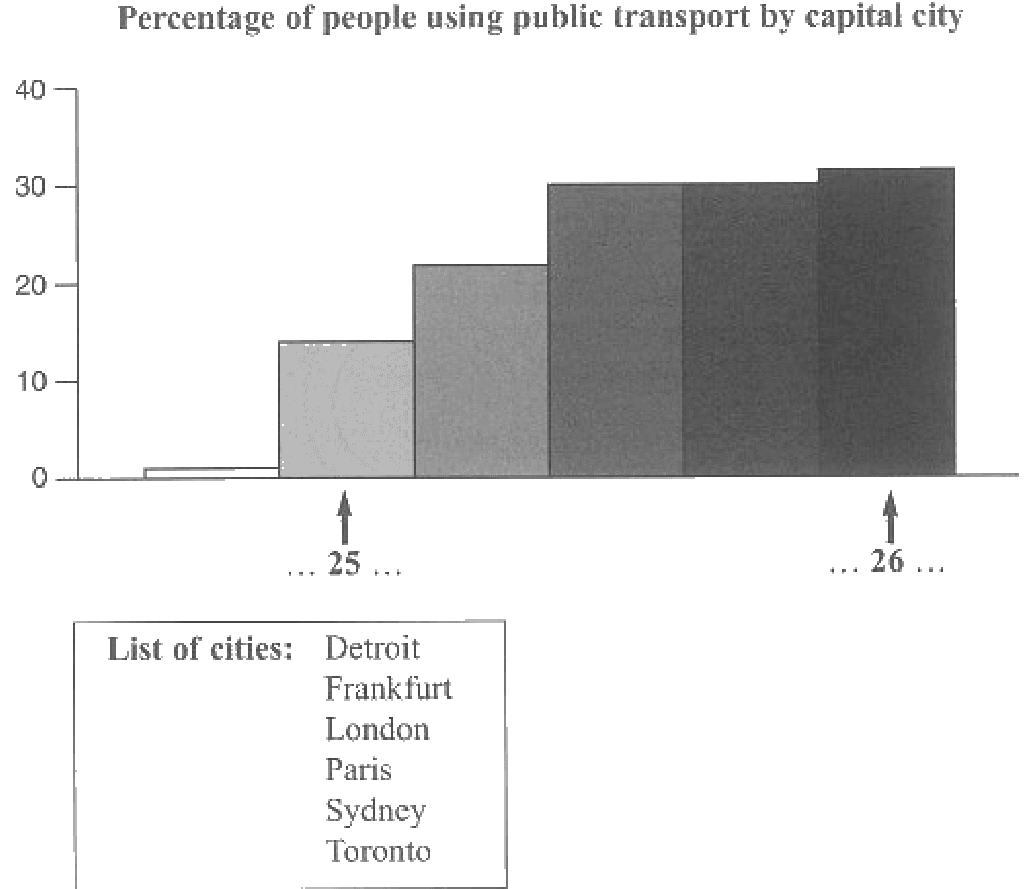
Percentage of people using public transport by capital city
(25) …………………………
(26) …………………………
Questions 27–28
Circle TWO letters A–F. Which TWO facts are mentioned about Copenhagen?
27. Copenhagen fact (lower letter)
A live street theatre encouraged
B 30% of citizens walk to work
C introduction of parking metres
D annual reduction of parking spots
E free city bicycles
F free public transport
28. Copenhagen fact (higher letter)
A live street theatre encouraged
B 30% of citizens walk to work
C introduction of parking metres
D annual reduction of parking spots
E free city bicycles
F free public transport
Questions 29–30
Circle TWO letters A–F. Which TWO reasons are given for the low popularity of public transport?
29. Reason (lower letter)
A buses slower than cars
B low use means reduced service
C private cars safer
D public transport expensive
E frequent stopping inconvenient
F making connections takes time
30. Reason (higher letter)
A buses slower than cars
B low use means reduced service
C private cars safer
D public transport expensive
E frequent stopping inconvenient
F making connections takes time
Methods of food preservation
Questions 31–32
Complete the notes below. Write NO MORE THAN THREE WORDS for each answer.
Reasons for preserving food
Available all year
For (31) …………………………
In case of (32) …………………………
Questions 33–37
Complete the table below. Write NO MORE THAN THREE WORDS for each answer.
| Method of preservation | Advantage | Disadvantage |
|---|---|---|
| Ultra-high temperature (UHT milk) | (33) ………………………… | spoils the taste |
| canning | inexpensive | risk of (34) ………………………… |
| refrigeration | stays fresh without processing | requires (35) ………………………… |
| _____ | effective | time-consuming. |
| drying | long-lasting, light and (37) ………………………… | loses nutritional value |
Questions 38–40
Label the diagram. Write NO MORE THAN THREE WORDS for each answer.
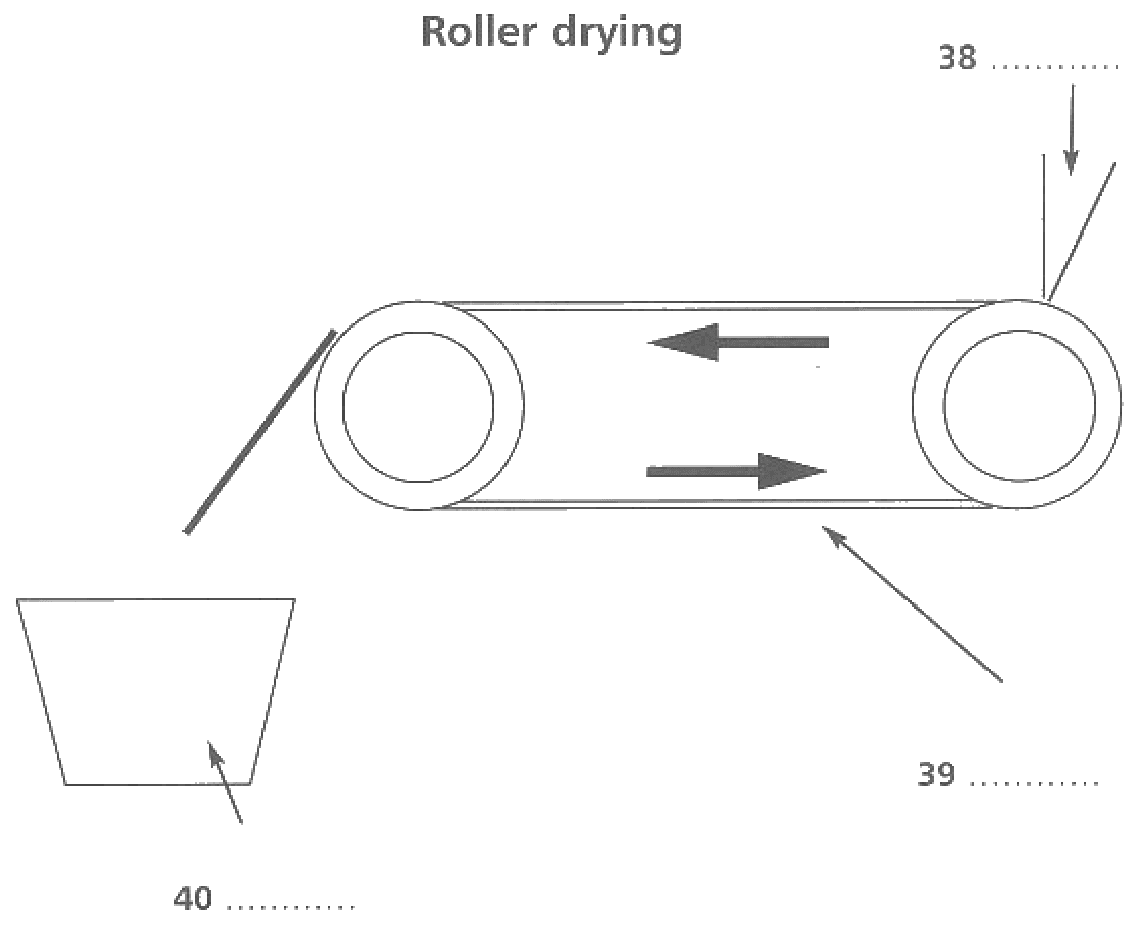
Roller drying
(38) …………………………
(39) …………………………
(40) …………………………
Answers
1. Sunday 2nd July
2. Marina
3. 9.30
4. 1,000
5. Hong Kong
6. captain
7. parents' permission
8. life jackets
9. clothes
10. name
11. stamps and coins
12. call
13. sense of smell
14. fly
15. introduced animals
16. scientific research
17. global education
18. eggs
19. reared
20. 85
21. result in more city suburbs.
22. like the advantages of the suburbs.
23. a City Link will be choked by traffic.
24. result in lower levels of pollution.
25. Sydney
26. Frankfurt
27. live street theatre encouraged
28. annual reduction of parking spots
29. low use means reduced service
30. making connections takes time
31. export
32. food shortages
33. lasts longer
34. food-poisoning
35. electricity
36. chemical preservatives
37. cheap to store
38. hot soup
39. heated belt
40. powdered soup
Explanations
- 1. Sunday 2nd July
- 'It's taking place on the 2nd July' and, when he checks, 'No, it's a Sunday.' Both the day and the date are needed.Common trap: Saturday is guessed first and corrected, so the day has to be picked up from the correction.
- 2. Marina
- 'it's Brighton Marina, that's MARINA' — the name is spelled out for him.Common trap: 'Brighton' is already printed, and the Palace Pier is named next as a landmark, not the venue.
- 3. 9.30
- 'you need to register half an hour before that — at 9.30'.Common trap: Three times are given in one sentence: the heats at 10.00, registration at 9.30, and arriving by 9.
- 4. 1,000
- 'Every crew member will receive a free tournament t-shirt if your team manages to raise £1,000 or more.'Common trap: The individual sponsorship target of £35 is given first; this blank is the team total.
- 5. Hong Kong
- 'What's the prize?' — 'It's a holiday in Hong Kong.'Common trap: The prize destination is given as a one-line answer with no repetition.
- 6. captain
- 'you then need to agree on who's going to be the team captain'.Common trap: The crew size of 20 is in the same sentence and is already printed on the notes.
- 7. parents' permission
- 'if you have a team member who's under 18 then they have to get their parents' permission to take part'.Common trap: The answer is preceded by 'there's no age limit as such', which sounds like there is no requirement at all.
- 8. life jackets
- 'we insist that everyone wears a life jacket as well and you can hire life jackets from us when your team arrives'.Common trap: The boat itself is never hired — only the jackets are.
- 9. clothes
- 'it's a very good idea to bring some spare clothes'.Common trap: What to wear (t-shirt, shorts, trainers) and what not to wear (jeans, boots) are listed first.
- 10. name
- 'Have you got a name for your team?' — 'Well you need to decide on one and then put it on the entrance form.'Common trap: The answer word appears in the question rather than in the reply, which only says 'one'.
- 11. stamps and coins
- 'Apart from being in toy stores and airport shops all over the world, you'll find them on our stamps and coins.'Common trap: Toy stores and airport shops are named first but are where kiwi toys are sold, not where pictures appear.
- 12. call
- 'It gets its name from its shrill call which sounds very much like this — kee-wee kee-wee.'Common trap: The genus name Apteryx is given in the sentence before and sounds like an origin for the name.
- 13. sense of smell
- 'It's a nocturnal bird with limited sight and therefore it has to rely on its very keen sense of smell.'Common trap: 'Limited sight' matches 'poor sight' already printed, so only the second half of the contrast is needed.
- 14. fly
- 'Although kiwis have wings, they serve little purpose because the kiwi is a flightless bird.'Common trap: The recording says what the kiwi is ('flightless'); the notes need what it cannot do.
- 15. introduced animals
- 'they're being threatened by what we call introduced animals animals which were brought to New Zealand such as cats and ferrets'.Common trap: The specific examples (cats and ferrets) follow and are more than three words together with the term.
- 16. scientific research
- 'Firstly, we have the scientific research stage — this involves research to find out more about what kiwis need to survive in the wild.'Common trap: The three stages are listed quickly and the middle one ('action') is already printed.
- 17. global education
- 'and then we come to the third stage — the global education stage. By working with schools and groups like yourself, as well as through our award winning kiwi website'.Common trap: Schools and the website are already printed in the next column, so the stage name is what is missing.
- 18. eggs
- 'First of all, we go out to the kiwi's natural habitat and we collect kiwi eggs.'Common trap: The habitat is named in the same clause and can be mistaken for what is collected.
- 19. reared
- 'Then, in safe surroundings, away from predators ... the chicks are reared.'Common trap: Where the rearing happens (predator-free islands, captivity) is described immediately afterwards.
- 20. 85
- 'their chances of survival have increased from 5 to 85%'.Common trap: Two other percentages follow — 95% of chicks still dying, and the 34 chicks raised this year.
- 21. result in more city suburbs.
- 'by continuing to encourage this dependence on the motor car, we simply create more congestion and more urban sprawl' — urban sprawl means more suburbs.Common trap: 'Urban sprawl' has to be matched to 'more city suburbs'; the professor never uses the word 'suburbs' here.
- 22. like the advantages of the suburbs.
- 'The freeways mean people can enjoy the benefits of living away from the centre on larger blocks with gardens but still be able to drive back into the city centre for work or entertainment.'Common trap: Coming into the city for entertainment is mentioned in the same sentence, which makes options B and C tempting.
- 23. a City Link will be choked by traffic.
- 'If you give the automobile road space, it will fill that space and you'll soon find you'll be crawling along your City Link.'Common trap: The cost of the road is discussed nearby, which makes the ten-times-cost option sound plausible.
- 24. result in lower levels of pollution.
- 'good roads increase traffic speeds and thus the amount of time cars are actually on the roads' — it is 'the stationary cars that cause the pollution and smog'.Common trap: Efficient modern cars are mentioned first, which makes the 'old cars' option tempting.
- 25. Sydney
- 'in Detroit only 1% of passenger travel is by public transport whereas in Toronto it's 24% ... than Sydney which can only boast 16%.' The second bar sits at 16%.Common trap: Four cities and four figures are read out in two sentences, and only two of them are arrowed on the graph.
- 26. Frankfurt
- 'and Frankfurt comes in higher still at 32%' — the tallest bar on the graph.Common trap: Frankfurt is added as an afterthought, after the other cities have been compared.
- 27. live street theatre encouraged
- 'they paid musicians and artists to perform in the streets'.Common trap: Several measures are listed in quick succession and only two appear among the options.
- 28. annual reduction of parking spots
- 'every year 3% of the city parking is removed and by constantly reducing parking they've created public spaces and clean air'.Common trap: Parking is removed, not metered — the opposite of one of the distractors.
- 29. low use means reduced service
- 'if there aren't many people using the service then they don't schedule enough buses or trains for that route'.Common trap: The cause and effect run in the opposite direction to what students expect — low use causes poor service, not vice versa.
- 30. making connections takes time
- 'the whole process takes so long because usually you have to change ... from bus to train — that sort of thing, and that can be quite difficult'.Common trap: 'Takes so long' sounds like slowness in general; the reason given is specifically changing services.
- 31. export
- 'We also need to preserve food for export overseas to make sure that it doesn't perish in transit.'Common trap: The three reasons are run together in one sentence and the first is already printed on the notes.
- 32. food shortages
- 'lastly we need to be able to preserve food for when there are food shortages'.Common trap: It is the last item in a three-part list delivered without a pause.
- 33. lasts longer
- 'The advantage of treating milk in this way is that it lasts much longer.'Common trap: The disadvantage (taste) is stated in the same sentence and is already printed in the next column.
- 34. food-poisoning
- 'there were many early cases of food-poisoning because the canning process was not fully understood'.Common trap: The advantage (cost effective) is given first, and the risk is said to have been 'greatly reduced' since.
- 35. electricity
- 'refrigeration requires an electricity supply and unfortunately if the power goes off, so does the food'.Common trap: The advantage in the previous column is stated first, in the same sentence pattern.
- 36. chemical preservatives
- 'Chemical preservatives are effective but they do not suit all foods and the processes involved are time-consuming.'Common trap: Salt, sugar and vinegar are named first as examples, not as the method's name.
- 37. cheap to store
- 'it also becomes much lighter which is a big advantage as this makes it cheap to store'.Common trap: 'Long-lasting' and 'light' are already printed, so only the third advantage is missing.
- 38. hot soup
- 'first of all the hot soup is poured in at one end — here'.Common trap: The diagram is walked through in order, so each label depends on tracking the stage being described.
- 39. heated belt
- 'The liquid spreads to form a thin layer on a heated belt.'Common trap: 'A thin layer' is the more prominent phrase but describes the liquid, not the labelled part.
- 40. powdered soup
- 'all the water has evaporated leaving only dry powder. A blade then scrapes the dried material off the roller and captures it in powder form.'Common trap: The blade and the roller are both named in the same sentence as the product being collected.
Audio transcripts
Part 1 — Entering a dragon boat race
Female: Scope charity office, how can I help you? Male: Oh hello. I'm ringing about the Dragon Boat Race that you're asking people to take part in. Female: Oh yes, we still need a few more teams. Are you interested in joining the race? Male: Yes, we want to enter a team but we don't know anything about it? Could I ask you for some more information first? Female: Of course. Male: I don't even know when it's being held. Female: It's taking place on the 2nd July ... Male: Is that a Saturday? Female: No, it's a Sunday. It's a much more popular day and more people can take part then. Male: Right. And where's it being held? Female: ... at the Brighton Marina. Male: Oh, I'm an overseas student ... Could you spell that for me? Female: Yes, it's Brighton Marina, that's MARINA. Do you know where it is? Male: I'm not sure. Female: It's a couple of miles past the Palace Pier. Male: Oh yes, I know it. Female: You take a right turning off the coast road or you can cycle along the seafront. Male: That's good. What time does the race start? Female: Well, the first heats begin at 10.00am - but you need to register half an hour before that - at 9.30 and we really recommend that you aim to be there by 9. It's a good idea to arrange a meeting place for your team. Male: Right ... And the race is to help raise money for charity? Female: It is. We're asking every team member to try and raise £35 by getting friends and/or relatives to sponsor them. Every crew member will receive a free tournament t-shirt if your team manages to raise £1,000 or more. Male: Oh that's quite good. Female: Also we're holding a raffle ... every crew member who takes part in the race this season will be entered into a free Prize Draw. Male: Oh, what's the prize? Female: It's a holiday in Hong Kong. Male: Sounds great. Female: Is there anything else you need to know? Male: Could you just tell me a little bit more about the teams? Female: Well, you need to have a crew of 20 people for your dragon boat ... and you then need to agree on who's going to be the team captain ... That would probably be you ... Male: Fine. Um, I've got a group of 20 people who are interested ... do all the team members have to be a certain age? Female: Well there's no age limit as such but if you have a team member who's under 18 then they have to get their parents' permission to take part. Male: Yes, that makes sense. Female: It isn't dangerous but we do have boats that turn over in the water and for that reason we insist that everyone wears a life jacket as well and you can hire life jackets from us when your team arrives. Male: What do you advise people to wear? Female: Well, most people wear a t-shirt, shorts and trainers. I certainly wouldn't recommend that you wear jeans or boots. In fact, it's a very good idea to bring some spare clothes. Male: OK. Female: It can get quite cold and wet if the weather's bad. And there's quite a bit of hanging around especially if you qualify for the semi-finals or the final ... Male: I see what you mean. Female: Have you got a name for your team? Male: Oh, not yet, no. Female: Well you need to decide on one and then put it on the entrance form which I'll send you ... Male: Oh OK. Female: So if you'd like to give me your address ...
Part 2 — The kiwi and the Kiwi Recovery Programme
Female: Ladies and Gentlemen - welcome to Auckland Zoo on this sunny Sunday afternoon and to our special kiwi fund raising event. My job is to tell you all about the amazing little kiwi - and your job, hopefully, is to dig deep in your pockets. Now for the benefit of our overseas visitors here today, I should explain first of all that the kiwi is the national bird of New Zealand - and sometimes New Zealanders themselves are known as 'Kiwis'. Now, while kiwis in the wild are a rare sight, the kiwi as a symbol is far more visible. Apart from being in toy stores and airport shops all over the world, you'll find them on our stamps and coins. The kiwi is the smallest member of the genus Apteryx which also includes ostriches and emu. It gets its name from its shrill call which sounds very much like this - kee-wee kee-wee. Kiwis live in forests or swamps and feed on insects, worms, snails and berries. It's a nocturnal bird with limited sight and therefore it has to rely on its very keen sense of smell to find food and to sense danger. Its nostrils are actually right on the end of its long beak which is one third of the body length. Now here's an interesting fact. Although kiwis have wings, they serve little purpose because the kiwi is a flightless bird. Since white settlement of the islands, kiwi numbers have dropped from 12 million to less than 70,000 and our national bird is rapidly becoming an endangered species. This is because they're being threatened by what we call introduced animals animals which were brought to New Zealand such as cats and ferrets which eat kiwi eggs and their chicks. And so we have launched the Kiwi Recovery Programme; in an all-out effort to save our national bird from extinction. There are three stages to this Programme: Firstly, we have the scientific research stage - this involves research to find out more about what kiwis need to survive in the wild. Then secondly we have the action stage. This is where we go into the field and actually put our knowledge to work - we call this putting science into practice. and then we come to the third stage - the global education stage. By working with schools and groups like yourself, as well as through our award winning kiwi website we are hoping to educate people about the plight of the kiwi. As part of the action stage, which I just mentioned, we have introduced 'Operation Nest Egg' and this is where your money will be going. It works like this: It's a three-stage process. First of all, we go out to the kiwi's natural habitat and we collect kiwi eggs. This is the tricky part because it can be very difficult to find the eggs. Then, in safe surroundings, away from predators ... the chicks are reared. Now this can be done on predator-free islands or in captivity - they're reared until they are about nine months old at which stage the chicks are returned to the wild. So far it's proving successful and since we started the programme some 34 chicks have been successfully raised this year and their chances of survival have increased from 5 to 85%. However, it's not time to celebrate kiwi survival just yet. About 95% of kiwi chicks still don't make it to six months of age without protection. Which is why Operation Nest Egg is so important and we ask you to give generously today.
Part 3 — Tutorial on highways and public transport
Tutor: We're very pleased to welcome Professor Isaac Nebworth to our tutorial group today and he's come to share one of his pet passions with us - City traffic and our western dependence on the motor car. I believe questions are quite welcome throughout. Professor: Thank you. Well, I know you're all very familiar with the super highway here in Melbourne. But do super highways automatically lead to super wealth, as our politicians would have us believe? I think not. Tutor: Can you give us an example of what you mean exactly? Professor: Sure ... well, by continuing to encourage this dependence on the motor car, we simply create more congestion and more urban sprawl. And you can see that here in Melbourne right under your nose. Student: Excuse me. I would just like to say that I feel the sprawl is part of the city. The freeways mean people can enjoy the benefits of living away from the centre ... on larger blocks with gardens ... but still be able to drive back into the city centre for work or entertainment. Professor: Well I'm not convinced that people want to do that. And is our money being well spent? It may be OK for you now but come back to me in five years' time! Let's take City Link, for example, the new freeway here in Melbourne. Student: Well ... I use the freeway all the time. I think it's great. Professor: Ah yes, but it cost $2 billion to build, and you could have gotten ten times the value by putting the money into public transport. If you give the automobile road space, it will fill that space ... and you'll soon find you'll be crawling along your City Link. Tutor: But surely, you cannot simply blame the car. Some of the blame must rest with governments and city planners? Student: Well there is an argument, surely, that building good roads is actually beneficial because most new cars these days are highly efficient - they use far less petrol than in the past and emissions of dangerous gases are low. Old congested roads, on the other hand, encourage traffic to move slowly and it's the stationary cars that cause the pollution and smog ... whereas good roads increase traffic speeds and thus the amount of time cars are actually on the roads. Professor: Well ... this is the old argument put forward by the road lobby but, for me it's clear cut. Roads equal cars which equal smog. Public transport is the way to go. Tutor: Now ... on that topic of public transport, I read somewhere recently that Australia isn't doing too badly in the challenge to increase the use of public transport. Professor: Better than America, granted, but by comparison with Canada, it's not so good. For instance, if you compare Toronto with the US metropolis of Detroit only 160 kilometres away ... in Detroit only 1% of passenger travel is by public transport whereas in Toronto it's 24% which is considerably better than Sydney which can only boast 16%. Tutor: Well I think it's encouraging that our least car-dependent city is actually our largest city. 16% of trips being taken on public transport in Sydney, isn't too bad. Professor: But it's a long way behind Europe. Take both London and Paris for instance ... where 30% of all trips are taken on public transport. Tutor: Well, they do both have an excellent underground system. Professor: ... and Frankfurt comes in higher still at 32%. Tutor: I understand that they've been very successful in Copenhagen at ridding the city of the car. Can you tell us anything about that experiment? Professor: Yes indeed. Copenhagen is a wonderful example of a city that has learnt to live without the motor car. Back in the 1960s they adopted a number of policies designed to draw people back into the city. For instance they paid musicians and artists to perform in the streets. They also built cycle lanes and now 30% of the inhabitants of Copenhagen use a bicycle to go to work. Sydney by comparison can only boast 1% of the population cycling to work. Student: It could have something to do with all the hills! Professor: Then they banned cars from many parts of the city and every year 3% of the city parking is removed and by constantly reducing parking they've created public spaces and clean air. Student: Really!! Professor: There are also freely available bicycles which you can hire for practically nothing. And of course, they have an excellent public transport system. Student: Well, that's all very well for Copenhagen. But I'd just like to say that some cities are just too large for a decent public transport system to work well. Particularly in areas with low population, because if there aren't many people using the service then they don't schedule enough buses or trains for that route. Professor: I accept that there is a vicious circle here but people do need to support the system. Student: And secondly the whole process takes so long because usually you have to change ... you know, from bus to train - that sort of thing, and that can be quite difficult. Ultimately it's much easier to jump in your car. And often it turns out to be cheaper. Professor: Sure ... but cheaper for whom, you or society? We have to work towards the ideal and not give in all the time because things are too difficult ... Anyway lets move on to some of the results of the survey ... [fade]
Part 4 — Methods of food preservation
Lecturer: In today's lecture I'd like to look at the topic of food preservation and start by asking the obvious question 'Why do we need to preserve food?' Well, apart from keeping it fresh for our daily needs, many foods, such as fruit and vegetables are only available at certain times of the year so if we want to be able to eat these foods all year round, we need to preserve them. We also need to preserve food for export overseas to make sure that it doesn't perish in transit, and lastly we need to be able to preserve food for when there are food shortages. There are a number of methods of preserving food which involve both high and low temperatures, chemicals, irradiation and drying. Let's have a look at these in turn. In the 1870s the French scientist, Louis Pasteur, showed that micro-organisms in food could be destroyed by raising the temperature of the food - a process now known as pasteurisation. This involves heating milk to just 65°C for 30 minutes. A new method, the ultra-high temperature or UHT process, involves heating milk to 150°C for three seconds. The advantage of treating milk in this way is that it lasts much longer though I tend to feel, and I'm sure many of you would agree, that taste is somewhat sacrificed in the UHT process. Tin cans were first used in the early 1800s to store and preserve food. Just as they are now, the cans were tin-plated, steel containers and the process had the advantage of being cost effective. Unfortunately, however, there were many early cases of food-poisoning because the canning process was not fully understood at that stage. We now know the exact temperature and length of time each food needs for proper preservation which has greatly reduced the risk of food-poisoning. People living in cold climates often preserved food by burying it in the snow and the Romans knew all about the advantages of packing food in ice but for most people this was not an option until the invention of the refrigerator in 1834. Today, however, refrigeration is the most important means of preserving food because the food stays fresh without needing to be treated. However, refrigeration requires an electricity supply and unfortunately if the power goes off, so does the food!! A variety of chemicals can be added to food and you'll find their names listed on the labels of cans and bottles. Salt is probably the oldest of all the chemical preservatives and was used by many ancient civilisations for many years. Sugar also acts as a preservative and is used to preserve jams in much the same way that vinegar is used to pickle foods. Chemical preservatives are effective but they do not suit all foods and the processes involved are time-consuming. Another method of preserving food is by drying it. Most foods are 75% to 90% water so if you remove the water the micro-organisms simply can't survive. When food is dried it not only lasts a long time but it also becomes much lighter which is a big advantage as this makes it cheap to store, though some people argue that valuable nutrients are lost in the process. Early methods for drying food involved cutting it into strips and hanging it in the sun or over fires. But there are now a number of more modern methods which involve the use of recent technology. One of these is known as roller drying and it's a highly effective way of making dried foods from liquids, such as soup. Have a look at this diagram to see how it works. Well, first of all the hot soup is poured in at one end - here. The liquid spreads to form a thin layer on a heated belt. The liquid dries as it moves along. By the time it reaches the end of the belt, all the water has evaporated leaving only dry powder. A blade then scrapes the dried material off the roller and captures it in powder form. All you have to do is add boiling water and you have your hot soup back again, ready to drink! Another method is called freeze drying ...
Comments
Loading comments…