

Practice Tests Plus 1 Listening Test 1
4 parts · 42 questions · 30 minutes
Enquiring about a paragliding course
Questions 1–3
Listen to the telephone conversation between a student and the owner of a paragliding school and answer the questions below. Circle the correct letters A–D.
1. How much is the beginner's course?
A $190
B $320
C $330
D $430
2. What does the club insurance cover?
A injury to yourself
B injury to your equipment
C damage to other people's property
D loss of personal belongings
3. How do the girls want to travel?
A public transport
B private bus
C car
D bicycle
Questions 4–7
Complete the form below. Write NO MORE THAN THREE WORDS AND/OR A NUMBER for each answer.
TELEPHONE MEMO
Name: Maria Gentle
Address: C/o Mr & Mrs (4) …………………………
(5) ………………………… Newcastle
Fax no: 0249 (6) …………………………
Type of Card: (7) …………………………
Questions 8–9
Circle TWO letters A–G. Which TWO of the following items must people take with them?
8. Required item (lower letter)
A sandals
B old clothes
C pullover
D shirt with long sleeves
E soft drinks
F hat
G sunglasses
9. Required item (higher letter)
A sandals
B old clothes
C pullover
D shirt with long sleeves
E soft drinks
F hat
G sunglasses
Questions 10–11
Circle TWO letters A–G. Which TWO accommodation options mentioned are near the paragliding school?
10. Accommodation option (lower letter)
A camping
B youth hostel
C family
D backpackers' inn
E caravan park
F bed and breakfast
G cheap hotel
11. Accommodation option (higher letter)
A camping
B youth hostel
C family
D backpackers' inn
E caravan park
F bed and breakfast
G cheap hotel
Question 12
Write NO MORE THAN THREE WORDS for your answer.
12. Which weekend do the girls decide to go?
The Goodwood Car Show
Questions 13–22
Complete the notes below. Write NO MORE THAN THREE WORDS AND/OR A NUMBER for each answer.
GOODWOOD CAR SHOW
Type of car: Duesenberg J-type
Number made: (13) …………………………
Type of body: (14) …………………………
Engines contained capsules of mercury to ensure a (15) ………………………… trip.
Top speed: (16) ………………………… per hour.
Sold as a (17) …………………………
Main attraction: (18) …………………………
Type of car: Leyat Helica
Number built: (19) …………………………
Car looks like a (20) …………………………
without (21) …………………………
Steering used the (22) …………………………
Student presentation on local entertainment
Questions 23–24
Complete the notes below. Write NO MORE THAN THREE WORDS for each answer.
Research details:
Title of project: (23) …………………………
Focus of project: entertainment away from (24) …………………………
Questions 25–28
Circle the correct letters A–C.
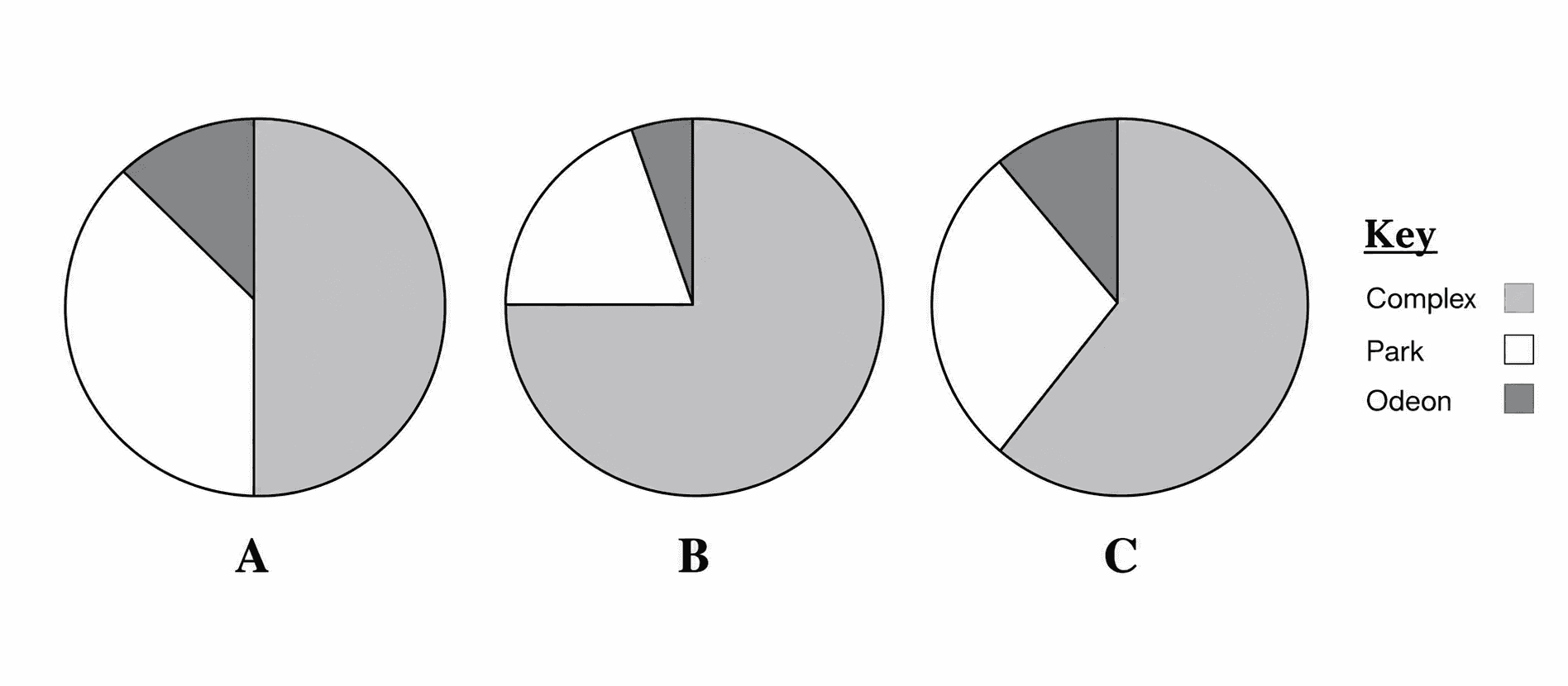
25. Which chart shows the percentage of cinema seats provided by the different cinema houses?
A Chart A
B Chart B
C Chart C
26. Which graph shows the relative popularity of different cinemas?
A Graph A
B Graph B
C Graph C
27. What did Rosie and Mike realise about the two theatres?
A The prices were very similar.
B They were equally popular.
C They offered the same facilities.
28. Which graph shows comparative attendance for cinema and theatre?
A Graph A
B Graph B
C Graph C
Questions 29–32
Complete the chart about the different music clubs below. Write NO MORE THAN TWO WORDS or use ONE of the labels for each answer. A poor B OK C excellent
| Club | Type of music | Quality of venue |
|---|---|---|
| The Blues Club | Blues | (29) ………………………… |
| The Sansue | (30) ………………………… | C |
| Pier Hotel | Folk | (31) ………………………… |
| Baldrock Café | Rock | (32) ………………………… |
Human activity and dust storms
Questions 33–34
Complete the notes using NO MORE THAN THREE WORDS for each answer.
Main focus of lecture: the impact of (33) ………………………… on the occurrence of dust storms.
Two main types of impact:
A) break up ground surface, e.g. off-road vehicle use
B) remove protective plants, e.g. (34) …………………………
Questions 35–38
Complete the table using NO MORE THAN THREE WORDS for each answer.
| Name of area | Details |
|---|---|
| USA 'dust bowl' | Caused by mismanagement of farmland Decade renamed the (35) ………………………… |
| West Africa | Steady rise in dust storms over 20-year period |
| Arizona | Worst dust clouds arise from (36) ………………………… Dust deposits are hazardous to (36) ………………………… |
| Sahara | Increased wind erosion has occurred along with long-term (38) ………………………… |
Questions 39–42
Complete the flow chart using NO MORE THAN THREE WORDS for each answer.
Drying-up of Aral Sea
Intensive (39) ………………………… in Central Asian Republics
↓
Drop in water in major tributaries
↓
Total volume of water in lake reduced by (40) …………………………
↓
Increase in wind-blown material
↓
Lake has become more (41) …………………………
↓
Serious effects on (42) ………………………… nearby
Answers
1. $330
2. damage to other people's property
3. bicycle
4. McDonald
5. PO Box 676
6. 775431
7. credit card
8. shirt with long sleeves
9. hat
10. camping
11. bed and breakfast
12. after the exams
13. 473
14. open two-seater
15. smooth
16. 180 kilometres
17. frame and engine
18. instrument panel
19. 30
20. light aircraft
21. wings
22. rear wheels
23. Out and About
24. the university campus
25. Chart B
26. Graph B
27. They were equally popular.
28. Graph A
29. A
30. South American
31. B
32. C
33. human activity
34. farming and drainage
35. Dirty Thirties
36. dry thunderstorms
37. machine operators
38. drought
39. irrigation
40. two-thirds
41. salty
42. crops
Explanations
- 1. $330
- The man quotes three prices in one breath and then corrects himself: the beginners' course 'is $320 - no, sorry 330 - it's just gone up'. The corrected figure is the one that counts.Common trap: The first price given for the beginners' course is immediately corrected, and the two other course prices are read out in the same sentence.
- 2. damage to other people's property
- The club insurance is third party only: it 'covers you against damage to other people or their belongings, but not theft or injury'. Injury to yourself needs separate personal accident cover.Common trap: The cover is defined mostly by what it excludes, and the exclusions come straight after the inclusion.
- 3. bicycle
- Maria asks 'could we come by bike? We're pretty keen cyclists', and the man confirms 'you could ride here OK'. The other options describe how other people get there, not what the girls want.Common trap: The question asks what the girls want; the man's reply describes what most visitors do instead.
- 4. McDonald
- Maria gives her address as 'Care of Mr and Mrs. McDonald' — the family she is staying with in Newcastle.Common trap: The spelling is only confirmed indirectly, by the man's joke about the hamburgers.
- 5. PO Box 676
- Maria offers the postal box rather than a street address: 'The post office box address is probably best. It's PO Box 676, Newcastle.'Common trap: Newcastle is already printed on the form, and the number 676 is said only once.
- 6. 775431
- The fax number is read out as 'It's 0249 that's for Newcastle and then double seven five four three one', so the missing part is 775431.Common trap: 'Double seven' has to be written as two digits, and the 0249 area code is already printed on the form.
- 7. credit card
- Maria says she will pay 'By credit card, if that's OK. Do you take Visa?' and the man confirms 'We take all major cards, including Visa'. Either name is accepted.Common trap: Two different labels for the same answer are given one after the other.
- 8. shirt with long sleeves
- The packing advice includes 'clothes suitable for an active day in the hills, preferably a long-sleeved t-shirt'.Common trap: The list mixes things to bring with things NOT to bring, inside the same turn.
- 9. hat
- 'We'd also need to bring suntan lotion and something to protect your head from the sun' — that is, a hat.Common trap: The item is described by its purpose and never named as a hat.
- 10. camping
- The school runs its own campsite: 'They seem to operate a campsite too, because it says here that it's only $10 a day to pitch a tent.'Common trap: Several other options are named only to be ruled out as too far away or unwanted.
- 11. bed and breakfast
- Pauline suggests the second nearby option: 'perhaps we could stay in a bed-and-breakfast nearby. It gives a couple of names here we could ring.'Common trap: The question asks which options are near the school, not which one the girls finally choose — they end up taking a tent.
- 12. after the exams
- Two weekends are proposed and rejected — next weekend (field trip) and the weekend before the exams (studying) — before Maria settles it: 'Let's make it the one after the exams.'Common trap: The answer comes last, after two rejected weekends.
- 13. 473
- 'only 473 Duesenberg J-types were ever built' — the total number made.Common trap: Other numbers (the 125-inch chassis, the 6.9-litre engine) follow immediately.
- 14. open two-seater
- 'the body was always in the form of an open two-seater'. The word 'open' is optional.Common trap: The chassis measurement is given in the same sentence and can be mistaken for the body type.
- 15. smooth
- The mercury capsules 'absorb vibration and provide an incredibly smooth ride' — a smooth trip.Common trap: 'Ride' in the recording is paraphrased as 'trip' on the question paper.
- 16. 180 kilometres
- 'the Duesenberg promised a top speed of 180 kilometres per hour'. 'Per hour' is already printed on the notes.Common trap: Three speeds sit in one sentence — 160 (what counted as fast at the time) and 140 (in second gear) are distractors.
- 17. frame and engine
- 'Duesenberg, who designed the car, sold it as a frame and engine' — buyers then commissioned their own bodywork.Common trap: The price of the basic car follows straight afterwards and pulls attention away from what was actually sold.
- 18. instrument panel
- 'The Duesenberg's great attraction for the driver, was its instrument panel which offered all the usual features but also several others including a stop-watch.'Common trap: The car's racing record follows immediately and sounds like an attraction too.
- 19. 30
- 'Only 30 of these French propellor cars were built.'Common trap: The model on show 'was the fourth to be made' — an ordinal in the same sentence.
- 20. light aircraft
- 'The Leyat very strongly resembles a light aircraft with its front propellor.'Common trap: The designer's background in aviation is mentioned first and is not itself the answer.
- 21. wings
- '... with its front propellor but in this case it's minus any wings of course!' — it looks like a light aircraft without wings.Common trap: 'Minus' has to be understood as 'without'.
- 22. rear wheels
- 'The Leyat matched its propellor drive with its equally bizarre steering which used the rear rather than the front wheels.'Common trap: Both 'rear' and 'front' appear in the same phrase, in that order.
- 23. Out and About
- 'Yes, so we've called our project ‘Out and About’ ...' — confirmed by the tutor repeating it.Common trap: The survey's subject ('local entertainment') is stated first and is not the title.
- 24. the university campus
- 'we really wanted to examine outside entertainment in the town as opposed to on the university campus' — the focus is entertainment away from the campus.Common trap: 'In the town' is what they looked AT; the question asks what they looked away FROM.
- 25. Chart B
- Mike gives the split as complex 75%, Park 20%, Odeon 5% — only Chart B shows three-quarters of the seats at the complex and a 5% sliver for the Odeon.Common trap: The figures are read out once, quickly, and this question is about seats — popularity is asked separately in Q26.
- 26. Graph B
- Two facts fix the order. The late-night Odeon is the most popular, 'surprisingly' — not the multi-screen complex, as they had expected. And students go to the Park rather than the complex for new films because the complex costs more, which the tutor confirms 'detracts from the popularity'. So Odeon > Park > complex, which is Graph B.Common trap: Popularity and seating capacity point in opposite directions: the cinema with the fewest seats is the most popular.
- 27. They were equally popular.
- Mike explains that 'students tend to buy seats at both and like using both for different reasons' — the two theatres are used equally, for different reasons.Common trap: Prices are discussed at length in the same turn, which makes option A sound right.
- 28. Graph A
- Rosie describes a theatre peak in November/December, a dip for both in April/May, then the theatre trailing off while the cinema picks up in June/July — the pattern in Graph A.Common trap: Three separate time references have to be tracked against two lines at once.
- 29. A
- 'This was a pretty small place and the seating was minimal so we didn't give that a very good rating' — i.e. poor (A).Common trap: The rating is given by understatement ('not a very good rating'), never by the word 'poor'.
- 30. South American
- 'Then The Sansue which plays a lot of South American music was a big place, very lively, good performers so two ticks for that one.'Common trap: The venue's rating (two ticks = excellent) is already printed, so only the music type is needed.
- 31. B
- 'the quality of the entertainment was reasonable and the lighting was very warm so we felt it deserved an average rating' — an average rating is OK (B).Common trap: The negatives (basement, a bit dark) come first and suggest a poor rating.
- 32. C
- 'we enjoyed ourselves there as well, so top marks for that one' — top marks means excellent (C).Common trap: 'Top marks' is the only wording used for the highest rating.
- 33. human activity
- 'what we want to focus on today is the extent to which human activity is causing them' — the lecture is about the impact of human activity on dust storms.Common trap: The previous lecture's topic (the effects of dust on global climate) is stated first.
- 34. farming and drainage
- 'there are those that remove protective vegetation cover from soils, for example, mainly farming and drainage'.Common trap: The examples for the first type of impact (off-road vehicle use and construction) are given in the same sentence.
- 35. Dirty Thirties
- 'choking dust storms became so commonplace that the decade became known as the ‘Dirty Thirties’'.Common trap: The decade is first called the 1930s, so the nickname has to be caught separately.
- 36. dry thunderstorms
- 'In places like Arizona, the most dangerous dust clouds are those generated by dry thunderstorms.'Common trap: The alert system mentioned next is a response to the storms, not their cause.
- 37. machine operators
- 'When this dust is deposited it causes all sorts of problems for machine operators.'Common trap: The West Africa paragraph just before names pilots and road users as the people at risk there.
- 38. drought
- 'This increase in wind erosion has coincided with a prolonged drought, which has gripped the Sahara's southern fringe.'Common trap: Low rainfall is named as the cause of the drought, so it is tempting as an answer.
- 39. irrigation
- 'Its ecological demise dates from the 1950s when intensive irrigation began in the then Central Asian republics of the USSR.'Common trap: The date (1950s) sits in the same clause and is not what the box asks for.
- 40. two-thirds
- 'since that time it has lost two-thirds of its volume'.Common trap: Two other measurements follow at once — the surface area halving and the water level dropping by 216 metres.
- 41. salty
- 'The salinity of the lake has increased so that it is now virtually the same as sea water.'Common trap: The noun 'salinity' has to be turned into an adjective to fit 'more _____'.
- 42. crops
- 'Scientists believe it is adversely affecting crops around the sea because salts are toxic to plants.'Common trap: The closing sentence widens out to 'people living in drylands', which is not what this box asks for.
Audio transcripts
Part 1 — Enquiring about a paragliding course
Man: Hello 'Paragliders' Paradise'. How can I help you? Maria: Oh hi. I'm interested in doing a course in paragliding. Man: Which course are you interested in? Maria: Well, I'm not sure. What's available? Man: Well ... we've got the introductory course which lasts for two days. Maria: OK. Man: Or there's the 4-day beginners' course which is what most people do first. I'd tend to recommend that one. And there's also the elementary pilot course which takes five to six days depending on conditions. Maria: We might try the beginner's course. What sort of prices are we looking at? Man: The introductory is $190; the beginner's course, which is what you'd probably be looking at, is $320 - no, sorry 330 - it's just gone up - and the pilot course is $430. Maria: Right. Man: And you also have to become a member of our club so that you're insured. That'll cost you $12 a day. Everyone has to take out insurance, you see. Maria: Does that cover me if I break a leg? Man: No, I'm afraid not - it's only 3rd party and covers you against damage to other people or their belongings, but not theft or injury. You would need to take out your own personal accident insurance. Maria: I see! And what's the best way to get to your place? By public transport or could we come by bike? We're pretty keen cyclists. Man: It's difficult by public transport although there is a bus from Newcastle; most people get here by car, though, 'cos we're a little off the beaten track. But you could ride here OK. I'll send you a map. Just let me take down a few details. What's your name? Maria: Maria Gentle. Man: And your address, Maria? Maria: Well, I'm a student staying with a family in Newcastle. Man: So it's care of ... Maria: Care of Mr and Mrs. McDonald. Man: Like the hamburgers! Maria: Yes, exactly. Man: McDonald ... Maria: The post office box address is probably best. It's PO Box 676, Newcastle. Man: Is there a fax number there, because I could fax you the information? Maria: Yes, actually, there is. It's 0249 that's for Newcastle and then double seven five four three one. Man: OK. Now if you decide to do one of our courses, you'll need to book in advance and to pay when you book. How would you be paying? Maria: By credit card, if that's OK. Do you take Visa? Man: Yes, fine. We take all major cards, including Visa. Maria: OK then. Thanks very much. Maria: Hi, Pauline. Pauline: Hi, Maria! What's that you're reading? Maria: Just some information from a paragliding school - it looks really good fun. Do you fancy a go at paragliding? Pauline: Sure! Do you have to buy lots of equipment and stuff? Maria: Not really. The school provides the equipment but we'd have to take a few things along. Pauline: Such as? Maria: Well it says here. Clothes: wear stout boots, so no sneakers or sandals I suppose, and clothes suitable for an active day in the hills, preferably a long-sleeved t-shirt. That's probably in case you land in the stinging nettles! It also says we should bring a packed lunch. We do not recommend soft drinks or flasks of coffee. Water is really the best thing to drink. We'd also need to bring suntan lotion and something to protect your head from the sun! Pauline: OK that sounds reasonable. And where would we stay? Maria: Well look! They seem to operate a campsite too, because it says here that it's only $10 a day to pitch a tent. That'd be fine, wouldn't it? And that way we'd save quite a bit because even a cheap hotel would cost money. Pauline: Um..or perhaps we could stay in a bed-and-breakfast nearby. It gives a couple of names here we could ring. I think I might prefer that. Hotels and youth hostels would all be miles away from the farm and I don't fancy a caravan. Maria: No, I agree. But let's take a tent and pray for good weather. Pauline: OK - let's do it. What about next weekend? Maria: No, I can't - I'm going on a geography field trip. Pauline: ....and then it's the weekend before the exams and I really need to study. Maria: OK, then. Let's make it the one after the exams. Pauline: Fine - we'll need a break by then. Can you ring and ...
Part 2 — The Goodwood Car Show
Announcer: The Goodwood Museum is currently celebrating some of the most extravagant types of car design in its festival of speed. Here's our reporter Vincent Freed, who's on site, to tell us about some of the cars on display. Reporter: Well, here I am, standing in front of one of the most prestigious cars ever built, the Duesenberg, a fantastically expensive, luxurious car built in the early part of the 20th century and bearing all the glamorous qualities of the jazz age. How many were there? Well, only 473 Duesenberg J-types were ever built and the model here is one of the rarest. Each had a short 125-inch chassis or framework and the body was always in the form of an open two-seater. The technology behind the car's 6.9-litre engine was extraordinary. It featured capsules of mercury in the engines to absorb vibration and provide an incredibly smooth ride. In fact, these cars offered unparalleled performance ... in an age when 160 kilometres per hour was considered very fast, the Duesenberg promised a top speed of 180 kilometres per hour and could do 140 kilometres per hour in second gear. Duesenberg, who designed the car, sold it as a frame and engine ... this was typical of the age again and many prestige manufacturers such as Rolls-Royce did exactly the same. Owners able to afford the hefty $9,000 price tag for the basic car would then commission a coachwork company to build a body tailored to their own individual requirements. The Duesenberg's great attraction for the driver, was its instrument panel which offered all the usual features but also several others including a stop-watch. It was the Duesenberg's technology that lay behind its success as a racing car and they dominated the American racing scene in the 1920s winning the Indianapolis Grand Prix in 1924, '25 and '27. On to another celebrity, the 1922 Leyat Helica. Only 30 of these French propellor cars were built and the model here at Goodwood, which was the fourth to be made, is thought to be the only surviving example still capable of running. The brains behind this car was Marcel Leyat who was an aviation pioneer first and foremost, and the influence of flying is quite apparent in the car. The Leyat very strongly resembles a light aircraft with its front propellor but in this case it's minus any wings of course! It's quite odd to think that this car was whirring through France, just as the Duesenberg was blasting down roads at 160 kilometres per hour across the Atlantic. The Leyats were used regularly in France in the 1920s and were even produced in saloon and van form, as well as two-seater. The Leyat matched its propellor drive with its equally bizarre steering which used the rear rather than the front wheels! But despite looking rather frail, it was a tough machine. In fact, when troops tried to steal it during the Second World War, the car's baffling design was clearly beyond the would-be thieves and it ended up being driven into a tree, breaking the propellor. And now for the Firebird ...
Part 3 — Student presentation on local entertainment
Tutor: Good morning everyone. Well I think we can start straightaway by getting Rosie and Mike to do their presentation. Would you like to start, Rosie? Rosie: Yes, well, um, we've done a survey on local entertainment. Basically, we tried to find out how students feel about the entertainment in the town and how much they use it. Mike: Yes, so we've called our project 'Out and About' ... Tutor: Yes, that's a good title! 'Out and About'. Rosie: We wanted to find out how well students use the entertainment facilities in town ... whether they get to see the latest plays, films ... that kind of thing. Tutor: Now, we have our own facilities on campus of course ... Rosie: Yes, we deliberately omitted those as we really wanted to examine outside entertainment in the town as opposed to on the university campus. Mike: Actually there were a lot of areas to choose from but in the end we limited ourselves to looking at three general categories: cinema, theatre and music. Tutor: Right. Rosie: OK. Well, first of all cinema. In the town, there are three main places where you can see films. There's the new multi-screen cinema complex, the old Park cinema, and a late-night Odeon. Mike: So if you look at this chart ... in terms of audience size, the multi-screen complex accounts for 75% of all cinema seats, the Park Cinema, accounts for 20% of seats and the late-night Odeon has just 5% of seats. Rosie: As you probably know, the complex and the Park show all the latest films, while the late-night cinema tends to show cult films. So, when we interviewed the students, we thought the complex would be the most popular choice of cinema ... but surprisingly it was the late-night Odeon. Mike: Yeah, and most students said that if they wanted to see a new film, they waited for it to show at the Park because the complex is more expensive and further out of town so you have to pay more to get there as well. Tutor: Yes, and that adds to the cost, of course, and detracts from the popularity, evidently. Rosie: Well, next, we looked at theatres. The results here were interesting because, as you know, there's a theatre on campus, which is popular. But there's also the Stage Theatre in town, which is very old and architecturally quite beautiful. And there's the large, modern theatre, the Ashtop, that has recently been built. Tutor: So you just looked at the two theatres in town? Mike: Yes. But the thing about the theatres is that there's a whole variety of seat prices. Also, the types of performance vary ... so students tend to buy seats at both and like using both for different reasons and if they want cheap seats at the Ashtop, they can just sit further from the front. Rosie: What we did find that was very interesting is that there are periods during the year when students seem to go to the theatre and periods when they go to the cinema and we really think that's to do with budget. If you look at this graph, you can see that there's a peak around November/December when they go to the theatre more and then a period in April/May when neither is particularly popular and then theatre viewing seems to trail off virtually while the cinema becomes quite popular in June/July. Tutor: Mmm. I think you're probably right about your conclusions ... Mike: Well, lastly we looked at music. And this time we were really investigating the sort of small music clubs that offer things like folk or specialise in local bands. Tutor: So not musicals as such ... Mike: That's right. Rosie: We looked at three small music venues and we examined the quality of the entertainment and venue and gave a ranking for these: a cross meaning that the quality was poor, a tick meaning it was OK and two ticks for excellent. First of all, The Blues Club, which obviously specialises in blues music. This was a pretty small place and the seating was minimal so we didn't give that a very good rating. Mike: No! We don't recommend that one really. Rosie: Then The Sansue which plays a lot of South American music was a big place, very lively, good performers so two ticks for that one. The Pier Hotel is a folk venue ... a good place for local and up-and-coming folk artists to play. Not the best of venues as it's in a basement and a bit dark but the quality of the entertainment was reasonable and the lighting was very warm so we felt it deserved an average rating. Finally, there's the Baldrock Café which features big rock bands and is pretty popular with students and we enjoyed ourselves there as well, so top marks for that one. Tutor: And then did you get any information from the students as to which of the clubs they preferred?
Part 4 — Human activity and dust storms
Lecturer: In the last lecture, we looked at the adverse effects of desert dust on global climate. Today we're going to examine more closely what causes dust storms and what other effects they can have. As you know, dust storms have always been a feature of desert climates, but what we want to focus on today is the extent to which human activity is causing them. And it is this trend that I want to look at, because it has wide-ranging implications. So - what are these human activities? Well, there are two main types that affect the wind erosion process, and thus the frequency of dust storms. There are activities that break up naturally wind-resistant surfaces such as off-road vehicle use and construction and there are those that remove protective vegetation cover from soils, for example, mainly farming and drainage. In many cases the two effects occur simultaneously which adds to the problem. Let's look at some real examples and see what I'm talking about. Perhaps the best-known example of agricultural impact on desert dust is the creation of the USA's 'dust bowl' in the 1930s. The dramatic rise in the number of dust storms during the latter part of that decade was the result of farmers mismanaging their land. In fact, choking dust storms became so commonplace that the decade became known as the 'Dirty Thirties'. Researchers observed a similar, but more prolonged, increase in dustiness in West Africa between the 1960s and the 1980s when the frequency of the storms rose to 80 a year and the dust was so thick that visibility was reduced to 1,000 metres. This was a hazard to pilots and road users. In places like Arizona, the most dangerous dust clouds are those generated by dry thunderstorms. Here, this type of storm is so common that the problem inspired officials to develop an alert system to warn people of oncoming thunderstorms. When this dust is deposited it causes all sorts of problems for machine operators. It can penetrate the smallest nooks and crannies and play havoc with the way things operate because most of the dust is made up of quartz which is very hard. Another example - the concentration of dust originating from the Sahara has risen steadily since the mid-1960s. This increase in wind erosion has coincided with a prolonged drought, which has gripped the Sahara's southern fringe. Drought is commonly associated with an increase in dust-raising activity but it's actually caused by low rainfall which results in vegetation dying off. One of the foremost examples of modern human-induced environmental degradation is the drying up of the Aral Sea in Central Asia. Its ecological demise dates from the 1950s when intensive irrigation began in the then Central Asian republics of the USSR. This produced a dramatic decline in the volume of water entering the sea from its two major tributaries. In 1960, the Aral Sea was the fourth-largest lake in the world, but since that time it has lost two-thirds of its volume, its surface area has halved and its water level has dropped by more than 216 metres. A knock-on effect of this ecological disaster has been the release of significant new sources of wind-blown material, as the water level has dropped. And the problems don't stop there. The salinity of the lake has increased so that it is now virtually the same as sea water. This means that the material that is blown from the dry bed of the Aral Sea is highly saline. Scientists believe it is adversely affecting crops around the sea because salts are toxic to plants. This shows that dust storms have numerous consequences beyond their effects on climate, both for the workings of environmental systems and for people living in drylands ...
Comments
Loading comments…