

Official Cambridge Guide 1 Listening Test 7
4 parts · 40 questions · 30 minutes
Choosing a hostel in Darwin
Questions 1–6
Complete the table below. Write NO MORE THAN ONE WORD AND/OR A NUMBER for each answer.
| Name | Price per person (dormitory rooms) | Comments and reviews |
|---|---|---|
| Example – Top End Backpackers | $19 | • parking available • staff are (1) ………………………… • nice pool • air-conditioning is too (1) ………………………… |
| Gum Tree Lodge | $ (3) ………………………… | • good quiet location • pool and gardens • (4) ………………………… in the dormitories |
| Kangaroo Lodge | $22 | • downtown location • reception at the lodge is always open • no lockers in the rooms • the (5) ………………………… are very clean • seems to be a (5) ………………………… every night |
Questions 7–10
Complete the notes below. Write ONE WORD ONLY for each answer.
Kangaroo Lodge
Address: on (7) ………………………… Lane
General information about hostel accommodation
• sheets are provided
• can hire a (8) …………………………
• (9) ………………………… is included
• a shared (10) ………………………… is available
Anglia Sculpture Park tour
Questions 11–16
Choose the correct letter, A, B or C.
11. The land where the Sculpture Park is located was previously
A completely covered by forest.
B the site of a private house.
C occupied by a factory.
12. What is unusual about the Anglia Sculpture Park?
A Artists have made sculptures especially for it.
B Some of its sculptures were donated by the artists.
C It only shows contemporary sculptures.
13. What is the theme of Joe Tremain's 'burnt' sculptures?
A the contrast between nature and urban life
B the effect of man on the environment
C the violence of nature
14. The path by the Lower Lake
A is rather wet in some places.
B has recently been repaired.
C is difficult to walk on.
15. What does the speaker say about the Visitor Centre?
A It is being enlarged at present.
B It has received an international award.
C It was designed by a Canadian architect.
16. Today, visitors can buy snacks and sandwiches
A at the kiosk.
B in the Terrace Room.
C at the Lower Lake Café.
Questions 17–20
Label the map below. Write the correct letter, A–F, next to Questions 17–20.
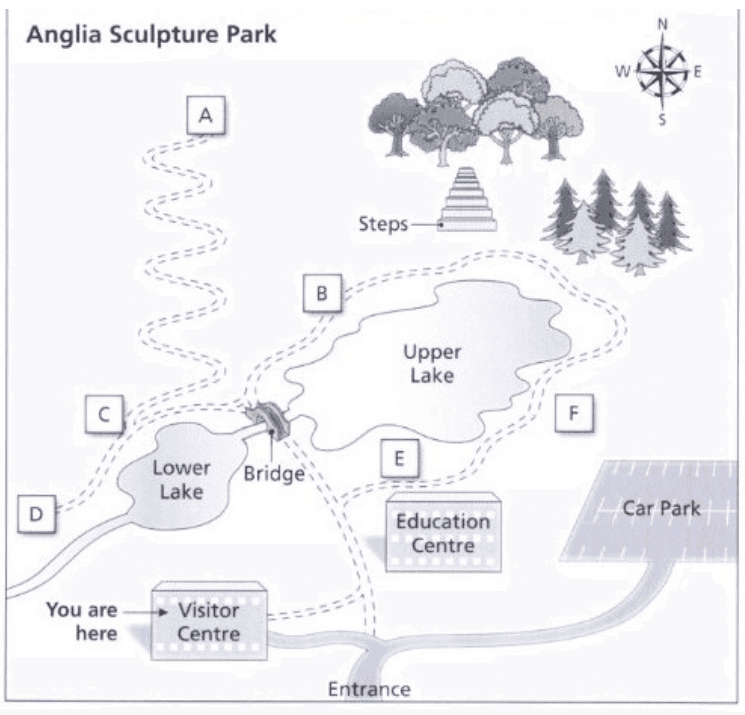
17. Joe Tremain sculptures
18. Giorgio Catalucci bird sculptures
19. Garden Gallery
20. Long House
Advice on a marketing report
Questions 21–26
Choose the correct letter, A, B or C.
21. Why did Leo choose instant coffee as the topic for his marketing report?
A He found plenty of material on the topic.
B He had some practical experience in the area.
C He had an idea of a brand he wanted to target.
22. Leo discovered that in Australia, recent technological developments
A are producing less healthy types of instant coffee.
B are reducing the demand for instant coffee.
C are improving the quality of instant coffee.
23. What do the speakers agree about Leo's table of coffee products?
A It needs more explanation in the text.
B It is factually inaccurate in some places.
C It would be best to put this in the appendix.
24. What do they decide about the description of Shaffers coffee as a market follower?
A Leo needs to define his terms.
B Leo needs to provide more evidence.
C Leo needs to put it in a different section.
25. What does Anna say about originality in someone's first marketing report?
A Clear analysis of data can be considered original.
B Graphs and diagrams should be original, not copied.
C Reports should contain some original data collected by the student.
26. What difference between his school assignments and this report has surprised Leo?
A not knowing the criteria for getting a good mark
B being required to produce work without assistance
C having to do a great deal of research
Questions 27–30
Complete the notes below. Write ONE WORD ONLY for each answer.
Notes on specific sections of marketing report
Executive summary
Give a brief overview including the (27) …………………………
Problems
Link each problem to a (28) ………………………… which explains it
Implementation
Practical solutions to problems
Include details such as participants, (29) ………………………… and sequence
Section is often poorly done because of lack of (30) …………………………
Conclusion
Don't use new material here
History of fireworks in Europe
Questions 31–40
Complete the notes below. Write ONE WORD ONLY for each answer.
History of Fireworks in Europe
13th–16th centuries
Fireworks were introduced from China.
Their use was mainly to do with:
• war
• (31) ………………………… (in plays and festivals)
17th century
Various features of (32) ………………………… were shown in fireworks displays.
Scientists were interested in using ideas from fireworks displays:
• to make human (33) ………………………… possible
• to show the formation of (34) …………………………
London:
Scientists were distrustful at first
Later, they investigated (35) ………………………… uses of fireworks (e.g. for sailors)
St Petersburg:
Fireworks were seen as a method of (36) ………………………… for people
Paris:
Displays emphasised the power of the (37) …………………………
Scientists aimed to provide (38) …………………………
18th century
Italian fireworks specialists became influential.
Servandoni's fireworks display followed the same pattern as an (39) …………………………
The appeal of fireworks extended to the middle classes.
Some displays demonstrated new scientific discoveries such as (40) …………………………
Answers
1. unfriendly
2. noisy
3. 23.50
4. insects
5. bathrooms
6. party
7. SHADFORTH
8. towel
9. breakfast
10. kitchen
11. the site of a private house.
12. Artists have made sculptures especially for it.
13. the violence of nature
14. has recently been repaired.
15. It is being enlarged at present.
16. at the kiosk.
17. E
18. C
19. F
20. A
21. He found plenty of material on the topic.
22. are reducing the demand for instant coffee.
23. It needs more explanation in the text.
24. Leo needs to provide more evidence.
25. Clear analysis of data can be considered original.
26. not knowing the criteria for getting a good mark
27. background
28. theory
29. cost
30. time
31. religion
32. nature
33. flight
34. stars
35. practical
36. education
37. king
38. entertainment
39. opera
40. electricity
Explanations
- 1. unfriendly
- 'Some people said they didn't like the staff, they had an unfriendly attitude.'Common trap: Opposite-word trap — 'welcoming' is said one line later, describing hostels in general.
- 2. noisy
- 'the rooms had air-conditioning, but the problem with that was that it was very noisy, so they were kept awake.'Common trap: Second-complaint trap — 'too hot' follows and also fits 'air-conditioning is too ___'.
- 3. 23.50
- 'It costs a bit more, forty-five dollars a person.' / 'Oh, no, that's for private rooms, it's twenty-three fifty for the dorms.' The column is dormitory prices.Common trap: Self-correction trap — the private-room price is given first and then corrected.
- 4. insects
- 'one person who said they couldn't sleep because there were insects flying around in the dormitories.'Common trap: Positive-review trap — the good points are listed before the single complaint.
- 5. bathrooms
- 'the standard of cleanliness was pretty good, and especially the bathrooms, they were excellent as far as that went.'Common trap: Contrast trap — the rooms are described as untidy just before the bathrooms are praised.
- 6. party
- 'every night everyone staying there got together and ended up having a party.'Common trap: Summary-word trap — 'atmosphere' follows but is not what happens every night.
- 7. SHADFORTH
- 'it's on Shadforth Lane.' / 'Can you spell that?' / 'S-H-A-D-F-O-R-T-H.'Common trap: Spelled-name trap — the street name is spelled out letter by letter.
- 8. towel
- 'you can usually either bring your own towel, or hire one there, but they don't usually provide those for free.'Common trap: Provided-versus-hired trap — sheets are provided free and are already printed in the notes.
- 9. breakfast
- 'you don't have to pay extra for breakfast.' Lunch has to be bought at the cafe.Common trap: Paid-meal trap — lunch is named immediately after and must be paid for.
- 10. kitchen
- 'usually for every five or six rooms there's a kitchen where you can knock up a snack, and that saves a lot of money.'Common trap: Similar-facility trap — the cafe is described in the sentence before the shared kitchen.
- 11. the site of a private house.
- 'They built a house in the centre of the park ... but this burnt down in 1980 and the De Quincies then sold the land.'Common trap: Same-sentence trap — machinery manufacturing and forest land are both mentioned just before.
- 12. Artists have made sculptures especially for it.
- 'we're unique in that some of our sculptures were actually created for the sites they occupy here.'Common trap: Comparison trap — contemporary sculpture is what other parks also do.
- 13. the violence of nature
- 'carved and marked with fire to illustrate the ferocity and intensity of the forces that have shaped our planet over millions of years.'Common trap: Setting-versus-theme trap — the rural setting is described but is not the theme.
- 14. has recently been repaired.
- 'We had to renovate this after the lake overflowed its banks a couple of months ago and flooded the area.'Common trap: Past-versus-present trap — the flooding was two months ago and the path is now fine.
- 15. It is being enlarged at present.
- 'It's not possible to go upstairs at present as builders are working there adding another floor.'Common trap: Transferred-fact trap — the award and Canada belong to a different building by the same architect.
- 16. at the kiosk.
- 'the Terrace Room is currently closed, but you can go to the kiosk and buy something.'Common trap: Location trap — the Lower Lake is where you eat, not where you buy.
- 17. E
- 'displayed on this side of the Upper Lake, just behind the Education Centre and near the bridge.'Common trap: Two-landmark trap — the position needs both the Education Centre and the bridge.
- 18. C
- 'they're just across the bridge on the north side of Lower Lake.'Common trap: Side-of-lake trap — D also sits by the Lower Lake but on the wrong side of the bridge.
- 19. F
- 'It's on this side of the Upper Lake - from the Visitor Centre you go to the Education Centre, then keep on along the path, and you'll see it on your right.'Common trap: Continue-past trap — E is reached first; the gallery is further along on the right.
- 20. A
- 'you go to the bridge and then turn left on the other side. Soon you'll see a winding pathway going up towards the northern boundary of the park - go up there and you'll find it at the top.'Common trap: Multi-step trap — three moves must be followed; C sits at the turn rather than at the top.
- 21. He found plenty of material on the topic.
- 'when I searched for men's clothing on the Internet there were hardly any articles. So then I looked for coffee and I found there were tons.'Common trap: Rejected-topic trap — the practical-experience reason belongs to the topic he did not choose.
- 22. are reducing the demand for instant coffee.
- 'how in Australia fewer people are buying instant coffee because of cheap coffee percolators that they can use to make real coffee at home.'Common trap: Wrong-category trap — the health point is explicitly labelled cultural, not technological.
- 23. It needs more explanation in the text.
- 'it's too factual on its own, you need to add some comment in that section about the implications of the figures.' / 'Right, I'll do that.'Common trap: Question-not-proposal trap — the appendix is raised as a question, not a recommendation.
- 24. Leo needs to provide more evidence.
- 'it's fine where it is but you've got to back it up with some data or they'll say your report lacks weight.'Common trap: Already-done trap — defining terms is praised as done, and the section move is Leo's own rejected idea.
- 25. Clear analysis of data can be considered original.
- 'what makes your work original is the perspective you provide by your interpretation of it.'Common trap: Explicit-negatives trap — both wrong options are stated as things that are NOT required.
- 26. not knowing the criteria for getting a good mark
- 'I knew exactly what I had to do to get a good grade at school ... but I haven't got information on how the lecturer is going to grade my work - what he's looking for.'Common trap: Wrong-guess trap — Anna guesses 'research' and Leo corrects her.
- 27. background
- 'Have you got something about the background there?' / 'Yeah.' Aims are explicitly excluded as 'too personal'.Common trap: Excluded-item trap — aims are raised and then ruled out of the executive summary.
- 28. theory
- 'you analyse each one by connecting it with a theory ... that's where your reading comes in.'Common trap: Prior-step trap — prioritising comes first in the same sentence.
- 29. cost
- 'don't forget to specify things like who would be involved, and the cost, and the order that things would be done in.' Participants and sequence are already printed.Common trap: Already-given trap — the first and third items in the list are printed in the notes.
- 30. time
- 'that's the bit that tends to get badly done because people run out of time.'Common trap: Ironic-setup trap — Leo says it won't take long immediately before the warning.
- 31. religion
- 'they were also sometimes a feature of plays and festivals where their chief purpose was related to religion.'Common trap: Already-given trap — the military use is printed as 'war' in the notes.
- 32. nature
- 'Technicians were employed to stage spectacular shows which displayed aspects of nature, with representations of the sun, snow and rain.'Common trap: Occasion-versus-content trap — royal occasions are why displays happened, not what they showed.
- 33. flight
- 'scientists thought that in a similar way, humans might be able to achieve flight - a dream of many scientists at the time.'Common trap: Trigger-versus-goal trap — the dragon display is what prompted the idea, not the idea itself.
- 34. stars
- 'it occurred to him that fireworks might provide an effective way of demonstrating how stars were formed.'Common trap: Observation-versus-application trap — the lighting effect is the observation, stars are the application.
- 35. practical
- 'later in the century scientists and technicians started to look at the practical purposes for which fireworks might be employed, such as using rockets to help sailors establish their position at sea.'Common trap: Already-given trap — the earlier distrust is printed in the notes.
- 36. education
- 'those in power regarded fireworks as being an important element in the education of the masses.'Common trap: Motive trap — keeping the Academy open was the Academy's own hope, not how fireworks were seen.
- 37. king
- 'the fireworks and the spectacle they created were all designed to encourage the public to believe in the supreme authority of the king.'Common trap: Paraphrase trap — 'supreme authority' has to be matched to the printed 'power'.
- 38. entertainment
- 'The purpose of scientists was basically to offer entertainment to fashionable society.'Common trap: Means-versus-aim trap — demonstrating natural laws is how, entertainment is what.
- 39. opera
- 'A fireworks display staged by Servandoni would be structured in the same way as an opera, and was even divided into separate acts.'Common trap: Feature-versus-structure trap — temples and arches are what the display contained, not its pattern.
- 40. electricity
- 'displays now showed a fascinated public the curious phenomenon of electricity.'Common trap: Old-versus-new trap — laws and theories were already demonstrated; electricity is the new discovery.
Audio transcripts
Part 1 — Choosing a hostel in Darwin
Julie: Hi Nick. It's Julie. Have you managed to find any information about accommodation in Darwin? Nick: Hi. I was just going to call you. I've found some on the Internet. There are quite a few hostels for backpackers there. The first possibility I found was a hostel called Top End Backpackers. Julie: OK. Nick: It's pretty cheap, you can get a bed in a dormitory for nineteen dollars per person. Private rooms cost a bit more, but we'll be OK in dormitories, won't we? Julie: Sure. Nick: So that hostel has parking, though that doesn't really matter to us as we'll be using public transport. Julie: Yeah. Are there any reviews on the website from people who've been there? Nick: Well, yes. They aren't all that good though. Some people said they didn't like the staff, they had an unfriendly attitude. Julie: Mmm. That's quite unusual in a hostel, usually all the staff are really welcoming. Nick: That's what I thought. People said they liked the pool, and the fact that the rooms had air-conditioning, but the problem with that was that it was very noisy, so they were kept awake. But it was too hot if they turned it off, so they had to put up with it. Julie: Someone told me there's another hostel called Gum Tree something. Nick: Gum Tree Lodge. It costs a bit more, forty-five dollars a person. Julie: What? Nick: Oh, no, that's for private rooms, it's twenty-three fifty for the dorms. Julie: That's more like it. Nick: It looks to be in quite a good location, a bit out of town and quiet but with good transport, and quite near a beach. Julie: Has it got a pool? Nick: Yes, and its own gardens. The reviews for that one are mostly OK except for one person who said they couldn't sleep because there were insects flying around in the dormitories. Julie: Not for me then. And I'd rather be somewhere central really. Nick: Right. There's a place called Kangaroo Lodge. They've got dorms at twenty-two dollars. And it's downtown, near all the restaurants and clubs and everything, so that should suit you. And it doesn't close at night. Julie: So there's always someone on reception. That sounds good. Nick: The only criticism I saw was that the rooms were a bit messy and untidy because people just left their clothes and stuff all over the beds and the floor. Julie: Don't hostels usually have lockers in the bedrooms where you can leave your stuff? Nick: Yeah, they do usually, but apparently they don't here. Still, hostels are never particularly tidy places, so that doesn't bother me. And the same person said that the standard of cleanliness was pretty good, and especially the bathrooms, they were excellent as far as that went. Julie: Right. Yeah, I reckon Kangaroo Lodge sounds the best. Nick: Me too. Quite a lot of people reviewing it said it was really fun there, like every night everyone staying there got together and ended up having a party. So it sounds like it's got a really good atmosphere. Julie: OK, let's go for that one. Julie: Did you get the address of Kangaroo Lodge? Nick: Yes ... it's on Shadforth Lane. Julie: Can you spell that? Nick: S-H-A-D-F-O-R-T-H. It's near the transit centre where the intercity buses and the airport buses drop you off. Julie: Cool. I'm really looking forward to this. I've never stayed in a hostel before. Do they provide bed linen - sheets and things? Nick: Yeah. And you can usually either bring your own towel, or hire one there, but they don't usually provide those for free. Julie: OK. And what happens about meals? Nick: Well, you don't have to pay extra for breakfast. It varies a lot in different places but generally it's OK. And there's usually a cafe where you can buy a snack or a hot meal for lunch. But actually if you're really travelling on the cheap, usually for every five or six rooms there's a kitchen where you can knock up a snack, and that saves a lot of money. Julie: Great. Right, well shall I go ahead and book that ...
Part 2 — Anglia Sculpture Park tour
Guide: Hello everyone and welcome to the Anglia Sculpture Park. Right, well, the idea behind the sculpture park is that it's a place where works of art such as large sculptures and carvings can be displayed out of doors in a natural setting. As you'll have noticed when you drove here, most of the land around the park is farmland. The park itself belonged to a family called the De Quincies, who had made a lot of money from manufacturing farm machinery, and who also owned substantial stretches of forest land to the north of the park. They built a house in the centre of the park, not far from where we're standing now, but this burnt down in 1980 and the De Quincies then sold the land. The Anglia Sculpture Park isn't the only one in the country; several of the London parks sometimes display contemporary sculptures, and there are a couple of other permanent sculpture parks in England. But we're unique in that some of our sculptures were actually created for the sites they occupy here, and we also show sculptures by a wider range of artists than anywhere else in the country. For example, at present we have an exhibition by Joe Tremain, of what he calls 'burnt' sculptures. These are wood and stone sculptures that he's carved and marked with fire to illustrate the ferocity and intensity of the forces that have shaped our planet over millions of years. They look really dramatic in this rural setting. To see some of the sculptures, you'll need to follow the path alongside the Lower Lake. We had to renovate this after the lake overflowed its banks a couple of months ago and flooded the area. The water level's back to normal now and you shouldn't have any trouble, the path's very level underfoot. You should be back at the Visitor Centre at about four o'clock. If you have time it's worth taking a look at the Centre itself. It's not possible to go upstairs at present as builders are working there adding another floor, but the rest's well worth seeing. The architect was Guy King. He was actually born in this part of England but he recently designed a museum in Canada that won a prize for innovation in public buildings. If you want to get something to eat when you get back, like a snack or a sandwich, the Terrace Room is currently closed, but you can go to the kiosk and buy something, then sit on one of the chairs overlooking the Lower Lake and enjoy the view as you're eating. Now, let me just tell you a bit about what you can see in the Sculpture Park. If you look at your map, you'll see the Visitor Centre, where we are now, at the bottom, just by the entrance. Since we only have an hour, you might not be able to get right around the park, but you can choose to visit some of the highlights. You might like to take a look at the Joe Tremain sculptures which are displayed on this side of the Upper Lake, just behind the Education Centre and near the bridge. They're really impressive, but please remember not to let your children climb on them. One of our most popular exhibitions is the Giorgio Catalucci bird sculptures - they're just across the bridge on the north side of Lower Lake. I love the way they're scattered around in the long grass beside the lake, looking as if they're just about to take to their wings. You could also go to the Garden Gallery. It's on this side of the Upper Lake - from the Visitor Centre you go to the Education Centre, then keep on along the path, and you'll see it on your right. There's an exhibition of animal carvings there which is well worth a look. We also have the Long House - that's quite a walk. From here, you go to the bridge and then turn left on the other side. Soon you'll see a winding pathway going up towards the northern boundary of the park - go up there and you'll find it at the top. They have some abstract metal sculptures that are well worth seeing if you have time. OK well now if you're ...
Part 3 — Advice on a marketing report
Leo: Anna, I wanted to ask you about my marketing report. I'm not sure about it ... Anna: That's OK, Leo. So what do you have to do? Leo: Choose a product or service then compare two organisations that produce it. I'm doing instant coffee. Anna: But haven't you got a weekend job in a clothing store? Why didn't you choose clothing? Leo: That was my first thought, because I thought it'd give me some practical examples, but when I searched for men's clothing on the Internet there were hardly any articles. So then I looked for coffee and I found there were tons. Anna: Yeah, there are so many brands on the market now. OK, so how much have you actually written? Leo: I've done part one, on economic and technological factors. I found some good data on technological changes, how in Australia fewer people are buying instant coffee because of cheap coffee percolators that they can use to make real coffee at home. Anna: But there's also a movement away from drinking coffee ... Leo: ... switching to things like herbal teas instead because they think it's healthier? But that's not really to do with technology, it's more cultural. Anyway, for part two I'm comparing two instant coffee companies, CoffeeNow and Shaffers, and I've made this table of products. Anna: Right. Let's see ... so you've got the brand names, and prices and selling size, and descriptions. OK, the table looks good, you'll get marks for research there. Where will it go? Leo: In the section on the marketing mix, under 'Product'. Anna: Not in the appendix? Leo: No. Anna: OK, but it's too factual on its own, you need to add some comment in that section about the implications of the figures. Leo: Right, I'll do that. Now I want to say that I think that Shaffers is more of a follower than a leader in the coffee industry. Now, I'm putting that in the section on market share. Does that seem OK? Anna: Let's see ... so you've begun by explaining what market share is, that's important, but you've got to be careful how you give that opinion. Leo: Do you think it should go in another section? Anna: Well, it's fine where it is but you've got to back it up with some data or they'll say your report lacks weight. Leo: OK. One thing I'm worried about is finding anything original to say. Anna: Well, since this is your first marketing report, you're not expected to go out and do interviews and things to collect your own data, you're just using published data. So the analysis you do might not throw up anything that people didn't know before. But the focus is more on how you handle the data - I mean, you might take something like a graph of sales directly from a website, but what makes your work original is the perspective you provide by your interpretation of it. Leo: Oh. You know, it's all so different from business studies assignments at school. It's really surprised me. Anna: What, how much research you have to do? Leo: I expected that. It's more ... I knew exactly what I had to do to get a good grade at school - and I knew I'd be expected to go more deeply into things here, but I haven't got information on how the lecturer is going to grade my work - what he's looking for. Anna: Well, one thing you have to remember is that in a marketing report you've got to have what they call an executive summary at the beginning. I forgot that and I got marked down. Leo: Yeah, I've drafted it. I've got an overview. Anna: Have you got something about the background there? Leo: Yeah. Anna: Good. Leo: So I've just made a summary of the main points. I wasn't sure whether or not I should have my aims there. Anna: No, that's too personal. The executive summary is just, like, what a manager would read to get a general idea of your report if he was in a hurry. Leo: Right. Then I'm OK for the first main part, all of the macroenvironment stuff, but it's when I get onto the problems section ... I've listed all the problems that CoffeeNow and Shaffers are facing, but then what? Anna: Well you have to prioritise, so indicate the main problems, and then you analyse each one by connecting it with a theory ... that's where your reading comes in. Leo: OK. Anna: Have you done your implementation section yet? Leo: I've thought about it - so that's where I write about what could be done about the problems. Anna: Yes, and it's got to be practical so don't forget to specify things like who would be involved, and the cost, and the order that things would be done in. Leo: Right. Well that shouldn't take long. Anna: You'd be surprised. Actually that's the bit that tends to get badly done because people run out of time. That and the conclusion ... Leo: Any hints for that? Anna: Well, it's got to draw out the main points from your report, so it's got to be quite general. You need to avoid introducing new stuff here, it's got to sum up what you've said earlier. Leo: OK. Thanks Anna. That's been a big help.
Part 4 — History of fireworks in Europe
Lecturer: An interesting aspect of fireworks is that their history tells us a lot about the changing roles of scientists and technicians in Europe. Fireworks were introduced from China in the 13th century. Up to the 16th century they were generally used for military purposes, with rockets and fire tubes being thrown at the enemy, but they were also sometimes a feature of plays and festivals where their chief purpose was related to religion. By the 17th century, the rulers of Europe had started using fireworks as a way of marking royal occasions. Technicians were employed to stage spectacular shows which displayed aspects of nature, with representations of the sun, snow and rain. These shows were designed for the enjoyment of the nobility and to impress ordinary people. But fireworks also aroused the interest of scientists, who started to think of new uses for them. After seeing one firework display where a model of a dragon was propelled along a rope by rockets, scientists thought that in a similar way, humans might be able to achieve flight - a dream of many scientists at the time. Other scientists, such as the chemist Robert Boyle, noticed how in displays one firework might actually light another, and it occurred to him that fireworks might provide an effective way of demonstrating how stars were formed. Scientists at the time often depended on the royal courts for patronage, but there was considerable variation in the relationships between the courts and scientists in different countries. This was reflected in attitudes towards fireworks and the purposes for which they were used. In London in the middle of the 17th century there was general distrust of fireworks among scientists. However, later in the century scientists and technicians started to look at the practical purposes for which fireworks might be employed, such as using rockets to help sailors establish their position at sea. It was a different story in Russia, where the St Petersburg Academy of Science played a key role in creating fireworks displays for the court. Here, those in power regarded fireworks as being an important element in the education of the masses, and the displays often included a scientific message. Members of the Academy hoped that this might encourage the Royal Family to keep the Academy open at a time when many in the government were considering closing it. In Paris, the situation was different again. The Paris Academy of Sciences played no role in staging fireworks displays. Instead the task fell to members of the Royal Academy of Painting and Sculpture. As in Russia, the work of the technicians who created the fireworks was given little attention. Instead, the fireworks and the spectacle they created were all designed to encourage the public to believe in the supreme authority of the king. However, science was also enormously popular among the French nobility, and fashionable society flocked to demonstrations such as Nicolas Lemery's display representing an erupting volcano. The purpose of scientists was basically to offer entertainment to fashionable society, and academicians delighted in amazing audiences with demonstrations of the universal laws of nature. In the course of the 18th century, the circulation of skills and technical exchange led to further developments. Fireworks specialists from Italy began to travel around Europe staging displays for many of the European courts. The architect and stage designer Giovanni Servandoni composed grand displays in Paris, featuring colourfully painted temples and triumphal arches. A fireworks display staged by Servandoni would be structured in the same way as an opera, and was even divided into separate acts. Italian fireworks specialists were also invited to perform in London, St Petersburg and Moscow. As these specialists circulated around Europe, they sought to exploit the appeal of fireworks for a wider audience, including the growing middle classes. As in the previous century, fireworks provided resources for demonstrating scientific laws and theories, as well as new discoveries, and displays now showed a fascinated public the curious phenomenon of electricity. By the mid-18th century, fireworks were being sold for private consumption. So the history of fireworks shows us the diverse relationships which existed between scientists, technicians and the rest of society ...
Comments
Loading comments…