

Official Cambridge Guide 1 Listening Test 4
4 parts · 40 questions · 30 minutes
Evening classes at a community centre
Questions 1–6
Complete the table below. Write NO MORE THAN ONE WORD AND/OR A NUMBER for each answer.
| Class | Where | When | What to bring | Cost |
|---|---|---|---|---|
| Painting with watercolours | Example – in the hall | at (1) ………………………… pm on Tuesdays | water jar and set of (2) ………………………… | £45 – four classes |
| Maori language | the small room at the (3) ………………………… of the building | starts in (4) ………………………… | small recorder | £40 – five classes |
| Digital photography | room 9 | 6 pm Wednesday evenings | the (5) ………………………… for the camera | £ (6) ………………………… – eight classes |
Questions 7–10
Complete the sentences below. Write ONE WORD ONLY for each answer.
7. • The watercolours class suits people who are ………………………… .
8. • To find out about the Maori language class, contact Jason ………………………… .
9. • For the photography class, check the ………………………… for the camera.
10. • There is a trip to a local ………………………… in the final week of the photography class.
Hadley Park community gardens volunteers
Questions 11–12
Choose TWO letters, A–E.
11. Which TWO tasks will the volunteers in Group A be responsible for? Task selection (lower letter)
A widening pathways
B planting trees
C picking up rubbish
D putting up signs
E building fences
12. Which TWO tasks will the volunteers in Group A be responsible for? Task selection (higher letter)
A widening pathways
B planting trees
C picking up rubbish
D putting up signs
E building fences
Questions 13–14
Choose TWO letters, A–E.
13. Which TWO items should volunteers in Group A bring with them? Item selection (lower letter)
A food and water
B boots
C gloves
D raincoats
E their own tools
14. Which TWO items should volunteers in Group A bring with them? Item selection (higher letter)
A food and water
B boots
C gloves
D raincoats
E their own tools
Questions 15–20
Label the plan below. Write the correct letter, A–I, next to Questions 15–20.
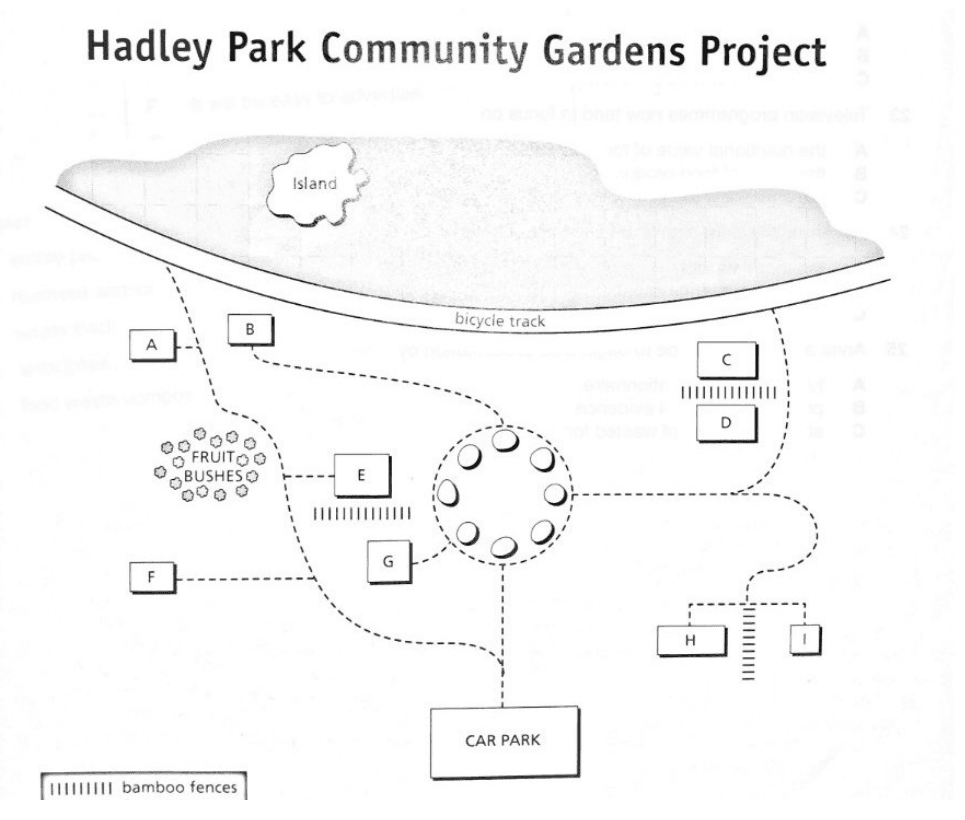
15. Vegetable beds
16. Bee hives
17. Seating
18. Adventure playground
19. Sand area
20. Pond
Preparing a presentation on food waste
Questions 21–25
Choose the correct letter, A, B or C.
21. What point does Robert make about the 2013 study in Britain?
A It focused more on packaging than wasted food.
B It proved that households produced more waste than restaurants.
C It included liquid waste as well as solid waste.
22. The speakers agree that food waste reports should emphasise the connection between carbon dioxide emissions and
A food production.
B transport of food to landfill sites.
C distribution of food products.
23. Television programmes now tend to focus on
A the nutritional value of food products.
B the origin of food products.
C the chemicals found in food products.
24. For Anna, the most significant point about food waste is
A the moral aspect.
B the environmental impact.
C the economic effect.
25. Anna and Robert decide to begin their presentation by
A handing out a questionnaire.
B providing statistical evidence.
C showing images of wasted food.
Questions 26–30
What advantage do the speakers identify for each of the following projects? Choose FIVE answers from the box and write the correct letter, A–G, next to Questions 26–30.
Advantages
A It should save time.
B It will create new jobs.
C It will benefit local communities.
D It will make money.
E It will encourage personal responsibility.
F It will be easy to advertise.
G It will involve very little cost.
26. edible patch
27. ripeness sensor
28. waste tracking technology
29. smartphone application
30. food waste composting
Maori kite-making
Questions 31–40
Complete the notes below. Write ONE WORD for each answer.
Kite-making by the Maori people of New Zealand
Making and appearance of the kites
The priests who made the kites had rules for size and scale
(31) ………………………… was not allowed during a kite's preparation
Kites:
• often represented a bird, a god, or a (32) …………………………
• had frames that were decorated with grasses and (33) …………………………
• had a line of noisy (34) ………………………… attached to them.
• could be triangular, rectangular or (35) ………………………… shaped.
• had patterns made from clay mixed with (36) ………………………… oil.
• sometimes had human-head masks with (37) ………………………… and a tattoo.
Purpose and function of kites:
• a way of sending (38) ………………………… to the gods
• a way of telling other villages that a (39) ………………………… was necessary
• a means of (40) ………………………… if enemies were coming.
Answers
1. 7.30
2. pencils
3. top
4. August
5. instructions
6. 55
7. beginners
8. Kahui
9. battery
10. show
11. planting trees
12. building fences
13. boots
14. gloves
15. G
16. I
17. B
18. E
19. C
20. A
21. It included liquid waste as well as solid waste.
22. food production.
23. the origin of food products.
24. the economic effect.
25. handing out a questionnaire.
26. G
27. A
28. D
29. C
30. E
31. food
32. hero
33. feathers
34. shells
35. diamond
36. shark
37. teeth
38. messages
39. meeting
40. escape
Explanations
- 1. 7.30
- 'It was 6.30 last term, but let me just have a look at the details. OK, it'll be 7.30 this time.' 6.30 is last term's time and 7.15 is when Andrew's wife gets home.Common trap: Three-times trap — the old class time and the wife's arrival home are both stated nearby.
- 2. pencils
- 'the information says she'll need just a jar for water and some pencils for drawing.' Paints are provided and aprons are already there.Common trap: Provided-versus-bring trap — paints and aprons are supplied, and the water jar is already printed in the cell.
- 3. top
- 'you'll need to go straight up the stairs in front of you, all the way to the top. And it's the small room you'll find there.'Common trap: Direction trap — the entrance is described first as the starting point.
- 4. August
- 'I heard from someone that the July course has been delayed until August.' / 'I'm afraid so.' The June course is already halfway through.Common trap: Three-months trap — June, July and August are all named; only August is the new start.
- 5. instructions
- 'I suppose it'd be useful to have the instructions that go with the camera, too.' / 'I'd say so.' Extra lenses are explicitly unnecessary.Common trap: Not-needed trap — accessories are named and then ruled out; the camera itself is a given.
- 6. 55
- 'For four classes, it's £35, but if you take eight, it works out as £55.' The cell already prints 'eight classes', so £35 (four classes) and the £15 saving are both wrong.Common trap: Price-cluster trap — three figures appear in one sentence, tied to four classes, eight classes and the saving.
- 7. beginners
- 'you don't have to be very skilled or anything like that. It's designed for beginners, actually.'Common trap: Negative-definition trap — the level is first described by what it is not.
- 8. Kahui
- 'His name's Jason Kahui. That's K-A-H-U-I.'Common trap: Spelled-name trap — the surname is spelled out and the first name is already printed.
- 9. battery
- 'don't forget to look at your camera battery and make sure it's charged.' The instructions are a separate item, printed in the table for Q5.Common trap: Cross-question trap — 'the ___ for the camera' also matched 'instructions' earlier in the recording.
- 10. show
- 'in the final week of the photography course, is it right that there's a visit to a show in the local area?' / 'Yes.'Common trap: Confirmation trap — the answer sits inside the student's question, confirmed only by 'Yes'.
- 11. planting trees
- Group A get two jobs: the new wooden fencing ('The priority for you will be to give us a hand with the new wooden fencing') and putting native plants and trees back into the ground ('you'll be doing some digging for us and getting those into the ground').Common trap: Someone-else's-job trap — the council and a local school are assigned three of the five listed tasks.
- 12. building fences
- Group A get two jobs: the new wooden fencing ('The priority for you will be to give us a hand with the new wooden fencing') and putting native plants and trees back into the ground ('you'll be doing some digging for us and getting those into the ground').Common trap: Someone-else's-job trap — the signs are the council's promise, not the volunteers' task.
- 13. boots
- 'I'd definitely recommend a strong pair of boots, waterproof would be best; it's quite muddy at the moment, and your own gloves would also be advisable.' Raincoats are cancelled by the forecast, tools are provided and food and drink are supplied.Common trap: Withdrawn-item trap — raincoats are raised and cancelled in the sentence before.
- 14. gloves
- 'I'd definitely recommend a strong pair of boots, waterproof would be best; it's quite muddy at the moment, and your own gloves would also be advisable.' Raincoats are cancelled by the forecast, tools are provided and food and drink are supplied.Common trap: Supplied-item trap — tools and food are both supplied, though 'your own' invites the tools answer.
- 15. G
- From the car park, up the footpath to the circle of trees in the middle; 'on the left-hand side of that circular footpath, there's a short track which takes you directly to the vegetable beds.'Common trap: Landmark trap — the bamboo fence above the beds can be mistaken for the location itself.
- 16. I
- East from the circle of trees, then the path that 'heads down'; 'you see two areas divided by a bamboo fence - and as we're looking at the plan, the bee hives are on the right of the fence - the smaller section.'Common trap: Fork trap — the path divides, and the wrong branch leads to the sand area.
- 17. B
- 'look at the circular footpath, at the top of it, there's a path that goes from there and takes you up to the seating area, alongside the bicycle track and with a good view of the island.'Common trap: Adjacent-label trap — A also sits near the bicycle track on the left.
- 18. E
- 'start from the car park again and go up the footpath, but then you want the first left turn. Go up there, and then you see there's a short path that goes off to the right - go down there and that's the adventure playground area, above the bamboo fence.'Common trap: Multi-step trap — three turns must be followed in order; F sits at the end of the wrong branch.
- 19. C
- 'find the track that goes east ... and where that track divides, you need the little path that goes up towards the bicycle track. The sand area is just above the bamboo fence there.'Common trap: Fork trap — the same junction as the bee hives, taken in the opposite direction.
- 20. A
- 'it's on the left-hand side of your plan - towards the top - just above the fruit bushes and to the left of the little path.'Common trap: Relative-position trap — E also sits beside the fruit bushes, but to their right.
- 21. It included liquid waste as well as solid waste.
- 'one thing the study did investigate was the amount of milk and soft drinks that were wasted, and I think it was probably quite unique in that respect.' Milk and soft drinks = liquid waste.Common trap: Scope trap — packaging and restaurants are both named as things the study left out.
- 22. food production.
- 'They never refer to the fuel that farms and factories require to produce the food, and the carbon dioxide that releases?' / 'Exactly ... They forget about one of the key causes of carbon dioxide.'Common trap: Over-covered trap — transport and distribution are both mentioned, but as what reports already do.
- 23. the origin of food products.
- 'These days they all seem to be focusing on where your meat, fruit and vegetables are sourced from. We're being encouraged to buy locally, not from overseas.'Common trap: Wrong-medium trap — the other two options are what magazines, not television, focus on.
- 24. the economic effect.
- 'What concerns me above all else is that in a recession governments should be encouraging business to find ways to cut costs ... That's throwing money away.'Common trap: Excluded-topics trap — the other two options are each named and then explicitly ruled out.
- 25. handing out a questionnaire.
- 'How about we give the other students a set of questions to answer - about what they suspect they waste every day?' / 'I'm fine with that.'Common trap: Rejected-openings trap — both wrong options are raised and dismissed around the answer.
- 26. G
- 'The other good thing about the patches is that apparently they'll be cheap to manufacture.' Cheap to make = very little cost.Common trap: First-benefit trap — the patch's main function is described before the advantage the question wants.
- 27. A
- 'That's got to be a quicker way to check for ripeness than taking each box off the shelf and opening it.'Common trap: Mechanism-versus-benefit trap — how the sensor works is explained just before the time saving.
- 28. D
- 'Their waste tracking technology means that caterers can see how much food is being wasted and why. That'll increase profits for them eventually.'Common trap: Purpose-versus-advantage trap — the visibility it gives caterers is not the listed advantage.
- 29. C
- 'In the long run, that'll definitely benefit poorer families in the neighbourhood.' Neighbourhood families = local communities.Common trap: Paraphrase trap — 'poorer families in the neighbourhood' must be mapped to 'local communities'.
- 30. E
- 'if we all start composting, we'd be doing something positive about the problem of food waste ourselves, rather than relying on the government to sort it out.'Common trap: Drawback-first trap — the extra work is mentioned before the advantage.
- 31. food
- 'during the preparation of both small and large kites, food was strictly forbidden.'Common trap: Rule-cluster trap — several rituals are listed together; only the ban on food fits the gap.
- 32. hero
- 'kites were frequently designed in the image of a native bird, or a Maori god, and sometimes, perhaps less often, a well-known hero.'Common trap: Already-given trap — bird and god are printed, so the answer is the third item.
- 33. feathers
- 'For this the priests used long grasses ... They also used a variety of feathers to add, um, colour to their creations.'Common trap: Materials trap — bark and roots are the frame materials, not the decoration.
- 34. shells
- 'They could be quite noisy indeed, and this was because some priests liked to hang a long row of shells from the kite.'Common trap: Cause-and-effect trap — the noise is described first and the object only afterwards.
- 35. diamond
- 'there were kites that were triangular, rectangular and also shaped like a diamond.'Common trap: Already-given trap — the first two shapes are printed in the notes.
- 36. shark
- 'red-brown clay which had been combined with oil obtained from a local species of shark.'Common trap: Alternative-pigment trap — the charcoal base is the other option, not the one mixed with oil.
- 37. teeth
- 'it's a mask of a human head - and you can clearly see it has a tattoo and also a set of teeth.'Common trap: Already-given trap — the tattoo is printed, so the answer is the other feature.
- 38. messages
- 'the flying of kites was a way of communicating with the gods and when the kites rose into the air, the Maori used them to deliver messages.'Common trap: Examples trap — the things requested follow immediately and can be mistaken for the answer.
- 39. meeting
- 'to attract the attention of a neighbouring village. This was done when a meeting was required between Maori elders.'Common trap: Paraphrase trap — 'a neighbouring village' matches the printed 'other villages', not the gap.
- 40. escape
- 'when a Maori warrior found himself surrounded by his enemies, a kite could actually provide the possibility of escape.'Common trap: Second-use trap — the attacking use is described straight after the escape.
Audio transcripts
Part 1 — Evening classes at a community centre
Receptionist: Hello. Eastwood Community Centre. Andrew: Oh, hello. My name's Andrew Dyson. I'm calling about the evening classes you offer. Receptionist: OK, Mr Dyson, are there any classes in particular that you're interested in? Andrew: Yes, you've got a class called 'Painting with watercolours', I believe. Receptionist: That's right. It's a popular class so this term it'll be moving to the hall, so they've got more room. Andrew: Right. I know it's on Tuesdays but what time exactly? Receptionist: It was 6.30 last term, but let me just have a look at the details. OK, it'll be 7.30 this time, probably it suits more people. Andrew: Well, it's my wife who's really interested and that'll be good for her because she's home from work by 7.15 - that'll give her just enough time to get there. Um, what does she need to bring? Receptionist: OK, well paints are provided by the tutor, I know that. Um, the information says she'll need just a jar for water and some pencils for drawing. There are also lots of aprons here, so she needn't worry what she's wearing. And the cost for four classes is 45 pounds, including paints, as I said. Andrew: OK, now we're both quite keen on the Maori language class. Receptionist: There are spaces on the next course, so you could join that. Andrew: Oh, good. Which room will that be in? Receptionist: When you come in through the entrance of the community centre building, you'll need to go straight up the stairs in front of you, all the way to the top. And it's the small room you'll find there. Andrew: I see. All right, and let me just check when it's starting. I heard from someone that the July course has been delayed until August. Receptionist: I'm afraid so. And we're halfway through the June course at the moment so there's not much point you taking that. Andrew: I guess we'll have to wait, then. Receptionist: Well, when you do come, the tutor recommends bringing a small recorder with you just so you can listen again later, and er, the cost for five classes is currently 40 pounds. Andrew: OK, useful information to know. Um, there's one more class I'm interested in - that's the digital photography class. Receptionist: Oh, I've taken that class myself. The tutor's very good. That'll be in room 9 and it's starting in two weeks' time - in the evening - every Wednesday at 6 o'clock. Andrew: Um, obviously I need to bring the camera with me. I suppose it'd be useful to have the instructions that go with the camera, too. Receptionist: I'd say so. Um, some people bring along a lot of accessories like extra lenses, but there's really no need for this class. It's mainly focusing on composition really, and getting the most out of the basic camera. Andrew: That's exactly what I need. And how much does it cost? Receptionist: Let's see. For four classes, it's 35 pounds, but if you take eight, it works out as 55 pounds, so you're making a bit of a saving - 15 pounds that is. Andrew: I see. Andrew: OK, now just another question for the watercolours class; I've just remembered that my wife asked me to find out about the level - who's it for? Receptionist: OK, well you don't have to be very skilled or anything like that. It's designed for beginners, actually. People who might see art as a hobby rather than as a professional opportunity. Andrew: That sounds like my wife. And er, who do I talk to if I want to find out some more about the Maori language classes? Receptionist: Probably best to talk to the tutor directly. He'll be in the office in about half an hour. His name's Jason Kahui. That's K-A-H-U-I. Andrew: Good - I'll give him a call. Receptionist: Oh, if you do decide to come to the photography class, don't forget to look at your camera battery and make sure it's charged. I know it sounds obvious but I've seen a few people suddenly find the camera's stopped working right in the middle of class. Andrew: Yes, I can imagine it'd be easy to forget that. Oh, that reminds me, in the final week of the photography course, is it right that there's a visit to a show in the local area? I work in the city, you see, so I might have to come home early for that one. Receptionist: Yes. They'll decide the date once the class has started. Is there anything else I can
Part 2 — Hadley Park community gardens volunteers
Organiser: Good morning - it's great to see so many people here. Thank you all very much for coming. Well, as you know, the community gardens at Hadley Park are really not looking as good as they should, quite bad really, and although the local council has a budget to deal with some of the problems, we do need volunteers for other tasks. If you don't mind, I'm going to divide you into two groups. So, everyone on this side of the room is Group A, and the rest of you are Group B. So, Group A, there are a couple of things we'd like you to help with. Um, first of all, don't worry about any litter or empty bottles you see lying about - one of the local schools has offered to help out with that as part of their own environmental project. The priority for you will be to give us a hand with the new wooden fencing - it needs constructing along parts of the bicycle track, as there are parts which have now fallen down or broken - as I'm sure you've seen. You've probably also noticed that some of the pathways that come from the bicycle track are quite narrow - and there are plans to make them wider - but the council will be dealing with that later in the year, and they've also promised to produce some informational signs about the plants in the gardens. Hopefully they'll be up in a few weeks' time. The other thing we're doing is getting rid of some of the foreign species that are growing in the gardens and putting back some native plants and trees. So, you'll be doing some digging for us and getting those into the ground. So, Group A, there's some items you'll need to bring along with you. I was going to say 'raincoats' but the forecast has changed so you can leave those at home. I'd definitely recommend a strong pair of boots, waterproof would be best; it's quite muddy at the moment, and your own gloves would also be advisable. Tools will be available - spades and hammers, that kind of thing. You just need to make sure they go back in the trucks. And, there's no need to worry about food and drink as we'll be supplying sandwiches and coffee - possibly some biscuits, even! OK, Group B, your turn. Does everyone have a copy of the plan? Great. OK, we'll all be meeting in the car park - that's on the bottom of the plan, see? Now, if you've been assigned to the vegetable beds, to get there, you go out of the car park and go up the footpath until you reach the circle of trees - there they are - in the middle of the plan, and you see that the footpath goes all the way around them. Well, on the left-hand side of that circular footpath, there's a short track which takes you directly to the vegetable beds. You can see a bamboo fence marked just above them. All right? OK, if you're helping out with the bee hives, pay attention. Look again at the circle of trees in the middle of the plan, and the footpath that goes around them. On the right side of that circle - you can see that the footpath goes off in an easterly direction - heading towards the right-hand side of the plan. And then, the path splits into two and you can either go up or down. You want the path that heads down and at the end of this, you see two areas divided by a bamboo fence - and as we're looking at the plan, the bee hives are on the right of the fence - the smaller section, I mean. Now don't worry - all the bees have been removed! You just need to transport the hives back to the car park. OK, for the seating, look at the circular footpath, at the top of it, there's a path that goes from there and takes you up to the seating area, alongside the bicycle track and with a good view of the island, I suppose. OK, if you're volunteering for the adventure playground area, let's start from the car park again and go up the footpath, but then you want the first left turn. Go up there, and then you see there's a short path that goes off to the right - go down there and that's the adventure playground area, above the bamboo fence. That fence does need repairing, I'm afraid. Right, what else? Oh yes, the sand area. We've got that circular footpath in the middle - find the track that goes east, towards the right-hand side of the plan, and where that track divides, you need the little path that goes up towards the bicycle track. The sand area is just above the bamboo fence there. And finally, the pond area. So, it's on the left-hand side of your plan - towards the top - just above the fruit bushes and to the left of the little path. OK, as I said already, hopefully we'll...
Part 3 — Preparing a presentation on food waste
Anna: Hi, Robert. Robert: Hi. Sorry I'm late. I was just printing off some pages about food waste in Britain. Anna: Do you want to include Britain in the presentation? I thought we were concentrating on the USA? Robert: Well, it is a global problem, so I thought we ought to provide some statistics that show that. Anna: Fair enough. What did you find out? Robert: Well, I was looking at a British study from 2013. It basically concluded that 12 billion pounds' worth of food and drink was thrown away each year - all of it ending up in landfill sites. Over eight million tons - and that wasn't including packaging. Anna: An incredible amount. Robert: Yes, and they were only looking at what households threw away, so there's no information about restaurants and the catering industry. But one thing the study did investigate was the amount of milk and soft drinks that were wasted, and I think it was probably quite unique in that respect. Anna: Interesting. You know, in the other European reports I've read - there's one thing they have in common when they talk about carbon dioxide emissions. Robert: I know what you are going to say. They never refer to the fuel that farms and factories require to produce the food, and the carbon dioxide that releases? Anna: Exactly. We could really cut down on carbon emissions if less food was supplied in the first place. To my mind, the reports talk too much about the carbon dioxide produced by the trucks that deliver the fresh goods to the shops and take the waste away. They forget about one of the key causes of carbon dioxide. Robert: Absolutely. If the reports are actually going to be useful to people, they need to be more comprehensive. Anna: Who do you mean by 'people'? Robert: Well, the government, industries ... people making television programmes. Have you seen any documentaries about food waste? Anna: Not that I remember. Robert: My point exactly. These days they all seem to be focusing on where your meat, fruit and vegetables are sourced from. We're being encouraged to buy locally, not from overseas. That's probably a good thing but I'd still like to see something about waste. Anna: Yes, it's the same with magazine articles - it's all about fat and sugar content and the kind of additives and colouring in food - but nothing about how it reaches your table and what happens after it ends up in the bin. Robert: Well, we've only got 15 minutes for this presentation, so I think we'll have to limit what we say about the consequences of food waste. What do we want to concentrate on? Anna: Well, I know some of the other presentations are looking at food and farming methods and what they do to the environment, so I think we'll avoid that. And the fact that in some countries, people can't afford the food grown on their own farms - that was covered last term. Robert: OK. We don't want to repeat stuff. Anna: What concerns me above all else is that in a recession governments should be encouraging business to find ways to cut costs. Apparently supermarkets in the USA lose about 11% of their fruit to waste. That's throwing money away. Robert: All right - we'll focus on that problem. It should get the others' attention, anyway. Now, how do you want to begin the presentation? Let's not start with statistics, though, because that's what everybody does. Anna: I agree. How about we give the other students a set of questions to answer - about what they suspect they waste every day? Robert: I'm fine with that. Probably a better option than showing pictures of landfill sites. It'll be more personalised, that way. Anna: All right, now let's start... Robert: OK, shall we now have a look at the projects that different researchers and organisations are working on? Anna: For me, the project I really liked was the one at Tufts University - you know, where they've invented tiny edible patches to stick on fresh foods that show you what level of bacteria is present, and so whether you can still eat it. Robert: It's a great idea as it tells you if you need to hurry up and eat the food before it goes off. The other good thing about the patches is that apparently they'll be cheap to manufacture. Anna: Good. Then the other thing I thought was great was the Massachusetts Institute of Technology project. Robert: I hadn't seen that. Anna: Well, they've developed these sensors that can detect tiny amounts of ethylene. Ethylene is the natural plant hormone in fruit that makes them turn ripe, apparently. The researchers think that they can attach the sensors to cardboard boxes - and then supermarkets can scan the sensors with a portable device to see how ripe the fruit inside is. That's got to be a quicker way to check for ripeness than taking each box off the shelf and opening it. Robert: Definitely. And I thought that Lean Path was worth mentioning, too. Their waste tracking technology means that caterers can see how much food is being wasted and why. That'll increase profits for them eventually. Anna: Yes. And did you read about Zero PerCent? They've produced this smartphone application that allows restaurants to send donation alerts to food charities. The charities can then pick up the unwanted food and distribute it to people in need. Robert: In the long run, that'll definitely benefit poorer families in the neighbourhood. No kid should go to school hungry. Anna: I agree. And I read that quite a few local governments in the USA are thinking about introducing compulsory composting in their states - so you can't put any food waste into your rubbish bins, just the compost bin. Robert: Well, I guess that means a bit more work for people. I mean, they have to separate the organic and inorganic waste themselves before they take it out to the compost bin, and you know how lazy some people are! But I guess if we all start composting, we'd be doing something positive about the problem of food waste ourselves, rather than relying on the government to sort it out. Having said that, not everyone has a garden so ...
Part 4 — Maori kite-making
Lecturer: Well, good morning everyone. As you know, we've been looking at different kinds of art and craft that were practised by the Maori people of New Zealand - at least before the Europeans began to arrive in the 18th century. So, the focus of this lecture is kite making; how the kites were made, their appearance and the purposes they served. Well, let's start with the way they were made. As with other Maori artistic traditions, kite-making involved certain rituals. So, firstly, only priests were allowed to fly and handle the largest, most sacred kites. There were rules, too, for the size and scale of the kites that the priests had to follow, and during the preparation of both small and large kites, food was strictly forbidden. In terms of appearance, kites were frequently designed in the image of a native bird, or a Maori god, and sometimes, perhaps less often, a well-known hero. You can imagine that when Maori first arrived in the new country, in New Zealand, it may have taken some time to find suitable materials for their kites - but through trial and error no doubt, they found plants and trees that provided bark and even roots that they could use to make the frames and wings of their kites. And after the frame had been constructed, the kite then had to be decorated. For this the priests used long grasses, and these - when the kite was in the air - would stream along behind it. They also used a variety of feathers to add, um, colour to their creations. Well, all this meant it was easy to see a kite in the sky but you could also hear Maori kites. They could be quite noisy indeed, and this was because some priests liked to hang a long row of shells from the kite. You can imagine how they'd rattle and clatter in the wind - how they might completely capture your attention. As I said before, the most common image was probably a bird, and that's the same for other kite-making cultures, but the kites were designed in particular shapes - so there were kites that were triangular, rectangular and also shaped like a diamond. And some of them were so large, it would actually require several men to operate them. Um, some of the kites were also covered in patterns, and to make these patterns, the Maori used different pigments of red and black, and these were either made from a charcoal base or from red-brown clay which had been combined with oil obtained from a local species of shark. Now, before I forget, if you have a chance, do visit the Auckland Museum because they have the last surviving 'birdman' kite on display. This is the kind of kite that has a wooden mask at the top of the frame - it's a mask of a human head - and you can clearly see it has a tattoo and also a set of teeth. Quite impressive - and a good example of Maori craftsmanship and symbolism. Right, turning to the purpose and function of the kites; they certainly had multiple uses. Primarily, the flying of kites was a way of communicating with the gods and when the kites rose into the air, the Maori used them to deliver messages - perhaps requesting a good harvest, good fortune in war, a successful hunting expedition. So, these kites were incredibly valuable to a community - treasured objects that one generation would pass to the next. People would also fly kites for other reasons, for example, to attract the attention of a neighbouring village. This was done when a meeting was required between Maori elders - a convenient method, indeed. And finally, when it comes to war, there are traditional stories that describe how when a Maori warrior found himself surrounded by his enemies, a kite could actually provide the possibility of escape - the kites were powerful enough to take a man up into the air; and for this reason, they could also be used to lower him into enemy fortifications so that an attack could begin from the inside. Well, I'm happy to say there seems to be a revival and growing interest in kite-making, and ...
Comments
Loading comments…