

Cambridge IELTS 9 Listening Test 2
4 parts · 40 questions · 30 minutes
A student arranging hall accommodation
Questions 1–10
Complete the form below. Write ONE WORD AND/OR A NUMBER.
Accommodation Form – Student Information
Example — Type of accommodation: hall of residence
Name: Anu (1) …………………………
Date of birth: (2) …………………………
Country of origin: India
Course of study: (3) …………………………
Number of years planned in hall: (4) …………………………
Preferred catering arrangement: half board
Special dietary requirements: no (5) ………………………… (red)
Preferred room type: a single (6) …………………………
Interests: the (7) ………………………… , badminton
Priorities in choice of hall:
• to be with other students who are (8) …………………………
• to live outside the (9) …………………………
• to have a (10) ………………………… area for socialising
A talk to new members of a wildlife club
Questions 11–13
Complete the table below. Write NO MORE THAN THREE WORDS for each answer.
| Name of place | Of particular interest | Open |
|---|---|---|
| Halland Common | source of River Ouse | 24 hours |
| Holt Island | many different (11) ………………………… | between (12) ………………………… and Sunday |
| Longfield Country Park | reconstruction of a 2,000-year-old (13) ………………………… with activities for children | daylight hours |
Questions 14–16
Choose the correct letter, A, B or C. Longfield Park.
14. As part of Monday's activity, visitors will
A prepare food with herbs.
B meet a well-known herbalist.
C dye cloth with herbs.
15. For the activity on Wednesday,
A only group bookings are accepted.
B visitors should book in advance.
C attendance is free.
16. For the activity on Saturday, visitors should
A come in suitable clothing.
B make sure they are able to stay for the whole day.
C tell the rangers before the event what they wish to do.
Questions 17–20
Label the map below. Write the correct letter, A–I, next to Questions 17–20. Hinchingbrooke Park.
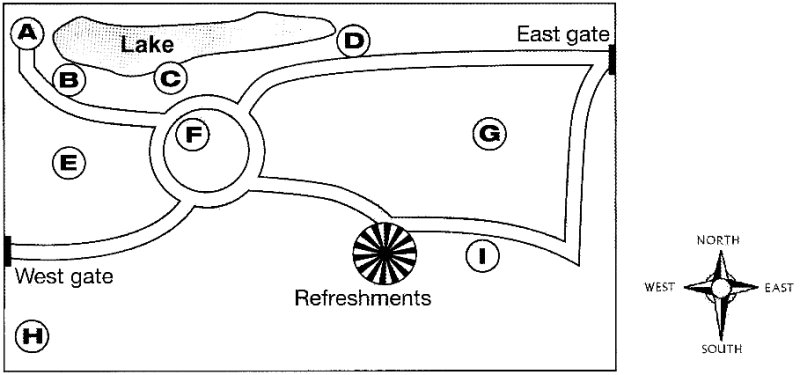
17. bird hide
18. dog-walking area
19. flower garden
20. wooded area
A discussion about a self-access centre
Questions 21–24
Choose the correct letter, A, B or C. Self-Access Centre.
21. Students want to keep the Self-Access Centre because
A they enjoy the variety of equipment.
B they like being able to work on their own.
C it is an important part of their studies.
22. Some teachers would prefer to
A close the Self-Access Centre.
B move the Self-Access Centre elsewhere.
C restrict access to the Self-Access Centre.
23. The students' main concern about using the library would be
A the size of the library.
B difficulty in getting help.
C the lack of materials.
24. The Director of Studies is concerned about
A the cost of upgrading the centre.
B the lack of space in the centre.
C the difficulty in supervising the centre.
Questions 25–30
Complete the notes below. Write NO MORE THAN TWO WORDS.
Necessary improvements to the existing Self-Access Centre
Equipment
Replace computers to create more space.
Resources
The level of the (25) ………………………… materials, in particular, should be more clearly shown.
Update the (26) ………………………… collection.
Buy some (27) ………………………… and divide them up.
Use of the room
Speak to the teachers and organize a (28) ………………………… for supervising the centre.
Install an (29) ………………………… .
Restrict personal use of (30) ………………………… on computers.
A lecture on business cultures
Questions 31–40
Complete the notes below. Write ONE WORD ONLY.
Business Cultures
Power Culture
Characteristics of organisation: small
• (31) ………………………… power source
• Few rules and procedures
Communication by (32) …………………………
Advantage: can act quickly
Disadvantage: might not act (33) …………………………
Suitable employee: not afraid of (34) ………………………… / Does not need job security
Role Culture
Characteristic of organisation: large, many (35) …………………………
Specialised departments
Rules and procedures e.g. job (36) ………………………… and rules for discipline
Advantages: economies of scale
• Successful when (37) ………………………… ability is important
Disadvantages: slow to see when (38) ………………………… is needed / Slow to react
Suitable employee: values security / Does not want (39) …………………………
Task Culture
Characteristic of organisation: project oriented / In competitive market or making product with short life / a lot of delegation
Advantages: (40) …………………………
Disadvantages: no economies of scale or special expertise / Suitable employee: like to work in groups
Answers
1. Bhatt
2. 31 March
3. nursing
4. 2
5. meat
6. bedsit
7. theatre
8. mature
9. town
10. shared
11. trees
12. Friday
13. farm
14. dye cloth with herbs.
15. visitors should book in advance.
16. come in suitable clothing.
17. A
18. I
19. F
20. E
21. it is an important part of their studies.
22. move the Self-Access Centre elsewhere.
23. difficulty in getting help.
24. the difficulty in supervising the centre.
25. reading
26. CD
27. workbooks
28. timetable
29. alarm
30. email
31. central
32. conversation
33. effectively
34. risk
35. levels
36. descriptions
37. technical
38. change
39. responsibility
40. flexible
Explanations
- 1. Bhatt
- 'It's Anu Bhatt.' — spelt out as A-N-U-B-H-A-T-T.Common trap: The first name is already printed on the form, and the spelling runs both names together without a pause.
- 2. 31 March
- 'And could I ask your date of birth? The 31st of March, 1972.'Common trap: The year follows the date and is not needed, so the answer has to be trimmed.
- 3. nursing
- 'And what will you be studying? I'm doing a course in nursing.'Common trap: 'Course' is the word the form uses, and it appears in the answer sentence attached to the subject rather than before it.
- 4. 2
- 'It'll take three years, but I'd only like to stay in Hall for two.'Common trap: Three is said first as the length of the course, and the third year is mentioned again straight after.
- 5. meat
- 'Yes, I don't take red meat.'Common trap: 'Red' is already printed on the form, so only the noun is needed from a very short answer.
- 6. bedsit
- 'My grant is quite generous and I think the bedsit sounds the best option.'Common trap: Single and shared study bedrooms are described first, and the word 'single' is already on the form.
- 7. theatre
- 'Well, I love the theatre.' — badminton follows as the second interest.Common trap: Badminton is already printed on the form and is the more distinctive of the two interests.
- 8. mature
- 'I'd prefer a hall where there are other mature students, if possible.'Common trap: The officer's reply rephrases it as 'slightly older students', so two acceptable words are spoken in turn.
- 9. town
- 'And I'd prefer to be out of town.' — 'We tend to have more vacancies in out-of-town halls.'Common trap: The form says 'outside the' where the speaker says 'out of', so the phrasing does not line up.
- 10. shared
- 'I would like somewhere with a shared area, a TV room, for example.'Common trap: 'TV room' follows as the example and is the more concrete phrase.
- 11. trees
- 'Then there's Holt Island, which is noted for its great range of trees.'Common trap: Willows and basket-making follow immediately and are the more memorable detail.
- 12. Friday
- 'The island is only open to the public from Friday to Sunday.'Common trap: Sunday is already printed in the table, and the reason for the restriction follows immediately.
- 13. farm
- 'Longfield has a modern replica of a farm from over 2,000 years ago.'Common trap: 'Replica' is the recording's word for the table's 'reconstruction', and the children's activities follow.
- 14. dye cloth with herbs.
- 'Practice the technique of using them as colour dyes for cloth.'Common trap: Cooking and medicine are named in the same sentence, but only as the subject of a talk.
- 15. visitors should book in advance.
- 'If you want to go, you'll need to phone the park ranger a few days ahead.'Common trap: 'We keep to a small number of people in the group' precedes it and suggests group-only booking; the charge follows.
- 16. come in suitable clothing.
- 'One thing, though, is to make sure you're wearing something that you don't mind getting dirty or torn.'Common trap: The rangers working all day and the free choice of activities both appear first, matching the two wrong options.
- 17. A
- 'There's a lake in the north-west of the park, with a bird hide to the west of it at the end of a path.'Common trap: B, C and D all sit around the same lake — only 'to the west of it, at the end of a path' separates them.
- 18. I
- 'Fairly close to where refreshments are available, there's a dog-walking area in the southern part of the park, leading off from the path.'Common trap: H is also in the south of the map, but on the far side of the west gate rather than near the refreshments.
- 19. F
- 'If you just want to sit and relax, you can go to the flower garden. That's the circular area on the map, surrounded by paths.'Common trap: The shape is the only clue given — no compass direction — so it has to be matched visually.
- 20. E
- 'There's a wooded area in the western section of the park, between two paths.'Common trap: The bird hide is also in the west of the park, so 'between two paths' is what fixes this one.
- 21. it is an important part of their studies.
- 'They see it as a pretty major component of their course.'Common trap: 'A variation on the classroom routine' comes first in the same sentence and sounds like enjoying variety.
- 22. move the Self-Access Centre elsewhere.
- 'Some of us also think that we could benefit a lot more by relocating the self-access centre to the main university library building.'Common trap: The complaint about students checking personal emails comes first and reads as wanting access restricted.
- 23. difficulty in getting help.
- 'Our main worry would be not being able to go to a teacher for advice.'Common trap: Size and materials are both raised in the same turn and both dismissed as non-problems.
- 24. the difficulty in supervising the centre.
- 'It's not so much the expense that I'm worried about, and we've certainly got room to do it, but it's the problem of timetabling a teacher to be in there outside class hours.'Common trap: All three options appear in one sentence, with the first two explicitly dismissed before the 'but'.
- 25. reading
- 'They find it difficult to find materials that are appropriate for their level, especially reading resources, so I think we need to label them more clearly.'Common trap: 'Resources' is the recording's word where the note says 'materials', and 'level' comes much earlier in the sentence.
- 26. CD
- 'The CD section especially needs to be more current.'Common trap: The general point about out-of-date study resources comes first, so the specific item is easy to miss.
- 27. workbooks
- 'What do you think of the idea of introducing some workbooks? If we break them up into separate pages and laminate them, they'd be a great resource.'Common trap: 'Course book' appears in the next sentence, and 'break them up into separate pages' is the note's 'divide them up'.
- 28. timetable
- 'I'll have to talk to the teachers and make sure we can all reach some agreement on a timetable to supervise the centre after class.'Common trap: 'Agreement' sits directly before the answer and could be mistaken for it.
- 29. alarm
- 'But we also need to think about security too … What about putting in an alarm?'Common trap: 'Security' and 'new equipment' come first and are the nouns the sentence builds from.
- 30. email
- 'Talk to our technicians and see whether we could somehow limit the access to email.'Common trap: 'Technicians' and 'computers' both appear around the answer, and 'limit the access' is the note's 'restrict'.
- 31. central
- 'It's the type of culture that needs a central source of power to be effective.'Common trap: 'Control is in the hands of just one or two people' follows and expresses the same idea differently.
- 32. conversation
- 'Communication usually takes the form of conversations rather than, say, formal meetings or written memos.'Common trap: Meetings and memos follow in the same sentence as the rejected alternatives.
- 33. effectively
- 'This type of organization doesn't always act effectively, because it depends too much on one or two people at the top.'Common trap: 'Act quickly' is already printed above as the advantage, so the two verbs sit close together.
- 34. risk
- 'The kind of person who does well in this type of business culture is one who is happy to take risks and for whom job security is a low priority.'Common trap: Job security is already printed in the note and closes the same sentence.
- 35. levels
- 'This type is usually found in large companies, which have lots of different levels in them.'Common trap: The spelling aside — 'R-O-L-E, not R-O-double-L' — interrupts the sentence just before the answer.
- 36. descriptions
- 'There are specific job descriptions, rules for discipline, and so on.'Common trap: 'Rules for discipline' is already printed in the note and follows immediately.
- 37. technical
- 'It is particularly successful in business markets where technical expertise is important.'Common trap: The recording says 'expertise' where the note says 'ability', so the noun does not confirm the match.
- 38. change
- 'This culture is often very slow to recognize the need for change, and even slower to react.'Common trap: 'Slow to react' is already printed in the note and closes the same sentence.
- 39. responsibility
- 'It suits employees who value security and who don't particularly want to have responsibility.'Common trap: 'Values security' is already printed and opens the same sentence.
- 40. flexible
- 'One of the major benefits of this culture is that it's flexible.'Common trap: The disadvantages are named in the same sentence, and the answer is a single adjective rather than a noun phrase.
Audio transcripts
Part 1 — A student arranging hall accommodation
Good morning, can I help you? Yes, I've just been accepted on a course at the university and I'd like to try and arrange accommodation in the Hall of Residence. Yes, certainly. Please sit down. What I'll do is fill in a form with you to find out a little more about your preferences and so forth. Thank you. So, first of all, can I take your name? It's Anu Bhatt. Could you spell your name please? Yes, A-N-U-B-H-A-T-T. Thanks. And could I ask your date of birth? The 31st of March, 1972. Thank you. And where are you from? India. Oh, right. And what will you be studying? I'm doing a course in nursing. Right, thank you. And how long would you want to stay in Hall, do you think? Well, it'll take three years, but I'd only like to stay in Hall for two. I'd like to think about living outside for the third year. Fine. And what did you have in mind for catering? Do you want to cook for yourself or have all your meals provided? That's full board. Is there something in between? Yes, you can just have evening meal provided, which is half board. That's what I'd prefer. Yes, a lot of students opt for that. Now, with that in mind, do you have any special diet, anything we should know about? Yes, I don't take red meat. No red meat. Now, thinking about the room itself, we have a number of options. You can have a single study bedroom or you can have a shared one. These are both what we call simple rooms. The other alternative is to opt for a single bedsit, which actually has more space and better facilities. There's about twenty pounds a week difference between them. Well, actually, my grant is quite generous and I think the bedsit sounds the best option. Lovely. I'll put you down for that and we'll see what availability is like. Now, can I ask some other personal details which we like to have on record? Yes, of course. I wonder if you could let us know what your interests are. This might help us get a closer match for placing you in a particular hall. Well, I love the theatre. Right. And I enjoy sports, particularly badminton. Ah, that's worth knowing. Now, what we finish with on the form is really a list from you of what your priorities are in choosing a hall and we'll do our best to take these into account. Well, the first thing is I'd prefer a hall where there are other mature students, if possible. Yes, we do have halls which tend to cater for slightly older students. And I'd prefer to be out of town. That's actually very good for you because we tend to have more vacancies in out-of-town halls. Lucky! Yes. Anything else? Well, I would like somewhere with a shared area, a TV room, for example, or something like that. It's a good way to socialise. It certainly is. That's it. Now, we just need a contact telephone number for you. Oh, sure, I'll just find it. It's 667549. Great. So we'll be in contact with you as soon as possible.
Part 2 — A talk to new members of a wildlife club
Now listen carefully and answer questions 11 to 13. Hello. I'm delighted to welcome you to our wildlife club, and very pleased that you're interested in the countryside and the plants and creatures of this area. I think you'll be surprised at the variety we have here, even though we're not far from London. I'll start by telling you about some of the parks and open spaces nearby. One very pleasant place is Halland Common. This has been public land for hundreds of years, and what you'll find interesting is that the River Ouse, which flows into the sea 80 kilometres away, has its source in the Common. There's an information board about the plants and animals you can see here, and, by the way, the Common is accessible 24 hours a day. Then there's Holt Island, which is noted for its great range of trees. In the past, willows were grown here commercially for basket-making, and this ancient craft has recently been reintroduced. The island is only open to the public from Friday to Sunday, because it's quite small, and if there were people around every day, much of the wildlife would keep away. From there, it's just a short walk across the bridge to Longfield Country Park. Longfield has a modern replica of a farm from over 2,000 years ago. Children's activities are often arranged there, like bread-making and face-painting. The park is only open during daylight hours, so bear that in mind if you decide to go there. Longfield Park has a programme of activities throughout the year, and to give you a sample, this is what's happening in the next few days. On Monday, you can learn about herbs and how they've been used over the centuries. You'll start with a tour of our herb garden, practice the technique of using them as colour dyes for cloth, and listen to an illustrated talk about their use in cooking and medicine. Then on Wednesday, you can join local experts to discover the variety of insects and birds that appear in the evening. We keep to a small number of people in the group, so if you want to go, you'll need to phone the park ranger a few days ahead. There's a small charge which you should pay when you turn up. I'm sure you're all keen to help with the practical task of looking after the park, so on Saturday, you can join a working party. You'll have a choice of all sorts of activities, from planting hedges to picking up litter, so you'll be able to change from one to another when you feel like it. The rangers will be hard at work all day, but do come and join in, even for just a short while. One thing, though, is to make sure you're wearing something that you don't mind getting dirty or torn. And finally, I'd like to tell you about our new wildlife area, Hinching Brook Park, which will be opened to the public next month. This slide doesn't really indicate how big it is, but anyway, you can see the two gates into the park and the main paths. As you can see, there's a lake in the north-west of the park, with a bird hide to the west of it at the end of a path, so it'll be a nice, quiet place for watching the birds on the lake. Fairly close to where refreshments are available, there's a dog-walking area in the southern part of the park, leading off from the path. And if you just want to sit and relax, you can go to the flower garden. That's the circular area on the map, surrounded by paths. And finally, there's a wooded area in the western section of the park, between two paths. OK, that's enough from me, so let's get on... That is the end of Section 2.
Part 3 — A discussion about a self-access centre
Now listen carefully, and answer questions 21 to 24. Hi, Euan. As you know, I've asked you here today to discuss the future of our self-access centre. We have to decide what we want to do about this very important resource for our English language students. So, can you tell me what the students think about this? Well, from the students' point of view, we would like to keep it. The majority of students say that they enjoy using it because it provides a variation on the classroom routine, and they see it as a pretty major component of their course. But we would like to see some improvements to the equipment, particularly the computers. There aren't enough for one each at the moment, and we always have to share. Well, yes, the teachers agree that it is a very valuable resource, but one thing we have noticed is that a lot of the students are using it to check their personal emails. We don't want to stop you students using it, but we think the computers should be used as a learning resource, not for emails. Some of us also think that we could benefit a lot more by relocating the self-access centre to the main university library building. How do you think the students would feel about that, Euan? Well, the library is big enough to incorporate the self-access centre, but it wouldn't be like a class activity anymore. Our main worry would be not being able to go to a teacher for advice. I'm sure there would be plenty of things to do, but we really need teachers to help us choose the best activities. Well, there would still be a teacher present, and he or she would guide the activities of the students. We wouldn't just leave them to get on with it. Yes, but I think the students would be much happier keeping the existing set up. They really like going to the self-access centre with their teacher, and staying together as a group to do activities. If we could just improve the resources and facilities, I think it would be fine. Is the cost going to be a problem? It's not so much the expense that I'm worried about, and we've certainly got room to do it, but it's the problem of timetabling a teacher to be in there outside class hours. If we're going to spend a lot of money on equipment and resources, we really need to make sure that everything is looked after properly. Anyway, let's make some notes to see just what needs doing to improve the centre. Now, what about the computers? I think it might be a good idea to install some new models. They would take up a lot less room, and so that would increase the workspace for textbooks and so on. That would be great. It is a bit cramped in there at times. What about other resources? Do you have a list of things that the students would like to see improved? Yes. One of the comments that students frequently make is that they find it difficult to find materials that are appropriate for their level, especially reading resources, so I think we need to label them more clearly. Well, that's easy enough. We can get that organised very quickly. In fact, I think we should review all of the study resources as some of them are looking a bit out of date. Definitely. The CD section especially needs to be more current. I think we should get some of the ones that go with our latest course books and also make multiple copies. Good. Now, I was also thinking about some different materials that we haven't got in there at all. What do you think of the idea of introducing some workbooks? If we break them up into separate pages and laminate them, they'd be a great resource. The students could study the main course book in class and then do follow-up practice in the self-access centre. That sounds good. OK. Now, finally, we need to think about how the room is used. I'll have to talk to the teachers and make sure we can all reach some agreement on a timetable to supervise the centre after class. But we also need to think about security too, especially if we're going to invest in some new equipment. What about putting in an alarm? Good idea. The other thing I'd like to do is talk to our technicians and see whether we could somehow limit the access to email. I really don't want to see that resource misused. What about if we agree to only use it before and after class? Yes, that would be fine. OK, anyway, that's great for now. We'll discuss it further when we've managed to... That is the end of Section 3.
Part 4 — A lecture on business cultures
Now listen carefully and answer questions 31 to 40. Good morning, everyone. Now, whether you're going to university to study business or some other subject, many of you will eventually end up working for a company of some kind. Now, when you first start working somewhere, you will realize that the organization you've joined has certain characteristics, and we often refer to these social characteristics as the culture of the organization. This includes its unwritten ideas, beliefs, values, and things like that. One well-known writer has classified company cultures by identifying four major types. The first type is called the power culture, and it's usually found in small organizations. It's the type of culture that needs a central source of power to be effective, and because control is in the hands of just one or two people, there aren't many rules or procedures. Another characteristic is that communication usually takes the form of conversations rather than, say, formal meetings or written memos. Now, one of the benefits of this culture is that the organization has the ability to act quickly, so it responds well to threat or danger on the one hand and opportunity on the other. But on the negative side, this type of organization doesn't always act effectively, because it depends too much on one or two people at the top, and when these people make poor decisions, there's no one else who can influence them. And the kind of person who does well in this type of business culture is one who is happy to take risks and for whom job security is a low priority. The next type is known as role culture, that's R-O-L-E, not R-O-double-L, by the way, and this type is usually found in large companies, which have lots of different levels in them. These organizations usually have separate departments that specialize in things like finance or sales or maintenance or whatever. Each one is coordinated at the top by a small group of senior managers, and typically everyone's job is controlled by sets of rules and procedures. For example, there are specific job descriptions, rules for discipline, and so on. What are the benefits of this kind of culture? Well, firstly, because it's found in large organizations, its fixed costs, or overheads as they're known, are low in relation to its output or what it produces. In other words, it can achieve economies of scale. And secondly, it is particularly successful in business markets where technical expertise is important. On the other hand, this culture is often very slow to recognize the need for change, and even slower to react. What kind of person does this type of culture suit? Well, it suits employees who value security and who don't particularly want to have responsibility. Moving on now to task cultures, this type is found in organizations that are project-oriented. You usually find it where the market for the company's product is extremely competitive, or where the products themselves have a short lifespan. Usually top management delegates the projects, the people, and other resources, and once these have been allocated, little day-to-day control is exercised from the top, because this would seem like breaking the rules. Now, one of the major benefits of this culture is that it's flexible, but it does have some major disadvantages, too. For instance, it can't produce economies of scale or great depth of expertise. People who like working in groups or teams prefer this type of culture. And finally, the fourth category is called the person culture.
Comments
Loading comments…