

Cambridge IELTS 2 Listening Test 2
4 parts · 40 questions · 30 minutes
Arranging home contents insurance
Questions 1–2
Questions 1 and 2: Circle the correct letters A–C.
1. Gavin's apartment is located on the ...
A ground floor.
B second floor.
C third floor.
2. The monthly rent for Gavin's apartment is ...
A $615.
B $650.
C $655.
Questions 3–6
Complete the table below. Write NO MORE THAN THREE WORDS for each answer.
| ITEM | VALUE |
|---|---|
| _____ | $450 |
| _____ | $1,150 |
| Watches | $2,000 |
| CDs and _____ | $400 |
| Total annual cost of insurance | $ (6) ………………………… |
Questions 7–10
Complete the form below. Write NO MORE THAN THREE WORDS for each answer.
INSURANCE APPLICATION FORM
Date of Birth: 12th November 1980 Telephone (Home): 9872 4855
Name: Mr Gavin (7) …………………………
Address: (8) ………………………… Biggins Street
(9) …………………………
Nationality: (10) …………………………
An introduction to a residential college
Question 11
Circle the correct letter A–D.
11. Smith House was originally built as ...
A a residential college.
B a family house.
C a university.
D an office block.
Questions 12–14
Complete the explanation of the room number. Write NO MORE THAN THREE WORDS for each answer.
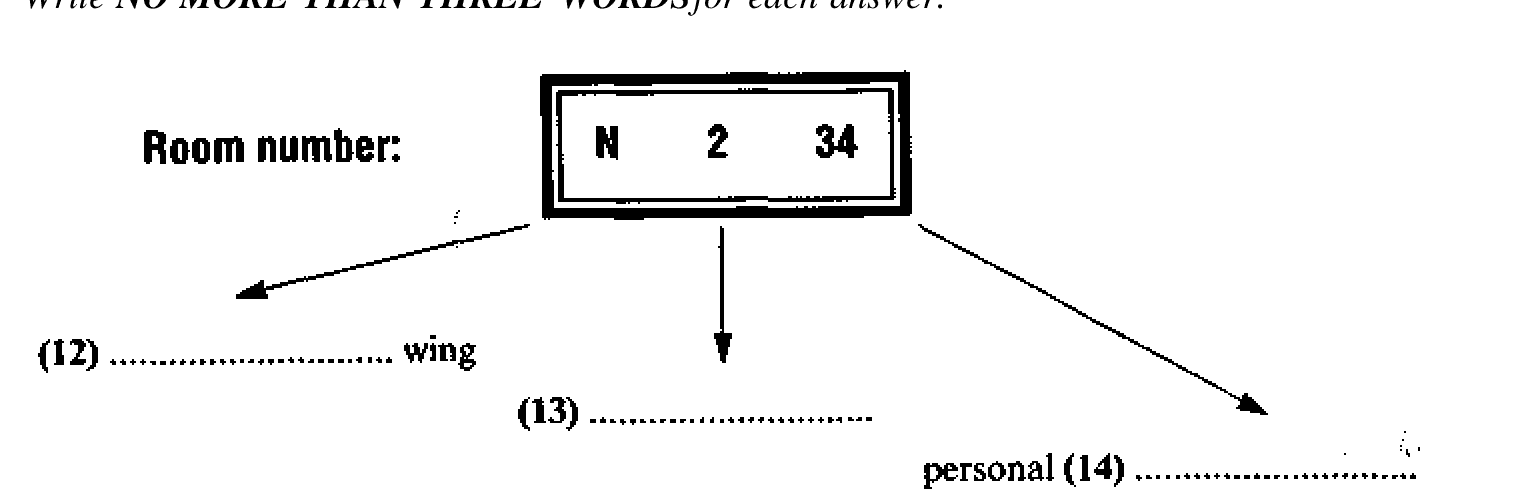
Room number: N 2 34
The three parts of a room number, in order:
• N = (12) ………………………… wing
• 2 = (13) …………………………
• 34 = personal (14) …………………………
Questions 15–17
Complete the sentences below. Write NO MORE THAN THREE WORDS for each answer.
15. • Students need a front door key between ………………………… AND ………………………… .
16. • In an emergency, students should use ………………………… .
17. • Fees also cover some ………………………… charges.
Questions 18–20
Complete the notice below. Write NO MORE THAN THREE WORDS for each answer.
NOTICE
• No noise after 9 pm.
• Smoking only allowed on (18) …………………………
• No changes can be made to (19) …………………………
• If you have any questions, ask the (20) …………………………
Two students planning an essay on media
Questions 21–25
Complete the table below. Write NO MORE THAN THREE WORDS for each answer.
| Forms of media | Examples |
|---|---|
| • books • (21) ………………………… | |
| Pictures | • (22) ………………………… |
| Audio (listening) | • CDs • (23) ………………………… |
| Audio-visual | • film • (24) ………………………… • videos |
| Electronic | • (25) ………………………… |
Questions 26–30
Write the appropriate letters A–C against Questions 26–30.
Situations
A individual children
B five or six children
C whole class
26. According to the speakers, in which situation are the following media most useful? tapes
27. According to the speakers, in which situation are the following media most useful? computers
28. According to the speakers, in which situation are the following media most useful? videos
29. According to the speakers, in which situation are the following media most useful? books
30. According to the speakers, in which situation are the following media most useful? wall maps
A lecture on British agriculture
Question 31
Circle the correct letter A–D.
31. What percentage of the workforce were employed in agriculture in the mid 1900s?
A 3%
B 10%
C 20%
D 50%
Questions 32–33
Questions 32 and 33: Complete the notes below. Write NO MORE THAN ONE WORD for each answer.
Three factors contributing to the efficiency of the agricultural sector
• 50 – 60 years of intelligent state support
• the quality of (32) ………………………… among those employed
• the farmers' investment in (33) …………………………
Questions 34–39
Complete the table below. Write NO MORE THAN THREE WORDS AND/OR A NUMBER for each answer.
| Region | Land | Climate | Farm type | Produce |
|---|---|---|---|---|
| North | hilly with thin soil | (34) ………………………… and (34) ………………………… | small, family-run | (35) ………………………… and (35) ………………………… |
| East | flat with (36) ………………………… | mixed | commercial | cereals and (37) ………………………… |
| West | rich soil | (38) ………………………… and (38) ………………………… | average size (39) ………………………… hectares | milk, cheese and meat |
Question 40
Circle the correct letter A–C.
40. Farmers have a strong sense of solidarity because
A the media supports them.
B they have a strong Union.
C they have countrywide interests.
Answers
1. second floor.
2. $615.
3. fridge
4. stereo
5. books
6. 184
7. Murray
8. 16C
9. South Hills
10. English
11. a family house.
12. north
13. second floor
14. room number
15. 8 pm AND 7 am
16. the fire doors
17. laundry
18. the balconies
19. meal times
20. floor senior
21. newspapers
22. maps
23. radios
24. television
25. computers
26. B
27. B
28. C
29. A
30. B
31. 3%
32. training
33. technology
34. cool and wet
35. wool and timber
36. fertile soils
37. vegetables
38. warm and wet
39. 800
40. they have a strong Union.
Explanations
- 1. second floor.
- 'It's on the third, no... second floor.' Gavin corrects himself immediately.Common trap: A self-correction mid-sentence — the first floor number said is the wrong one.
- 2. $615.
- 'It's $615 per month.'Common trap: The three options differ only in the last two digits, and several other dollar figures follow soon after.
- 3. fridge
- 'Well, I've got a fridge and a stereo system which I've just bought from a friend.' — 'And how much did you pay for the fridge?' — '$450.'Common trap: A television is discussed straight afterwards but is 'very old and not worth much', so it is never insured.
- 4. stereo
- '50, and the stereo system cost $1,150.'Common trap: The fridge's $450 is confirmed in the same turn ('50 or 15?' — '50'), so the two prices arrive together.
- 5. books
- 'Yes, I've got a couple of watches and my CDs and books.' — 'all together, the CDs and books cost me about $400.'Common trap: 'CDs' is already printed in the cell, so only the second item of the pair is wanted.
- 6. 184
- '...it comes to $184.00 for a twelve-month period.' The key rejects adding 'per month' — the figure is annual.Common trap: The total insured value ($4,000) is stated in the same sentence, and the key explicitly rejects 'per month'.
- 7. Murray
- 'Gavin Murray, that's M-U-R-R-A-Y.'Common trap: 'Gavin' is already printed, and the surname is spelled out immediately after being said.
- 8. 16C
- 'It's 16C Biggins Street, South Hills.' — read back by Diane as '16C Biggins Street, South Hills?'Common trap: The number and letter run together with no pause, and the street name is already printed.
- 9. South Hills
- 'It's 16C Biggins Street, South Hills.' — 'That's right, it's two words, South Hills.'Common trap: Gavin explicitly flags it as two words, which is the hint that it must not be written as one.
- 10. English
- 'Right... and er... you're Australian?' — 'No... I was born in London, although my mother is from Tasmania.' Born in London = English/British.Common trap: Australia, Tasmania and Hobart are all named around the answer — but they belong to his mother, not to him.
- 11. a family house.
- '...part of the original old house, built in the 1840s to be used by the family of George Smith.' It became a college only in 1940.Common trap: The opening sentence calls Smith House 'one of the oldest residential colleges' — the question asks what it was ORIGINALLY built as.
- 12. north
- 'The first letter refers to the three wings of the college... Of course the letters represent the three directions - in this case - north, south and west.'Common trap: Three directions are read out together — only the one matching the printed letter N is wanted.
- 13. second floor
- 'Each wing has two floors, and so the next number you see is either one, or in this case two, and this indicates which floor your room is on.'Common trap: 'two floors' and 'either one, or in this case two' put three numbers in one sentence before the meaning is given.
- 14. room number
- 'The number after that is your individual room number.'Common trap: 'personal' is already printed, and 'individual' is its paraphrase — only 'room number' is missing.
- 15. 8 pm AND 7 am
- 'This door is closed and locked at 8 pm every night and opened again at 7 am. You'll need your key if you're coming back to the college between those times.' Both times are needed for the one mark.Common trap: 'no noise after 9 pm' comes later in the same talk — a third time that belongs to a different rule.
- 16. the fire doors
- 'You will notice at the end of each corridor that there is another door but these are fire doors... They should only be opened from the inside in case of emergency.'Common trap: The front door dominates the preceding sentences — students are told to always use it, except in an emergency.
- 17. laundry
- 'In your fees you've paid a laundry fee which covers the cleaning of bed linen and towels.'Common trap: 'a small extra fee' for personal laundry follows immediately — that is what the fees do NOT cover.
- 18. the balconies
- 'There is also no smoking in the rooms or anywhere inside the college but smoking is permitted on the balconies.'Common trap: 'the rooms' and 'anywhere inside the college' come first — both are where smoking is banned.
- 19. meal times
- 'Meal times are listed in your orientation pack. Please read these carefully as meal times cannot be changed.'Common trap: 'the orientation pack' and 'the dining room' are both named in the same breath as the meal times.
- 20. floor senior
- '...each floor has an elected floor senior who is usually a student in their third or fourth year... The floor seniors will introduce themselves later today and answer any questions you have.'Common trap: 'Marney' is named in the closing sentence as the person handing out packs and keys — a person, but not the one to ask questions.
- 21. newspapers
- 'Here you'd have things like books and newspapers, that sort of thing...' Print media = books (printed) and newspapers.Common trap: 'books' is already printed in the cell, so only the second example is wanted.
- 22. maps
- 'and included in these are the pictorial forms of print media, like maps...' — 'Yes, maps are really just formal pictures, aren't they?'Common trap: Maps are introduced as a sub-type of PRINT media, one row above where the answer belongs.
- 23. radios
- 'CDs and radios are probably the best examples, because a lot of children have access to these especially radios.'Common trap: 'CDs' is already printed beside the gap, and both examples are given in one short clause.
- 24. television
- 'And this would lead into the audio-visual media, which can be seen as well as heard... film, television... and we mustn't forget videos.'Common trap: Film and videos are already printed either side of the gap, so the middle item of the three is the answer.
- 25. computers
- 'Yes, but there's a final category as well... computers, that make up the so-called electronic media.'Common trap: The statistic that follows ('one in three families has a computer') can distract from the single-word answer.
- 26. B
- 'Although tapes look ideal for individual children, I feel they're best suited to small group work. This way, children don't feel isolated.'Common trap: The concessive opening ('Although tapes look ideal for individual children') states option A before rejecting it.
- 27. B
- 'Computers are the same... I think they're better with small numbers of children and they're hardly ever useful with a whole class.'Common trap: 'the same' refers back to tapes — you must be holding the previous answer to follow this one.
- 28. C
- 'Videos, however, are ideal for use with everyone present in the class, especially when children have individual activity sheets.'Common trap: 'individual activity sheets' in the same sentence matches option A word for word, but the sheets are used by the whole class.
- 29. A
- 'Books are ideal for children to use by themselves. I know they're used with groups in schools, but I wouldn't recommend it.'Common trap: Group use is mentioned in the very next clause, but only to be rejected.
- 30. B
- 'Other pictorial media like maps, though, are different... I'd always plan group work around those... give the children a chance to interact and to share ideas.'Common trap: Robin's reply describes teachers leaving maps on the wall 'for children to look at when they have some free time' — individual use, but not what is recommended.
- 31. 3%
- 'By the middle of the next century, in 1850 that is, it had fallen sharply to 10%, and then to 3% by the middle of the twentieth century.' The mid 1900s = the middle of the twentieth century = 3%.Common trap: Four percentages are in play — 20% (GNP), 10% (1850), 3% (mid 1900s) and 2% (now) — and the dates are given as centuries, not years.
- 32. training
- 'Then the two other factors I should mention, both very important, are the high level of training amongst the agricultural workforce.'Common trap: 'the high level of' has to be matched to the printed 'the quality of', and state support is already printed above.
- 33. technology
- 'And secondly, the recognition by farmers of the value of investing in technology.'Common trap: Only ONE word is allowed, so 'value of technology' or 'new technology' would break the limit.
- 34. cool and wet
- 'The climate up here, and you've already had evidence of this, is generally cool and wet.' Both words are needed for the one mark.Common trap: The west is 'warmer than in the north and much wetter than in the east' — three climates described with overlapping words.
- 35. wool and timber
- 'The typical farm here in the North is a small, family-run concern, producing mainly wool and timber for the market.' Both words are needed for the one mark.Common trap: 'small, family-run' is already printed in the neighbouring column, so only the produce is wanted.
- 36. fertile soils
- 'the east is flatter and more low-lying, with fertile soils and a mixed climate.'Common trap: 'flat' and 'mixed' are already printed in the table, so only the soil description is missing.
- 37. vegetables
- 'However, increasingly significant areas are now also given over to high quality vegetables for supply direct to the supermarkets.'Common trap: 'cereals' is already printed beside the gap — the east's other product arrives only after a contrastive 'However'.
- 38. warm and wet
- 'The climate is warmer than in the north and much wetter than in the east.' Both words are needed for the one mark.Common trap: The climate is given only as a comparison with the other two regions, so the plain adjectives have to be derived.
- 39. 800
- 'the farms there are quite large, typically around 800 hectares.'Common trap: 'hectares' is already printed, and 'rich soils' in the same sentence is already given in the Land column.
- 40. they have a strong Union.
- 'And a third factor making for solidarity is the national structure of the Farmers' Union, of which virtually all farmers are members.'Common trap: The media appears in the first reason given for solidarity — but as an adversary, not a supporter.
Audio transcripts
Part 1 — Arranging home contents insurance
DIANE: Good morning. Diane Davies. Can I help you? GAVIN: Yes, I'd like to get some insurance for the contents of my home. DIANE: Fine. When did you move into the house? GAVIN: A couple of weeks ago, and it's an apartment actually. I was told by the landlord Example that it would be a good idea to get some insurance for the furniture and other personal possessions. DIANE: Fine. Well, let's get some details. What kind of apartment is it? GAVIN: It's a two-bedroom apartment. DIANE: What floor is it on? GAVIN: Why do you need to know that? DIANE: Because it affects the cost of the insurance. An apartment on the ground floor isn't as protected as others and there's more chance of a break-in. GAVIN: Really? I didn't know that. It's on the third, no... second floor. DIANE: Second... and how much is the rent? GAVIN: It's $615 per month. DIANE: Good, and where is it located? GAVIN: In Biggins St, South Hills. DIANE: I see. And what things did you want to insure? GAVIN: Well, what do you recommend? DIANE: Well, the most important things are those which you would normally find in a home. Things like the television, fridge and so on. GAVIN: I see. Well, I've got a fridge and a stereo system which I've just bought from a friend. DIANE: And how much did you pay for the fridge? GAVIN: Er, $450. DIANE: 50 or 15? GAVIN: 50, and the stereo system cost $1,150. DIANE: Have you got a television? GAVIN: Yes, but it's very old and not worth much. DIANE: OK. Well, is there anything else you want to insure? GAVIN: Yes, I've got a couple of watches and my CDs and books. DIANE: How much do you think they're worth? GAVIN: The watches are worth $1,000... DIANE: For both of them? GAVIN: No, each one and, all together, the CDs and books cost me about $400. DIANE: OK, so the value of everything you want to insure is $4,000. GAVIN: How much will the insurance cost? DIANE: Let me see, $4,000 divided by... plus 10%... right, so this kind of insurance, er, that's Private Contents insurance, it comes to $184.00 for a twelve-month period. GAVIN: $184.00. Well, that sounds pretty good. OK, I'll take that policy. GAVIN: Can I arrange the policy over the phone? DIANE: Sure, just let me get the details down. So that's Mr... GAVIN: Gavin Murray, that's M-U-R-R-A-Y. DIANE: And the address is? GAVIN: It's 16C Biggins Street, South Hills. DIANE: OK (writing) 16C Biggins Street, South Hills? GAVIN: That's right, it's two words, 'South Hills'. DIANE: And your date of birth is? GAVIN: 12 November 1980. DIANE: And your contact number? GAVIN: Home phone number is 9872 4855. DIANE: Right... and er... you're Australian? GAVIN: No... I was born in London, although my mother is from Tasmania. DIANE: Really? Whereabouts? GAVIN: Hobart. DIANE: I see... interesting place. Now, are you working at the moment? GAVIN: No, I'm a full-time student at Sydney University. DIANE: Right, good.,
Part 2 — An introduction to a residential college
COLLEGE PRESIDENT: Well, good morning, everyone, it's good to see you all here. Welcome to Smith House. Smith House as you may or may not know is one of the oldest residential colleges of the university. As you can see, the building you're in now which contains this main lounge, the dining room, the recreation room, the kitchen and the offices was part of the original old house, built in the 1840s to be used by the family of George Smith. That's of course how the house and college got their names. The original house was converted into a residential college for the university in 1940 and since then has continued to be added on to and modernised. You'll notice when you receive your room allocation in a few minutes that your room number either begins with the letter N, S, or W like this one here. The first letter refers to the three wings of the college which come away from this main building. Of course the letters represent the three directions - in this case - north, south and west. Each wing has two floors, and so the next number you see is either one, or in this case two, and this indicates which floor your room is on. The number after that is your individual room number. So it's quite simple to find any room by going to the right wing, then floor, and then room number. You'll also notice, when you receive your orientation pack shortly, that there are two keys. One is the key to your room and only you have that key - and the other is a key to the front door which you've just come through here from the street. This door is closed and locked at 8 pm every night and opened again at 7 am. You'll need your key if you're coming back to the college between those times. We ask all students to always enter and leave the college through the front door. You will notice at the end of each corridor that there is another door but these are fire doors and are kept locked from the outside. They should only be opened from the inside in case of emergency. In your fees you've paid a laundry fee which covers the cleaning of bed linen and towels. All bed linen and towels are clearly embossed with the name Smith House so it's easily identifiable. If you want your other laundry to be done by the college this can be arranged for a small extra fee. There are only a few rules here at Smith House and we have these rules so that we can all live comfortably together. The most important rule is that there must be no noise after 9 pm. There is also no smoking in the rooms or anywhere inside the college but smoking is permitted on the balconies. All meals are served in the dining room. Meal times are listed in your orientation pack. Please read these carefully as meal times cannot be changed and if you arrive late I'm sorry to say you'll just go hungry. If you're unsure about things, each floor has an elected 'floor senior' who is usually a student in their third or fourth year of study who's been at Smith House for a while. The floor seniors will introduce themselves later today and answer any questions you have. But for now I'm going to hand you over to Marney who is going to give you the orientation packs and keys. Thanks Marney.
Part 3 — Two students planning an essay on media
LYNNE: That essay we have to write... the one on how children learn through the media... how are you planning to write it? ROBIN: Well, I've given it some thought and I think that the best way to approach it is to divide the essay into two parts. First of all, we'd have to look at some examples of each type of media... LYNNE: Yes, what they are... then we could describe how we can use each medium so that children can learn something from each one. ROBIN: Exactly. Maybe we could draw up a table and look at examples of each medium in turn. Let's see, the different forms of media would b e... the print media... LYNNE: Here you'd have things like books and newspapers, that sort of thing... ROBIN: Urn, and included in these are the pictorial forms of print media, like maps... LYNNE: Yes, maps are really just formal pictures, aren't they? And then there are what we call the audio forms of media... where children can listen. CDs and radios are probably the best examples, because a lot of children have access to these especially radious. ROBIN: And this would lead into the audio-visual media, which can be seen as well as heard... film, television... and we mustn't forget videos. LYNNE: Yes, but there's a final category as well... computers, that make up the so-called electronic media. In the United Kingdom and Australia, they say that one in three families has a computer now. ROBIN: Yes, I believe it. Well that's a good list to start with... we're really getting somewhere with this essay now... so let's move on to when each type of medium could be used. I guess we could start by trying to identify the best situation for each type of media. LYNNE: What do you mean? ROBIN: I'm talking about whether each medium should be used with different sized groups. For example, we could look at pictures, and ask whether they're more useful for an individual child, a few children together or a full class - in this case, I'd say pictures are best with individual children, because they give them an opportunity to let their imaginations run wild. LYNNE: Yes, I see... ROBIN: Let's take tapes next. Although tapes look ideal for individual children, I feel they're best suited to small group work. This way, children don't feel isolated, because they can get help from their friends. Computers are the same... I think they're better with small numbers of children and they're hardly ever useful with a whole class. Videos, however, are ideal for use with everyone present in the class, especially when children have individual activity sheets to help them focus their minds on what's in the video. LYNNE: And what about books, what would you recommend for them? Books are ideal for children to use by themselves. I know they're used with groups in schools, but I wouldn't recommend it. Other pictorial media like maps, though, are different... I'd always plan group work around those... give the children a chance to interact and to share ideas. ROBIN: I agree... teachers often just leave maps on the wall for children to look at when they have some free time, but kids really enjoy using them for problem solving. LYNNE: Yes, different people have different ideas I suppose... ROBIN: Yes, and different teachers recommend different tools for different age groups...
Part 4 — A lecture on British agriculture
LECTURER: I hope that this first session, which I've called An Introduction to British Agriculture, will provide a helpful background to the farm visits you'll be doing next week. I think I should start by emphasising that agriculture still accounts for a very important part of this country's economy. We are used to hearing the UK's society and economy described as being 'industrial' or even 'post-industrial', but we mustn't let this blind us to the fact that agriculture and its supporting industries still account for around 20% of our Gross National Product. This figure is especially impressive, I think, when you bear in mind how very small a percentage of the UK workforce is employed in agriculture. This is not a recent development - you would have to go back to 1750 or so to find a majority of the workforce in this country working in agriculture: By the middle of the next century, in 1850 that is, it had fallen sharply to 10%, and then to 3% by the middle of the twentieth century. And now just 2% of the workforce contribute 20% of GNP. How is this efficiency achieved? Well, my own view is that it owes a great deal to a history, over the last 50 or 60 years, of intelligent support by the state, mainly taking the form of helping farmers to plan ahead. Then the two other factors I should mention, both very important, are the high level of training amongst the agricultural workforce. And secondly, the recognition by farmers of the value of investing in technology. Now, although the UK is a fairly small country, the geology and climate vary a good deal from region to region. For our purposes today we can divide the country broadly into three - I've marked them on the map here (indicates map). The region you'll get to know best, of course, is the north, where we are at present. The land here is generally hilly, and the soils thin. The climate up here, and you've already had evidence of this, is generally cool and wet. As you will see next week, the typical farm here in the North is a small, family-run concern, producing mainly wool and timber for the market. If we contrast that with the Eastern region, over here (indicating on map), the east is flatter and more low-lying, with fertile soils and a mixed climate. Average farm-size is much bigger in the east, and farms are likely to be managed strictly on commercial lines. As for crops, well, the east is the UK's great cereal-producing region. However, increasingly significant areas are now also given over to high quality vegetables for supply direct to the supermarkets. The third broad region is the west, where it's a different story again. The climate is warmer than in the north and much wetter than in the east. The resulting rich soils in the west provide excellent pasture, and the farms there are quite large, typically around 800 hectares. The main products are milk, cheese and meat. So, clearly, there are marked differences between regions. But this does not prevent quite a strong sense of solidarity amongst the farming community as a whole, right across the country. This solidarity comes in part from the need to present a united front in dealing with other powerful interest-groups, such as government or the media. It also owes something to the close co-operation between all the agricultural training colleges, through which the great majority of farmers pass at the beginning of their careers. And a third factor making for solidarity is the national structure of the Farmers' Union, of which virtually all farmers are members. Finally in this short talk, I would like to say a little about the challenges facing farmers in the next...
Comments
Loading comments…