

Cambridge IELTS 19 Listening Test 1
4 parts · 40 questions · 30 minutes
A phone call about school visits to a country park
Questions 1–10
Complete the notes below. Write ONE WORD AND/OR A NUMBER for each answer.
Hinchingbrooke Country Park
The park
Area: (1) ………………………… hectares
Habitats: wetland, grassland and woodland
Wetland: lakes, ponds and a (2) …………………………
Wildlife includes birds, insects and animals
Subjects studied in educational visits include
Science: Children look at (3) ………………………… about plants, etc.
Geography: includes learning to use a (4) ………………………… and compass
History: changes in land use
Leisure and tourism: mostly concentrates on the park's (5) …………………………
Music: Children make (6) ………………………… with natural materials, and experiment with rhythm and speed.
Benefits of outdoor educational visits
They give children a feeling of (7) ………………………… that they may not have elsewhere.
Children learn new (8) ………………………… and gain self-confidence.
Practical issues
Cost per child: £(9) …………………………
Adults, such as (10) …………………………, free
A talk to a town twinning association
Questions 11–15
Choose the correct letter, A, B or C. Stanthorpe Twinning Association.
11. During the visit to Malatte, in France, members especially enjoyed
A going to a theme park.
B experiencing a river trip.
C visiting a cheese factory.
12. What will happen in Stanthorpe to mark the 25th anniversary of the Twinning Association?
A tree will be planted.
A garden seat will be bought.
A footbridge will be built.
13. Which event raised most funds this year?
A the film show
B the pancake evening
C the cookery demonstration
14. For the first evening with the French visitors host families are advised to
A take them for a walk round the town.
B go to a local restaurant.
C have a meal at home.
15. On Saturday evening there will be the chance to
A listen to a concert.
B watch a match.
C take part in a competition.
Questions 16–20
Label the map below. Write the correct letter, A–H, next to Questions 16–20. Farley House.
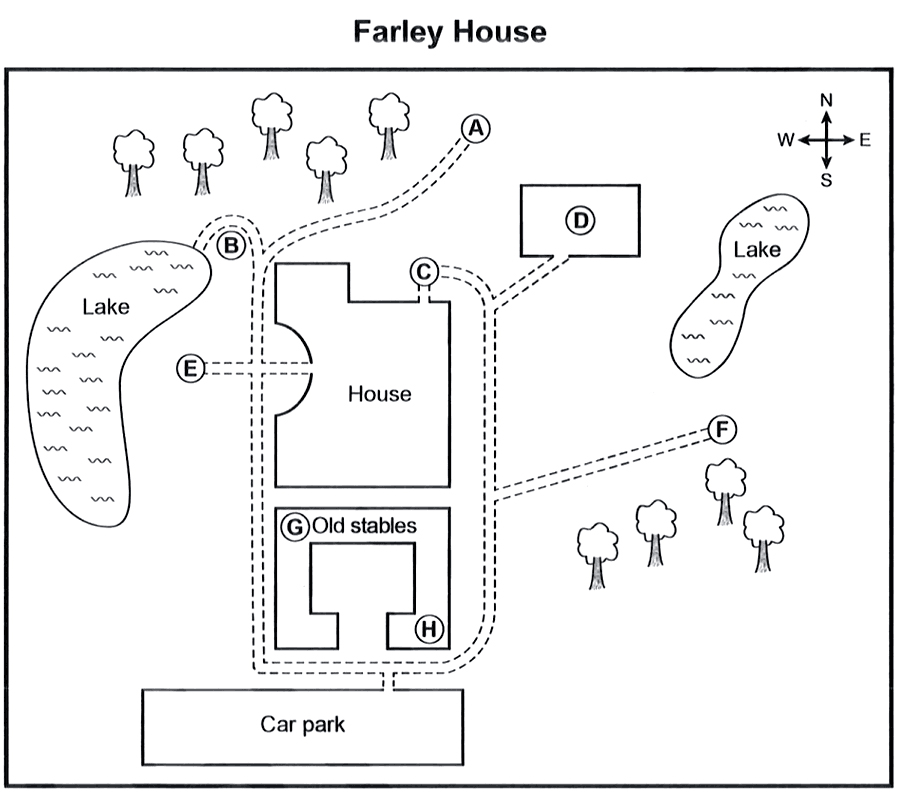
16. Farm shop
17. Disabled entry
18. Adventure playground
19. Kitchen gardens
20. The Temple of the Four Winds
Two students discussing food projects and food trends
Questions 21–22
Questions 21 and 22: Choose TWO letters, A–E. Which TWO things did Colin find most satisfying about his bread reuse project?
21. Aspect selection (lower letter)
A receiving support from local restaurants
B finding a good way to prevent waste
C overcoming problems in a basis process
D experimenting with designs and colours
E learning how to apply 3-D printing
22. Aspect selection (higher letter)
A receiving support from local restaurants
B finding a good way to prevent waste
C overcoming problems in a basis process
D experimenting with designs and colours
E learning how to apply 3-D printing
Questions 23–24
Questions 23 and 24: Choose TWO letters, A–E. Which TWO ways do the students agree that touch-sensitive sensors for food labels could be developed in future?
23. Development selection (lower letter)
A for use on medical products
B to show that food is no longer fit to eat
C for use with drinks as well as foods
D to provide applications for blind people
E to indicate the weight of certain foods
24. Development selection (higher letter)
A for use on medical products
B to show that food is no longer fit to eat
C for use with drinks as well as foods
D to provide applications for blind people
E to indicate the weight of certain foods
Questions 25–30
What is the students' opinion about each of the following food trends? Choose SIX answers from the box and write the correct answer, A–H, next to Questions 25–30.
Opinions
A This is only relevant to young people.
B This may have disappointing results.
C This already seems to be widespread.
D Retailers should do more to encourage this.
E More financial support is needed for this.
F Most people know little about this.
G There should be stricter regulations about this.
H This could be dangerous.
25. Use of local products
26. Reduction in unnecessary packaging
27. Gluten-free and lactose-free food
28. Use of branded products related to celebrity chefs
29. Development of 'ghost kitchens' for takeaway food
30. Use of mushrooms for common health concerns
A presentation on the Céide Fields
Questions 31–40
Complete the notes below. Write ONE WORD ONLY for each answer.
Céide Fields
• an important Neolithic archaeological site in the northwest of Ireland
Discovery
• In the 1930s, a local teacher realised that stones beneath the bog surface were once (31) ………………………… .
• His (32) ………………………… became an archaeologist and undertook an investigation of the site:
– a traditional method used by local people to dig for (33) ………………………… was used to identify where stones were located
– carbon dating later proved the site was Neolithic.
• Items are well preserved in the bog because of a lack of (34) ………………………… .
Neolithic farmers
• Houses were (35) ………………………… in shape and had a hole in the roof.
• Neolithic innovations include:
– cooking indoors
– pots used for storage and to make (36) ………………………… .
• Each field at Céide was large enough to support a big (37) ………………………… .
• The fields were probably used to restrict the grazing of animals – no evidence of structures to house them during (38) ………………………… .
Reasons for the decline in farming
• a decline in (39) ………………………… quality
• an increase in (40) …………………………
Answers
1. 69
2. stream
3. data
4. map
5. visitors
6. sounds
7. freedom
8. skills
9. 4.95
10. leaders
11. experiencing a river trip.
12. A tree will be planted.
13. the pancake evening
14. have a meal at home.
15. listen to a concert.
16. G
17. C
18. B
19. D
20. A
21. finding a good way to prevent waste
22. experimenting with designs and colours
23. for use on medical products
24. to indicate the weight of certain foods
25. D
26. G
27. C
28. B
29. F
30. H
31. walls
32. son
33. fuel
34. oxygen
35. rectangular
36. lamps
37. family
38. winter
39. soil
40. rain
Explanations
- 1. 69
- 'Altogether the park covers 170 acres, that's 69 hectares.' The note asks for hectares, which is the second figure.Common trap: Two units, two numbers. 170 comes first and is in acres; the note's unit is what selects the smaller figure.
- 2. stream
- 'There are also several smaller ones, ponds and a stream that flows through the park.'Common trap: Gravel pits, lakes and ponds all crowd the sentence, and the answer is the last item of the list — the two before it are already printed in the note.
- 3. data
- 'We help children to discover and study plants, trees and insects. They also collect and analyse data about the things they see.'Common trap: Plants, trees and insects fill the first half of the answer and are already covered by the note's 'about plants, etc.' — the gap needs what the children handle.
- 4. map
- 'The park is a great environment to learn and practice reading a map and using a compass to navigate around the park.'Common trap: 'Compass' is printed in the note, so the answer is the other half of the pair — and it arrives attached to 'reading' rather than 'using'.
- 5. visitors
- John supplies it — 'That focuses on your visitors, I would imagine' — and Sally confirms: 'Yes, mostly. The children find out about them, their requirements, the problems they may cause.'Common trap: The word comes from the caller, and Sally's confirmation uses only 'them' and 'their requirements'.
- 6. sounds
- 'Here the children experiment with natural materials to create sounds and explore rhythm and tempo.' 'Tempo' is the note's 'speed'.Common trap: 'Natural materials', 'rhythm' and 'tempo' are all in the note already, so the one new word sits in the middle of a busy sentence.
- 7. freedom
- 'I would imagine they get a sense of freedom that might not be a normal part of their lives.' 'That's right', says Sally.Common trap: 'Creative', 'explore' and 'discover' come immediately before, all describing the same benefit in different words.
- 8. skills
- 'Very often the children discover that they can do things they didn't know they could do, and they develop new skills. This gives them greater self-confidence.'Common trap: The long clause about discovering what they can do delays the two-word answer, and 'self-confidence' — already in the note — follows straight after it.
- 9. 4.95
- 'If there are over 30, it costs £4.95 for each child who attends on the day.' John's group is 30 to 40 children.Common trap: The group sizes — 30 and 40 — are said in the question before, so three numbers arrive in two sentences.
- 10. leaders
- 'There's no charge for leaders and other adults – as many as you want to bring.'Common trap: 'Other adults' is already the note's word, so the answer is the specific group named first — and it closes a sentence that begins with the invoicing arrangement.
- 11. experiencing a river trip.
- 'The theme park trip had to be cancelled, but we all had a great time on the final boat trip down the river – that was the real highlight.'Common trap: All three appear in two sentences — one cancelled, one merely done, one singled out as 'the real highlight'.
- 12. A tree will be planted.
- 'We've been discussing what to do here and we've decided to plant a poplar tree in the museum gardens.'Common trap: Two towns, two plans. The footbridge belongs to Malatte, and the seat was rejected — 'here' is the word that separates them.
- 13. the pancake evening
- 'Our pancake evening was well attended and made record profits.' The cookery demonstration was 'nearly as successful', so it comes second.Common trap: 'Nearly as successful' is the trap — the cookery demonstration is praised in the very next sentence and comes second by one word.
- 14. have a meal at home.
- 'Don't try to do too much that first evening as they'll be tired, so have dinner in the house or garden rather than eating out.'Common trap: Both wrong options are in the same paragraph — eating out as the rejected half of the sentence, and the town stroll as the following morning's plan.
- 15. listen to a concert.
- 'On Saturday evening, we'll all meet up at the football club, where once again we'll have Toby Sharp and his band performing English and Scottish country songs.'Common trap: The venue is a football club and the same man ran a quiz last year — the two wrong options come from the setting and from the past.
- 16. G
- 'It's in the old stables, which is the first building you come to. They're built round a courtyard, and the shop's in the far corner on the left.'Common trap: Two things sit inside the stables — the shop in the far left corner and a café on the right as you go in.
- 17. C
- 'The main entrance to the house has a lot of steps so you might want to use the disabled entry. This is on the far side of the house from the car park.'Common trap: The position is given relative to the car park at the bottom of the map, so 'the far side' has to be converted into the top of the house.
- 18. B
- 'That's at the northern end of the larger lake, in a bend on the path that leads to the lake.'Common trap: Two lakes on the map. 'The larger' one is on the west side, and the bend in the path is what fixes the exact spot.
- 19. D
- 'The kitchen gardens are rectangular and surrounded by a wall. They're to the north-east of the house, quite near the smaller lake.'Common trap: The smaller lake is the eastern one, so the compass direction and the right lake both have to be tracked.
- 20. A
- 'Take the path from the car park and go past the western sides of the stables and the house. Then when the path forks, take the right-hand path. Go up there with the woods on your left and the temple is right at the end.'Common trap: A four-step route — past two buildings, a fork, the woods on the left, then the end of the path. Missing the fork lands on the wrong branch entirely.
- 21. finding a good way to prevent waste
- Marie sums it up — 'It must've been a great feeling to make something appetising out of bits of old bread that would've been thrown away otherwise' — and Colin agrees: 'It was.'Common trap: Three near-misses in one exchange: the process was easy rather than a challenge, 3-D printing was already familiar, and the restaurants are still just a hope.
- 22. experimenting with designs and colours
- 'I had time to play around with different patterns for the biscuits and finding how I could add fruit and vegetables to make them a more appetising colour, and I was really pleased with what I managed to produce.'Common trap: 3-D printing frames the sentence — 'I'd used that before, but in this project…' — so the satisfying part is what came after the 'but'.
- 23. for use on medical products
- 'But actually, I thought it might be really good for drug storage in hospitals and pharmacies.'Common trap: Three of the five options describe what the label already does — spoiled food, drinks, blind users — so the question turns entirely on 'in future'.
- 24. to indicate the weight of certain foods
- 'Maybe it'd be possible to use it for other things besides freshness. Like how many kilograms a joint of meat is, for example.' Marie agrees: 'there's all sorts of possibilities'.Common trap: The word 'weight' is never used — the idea arrives as 'how many kilograms a joint of meat is', tucked into an aside.
- 25. D
- 'That seems so obvious, but the shops are still full of imported foods.' Colin: 'Yes, they need to be more proactive to address that.' Retailers should do more (D).Common trap: 'That seems so obvious' sounds like the widespread option, but the very next clause says shops are still full of imports.
- 26. G
- 'Just about everything you buy in supermarkets is still covered in plastic. The government needs to do something about it.' Marie agrees: 'It's got to change.'Common trap: Supermarkets are named in the same breath, which pulls towards the retailers option used one question earlier — but the call here is for government action.
- 27. C
- 'Lots of people I know have been buying that type of food for years now.' Colin adds, 'even if they haven't been diagnosed with an allergy.' Already widespread (C).Common trap: Allergies and intolerances open the exchange, which invites a health-related option — the opinion given is about how common the food already is.
- 28. B
- 'I bought something like that once, but I won't again.' Colin's spice mix 'didn't actually taste of anything'. Disappointing results (B).Common trap: The trend is described as growing and TV-driven, so the opinion is only in the two short personal verdicts that follow.
- 29. F
- 'But people aren't aware of that – it's all kept very quiet.' Colin confirms: 'So people don't realise the food's not actually from the restaurant?' Most people know little about it (F).Common trap: Colin has to ask what a ghost kitchen even is, which makes his ignorance rather than the public's the salient thing — the opinion is Marie's remark about awareness.
- 30. H
- 'Hmm. They might be taking a big risk there.' Colin agrees: 'it's hard to know which varieties are safe to eat.'Common trap: 'More and more people are using' opens the item, which points at the widespread option — the opinion is the two-word warning that follows.
- 31. walls
- 'He noticed that when local people were digging in the bog, they were constantly hitting against what seemed to be rows of stones. He realised that these must be walls.'Common trap: 'Rows of stones' is how they are first described, and the note already says 'stones' — the realisation is what those stones once formed.
- 32. son
- 'It wasn't until 40 years later, when Patrick Caulfield's son Seamus, who had become an archaeologist by then, began to explore further.'Common trap: Two names and a 40-year gap crowd the sentence, and the relationship word sits between them.
- 33. fuel
- 'He inserted iron probes into the bog to map the formation of the stones, a traditional method which local people had always used for finding fuel buried in the bog for thousands of years.'Common trap: 'Iron probes' and 'stones' both sit in the same sentence — the note asks what the locals were originally digging for, which comes at the end.
- 34. oxygen
- 'Objects remain so well preserved in these conditions because of the acidity of the peat and the deficiency of oxygen.' 'Deficiency' is the note's 'lack'.Common trap: Two causes are given — acidity and a deficiency — and only the second is phrased as something lacking.
- 35. rectangular
- 'These weren't round as people often assume, but rectangular with a small hole in the roof that allowed smoke to escape.'Common trap: 'Round' is stated first as the common assumption, so the answer is the shape after the 'but'.
- 36. lamps
- 'As well as for storing food, pots were filled with a small amount of fat and when this was set alight, they served as lamps.'Common trap: 'Fat' is the material poured in and sits earlier in the clause; the note wants what the pots became.
- 37. family
- 'Evidence from the Céide Fields suggests that each plot of land was of a suitable size to sustain an extended family.' 'Extended' is the note's 'big'.Common trap: 'Plot of land' matches the note's 'field' and 'suitable size' its 'large enough', so every phrase but the answer is a paraphrase.
- 38. winter
- 'This must have been a year-round activity as no structures have been found which would have been used to shelter animals in the winter.'Common trap: The rotational grazing explanation runs on for two sentences, and the season arrives as the last word of the paragraph.
- 39. soil
- 'The soil would have become less productive and led to the abandonment of farming.' 'Less productive' is the note's 'decline in quality'.Common trap: The crop rotation system is blamed in the next sentence, which gives a tempting alternative noun for a gap before 'quality'.
- 40. rain
- 'The farmers at Céide would have enjoyed a relatively dry period, but this began to change and the conditions became wetter as there was a lot more rain.'Common trap: 'Wetter' and 'climatic pressures' both describe the change, but the note needs the single noun that 'a lot more' attaches to.
Audio transcripts
Part 1 — A phone call about school visits to a country park
SALLY: Good morning. Hinchingbrooke Country Park, Sally speaking. I’m one of the rangers. JOHN: Oh hello. My name’s John Chapman, and I’m a teaching assistant at a local primary school. I’ve been asked to arrange a visit to the park for two of our classes. SALLY: OK. What would you like to know? JOHN: Well, I’m new to this area, so perhaps you could tell me something about the park first, please. SALLY: Of course. Altogether the park covers 170 acres, that’s 69 hectares. There are three main types of habitat: wetland, grassland and woodland. The woods are well established and varied, with an oak plantation, and other areas of mixed species. JOHN: Right. SALLY: The wetland is quite varied, too. The original farmland was dug up around 40 years ago to extract gravel. Once this work was completed, the gravel pits filled with water, forming the two large lakes. There are also several smaller ones, ponds and a stream that flows through the park. JOHN: OK, so I suppose with these different habitats there’s quite a variety of wildlife. SALLY: There certainly is – a lot of different species of birds and insects, and also animals like deer and rabbits. JOHN: And I understand you organise educational visits for school parties. SALLY: That’s right. We can organise a wide range of activities and adapt them to suit all ages. JOHN: Can you give me some examples of the activities? SALLY: Well, one focus is on science, where we help children to discover and study plants, trees and insects. They also collect and analyse data about the things they see. JOHN: Uhuh. SALLY: Another focus is on geography. The park is a great environment to learn and practice reading a map and using a compass to navigate around the park. JOHN: Do you do anything connected with history? SALLY: Yes, we do. For instance, the children can explore how the use of the land has changed over time. Then there’s leisure and tourism. JOHN: That focuses on your visitors, I would imagine. SALLY: Yes, mostly. The children find out about them, their requirements, the problems they may cause and how we manage these. And another subject we cover is music: here the children experiment with natural materials to create sounds and explore rhythm and tempo. JOHN: That must be fun! SALLY: Most children really enjoy it. SALLY: And of course, all the activities are educational, too. Learning outside the classroom encourages children to be creative, and to explore and discover for themselves. JOHN: I would imagine they get a sense of freedom that might not be a normal part of their lives. SALLY: That’s right. And very often the children discover that they can do things they didn’t know they could do, and they develop new skills. This gives them greater self-confidence. JOHN: It sounds great. So, what about the practical side of it? How much does it cost for a full-day visit? We would expect to bring between 30 and 40 children. SALLY: If there are over 30, it costs £4.95 for each child who attends on the day. We invoice you afterwards, so you don’t pay for children who can’t come because of sickness, for example. There’s no charge for leaders and other adults – as many as you want to bring. JOHN: That sounds very fair. Well, thanks for all the information. I’ll need to discuss it with my colleagues, and I hope to get back to you soon to make a booking. SALLY: We’ll look forward to hearing from you. Goodbye. JOHN: Goodbye, and thank you.
Part 2 — A talk to a town twinning association
It’s great to see so many members of the Twinning Association here tonight. Since the twinning link between our two towns, Stanthorpe here in England and Malatte in France, was established, the relationship between the towns has gone from strength to strength. Last month, 25 members of the association from Stanthorpe spent a weekend in Malatte. Our hosts had arranged a great programme. We learned how cheese is produced in the region and had the chance to taste the products. The theme park trip had to be cancelled, but we all had a great time on the final boat trip down the river – that was the real highlight. This is a special year for the Association because it’s 25 years since we were founded. In Malatte, they’re planning to mark this by building a footbridge in the municipal park. We’ve been discussing what to do here and we’ve decided to plant a poplar tree in the museum gardens. We considered buying a garden seat to put there, but the authorities weren’t happy with that idea. In terms of fundraising to support our activities, we’ve done very well. Our pancake evening was well attended and made record profits. And everyone enjoyed the demonstration of French cookery, which was nearly as successful. Numbers for our film show were limited because of the venue so we’re looking for somewhere bigger next year. We’re looking forward to welcoming our French visitors here next week, and I know that many of you here will be hosting individuals or families. The coach from France will arrive at 5 pm on Friday. Don’t try to do too much that first evening as they’ll be tired, so have dinner in the house or garden rather than eating out. The weather looks as if it’ll be OK so you might like to plan a barbecue. Then the next morning’s market day in town, and that’s always a good place to stroll round. On Saturday evening, we’ll all meet up at the football club, where once again we’ll have Toby Sharp and his band performing English and Scottish country songs. Toby will already be well known to many of you as last year he organized our special quiz night and presented the prizes. Now on Sunday, we’ll be taking our visitors to Farley House. You may not all be familiar with it, so here’s a map to help you. You can see the car park at the bottom of the map. There’s an excellent farm shop in the grounds where our visitors can buy local produce – it’s in the old stables, which is the first building you come to. They’re built round a courtyard, and the shop’s in the far corner on the left. There’s also a small café on the right as you go in. I know that one or two of our visitors may not be all that mobile. The main entrance to the house has a lot of steps so you might want to use the disabled entry. This is on the far side of the house from the car park. Children will probably be most interested in the adventure playground. That’s at the northern end of the larger lake, in a bend on the path that leads to the lake. There’s lots for children to do there. There are a number of lovely gardens near the house. The kitchen gardens are rectangular and surrounded by a wall. They’re to the north-east of the house, quite near the smaller lake. They’re still in use and have a great collection of fruit and vegetables. The Temple of the Four Winds is a bit more of a walk – but it’s worth it. Take the path from the car park and go past the western sides of the stables and the house. Then when the path forks, take the right-hand path. Go up there with the woods on your left and the temple is right at the end. There are great views over the whole area. OK, so that’s . . .
Part 3 — Two students discussing food projects and food trends
COLIN: I haven’t seen you for a bit, Marie. MARIE: No. I’ve been busy with my project. COLIN: You’re making a vegan alternative to eggs, aren’t you? Something that doesn’t use animal products? MARIE: Yes. I’m using chickpeas. I had two main aims when I first started looking for an alternative to eggs, but actually I’ve found chickpeas have got more advantages. COLIN: Right. MARIE: But how about your project on reusing waste food – you were looking at bread, weren’t you? COLIN: Yes. It’s been hard work, but I’ve enjoyed it. The basic process was quite straightforward – breaking the stale bread down to a paste then reforming it. MARIE: But you were using 3-D printing, weren’t you, to make the paste into biscuits? COLIN: Yeah, I’d used that before, but in this project, I had time to play around with different patterns for the biscuits and finding how I could add fruit and vegetables to make them a more appetising colour, and I was really pleased with what I managed to produce. MARIE: It must’ve been a great feeling to make something appetising out of bits of old bread that would’ve been thrown away otherwise. COLIN: It was. And I’m hoping that some of the restaurants in town will be interested in the biscuits. I’m going to send them some samples. MARIE: I came across something on the internet yesterday that might interest you. It was a company that’s developed touch-sensitive sensors for food labels. COLIN: Mmm? MARIE: It’s a special sort of label on the food package. When the label’s smooth, the food is fresh and then when you can feel bumps on the label, that means the food’s gone bad. It started off as a project to help visually impaired people know whether food was fit to eat or not. COLIN: Interesting. So just solid food? MARIE: No, things like milk and juice as well. But actually, I thought it might be really good for drug storage in hospitals and pharmacies. COLIN: Right. And coming back to food, maybe it’d be possible to use it for other things besides freshness. Like how many kilograms a joint of meat is. for example. MARIE: Yes, there’s all sorts of possibilities. COLIN: I was reading an article about food trends predicting how eating habits might change in the next few years. MARIE: Oh – things like more focus on local products? That seems so obvious, but the shops are still full of imported foods. COLIN: Yes, they need to be more proactive to address that. MARIE: And somehow motivate consumers to change, yes. COLIN: One thing everyone’s aware of is the need for a reduction in unnecessary packaging – but just about everything you buy in supermarkets is still covered in plastic. The government needs to do something about it. MARIE: Absolutely. It’s got to change. COLIN: Do you think there’ll be more interest in gluten – and lactose-free food? MARIE: For people with allergies or food intolerances? I don’t know. Lots of people I know have been buying that type of food for years now. COLIN: Yes, even if they haven’t been diagnosed with an allergy. MARIE: That’s right. One thing I ’ve noticed is the number of branded products related to celebrity chefs – people watch them cooking on TV and then buy things like spice mixes or frozen foods with the chef’s name on . . . I bought something like that once, but I won’t again. COLIN: Yeah – I bought a ready-made spice mix for chicken which was supposed to be used by a chef I’d seen on television, and it didn’t actually taste of anything. MARIE: Mm. Did the article mention ‘ghost kitchens’ used to produce takeaway food? COLIN: No. What are they? MARIE: Well, they might have the name of a restaurant, but actually they’re a cooking facility just for delivery meals – the public don’t ever go there. But people aren’t aware of that – it’s all kept very quiet. COLIN: So people don’t realise the food’s not actually from the restaurant? MARIE: Right. COLIN: Did you know more and more people are using all sorts of different mushrooms now, to treat different health concerns? Things like heart problems? MARIE: Hmm. They might be taking a big risk there. COLIN: Yes, it’s hard to know which varieties are safe to eat. Anyway maybe now…
Part 4 — A presentation on the Céide Fields
For my presentation today, I’m going to talk about the Céide Fields in the northwest of Ireland, one of the largest Neolithic sites in the world. I recently visited this site and observed the work that is currently being done by a team of archaeologists there. The site was first discovered in the 1930s by a local teacher, Patrick Caulfield. He noticed that when local people were digging in the bog, they were constantly hitting against what seemed to be rows of stones. He realised that these must be walls and that they must be thousands of years old for them to predate the bog which subsequently grew over them. He wrote to the National Museum in Dublin to ask them to investigate, but no one took him seriously. It wasn’t until 40 years later, when Patrick Caulfield’s son Seamus, who had become an archaeologist by then, began to explore further. He inserted iron probes into the bog to map the formation of the stones, a traditional method which local people had always used for finding fuel buried in the bog for thousands of years. Carbon dating later proved that the site was over 5,000 years old and was the largest Neolithic site in Ireland. Thanks to the bog which covers the area, the remains of the settlement at Céide Fields, which is over 5,000 years old, are extremely well-preserved. A bog is 90 percent water; its soil is so saturated that when the grasses and heathers that grow on its surface die, they don’t fully decay but accumulate in layers. Objects remain so well preserved in these conditions because of the acidity of the peat and the deficiency of oxygen. At least 175 days of rain a year are required for this to happen; this part of Ireland gets an average of 225 days. The Neolithic farmers at Céide would have enjoyed several centuries of relative peace and stability. Neolithic farmers generally lived in larger communities than their predecessors, with a number of houses built around a community building. As they lived in permanent settlements, Neolithic farmers were able to build bigger houses. These weren’t round as people often assume, but rectangular with a small hole in the roof that allowed smoke to escape. This is one of many innovations and indicates that the Neolithic farmers were the first people to cook indoors. Another new technology that Neolithic settlers brought to Ireland was pottery. Fragments of Neolithic pots have been found in Céide and elsewhere in Ireland. The pots were used for many things; as well as for storing food, pots were filled with a small amount of fat and when this was set alight, they served as lamps. It’s thought that the Céide Fields were mainly used as paddocks for animals to graze in. Evidence from the Céide Fields suggests that each plot of land was of a suitable size to sustain an extended family. They may have used a system of rotational grazing in order to prevent over-grazing and to allow for plant recovery and regrowth. This must have been a year-round activity as no structures have been found which would have been used to shelter animals in the winter. However, archaeologists believe that this way of life at Céide ceased abruptly. Why was this? Well, several factors may have contributed to the changing circumstances. The soil would have become less productive and led to the abandonment of farming. The crop rotation system was partly responsible for this as it would have been very intensive and was not sustainable. But there were also climatic pressures too. The farmers at Céide would have enjoyed a relatively dry period, but this began to change and the conditions became wetter as there was a lot more rain. It was these conditions that encouraged the bog to form over the area which survives today. So now I’d like to show you some …
Comments
Loading comments…