

Cambridge IELTS 16 Listening Test 1
4 parts · 40 questions · 30 minutes
A phone call about children's engineering workshops
Questions 1–10
Complete the notes below. Write ONE WORD AND/OR A NUMBER for each answer.
Children's Engineering Workshops
Tiny Engineers (ages 4–5)
Activities
• Create a cover for an (1) ………………………… so they can drop it from a height without breaking it.
• Take part in a competition to build the tallest (2) ………………………… .
• Make a (3) ………………………… powered by a balloon.
Junior Engineers (ages 6–8)
Activities:
• Build model cars, trucks and (4) ………………………… and learn how to program them so they can move.
• Take part in a competition to build the longest (5) ………………………… using card and wood.
• Create a short (6) ………………………… with special software.
• Build, (7) ………………………… and program a humanoid robot.
Cost for a five-week block: £50
Held on (8) ………………………… from 10 am to 11 am
Location
Building 10A, (9) ………………………… Industrial Estate, Grasford
Plenty of (10) ………………………… is available.
An induction talk for work experience students
Questions 11–14
Choose the correct letter, A, B or C.
11. Stevenson's was founded in
A 1923.
B 1924.
C 1926.
12. Originally, Stevenson's manufactured goods for
A the healthcare industry.
B the automotive industry.
C the machine tools industry.
13. What does the speaker say about the company premises?
A The company has recently moved.
B The company has no plans to move.
C The company is going to move shortly.
14. The programme for the work experience group includes
A time to do research.
B meetings with a teacher.
C talks by staff.
Questions 15–20
Label the map below. Write the correct letter, A–J, next to Questions 15–20. Plan of Stevenson's site.
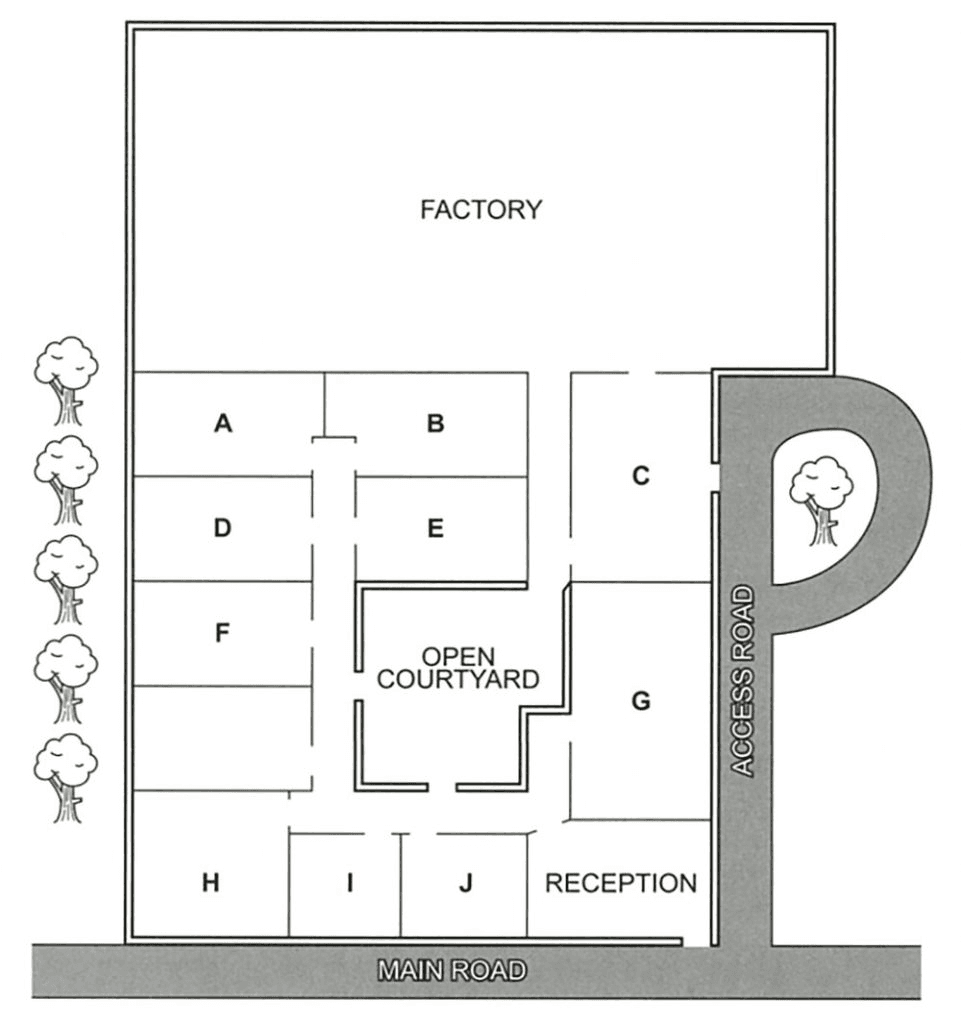
15. coffee room
16. warehouse
17. staff canteen
18. meeting room
19. human resources
20. boardroom
Two students discussing an art project on birds
Questions 21–22
Questions 21 and 22: Choose TWO letters, A–E. Which TWO parts of the introductory stage to their art projects do Jess and Tom agree were useful?
21. Part selection (lower letter)
A the Bird Park visit
B the workshop sessions
C the Natural History Museum visit
D the projects done in previous years
E the handouts with research sources
22. Part selection (higher letter)
A the Bird Park visit
B the workshop sessions
C the Natural History Museum visit
D the projects done in previous years
E the handouts with research sources
Questions 23–24
Questions 23 and 24: Choose TWO letters, A–E. In which TWO ways do both Jess and Tom decide to change their proposals?
23. Change selection (lower letter)
A by giving a rationale for their action plans
B by being less specific about the outcome
C by adding a video diary presentation
D by providing a timeline and a mind map
E by making their notes more evaluative
24. Change selection (higher letter)
A by giving a rationale for their action plans
B by being less specific about the outcome
C by adding a video diary presentation
D by providing a timeline and a mind map
E by making their notes more evaluative
Questions 25–30
Which personal meaning do the students decide to give to each of the following pictures? Choose SIX answers from the box and write the correct letter, A–H, next to Questions 25–30.
Personal meanings
A a childhood memory
B hope for the future
C fast movement
D a potential threat
E the power of colour
F the continuity of life
G protection of nature
H a confused attitude to nature
25. Falcon (Landseer)
26. Fish hawk (Audubon)
27. Kingfisher (van Gogh)
28. Portrait of William Wells
29. Vairumati (Gauguin)
30. Portrait of Giovanni de Medici
A lecture on Stoicism
Questions 31–40
Complete the notes below. Write ONE WORD ONLY for each answer.
Stoicism
Stoicism is still relevant today because of its (31) ………………………… appeal.
Ancient Stoics
• Stoicism was founded over 2,000 years ago in Greece.
• The Stoics' ideas are surprisingly well known, despite not being intended for (32) …………………………
Stoic principles
• Happiness could be achieved by leading a virtuous life.
• Controlling emotions was essential.
• Epictetus said that external events cannot be controlled but the (33) ………………………… people make in response can be controlled.
• A Stoic is someone who has a different view on experiences which others would consider as (34) ………………………… .
The influence of Stoicism
• George Washington organised a (35) ………………………… about Cato to motivate his men.
• The French artist Delacroix was a Stoic.
• Adam Smith's ideas on (36) ………………………… were influenced by Stoicism.
• Some of today's political leaders are inspired by the Stoics.
• Cognitive Behaviour Therapy (CBT)
– the treatment for (37) ………………………… is based on ideas from Stoicism
– people learn to base their thinking on (38) ………………………… .
• In business, people benefit from Stoicism by identifying obstacles as (39) ………………………… .
Relevance of Stoicism
• It requires a lot of (40) ………………………… but Stoicism can help people to lead a good life.
• It teaches people that having a strong character is more important than anything else.
Answers
1. egg
2. tower
3. car
4. animals
5. bridge
6. movie
7. decorate
8. Wednesdays
9. Fradstone
10. parking
11. 1926.
12. the healthcare industry.
13. The company has no plans to move.
14. talks by staff.
15. H
16. C
17. G
18. B
19. I
20. A
21. the Natural History Museum visit
22. the handouts with research sources
23. by being less specific about the outcome
24. by making their notes more evaluative
25. D
26. C
27. A
28. H
29. F
30. G
31. practical
32. publication
33. choices
34. negative
35. play
36. capitalism
37. depression
38. logic
39. opportunity
40. practice
Explanations
- 1. egg
- 'They work together to design a special cover that goes round an egg, so that when it's inside they can drop it from a height and it doesn't break.'Common trap: The object is named in the middle of a long sentence, before the drop-without-breaking detail that identifies which note line it belongs to.
- 2. tower
- 'Well, they have a competition to see who can make the highest tower.' 'Highest' is the note's 'tallest'.Common trap: Synonym for the adjective. The talk says 'highest' where the note says 'tallest', so the match is on the competition rather than on repeated wording.
- 3. car
- 'One thing they do is to design and build a car that's attached to a balloon, and the force of the air in that actually powers the car and makes it move along.'Common trap: 'Balloon' is printed in the note, so it cannot be the answer — the thing being powered is what has to be picked out of the same clause.
- 4. animals
- 'They work out how to build model vehicles, things like cars and trucks, but also how to construct animals using the same sorts of material and technique, and then they learn how they can program them and make them move.'Common trap: Cars and trucks are already printed in the note. The 'but also' is what introduces the third item, and 'vehicles' just before it is a tempting general word.
- 5. bridge
- 'With the Junior Engineers, it's to use recycled materials like card and wood to build a bridge, and the longest one gets a prize.'Common trap: Two competitions in one recording. The younger group builds the tallest tower, so the materials — card and wood — are what tie this line to the older group's task.
- 6. movie
- 'Then they have something a bit different, which is to think up an idea for a five-minute movie and then film it, using special animation software.' 'Five-minute' is the note's 'short'.Common trap: 'Animation' and 'software' are both in the same clause and 'software' is already printed in the note — the answer is the thing being created, not the tool.
- 7. decorate
- 'They also build a robot in the shape of a human, and they decorate it and program it so that it can move its arms and legs.' Build and program are printed in the note, so the missing verb is decorate.Common trap: A verb, not a noun. Two of the three verbs are already in the note, so the gap has to be filled from the middle of a three-part list.
- 8. Wednesdays
- 'They used to be, but we found it didn't give our staff enough time to clear up after the first workshop, so we moved them to Wednesdays.'Common trap: The wrong day is in the question that prompts the answer. 'Are the classes on a Monday, too?' is confirmed with 'They used to be' — the past tense is the only warning.
- 9. Fradstone
- 'They're in building 10A … and that's in Fradstone Industrial Estate', spelled out immediately afterwards as 'F-R-A-D-S-T-O-N-E'.Common trap: Spelled-out place name. Grasford and building 10A are both printed in the note, so the only thing to write is the invented name that gets spelled out.
- 10. parking
- 'And will I have any parking problems there?' 'No, there's always plenty available.' 'Plenty available' is exactly what the note records.Common trap: The word comes from the caller and the confirmation from the receptionist, who says only 'plenty available' without naming what is plentiful.
- 11. 1926.
- 'He set up this company when he finished his apprenticeship, in 1926, although he actually started making plans two years earlier, in 1924.' Setting up the company is founding it.Common trap: Three dates in two sentences, in the order 1923, 1926, 1924. Only the middle one goes with 'set up this company'.
- 12. the healthcare industry.
- 'Stevenson was given the opportunity to make goods for hospitals and other players in the healthcare industry, so that's what we did for the first five years.' The first five years is what 'originally' asks about.Common trap: The plan is described before what actually happened. Machine tools and the automotive industry are both named first as the long-term intention, and 'however, there was a delay of five years' is the turn.
- 13. The company has no plans to move.
- 'We were lucky that the site is big enough, so moving to a new location has never been necessary.' What is planned instead is 'major refurbishment of this site over the next five years'.Common trap: Change is announced immediately after. Major work over the next five years sounds like relocation until you notice it is 'of this site'.
- 14. talks by staff.
- 'Most mornings you'll have a presentation from one of the managers, to learn about their department.' Presentations by managers are talks by staff.Common trap: The teacher visit is described in the past tense at the end, and the departmental time sounds like research — both are real details that fail on one word ('this year', 'observing').
- 15. H
- 'There's a corridor running left from here, and if you go along that, the door facing you at the end is the entrance to the coffee room. This looks out onto the main road on one side, and some trees on the other.' The room at the far end of that corridor, with the main road on one side and the trees on the other, is H.Common trap: Two views to satisfy at once. Several rooms face the trees and several face the main road; only the corner room at the end of the left corridor does both.
- 16. C
- 'You can get to the warehouse by crossing to the far side of the courtyard, and then the door is on your right.' Crossing the courtyard and turning right, next to the factory and the access road, is C.Common trap: The factory is described first. 'The factory is the very big room on the far side of the site. Next to it is the warehouse' places it loosely — the route across the courtyard is what fixes it.
- 17. G
- 'Somewhere you'll be keen to find is the staff canteen. This is right next to reception.' The windows look onto the corridor and courtyard on one side and the access road on the other, which is G.Common trap: The position is given in five words and then buried under a long complaint about the view — a listener waiting for directions gets only descriptions of what the windows face.
- 18. B
- 'You'll find it by walking along the corridor to the left of the courtyard, and continuing along it to the end. The meeting room is the last one on the right, and I'm afraid there's no natural daylight in the room.' The last room on the right at the top of that corridor, with no outside wall, is B.Common trap: 'No natural daylight' is the confirming detail. Several rooms sit at the end of the corridor, but only an inside room with no external window fits.
- 19. I
- 'You head to the left along the corridor from reception, and it's the second room you come to. It looks out onto the main road.' The second room along the front of the building is I.Common trap: Counting rooms. The coffee room lies at the end of the same corridor, so the answer depends on stopping at the second door rather than following the route to its end.
- 20. A
- 'That has quite a pleasant view, as it looks out on to the trees. Go along the corridor past the courtyard, right to the end. The boardroom is on the left, next to the factory.'Common trap: Same corridor as the meeting room, opposite side. Both are at the far end, so 'on the left' and 'next to the factory' are what separate them.
- 21. the Natural History Museum visit
- Jess calls the Bird Park 'much less use than the trip to the Natural History Museum', and Tom agrees: 'Yeah, I liked all the stuff about evolution there.'Common trap: Agreement is the test, not usefulness. The workshops were genuinely good — but only for Tom, since Jess was ill, and the question asks what both found useful.
- 22. the handouts with research sources
- 'When they gave us all those handouts with details of books and websites to look at, I was really put off, but the more I read, the more interested I got.' Tom replies, 'Me too. I found I could research so many different aspects of birds in art.'Common trap: A negative first reaction. 'I was really put off' can sound like a verdict, and the 'but' that reverses it comes halfway through the sentence.
- 23. by being less specific about the outcome
- Jess: 'It's best not to be too precise about your actual outcome at this stage … So I'm going to go back to my proposal to make it a bit more vague.' Tom: 'Really? OK, I'll change that too then.'Common trap: Several proposal elements are discussed, but most are already done. The two answers are the only points where each student says the other's problem applies to them as well.
- 24. by making their notes more evaluative
- Tom: 'The notes from my research are almost all just descriptions, I haven't actually evaluated anything. So I'll have to fix that.' Jess: 'Oh, I didn't know we had to do that. I'll have to look at that too.'Common trap: The rationale point is the mirror image. There, Jess had done it and Tom had not; here Tom spots it and Jess had not — only the second one ends with both changing.
- 25. D
- Tom worries that 'it's a bit scary' is too thin, and Jess suggests the wording: 'You could talk about the possible danger suggested by the bird's look.' Possible danger is a potential threat (D).Common trap: The description comes before the meaning. The head turned to one side and the stare are picture details; the personal meaning is what Jess supplies afterwards.
- 26. C
- 'Well actually I think I'll concentrate on the impression of rapid motion it gives.' Rapid motion is fast movement (C).Common trap: Tom's suggestion is rejected. 'Predators and food chains' would point towards a threat, and 'well actually' is the signal that Jess is choosing something else.
- 27. A
- 'I've actually chosen it because I saw a real kingfisher once when I was litter, I was out walking with my grandfather, and I've never forgotten it.' A memory from childhood is A.Common trap: Colour is discussed first. 'Beautiful blue and red and black shades' points straight at the power of colour (E), but the reason Jess chose the picture is personal.
- 28. H
- 'To me it's about how ambiguous people are in the way they exploit the natural world.' Ambiguity towards nature is a confused attitude to nature (H).Common trap: The man has just shot a bird, which invites a threat reading — but the meaning Tom gives is about his uncertain expression, not the danger.
- 29. F
- 'What I'm interested in is what idea this bird refers to. Apparently, it's a reference to the never-ending cycle of existence.' The never-ending cycle of existence is the continuity of life (F).Common trap: A bird eating a lizard is described first, which suggests a food-chain or threat reading — the chosen meaning is the symbolic one that follows.
- 30. G
- 'I like the way he's holding it carefully so he doesn't hurt it.' Handling the bird carefully to avoid harming it is protection of nature (G).Common trap: A child in the picture pulls towards childhood memory (A), but the meaning is about how the boy treats the bird, not about anyone's past.
- 31. practical
- 'Specifically, I am referring to Stoicism, which, in my opinion, is the most practical of all philosophies and therefore the most appealing.' 'Therefore the most appealing' links the adjective to the note's 'appeal'.Common trap: The lead-in argues that philosophy is not just talking or reading — several abstract words pass by before the one adjective that the note needs.
- 32. publication
- 'Amazingly, we still have access to these ideas, despite the fact that the most famous Stoics never wrote anything down for publication.' 'Amazingly' matches 'surprisingly', and 'despite' is repeated in the note.Common trap: Examples follow the answer. Meditations, letters and a student's notes are all listed afterwards and are more memorable than the abstract noun that fits the gap.
- 33. choices
- Epictetus is quoted directly: 'external events I cannot control, but the choices I make with regard to them, I do control'.Common trap: The note keeps the quotation's shape but changes person. 'Emotions', 'anger' and 'jealousy' all appear in the run-up and fit 'the _____ people make' badly only if you check the grammar.
- 34. negative
- 'Nassim Nicholas Taleb defines a Stoic as someone who has a different perspective on experience which most of us would see as wholly negative.' 'Most of us' is the note's 'others'.Common trap: The quotation that follows supplies four vivid nouns — fear, pain, mistakes, desire — any of which can be grabbed instead of the adjective the note asks for.
- 35. play
- 'George Washington … later, put on a play based on the life of Cato to inspire his men.' 'Put on' is the note's 'organised' and 'inspire' is 'motivate'.Common trap: Two founding fathers, two kinds of text. Jefferson's copy of Seneca comes next, and 'life of Cato' can be mistaken for a book rather than a play.
- 36. capitalism
- 'The economist Adam Smith's theories on capitalism were significantly influenced by the Stoicism that he studied as a schoolboy.'Common trap: 'Economist' arrives first and describes Smith, not his theories — the subject of the theories is the next noun along.
- 37. depression
- CBT 'is used to help people manage their problems by changing the way that they think and behave. It's most commonly used to treat depression.'Common trap: The therapy is described in general terms first, and the specific condition comes in a short separate sentence that is easy to talk over.
- 38. logic
- 'We can take control of our lives by challenging the irrational belief that create our faulty thinking, symptoms and behaviours by using logic instead.' Logic is what replaces the irrational thinking.Common trap: The answer is the last word of a long sentence built around its opposite — 'irrational belief' and 'faulty thinking' dominate the clause.
- 39. opportunity
- 'Stoic principles can build the resilience and state of mind required to overcome setbacks because Stoics teach turning obstacles into opportunity.'Common trap: 'Resilience' and 'setbacks' are both in the same sentence and both sound like business vocabulary — the note's 'obstacles' points to the word paired with it.
- 40. practice
- 'This is not as easy as it sounds and will require considerable practice - it can take a lifetime to master.' 'Considerable' is the note's 'a lot of'.Common trap: The good-life claim is made several sentences earlier, so the two halves of the note line are far apart in the talk — and 'a lifetime' follows the answer as a tempting alternative.
Audio transcripts
Part 1 — A phone call about children's engineering workshops
SARAH: Hello. Children’s Engineering Workshops. FATHER: Oh hello. I wanted some information about the workshops in the school holidays. SARAH: Sure. FATHER: I have two daughters who are interested. The younger one’s Lydia, she’s four - do you take children as young as that? SARAH: Yes, our Tiny Engineers workshop is for four to five-year-olds. FATHER: What sorts of activities do they do? SARAH: All sorts. For example, they work together to design a special cover that goes round an egg, so that when it’s inside they can drop it from a height and it doesn’t break. Well, sometimes it does break but that’s part of the fun! FATHER: Right. And Lydia loves building things. Is there any opportunity for her to do that? SARAH: Well, they have a competition to see who can make the highest tower. You’d be amazed how high they can go. FATHER: Right. SARAH: But they’re learning all the time as well as having fun. For example, one thing they do is to design and build a car that’s attached to a balloon, and the force of the air in that actually powers the car and makes it move along. They go really fast too. FATHER: OK, well, all this sounds perfect. FATHER: Now Carly, that’s my older daughter, has just had her seventh birthday, so presumably she’d be in a different group? SARAH: Yes, she’d be in the Junior Engineers. That’s for children from six to eight. FATHER: And do they do the same sorts of activities? SARAH: Some are the same, but a bit more advanced. So they work out how to build model vehicles, things like cars and trucks, but also how to construct animals using the same sorts of material and technique, and then they learn how they can program them and make them move. FATHER: So they learn a bit of coding? SARAH: They do. They pick it up really quickly. We’re there to help if they need it, but they learn from one another too. FATHER: Right. And do they have competition too? SARAH: Yes, with the Junior Engineers, it’s to use recycled materials like card and wood to build a bridge, and the longest one gets a prize. FATHER: That sounds fun. I wouldn’t mind doing that myself! SARAH: Then they have something a bit different, which is to think up an idea for a five-minute movie and then film it, using special animation software. You’d be amazed what they come up with. FATHER: And of course, that’s something they can put on their phone and take home to show all their friends. SARAH: Exactly. And then they also build a robot in the shape of a human, and they decorate it and program it so that it can move its arms and legs. FATHER: Perfect. So, is it the same price as the Tiny Engineers? SARAH: It’s just a bit more: £50 for the five weeks. FATHER: And are the classes on a Monday, too? SARAH: They used to be, but we found it didn’t give our staff enough time to clear up after the first workshop, so we moved them to Wednesdays. The classes are held in the morning from ten to eleven. FATHER: OK. That’s better for me actually. And what about the location? Where exactly are the workshops held? SARAH: They’re in building 10A - there’s a big sign on the door, you can’t miss it, and that’s in Fradstone Industrial Estate. FATHER: Sorry? SARAH: Fradstone - that’s F-R-A-D-S-T-O-N-E. FATHER: And that’s in Grasford, isn’t it? SARAH: Yes, up past the station. FATHER: And will I have any parking problems there? SARAH: No, there’s always plenty available. So would you like to enrol Lydia and Carly now? FATHER: OK. SARAH: So can I have your full name …
Part 2 — An induction talk for work experience students
Good morning, everyone, and welcome to Stevenson’s, one of the country’s major manufacturers of metal goods. Thank you for choosing us for your two weeks of work experience. My name is Julia Simmons, and since the beginning of this year I’ve been the managing director. Stevenson’s is quite an old company. Like me, the founder, Ronald Stevenson, went into the steel industry when he left school - that was in 1923. He set up this company when he finished his apprenticeship, in 1926, although he actually started making plans two years earlier, in 1924. He was a very determined young man! Stevenson’s long-term plan was to manufacture components for the machine tools industry - although in fact that never came about - and for the automotive industry, that is, cars and lorries. However, there was a delay of five years before that happened, because shortly before the company went into production, Stevenson was given the opportunity to make goods for hospitals and other players in the healthcare industry, so that’s what we did for the first five years. Over the years, we’ve expanded the premises considerably - we were lucky that the site is big enough, so moving to a new location has never been necessary. However, the layout is far from ideal for modern machinery and production methods, so we intend to carry out major refurbishment of this site over the next five years. I’d better give you some idea of what you’ll be doing during your two weeks with us, so you know what to expect. Most mornings you’ll have a presentation from one of the managers, to learn about their department, starting this morning with research and development. And you’ll all spend some time in each department, observing what’s going on and talking to people - as long as you don’t stop them from doing their work altogether! In the past, a teacher from your school has come in at the end of each week to find out how the group were getting on, but your school isn’t able to arrange that this year. OK, now I’ll briefly help you to orientate yourselves around the site. As you can see, we’re in the reception area, which we try to make attractive and welcoming to visitors. There’s a corridor running left from here, and if you go along that, the door facing you at the end is the entrance to the coffee room. This looks out onto the main road on one side, and some trees on the other, and that’ll be where you meet each morning. The factory is the very big room on the far side of the site. Next to it is the warehouse, which can be accessed by lorries going up the road to the turning area at the end. You can get to the warehouse by crossing to the far side of the courtyard, and then the door is on your right. Somewhere you’ll be keen to find is the staff canteen. This is right next to reception. I can confidently say that the food’s very good, but the view isn’t. The windows on one side look onto a corridor and courtyard, which aren’t very attractive at all, and on the other onto the access road, which isn’t much better. You’ll be using the meeting room quite often, and you’ll find it by walking along the corridor to the left of the courtyard, and continuing along it to the end. The meeting room is the last one on the right, and I’m afraid there’s no natural daylight in the room. Then you’ll need to know where some of the offices are. The human resources department is all the front of this building, so you head to the left along the corridor from reception, and it’s the second room you come to. It looks out onto the main road. And finally, the boardroom, where you’ll be meeting sometimes. That has quite a pleasant view, as it looks out on to the trees. Go along the corridor past the courtyard, right to the end. The boardroom is on the left, next to the factory. OK, now are there any questions before we …
Part 3 — Two students discussing an art project on birds
JESS: How are you getting on with your art project, Tom? TOM: OK. Like, they gave us the theme of birds to base our project on, and I’m not really all that interested in wildlife. But I’m starting to get into it. I’ve pretty well finished the introductory stage. JESS: So have I. When they gave us all those handouts with details of books and websites to look at, I was really put off, but the more I read, the more interested I got. TOM: Me too. I found I could research so many different aspects of birds in art - colour, movement, texture. So I was looking forward to the Bird Park visit. JESS: What a letdown! It poured with rain and we hardly saw a single bird. Much less use than the trip to the Natural History Museum. TOM: Yeah, I liked all the stuff about evolution there. The workshop sessions with Dr Fletcher were good too, especially the brainstorming sessions. JESS: I missed those because I was ill. I wish we could’ve seen the projects last year’s students did. TOM: Mm. I suppose they want us to do our own thing, not copy. JESS: Have you drafted your proposal yet? TOM: Yes, but I haven’t handed it in. I need to amend some parts. I’ve realised the notes from my research are almost all just descriptions, I haven’t actually evaluated anything. So I’ll have to fix that. JESS: Oh, I didn’t know we had to do that. I’ll have to look at that too. Did you do a timeline for the project? TOM: Yes, and a mind map. JESS: Yeah, so did I. I quite enjoyed that. But it was hard having to explain the basis for my decisions in my action plan. TOM: What? JESS: You know, give a rationale. TOM: I didn’t realise we had to do that. OK, I can add it now. And I’ve done the video diary presentation, and worked out what I want my outcome to be in the project. JESS: Someone told me it’s best not to be too precise about your actual outcome at this stage, so you have more scope to explore your ideas later on. So I’m going to do back to my proposal to make it a bit more vague. TOM: Really? OK, I’ll change that too then. TOM: One part of the project, I’m unsure about is where we choose some paintings of birds and say what they mean to us. Like, I chose a painting of a falcon by Landseer. I like it because the bird’s standing there with his head turned to one side, but he seems to be staring straight at you. But I can’t just say it’s a bit scary, can I? JESS: You could talk about the possible danger suggested by the bird’s look. TOM: Oh, OK. JESS: There’s a picture of a fish hawk by Audubon I like. It’s swooping over the water with a fish in its talons, and with great black wings which take up most of the picture. TOM: So you could discuss it in relation to predators and food chains? JESS: Well actually I think I’ll concentrate on the impression of rapid motion it gives. TOM: Right. JESS: Do you know that picture of a kingfisher by van Gosh - it’s perching on a reed growing near a stream. TOM: Yes, it’s got these beautiful blue and red and black shades. JESS: Mm hm. I’ve actually chosen it because I saw a real kingfisher once when I was litter, I was out walking with my grandfather, and I’ve never forgotten it. TOM: So we can use a personal link? JESS: Sure. TOM: OK. There’s a portrait called William Wells. I can’t remember the artist but it’s a middle-aged man who’s just shot a bird. And his expression, and the way he’s holding the bird in his hand suggests he’s not sure about what he’s done. To me it’s about how ambiguous people are in the way they exploit the natural world. JESS: Interesting. There’s Gauguin’s picture Vairumati. He did it in Tahiti. It’s a woman with a white bird behind her that is eating a lizard, and what I’m interested in is what idea this bird refers to. Apparently, it’s a reference to the never-ending cycle of existence. TOM: Wow. I chose a portrait of a little boy, Giovanni de Medici. He’s holding a tiny bird in one fist. I like the way he’s holding it carefully so he doesn’t hurt it. JESS: Ah right.
Part 4 — A lecture on Stoicism
Ancient philosophy is not just about talking or lecturing, or even reading long, dense books. In fact, it is something people have used throughout history - to solve their problems and to achieve their greatest triumphs. Specifically, I am referring to Stoicism, which, in my opinion, is the most practical of all philosophies and therefore the most appealing. Stoicism was founded in Ancient Greece by Zeno of Citium in the early 3rd century BC, but was practised by the likes of Epictetus, Cato. Seneca and Marcus Aurelius. Amazingly, we still have access to these ideas, despite the fact that the most famous Stoics never wrote anything down for publication. Cato definitely didn’t. Marcus Aurelius never intended his Meditations to be anything but personal. Seneca’s letters were, well, letters and Epictetus’ thoughts come to us by way of a note-taking student. Stoic principles were based on the idea that its followers could have an unshakable happiness in this life and the key to achieving this was virtue. The road to virtue, in turn, lay in understanding that destructive emotions, like anger and jealousy, are under our conscious control - they don’t have to control us, because we can learn to control them. In the words of Epictetus: “external events I cannot control, but the choices I make with regard to them, I do control”. The modern day philosopher and writer Nassim Nicholas Taleb defines a Stoic as someone who has a different perspective on experience which most of us would see as wholly negative; a Stoic “transforms fear into caution, pain into transformation, mistakes into initiation and desire into undertaking”. Using this definition as a model, we can see that throughout the centuries Stoicism has been practised in more recent history by kings, presidents, artists, writers and entrepreneurs. The founding fathers of the United States were inspired by the philosophy. George Washington was introduced to Stoicism by his neighbours at age seventeen, and later, put on a play based on the life of Cato to inspire his men. Thomas Jefferson kept a copy of Seneca beside his bed. Writers and artists have also been inspired by the stoics. Eugène Delacroix, the renowned French Romantic artist (known best for his painting Liberty Leading the People) was an ardent Stoic, referring to it as his “consoling religion”. The economist Adam Smith’s theories on capitalism were significantly influenced by the Stoicism that he studied as a schoolboy, under a teacher who had translated Marcus Aurelius’ works. Today’s political leaders are no different, with many finding their inspiration from the ancient texts. Former US president Bill Clinton rereads Marcus Aurelius every single year, and many have compared former President Obama’s calm leadership style to that of Cato. Wen Jiabao, the former prime minister of China, claims that Meditations is one of two books he travels with and that he has read it more than one hundred times over the course of his life. Stoicism had a profound influence on Albert Ellis, who invented Cognitive Behaviour Therapy, which is used to help people manage their problems by changing the way that they think and behave. It’s most commonly used to treat depression. The idea is that we can take control of our lives by challenging the irrational belief that create our faulty thinking, symptoms and behaviours by using logic instead. Stoicism has also become popular in the world of business. Stoic principles can build the resilience and state of mind required to overcome setbacks because Stoics teach turning obstacles into opportunity. A lesson every business entrepreneur needs to learn. I would argue that study Stoicism is as relevant today as it was 2,000 years ago, thanks to its brilliant insights into how to lead a good life. At the very root of the thinking, there is a very simple way of living - control what you can and accept what you can’t. This is not as easy as it sounds and will require considerable practice - it can take a lifetime to master. The Stoics also believed the most important foundation for a good and happy life is not money, fame, power or pleasure, but having a disciplined and principled character - something which seems to resonate with many people today.
Comments
Loading comments…