

Cambridge IELTS 15 Listening Test 2
4 parts · 40 questions · 30 minutes
An enquiry about a town festival
Questions 1–4
Complete the table below. Write ONE WORD ONLY for each answer.
| Date | Type of event | Details |
|---|---|---|
| 17th | a concert | performers from Canada |
| 18th | a ballet | company called (1) ………………………… |
| 19th–20th (afternoon) | a play | type of play: a comedy called Jemima has had a good (2) ………………………… |
| 20th (evening) | a (3) ………………………… show | show is called (4) ………………………… |
Questions 5–10
Complete the notes below. Write ONE WORD ONLY for each answer.
Workshops
• Making (5) ………………………… food
• (children only) Making (6) …………………………
• (adults only) Making toys from (7) ………………………… using various tools
Outdoor activities
• Swimming in the (8) …………………………
• Walking in the woods, led by an expert on (9) …………………………
See the festival organiser's (10) ………………………… for more information
A talk about the transformation of Minster Park
Questions 11–14
Choose the correct letter, A, B or C. Minster Park.
11. The park was originally established
A as an amenity provided by the city council.
B as land belonging to a private house.
C as a shared area set up by the local community.
12. Why is there a statue of Diane Gosforth in the park?
A She was a resident who helped to lead a campaign.
B She was a council member responsible for giving the public access.
C She was a senior worker at the park for many years.
13. During the First World War, the park was mainly used for
A exercises by troops.
B growing vegetables.
C public meetings.
14. When did the physical transformation of the park begin?
A 2013
B 2015
C 2016
Questions 15–20
Label the map below. Write the correct letter, A–I, next to Questions 15–20. Minster Park.
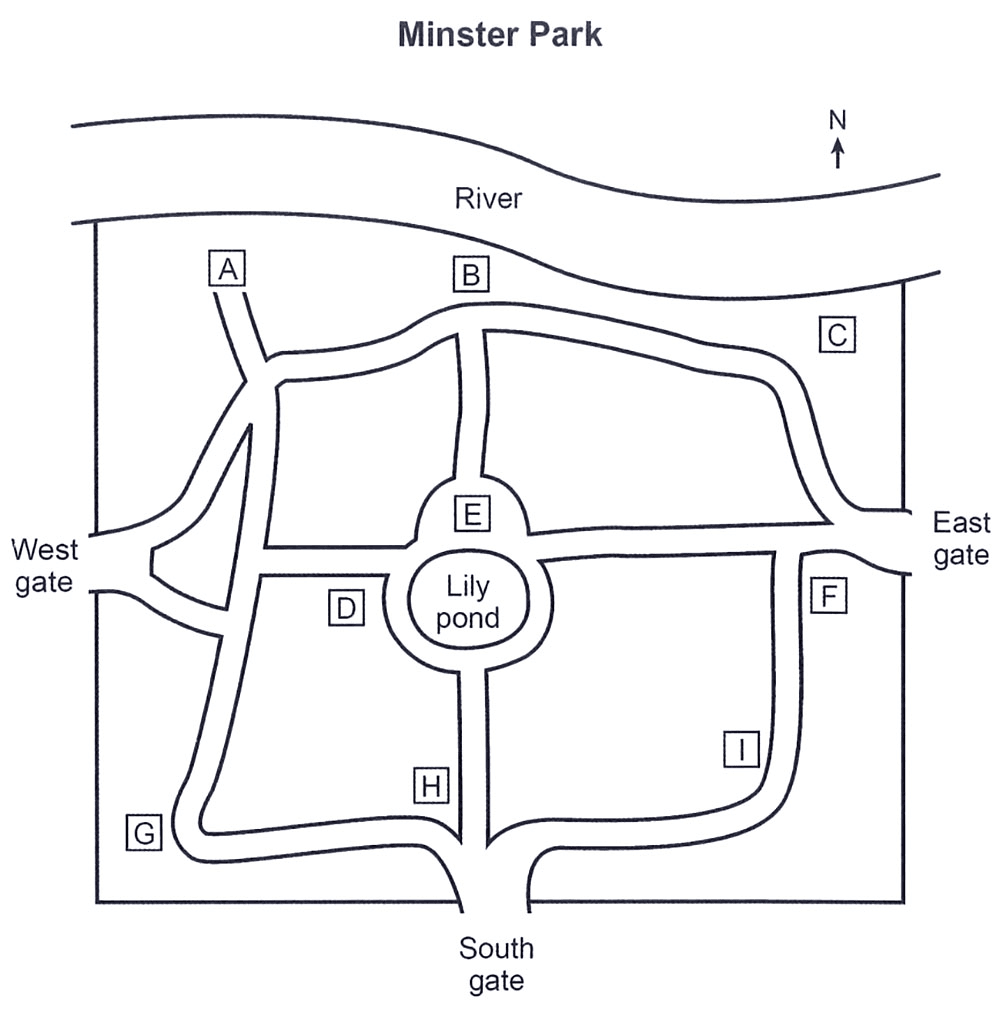
15. statue of Diane Gosforth
16. wooden sculptures
17. playground
18. maze
19. tennis courts
20. fitness area
Two students planning a display on Dickens
Questions 21–22
Questions 21 and 22: Choose TWO letters, A–E. Which TWO groups of people is the display primarily intended for?
21. Group selection (lower letter)
A student from the English department
B residents of the local area
C the university's teaching staff
D potential new students
E students from other departments
22. Group selection (higher letter)
A student from the English department
B residents of the local area
C the university's teaching staff
D potential new students
E students from other departments
Questions 23–24
Questions 23 and 24: Choose TWO letters, A–E. What are Cathy and Graham's TWO reasons for choosing the novelist Charles Dickens?
23. Reason selection (lower letter)
A His speeches inspired others to try to improve society.
B He used his publications to draw attention to social problems.
C His novels are well-known now.
D He was consulted on a number of social issues.
E His reputation has changed in recent times.
24. Reason selection (higher letter)
A His speeches inspired others to try to improve society.
B He used his publications to draw attention to social problems.
C His novels are well-known now.
D He was consulted on a number of social issues.
E His reputation has changed in recent times.
Questions 25–30
What topic do Cathy and Graham choose to illustrate with each novel? Choose SIX answers from the box and write the correct letter, A–H, next to Questions 25–30.
Topics
A poverty
B education
C Dickens's travels
D entertainment
E crime and the law
F wealth
G medicine
H a woman's life
25. The Pickwick Papers
26. Oliver Twist
27. Nicholas Nickleby
28. Martin Chuzzlewit
29. Bleak House
30. Little Dorrit
A case study of an agricultural programme in Mozambique
Questions 31–40
Complete the notes below. Write ONE WORD ONLY for each answer.
Agricultural programme in Mozambique
How the programme was organised
• It focused on a dry and arid region in Chicualacuala district, near the Limpopo River.
• People depended on the forest to provide charcoal as a source of income.
• (31) ………………………… was seen as the main priority to ensure the supply of water.
• Most of the work organised by farmers' associations was done by (32) …………………………
• Fenced areas created to keep animals away from crops.
• The programme provided
– (33) ………………………… for the fences
– (34) ………………………… for suitable crops
– water pumps.
• The farmers provided
– labour
– (35) ………………………… for the fences on their land.
Further developments
• The marketing of produce was sometimes difficult due to lack of (36) …………………………
• Training was therefore provided in methods of food (37) …………………………
• Farmers made special places where (38) ………………………… could be kept.
• Local people later suggested keeping (39) …………………………
Evaluation and lessons learned
• Agricultural production increased, improving incomes and food security.
• Enough time must be allowed, particularly for the (40) ………………………… phase of the programme.
Answers
1. Eustatis
2. review
3. dance
4. Chat
5. healthy
6. posters
7. wood
8. lake
9. insects
10. blog
11. as a shared area set up by the local community.
12. She was a resident who helped to lead a campaign.
13. growing vegetables.
14. 2016
15. E
16. C
17. B
18. A
19. G
20. D
21. residents of the local area
22. potential new students
23. He used his publications to draw attention to social problems.
24. His novels are well-known now.
25. G
26. B
27. D
28. C
29. H
30. F
31. irrigation
32. women
33. wire
34. seed
35. posts
36. transport
37. preservation
38. fish
39. bees
40. design
Explanations
- 1. Eustatis
- 'The next day, the 18th, there's a performance by a ballet company called Eustatis' — and Tim spells it out when Jean doesn't catch it: 'E-U-S-T-A-T-I-S'.Common trap: Spelled-out name. The word is unfamiliar, so the mark depends on catching the letters given after Jean's 'Sorry?' rather than on the first hearing.
- 2. review
- 'I haven't seen it myself, but the review in the local paper was very good.' A good review in the paper is what the table records for the comedy.Common trap: Opinion from a third party. Tim says he hasn't seen the play, so the positive verdict has to be traced to the newspaper's review rather than to him.
- 3. dance
- Jean asks, 'And what about dance? Will there be any performances?' and Tim confirms, 'Yes, also on the 20th, but in the evening.' The evening event on the 20th is a dance show.Common trap: The answer is in the question, not the answer. Tim only says 'Yes' — the word for the table comes from Jean's enquiry, and the confirmation is what ties it to the 20th evening.
- 4. Chat
- 'The show is about how people communicate, or fail to communicate, with each other, so it's got the rather strange name, Chat.' The name of the show is the answer.Common trap: Theme before title. The description of the show comes first, so a listener writing down 'communicate' misses the actual name at the end of the sentence.
- 5. healthy
- 'It's going to focus on how to make food part of a healthy lifestyle, and it'll show that even sweet things like cakes can contain much less sugar than they usually do.' The cookery workshop is about healthy food.Common trap: Adjective attached to the wrong noun. In the talk 'healthy' describes the lifestyle; the note moves it onto the food itself.
- 6. posters
- 'Another workshop is just for children, and that's on creating posters to reflect the history of the town.' 'Just for children' matches the note's '(children only)'.Common trap: Two age-restricted workshops in a row. The toy-making workshop is adults only, so the children's item has to be taken from the one introduced as 'just for children'.
- 7. wood
- 'Because it involves carpentry – participants will be making toys out of wood, so there'll be a lot of sharp chisels and other tools around.' The material is wood, which is also why the workshop is adults only.Common trap: Explanation before material. 'Carpentry' is said first and fits the sense but not the gap, which needs the material the toys are made from.
- 8. lake
- Jean works out what wild swimming means — 'In a lake, for instance' — and Tim confirms: 'Yes, there's a beautiful one just outside the town, and that'll be the venue for the swimming.'Common trap: The word comes from the wrong speaker. Tim never repeats 'lake' — he says 'one', so the answer has to be carried over from Jean's guess and confirmed by his reply.
- 9. insects
- 'There'll be a walk in some nearby woods every day. The leader is an expert on insects.' 'The leader' matches the note's 'led by', and his subject is insects.Common trap: Environment vocabulary nearby. 'The woods' and 'the environment' are both in the same two sentences and sound like plausible fields of expertise.
- 10. blog
- 'If you'd like to read about how the preparations for the festival are going, the festival organizer is keeping a blog.' The organiser's blog is where more information can be found.Common trap: A second source in the next clause. 'Search online for the festival website' follows immediately, but the website is only how you find the blog.
- 11. as a shared area set up by the local community.
- 'Unlike many public parks that started in private ownership … Minster was some waste land, which people living nearby started planting with flowers in 1892.' Local residents planting waste land themselves is a community-created shared space.Common trap: Both wrong options are stated as things the park was not. The council and the private-garden origin are named in the same two sentences, one before the answer and one as an explicit contrast.
- 12. She was a resident who helped to lead a campaign.
- When the council planned to sell the land for housing, 'many local people wanted it to remain a place that everyone could go to … Diane Gosforth was one of those people, and she organised petitions and demonstrations.' She was a local resident who organised the campaign.Common trap: Council on both sides of the answer. The council owns the land before and changes its mind after, so a listener hearing 'council' beside her name can place her inside it.
- 13. growing vegetables.
- 'Most of the park was dug up and planted with vegetables, which were sold locally.' 'Most of the park' is what the question's 'mainly' asks for.Common trap: All three uses are mentioned; only one is the main one. The army got as far as contacting the council, and meetings did take place — but 'too small to be of use' and 'occasional' rule them out against 'most of the park'.
- 14. 2016
- 'Plans for transforming it were drawn up at various times, most recently in 2013, though they were revised in 2015, before any work had started. The changes finally got going in 2016.' Only 2016 is when work actually began.Common trap: Three dates, one verb that matters. Planning and revising both have years attached; the question asks when the physical work began, which is signalled by 'finally got going'.
- 15. E
- 'It used to be close to the south gate, but it's now immediately to the north of the lily pond, almost in the centre of the park.' North of the lily pond, in the middle of the map, is E.Common trap: The old position is given first. 'Close to the south gate' describes where the statue was, and H sits exactly there — 'but it's now' is the switch a listener has to catch.
- 16. C
- 'There's a new area of wooden sculptures, which are on the river bank, where the path from the east gate makes a sharp bend.' On the river bank at the bend of the east-gate path is C.Common trap: Two river-bank positions. A and B are also on the river, so the deciding detail is the sharp bend in the path coming from the east gate.
- 17. B
- 'The playground has been enlarged and improved, and that's between the river and the path that leads from the pond to the river.' The space enclosed by the river and that connecting path is B.Common trap: Boundaries, not landmarks. The position is given only as what lies either side of it, so it has to be worked out from two lines on the map rather than from a named feature.
- 18. A
- 'There's a new maze … That's near the west gate – you go north from there towards the river and then turn left to reach it.' North from the west gate, then left, puts it at A.Common trap: Directions given as a route. Two moves are needed from the west gate, and G also sits near that gate for anyone who stops after 'near the west gate'.
- 19. G
- 'They're still in the south-west corner of the park, where there's a right-angle bend in the path.' The south-west corner at the right-angle bend is G.Common trap: 'Still' signals no change. The courts have been doubled from four to eight, which invites a listener to expect a new location — but the position is unchanged.
- 20. D
- 'This is right next to the lily pond on the same side as the west gate.' Beside the pond on its west side is D.Common trap: Same landmark as an earlier answer. The statue is also placed by the lily pond, so the fitness area only separates from it on the second detail — the west side rather than the north.
- 21. residents of the local area
- 'It'll be publicised in the city, to encourage people to come and find out something of what does on here.' Publicising it in the city to bring people in means local residents are a target audience.Common trap: The distractors are all named in the question that opens the exchange. English students, other departments, current students and lecturers are all raised — each is then set aside as past practice or as not the focus.
- 22. potential new students
- 'It's included in the information that's sent to people who are considering applying to study here next year.' People considering applying are potential new students.Common trap: Paraphrase without the word 'students'. The group is described only as 'people who are considering applying', so matching depends on the idea rather than on repeated vocabulary.
- 23. He used his publications to draw attention to social problems.
- 'His novels show the awful conditions that most people had to live in, don't they: he wanted to shock people into doing something about it.' Using novels to expose bad conditions is drawing attention to social problems through his publications.Common trap: A real activity that is deliberately dropped. His campaigning and public talks are described immediately afterwards, but the speakers agree to leave them out — so option A is true of Dickens yet not a reason for the choice.
- 24. His novels are well-known now.
- 'Most people have heard of him, and have probably read some of his novels, or seen films based on them, so that's a good lead-in to life in his time.' Present-day familiarity with the novels is the reason given.Common trap: Present fame vs changed reputation. The point is that people know his work today; option E turns the same idea into a change over time, which is never claimed.
- 25. G
- 'There's a character who keeps falling asleep, and that medical condition was named after the book – Pickwickian Syndrome.' Cathy agrees to 'use that as the topic', and a named medical condition is medicine (G).Common trap: Two facts about the same novel. Its theatrical adaptation is mentioned in the previous line and would point to entertainment (D) — but the chosen topic is the one Graham calls 'an interesting point'.
- 26. B
- 'We could use that to illustrate the fact that very few children went to school, particularly not poor children, so they learnt in other ways.' Schooling and how children learnt is education (B).Common trap: The obvious topic is rejected out loud. Graham says 'There's a lot in the novel about poverty. But maybe something less obvious', so A is raised only to be passed over.
- 27. D
- 'There's also the company of touring actors that Nicholas joins. We could do something on theatres and other amusements of the time.' Theatres and amusements are entertainment (D).Common trap: Education mentioned first for this novel too. 'He taught in a really cruel school' invites B, but Graham steers away with 'We don't want only the bad things, do we?'
- 28. C
- 'Yes, and Dickens himself had been there a year before, and drew on his experience there in the novel.' Graham endorses it — 'let's keep to your idea' — so the topic is Dickens's own travels (C).Common trap: An alternative topic is proposed and dismissed in the same turn. 'The main theme is selfishness, so we could do something on social justice? No, too general' is rejected before they settle on the travels.
- 29. H
- Cathy traces Esther's story — living with an aunt who treats her badly, then running her guardian's household, then marrying and being given a house. Graham approves: 'Yes, I like that.' The topic is a woman's life (H).Common trap: Both speakers praise the legal satire first. 'His satire of the legal system is pretty powerful' points to crime and the law (E), and Cathy's 'That's true, but' is the only signal that it is not the chosen topic.
- 30. F
- 'What about focusing on the part when Mr Dorrit inherits a fortune, and he starts pretending he's always been rich?' Inheriting a fortune and pretending to be rich is wealth (F).Common trap: The novel opens on the opposite idea. Old Mr Dorrit's years in a debtors' prison suggest poverty (A), and the chosen focus is the reversal that comes later.
- 31. irrigation
- 'The programme focused primarily on making use of existing water resources from the Limpopo River by setting up systems of irrigation, which would provide a dependable water supply for crops and animals.' 'Focused primarily' matches 'main priority'.Common trap: The water source is named just before the method. 'The Limpopo River' and 'existing water resources' both sit in the gap's sentence, but the priority is the system built to use them.
- 32. women
- 'These associations planned and carried out activities including water management, livestock breeding and agriculture, and it was notable that in general, women formed the majority of the workforce.' 'The majority of the workforce' is the note's 'most of the work'.Common trap: Buried in a list. The answer comes after three named activities and behind the hedge 'it was notable that in general', so it is easy to miss while still writing the previous item.
- 33. wire
- 'The community was responsible for creating these fences, but the programme provided the necessary wire for making them.' The split is explicit: labour from the community, wire from the programme.Common trap: Two providers, one fence. The community makes the fences and later supplies the posts; only the wire comes from the programme, and 'but' is the word that separates them.
- 34. seed
- 'Vegetables and cereals appropriate to the climate could be grown, and the programme provided the necessary seeds for this.' 'Appropriate to the climate' matches the note's 'suitable crops'.Common trap: Crops named before the item supplied. 'Vegetables and cereals' fill the same slot grammatically, but what the programme provided is the seeds.
- 35. posts
- 'However, the labour was all provided by local people, and they also provided and put up the posts that supported the fences around the fields.' Labour is already printed in the note, so the second item the farmers provided is the posts.Common trap: Same sentence, two suppliers again. Pumps and pipes are described immediately before, and both come from the programme — only the posts come from the farmers.
- 36. transport
- 'Getting the produce to places where it could be marketed was sometimes a problem, as the farmers did not have access to transport.' 'Did not have access to' is the note's 'lack of'.Common trap: Consequence, not cause. The sentence ends with produce being spoiled, especially vegetables — a listener answering on what they hear last takes the effect rather than the missing resource.
- 37. preservation
- 'In order to prevent food from being spoiled, the farmers needed to learn techniques for its preservation.' 'Needed to learn techniques' is delivered as the training the note refers to.Common trap: The word arrives at the very end of a long sentence, after the problem, the discussion and the decision — all of which supply tempting nouns like 'spoiled' and 'techniques'.
- 38. fish
- 'Farmers started to dig holes for tanks in the fenced-off areas and to fill these with water and use them for breeding fish.' The tanks are the 'special places', and what is kept in them is fish.Common trap: Container vs contents. 'Holes', 'tanks' and 'water' all appear before the answer and fit 'special places where _____ could be kept' for anyone who stops listening early.
- 39. bees
- 'Another suggestion was made by local people … They decided to try setting up colonies of bees, which would provide honey both for their own consumption and to sell.' The suggestion from local people was beekeeping.Common trap: Two unplanned additions in a row. The fish tanks were also outside the original proposal, so the marker for this one is 'suggestion was made by local people' rather than novelty.
- 40. design
- 'It's important to set realistic timelines for each phase of the programme, especially for its design, as mistakes made at this stage may be hard to correct later on.' 'Especially for its design' matches 'particularly for the _____ phase'.Common trap: Final sentence of the talk. The lesson is stated once, in an abstract clause about timelines, with no repetition afterwards.
Audio transcripts
Part 1 — An enquiry about a town festival
TIM: Good morning. You’re through to the tourist information office, Tim speaking. How can I help you? JEAN: Oh hello. Could you give me some information about next month’s festival, please? My family and I will be staying in the town that week. TIM: Of course. Well it starts with a concert on the afternoon of the 17th. JEAN: Oh I heard about that. The orchestra and singers come from the USA, don’t they? TIM: They’re from Canada. They’re very popular over there. They’re going to perform a number of well-known pieces that will appeal to children as well as adults. JEAN: That sounds good. My whole family are interested in music. TIM: The next day, the 18th, there’s a performance by a ballet company called Eustatis. JEAN: Sorry? TIM: The name is spelt E-U-S-T-A-T-I-S. They appeared in last year’s festival, and went down very well. Again, their programme is designed for all ages. JEAN: Good. I expect we’ll go to that. I hope there’s going to be a play during the festival, a comedy, ideally. TIM: You’re in luck! On the 19th and 20th a local amateur group are performing one written by a member of group. It’s called Jemima. That’ll be on in the town hall. They’ve already performed it two or three times. I haven’t seen it myself, but the review in the local paper was very good. JEAN: And is it suitable for children? TIM: Yes, in fact it’s aimed more at children than at adults, so both performances are in the afternoon. JEAN: And what about dance? Will there by any performances? TIM: Yes, also on the 20th, but in the evening. A professional company is putting on a show of modern pieces, with electronic music by young composers. JEAN: Uh-huh. TIM: The show is about how people communicate, or fail to communicate, with each other, so it’s got the rather strange name, Chat. JEAN: I suppose that’s because that’s something we do both face to face and online. TIM: That’s right. TIM: Now there are also some workshops and other activities. They’ll all take place at least once every day, so everyone who wants to take part will have a chance. JEAN: Good. We’re particularly interested in cookery – you don’t happen to have a cookery workshop, do you? TIM: We certainly do. It’s going to focus on how to make food part of a healthy lifestyle, and it’ll show that even sweet things like cakes can contain much less sugar than they usually do. JEAN: That might be worth going to. We’re trying to encourage our children to cook. TIM: Another workshop is just for children, and that’s on creating posters to reflect the history of the town. The aim is to make children aware of how both the town and people’s lives have changed over the centuries. The results will be exhibited in the community centre. Then the other workshop is in toy-making, and that’s for adults only. JEAN: Oh, why’s that? TIM: Because it involves carpentry – participants will be making toys out of wood, so there’ll be a lot of sharp chisels and other tools around. JEAN: It makes sense to keep children away from it. TIM: Exactly. Now let me tell you about some of the outdoor activities. There’ll be supervised wild swimming … JEAN: Wild swimming? What’s that? TIM: It just means swimming in natural waters, rather than a swimming pool. JEAN: Oh OK. In a lake, for instance. TIM: Yes, there’s a beautiful one just outside the town, and that’ll be the venue for the swimming. There’ll be lifeguards on duty, so it’s suitable for all ages. And finally, there’ll be a walk in some nearby woods every day. The leader is an expert on insects. He’ll show some that live in the woods, and how important they are for the environment. So there are going to be all sorts of different things to do during the festival. JEAN: There certainly are. TIM: If you’d like to read about how the preparations for the festival are going, the festival organizer is keeping a blog. Just search online for the festival website, and you’ll find it. JEAN: Well, thank you very much for all the information. TIM: You’re welcome. Goodbye. JEAN: Goodbye.
Part 2 — A talk about the transformation of Minster Park
WOMAN: I’m very pleased to welcome this evening’s guest speaker, Mark Logan, who’s going to tell us about the recent transformation of Minster Park. Over to you, Mark. MARK: Thank you. I’m sure you’re all familiar with Minster Park. It’s been a feature of the city for well over a century, and has been the responsibility of the city council for most of that time. What perhaps isn’t so well known is the origin of the park: unlike many public parks that started in private ownership, as the garden of a large house, for instance, Minster was some waste land, which people living nearby started planting with flowers in 1892. It was unclear who actually owned the land, and this wasn’t settled until 20 years later, when the council took possession of it. You may have noticed the statue near one of the entrances. It’s of Diane Gosforth, who played a key role in the history of the park. Once the council had become the legal owner, it planned to sell the land for housing. Many local people wanted it to remain a place that everyone could go to, to enjoy the fresh air and natural environment – remember the park is in a densely populated residential area. Diane Gosforth was one of those people, and she organised petitions and demonstrations, which eventually made the council change its mind about the future of the land. Soon after this the First World War broke out, in 1914, and most of the park was dug up and planted with vegetables, which were sold locally. At one stage the army considered taking in over for troop exercises and got as far as contacting the city council, then decided the park was too small to be of use. There were occasional public meetings during the war, in an area that had been retained as grass. After the war, the park was turned back more or less to how it had been before 1914, and continued almost unchanged until recently. Plans for transforming it were drawn up at various times, most recently in 2013, though they were revised in 2015, before any work had started. The changes finally got going in 2016, and were finished on schedule last year. OK, let me tell you about some of the changes that have been made – and some things that have been retained. If you look at this map, you’ll see the familiar outline of the park, with the river forming the northern boundary, and a gate in each of the other three walls. The statue of Diane Gosforth has been moved: it used to be close to the south gate, but it’s now immediately to the north of the lily pond, almost in the centre of the park, which makes it much more visible. There’s a new area of wooden sculptures, which are on the river bank, where the path from the east gate makes a sharp bend. There are two areas that are particularly intended for children. The playground has been enlarged and improved, and that’s between the river and the path that leads from the pond to the river. Then there’s a new maze, a circular series of paths, separated by low hedges. That’s near the west gate – you go north from there towards the river and then turn left to reach it. There have been tennis courts in the park for many years, and they’ve been doubled, from four to eight. They’re still in the south-west corner of the park, where there’s a right-angle bend in the path. Something else I’d like to mention is the new fitness area. This is right next to the lily pond on the same side as the west gate. Now, as you’re all gardeners, I’m sure you’ll like to hear about the plants that have been chosen for the park.
Part 3 — Two students planning a display on Dickens
CATHY: OK, Graham, so let’s check we both know what we’re supposed to be doing. GRAHAM: OK. CATHY: So, for the university’s open day, we have to plan a display on British life and literature in the mid-19th century. GRAHAM: That’s right. But we’ll have some people to help us find the materials and set it up, remember – for the moment, we just need to plan it. CATHY: Good. So have you gathered who’s expected to come and see the display? Is it for the people studying English, or students from other departments? I’m not clear about it. GRAHAM: Nor me. That was how it used to be, but it didn’t attract many people, so this year it’s going to be part of an open day, to raise the university’s profile. It’ll be publicised in the city, to encourage people to come and find out something of what does on here. And it’s included in the information that’s sent to people who are considering applying to study here next year. CATHY: Presumably some current students and lecturers will come? GRAHAM: I would imagine so, but we’ve been told to concentrate on the other categories of people. CATHY: Right. We don’t have to cover the whole range of 19th-century literature, do we? GRAHAM: No, it’s entirely up to us. I suggest just using Charles Dickens. CATHY: That’s a good idea. Most people have heard of him, and have probably read some of his novels, or seen films based on them, so that’s a good lead-in to life in his time. GRAHAM: Exactly. And his novels show the awful conditions that most people had to live in, don’t they: he wanted to shock people into doing something about it. CATHY: Did he do any campaigning, other than writing? GRAHAM: Yes, he campaigned for education and other social reforms, and gave talks, but I’m inclined to ignore that and focus on the novels. CATHY: Yes, I agree. CATHY: OK, so now shall we think about a topic linked to each novel? GRAHAM: Yes. I’ve printed out a list of Dicken’s novels in the order they were published, in the hope you’d agree to focus on him! CATHY: You’re lucky I did agree! Let’s have a look. OK, the first was The Pickwick Papers, published in 1836. It was very successful when it came out, wasn’t it, and was adapted for the theatre straight away. GRAHAM: There’s an interesting point, though, that there’s a character who keeps falling asleep, and that medical condition was named after the book – Pickwickian Syndrome. CATHY: Oh, so why don’t we use that as the topic, and include some quotations from the novel? GRAHAM: Right, Next is Oliver Twist. There’s a lot in the novel about poverty. But maybe something less obvious … CATHY: Well Oliver is taught how to steal, isn’t he? We could use that to illustrate the fact that very few children went to school, particularly not poor children, so they learnt in other ways. GRAHAM: Good idea. What’s next? CATHY: Maybe Nicholas Nickleby. Actually he taught in a really cruel school, didn’t he? GRAHAM: That’s right. But there’s also the company of touring actors that Nicholas joins. We could do something on theatres and other amusements of the time. We don’t want only the bad things, do we? CATHY: OK. GRAHAM: What about Martin Chuzzlewit? He goes to the USA, doesn’t he? CATHY: Yes, and Dickens himself had been there a year before, and drew on his experience there in the novel. GRAHAM: I wonder, though … The main theme is selfishness, so we could do something on social justice? No, too general, let’s keep to your idea – I think it would work well. CATHY: He wrote Bleak House next – that’s my favourite of his novels. GRAHAM: Yes, mine too. His satire of the legal system is pretty powerful. CATHY: That’s true, but think about Esther, the heroine. As a child she lives with someone she doesn’t know is her aunt, who treats her very badly. Then she’s very happy living with her guardian, and he puts her in charge of the household. And at the end she gets married and her guardian gives her and her husband a house, where of course they’re very happy. GRAHAM: Yes, I like that. CATHY: What shall we take next? Little Dorrit? Old Mr Dorrit has been in a debtors’ prison for years … GRAHAM: So was Dicken’s father, wasn’t he? CATHY: That’s right. GRAHAM: What about focusing on the part when Mr Dorrit inherits a fortune, and he starts pretending he’s always been rich? CATHY: Good idea. GRAHAM: OK, so next we need to think about what materials we want to illustrate each issue. That’s going to be quite hard.
Part 4 — A case study of an agricultural programme in Mozambique
I’m going to report on a case study of a programme which has been set up to help rural populations in Mozambique, a largely agricultural country in South-East Africa. The programme worked with three communities in Chicualacuala district, near the Limpopo River. This is a dry and arid region, with unpredictable rainfall. Because of this, people in the area were unable to support themselves through agriculture and instead they used the forest as a means of providing themselves with an income, mainly by selling charcoal. However, this was not a sustainable way of living in the long term, as they were rapidly using up this resource. To support agriculture in this dry region, the programme focused primarily on making use of existing water resources from the Limpopo River by setting up systems of irrigation, which would provide a dependable water supply for crops and animals. The programme worked closely with the district government in order to find the best way of implementing this. The region already had one farmers’ association, and it was decided to set up two more of these. These associations planned and carried out activities including water management, livestock breeding and agriculture, and it was notable that in general, women formed the majority of the workforce. It was decided that in order to keep the crops safe from animals, both wild and domestic, special areas should be fenced off where the crops could be grown. The community was responsible for creating these fences, but the programme provided the necessary wire for making them. Once the area had been fenced off, it could be cultivated. The land was dug, so that vegetables and cereals appropriate to the climate could be grown, and the programme provided the necessary seeds for this. The programme also provided pumps so that water could be brought from the river in pipes to the fields. However, the labour was all provided by local people, and they also provided and put up the posts that supported the fences around the fields. Once the programme had been set up, its development was monitored carefully. The farmers were able to grow enough produce not just for their own needs, but also to sell. However, getting the produce to places where it could be marketed was sometimes a problem, as the farmers did not have access to transport, and this resulted in large amounts of produce, especially vegetables, being spoiled. This problem was discussed with the farmers’ associations and it was decided that in order to prevent food from being spoiled, the farmers needed to learn techniques for its preservation. There was also an additional initiative that had not been originally planned, but which became a central feature of the programme. This was when farmers started to dig holes for tanks in the fenced-off areas and to fill these with water and use them for breeding fish – an important source of protein. After a time, another suggestion was made by local people which hadn’t been part of the programme’s original proposal, but which was also adopted later on. They decided to try setting up colonies of bees, which would provide honey both for their own consumption and to sell. So what lessons can be learned from this programme? First of all, it tells us that in dry, arid regions, if there is access to a reliable source of water, there is great potential for the development of agriculture. In Chicualacuala, there was a marked improvement in agricultural production, which improved food security and benefited local people by providing them with both food and income. However, it’s important to set realistic timelines for each phase of the programme, especially for its design, as mistakes made at this stage may be hard to correct later on. The programme demonstrates that sustainable development is possible in areas where …
Comments
Loading comments…