

Cambridge IELTS 11 Listening Test 4
4 parts · 40 questions · 30 minutes
A call to the Stretton Festival box office
Questions 1–7
Complete the table below. Write ONE WORD AND/OR A NUMBER for each answer.
| Event | Cost | Venue | Notes |
|---|---|---|---|
| Jazz band | Tickets available for £18 | The (1) ………………………… school | Also appearing: Carolyn Hart (plays the (2) …………………………) |
| Duck races | £1 per duck | Start behind the (3) ………………………… | Prize: tickets for (4) ………………………… held at the end of the festival. / Ducks can be bought in the (4) ………………………… |
| Flower show | Free | (6) ………………………… Hall | Prizes presented at 5 pm by a well-known (7) ………………………… |
Questions 8–10
Who is each play suitable for? Write the correct letter, A, B or C, next to Questions 8–10.
Audiences
A mainly for children
B mainly for adults
C suitable for people of all ages
8. The Mystery of Muldoon
9. Fire and Flood
10. Silly Sailor
An introduction to a museum's collections
Questions 11–16
What does the speaker say about each of the following collections? Choose SIX answers from the box and write the correct letter, A–G, next to Questions 11–16.
Comments
A was given by one person
B was recently publicised in the media
C includes some items given by members of the public
D includes some items given by the artists
E includes the most popular exhibits in the museum
F is the largest of its kind in the country
G has had some of its contents relocated
11. 20th- and 21st-century paintings
12. 19th-century paintings
13. Sculptures
14. 'Around the world' exhibition
15. Coins
16. Porcelain and glass
Questions 17–20
Label the plan below. Write the correct letter, A–H, next to Questions 17–20. Basement of museum.
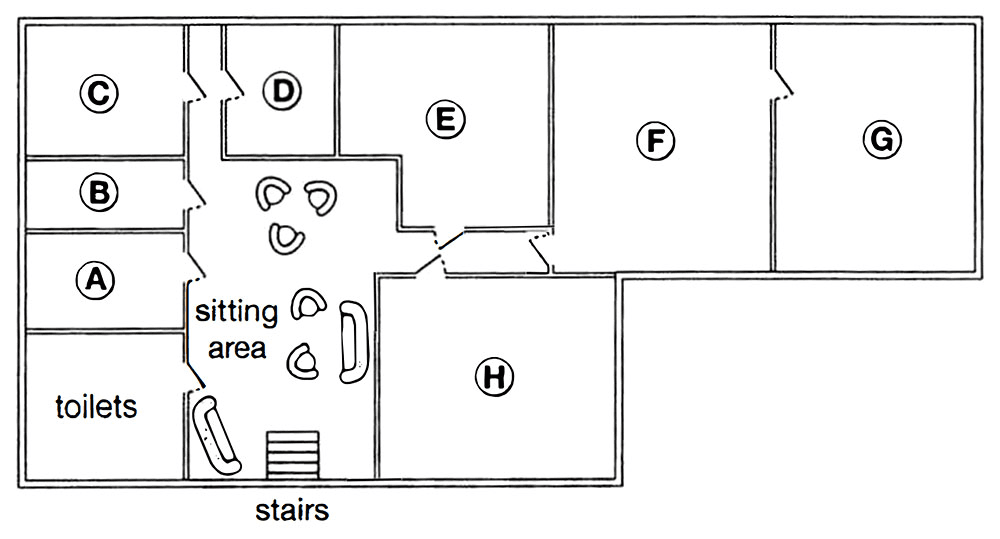
17. restaurant
18. café
19. baby-changing facilities
20. cloakroom
A supervision about a study of musicians' concert dress
Questions 21–22
Questions 21 and 22: Choose TWO letters, A–E. Which TWO characteristics were shared by the subjects of Joanna's psychology study?
21. Characteristic (lower letter)
A They had all won prizes for their music.
B They had all made music recordings.
C They were all under 27 years old.
D They had all toured internationally.
E They all played a string instrument.
22. Characteristic (higher letter)
A They had all won prizes for their music.
B They had all made music recordings.
C They were all under 27 years old.
D They had all toured internationally.
E They all played a string instrument.
Questions 23–24
Questions 23 and 24: Choose TWO letters, A–E. Which TWO points does Joanna make about her use of telephone interviews?
23. Point (lower letter)
A It meant rich data could be collected.
B It allowed the involvement of top performers.
C It led to a stressful atmosphere at times.
D It meant interview times had to be limited.
E It caused some technical problems.
24. Point (higher letter)
A It meant rich data could be collected.
B It allowed the involvement of top performers.
C It led to a stressful atmosphere at times.
D It meant interview times had to be limited.
E It caused some technical problems.
Questions 25–26
Questions 25 and 26: Choose TWO letters, A–E. Which TWO topics did Joanna originally intend to investigate in her research?
25. Topic (lower letter)
A regulations concerning concert dress
B audience reactions to the dress of performers
C changes in performer attitudes to concert dress
D how choice of dress relates to performer roles
E links between musical instrument and dress choice
26. Topic (higher letter)
A regulations concerning concert dress
B audience reactions to the dress of performers
C changes in performer attitudes to concert dress
D how choice of dress relates to performer roles
E links between musical instrument and dress choice
Questions 27–30
Choose the correct letter, A, B or C.
27. Joanna concentrated on women performers because
A women are more influenced by fashion.
B women's dress has led to more controversy.
C women's code of dress is less strict than men's.
28. Mike Frost's article suggests that in popular music, women's dress is affected by
A their wish to be taken seriously.
B their tendency to copy each other.
C their reaction to the masculine nature of the music.
29. What did Joanna's subjects say about the audience at a performance?
A The musicians' choice of clothing is linked to respect for the audience.
B The clothing should not distract the audience from the music.
C The audience should make the effort to dress appropriately.
30. According to the speakers, musicians could learn from sports scientists about
A the importance of clothing for physical freedom.
B the part played by clothing in improving performance.
C the way clothing may protect against physical injury.
A lecture on using soil to reduce carbon dioxide
Questions 31–40
Complete the notes below. Write ONE WORD ONLY for each answer.
The use of soil to reduce carbon dioxide (CO2) in the atmosphere
Rattan Lal:
• Claims that 13% of CO2 in the atmosphere could be absorbed by agricultural soils
• Erosion is more likely in soil that is (31) …………………………
• Lal found soil in Africa that was very (32) …………………………
• It was suggested that carbon from soil was entering the atmosphere
Soil and carbon:
• plants turn CO2 from the air into carbon-based substances such as (33) …………………………
• some CO2 moves from the (34) ………………………… of plants to microbes in the soil
• carbon was lost from the soil when agriculture was invented
Regenerative agriculture:
• uses established practices to make sure soil remains fertile and (35) …………………………
• e.g. through year-round planting and increasing the (36) ………………………… of plants that are grown
California study:
• taking place on a big (37) ………………………… farm
• uses compost made from waste from agriculture and (38) …………………………
Australia study:
• aims to increase soil carbon by using (39) ………………………… that are always green
Future developments may include:
• reducing the amount of fertilizer used in farming
• giving farmers (40) ………………………… for carbon storage, as well as their produce
Answers
1. secondary
2. flute
3. cinema
4. concert
5. market
6. Bythwaite
7. actor
8. A
9. B
10. C
11. E
12. D
13. G
14. B
15. C
16. A
17. F
18. H
19. C
20. B
21. They had all made music recordings.
22. They had all toured internationally.
23. It meant rich data could be collected.
24. It allowed the involvement of top performers.
25. audience reactions to the dress of performers
26. links between musical instrument and dress choice
27. women's code of dress is less strict than men's.
28. their wish to be taken seriously.
29. The musicians' choice of clothing is linked to respect for the audience.
30. the way clothing may protect against physical injury.
31. dry
32. hard
33. sugars
34. roots
35. moist
36. variety
37. cattle
38. gardens
39. grasses
40. payment
Explanations
- 1. secondary
- 'Yes, that's right, the secondary school. Make sure you don't go to the primary school by mistake!'Common trap: The primary school is named in the very next sentence, precisely as the place not to go.
- 2. flute
- 'Doesn't she play the oboe, or flute or something?' — 'Yes the flute.'Common trap: Melanie offers the oboe first in the same breath, and 'symphony orchestras' follows immediately.
- 3. cinema
- 'All the ducks will be launched into the river at the back of the cinema, then they'll float along the river for 500 metres, as far as the railway bridge.'Common trap: The railway bridge closes the sentence as the finishing point, not the start.
- 4. concert
- 'The first duck in each race to arrive at the finishing line wins its owner free tickets for the concert on the last night of the festival.'Common trap: 'Free tickets' and 'the last night' are both easier to catch than the single word naming the event.
- 5. market
- 'They're on sale at a stall in the market. You can't miss it - it's got an enormous sign showing a couple of ducks.'Common trap: 'Stall' comes first and is the more specific noun, but the table asks where the stall is.
- 6. Bythwaite
- 'The show is being held in Bythwaite Hall.' — spelt out as B-Y-T-H-W-A-I-T-E.Common trap: The name comes at the end of a sentence that also gives the price, and the spelling only arrives after Melanie asks.
- 7. actor
- 'The prizes are being given by a famous actor, Kevin Shapless.'Common trap: His name follows immediately and is what Melanie reacts to, while the table needs his profession.
- 8. A
- 'That's aimed at five to ten-year-olds.' — 'So if I take my children, I can expect them to enjoy it more than I do?' — 'I think so.'Common trap: Melanie's own children are five and seven, so the ages are easy to hear as a coincidence rather than the answer.
- 9. B
- 'If you'd like something for yourself and your husband and leave your children with a babysitter … children might find it rather frightening.'Common trap: The historical subject matter sounds educational, which suggests a family audience rather than an adult one.
- 10. C
- 'That's a comedy, and it's for young and old.'Common trap: The title and the word 'comedy' both suggest a children's show, and the drama-festival award closes the item.
- 11. E
- 'This is the gallery that attracts the largest number of visitors, so it's best to go in early in the day, before the crowds arrive.'Common trap: 'Largest' also appears in the box as the largest collection of its kind — here it is the largest crowd, not the largest collection.
- 12. D
- 'Several of the artists each donated one work - to get the museum started, as it were.'Common trap: The museum's founding date opens the sentence, and 'donated' can be heard as a gift from the public rather than from the artists.
- 13. G
- 'A number of the sculptures have been moved to other parts of the museum.'Common trap: The gallery's closure for refurbishment dominates the item, so the relocation is the final clause.
- 14. B
- 'You've probably seen something about it on TV or in the newspapers.'Common trap: 'It's created a great deal of interest' follows and sounds like popularity, which is a different option in the box.
- 15. C
- 'Many of them were discovered by ordinary people digging their gardens and donated to the museum!'Common trap: The collection is called 'focused, specialist' first, which pulls towards the largest-of-its-kind option.
- 16. A
- 'All our porcelain and glass we left to the museum by its founder, when he died in 1878.'Common trap: The rest of the item is about the will forbidding additions, which can read as a relocation or restriction rather than a single donor.
- 17. F
- 'Go straight ahead to the far side of the sitting area, then turn right into the corridor. You'll see the door on the restaurant facing you.'Common trap: The café directions start identically — straight ahead and right into the corridor — and differ only in how far along you go.
- 18. H
- 'Go straight ahead, turn right into the corridor, and the café is immediately on the right.'Common trap: 'Immediately on the right' is the only thing separating it from the restaurant at the far end of the same corridor.
- 19. C
- 'Cross the sitting area, continue straight ahead along the corridor on the left and you and your baby will find the facilities on the left-hand side.'Common trap: This route uses the left-hand corridor, while the two eating places both use the right — easy to conflate under pressure.
- 20. B
- 'It's on the left hand side of the sitting area. It's through the last door before you come to the corridor.'Common trap: The toilets are described next as 'the first rooms on the left', which is the same side of the same area.
- 21. They had all made music recordings.
- 'I wasn't specifically looking for artists who'd produced recordings, but this is something that's just taken for granted these days, and they all had.'Common trap: The prizes and the instruments are both mentioned with quantifiers — 'quite a few', 'there was also' — that fall short of 'all'.
- 22. They had all toured internationally.
- 'They were all very highly regarded in the music world and they'd done quite extensive tours in different continents.'Common trap: The age figures follow — 25 to 29, mean 27.8 — and 27 appears in both the mean and the wrong option.
- 23. It meant rich data could be collected.
- 'I don't think using the phone meant I got less rich data rather the opposite in fact.'Common trap: Stress, recording quality and interview length are all raised in the same stretch, and each is resolved as a non-problem.
- 24. It allowed the involvement of top performers.
- 'I realised if I was going to interview leading musicians it'd only be possible over the phone because they're so busy.'Common trap: 'Because they're so busy' points at time pressure, which is close to the limited-interview-time option.
- 25. audience reactions to the dress of performers
- 'When I started I was more interested in trying to investigate the impact of what was worn on those listening.'Common trap: The role-based focus is described first as what the research became — 'that focus didn't emerge immediately' is the pivot.
- 26. links between musical instrument and dress choice
- 'And also whether someone like a violinist might adopt a different style of clothing from, say, someone playing the flute or the trumpet.'Common trap: The supervisor's next remark about dress being up to the individual introduces the rules option immediately afterwards.
- 27. women's code of dress is less strict than men's.
- 'I think a lot of the men are very much influenced by fashion, but in social terms the choices they have are more limited … quite narrow boundaries.'Common trap: The supervisor's question offers the fashion explanation, and Joanna's reply opens by conceding it before the 'but'.
- 28. their wish to be taken seriously.
- 'A lot of female singers … tend to dress down in performances, and wear less feminine clothes … he suggests this is because otherwise they'd just be discounted as trivial.'Common trap: Joanna's counter — that jeans are simply practical for an energetic concert — follows and is endorsed by the supervisor.
- 29. The musicians' choice of clothing is linked to respect for the audience.
- 'They believed the audience had certain expectations and it was up to them as performers to fulfil these expectations to show a kind of esteem.'Common trap: Joanna's last remark is about audiences dressing up for one another — true in the past, but not what her subjects said.
- 30. the way clothing may protect against physical injury.
- 'Some features of sports clothing could safeguard the players from the potentially dangerous effects of this sort of thing' — intensive, repetitive movements.Common trap: Freedom of movement is named in Joanna's reply as the one thing musicians do consider, which makes it sound like the lesson.
- 31. dry
- 'But erosion can occur if soil is dry, which is a likely effect if it contains inadequate amounts of carbon.'Common trap: The sentence before describes good soil as 'dark, crumbly and fertile', so four adjectives are in play at once.
- 32. hard
- 'Lal was studying soils in Africa so devoid of organic matter that the ground had become extremely hard, like cement.'Common trap: 'Like cement' follows as the simile and is the more vivid phrase, while the answer is the plain adjective before it.
- 33. sugars
- 'Plants absorb CO2 from the air and transform it into sugars and other carbon-based substance.'Common trap: The note reverses the order — the recording names the substance first and the category second.
- 34. roots
- 'Some transfer from the roots to fungi and soil microbes, which store the carbon in the soil.'Common trap: Fungi and microbes follow immediately, and microbes are already printed in the notes.
- 35. moist
- 'This aims to boost the fertility of soil and keep it moist through established practices.'Common trap: 'Fertility' is already printed in the notes and comes first, so the answer is the second half of the aim.
- 36. variety
- 'These include keeping fields planted all year round, and increasing the variety of plants being grown.'Common trap: Year-round planting is already printed in the notes and shares the sentence with the answer.
- 37. cattle
- 'She and her students are testing … on a large cattle farm in the state.'Common trap: The researcher's name and university fill the first half of the sentence, and the answer is one word before 'farm'.
- 38. gardens
- 'The compost that is created from waste - both agricultural, including manure and cornstalks, and waste produced in gardens, such as leaves, branches, and lawn trimmings.'Common trap: Manure, cornstalks, leaves, branches and lawn trimmings are all listed, but the note needs the source category.
- 39. grasses
- 'Jones and 12 farmers are working to build up soil carbon by cultivating grasses that stay green all year round.'Common trap: Composting is named in the very next sentence as the comparison, which is the other study's method.
- 40. payment
- 'Rattan Lal argues that farmers should receive payment not just for the corn or beef they produce but also for the carbon they can store in their soil.'Common trap: Corn and beef are named as the produce, and the note reverses the sentence's order of ideas.
Audio transcripts
Part 1 — A call to the Stretton Festival box office
ROB: Good morning. Stretton Festival box office. How can I help you? MELANIE: Oh, hello. My family and I are on holiday on the area, and we’ve seen some posters about the festival this week. Could you tell me about some of the events, please? ROB: Of course. MELANIE: First of all, are there still tickets available for the jazz band on Saturday? ROB: There are, but only £18. The £12 seats have all been sold. MELANIE: OK. And the venue is the school, isn’t it? ROB: Yes, that’s right, the secondary school. Make sure you don’t go to the primary school by mistake! And there’s an additional performer who isn’t mentioned on the posters - Carolyn Hart is going to play with the band. MELANIE: Oh, I think I’ve heard her on the radio. Doesn’t she play the oboe, or flute or something? ROB: Yes the flute. She usually plays with symphony orchestras, and apparently this is her first time with a jazz band. MELANIE: Well, I’d certainly like to hear her. Then the next thing I want to ask about is the duck races - I saw a poster beside a river. What are they, exactly? ROB: Well, you buy a yellow plastic duck - or as many as you like - they’re a pound each. And you write your name on each one. There’ll be several races, depending on the number of ducks taking part. And John Stevens, a champion swimmer who lives locally, is going to start the races. All the ducks will be launched into the river at the back of the cinema, then they’ll float along the river for 500 metres, as far as the railway bridge. MELANIE: And are there any prizes? ROB: Yes, the first duck in each race to arrive at the finishing line wins its owner free tickets for the concert on the last night of the festival. MELANIE: You said you can buy a duck? I’m sure my children will both want one. ROB: They’re on sale at a stall in the market. You can’t miss it - it’s got an enormous sign showing a couple of ducks. MELANIE: OK. I’ll go there this afternoon. I remember walking past there yesterday. Now could you tell me something about the flower show, please? ROB: Well, admission is free, and the show is being held in Bythwaite Hall. MELANIE: Sorry, how do you spell that? ROB: B-Y-T-H-W-A-I-T-E. Bythwaite. MELANIE: Is it easy to find? I’m no very familiar with the town yet. ROB: Oh, you won’t have any problem. It’s right in the centre of Stretton. It’s the only old building in the town, so it’s easy to recognise. MELANIE: I know it. I presume it’s open all day. ROB: Yes, but if you’d like to see the prizes being awarded for the best flowers, you’ll need to be there at 5 o’clock. The prizes are being given by a famous actor, Kevin Shapless. He lives nearby and gets involved in a lot of community events. MELANIE: Gosh, I’ve seen him on TV. I’ll definitely go to the prize-giving. ROB: Right. MELANIE: I’ve seen a list of plays that are being performed this week, and I’d like to know which are suitable for my children, and which ones my husband and I might go to. ROB: How old are your children? MELANIE: Five and seven. What about ‘The Mystery of Muldoon’? ROB: That’s aimed at five to ten-year-olds. MELANIE: So if I take my children, I can expect them to enjoy it more than I do? ROB: I think so. If you’d like something for yourself and your husband and leave your children with a babysitter, you might like to see ‘Fire and Flood’ - it’s about events that really happened in Stretton two hundred years ago, and children might find it rather frightening. MELANIE: Oh, thanks for the warning. And finally, what about ‘Silly Sailor’? ROB: That’s a comedy, and it’s for young and old. In fact, it won an award in the Stretton Drama Festival a couple of months ago. MELANIE: OK. Well, goodbye, and thanks for all the information. I’m looking forward to the festival! ROB: Goodbye.
Part 2 — An introduction to a museum's collections
Good morning, and welcome to the museum - one with a remarkable range of exhibits, which I’m sure you’ll enjoy. My name’s Greg, and I’ll tell you about the various collections as we go round. But before we go, let me just give you a taste of what we have here. Well, for one thing, we have a fine collection of twentieth and twenty-first century paintings, many by very well-known artists. I’m sure you’ll recognise several of the paintings. This is the gallery that attracts the largest number of visitors, so it’s best to go in early in the day, before the crowds arrive. The there are the nineteenth-century paintings. The museum was opened in the middle of that century, and several of the artists each donated one work - to get the museum started, as it were. So they’re of special interest to us - we feel closer to them than to other works. The sculpture gallery has a number of fine exhibits, but I’m afraid it’s currently closed for refurbishment. You’ll need to come back next year to see it properly, but a number of the sculptures have been moved to other parts of the museum. ‘Around the world’ is a temporary exhibition - you’ve probably seen something about it on TV or in the newspapers. It’s created a great deal of interest, because it presents objects from every continent and many countries, and provides information about their social context - why they were made, who for, and so on. Then there’s the collection of coins. This is what you might call a focused, specialist collection, because all the coins come from this country, and were produced between two thousand and a thousand years ago. And many of them were discovered by ordinary people digging their gardens and donated to the museum! All our porcelain and glass we left to the museum by its founder, when he died in 1878. And in the terms of his will, we’re not allowed to add anything to that collection: he believed it was perfect in itself, and we don’t see any reason to disagree! OK, that was something about the collections, and now here’s some more practical information, in case you need it. Most of the museum facilities are downstairs, in the basement, so you go down the stairs here. When you reach the bottom of the stairs, you’ll find yourself in a sitting area, with comfortable chairs and sofas where you can have a rest before continuing your exploration of the museum. We have a very good restaurant, which serves excellent food all day, in a relaxing atmosphere. To reach it, when you get to the bottom of the stairs, go straight ahead to the far side of the sitting area, then turn right into the corridor. You’ll see the door on the restaurant facing you. If you just want a snack, or if you’d like to eat somewhere with facilities for children, we also have a café. When you reach the bottom of the stairs, you’ll need to go straight ahead, turn right into the corridor, and the café is immediately on the right. And talking about children, there are baby-changing facilities downstairs: cross the sitting area, continue straight ahead along the corridor on the left and you and your body will find the facilities on the left-hand side. The cloakroom where you should leave coats, umbrella and any large bags, is on the left hand side of the sitting area. It’s through the last door before you come to the corridor. There are toilets on every floor, but in the basement they’re the first rooms on the left when you get down there. OK, now if you’ve got anything to leave in the cloakroom, please do that now, and then we’ll start our tour.
Part 3 — A supervision about a study of musicians' concert dress
SUPERVISOR: Hi, Joanna, good to meet you. Now, before we discuss your new research project. I’d like to hear something about the psychology study you did last year for your Master’s degree. So how did you choose your subjects for that? JOANNA: Well, I had six subjects, all professional musicians, and all female. There were violinists and there was also a cello player and a pianist and a flute player. They were all very highly regarded in the music world and they’d done quite extensive tours in different continents, and quite a few had won prizes and competitions as well. SUPERVISOR: And they were quite young, weren’t they? JOANNA: Yes, between 25 and 29 - the mean was 27.8. I wasn’t specifically look for artists who’d produced recordings, but this is something that’s just taken for granted these days, and they all had. SUPERVISOR: Right. Now you collected your data through telephone interviews, didn’t you? JOANNA: Yes. I realised if I was going to interview leading musicians it’s only be possible over the phone because they’re so busy. I recorded them using a telephone recording adaptor. I’d been worried about the quality, but it worked out all right. I managed at least a 30-minute interview with each subject, sometimes longer. SUPERVISOR: Did doing it on the phone make it more stressful? JOANNA: I’d thought it might … it was all quite informal though and in fact they seemed very keen to talk. And I don’t think using the phone meant I got less rich data rather the opposite in fact. SUPERVISOR: Interesting. And you were looking at how performers dress for concert performances? JOANNA: That’s right. My research investigated the way players see their role as a musician and how this is linked to the type of clothing they decide to wear. But that focus didn’t emerge immediately. When I started I was more interested in trying to investigate the impact of what was worn on those listening, and also whether someone like a violinist might adopt a different style of clothing from, say, someone playing the flute or the trumpet. SUPERVISOR: It’s interesting that the choice of dress is up to the individual, isn’t it? JOANNA: Yes, you’d expect there to be rules about it in orchestras, but that’s quite rare. SUPERVISOR: You only had women performers in your study. Was that because male musicians are less worried about fashion? JOANNA: I think a lot of the men are very much influenced by fashion, but in social terms the choices they have are more limited … they’d really upset audiences if they strayed away from quite narrow boundaries. SUPERVISOR: Hmm. Now, popular music has quite different expectations. Did you read Mike Frost’s article about the dress of women performers in popular music? JOANNA: No. SUPERVISOR: He points out that a lot of female singers and musicians in popular music tend to dress down in performances, and wear less feminine clothes, like jeans instead of skirts, and he suggests this is because otherwise they’d just be discounted as trivial. JOANNA: But you could argue they’re just wearing what’s practical … I mean, a pop-music concert is usually a pretty energetic affair. SUPERVISOR: Yes, he doesn’t make that point, but I think you’re probably right. I was interested by the effect of the audience at a musical performance when it came to the choice of dress. JOANNA: The subjects I interviewed felt this was really important. It’s all to do with what we understand by performance as a public event. They believed the audience had certain expectations and it was up to them as performers to fulfil these expectations to show a kind of esteem … SUPERVISOR: … they weren’t afraid of looking as if they’d made an effort to look good. JOANNA: Mmm. I think in the past the audience would have had those expectation of one another too, but that’s not really the case now, not in the UK anyway. SUPERVISOR: No. JOANNA: And I also got interested in what sports scientists are doing too, with regard to clothing. SUPERVISOR: Musicians are quite vulnerable physically, aren’t they, because the movements they carry out are very intensive and repetitive, so I’d imagine some features of sports clothing could safeguard the players from the potentially dangerous effects of this sort of thing. JOANNA: Yes, but musicians don’t really consider it. They avoid clothing that obviously restricts their movements, but that’s as far as they go. SUPERVISOR: Anyway, coming back to your own research, do you have any idea where you’re going from here? JOANNA: I was thinking of doing a study using an audience, including ..
Part 4 — A lecture on using soil to reduce carbon dioxide
As we saw in the last lecture, a major cause of climate change is the rapid rise in the level of carbon dioxide in the atmosphere over the last century. If we could reduce the amount of CO2, perhaps the rate of climate change could also be slowed down. One potential method involves enhancing the role of the soil that plants grow in, with regard to absorbing CO2. Rattan Lal, a soil scientist from Ohio Stage University, in the USA, claims that the world’s agricultural soils could potentially absorb 13 per cent of the carbon dioxide in the atmosphere - the equivalent of the amount released in the last 3o years. And research is going on into how this might be achieved. Lal first came to the idea that soil might be valuable in this way not through an interest in climate change, but rather out of concern for the land itself and the people dependent on it. Carbon-rich soil is dark, crumbly and fertile, and retains some water. But erosion can occur if soil is dry, which is a likely effect if it contains inadequate amounts of carbon. Erosion is of course bad for people trying to grow crops or breed animals on that terrain. In the 1970s and ‘80s, Lal was studying soils in Africa so devoid of organic matter that the ground had become extremely hard, like cement. There he met a pioneer in the study of global warming, who suggested that carbon from the soil had moved into the atmosphere. This is now looking increasingly likely. Let me explain. For millions of years, carbon dioxide levels in the atmosphere have been regulated, in part, by a natural partnership between plants and microbes - tiny organisms in the soil. Plants absorb CO2 from the air and transform it into sugars and other carbon-based substance. While a proportion of these carbon products remain in the plant, some transfer from the roots to fungi and soil microbes, which store the carbon in the soil. The invention of agriculture some 10,000 years ago disrupted these ancient soil-building processes and led to the loss of carbon from the soil. When humans started draining the natural topsoil, and ploughing it up for planting, they exposed the buried carbon to oxygen. This created carbon dioxide and released it into the air. And in some places, grazing by domesticated animals has removed all vegetation, releasing carbon into the air. Tons of carbon have been stripped from the world’s soils - where it’s needed - and pumped into the atmosphere. So what can be done? Researchers are now coming up with evidence that even modest changes to farming can significantly help to reduce the amount of carbon in the atmosphere. Some growers have already started using an approach known as regenerative agriculture. This aims to boost the fertility of soil and keep it moist through established practices. These include keeping fields planted all year round, and increasing the variety of plants being grown. Strategies like these can significantly increase the amount of carbon stored in the soil, so agricultural researchers are now building a case for their use in combating climate change. One American investigation into the potential for storing CO2 on agricultural lands is taking place in California. Soil scientist Whendee Silver of the University of California, Berkeley, is conducting a first-of-its-kind study on a large cattle farm in the state. She and her students are testing the effects on carbon storage of the compost that is created from waste - both agricultural, including manure and cornstalks, and waste produced in gardens, such as leaves, branches, and lawn trimmings. In Australia, soil ecologist Christine Jones is testing another promising soil-enrichment strategy. Jones and 12 farmers are working to build up soil carbon by cultivating grasses that stay green all year round. Like composting, the approach has already been proved experimentally; Jones now hopes to show that it can be applied on working farms and that the resulting carbon capture can be accurately measured. It’s hoped in the future that projects such as these will demonstrate the role that farmers and other land managers can play in reducing the harmful effects of greenhouse gases. For example, in countries like the United States, where most farming operations use large applications of fertiliser, changing such long-standing habits will require a change of system. Rattan Lal argues that farmers should receive payment not just for the corn or beef they produce but also for the carbon they can store in their soil. Another study being carried out …
Comments
Loading comments…