

Recent Actual Tests Academic Reading Test 54
3 passages · 40 questions · 60 minutes
Wildfires
[A] Wildfires are usually the product of human negligence. Humans start about 90% of wild fires and lightning causes the other 10%. Regular causes for wildfires include arson, camping fires, throwing away cigarettes, burning rubbish, and playing with fireworks or matches. Once begun, wildfires can spread at a rate of up to 23 kph and, as a fire spreads over a landscape, it could undertake a life of its own – doing different things to keep itself going, even creating other blazes by throwing cinders miles away.
Three components are necessary to start a fire: oxygen, fuel and heat. These three make up “the fire triangle” and fire fighters frequently talk about this when they are attempting to put out blazes. The theory is that if the fire fighters can remove one of the triangle pillars, they can take control of and eventually put out the fire.
[B] The speed at which wildfires spread depends on the fuel around them. Fuel is any living or dead material that will burn. Types of fuel include anything from trees, underbrush and grassland to houses. The quantity of inflammable material around a fire is known as “the fuel load” and is determined by the amount of available fuel per unit area, usually tons per acre. How dry the fuel is can also influence how fires behave. When the fuel is very dry, it burns much more quickly and forms fires that are much harder to control.
Basic fuel characteristics affecting a fire are size and shape, arrangement and moisture, but with wildfires, where fuel usually consists of the same type of material, the main factor influencing ignition time is the ratio of the fuel’s total surface area to its volume. Because the surface area of a twig is not much bigger than its volume, it ignites rapidly. However, a tree’s surface area is much smaller than its volume, so it requires more time to heat up before ignition.
[C] Three weather variables that affect wildfires are temperature, wind and moisture. Temperature directly influences the sparking of wildfires, as heat is one of the three pillars of the fire triangle. Sticks, trees and underbrush on the ground receive heat from the sun, which heats and dries these potential fuels. Higher temperatures allow fuels to ignite and burn more quickly and add to the speed of a wildfire’s spread. Consequently, wildfires tend to rage in the afternoon, during the hottest temperatures.
The biggest influence on a wildfire is probably wind and this is also the most unpredictable variable. Winds provide fires with extra oxygen, more dry fuel, and wind also makes wildfires spread more quickly. Fires also create winds of their own that can be up to ten times faster than the ambient wind. Winds can even spread embers that can generate additional fires, an event known as spotting. Winds also change the course of fires, and gusts can take flames into trees, starting a “crown fire”. Humidity and precipitation provide moisture that can slow fires down and reduce their intensity, as it is hard for fuel to ignite if it has high moisture levels. Higher levels of humidity mean fewer wildfires.
[D] Topography can also hugely influence wildfire behaviour. In contrast to fuel and weather, topography hardly changes over time and can help or hamper the spread of a wildfire. The principal topographical factor relating to wildfires is slope. As a rule, fires move uphill much faster than downhill and the steeper the slope, the quicker fires move. This is because fires move in the same direction of the ambient wind, which generally blows uphill. Moreover, the fire can preheat fuel further uphill as smoke and heat rise in that direction. On the other hand, when the fire reaches the top of a hill, it has to struggle to come back down.
[E] Each year thousands of fire fighters risk their lives in their jobs. Elite fire fighters come in two categories: Hotshots and Smokejumpers. Operating in 20 man units, the key task of hotshots is to construct firebreaks around fires. A firebreak is a strip of land with all potential fuel removed. As their name suggests, smokejumpers jump out of aircraft to reach smaller fires situated in inaccessible regions. They attempt to contain these smaller fires before they turn into bigger ones.
As well as constructing firebreaks and putting water and fire retardant on fires, fire fighters also use “backfires”. Backfires are created by fire fighters and burn towards the main fire incinerating any potential fuel in its path. Fire fighters on the ground also receive extensive support from the air with tankers dropping thousands of gallons of water and retardant. Dropped from planes and helicopters, retardant is a red chemical containing phosphate fertilizer, which slows and cools fires.
Questions 1–4
Choose the correct heading for each paragraph from the list of headings below.
List of Headings:
i. Climate Conditions
ii. Solutions from the Air
iii. Fire Starters
iv. Battling the Blaze
v. The Lie of the Land
vi. Rain – The Natural Saviour
vii. Fuelling the Flames
viii. Fires and Trees
1. Paragraph B:
2. Paragraph C:
3. Paragraph D:
4. Paragraph E:
Question 5
Using NO MORE THAN THREE WORDS from Reading Passage 1, answer the following questions.
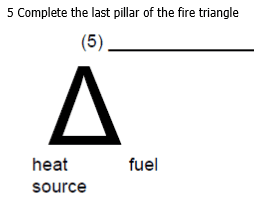
Complete the last pillar of the fire triangle: (5) …………………………
Questions 6–9
Using NO MORE THAN THREE WORDS from Reading Passage 1, answer the following questions.
6. What is measured in tons per acre?
7. When do wildfires burn at their fiercest?
8. What can travel in the wind to create fires at some distance from the initial fire?
9. Name a method using an additional fire that fire fighters use to control wild fires.
Questions 10–13
Complete each of the following statements with words taken from Reading Passage 1. Write NO MORE THAN THREE WORDS for each answer.
10. The most important factor in how quickly a wildfire catches fire is the surface to volume ………………………….
11. The most significant weather factor to affect wildfires’ actions is ………………………….
12. Fires on the tops of trees are known as ………………………….
13. Wildfires usually travel much faster ………………………… because of the typical direction of prevailing winds.
Problems with Water
Nearly half the world’s population will experience critical water shortages by 2025, according to the United Nations (UN). Wars over access to water are a rising possibility in this century and the main conflicts in Africa during the next 25 years could be over this most precious of commodities, as countries fight for access to scarce resources. “Potential water wars are likely in areas where rivers and lakes are shared by more than one country,” says Mark Evans a UN worker. Evans predicts that “population growth and economic development will lead to nearly one in two people in Africa living in countries facing water scarcity or what is known as ‘water stress’ within 25 years.” Water scarcity is defined as less than 1,000 cubic metres of water available per person per year, while water stress means less than 1,500 cubic metres of water is available per person per year. The report says that by 2025, 12 more African countries will join the 13 that already suffer from water stress or water scarcity. What makes the water issue even more urgent is that demand for water will grow increasingly fast as larger areas are placed under crops and economic development. Evans adds that “the strong possibility that the world is experiencing climate change also adds to this urgency.”
How to deal with water shortages is in the forefront of the battle between environmental activists on the one hand and governments and construction firms on the other. At the recent World Summit on Sustainable Development in Johannesburg activists continued their campaign to halt dam construction, while many governments were outraged about a vocal minority thwarting their plans.
One of the UN’s eight millennium development goals is to halve the proportion of people without “sustainable” access to safe drinking water by 2015. How to ensure this happens was one of the big issues of the summit. Much of the text on this was already agreed, but one of the unresolved issues in the implementation plan was whether the goal on water would be extended to cover sanitation. The risks posed by water-borne diseases in the absence of sanitation facilities means the two goals are closely related. Only US negotiators have been resisting the extension of goals to include sanitation due to the financial commitment this would entail. However, Evans says the US is about to agree to this extension. This agreement could give the UN a chance to show that in one key area the world development agenda was advanced in Johannesburg.
But the UN has said Johannesburg was not about words alone, but implementation. A number of projects and funding initiatives were unveiled at the summit. But implementation is always harder, as South Africa has experienced in its water programme. Graham Bennetts, a water official in the South African government explains: “Since the 1994 elections government has provided easy access to water to 7 million people, but extending this to a further 7 million and ensuring this progress is sustainable is one of South Africa’s foremost implementation challenges.” In South Africa, access to water is defined as 25 litres a person daily, within a distance of 200m from where they live. “Although South Africa’s feat far exceeds the UN millennium goal on water supply, severe constraints on local government capacity make a more rapid expansion difficult,” says Bennetts.
For some of those who have only recently been given ready access to water, their gains are under threat as the number of cut-offs by municipalities for non-payment rise, says Liane Greef of the Environmental Monitoring Group. Greef is programme manager for Water Justice in southern Africa. Those who have their water supply cut off also automatically forfeit their right to 6000 free litres of water for a family a month under South Africa’s “water for all” policy. In the face of continued increases in unemployment, payment for water and other utilities has the potential to fast undo government’s high profile feats in delivery since 1994.
It is also the way of ensuring sufficient water supply and its management that will increasingly become a political battleground in South Africa. Water Affairs director-general Mike Muller says South Africa is near the end of its dam-building programme. However, there are big projects proposed elsewhere in southern Africa that could possibly be halted by activists who could bring pressure on funding agencies such as the World Bank. Greef says her group will campaign during the summit against the proposed Skuifraam Dam, which would be built near Franschhoek to supply additional water to Cape Town.
Rather than rely on new dam construction, the city should ensure that water is used wisely at all times rather than only in dry spells, Greef says. Another battleground for her group is over the privatisation of water supply, she says. Water supply, she insists, is best handled in the public interest by accountable government.
There is increasing hope from advances in technology to deal with water shortages. It is agricultural production which takes up about 90% of water consumed for human purposes, says the UN. To lower agricultural demand for water the Sri Lanka-based International Water Management Institute is researching ways of obtaining “more crop per drop” through the development of drought resistant crops, as well as through better water management techniques. One of the institute’s research sites is the Limpopo River basin. According to the institute’s director-general, Frank Rijsbereman, rice growers in China use a quarter of the water a ton of produce to those in South Africa. The institute hopes the “green revolution” in crop productivity will soon be matched by the “blue revolution” in improving water utilisation in agriculture.
Questions 14–21
Match the views with the people listed below.
People
A Mike Muller (MM)
B Frank Rijsbereman (FR)
C Mark Evans (ME)
D Liane Greef (LG)
E Graham Bennetts (GB)
14. Water needs to be utilised more prudently by some people.
15. South Africa has almost completed its plans for building dams.
16. Local government has excluded some South African households from getting free water for not meeting their bills.
17. The World Summit in Johannesburg will soon have its aims on hygiene agreed among all participants.
18. Faster development of water supply in South Africa is limited by the facilities of community administrations.
19. Water use is more efficient than in South Africa in some foreign food production.
20. Government should be answerable for water delivery and not private companies.
21. The water question’s importance has been increased due to the risk of global weather temperature rises.
Questions 22–27
Do the following statements agree with the information given in the passage?
TRUEif the statement agrees with the information
FALSEif the statement contradicts the information
NOT GIVENif there is no information on this
22. Some African countries are currently at war over water resources.
23. A recent report says by 2025 that 25 African countries will suffer from water scarcity alone.
24. Vocal environment activists were arrested at the World Summit.
25. Questions at the World Summit over including water sanitation have not yet been agreed.
26. The World Summit had many good ideas but had little contribution on how to put the ideas into practice.
27. Plants are being introduced that can flourish with little water.
The History of Papermaking in the United Kingdom
The first reference to a paper mill in the United Kingdom was in a book printed by Wynken de Worde in about 1495. This mill belonged to a certain John Tate and was near Hertford. Other early mills included one at Dartford, owned by Sir John Speilman, who was granted special privileges for the collection of rags by Queen Elizabeth and one built in Buckinghamshire before the end of the sixteenth century. During the first half of the seventeenth century, mills were established near Edinburgh, at Cannock Chase in Staffordshire, and several in Buckinghamshire, Oxfordshire and Surrey. The Bank of England has been issuing bank notes since 1694, with simple watermarks in them since at least 1697. Henri de Portal was awarded the contract in December 1724 for producing the Bank of England watermarked bank-note paper at Bere Mill in Hampshire. Portals have retained this contract ever since but production is no longer at Bere Mill.
There were two major developments at about the middle of the eighteenth century in the paper industry in the UK. The first was the introduction of the rag engine or hollander, invented in Holland sometime before 1670, which replaced the stamping mills, which had previously been used, for the disintegration of the rags and beating of the pulp. The second was in the design and construction of the mould used for forming the sheet. Early moulds had straight wires sewn down on to the wooden foundation, this produced an irregular surface showing the characteristic “laid” marks, and, when printed on, the ink did not give clear, sharp lines. Baskerville, a Birmingham printer, wanted a smoother paper. James Whatman the Elder developed a woven wire fabric, thus leading to his production of the first woven paper in 1757.
Increasing demands for more paper during the late eighteenth and early nineteenth centuries led to shortages of the rags needed to produce the paper. Part of the problem was that no satisfactory method of bleaching pulp had yet been devised, and so only white rags could be used to produce white paper. Chlorine bleaching was being used by the end of the eighteenth century, but excessive use produced papers that were of poor quality and deteriorated quickly. By 1800 up to 24 million pounds of rags were being used annually, to produce 10,000 tons of paper in England and Wales, and 1000 tons in Scotland, the home market being supplemented by imports, mainly from the continent. Experiments in using other materials, such as sawdust, rye straw, cabbage stumps and spruce wood had been conducted in 1765 by Jacob Christian Schaffer. Similarly, Matthias Koops carried out many experiments on straw and other materials at the Neckinger Mill, Bermondsey around 1800, but it was not until the middle of the nineteenth century that pulp produced using straw or wood was utilised in the production of paper.
By 1800 there were 430 (564 in 1821) paper mills in England and Wales (mostly single vat mills), under 50 (74 in 1823) in Scotland and 60 in Ireland, but all the production was by hand and the output was low. The first attempt at a paper machine to mechanise the process was patented in 1799 by Frenchman Nicholas Louis Robert, but it was not a success. However, the drawings were brought to England by John Gamble in 1801 and passed on to the brothers Henry and Sealy Fourdrinier, who financed the engineer Henry Donkin to build the machine. The first successful machine was installed at Frogmore, Hertfordshire, in 1803. The paper was pressed onto an endless wire cloth, transferred to a continuous felt blanket and then pressed again. Finally it was cut off the reel into sheets and loft dried in the same way as hand made paper. In 1809 John Dickinson patented a machine that that used a wire cloth covered cylinder revolving in a pulp suspension, the water being removed through the centre of the cylinder and the layer of pulp removed from the surface by a felt covered roller (later replaced by a continuous felt passing round a roller). This machine was the forerunner of the present day cylinder mould or vat machine, used mainly for the production of boards. Both these machines produced paper as a wet sheet, which require drying after removal from the machine, but in 1821 T B Crompton patented a method of drying the paper continuously, using a woven fabric to hold the sheet against steam heated drying cylinders. After it had been pressed, the paper was cut into sheets by a cutter fixed at the end of the last cylinder.
By the middle of the nineteenth century the pattern for the mechanised production of paper had been set. Subsequent developments concentrated on increasing the size and production of the machines. Similarly, developments in alternative pulps to rags, mainly wood and esparto grass, enabled production increases. Conversely, despite the increase in paper production, there was a decrease, by 1884, in the number of paper mills in England and Wales to 250 and in Ireland to 14 (Scotland increased to 60), production being concentrated into fewer, larger units. Geographical changes also took place as many of the early mills were small and had been situated in rural areas. The change was to larger mills in, or near, urban areas closer to suppliers of the raw materials (esparto mills were generally situated near a port as the raw material was brought in by ship) and the paper markets.
Questions 28–34
Do the following statements agree with the views of the writer?
YESif the statement agrees with the views of the writer
NOif the statement contradicts the views of the writer
NOT GIVENif it is impossible to say what the writer thinks about this
28. The printing of paper money in the UK has always been done by the same company.
29. Early paper making in Europe was at its peak in Holland in the 18th century.
30. 18th Century developments in moulds led to the improvement of a flatter, more even paper.
31. Chlorine bleaching proved the answer to the need for more white paper in the 18th and 19th centuries.
32. The first mechanised process that had any success still used elements of the hand made paper-making process.
33. Modern paper making machines are still based on John Dickinson’s 1809 patent.
34. The development of bigger mills near larger towns was so that mill owners could take advantage of potential larger workforces.
Questions 35–40
Match the events with the dates listed below.
Dates
A 1803
B 1757
C 1821
D 1697
E 1799
F 1670
G 1694
35. Invention of the rag engine.
36. A new method for drying paper patented.
37. First successful machine for making paper put into production.
38. Manufacture of the first woven paper.
39. Watermarks first used for paper money.
40. The first machine for making paper patented.
Answers
1. vii
2. i
3. v
4. iv
5. air/oxygen
6. fuel load
7. in the afternoon
8. embers
9. backfire
10. ratio
11. the wind
12. crown fires
13. uphill
14. D
15. A
16. D
17. C
18. E
19. B
20. D
21. C
22. Not Given
23. False
24. Not Given
25. True
26. Not Given
27. True
28. Yes
29. Not Given
30. Yes
31. No
32. Yes
33. Yes
34. No
35. F
36. C
37. A
38. B
39. D
40. E
Explanations
- 1. vii
- Paragraph B discusses fuel and its role in feeding fires.Common trap: Distractor i ("Climate Conditions") belongs to Paragraph C, about weather rather than fuel.
- 2. i
- Paragraph C discusses weather/climate factors affecting wildfires.Common trap: Distractor vi ("Rain – The Natural Saviour") covers only part of this paragraph's content (moisture), not the whole climate discussion.
- 3. v
- Paragraph D discusses topography/landscape (slope) and its effect on fire spread.Common trap: Distractor viii ("Fires and Trees") is not this paragraph's main idea, which is about land shape, not trees specifically.
- 4. iv
- Paragraph E describes fire-fighting methods and personnel — battling the blaze.Common trap: Distractor ii ("Solutions from the Air") covers only part of this paragraph (smokejumpers/air support), not its full scope.
- 5. air/oxygen
- The passage states "Three components are necessary to start a fire: oxygen, fuel and heat." The diagram already labels "heat source" and "fuel", so the missing third pillar is oxygen/air.Common trap: None significant — directly stated in the passage.
- 6. fuel load
- The passage states fuel load is measured in tons per acre.Common trap: None significant — directly stated in the passage.
- 7. in the afternoon
- The passage states wildfires rage fiercest in the afternoon, the hottest part of the day.Common trap: None significant — directly stated in the passage.
- 8. embers
- The passage states wind-carried embers can generate additional, distant fires.Common trap: None significant — directly stated in the passage.
- 9. backfire
- The passage names backfires as a fire-fighting method that uses an additional, controlled fire.Common trap: None significant — directly stated in the passage.
- 10. ratio
- The passage names the surface-area-to-volume ratio as the main factor influencing ignition time.Common trap: None significant — directly stated in the passage.
- 11. the wind
- The passage states wind is probably the biggest influence on a wildfire.Common trap: None significant — directly stated in the passage.
- 12. crown fires
- The passage names fires that spread into treetops as "crown fires".Common trap: None significant — directly stated in the passage.
- 13. uphill
- The passage states fires move uphill faster because prevailing winds generally blow uphill.Common trap: None significant — directly stated in the passage.
- 14. D
- Greef states water should be used wisely at all times, not just in dry spells.Common trap: Multiple-speaker trap — several speakers discuss overlapping themes (dams, water access, accountability), so the exact wording of each quote must be matched to its speaker.
- 15. A
- Muller states South Africa is near the end of its dam-building programme.Common trap: Multiple-speaker trap — several speakers discuss overlapping themes (dams, water access, accountability), so the exact wording of each quote must be matched to its speaker.
- 16. D
- Greef (discussing water cut-offs for non-payment) notes that cut-off households also lose their free water allowance.Common trap: Multiple-speaker trap — several speakers discuss overlapping themes (dams, water access, accountability), so the exact wording of each quote must be matched to its speaker.
- 17. C
- Evans states the US (the last holdout) is about to agree to extending the summit's goals to include sanitation.Common trap: Multiple-speaker trap — several speakers discuss overlapping themes (dams, water access, accountability), so the exact wording of each quote must be matched to its speaker.
- 18. E
- Bennetts states local government capacity constraints limit faster water supply expansion.Common trap: Multiple-speaker trap — several speakers discuss overlapping themes (dams, water access, accountability), so the exact wording of each quote must be matched to its speaker.
- 19. B
- Rijsbereman compares Chinese rice growers' more efficient water use to South Africa's.Common trap: Multiple-speaker trap — several speakers discuss overlapping themes (dams, water access, accountability), so the exact wording of each quote must be matched to its speaker.
- 20. D
- Greef insists water supply is best handled by accountable government, not private companies.Common trap: Multiple-speaker trap — several speakers discuss overlapping themes (dams, water access, accountability), so the exact wording of each quote must be matched to its speaker.
- 21. C
- Evans states climate change adds urgency to the water issue.Common trap: Multiple-speaker trap — several speakers discuss overlapping themes (dams, water access, accountability), so the exact wording of each quote must be matched to its speaker.
- 22. Not Given
- The passage discusses water wars only as a future possibility, never stating that any war is currently happening.Common trap: Unsupported-inference trap — a related detail is mentioned but not the exact claim.
- 23. False
- The passage's 25 countries (13+12) suffer from water stress OR scarcity combined, not scarcity alone.Common trap: None significant — directly supported by the passage.
- 24. Not Given
- The passage describes activists campaigning and governments being outraged, but never mentions any arrests.Common trap: Unsupported-inference trap — the passage does not mention this at all.
- 25. True
- The passage confirms the sanitation extension was still unresolved at the time of writing.Common trap: None significant — directly supported by the passage.
- 26. Not Given
- The passage states implementation projects were unveiled, but never evaluates whether the summit's practical contribution was "little".Common trap: Unsupported-inference trap — a related detail is mentioned but not the exact claim.
- 27. True
- The passage confirms drought-resistant crops (able to flourish with little water) are being developed.Common trap: None significant — directly supported by the passage.
- 28. Yes
- The passage states Portals has retained the Bank of England banknote-paper contract ever since 1724.Common trap: None significant — directly supported by the passage.
- 29. Not Given
- The passage mentions the rag engine being invented in Holland before 1670, but never discusses Holland's papermaking being at a "peak" in the 18th century.Common trap: Unsupported-inference trap — the passage does not discuss this at all.
- 30. Yes
- The new woven-wire mould design produced smoother (flatter, more even) paper than the old "laid" mark moulds.Common trap: None significant — directly supported by the passage.
- 31. No
- Excessive chlorine bleaching caused poor-quality, quickly deteriorating paper, meaning it was not a complete solution.Common trap: None significant — directly supported by the passage.
- 32. Yes
- The first successful mechanised process (the 1803 Fourdrinier machine) still finished paper the same way hand-made paper was dried.Common trap: None significant — directly supported by the passage.
- 33. Yes
- The passage states Dickinson's 1809 machine was the forerunner of today's cylinder mould/vat machines.Common trap: None significant — directly supported by the passage.
- 34. No
- The passage attributes the move to urban areas to proximity to raw materials and markets, not to workforce availability.Common trap: None significant — directly supported by the passage.
- 35. F
- The rag engine was invented in Holland before 1670.Common trap: Near-date trap — several events happened within a few years of each other (1694/1697, 1799/1803/1821), so the exact date attributed to each must be matched carefully.
- 36. C
- Crompton patented a continuous paper-drying method in 1821.Common trap: Near-date trap — several events happened within a few years of each other (1694/1697, 1799/1803/1821), so the exact date attributed to each must be matched carefully.
- 37. A
- The first successful papermaking machine was installed in 1803.Common trap: Near-date trap — several events happened within a few years of each other (1694/1697, 1799/1803/1821), so the exact date attributed to each must be matched carefully.
- 38. B
- The first woven paper was produced in 1757.Common trap: Near-date trap — several events happened within a few years of each other (1694/1697, 1799/1803/1821), so the exact date attributed to each must be matched carefully.
- 39. D
- Watermarks were used in banknotes from at least 1697, distinct from banknotes first being issued in 1694.Common trap: Near-date trap — several events happened within a few years of each other (1694/1697, 1799/1803/1821), so the exact date attributed to each must be matched carefully.
- 40. E
- The first (unsuccessful) papermaking machine was patented in 1799.Common trap: Near-date trap — several events happened within a few years of each other (1694/1697, 1799/1803/1821), so the exact date attributed to each must be matched carefully.
Comments
Loading comments…