

Recent Actual Tests Academic Reading Test 51
3 passages · 40 questions · 60 minutes
Creativity
[A] It is a myth that creative people are born with their talents: gifts from God or nature. Creative genius is, in fact, latent within many of us, without our realising. But how far do we need to travel to find the path to creativity? For many people, a long way. In our everyday lives, we have to perform many acts out of habit to survive, like opening the door, shaving, getting dressed, walking to work, and so on. If this were not the case, we would, in all probability, become mentally unhinged. So strongly ingrained are our habits, though this varies from person to person, that sometimes, when a conscious effort is made to be creative, automatic response takes over. We may try, for example, to walk to work following a different route, but end up on our usual path. By then it is too late to go back and change our minds. Another day, perhaps. The same applies to all other areas of our lives. When we are solving problems, for example, we may seek different answers, but, often as not, find ourselves walking along the same well-trodden paths.
[B] So, for many people, their actions and behaviour are set in immovable blocks, their minds clogged with the cholesterol of habitual actions, preventing them from operating freely, and thereby stifling creation. Unfortunately, mankind’s very struggle for survival has become a tyranny – the obsessive desire to give order to the world is a case in point. Witness people’s attitude to time, social customs and the panoply of rules and regulations by which the human mind is now circumscribed.
[C] The groundwork for keeping creative ability in check begins at school. School, later university and then work, teach us to regulate our lives, imposing a continuous process of restrictions which is increasing exponentially with the advancement of technology. Is it surprising then that creative ability appears to be so rare? It is trapped in the prison that we have erected. Yet, even here in this hostile environment, the foundations for creativity are being laid; because setting off on the creative path is also partly about using rules and regulations. Such limitations are needed so that once they are learnt, they can be broken.
[D] The truly creative mind is often seen as totally free and unfettered. But a better image is of a mind, which can be free when it wants, and one that recognises that rules and regulations are parameters, or barriers, to be raised and dropped again at will. An example of how the human mind can be trained to be creative might help here. People’s minds are just like tense muscles that need to be freed up and the potential unlocked. One strategy is to erect artificial barriers or hurdles in solving a problem. As a form of stimulation, the participants in the task can be forbidden to use particular solutions or to follow certain lines of thought to solve a problem. In this way they are obliged to explore unfamiliar territory, which may lead to some startling discoveries. Unfortunately, the difficulty in this exercise, and with creation itself, is convincing people that creation is possible, shrouded as it is in so much myth and legend. There is also an element of fear involved, however subliminal, as deviating from the safety of one’s own thought patterns is very much akin to madness. But, open Pandora’s box, and a whole new world unfolds before your very eyes.
[E] Lifting barriers into place also plays a major part in helping the mind to control ideas rather than letting them collide at random. Parameters act as containers for ideas, and thus help the mind to fix on them. When the mind is thinking laterally, and two ideas from different areas of the brain come or are brought together, they form a new idea, just like atoms floating around and then forming a molecule. Once the idea has been formed, it needs to be contained or it will fly away, so fleeting is its passage. The mind needs to hold it in place for a time so that it can recognise it or call on it again. And then the parameters can act as channels along which the ideas can flow, developing and expanding. When the mind has brought the idea to fruition by thinking it through to its final conclusion, the parameters can be brought down and the idea allowed to float off and come in contact with other ideas.
Questions 1–5
Reading Passage 1 has five paragraphs, A–E. Which paragraph contains the following information? (You may use any letter more than once.)
1. The way parameters in the mind help people to be creative
2. The need to learn rules in order to break them
3. How habits restrict us and limit creativity
4. How to train the mind to be creative
5. How the mind is trapped by the desire for order
Questions 6–10
Choose the correct letter, A, B, C or D.
6. According to the writer, creative people
A are usually born with their talents
B are born with their talents
C are not born with their talents
D are geniuses
7. According to the writer, creativity is
A a gift from God or nature
B an automatic response
C difficult for many people to achieve
D a well-trodden path
8. According to the writer
A the human race’s fight to live is becoming a tyranny
B the human brain is blocked with cholesterol
C the human race is now circumscribed by talents
D the human race’s fight to survive stifles creative ability
9. Advancing technology
A holds creativity in check
B improves creativity
C enhances creativity
D is a tyranny
10. According to the author, creativity
A is common
B is increasingly common
C is becoming rarer and rarer
D is a rare commodity
Questions 11–14
Do the following statements agree with the views of the writer?
YESif the statement agrees with the views of the writer
NOif the statement contradicts the views of the writer
NOT GIVENif it is impossible to say what the writer thinks about this
11. Rules and regulations are examples of parameters.
12. The truly creative mind is associated with the need for free speech and a totally free society.
13. One problem with creativity is that people think it is impossible.
14. The act of creation is linked to madness.
Locked doors open access
The word, ‘security’, has both positive and negative connotations. Most of us would say that we crave security for all its positive virtues, both physical and psychological – its evocation of the safety of home, of undying love, or of freedom from need. More negatively, the word nowadays conjures up images of that huge industry which has developed to protect individuals and property from invasion by ‘outsiders’, ostensibly malicious and intent on theft or wilful damage.
Increasingly, because they are situated in urban areas of escalating crime, those buildings which used to allow free access to employees and other users (buildings such as offices, schools, colleges or hospitals) now do not. Entry areas which in another age were called ‘Reception’ are now manned by security staff. Receptionists, whose task it was to receive visitors and to make them welcome before passing them on to the person they had come to see, have been replaced by those whose task it is to bar entry to the unauthorized, the unwanted or the plain unappealing.
Inside, these buildings are divided into ‘secure zones’ which often have all the trappings of combination locks and burglar alarms. These devices bar entry to the uninitiated, hinder circulation, and create parameters of time and space for user access. Within the spaces created by these zones, individual rooms are themselves under lock and key, which is a particular problem when it means that working space becomes compartmentalized.
To combat the consequent difficulty of access to people at a physical level, we have now developed technological access. Computers sit on every desk and are linked to one another, and in many cases to an external universe of other computers, so that messages can be passed to and fro. Here too security plays a part, since we must not be allowed access to messages destined for others. And so the password was invented. Now correspondence between individuals goes from desk to desk and cannot be accessed by colleagues. Library catalogues can be searched from one’s desk. Papers can be delivered to, and received from, other people at the press of a button.
And yet it seems that, just as work is isolating individuals more and more, organizations are recognizing the advantages of ‘team-work’; perhaps in order to encourage employees to talk to one another again. Yet, how can groups work in teams if the possibilities for communication are reduced? How can they work together if e-mail provides a convenient electronic shield behind which the blurring of public and private can be exploited by the less scrupulous? If voice-mail walls up messages behind a password? If I can’t leave a message on my colleague’s desk because his office is locked?
Team-work conceals the fact that another kind of security, ‘job security’, is almost always not on offer. Just as organizations now recognize three kinds of physical resources: those they buy, those they lease long-term and those they rent short-term – so it is with their human resources. Some employees have permanent contracts, some have short-term contracts, and some are regarded simply as casual labour.
Telecommunication systems offer us the direct line, which means that individuals can be contacted without the caller having to talk to anyone else. Voice-mail and the answer-phone mean that individuals can communicate without ever actually talking to one another. If we are unfortunate enough to contact organizations with sophisticated touch-tone systems, we can buy things and pay for them without ever speaking to a human being.
To combat this closing in on ourselves we have the Internet, which opens out communication channels more widely than anyone could possibly want or need. An individual’s electronic presence on the Internet is known as a ‘Home Page’ – suggesting the safety and security of an electronic hearth. An elaborate system of 3-dimensional graphics distinguishes this very 2-dimensional medium of ‘web sites’. The nomenclature itself creates the illusion of a geographical entity, that the person sitting before the computer is travelling, when in fact the ‘site’ is coming to him. ‘Addresses’ of one kind or another move to the individual, rather than the individual moving between them, now that location is no longer geographical.
An example of this is the mobile phone. I am now not available either at home or at work, but wherever I take my mobile phone. Yet, even now, we cannot escape the security of wanting to ‘locate’ the person at the other end. It is no coincidence that almost everyone we see answering or initiating a mobile phone-call in public begins by saying where he or she is.
Questions 15–18
Choose the correct letter A, B, C or D.
15. According to the author, one thing we long for is
A the safety of the home
B security
C open access
D positive virtues
16. Access to many buildings
A is unauthorized
B is becoming more difficult
C is a cause of crime in many urban areas
D used to be called ‘Reception’
17. Buildings used to permit access to any users
A but now they do not
B and still do now
C especially offices and schools
D especially in urban areas
18. Secure zones
A do not allow access to the user
B compartmentalise the user
C are often like traps
D are not accessible to everybody
Questions 19–24
Complete the summary below using words from the box.
List of Words
A reducing of
B computer
C decrease in
D protected
E team-work
F combat
G similar
H developed
I no different from
J other people
K solved
L cut-off
M overcame
N isolating
O physical
19. The problem of physical access to buildings has now been ………………………… by technology.
20. Messages are ………………………… with passwords not allowing
21. ………………………… to read someone else’s messages.
22. But, while individuals are becoming increasingly ………………………… socially by the way they do their job, at the same time more value is being put on
23. ………………………….
24. However, e-mail and voice-mail have led to a ………………………… opportunities for person-to-person communication.
Questions 25–27
Complete the sentences below with words taken from Reading Passage 2. Use NO MORE THAN THREE WORDS for each answer.
25. The writer does not like ………………………….
26. An individual's Home Page indicates their ………………………… on the Internet.
27. Devices like mobile phones mean that location is ………………………….
A leap into history
[A] Between the Inishowen peninsula, north west of Derry, and the Glens of Antrim, in the east beyond the Sperrin Mountains, is found some of Western Europe’s most captivating and alluring landscape.
[B] The Roe Valley Park, some 15 miles east of Derry is a prime example. The Park, like so many Celtic places, is steeped in history and legend. As the Roe trickles down through heather bogs in the Sperrin Mountains to the South, it is a river by the time it cuts through what was once called the ‘garden of the soul’ – in Celtic ‘Gortenanima’.
[C] The castle of O’Cahan once stood here and a number of houses which made up the town of Limavady. The town takes its name from the legend of a dog leaping into the river Roe carrying a message, or perhaps chasing a stag. This is a wonderful place, where the water traces its way through rock and woodland; at times, lingering in brooding pools of dark cool water under the shade of summer trees, and, at others, forming weirs and leads for water mills now long gone.
[D] The Roe, like all rivers, is witness to history and change. To Mullagh Hill, on the west bank of the River Roe just outside the present day town of Limavady, St Columba came in 575 AD for the Convention of Drumceatt. The world is probably unaware that it knows something of Limavady; but the town is, in fact, renowned for Jane Ross’s song Danny Boy, written to a tune once played by a tramp in the street. Limavady town itself and many of the surrounding villages have Celtic roots but no one knows for sure just how old the original settlement of Limavady is.
[E] Some 30 miles along the coast road from Limavady, one comes upon the forlorn, but imposing ruin of Dunluce Castle, which stands on a soft basalt outcrop, in defiance of the turbulent Atlantic lashing it on all sides. The jagged-toothed ruins sit proud on their rock top commanding the coastline to east and west. The only connection to the mainland is by a narrow bridge. Until the kitchen court fell into the sea in 1639 killing several servants, the castle was fully inhabited. In the next hundred years so, the structure gradually fell into its present dramatic state of disrepair, stripped of its roofs by wind and weather and robbed by man of its carved stonework. Ruined and forlorn its aspect may be yet, in the haunting Celtic twilight of the long summer evenings, it is redolent of another age, another dream.
[F] A mile or so to the east of the castle lies Port na Spaniagh, where the Neapolitan Galleas, Girona, from the Spanish Armada went down one dark October night in 1588 on its way to Scotland. Of the 1500-odd men on board, nine survived.
[G] Even further to the east, is the Giant’s Causeway stunning coastline with strangely symmetrical columns of dark basalt – a beautiful geological wonder. Someone once said of the Causeway that it was worth seeing, but not worth going to see. That was in the days of horses and carriages, when travelling was difficult. But it is certainly well worth a visit. The last lingering moments of the twilight hours are the best time to savour the full power of the coastline’s magic; the time when the place comes into its own. The tourists are gone and if you are very lucky you will be alone. A fine circular walk will take you down to the Grand Causeway, past amphitheatres of stone columns and formations. It is not frightening, but there is a power in the place – tangible, yet inexplicable. The blackness of some nights conjure up feelings of eeriness and unease. The visitor realises his place in the scheme of the magnificent spectacle. Once experienced, it is impossible to forget the grandeur of the landscape.
[H] Beyond the Causeway, connecting the mainland with an outcrop of rock jutting out of the turbulent Atlantic, is the Carrick-a-Rede Rope Bridge. When first constructed, the bridge was a simple rope handrail with widely spaced slats which was used mainly by salmon fishermen needing to travel from the island to the mainland. In time, the single handrail was replaced with a more sturdy caged bridge however, it is still not a crossing for the faint-hearted. The Bridge swings above a chasm of rushing, foaming water that seems to drag the unwary down, and away. Many visitors who make the walk one way are unable to return resulting in them being taken off the island by boat.
Questions 28–32
Look at the following list of places from paragraphs A–E of Reading Passage 3 and their locations on the map. Match each place with its location on the map.
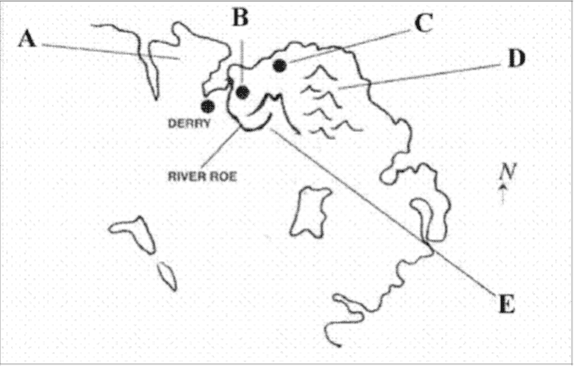
28. The Sperrin Mountains
29. Dunluce Castle
30. Inishowen
31. The Glens of Antrim
32. Limavady
Questions 33–38
Do the following statements agree with the views of the writer?
YESif the statement agrees with the views of the writer
NOif the statement contradicts the views of the writer
NOT GIVENif it is impossible to say what the writer thinks about this
33. After 1639 the castle of Dunluce was not completely uninhabited.
34. For the author, Dunluce Castle evokes another period of history.
35. There were more than 1500 men on the Girona when it went down.
36. The writer believes that the Giant’s Causeway is worth going to visit.
37. The author recommends twilight as the best time to visit the Giant's Causeway.
38. The more sturdy cage added to the Carrick-a-Rede Rope Bridge has helped to increase the number of visitors to the area.
Questions 39–40
Choose the correct letter, A, B, C or D.
39. The writer feels that the Giant’s Causeway is
A an unsettling place
B a relaxing place
C a boring place
D an exciting place
40. Which of the following would be a good title for the passage?
A The Roe Valley Park
B The Giant's Causeway
C Going East to West
A leap into history
Answers
1. E
2. C
3. A
4. D
5. B
6. are not born with their talents
7. difficult for many people to achieve
8. the human race’s fight to live is becoming a tyranny
9. holds creativity in check
10. is a rare commodity
11. Yes
12. Not Given
13. Yes
14. Yes
15. security
16. is becoming more difficult
17. but now they do not
18. compartmentalise the user
19. solved
20. protected
21. other people
22. cut-off
23. team-work
24. decrease in
25. touch-tone systems
26. electronic presence
27. no longer geographical
28. E
29. C
30. A
31. D
32. B
33. Not Given
34. Yes
35. Yes
36. Yes
37. Yes
38. Not Given
39. an unsettling place
40. A leap into history
Explanations
- 1. E
- Paragraph E explains how parameters/barriers help the mind contain and develop ideas creatively.Common trap: None significant — directly supported by the identified paragraph.
- 2. C
- Paragraph C states that rules/limitations are needed precisely so they can later be broken.Common trap: None significant — directly supported by the identified paragraph.
- 3. A
- Paragraph A describes how ingrained habits override conscious attempts at creativity.Common trap: None significant — directly supported by the identified paragraph.
- 4. D
- Paragraph D gives a specific example/strategy for training the mind to be creative.Common trap: None significant — directly supported by the identified paragraph.
- 5. B
- Paragraph B describes the obsessive desire for order as a tyranny that traps the mind.Common trap: None significant — directly supported by the identified paragraph.
- 6. are not born with their talents
- The passage opens by stating "It is a myth that creative people are born with their talents".Common trap: Contradiction trap — options A and B state the opposite of the passage's opening claim.
- 7. difficult for many people to achieve
- The passage states "how far do we need to travel to find the path to creativity? For many people, a long way," indicating creativity is hard for many to reach.Common trap: Reversed-meaning trap — option D uses passage wording ("well-trodden path") but that phrase describes the opposite of creativity.
- 8. the human race’s fight to live is becoming a tyranny
- The passage states "mankind’s very struggle for survival has become a tyranny".Common trap: Near-miss paraphrase trap — option D sounds plausible but subtly misstates the passage's claim.
- 9. holds creativity in check
- The passage states restrictions on our lives are "increasing exponentially with the advancement of technology," implying technology adds to what keeps creativity in check.Common trap: Unsupported-option trap — options B and C state the opposite of what the passage implies.
- 10. is a rare commodity
- The passage asks "Is it surprising then that creative ability appears to be so rare?" — stating creativity is rare, not that it is becoming rarer over time.Common trap: Static-vs-trend trap — option C wrongly implies an ongoing decline rather than the passage's simple claim of current rarity.
- 11. Yes
- The passage explicitly equates rules and regulations with parameters.Common trap: None significant — directly supported by the passage.
- 12. Not Given
- The passage discusses the creative mind being free "when it wants" in relation to ideas and problem-solving, but never mentions free speech or a free society.Common trap: Unsupported-inference trap — a related but distinct idea (mental freedom in problem-solving) is mentioned, not free speech/society.
- 13. Yes
- The passage states a key difficulty is convincing people that creation is even possible.Common trap: None significant — directly supported by the passage.
- 14. Yes
- The passage directly compares deviating into creative thought to madness.Common trap: None significant — directly supported by the passage.
- 15. security
- The passage states "we crave security for all its positive virtues, both physical and psychological" — security itself is the thing craved; the home and positive virtues are among its connotations.Common trap: Part-vs-whole trap — options A and D name qualities/connotations of security rather than security itself.
- 16. is becoming more difficult
- The passage states buildings "which used to allow free access... now do not," showing access is becoming more restricted/difficult.Common trap: Cause-effect reversal trap — option C reverses the passage's actual cause-and-effect relationship.
- 17. but now they do not
- The passage states these buildings "used to allow free access... now do not".Common trap: Contradiction trap — option B states the opposite of the passage.
- 18. compartmentalise the user
- The passage states secure zones mean "working space becomes compartmentalized".Common trap: Overstatement trap — options A, C and D each overstate or misstate the passage's more moderate description of secure zones.
- 19. solved
- Technology has addressed ("combatted"/solved) the problem of physical access.Common trap: Word-bank distractor trap — several similar-meaning entries in the box (e.g. "reducing of", "cut-off", "decrease in") must be matched precisely to the intended blank.
- 20. protected
- Passwords were invented so messages are protected from being read by others.Common trap: Word-bank distractor trap — several similar-meaning entries in the box (e.g. "reducing of", "cut-off", "decrease in") must be matched precisely to the intended blank.
- 21. other people
- Passwords stop other people (e.g. colleagues) from reading someone else's messages.Common trap: Word-bank distractor trap — several similar-meaning entries in the box (e.g. "reducing of", "cut-off", "decrease in") must be matched precisely to the intended blank.
- 22. cut-off
- Work is described as "isolating individuals" — i.e. cutting them off socially.Common trap: Word-bank distractor trap — several similar-meaning entries in the box (e.g. "reducing of", "cut-off", "decrease in") must be matched precisely to the intended blank.
- 23. team-work
- Organizations are increasingly valuing team-work even as individuals become more isolated.Common trap: Word-bank distractor trap — several similar-meaning entries in the box (e.g. "reducing of", "cut-off", "decrease in") must be matched precisely to the intended blank.
- 24. decrease in
- The passage states possibilities for communication are "reduced" by e-mail and voice-mail — a decrease in opportunities.Common trap: Word-bank distractor trap — several similar-meaning entries in the box (e.g. "reducing of", "cut-off", "decrease in") must be matched precisely to the intended blank.
- 25. touch-tone systems
- The writer's tone ("unfortunate enough") shows dislike of having to deal with touch-tone systems instead of a human being.Common trap: None significant — directly stated in the passage.
- 26. electronic presence
- The passage directly defines a Home Page as representing a person's "electronic presence" on the Internet.Common trap: None significant — directly stated in the passage.
- 27. no longer geographical
- The passage states that with devices like mobile phones, "location is no longer geographical".Common trap: None significant — directly stated in the passage.
- 28. E
- The Sperrin Mountains is shown at point E on the map, matching its description in the passage relative to Derry and the River Roe.Common trap: Positional-confusion trap — several places are described relative to each other (e.g. distances and directions from Derry/Limavady), so points must be traced carefully on the map rather than guessed from general compass direction.
- 29. C
- Dunluce Castle is shown at point C on the map, matching its description in the passage relative to Derry and the River Roe.Common trap: Positional-confusion trap — several places are described relative to each other (e.g. distances and directions from Derry/Limavady), so points must be traced carefully on the map rather than guessed from general compass direction.
- 30. A
- Inishowen is shown at point A on the map, matching its description in the passage relative to Derry and the River Roe.Common trap: Positional-confusion trap — several places are described relative to each other (e.g. distances and directions from Derry/Limavady), so points must be traced carefully on the map rather than guessed from general compass direction.
- 31. D
- The Glens of Antrim is shown at point D on the map, matching its description in the passage relative to Derry and the River Roe.Common trap: Positional-confusion trap — several places are described relative to each other (e.g. distances and directions from Derry/Limavady), so points must be traced carefully on the map rather than guessed from general compass direction.
- 32. B
- Limavady is shown at point B on the map, matching its description in the passage relative to Derry and the River Roe.Common trap: Positional-confusion trap — several places are described relative to each other (e.g. distances and directions from Derry/Limavady), so points must be traced carefully on the map rather than guessed from general compass direction.
- 33. Not Given
- The passage states the castle "was fully inhabited" until the kitchen court fell into the sea in 1639, then gradually fell into disrepair, but never states whether it remained partly inhabited afterwards.Common trap: Unsupported-inference trap — a related detail is mentioned but this specific claim is never confirmed.
- 34. Yes
- The passage states the castle "is redolent of another age, another dream" — evoking another historical period.Common trap: None significant — directly supported by the passage.
- 35. Yes
- "1500-odd" indicates slightly more than 1500 men were on board.Common trap: None significant — directly supported by the passage.
- 36. Yes
- The writer explicitly states the Causeway "is certainly well worth a visit", disagreeing with the old saying quoted just before.Common trap: None significant — directly supported by the passage.
- 37. Yes
- The passage states twilight hours are "the best time" to experience the Causeway.Common trap: None significant — directly supported by the passage.
- 38. Not Given
- The passage describes the bridge's construction and that some visitors cannot make the return walk, but never states that visitor numbers increased because of the sturdier cage.Common trap: Unsupported-inference trap — a related detail is mentioned but this specific claim is never confirmed.
- 39. an unsettling place
- The passage describes "feelings of eeriness and unease" and a power that is "tangible, yet inexplicable" — an unsettling atmosphere.Common trap: Tone-mismatch trap — options B and D read as generically positive/neutral, missing the passage's specific eerie, unsettling tone.
- 40. A leap into history
- The passage travels through several historical sites (Roe Valley, Limavady, Dunluce Castle, the Girona wreck, the Giant's Causeway, Carrick-a-Rede) each tied to legend and history — best summarised as "a leap into history".Common trap: Single-location trap — options A and B each name only one of several places covered by the whole passage.
Comments
Loading comments…