

Practice Tests Plus 2 General Training Reading Test 1
3 passages · 40 questions · 60 minutes
Clear Lighting / Rights in the Workplace
[[READ: 1–7]]
CLEAR LIGHTING
Use energy more efficiently and help save the planet by switching to low-energy light bulbs.
Many of us still use traditional bulbs around the house. But simply replacing one traditional 100-watt bulb in your home with a low-energy equivalent will save you the amount of electricity required to make 1,200 cups of tea. It will also reduce your annual electricity bill, so as well as using less energy, you'll be paying less money. This is because traditional bulbs only use 10% of the electrical energy to produce light, while the remaining 90% is wasted as heat. Low-energy bulbs, which are also known as compact fluorescent lamps, or CFLs, are more efficient because most of the electrical energy is used to generate actual light instead.
CFLs are more expensive to buy, costing an average of £6 each compared to 40p for a traditional equivalent, but they work out cheaper in the long run because they use less electricity and are much more durable, lasting at least six times longer.
However, they do have some drawbacks. For example, they can have a slow start-up, taking some time to reach their full brightness, so you are recommended to use them where they will be left on for longer periods, such as your living room or hallway. This also avoids frequent switching on and off, which may also shorten the life of the bulb.
CFLs are also noticeably dimmer when used in cold conditions, such as in a garage or outside, as this can reduce the bulb's efficiency, so this is not recommended. Finally, CFLs are also likely to be up to three times heavier than traditional bulbs, which may make them unsuitable for some light fittings, so you should always check these before changing your bulbs.
[[READ: 8–13]]
RIGHTS IN THE WORKPLACE
This leaflet explains your legal rights when you are at work, including what your employer must (and must not) do for you.
Do I need a contract?
A written contract of employment is useful to have because it sets out what you can expect from your job and from your employer. There are laws to protect workers, whether or not they have a written contract.
Every worker has the right to be paid and to enjoy a reasonably safe place of work. You also have certain legal rights, such as the right not to be discriminated against at work because of your sex, race or disability.
What can I do if I don't have a written contract?
Every employee has a legal right to receive a written statement which sets out your terms of employment. You should get this within eight weeks of starting your job. The terms include basic things like the name of your employer and where you will be working, the date you started work, how much you will earn and when you will be paid. It will also include terms about your hours of work, your holiday entitlement and any benefits, such as holiday and sickness pay and pensions. It should also state the length of notice you both have to give, as well as any disciplinary rules.
In many cases, employers don't do all of this. They either give employees a short offer letter or nothing at all. This is partly because an employer can't be fined for not giving you a proper contract.
If you want a contract, but your employer won't give you one, all you can do is apply to an employment tribunal for a list of what should be included in your written statement.
Questions 1–7
Complete the sentences below. Choose NO MORE THAN THREE WORDS from the text for each answer.
1. If you change your type of light bulb you could save both energy and ………………………….
2. Conventional bulbs convert most of the energy they use into ………………………….
3. You do not need to replace CFLs very often because they are very ………………………….
4. When they are first switched on, CFLs may have a ………………………….
5. Constantly using the light switch may ………………………… of a CFL.
6. Low temperatures may reduce the ………………………… of CFLs.
7. CFLs may weigh more than other bulbs, so you must only use them with appropriate ………………………….
Questions 8–13
Do the following statements agree with the information given in the text above?
TRUEif the statement agrees with the information
FALSEif the statement contradicts the information
NOT GIVENif there is no information on this
8. Write: TRUE if the statement agrees with the information FALSE if the statement contradicts the information NOT GIVEN if there is no information on this Employers have to provide written contracts for their employees.
9. Write: TRUE if the statement agrees with the information FALSE if the statement contradicts the information NOT GIVEN if there is no information on this There are laws to ensure that people are treated equally at work.
10. Write: TRUE if the statement agrees with the information FALSE if the statement contradicts the information NOT GIVEN if there is no information on this A written statement has the same value as a contract.
11. Write: TRUE if the statement agrees with the information FALSE if the statement contradicts the information NOT GIVEN if there is no information on this Employers should give written terms of employment to employees in the first two months of the job.
12. Write: TRUE if the statement agrees with the information FALSE if the statement contradicts the information NOT GIVEN if there is no information on this Employers must contribute towards their employees' pensions.
13. Write: TRUE if the statement agrees with the information FALSE if the statement contradicts the information NOT GIVEN if there is no information on this An employment tribunal can force employers to issue contracts.
Adult Education Courses / Enrol Now at Your Centre
[[READ: 14–20]]
ADULT EDUCATION COURSES: COMPUTING SKILLS FOR ALL LEVELS
[A] Introduction to Computing This 10-week course is for those with only a little experience but no confidence in your computing skills. It aims to help you to get to know your way around the computer, to understand the jargon and to use the basic applications of word processing, database and spreadsheets. Fees: £25 payable at start of course.
[B] Computer Literacy and Information Technology A certificated course offering three or more modules chosen from, e.g. word processing, database, spreadsheets, spreadsheet graphic data and computer art. This course is suitable for those with a basic understanding of computers. Fees: £10 per module, payable at start of course.
[C] Integrated Business Technology 1 This 30-week programme consists of five set modules that must be successfully completed in order to gain the intermediate level Certificate in IBT. Word processing, database, spreadsheets, spreadsheet graphic data and integrated documents are all covered. This is a challenging course leading to a good level of accuracy, presentation, business understanding and skill. Entry qualification – Certificate in Computer Literacy and IT. Fees: £75 payable at start of programme, or £25 payable at the start of each 10-week session.
[D] Text / Word Processing Levels 1, 2 and 3 Students wishing to apply will be assessed and entered for the appropriate exam course. All abilities are catered for, including absolute beginners with no previous keyboard experience [Level 1 group]. Fees: £20, £25 or £30 according to level. Additional examination fee of £10 – both payable in advance of course to reserve a place.
[E] Integrated Business Technology 2 Six set modules must be successfully completed in order to gain the certificate for this 60-week course. The modules will include Electronic Communication, File Management, Source Data Processing, Automated Presentation Production and Publication Production. This is a high-level course aimed at further developing business understanding, presentation and effective computing skills. Applicants must have the IBT intermediate level certificate and an intermediate level qualification in Desk Top Publishing, as well as experience of using email. Fees: £125 payable at start of course only. Booking essential for course places.
[[READ: 21–27]]
ENROL NOW AT YOUR CENTRE
Welcome to our new Adult Community Education brochure. You will find a wide range of learning opportunities which reflect the County Council's commitment to community-based adult learning.
How to join a course
Our courses are very popular so we advise you to enrol early to avoid disappointment.
By post: complete the booking form and return it together with your cheque to the main centre organising your course.
In person: at one of our main centres. Details of opening times can be found under the information for each centre.
At an information week: this is held at our main centres prior to the beginning of term. You can meet your tutor to make sure you have chosen the right course before you enrol.
At the first session: only if there are places available, so please telephone the centre beforehand.
Further information
You can telephone your main centre for the latest information on the availability of courses. Ask for a course description sheet, which will give you more details on the suitability of each course.
Come to a main centre at the beginning of term where you can talk to members of staff.
Visit our website at www.midland.edu.uk/adult
Lifelong learning for all - additional needs
We aim to accommodate students with disabilities into our provision wherever possible. Your main centre can give you information on special equipment and/or individual learner support which may be available to enable you to join our course. Disabled access does vary from centre to centre, however, so please check with your centre before enrolling.
Child care
Many of our centres offer crèche facilities, which are staffed by experienced and qualified workers. Please book early, as places are limited.
How much do courses cost?
The prices are displayed in three bands and are inclusive of tuition and registration fees. However, there may be additional costs such as examination fees, materials and books. You can find out about these at the main centre.
Band A: Full fee. Band B: Fee payable by people over the age of 60. Band C: Fee payable by low-income groups on recognised benefits.
NB If you are claiming a reduction in fees you will be required to bring evidence of your entitlement when you enrol, and at the start of each term.
Questions 14–20
Look at the following statements and the list of adult computing courses, A–E, below. For which course are the following statements true?
Adult Computing Courses
A Introduction to Computing
B Computer Literacy and Information Technology
C Integrated Business Technology 1
D Text/Word Processing Levels 1, 2 and 3
E Integrated Business Technology 2
14. People who know nothing about computers can join this course.
15. This course does not lead to any formal qualification.
16. Students can pay for parts of this course at different times.
17. This is an advanced-level course.
18. Those applying for this course only need one relevant qualification.
19. Students on this course can choose the number of components they want to do.
20. Students have to pay extra money to take the final test on this course.
Questions 21–27
Complete the sentences below. Choose NO MORE THAN THREE WORDS from the text for each answer.
21. People who mail their applications have to send a ………………………… together with payment.
22. Before all the courses start, the main centres hold ………………………….
23. It is not always possible to enrol at ………………………….
24. For more information about course content, students can talk to tutors, check the website or request a ………………………….
25. Many centres have special facilities and services for students with physical problems, but not all centres have ………………………….
26. Course fees only cover the cost of ………………………….
27. People such as senior citizens and those with little money can get a ………………………….
Battle of the Bag
BATTLE OF THE BAG
The world has declared war on the plastic bag. What did this harmless item do to attract such a negative reaction? Caroline Williams explains.
For a growing number of environmentalists, the humble plastic bag has become public enemy number one — an unnecessary evil that must be stopped. The only people who have a good word to say about plastic bags are the plastic-bag industry, unsurprisingly. They claim that plastic bags are nowhere near the world's worst environmental problem and say the reason they are under attack is because they are an easy and emotive target that reflects individuals' guilt about general environmental responsibility. So who is right?
Since it was introduced in the 1970s, the plastic bag - made from high-density polyethylene - has become part of our lives, and today most people around the world don't use anything else to carry their shopping. Estimates differ, but it is thought that the UK gets through at least 9 billion plastic bags a year. Globally, we carry home between 500 billion and a trillion every year. That is 150 bags a year for every person on Earth, or, to put it another way, a million a minute and rising. In the UK, even though up to 7 billion plastic bags may be reused, they still end up in rubbish bins, while a few become street litter. But ultimately the vast majority end up in landfill sites as waste. Only a fraction are incinerated for energy production and an even smaller number are recycled into heavy-duty plastic.
Startling as these statistics may be, they do not explain why plastic bags have become so hated, as they still constitute only 1% of UK litter. Claire Wilton of the environmental group Friends of the Earth claims that plastic bags are 'a waste of resources in that we use them once and throw them away'. But there are bigger and better examples of fossil fuel waste, so the issue is also about visible pollution.
Samantha Fanshawe of the UK Marine Conservation Society points out that, 'Plastic bags exceed what you would anticipate to be their pollution impact because they are so much more mobile than other types of litter. Once the wind reaches them, they become a highly visible problem, blowing around streets and getting caught in the branches of trees.'
But plastic bags can also have a devastating effect on wildlife, and the problem is increasing. One victim was a Minke whale washed up in northern France in 2002, with 800 kilograms of plastic bags and other packaging blocking its stomach. The Planet Ark Environmental Foundation in Australia estimates that tens of thousands of marine animals and birds are killed every year, and since most marine animals die far out at sea, the real death toll may be much higher.
Denmark was among the first to try reducing these problems in 1994 when they introduced a tax on packaging, including carrier bags. This led to a 66% drop in take-up at the checkout, despite the fact that it was the retailers and not their customers who had to pay up. Taiwan followed in 2001, charging consumers about two pence for a plastic bag. The tax was criticised by industry and the public as being confusing and unfair but still managed to slash plastic bag usage by 69%.
In 2002, Bangladesh took a more drastic approach, bringing in a total ban on the production and sale of polyethylene and introducing a £5 on-the-spot fine for using a plastic bag. If a blanket ban seems a little extreme, it was prompted by more than just green thinking. In a country with limited waste disposal and virtually no bins, most of the 10 million or so plastic bags used every day were dropped in the street, then washed into rivers and sewers where they choked the country's drainage system. Blocked drains are widely held responsible for the devastating monsoon floods of 1988 and 1989. In the two years since the ban, the once floundering jute-bag industry has been resurrected and street children are reportedly doing a roaring trade in handmade paper bags. A resurgence of rebel plastic-bag manufacturers this year has prompted a government crackdown, with manufacturers facing up to ten years in jail and a fine of £9000.
Elsewhere, governments rich and poor are making attempts to bin the bag. The government of the north Indian state of Himachal Pradesh is also taking a hard line. There, being caught in possession of a polyethylene bag could get you seven years behind bars and a £1000 fine. In 2002, Ireland introduced a tax of 15 cents on plastic carriers, payable by the consumer. Within months the number of bags taken from shops fell by 90%, and in the two years since then, the 'PlasTax' has raised €23 million for waste management initiatives.
According to Wilton, 'Plastic bags are symbolic of a society in which we use things without thinking and then throw them away. Governments have realised that, by focusing on something so symbolic, they can get messages across to people about their behaviour and how it affects the environment.'
The plastic bag industry, unsurprisingly, takes issue with being blamed for general environmental irresponsibility. But even with the facts on their side, manufacturers seem resigned. 'Green marketing wins out every time,' says spokesman Peter Woodall.
Questions 28–31
Label the diagram below. Choose ONE WORD OR A NUMBER from the passage for each answer.
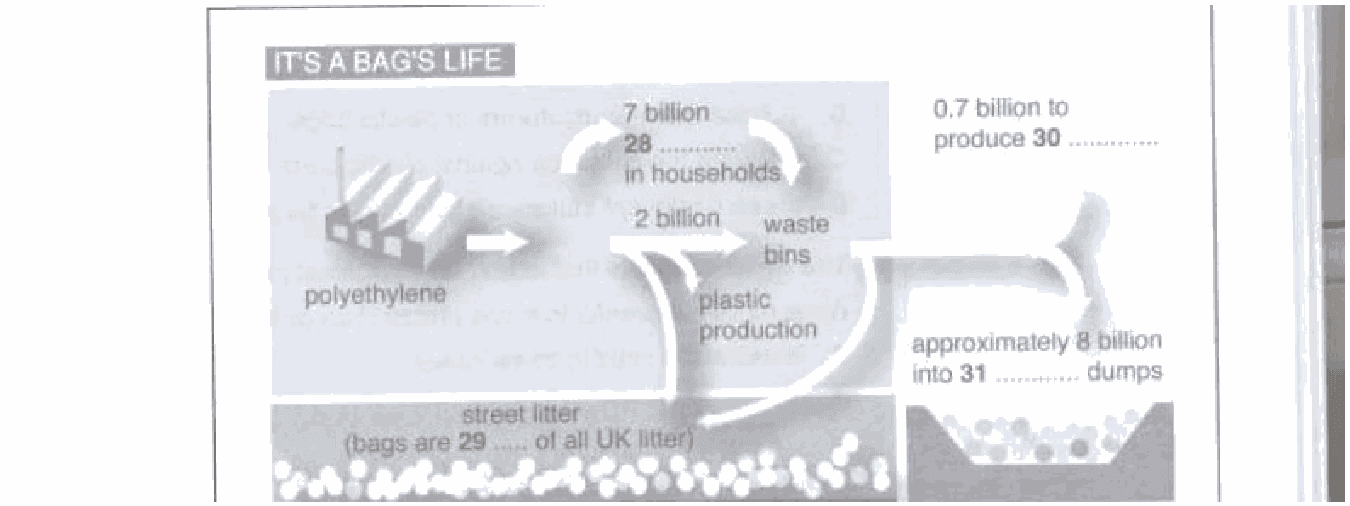
It's a Bag's Life
• 7 billion (28) ………………………… in households
• street litter (bags are (29) ………………………… of all UK litter)
• 0.7 billion to produce (30) …………………………
• approximately 8 billion into (31) ………………………… dumps
Questions 32–38
Look at the following situations and the list of places, A–E, below. Match each situation with the place it relates to.
List of Places
A Denmark
B Taiwan
C Bangladesh
D Himachal Pradesh (India)
E Ireland
32. The use of plastic bags fell by approximately two-thirds.
33. An unsuccessful local product became popular again.
34. Action against plastic bags was unpopular, but successful.
35. Money from plastic bag taxation is available for environmental projects.
36. Discarded bags may have caused national disasters.
37. Shops had to pay a tax on plastic bags.
38. People can be sent to prison for using plastic bags.
Questions 39–40
Choose the correct letter, A, B, C or D.
39. In the first part of this passage, the main aim of the writer is to
A describe the advantages and disadvantages of plastic bags.
B criticise the manufacturers of plastic bags.
C evaluate the evidence against plastic bags.
D present relevant statistics about plastic bags.
40. The writer suggests that action taken against plastic bags
A is more successful in some places than others.
B is much too strict in some cases.
C will solve our biggest environmental problem.
D will put manufacturers out of business.
Answers
1. money
2. heat
3. durable
4. slow start-up
5. shorten the life
6. efficiency
7. fittings
8. False
9. True
10. Not Given
11. True
12. Not Given
13. False
14. D
15. A
16. C
17. E
18. C
19. B
20. D
21. booking form
22. an information week
23. the first session
24. course description sheet
25. disabled access
26. tuition and registration
27. reduction in fees
28. reused
29. 1%
30. energy
31. landfill sites
32. B
33. C
34. B
35. E
36. C
37. A
38. D
39. evaluate the evidence against plastic bags.
40. is more successful in some places than others.
Explanations
- 1. money
- The sentence's 'save both energy and _____' maps directly onto the passage's contrast between 'using less energy' and 'you'll be paying less money' — the second saving alongside energy is financial, so the blank takes the passage's own word 'money'.Common trap: None significant.
- 2. heat
- The sentence's 'conventional bulbs' paraphrases 'traditional bulbs', and 'convert most of the energy... into _____' restates the passage's statement that 'the remaining 90% is wasted as heat' — 90% is the majority ('most'), and the wasted form is heat.Common trap: 'light' is the small 10% portion, not the majority the question asks about.
- 3. durable
- The sentence's 'do not need to replace... very often' paraphrases the passage's 'lasting at least six times longer', and the blank takes the passage's own adjective 'durable' describing why this is so.Common trap: None significant.
- 4. slow start-up
- The sentence's 'when they are first switched on' paraphrases the passage's 'they can have a slow start-up, taking some time to reach their full brightness' — the blank takes the passage's own compound noun 'slow start-up'.Common trap: None significant.
- 5. shorten the life
- The sentence's 'constantly using the light switch' paraphrases the passage's 'frequent switching on and off', and the blank takes the passage's own verb phrase 'shorten the life' describing the resulting effect on the bulb.Common trap: None significant.
- 6. efficiency
- The sentence's 'low temperatures' paraphrases 'cold conditions', and 'may reduce the _____' is lifted directly from the passage's own wording that cold 'can reduce the bulb's efficiency'.Common trap: None significant.
- 7. fittings
- The sentence's 'weigh more than other bulbs' paraphrases 'up to three times heavier than traditional bulbs', and 'appropriate _____' paraphrases the passage's warning to check 'these' (i.e. the light fittings) beforehand, since heavier bulbs may not suit every fitting.Common trap: None significant.
- 8. False
- The statement's claim of a legal requirement to provide a contract is contradicted by the passage's explanation that many employers give 'a short offer letter or nothing at all' precisely because 'an employer can't be fined for not giving you a proper contract' — if there were a legal duty to provide one, there would be a penalty for not doing so.Common trap: The passage does say every employee has a right to a written statement of terms, which can be confused with a full contract, but the text explicitly distinguishes the two and says a contract itself is not compulsory.
- 9. True
- The statement's 'treated equally' paraphrases the passage's specific legal rights 'not to be discriminated against at work because of your sex, race or disability' — protection from discrimination on these grounds is a form of equal treatment.Common trap: None significant.
- 10. Not Given
- The passage explains what a written statement of terms contains and that every employee has a right to one, but it never compares its legal value or standing to that of a full contract, so no judgement about equivalence can be made.Common trap: The written statement covers similar content to a contract (pay, hours, holidays), which can tempt a reader into assuming they are equivalent, but the passage never makes this comparison explicit.
- 11. True
- The statement's 'first two months' paraphrases the passage's 'within eight weeks of starting your job' — eight weeks is approximately two months, so the statement accurately restates the deadline given.Common trap: None significant.
- 12. Not Given
- The passage only says a written statement should include terms about 'benefits, such as holiday and sickness pay and pensions' — that pension terms should be documented if they exist, not that employers are obliged to contribute towards a pension at all.Common trap: The mention of 'pensions' as a benefit category can be mistaken for a stated obligation to contribute, but the passage only says such terms must be documented if applicable, not that contribution is compulsory.
- 13. False
- The passage says an employee can only 'apply to an employment tribunal for a list of what should be included in your written statement' — the tribunal supplies a list of required particulars, it does not compel the employer to issue a contract itself, contradicting the statement.Common trap: The tribunal's involvement can suggest it has enforcement power over contracts, but its role described here is limited to listing required content of the written statement, not compelling a contract.
- 14. D
- The statement's 'know nothing about computers' paraphrases the passage's 'absolute beginners with no previous keyboard experience' listed under the Text/Word Processing course, which explicitly caters for total novices.Common trap: Introduction to Computing (A) is aimed at those with 'only a little experience but no confidence', which still implies some prior exposure, unlike the absolute beginners in D.
- 15. A
- The statement's 'does not lead to any formal qualification' is supported by the absence of any certificate/qualification wording in the Introduction to Computing description, in clear contrast to the neighbouring course B, which is explicitly 'a certificated course'.Common trap: Computer Literacy and Information Technology (B) is explicitly described as 'a certificated course', the opposite of what this statement requires.
- 16. C
- The statement's 'pay for parts... at different times' paraphrases the passage's fee options for Integrated Business Technology 1: a single upfront payment, or paying '£25 payable at the start of each 10-week session' — i.e. in instalments across the programme's separate sessions.Common trap: None significant.
- 17. E
- The statement's 'advanced-level' paraphrases the passage's own description of Integrated Business Technology 2 as 'a high-level course', which also requires applicants to already hold an intermediate-level certificate as an entry qualification.Common trap: None significant.
- 18. C
- The statement's 'only need one relevant qualification' matches Integrated Business Technology 1's single stated entry requirement, in contrast to course E which requires both an IBT certificate and a Desk Top Publishing qualification plus email experience.Common trap: Integrated Business Technology 2 (E) requires multiple qualifications ('the IBT intermediate level certificate and an intermediate level qualification in Desk Top Publishing, as well as experience of using email'), not just one.
- 19. B
- The statement's 'choose the number of components' paraphrases the passage's 'offering three or more modules chosen from' — students are not restricted to a fixed number of modules, unlike the fixed five- or six-module structures of courses C and E.Common trap: None significant.
- 20. D
- The statement's 'pay extra money to take the final test' paraphrases the passage's 'Additional examination fee of £10', which is charged on top of the main course fee specifically for the exam.Common trap: None significant.
- 21. booking form
- The sentence's 'mail their applications' paraphrases the passage's 'By post', and 'send a _____ together with payment' is restated almost verbatim from the passage's instruction to 'complete the booking form and return it together with your cheque'.Common trap: None significant.
- 22. an information week
- The sentence's 'before all the courses start' paraphrases the passage's 'prior to the beginning of term', and the blank takes the passage's own term for this event, 'an information week'.Common trap: None significant.
- 23. the first session
- The sentence's 'not always possible' paraphrases the passage's condition 'only if there are places available', which qualifies enrolment 'At the first session' — unlike the other enrolment methods, this one is not always available.Common trap: None significant.
- 24. course description sheet
- The sentence lists the same three information sources as the passage — talking to staff, the website, and a document — with the blank taking the passage's own term 'course description sheet' as the document that 'will give you more details on the suitability of each course'.Common trap: None significant.
- 25. disabled access
- The sentence's 'special facilities and services for students with physical problems' paraphrases the passage's support for 'students with disabilities', and the blank takes the passage's own term 'disabled access', which the passage says 'does vary from centre to centre'.Common trap: None significant.
- 26. tuition and registration
- The sentence's 'only cover the cost of _____' paraphrases the passage's statement that the displayed prices 'are inclusive of tuition and registration fees', while extra costs such as exams and materials are billed separately.Common trap: 'examination fees, materials and books' are explicitly named as additional costs NOT included in the standard fee, the opposite of what this blank asks for.
- 27. reduction in fees
- The sentence's 'senior citizens and those with little money' paraphrases the passage's Band B ('people over the age of 60') and Band C ('low-income groups on recognised benefits'), and the blank takes the passage's own term for what such people can claim: 'a reduction in fees'.Common trap: None significant.
- 28. reused
- The diagram label '7 billion _____ in households' paraphrases the passage's account of what happens to the UK's plastic bags — 'up to 7 billion plastic bags may be reused' — with the number matching exactly and the blank taking the passage's own verb 'reused'.Common trap: None significant — the answer is a specific term/figure named directly in the passage.
- 29. 1%
- The diagram label 'bags are _____ of all UK litter' is lifted directly from the passage's statistic that plastic bags 'constitute only 1% of UK litter', with 'constitute' restated as 'are' in the diagram's shorter phrasing.Common trap: None significant — the answer is a specific term/figure named directly in the passage.
- 30. energy
- The diagram label 'produce _____' matches the passage's 'incinerated for energy production' — burning a fraction of the bags is described as producing energy, so the blank takes the passage's own noun 'energy'.Common trap: None significant — the answer is a specific term/figure named directly in the passage.
- 31. landfill sites
- The diagram label '_____ dumps' paraphrases the passage's own term 'landfill sites', which the passage says receive 'the vast majority' of bags — consistent with this being by far the largest quantity shown on the diagram.Common trap: None significant — the answer is a specific term/figure named directly in the passage.
- 32. B
- The statement's 'fell by approximately two-thirds' matches Taiwan's result most closely — the passage states its tax 'managed to slash plastic bag usage by 69%', which rounds to roughly two-thirds.Common trap: Denmark's 66% drop (A) is also close to two-thirds, but the passage's Taiwan figure of 69% is the closer match, and it is the one the answer key confirms.
- 33. C
- The statement's 'unsuccessful local product became popular again' paraphrases the passage's 'the once floundering jute-bag industry has been resurrected' in Bangladesh — 'floundering' matches 'unsuccessful', and 'resurrected' matches 'became popular again'.Common trap: None significant.
- 34. B
- The statement's 'unpopular, but successful' directly paraphrases the passage's description of Taiwan's tax as 'criticised by industry and the public as being confusing and unfair' (unpopular) yet one that 'still managed to slash plastic bag usage by 69%' (successful).Common trap: None significant.
- 35. E
- The statement's 'money... available for environmental projects' paraphrases the passage's statement that Ireland's 'PlasTax' 'has raised €23 million for waste management initiatives' — waste management initiatives are a type of environmental project.Common trap: None significant.
- 36. C
- The statement's 'national disasters' paraphrases the passage's 'devastating monsoon floods of 1988 and 1989', which are said to have been caused by drains blocked with discarded bags in Bangladesh.Common trap: None significant.
- 37. A
- The statement's 'shops had to pay' matches the passage's specific detail about Denmark, where 'it was the retailers and not their customers who had to pay up' — retailers are the shops, distinguishing Denmark from the other countries where the tax fell on consumers.Common trap: Taiwan, Ireland and Himachal Pradesh (India) all charge the consumer directly rather than the shop, so they do not fit this statement.
- 38. D
- The statement's 'sent to prison' paraphrases the passage's 'seven years behind bars' as the penalty for possessing a polyethylene bag in Himachal Pradesh.Common trap: Bangladesh (C) also has a prison penalty ('up to ten years in jail'), but that applies to manufacturers who illegally produce bags, not to people using them, which is what this statement specifies.
- 39. evaluate the evidence against plastic bags.
- The opening paragraphs set up two opposing claims — environmentalists calling plastic bags 'public enemy number one' versus the industry's claim that they are 'nowhere near the world's worst environmental problem' — and pose the direct question 'So who is right?', before the writer goes on to weigh usage statistics, litter share, and pollution impact. This structure of laying out and weighing competing claims and data is an evaluation of the evidence, not simply a description or a one-sided attack.Common trap: 'present relevant statistics' describes part of the writer's method in this section, but the statistics serve the larger purpose of weighing up the two sides' claims, not an end in themselves.
- 40. is more successful in some places than others.
- The passage surveys several countries' measures with clearly different results — Denmark's 66% drop, Taiwan's 69% drop despite public criticism, Bangladesh's ban prompting a black market and manufacturer crackdown, and Ireland's 90% fall — showing a range of outcomes rather than one uniform result, so the writer's overall picture is of varying degrees of success across different places.Common trap: 'will solve our biggest environmental problem' misreads the writer's earlier point that bags are only 1% of UK litter as evidence they are a top-tier issue, when the writer's point is closer to the opposite.
Comments
Loading comments…