

IELTS Trainer 2 Academic Reading Test 4
3 passages · 40 questions · 60 minutes
The Romans Reveal their Secrets
As Katherine Sheen rested on the banks of Hensham river on 3 August 2005, her gaze fell upon a small dirt-covered object amongst a tangle of tree roots. Cleaning away the soil, she realized it was a leather pouch. It fell apart as Katherine opened it, and the items inside fell to the ground. Although her university degree merely touched on the Roman occupation of ancient Britain, providing a very general overview of everyday activities, once she’d rubbed off some the dirt, Katherine immediately identified the coins in her hand as coming from that era. Despite their discoloration, Katherine had no doubt they were historically significant. As soon as she got home, she informed the police of her find.
That might have been the end of the story – except for the fact that the farmer who owned adjacent field then mentioned the lines of large stones his plough kept running into. By mid-August, with the farmer’s permission, a team of archaeologists, led by Professor Kevin Durrand, were camped out in the field. Durrand had previously worked on other projects where pieces of ancient pottery and the discovery of an old sword had led archaeologists to unearth sizeable Roman settlements. He was keen to start excavations at Hensham, and had got funding for a three-month dig. What his team eventually discovered, three weeks into excavations, were the remains of the outer walls of a Roman villa. As many Romans in Britain simply lived in wooden houses with thatched roofs, the family that occupied the villa must have been very wealthy. As the team continued their work, they looked for evidence that might indicated whether the villa had been attacked and purposely demolished, or fallen into such a poor state that it eventually collapsed. Looking at the way a set of slate roof tiles had fallen to the ground, they decided on the latter. What caused the noble Roman family and their servants to abandon the villa remains open to speculation. Another find was six blue beads, crafted from glass, which the archaeologists speculated were part of a necklace. Durrand has previously found gold bracelets on other sites, but for him the beads are no less significant. ‘Every find contributes to the story’, he says.
On the outer western wall, the archaeologists uncovered number of foundation stones. On one is carved what the archaeologists made out to be a Latin inscription. But as the stone itself has endured centuries of erosion, the team has yet to work out what it says. Another find was a section of traditional Roman mosaic. Although incomplete, enough pieces remain to show a geometrical pattern and stylized fish. From this, Durrand assumes that a bath house would have been a feature of the villa. While his team have so far not found any hard proof of this, Durrand is confident it will turn out to be the case.
Something that team particularly excited about is evidence of a heating system, which would have served the Roman family and their visitors well in winter months. Although much of the system has long since crumbled at Hensham, Durrand and his team believe it would have been based on a typical Roman hypocaust; they have created a model for visitors to see. The furnace that produced the hot air needed to be kept burning all the time, a task that would have fallen to the villa’s slaves. As large branches would have taken too long to produce the heat required, it is more likely that twigs would have been gathered from surrounding woodland instead. Another fuel source used in some Roman hypocausts was charcoal, but evidence for this at Hensham ha not presented itself. The underfloor space was made by setting the floor on top of piles of square stones. Known as pilae, these stones stood approximately two feet high. The gap this created meant that the hot air coming out of the furnace was not trapped and restricted. Instead its distribution around the pilae and under the floor was free flowing. Floor tiles were not placed directly onto the pilae but separated by a layer of concrete, or at least a primitive version of it. This would have made the whole structure more solid, and helped reduce the risk of fire spreading to upper levels. The walls of the rooms above heating system were made of bricks, but the key point here is that they were hollow, in order to allow heat to rise around the rooms and provide insulation. Some have been recovered from the Hensham villa and are now undergoing preservation treatment.
Another feature of the heating system that archaeologists have identified at Hensham was its clay pipes. These were cleverly built into the wall so as not to take up space. The principal reason for including the pipes was to let out air through a vent in the roof once it had cooled down. What the Romans may not have realised, however, was that gas produced by the burning fuel was expelled in this way too. In high doses, it could have been lethal if it had leaked into the upper levels. Inside the rooms in the villa, a layer of plaster would have been applied to the walls and painted in rich colours. Sadly, none of the original plaster at Hensham still exists. However, some of the tiles that the family would have walked on have survived. They would certainly have felt warm underfoot and helped generate an indoor climate that the family could relax in. In its day, the Hensham hypocaust would have been a remarkable piece of engineering.
Questions 1–7
Do the following statements agree with the information given in the passage?
TRUEif the statement agrees with the information
FALSEif the statement contradicts the information
NOT GIVENif there is no information on this
1. Katherine Sheen’s university course looked at Roman life in Britain only briefly.
2. It was clear to Sheen that the contents of the leather pouch were financially valuable.
3. Before excavations started, Kevin Durrand believed they would discover a Roman settlement.
4. Durrand’s team eventually concluded that the villa had been deliberately destroyed.
5. The blue beads would once have been owned by a Roman woman of high status.
6. The archaeologists now understand the Roman writing on the foundation stone.
7. In Durrand’s opinion, the mosaic strongly suggests that the villa contained a bath house.
Questions 8–13
Label the diagram below. Choose NO MORE THAN TWO WORDS from the passage for each answer.
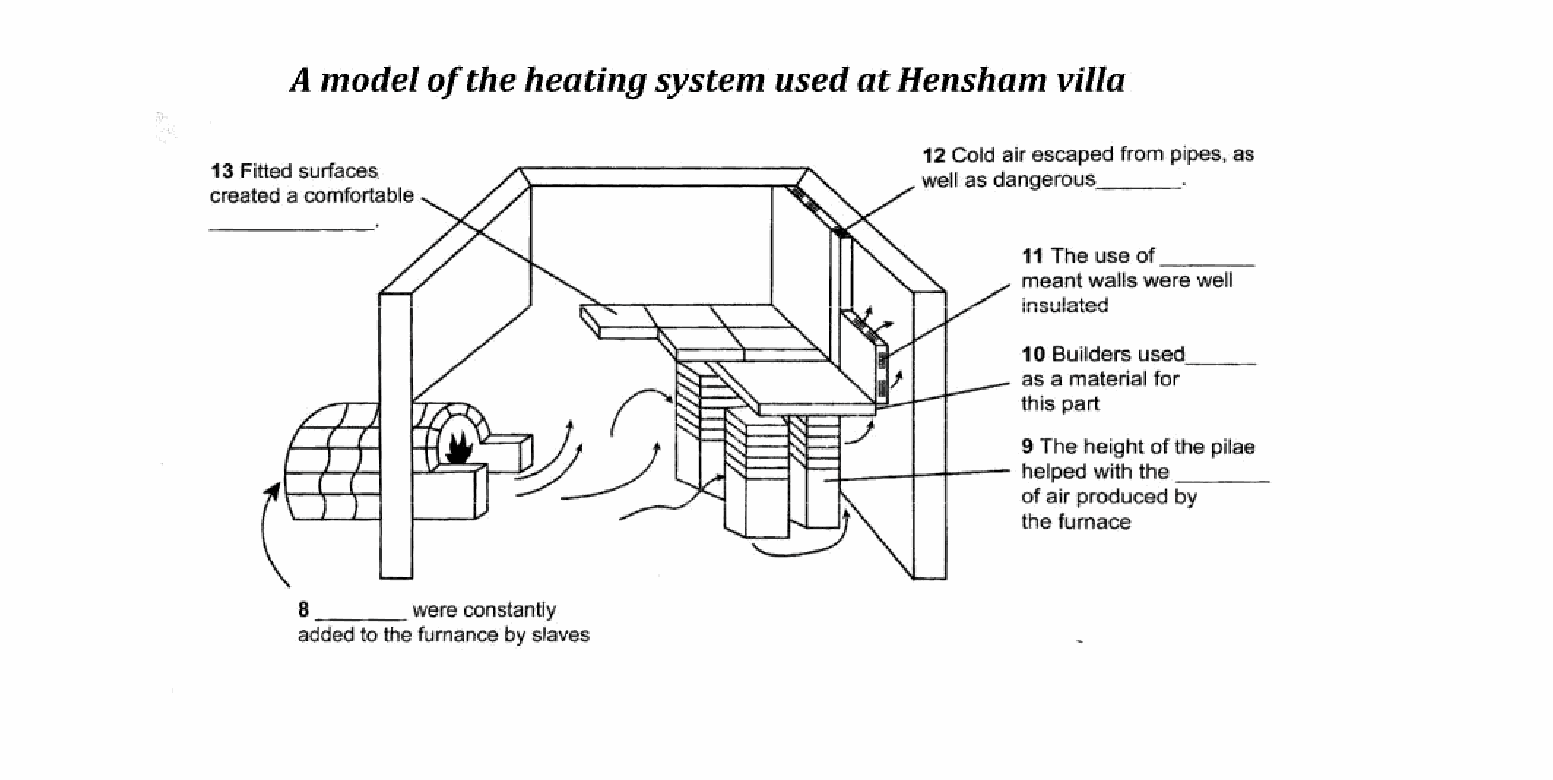
• (8) ………………………… were constantly added to the furnace by slaves
• The height of the pilae helped with the (9) ………………………… of air produced by the furnace
• Builders used (10) ………………………… as a material for this part
• The use of (11) ………………………… meant walls were well insulated
• Cold air escaped from pipes, as well as dangerous (12) ………………………….
• Fitted surfaces created a comfortable (13) ………………………….
The Truth about Lying
[A] An area of scientific study that caught the public imagination during the 1970s involved a gorilla called Koko. Animal psychologist Francine Patterson claimed to have taught Koko a simplified form of American Sign Language, and through singing, Koko could apparently communicate basic ideas such as ‘food’ and ‘more’, as well as concepts such as ‘good’ and ‘sorry’. But Koko also used signs to blame other people for damage she had caused herself. While today there is some dispute about whether Koko truly understood the meaning of all the signs she made, Professor Karen Goodger believes she was certainly capable of dishonesty. ‘People use words to lie, but for animals with higher brain functions, there’s also a higher probability that they’ll demonstrate manipulative behaviours. We see this not just in gorillas, but in other creatures with a large neocortex.’
[B] Human societies may appear to disapprove of lying, but that doesn’t mean we don’t all do it. And it seems that the ability, or at least the desire to deceive, starts from an early age. In one study run by psychologist Kang Lee, children were individually brought into a laboratory and asked to face a wall. They were asked to guess what toy one of Lee’s fellow researchers had placed on a table behind them – for example, a fluffy cat or dog. The researcher would then announce they had to leave the lab to take a phone call, reminding the child not to turn around. The research team were well aware that many children would be unable to resist peeking at the toy. Secret cameras showed that 30% of two-year-old children lied about not looking. This went up to 50% for three-year-olds and almost 80% of eight-year-olds. Interestingly, whereas the younger children simply named the toy and denied taking a peek, the older ones came up with some interesting reasons to explain how they had identified the toy correctly. Lee is reassured by this trend, seeing it as evidence in each case that the cognitive growth of a human child is progressing as it should. Parents, of course, may not be so pleased.
[C] Adults, however, can hardly criticise children. According to Professor Richard Wiseman, it appears that adults typically tell two major lies per day, and that one third of adult conversations contain an element of dishonesty. Other research indicates that spouses lie in one out of every 10 interactions. This probably comes as no surprise to Tali Sharot at University College London, who has run a series of experiments proving we become desensitised to lying over time. She has found that while we might initially experience a sense of shame about small lies, this feeling eventually wears off. The result, Sharot has found, is that we progress to more serious ones.
[D] Other researchers, including Tim Levine at the University of Alabama, have analysed our motives for lying. By far the most common is our desire to cover up our own wrongdoing. Second to this are lies we tell to gain economic advantage – we might lie during an interview to increase the chances of getting a job. Interestingly, ‘white lies’, the kind we tell to avoid hurting people’s feelings, account only for a small percentage of our untruths. But if we recognise our own tendency to lie, why don’t we recognise it in others? Professor Goodger thinks it has something to do with our strong desire for certain information we hear to be true, even when we might suspect it isn’t. This is because we might be ‘comforted by others’ lies or excited by the promise of a good outcome’, Goodger says.
[E] We might not expect ordinary people to be good at recognising lies, but what about people whose job it is to investigate the behavior of others? Paul Erkman is a psychologist from the University of California. As part of his research into deception, he has invited a range of experts to view videos of people telling lies and of others telling the truth. Among the experts have been judges, psychiatrists and people who operate polygraph machines for police investigations. None of these experts have shown they can detect dishonestly any better than people without their experience. Part of the problem is that so many myths still prevail about ‘give-away signs’ indicating that someone is lying.
[F] A common claim, for example, is that liars won’t look people in the eye during their explanations or while being questioned. Another is that they are likely to gesture as they tell their story, but so frequently that it seems unnatural – as if they are trying to convince others of their sincerity. However, many researchers have come to reject these ideas, suggesting a more effective approach is to listen to their narration style. A difficulty that liars face is having to remember exactly what they said, which is why they don’t provide as many details as a person giving an honest account would. It is also typical of liars to mentally rehearse their story, and this is why one stage follows another in apparently chronological fashion. Honest stories, however, feature revisions and repetition. Recent research has also disproved the widely believed notion that liars have a habit of fidgeting in their seats. Rather, it seems that they keep still, especially in the upper body, possibly hoping to give the impression of self-assurance. Liars also put some psychological distance between themselves and their lies. For that reason, they avoid the use of ‘I’ when narrating their stories. The reverse is true, however, when people write fake reviews, say, a hotel or restaurant. In these instances, ‘I’ features again and again as they attempt to convince use that their experience was real.
Questions 14–18
Reading Passage 2 has six paragraphs, A–F. Which paragraph contains the following information?
14. details regarding the frequency at which the average person tends to lie
15. a reference to an experiment testing the lie-detecting skills of various professional groups
16. an explanation of why people might frequently refer to themselves when lying
17. examples of the reasons why some people might choose to lie to others
18. a description of an experiment that gave participants the opportunity to lie
Questions 19–22
Look at the following statements and the list of researchers below. Match each statement with the correct researcher, A, B or C. You may use any letter more than once.
List of Researchers
A . Karen Goodger
B . Kang Lee
C . Tali Sharot
19. Guilt often diminishes as people become used to telling lies.
20. People’s need to feel reassured and hopeful makes them susceptible to lies.
21. More intelligent species are more likely to be deceptive.
22. The increasing sophistication of lying is part normal development.
Questions 23–26
Complete the summary below. Choose ONE WORD ONLY from the passage for each answer.
23. It is commonly claimed that people who are lying will avoid making eye contact with others and will ………………………… a lot.
24. Many researchers now disagree with these claims. Instead they analyse the way people tell their stories. For example, liars tend to offer fewer ………………………… than people who are telling the truth.
25. However, each ………………………… of their story seems to be in order, because they have carefully planned what they want to say.
26. And contrary to what many people believe, liars often remain ………………………… as they lie, perhaps in the belief that they will come across as more confident than they really are.
The Hidden Life of Trees by Peter Wohlleben
That so many copies of Peter Wohlleben’s book The Hidden Life of Trees have been sold is no surprise. Life in the urban jungle can be overwhelming, and many of us long to escape by seeing more natural environments. We hope an encounter with nature might make us feel more ‘alive’. Would we use this same term to describe nature itself, though? Forests and the trees that form them are commonly perceived as objects lacking awareness, like rocks or stones. But here, Wohlleben would beg to differ. From his observations, he has concluded that they are conscious in a way we do not fully understand.
In recent decades, a number of writers have investigated our planet’s flora. The Cabaret of Plants by Richard Mabey and What a Planet Knows by Daniel Chamovitz, for example, have done much to reformulate our views about the green world. Central to many of these books is a serious message about sustainability, and The Hidden Life Trees is no exception. What sets it apart is its approach to description: at the start Wohlleben announces that ‘When you know the trees ... have memories and that tree parents live together with their children, then you can no longer just chop them down.’ Not everyone will be comfortable with this kind of anthropomorphism.
Nevertheless, Wohlleben’s experience of working in a beech forest in the Eifel mountains of Germany may put him in a better position than many to write a book about trees. In the introduction, he explains that he started out as a state-employed forester, taking care of trees purely for industrial reasons. The straighter they were, the more high-quality logs could be sawn. But after a while he began to appreciate trees for more than just their commercial worth. He gives some of the credit for this realisation to the tourists that would come to the forest, who were more enchanted by bent, crooked, which did not conform to the straight ideal.
An anectode that stands out is Wohlleben’s encounter with ‘the gnarled remains of an enormous tree stump’ in the Eifel forest. More than anything else, it was this encounter that prompted him to look further into the hidden behaviour of trees. To his surprise, after scraping at the outside layer of bark covering the stump, he discovered a green layer underneath. This was chlorophyll, the pigment normally produced by living trees. Wohlleben realised that the only way the stump could still be alive was if the surrounding beeches were providing it with a sugar solution through their own roots.
Wohlleben is not the first person to claim that trees are cooperative. In the 1990s, Dr Suzanne Simard realised that fir and birch trees were supplying each other with carbon. Simard’s findings made complete sense to Wohlleben, who believes that this kind of nutrient exchange between neighbours is typical of a healthy forest. Wohlleben also had the opportunity to deepen his understanding of tree biology when researchers from Aachen University set up investigative programmes in his beech forest. Discussions with them reinforced his beliefs about the way trees thrived, and Wohlleben eventually found himself strongly opposed to some traditional forestry practices. He finally succeeded in persuading local villagers that the forest should be allowed to return to a natural state: this involved banning the use of machinery for logging, and giving up on pesticides for a start. Since then, Wohlleben has been noting how his beech forest has developed, and his observations formed the foundation for the book. Humour and straightforward narrative make it instantly appealing to readers without a science background – elements that have successfully been translated into over a dozen languages. Those that do have scientific training, however, will be more demanding. Critics of Wohlleben point out that proper academic studies need to be done to prove all his claims are factually accurate. This seems a fair point. What the book will certainly do is transform nature lovers’ experiences of a forest walk. Once you know what is happening below ground, you can’t help but marvel at the complex life of trees. Will it transform the way we produce timber for the manufacturing industry? As large corporations tend to focus on immediate profits, they are hardly likely to adopt the longer-term practices that Wohlleben recommends.
One of these is allowing trees to grow nearer to each other. This is the opposite of what happens in many state-owned forests, where foresters deliberately space out trees so they can get more sunlight and grow faster. But Wohlleben claims this spacing prevents vital root interaction, and so lowers resistance to drought. Older, established trees, he explains, draw up moisture through their deep roots and provide this to juvenile trees is also given attention. For instance, when pines require more nitrogen, the fungi growing at their base release a poison into the soil. This poison kills many minute organisms, which release nitrogen as they die, and this is absorbed by the trees’ roots. In return, the fungi receive photosynthesised sugar from pines. Then Wohlleben explores the way trees employ scent, giving the example of acacia trees in sub-Saharan Africa. When giraffes begin feeding on an acacia’s leaves, the tree emits ethylene gas as a warning to neighbouring acacias. These then pump tannins into their leaves – substances toxic to giraffes. More controversial is Wohlleben’s suggestion that trees feel pain. Although scientific research has now established that if branches are broken off or the trunk is hit with an axe, a tree will emit electrical signals from the site of the wound, the application of the concept of ‘pain’ might be an instance where readers are unconvinced.
Questions 27–30
Choose the correct letter.
27. What is the reviewer emphasising in the phrase ‘Wohlleben would beg to differ’?
A the fact that trees might not live as passively as we thing
B the idea that a forest trip might increase people’s vitality
C the way that a forest is the key feature of many landscapes
D the belief that trees exist only for the benefit of humans
28. According to the reviewer, a unique feature of The Hidden Life of Trees is
A its suggestion that ordinary people can act to protect forests.
B its viewpoint that only certain kinds of tree are worth preserving.
C its tendency to refer to trees as if they had human qualities.
D its simplistic rather than academic approach to writing.
29. What are we told about Peter Wohlleben’s time as a state-employed forester?
A He hoped he could make a good living from cutting down trees.
B He changed his mind about the way in which trees were valuable.
C He rejected the ideas that visitors to the beach forest put forward.
D He introduced new techniques for improving the growth of trees.
30. The reviewer mentions the trees stump anecdote in order to
A question traditional thinking about the way trees grow.
B explain the motivation behind Wohlleben’s area of research
C highlight Wohlleben’s lack of formal scientific training.
D suggest how personal stories have brought a dull topic to life.
Questions 31–36
Do the following statements agree with the views of the writer?
YESif the statement agrees with the views of the writer
NOif the statement contradicts the views of the writer
NOT GIVENif it is impossible to say what the writer thinks about this
31. Wohlleben was sceptical about the results of Dr Suzanne Simard’s research.
32. Wohlleben’s theories about trees were confirmed after talking to Aachen University scientists.
33. It was a good decision to get rid of machinery and pesticides from the beech forest.
34. The translators of The Hidden Life of Trees should be given more recognition for their contribution.
35. Some of Wohlleben’s ideas about trees must be investigated further before they can be accepted as true.
36. The Hidden Life of Trees is likely to affect how forests are managed by the manufacturing industry
Questions 37–40
Complete the summary using the list of words, A–G, below.
37. The distance between trees in state-owned forests
A may prevent harm occurring to the same tree species.
B can be the result of different forms of damage.
C might help the spread of trees in a new location.
D could be a sign that trees have reached maturity.
E may affect how vulnerable young trees are during dry periods.
F can play a part in providing essential nutrients.
G might encourage disease in trees growing nearby.
38. The fungi growing at the base of trees
A may prevent harm occurring to the same tree species.
B can be the result of different forms of damage.
C might help the spread of trees in a new location.
D could be a sign that trees have reached maturity.
E may affect how vulnerable young trees are during dry periods.
F can play a part in providing essential nutrients.
G might encourage disease in trees growing nearby.
39. The scent sometimes given off by trees
A may prevent harm occurring to the same tree species.
B can be the result of different forms of damage.
C might help the spread of trees in a new location.
D could be a sign that trees have reached maturity.
E may affect how vulnerable young trees are during dry periods.
F can play a part in providing essential nutrients.
G might encourage disease in trees growing nearby.
40. The electrical signals sent out by trees
A may prevent harm occurring to the same tree species.
B can be the result of different forms of damage.
C might help the spread of trees in a new location.
D could be a sign that trees have reached maturity.
E may affect how vulnerable young trees are during dry periods.
F can play a part in providing essential nutrients.
G might encourage disease in trees growing nearby.
Answers
1. True
2. Not Given
3. Not Given
4. False
5. Not Given
6. False
7. True
8. twigs
9. distribution
10. concrete
11. hollow bricks
12. gas
13. indoor climate
14. C
15. E
16. F
17. D
18. B
19. C
20. A
21. A
22. B
23. gesture
24. details
25. stage
26. still
27. the fact that trees might not live as passively as we thing
28. its tendency to refer to trees as if they had human qualities.
29. He changed his mind about the way in which trees were valuable.
30. explain the motivation behind Wohlleben’s area of research
31. No
32. Yes
33. Not Given
34. Not Given
35. Yes
36. No
37. may affect how vulnerable young trees are during dry periods.
38. can play a part in providing essential nutrients.
39. may prevent harm occurring to the same tree species.
40. can be the result of different forms of damage.
Explanations
- 1. True
- The passage states her degree 'merely touched on the Roman occupation of ancient Britain, providing a very general overview of everyday activities'. Paraphrase: 'looked at Roman life in Britain only briefly' = 'merely touched on the Roman occupation of ancient Britain'.Common trap: None significant — the answer is directly stated.
- 2. Not Given
- The passage states Katherine identified the coins and had 'no doubt they were historically significant', but no mention is made of whether she judged them to be financially valuable.Common trap: The confirmed historical significance of the coins could tempt a reader into assuming financial value was also established, but the passage never states this.
- 3. Not Given
- The passage states Durrand 'was keen to start excavations at Hensham, and had got funding for a three-month dig', but does not say what, specifically, he expected or believed they would find at this site before digging began.Common trap: The earlier mention that Durrand's previous projects led to the discovery of Roman settlements could tempt a reader into assuming he expected the same outcome here, but this is never explicitly stated for the Hensham dig.
- 4. False
- The passage states the team considered whether the villa 'had been attacked and purposely demolished, or fallen into such a poor state that it eventually collapsed' and, based on the fallen roof tiles, 'they decided on the latter' — i.e. natural decay, not deliberate destruction.Common trap: Deliberate attack is raised as one of the two possibilities the archaeologists weighed, which could tempt a reader who misreads 'the latter', but the passage confirms natural collapse was the conclusion.
- 5. Not Given
- The passage states the beads were 'speculated were part of a necklace', but nothing is said about the gender or social status of the original owner.Common trap: The idea of a necklace could tempt a reader into assuming a female, high-status owner, but neither detail is stated in the passage.
- 6. False
- The passage states 'the stone itself has endured centuries of erosion, the team has yet to work out what it says' — the inscription remains undeciphered.Common trap: None significant — the answer is directly stated.
- 7. True
- The passage states 'From this, Durrand assumes that a bath house would have been a feature of the villa', referring to the mosaic's geometric pattern and fish design.Common trap: None significant — the answer is directly stated.
- 8. twigs
- The passage states 'it is more likely that twigs would have been gathered from surrounding woodland instead' as fuel for the furnace, which needed to be 'kept burning all the time, a task that would have fallen to the villa's slaves'.Common trap: The mention of 'large branches' as an alternative fuel could tempt a reader, but the passage confirms twigs, not branches, were used.
- 9. distribution
- The passage states 'Instead its distribution around the pilae and under the floor was free flowing' — the pilae's height created a gap enabling this even distribution.Common trap: None significant — the answer is directly stated.
- 10. concrete
- The passage states floor tiles were 'separated by a layer of concrete, or at least a primitive version of it' from the pilae below.Common trap: None significant — the answer is directly stated.
- 11. hollow bricks
- The passage states the walls 'were made of bricks, but the key point here is that they were hollow, in order to allow heat to rise around the rooms and provide insulation'.Common trap: None significant — the answer is directly stated.
- 12. gas
- The passage states 'gas produced by the burning fuel was expelled in this way too', escaping alongside cooled air through the clay pipes and roof vent.Common trap: None significant — the answer is directly stated.
- 13. indoor climate
- The passage states the tiles the family walked on 'would certainly have felt warm underfoot and helped generate an indoor climate that the family could relax in'.Common trap: None significant — the answer is directly stated.
- 14. C
- Paragraph C states 'adults typically tell two major lies per day, and that one third of adult conversations contain an element of dishonesty'. Paraphrase: 'frequency at which the average person tends to lie' = 'adults typically tell two major lies per day'.Common trap: Paragraph B also gives lying frequencies (as percentages of children who lied), which could tempt a reader, but the question specifies the average person generally, matching the adult statistics in paragraph C.
- 15. E
- Paragraph E describes experts — 'judges, psychiatrists and people who operate polygraph machines for police investigations' — being tested on videos of people lying and telling the truth.Common trap: None significant — the paragraph directly matches the statement.
- 16. F
- Paragraph F states that when writing fake reviews, '‘I’ features again and again as they attempt to convince use that their experience was real' — an explanation for frequent self-reference in that specific kind of lie.Common trap: Paragraph F earlier states liars normally avoid 'I', which could tempt a reader away from F, but the same paragraph reverses this for fake reviews — the correct match.
- 17. D
- Paragraph D lists motives for lying: covering up wrongdoing, gaining economic advantage, and telling 'white lies' to avoid hurting feelings.Common trap: None significant — the paragraph directly matches the statement.
- 18. B
- Paragraph B describes Kang Lee's experiment where children were left alone with a toy and had 'the opportunity' (via the researcher leaving the room) to peek and then lie about it.Common trap: None significant — the paragraph directly matches the statement.
- 19. C
- Tali Sharot 'has found that while we might initially experience a sense of shame about small lies, this feeling eventually wears off'. Paraphrase: 'guilt...diminishes' = 'sense of shame...wears off'; 'become used to telling lies' = 'desensitised to lying over time'.Common trap: None significant — the named individual and their view are clearly attributable.
- 20. A
- Karen Goodger explains people believe others' lies 'because we might be ‘comforted by others’ lies or excited by the promise of a good outcome’'. Paraphrase: 'need to feel reassured and hopeful' = 'comforted...or excited by the promise of a good outcome'.Common trap: None significant — the named individual and their view are clearly attributable.
- 21. A
- Karen Goodger states 'for animals with higher brain functions, there’s also a higher probability that they’ll demonstrate manipulative behaviours'. Paraphrase: 'more intelligent species' = 'animals with higher brain functions'.Common trap: None significant — the named individual and their view are clearly attributable.
- 22. B
- Kang Lee 'is reassured by this trend, seeing it as evidence in each case that the cognitive growth of a human child is progressing as it should' — the older children's more sophisticated lies reflect normal development.Common trap: None significant — the named individual and their view are clearly attributable.
- 23. gesture
- The passage states 'they are likely to gesture as they tell their story, but so frequently that it seems unnatural'. The missing word is 'gesture'.Common trap: None significant — the answer is directly stated.
- 24. details
- The passage states liars 'don’t provide as many details as a person giving an honest account would'. The missing word is 'details'.Common trap: None significant — the answer is directly stated.
- 25. stage
- The passage states liars mentally rehearse their story, 'and this is why one stage follows another in apparently chronological fashion'. The missing word is 'stage'.Common trap: None significant — the answer is directly stated.
- 26. still
- The passage states liars 'keep still, especially in the upper body, possibly hoping to give the impression of self-assurance'. The missing word is 'still'.Common trap: The passage first disproves the notion that liars fidget, which could tempt a reader towards a fidgeting-related word, but the correct answer is the opposite behaviour: remaining still.
- 27. the fact that trees might not live as passively as we thing
- The reviewer states forests are 'commonly perceived as objects lacking awareness, like rocks or stones. But here, Wohlleben would beg to differ. From his observations, he has concluded that they are conscious in a way we do not fully understand' — i.e. trees may not be as passive/unaware as commonly thought.Common trap: Option B recycles an idea from the opening sentences (an encounter with nature making people feel more 'alive'), which could tempt a reader who conflates the two ideas.
- 28. its tendency to refer to trees as if they had human qualities.
- The reviewer states 'What sets it apart is its approach to description' — quoting Wohlleben's claim that trees 'have memories and that tree parents live together with their children' — and calls this 'anthropomorphism', i.e. attributing human qualities to trees.Common trap: Option D describes a genuine feature of the book discussed elsewhere in the review, which could tempt a reader, but it is not what the reviewer identifies as unique in this specific sentence.
- 29. He changed his mind about the way in which trees were valuable.
- The passage states Wohlleben started out 'taking care of trees purely for industrial reasons', but 'after a while he began to appreciate trees for more than just their commercial worth' — a change of mind about their value.Common trap: Option C misreads the tourists' influence as something Wohlleben rejected, when in fact their appreciation of crooked trees helped change his own view.
- 30. explain the motivation behind Wohlleben’s area of research
- The passage states 'More than anything else, it was this encounter that prompted him to look further into the hidden behaviour of trees' — the stump anecdote explains what motivated Wohlleben's research focus.Common trap: None significant — the answer is directly stated.
- 31. No
- The passage states 'Simard’s findings made complete sense to Wohlleben, who believes that this kind of nutrient exchange between neighbours is typical of a healthy forest' — he accepted, not doubted, her findings.Common trap: None significant — the answer follows directly from the writer's stated view.
- 32. Yes
- The passage states 'Discussions with them reinforced his beliefs about the way trees thrived' after researchers from Aachen University set up programmes in his forest.Common trap: None significant — the answer follows directly from the writer's stated view.
- 33. Not Given
- The passage states Wohlleben 'succeeded in persuading local villagers' to ban machinery and pesticides, but the writer never evaluates whether this was a good decision.Common trap: The passage's generally positive tone toward Wohlleben's approach could tempt a reader into inferring approval, but no explicit evaluative judgement of this particular decision is given.
- 34. Not Given
- The passage notes the book was 'successfully been translated into over a dozen languages', but makes no comment about whether the translators deserve more recognition.Common trap: None significant — translation is mentioned only as a fact about the book's reach, with no evaluative comment about translators.
- 35. Yes
- The passage states 'Critics of Wohlleben point out that proper academic studies need to be done to prove all his claims are factually accurate. This seems a fair point' — the writer endorses the need for further investigation.Common trap: None significant — the answer follows directly from the writer's stated view.
- 36. No
- The passage states 'As large corporations tend to focus on immediate profits, they are hardly likely to adopt the longer-term practices that Wohlleben recommends' — the writer doubts the book will change industrial forest management.Common trap: None significant — the answer follows directly from the writer's stated view.
- 37. may affect how vulnerable young trees are during dry periods.
- The passage states foresters 'deliberately space out trees' in state-owned forests, but 'this spacing prevents vital root interaction, and so lowers resistance to drought' — root interaction is what allows established trees to supply moisture to juvenile trees, so spacing affects young trees' vulnerability during dry spells.Common trap: None significant — the answer is directly stated.
- 38. can play a part in providing essential nutrients.
- The passage states fungi 'release a poison into the soil' that kills organisms which 'release nitrogen as they die, and this is absorbed by the trees’ roots' — the fungi help provide the essential nutrient nitrogen.Common trap: None significant — the answer is directly stated.
- 39. may prevent harm occurring to the same tree species.
- The passage states an acacia under attack 'emits ethylene gas as a warning to neighbouring acacias', which then 'pump tannins into their leaves – substances toxic to giraffes' — the scent warning helps protect other trees of the same species from being eaten.Common trap: None significant — the answer is directly stated.
- 40. can be the result of different forms of damage.
- The passage states 'if branches are broken off or the trunk is hit with an axe, a tree will emit electrical signals from the site of the wound' — two different kinds of damage both produce electrical signals.Common trap: None significant — the answer is directly stated.
Comments
Loading comments…