

Collins IELTS 2 General Training Reading Test 2
3 passages · 40 questions · 60 minutes
Car Boot Sale
[A] Car boot sales are a great way to raise money. Even if you don't have a lot of things you don't need, you can ask your friends and family to do a clear-out and give you their unwanted items to help you raise money. Spring is a great time to hold a car boot sale, before everyone goes on holiday and the days get too hot.
[B] Many people have found this a great way to start their fundraising; it doesn't take a lot of preparation and can raise quite a lot of money in one day. In the past volunteers have raised between £50 and £100 from one car boot sale; you could easily make £200–300 by doing two or three car boot sales if you have a lot of stuff to sell.
[C] Lots of websites advertise dates for car boot sales. Look at Your Car Booty and Car Boot Junction – websites that list boot sales across the UK. Otherwise, you can pick up your local newspaper or search for 'car boot sales' near you on the internet.
[D] Look in your garage, shed or attic. If you are not much of a collector, then contact your family and friends to see if they can give you anything to sell. Tell people about the sale through Facebook and Twitter. You could also put up an advert in your local shop asking people to donate their unwanted goods. Tell them it's for a good cause.
[E] Have a clear-out of all of your stuff, from clothes to furniture. In my house, the garage, shed and loft are normally great places to start! If you're not much of a hoarder, then it's a great idea to contact your friends and family members and see if they have anything you could sell. You can sell pretty much anything at boot sales, including clothing, books, jewellery, CDs, DVDs, games, furniture and kitchen items. Some car boot sales will also let you sell cakes or other food items (but make sure you check first); this can be a great boost to your fundraising and may attract people to your stall too!
[F] First of all, tell the place holding the car boot sale that you are selling for a good cause – they may offer a lower pitch price for stalls raising money for charity. Next, work out the prices for your items in advance, and either put stickers on them or put a sign up, for example 'All CDs £2'. Advertise that you are raising money for charity, and if people try to bargain you down on your prices, remind them you are raising money for a good cause. They may want to go with the higher price. Finally, check whether tables are provided. If not, you will need to remember to pack one.
[G] Tip 1: Put your alarm clock on! Car boot sales often start early. Take some hot coffee/tea/chocolate and dress up warm; you will probably be standing outside for a couple of hours!
Tip 2: Early in the car boot sale, you will have people wanting to buy your items at a cheap price. They will then put them on their own stall to sell at a higher price so don't sell all your items too early. Try to have a friend help you in the first couple of hours of the sale.
Tip 3: Say no when people haggle with you if you think the price they are offering is too low.
Questions 1–6
Choose the correct heading for each paragraph from the list of headings below.
List of Headings:
i. What can you sell?
ii. Where can you sell?
iii. What happens on the day?
iv. When is a good time for a car boot sale?
v. How much do car boot sales cost?
vi. How can you start?
vii. Why do a car boot sale?
viii. Who goes to car boot sales?
ix. What do I need to do to prepare?
1. Paragraph B:
2. Paragraph C:
3. Paragraph D:
4. Paragraph E:
5. Paragraph F:
6. Paragraph G:
Questions 7–14
Do the following statements agree with the information given in the text?
TRUEif the statement agrees with the information
FALSEif the statement contradicts the information
NOT GIVENif there is no information on this
7. Spring is a good time for a car boot sale because of the holidays.
8. Car boot sales raise £75 on average.
9. You could ask people close to you to give you things to sell.
10. You can sell vehicles at car boot sales.
11. If you are selling things for charity, you may get a discount from the organisers.
12. The organisers always provide tables to put things on.
13. Other sellers will often try to buy your items and then sell them at their table.
14. You should accept all offers to buy something.
Staff Training Events / Applying for Staff Development Funds
[[READ: 15–19]]
A Efficiency training
A better understanding of time management and time management techniques can make you more effective in your work, enabling you to achieve more in fewer hours and giving you time to relax properly. This course is a blend of online materials that will let you try things out before you have a short face-to-face session.
B Performance review for reviewees
As an employee, it is your responsibility to get the best out of your work so that your team functions at its full potential. This course will develop the skills you need to understand your performance review and focuses on the company policies which must guide you in your work. Presentation, DVD and group discussion will be used to give you an opportunity to practise in a supportive environment.
C Health and safety
This online course provides basic information about health and safety in the company and helps you to understand your responsibility to keep yourself safe, look out for the safety of others, and co-operate with other departments in the company in an emergency.
D Diversity and equality training
The company aims to provide a work environment free from unfairness. The course focuses on the law and people's rights, and looks at how we can accept and celebrate our differences. Improving our workplace culture can often be challenging, so the first step is to increase our knowledge, understanding and skills in this area.
E IT systems and remote working
Managing an effective team can be difficult even when the team is based in the same office, but when team members are working in different locations sometimes even based abroad, management becomes a real challenge. Remote working is on the increase and managers need all the help they can get to make it work. This course will enable you to deal with remote working, ensuring that your team feels motivated and integrated.
[[READ: 20–25]]
The company sees staff development as a priority and is committed to developing the experience, knowledge and ability of all staff regardless of position within the organisation.
The company has an annual budget for staff development, and staff are encouraged to apply for funds for training relevant to their job or any training identified in their yearly performance review. While it may be appropriate for some staff members to attend more than one training session, there is a limit of three sessions per year per staff member.
Funding should always be approved prior to incurring costs. This is to ensure that we are able to monitor the staff development budget. It also ensures that staff can be reimbursed for expenses. Without approval, there is a risk that a staff member will personally have to bear the cost of any training he or she has had.
The approval process:
1 Speak to your line manager about the training for which you would like to apply for funding. Afterwards, please make sure you have the agreement in writing so that the Staff Development Manager and Financial Officer are able to find evidence of the agreement in case any problems occur.
2 On agreement, you will need to complete a staff development form and submit it to the Staff Development Manager. He/She will review your application and reply within one week of receiving it. It is important to wait for signed approval before proceeding further. You will receive a staff development cost code on approval. You will need this for the next stage.
3 After approval, and in advance of any expenditure, you may need to complete a purchase request order. Send the purchase request to the finance office, and remember to include your staff development cost code. The finance office will then book travel tickets and/or make any payments so that staff members do not need to spend their own money. It is important to make sure you have allowed enough time for the finance office to process the purchase request.
4 Expense claims: In a situation where the time between applying for funding and sending in a purchase order and the date of the training or event is very short, a staff member may pay for the event themselves and then claim back the cost through an expense claim. Please note: you will still need to present a staff development form and have it approved before submitting an expense claim. You will also need a staff development cost code from your approved staff development form to complete a claim.
Questions 15–19
Look at the five staff training events, A–E, below and the list of training needs, i–viii. Match each event with the training need it is most suitable for. Note: there are more training needs than events, so you will not use them all.
15. Event A: Efficiency training
A You need to prepare for your yearly appraisal and would like to know what happens.
B You are not good at meeting deadlines.
C You would like more people to work flexibly from home.
D You need to know about the law regarding equal opportunities.
E You would like to learn more about computers and improve your word processing skills.
F You would like to know about working with international colleagues.
G You would like to learn first aid.
H You have to learn about the possible dangers at work.
16. Event B: Performance review for reviewees
A You need to prepare for your yearly appraisal and would like to know what happens.
B You are not good at meeting deadlines.
C You would like more people to work flexibly from home.
D You need to know about the law regarding equal opportunities.
E You would like to learn more about computers and improve your word processing skills.
F You would like to know about working with international colleagues.
G You would like to learn first aid.
H You have to learn about the possible dangers at work.
17. Event C: Health and safety
A You need to prepare for your yearly appraisal and would like to know what happens.
B You are not good at meeting deadlines.
C You would like more people to work flexibly from home.
D You need to know about the law regarding equal opportunities.
E You would like to learn more about computers and improve your word processing skills.
F You would like to know about working with international colleagues.
G You would like to learn first aid.
H You have to learn about the possible dangers at work.
18. Event D: Diversity and equality training
A You need to prepare for your yearly appraisal and would like to know what happens.
B You are not good at meeting deadlines.
C You would like more people to work flexibly from home.
D You need to know about the law regarding equal opportunities.
E You would like to learn more about computers and improve your word processing skills.
F You would like to know about working with international colleagues.
G You would like to learn first aid.
H You have to learn about the possible dangers at work.
19. Event E: IT systems and remote working
A You need to prepare for your yearly appraisal and would like to know what happens.
B You are not good at meeting deadlines.
C You would like more people to work flexibly from home.
D You need to know about the law regarding equal opportunities.
E You would like to learn more about computers and improve your word processing skills.
F You would like to know about working with international colleagues.
G You would like to learn first aid.
H You have to learn about the possible dangers at work.
Questions 20–22
Do the following statements agree with the information given in the text?
TRUEif the statement agrees with the information
FALSEif the statement contradicts the information
NOT GIVENif there is no information on this
20. There is an unlimited amount of money for staff development.
21. You can apply for funding to go to a conference.
22. You are discouraged from spending your own money.
Questions 23–25
Complete the flow-chart below. Choose NO MORE THAN THREE WORDS from the text for each answer.
The staff development funding approval process
• Speak to your line manager, then fill in a(n) (23) ………………………… and send it to the Staff Development Manager.
• If the application is approved, complete a(n) (24) ………………………….
• If there is very little time before the training or event, pay for it yourself and then complete a(n) (25) ………………………….
Fracking
Fracking refers to a technique for extracting natural gas from shale deep within the earth. Fracking is shorthand for 'hydraulic fracturing' and refers to how shale rock is fractured apart by injecting a mixture of water and chemicals into it at very high pressure. Fracking for shale gas has become big business in the United States, where the search for energy is one of the country's main concerns. However, the procedure is controversial and has as many opponents as supporters.
Fracking is not a new technique. It was first used in the 1860s, and then used industrially in 1949. However, as the oil reserves in America decreased and energy sources from abroad became more expensive, gas trapped in shale became an attractive commercial proposition. Shale gas is natural gas, or methane, trapped in tiny pockets in shale rock formations. Shale rock is a form of mudstone formed between 252 and 66 million years ago. It is distinguishable because it is laminated (made up of thin layers) and fissile (it can be split into thin layers). For the energy industry, black shale is important because it is the source rock for many of the world's most important oil and gas reserves. Black shale gets its colour from organic matter that was deposited along with the mud from which the shale formed. As the mud was compressed and warmed within the earth, the organic material was transformed into oil and natural gas.
In order to extract shale gas, a shaft, or well, is drilled to over one mile deep into the earth and then horizontally into the shale rock. The vertical well is then encased in steel and/or cement. After that, water needs to be delivered to the site: this can be up to 200 tanker trucks. The water is mixed with sand and chemicals and a pumper truck injects this hydraulic fluid into the shaft at high pressure, causing the shale to crack, or fracture. The sand in the mixture keeps the cracks open, allowing gas to flow to the surface into storage tanks. The gas is then piped to users. Meanwhile, water recovered from the shaft is stored in open pits before being taken to a treatment plant for recycling and eventual reuse. After all the gas has been collected, the shaft is sealed off with concrete to make sure that the injected hydraulic fluid cannot escape into water supplies.
An estimated 250 billion cubic metres of natural gas were brought to the surface using this method in the US in 2013. Since the US government gave out licenses to companies, its carbon emissions have gone down. Indeed, fracking has quite a few things going for it. This is because natural gas is far cleaner to burn than oil or coal in power stations. Furthermore, the area occupied by a fracking well is much smaller than a conventional oil well. So the question is, if fracking is so simple, clean and efficient, why are people concerned about it?
The problem is in the method used to get the gas out. The chemicals in the hydraulic fluid are toxic, consisting of a mixture of lubricants, poisons to stop bacteria growing in the pipes, and hydrochloric acid to dissolve unwanted cement in the pipes. This chemical mix finds its way to the surface through accidents at well-heads, fluids flowing back to the surface and leaks in the system. There is also the economical and environmental cost of transporting and using water – between three and five million gallons of water are needed to fracture a seam.
Furthermore, some experts think that fracking may be linked to the occurrence of earthquakes – earthquakes of magnitude 2.7 on the Richter scale have been increasing near Oklahoma City, an area where gas has been extracted using the technique. But perhaps the most persuasive argument is that fracking simply prolongs our over-reliance on carbon-based fuels, when we should be moving to technologies that do not produce carbon emissions or that are not harmful to the environment, such as solar energy, wind or wave power. In effect, fracking does not deal with the real issue of how we can produce energy without harming the environment. However, many people think fracking could be America's bridge between the carbon-based energy systems of the past and a cleaner way of producing energy in the future.
Questions 26–32
Do the following statements agree with the information given in the article?
TRUEif the statement agrees with the information
FALSEif the statement contradicts the information
NOT GIVENif there is no information on this
26. Fracking was first used commercially in 1949.
27. Natural gas is formed from organic material in shale rock.
28. The organic material in shale comes from organisms that lived in sea water.
29. Sand is used in fracking to keep fissures open.
30. Fracking is clean, simple and efficient.
31. Fracking involves the use of harmless chemicals.
32. Chemicals injected into the shale rock stay there.
Questions 33–36
Read the third paragraph again and complete the diagram below. Choose NO MORE THAN TWO WORDS from the article for each answer.
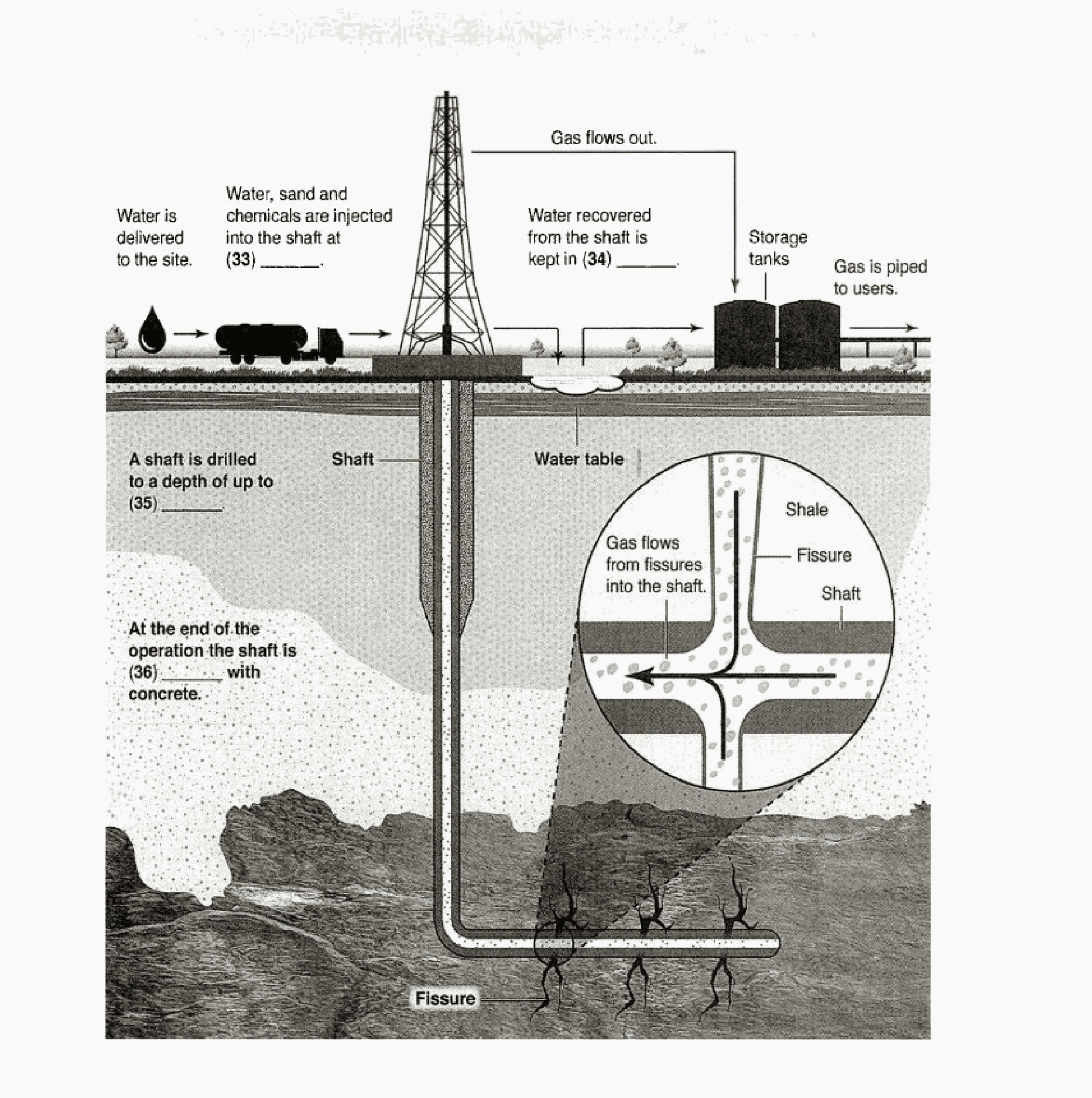
The fracking process
• Water, sand and chemicals are injected into the shaft at (33) ………………………….
• Water recovered from the shaft is kept in (34) ………………………….
• A shaft is drilled to a depth of up to (35) ………………………….
• At the end of the operation, the shaft is (36) ………………………… with concrete.
Questions 37–40
Complete the summary of the final paragraph below. Choose NO MORE THAN TWO WORDS from the article for each answer.
37. Opponents of fracking believe that …………………………
38. may be caused by the process. In addition, they claim that fracking encourages the United States' …………………………
39. on fossil fuels. They say that fracking does not help us to tackle the …………………………
40. but it may act as a ………………………… from carbon-based energy to green energy production.
Answers
1. vii
2. ii
3. vi
4. i
5. ix
6. iii
7. False
8. Not Given
9. True
10. Not Given
11. True
12. False
13. True
14. False
15. You are not good at meeting deadlines.
16. You need to prepare for your yearly appraisal and would like to know what happens.
17. You have to learn about the possible dangers at work.
18. You need to know about the law regarding equal opportunities.
19. You would like more people to work flexibly from home.
20. False
21. Not Given
22. True
23. staff development form
24. purchase request
25. expense claim
26. True
27. True
28. Not Given
29. True
30. True
31. False
32. False
33. high pressure
34. pits
35. one mile
36. sealed
37. earthquakes
38. over-reliance
39. real issue
40. bridge
Explanations
- 1. vii
- Paragraph B explains that a car boot sale doesn't take much preparation and can raise a lot of money quickly. Paraphrase: 'This paragraph sets out the appeal of doing a car boot sale in the first place.' Distractor analysis: iv (When is a good time) is answered in paragraph A instead, which is given free as an example and is not itself one of the tested paragraphs.Common trap: Topic-recurrence trap – iv also concerns car boot sales generally, but that heading belongs to paragraph A (the example), not B, which is about the appeal/benefit of the method.
- 2. ii
- Paragraph C tells the reader where to find out about car boot sales taking place – via websites, local newspapers or an internet search. Paraphrase: 'This paragraph is about finding the location and timing of car boot sales through various sources.' Distractor analysis: vi (How can you start?) is answered by paragraph D instead, which covers gathering items and publicising the sale, not finding sale locations.Common trap: Topic-recurrence trap – vi also concerns getting started, but paragraph C is specifically about locating sales, which paragraph D (starting/publicising) does not cover.
- 3. vi
- Paragraph D explains the practical first steps: looking for items, asking friends and family, and publicising the sale through social media and adverts. Paraphrase: 'This paragraph describes the initial actions needed to begin organising for the sale.' Distractor analysis: ix (What do I need to do to prepare?) is answered by paragraph F instead, which covers pricing and logistics rather than the initial sourcing/publicising steps.Common trap: Partial-information trap – ix looks tempting since D also discusses preparation-like actions, but ix specifically belongs to F's pricing/logistics content.
- 4. i
- Paragraph E lists in detail what can be sold at a car boot sale – clothing, books, jewellery, CDs, DVDs, games, furniture, kitchen items and even food. Paraphrase: 'This paragraph inventories the range of items that are acceptable to sell.' Distractor analysis: vi (How can you start?) is answered by paragraph D instead, which covers sourcing and publicising rather than listing sellable items.Common trap: Topic-recurrence trap – D and E both mention the garage/shed/attic and contacting family and friends, but only E goes on to enumerate the actual items you can sell.
- 5. ix
- Paragraph F covers what needs to be done to get ready on the practical side – negotiating the pitch price, pricing items, and arranging tables. Paraphrase: 'This paragraph sets out the concrete preparation tasks before the sale.' Distractor analysis: v (How much do car boot sales cost?) is not used anywhere in this passage as an answer – it is a pure distractor, since no paragraph focuses on the cost of running/attending a car boot sale.Common trap: Distractor-heading trap – v (cost) sounds plausible next to pricing details, but F is about preparation tasks broadly, not the cost of holding a sale.
- 6. iii
- Paragraph G gives three tips about the day of the sale itself – getting up early, not selling too cheaply too soon, and refusing low offers. Paraphrase: 'This paragraph advises on how to conduct yourself during the sale.' Distractor analysis: viii (Who goes to car boot sales?) is not used anywhere in this passage as an answer – it is a pure distractor, since no paragraph discusses who typically attends.Common trap: Distractor-heading trap – viii (who attends) is never actually addressed in the passage; G is about conduct during the sale, not who the buyers are.
- 7. False
- The passage says spring is a good time precisely because it is BEFORE everyone goes away on holiday and before the weather turns too hot – not because of the holidays themselves. Paraphrase: 'Spring works because the holiday season and the heat haven't started yet, not because of the holidays.' Distractor analysis: the statement reverses the passage's actual reason (avoiding the holiday period, not being caused by it).Common trap: Reason-reversal trap – the statement misattributes the cause; the passage gives 'before the holidays' as the reason, not 'because of the holidays'.
- 8. Not Given
- The passage only states a range – between £50 and £100 – from one sale. It never states an average figure. Paraphrase: 'A range of possible earnings is given, but no average is calculated or stated.' Distractor analysis: £75 happens to be the midpoint of the stated range, which is a tempting inference, but the text never makes this claim explicitly.Common trap: Calculated-inference trap – £75 is the arithmetic midpoint of the range given, but the passage never states an average.
- 9. True
- The passage advises contacting family and friends to see if they can give you anything to sell. Paraphrase: 'People who are close to you – friends and family – can be asked to donate items.' Distractor analysis: none significant – this is directly and clearly stated.Common trap: None significant – the answer is directly stated.
- 10. Not Given
- The passage lists many items that can be sold – clothing, books, jewellery, CDs, DVDs, games, furniture and kitchen items – but never mentions selling actual vehicles. Paraphrase: 'A detailed list of sellable items is given, but cars/vehicles are not among them.' Distractor analysis: the term 'car boot sale' itself might mislead a reader into assuming cars are sold, but the name only refers to selling goods from the boot (trunk) of a car.Common trap: Title-association trap – the name 'car boot sale' tempts readers into assuming vehicles are involved, but only the car's boot is used to sell other goods.
- 11. True
- The passage states that organisers may offer a lower pitch price for stalls raising money for charity. Paraphrase: 'Charity sellers may be charged less for their pitch by the people running the sale.' Distractor analysis: none significant – this is directly and clearly stated.Common trap: None significant – the answer is directly stated.
- 12. False
- The passage advises checking whether tables are provided and, if not, remembering to bring one – meaning tables are not always supplied. Paraphrase: 'Whether a table is provided varies, so sellers are told to check and be ready to bring their own.' Distractor analysis: the word 'always' in the statement contradicts the conditional 'if not' in the passage.Common trap: Absolute-word trap – 'always' contradicts the passage's conditional wording ('check whether... if not...').
- 13. True
- The passage's Tip 2 warns that early in the sale, other sellers will want to buy your items cheaply and resell them on their own stall at a higher price. Paraphrase: 'Fellow sellers may try to buy your goods cheaply so they can resell them for more themselves.' Distractor analysis: none significant – this is directly and clearly stated.Common trap: None significant – the answer is directly stated.
- 14. False
- Tip 3 advises saying no when someone haggles and the offered price is too low. Paraphrase: 'Sellers are told to refuse offers that are too low, not to accept every offer.' Distractor analysis: 'all offers' contradicts the passage's advice to reject low offers.Common trap: Absolute-word trap – 'all offers' contradicts the passage's explicit advice to refuse low offers.
- 15. You are not good at meeting deadlines.
- The Efficiency training course teaches time management, which helps someone become 'more effective in your work, enabling you to achieve more in fewer hours' – directly matching a need to get better at meeting deadlines. Paraphrase: 'Time management skills are exactly what someone struggling with deadlines needs.'Common trap: Category trap – several needs (appraisal, dangers, remote working) sound like plausible ‘efficiency’ topics, but only the deadline-related need matches the course's actual time-management focus.
- 16. You need to prepare for your yearly appraisal and would like to know what happens.
- The Performance review for reviewees course develops the skills needed to understand a performance review and the policies guiding it – directly matching a need to prepare for a yearly appraisal. Paraphrase: 'This course explains exactly what to expect from your annual review process.'Common trap: Synonym trap – 'performance review' and 'yearly appraisal' are the same process described with different wording.
- 17. You have to learn about the possible dangers at work.
- The Health and safety course provides basic information about safety in the company, helping staff understand how to keep themselves and others safe – directly matching a need to learn about possible dangers at work. Paraphrase: 'This course is specifically about recognising and managing risks in the workplace.'Common trap: Adjacent-topic trap – 'first aid' (vii) sounds close to health and safety, but the course covers general workplace hazard awareness, not first-aid treatment.
- 18. You need to know about the law regarding equal opportunities.
- The Diversity and equality training course focuses on the law and people's rights, and on accepting and celebrating differences – directly matching a need to know about equal opportunities law. Paraphrase: 'This course specifically covers the legal side of fair treatment at work.'Common trap: Synonym trap – 'the law and people's rights' is a direct match for 'the law regarding equal opportunities', just paraphrased.
- 19. You would like more people to work flexibly from home.
- The IT systems and remote working course is about managing teams whose members work in different locations, and states that 'remote working is on the increase' – directly matching a need for more people to work flexibly from home. Paraphrase: 'This course is squarely about supporting staff who work away from the office.'Common trap: Overlapping-option trap – both option C (flexible/home working) and option F (international colleagues) relate to this course, but 'remote working' in the text is the direct match for flexible/home working specifically.
- 20. False
- The passage states the company has an ANNUAL BUDGET for staff development, which by definition is a fixed, limited amount rather than unlimited. Paraphrase: 'Funding comes from a set yearly budget, not an open-ended pot of money.' Distractor analysis: 'unlimited' directly contradicts the concept of a budget.Common trap: Absolute-word trap – 'unlimited' contradicts the very idea of a fixed annual budget.
- 21. Not Given
- The passage says staff can apply for funds for training relevant to their job or identified in their performance review, but it never mentions conferences specifically. Paraphrase: 'Training funding in general is described, but conference attendance is never named as an eligible use.' Distractor analysis: a conference could plausibly count as 'training', but the passage does not confirm or deny this explicitly.Common trap: Not Given trap – conferences are a specific example that is never confirmed or denied within the general description of eligible training.
- 22. True
- The passage explains the finance office books tickets and makes payments directly 'so that staff members do not need to spend their own money', which shows staff are actively discouraged from personally funding training. Paraphrase: 'The whole point of the purchase-request process is to avoid staff having to pay out of pocket.' Distractor analysis: none significant – this is directly and clearly supported.Common trap: None significant – the answer is directly supported.
- 23. staff development form
- The passage states that on agreement with your line manager, 'you will need to complete a staff development form and submit it to the Staff Development Manager'. Paraphrase: 'The document filled in and sent to the Staff Development Manager is called a staff development form.' Distractor analysis: 'purchase request order' is a different, later-stage document (Q24), and 'expense claim' is a separate document used only when there is little time (Q25).Common trap: Sequence-confusion trap – three different documents (staff development form, purchase request, expense claim) appear at different stages of the process and are easy to mix up.
- 24. purchase request
- The passage states that 'after approval, and in advance of any expenditure, you may need to complete a purchase request order', sent to the finance office. Paraphrase: 'Once approved, the next document to complete is the purchase request.' Distractor analysis: 'staff development form' (Q23) is the earlier document sent to the Staff Development Manager, not the one completed after approval.Common trap: Sequence-confusion trap – easy to confuse with the staff development form, which is completed earlier, before approval.
- 25. expense claim
- The passage explains that when there is very little time between applying and the date of the training, 'a staff member may pay for the event themselves and then claim back the cost through an expense claim'. Paraphrase: 'The document used to reclaim money after paying yourself is the expense claim.' Distractor analysis: 'purchase request' (Q24) is used in advance of expenditure through the finance office, the opposite situation to paying yourself first.Common trap: Reversed-situation trap – the expense claim is specifically for when a staff member pays first and claims back, the reverse of the standard purchase-request route.
- 26. True
- The passage states fracking 'was first used in the 1860s, and then used industrially in 1949', so 1949 marks its first industrial/commercial use. Paraphrase: 'The technique existed earlier, but its first industrial application was in 1949.' Distractor analysis: none significant – 'used industrially' matches 'used commercially'.Common trap: None significant – the answer is directly supported ('industrially' matching 'commercially').
- 27. True
- The passage explains that as mud was compressed and warmed within the earth, 'the organic material was transformed into oil and natural gas'. Paraphrase: 'Natural gas originates from organic matter that underwent geological transformation.' Distractor analysis: none significant – this is directly and clearly stated.Common trap: None significant – the answer is directly stated.
- 28. Not Given
- The passage only says black shale's colour comes from organic matter deposited along with the mud from which the shale formed – it never specifies that this organic material came from marine (sea-dwelling) organisms. Paraphrase: 'The organic origin of the matter is described, but its marine/aquatic source is never stated.' Distractor analysis: readers might assume a marine origin given common knowledge about shale formation, but the passage does not make this claim.Common trap: Outside-knowledge trap – a marine origin for shale's organic matter may be generally true in geology, but the passage itself never states it.
- 29. True
- The passage states 'the sand in the mixture keeps the cracks open, allowing gas to flow to the surface'. Paraphrase: 'Sand serves the specific function of preventing cracks/fissures from closing.' Distractor analysis: none significant – this is directly and clearly stated.Common trap: None significant – the answer is directly stated.
- 30. True
- The passage lists fracking's advantages – natural gas burns cleaner than oil or coal, and a fracking well occupies less area than a conventional oil well – then rhetorically summarises this as fracking being 'simple, clean and efficient'. Paraphrase: 'The article presents this as an established set of benefits before turning to the concerns people have.' Distractor analysis: none significant – the phrase is used by the writer as a genuine (if rhetorical) description of fracking's advantages.Common trap: None significant – the answer is directly supported by the writer's own summary of fracking's benefits.
- 31. False
- The passage states plainly that 'the chemicals in the hydraulic fluid are toxic', consisting of lubricants, bacteria-killing poisons and hydrochloric acid. Paraphrase: 'The chemicals used are explicitly described as dangerous, not harmless.' Distractor analysis: 'harmless' directly contradicts 'toxic'.Common trap: Direct-contradiction trap – 'harmless' is the opposite of the passage's explicit description ('toxic').
- 32. False
- The passage states this chemical mix 'finds its way to the surface through accidents at well-heads, fluids flowing back to the surface and leaks in the system' – meaning the chemicals do not simply stay underground. Paraphrase: 'The chemicals can and do escape back to the surface in various ways.' Distractor analysis: the final sealing of the shaft with concrete might suggest containment, but that step only happens after gas collection and doesn't prevent the earlier surface leaks described.Common trap: Later-detail trap – the shaft being 'sealed off with concrete' at the end of the process might suggest full containment, but the passage separately describes chemicals already reaching the surface during operation.
- 33. high pressure
- The passage states the pumper truck 'injects this hydraulic fluid into the shaft at high pressure, causing the shale to crack'. Paraphrase: 'The injection happens under high pressure, which is what fractures the rock.' Distractor analysis: none significant – the answer is the exact phrase from the passage.Common trap: None significant – the answer is directly stated.
- 34. pits
- The passage states that water recovered from the shaft 'is stored in open pits before being taken to a treatment plant'. Paraphrase: 'Recovered water is first held in pits before it is treated.' Distractor analysis: 'storage tanks' (mentioned nearby in the passage) are for the gas, not the recovered water, and could be wrongly picked instead.Common trap: Adjacent-noun trap – 'storage tanks' are mentioned nearby but hold the gas, not the recovered water, which goes into pits.
- 35. one mile
- The passage states the shaft, or well, 'is drilled to over one mile deep into the earth'. Paraphrase: 'The drilling depth is given as over one mile.' Distractor analysis: none significant – the answer is the exact figure given in the passage.Common trap: None significant – the answer is directly stated.
- 36. sealed
- The passage states that after all the gas has been collected, 'the shaft is sealed off with concrete to make sure that the injected hydraulic fluid cannot escape'. Paraphrase: 'The final step is sealing the shaft with concrete.' Distractor analysis: none significant – the answer is the exact word used in the passage.Common trap: None significant – the answer is directly stated.
- 37. earthquakes
- The passage states 'some experts think that fracking may be linked to the occurrence of earthquakes'. Paraphrase: 'One argument against fracking is its possible link to earthquakes.' Distractor analysis: none significant – the answer is the exact word from the passage.Common trap: None significant – the answer is directly stated.
- 38. over-reliance
- The passage states fracking 'simply prolongs our over-reliance on carbon-based fuels'. Paraphrase: 'Fracking is accused of extending the country's excessive dependence on carbon-based fuel sources.' Distractor analysis: none significant – the answer is the exact word from the passage.Common trap: None significant – the answer is directly stated.
- 39. real issue
- The passage states 'fracking does not deal with the real issue of how we can produce energy without harming the environment'. Paraphrase: 'Critics argue fracking sidesteps the fundamental problem of clean energy production.' Distractor analysis: 'real' is an optional part of the answer – 'issue' alone captures the key noun, but the fuller passage wording is 'real issue'.Common trap: None significant – the answer is directly stated.
- 40. bridge
- The passage states that many people think fracking 'could be America's bridge between the carbon-based energy systems of the past and a cleaner way of producing energy in the future'. Paraphrase: 'Fracking is framed as a transitional step towards cleaner energy.' Distractor analysis: none significant – the answer is the exact word from the passage.Common trap: None significant – the answer is directly stated.
Comments
Loading comments…