

Collins IELTS 3 Listening Test 3
4 parts · 40 questions · 30 minutes
A job interview at Jamieson's
Questions 1–10
Complete the form below. Write NO MORE THAN THREE WORDS AND/OR A NUMBER for each answer.
Jamieson's Ltd Job Application
Applicant's name: Tessa Murphy
Placement of job advertisement: on the (1) …………………………
Post: (2) …………………………
Current occupation/Studies
Degree in (3) …………………………
Work experience
• Period: January - May: Stacey's Boutique
• Role: (4) …………………………
• Responsibilities: served customers and assisted the manager to arrange the (5) …………………………
• Period: (6) ………………………… : Summer school
• (7) ………………………… and evening events
• Skills: working as part of a team
Hobbies and interests
• Reading
• Going to (8) …………………………
Availability
Possible starting date: (9) …………………………
Unavailable on (10) …………………………
Marston Country Farm
Questions 11–17
Label the plan below. Write NO MORE THAN TWO WORDS for each answer.
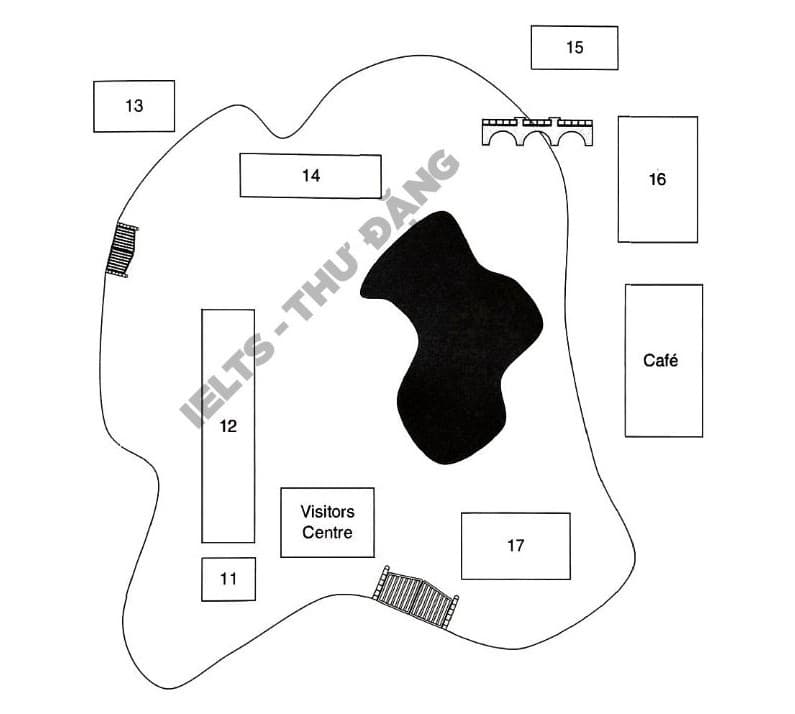
Marston Country Farm
(11) …………………………
(12) …………………………
(13) …………………………
(14) …………………………
(15) …………………………
(16) …………………………
(17) …………………………
Questions 18–20
Choose the correct letter, A, B or C.
18. The duck pond
A is quite shallow.
B often has people falling in.
C is closed to visitors due to heavy rain.
19. Visitors to the farm
A should not handle the animals before eating.
B often forget to wash their hands.
C should try to keep the hand wash stations clean.
20. Visitors needing first aid should
A phone for help.
B speak to someone at the main desk.
C go to the first aiders near the farm.
The work experience year
Questions 21–24
Choose the correct letter, A, B or C.
21. Work experience
A is usually organised by the student.
B is a necessary part of the degree.
C sometimes takes place at the university.
22. Students will be paid if
A they take time off in the summer.
B they are on placement for a year.
C they show they are responsible.
23. Companies that offer work experience placements
A sometimes hold competitions.
B expect you to know how to use databases and spreadsheets.
C often have more than one student applying.
24. Students attending an interview
A should expect it to be formal.
B should prepare for it.
C should chat with the Careers Service first.
Questions 25–26
Choose TWO letters, A–E.
25. Which TWO things does the Careers Service help with?
A identifying your strengths
B dealing with problems at the company
C supporting students with work-based assessments
D keeping a record of your experiences
E helping with academic work
26. Which TWO things does the Careers Service help with?
A identifying your strengths
B dealing with problems at the company
C supporting students with work-based assessments
D keeping a record of your experiences
E helping with academic work
Questions 27–30
Complete the summary below. Write ONE WORD ONLY for each answer.
27. Your year in industry will be a memorable experience and of enormous benefit in the future. If it goes well, it will confirm that your choice of ………………………… has been a wise one.
28. At the very least, the year spent at the company will give you the chance to ………………………… the kind of work you are interested in.
29. If you make a positive …………………………, you may be offered a job when you finish your degree.
30. There is also a good chance that you will make some ………………………… who may prove useful in the future.
Spider silk
Questions 31–32
Choose the correct letter, A, B or C.
31. The substance that makes up spider silk
A changes its form when it leaves the spider's body.
B consists of five different proteins.
C is commonly found in garden plants.
32. Spider silk
A is similar in strength to steel.
B can stretch 30 times its length.
C is not affected by freezing temperatures.
Questions 33–36
Complete the sentences below. Write NO MORE THAN TWO WORDS for each answer.
• The (33) ………………………… used spider silk to treat people who were bleeding.
• Spider silk was used by Indigenous Australians as (34) ………………………….
• Scientists have used spider silk to grow human skin to treat (35) ………………………….
• There is interest in using spider silk in airbags in cars to reduce the (36) ………………………… on the body.
Questions 37–40
Which method of producing silk matches the information in the sentences? Choose your answers from the box and write the correct letter, A–D.
Methods of producing silk
A cows' cells
B goats' milk
C silkworms
D synthetic silk
37. It could be used to help wounds heal.
38. It is stronger than a particular man-made material.
39. It requires no further work after the silk is spun.
40. It could produce large quantities of silk protein.
Answers
1. website
2. retail assistant
3. English and French
4. sales assistant
5. window displays
6. June to August
7. planned trips
8. dance classes
9. 7th June
10. Tuesdays
11. toilets
12. goat shed
13. donkey rides
14. rabbit house
15. insect house
16. picnic area
17. gift shop
18. is quite shallow.
19. should try to keep the hand wash stations clean.
20. speak to someone at the main desk.
21. is a necessary part of the degree.
22. they are on placement for a year.
23. often have more than one student applying.
24. should prepare for it.
25. dealing with problems at the company
26. keeping a record of your experiences
27. career
28. reconsider
29. impression
30. contacts
31. changes its form when it leaves the spider's body.
32. is not affected by freezing temperatures.
33. ancient Greeks
34. fishing lines
35. burn victims
36. impact
37. D
38. A
39. C
40. B
Explanations
- 1. website
- 'We advertised three jobs on our website' – the website is where the advertisement appeared.Common trap: Detail-in-passing trap – the location of the advert is mentioned only once, inside a sentence about the jobs themselves.
- 2. retail assistant
- Tessa rules out the helpline and delivery jobs: 'I'd be keen to apply for the retail assistant post that was advertised.'Common trap: Three-jobs trap – all three advertised posts are named, and two are turned down before the answer.
- 3. English and French
- 'Welworth offers a joint degree in English and French so I decided to do that.'Common trap: A-level trap – three A-level subjects are listed just before, and the interviewer's guess of 'French' alone is corrected.
- 4. sales assistant
- 'I worked as a sales assistant in Stacey's - that's a small boutique in town.'Common trap: Similar-title trap – 'retail assistant' is the post being applied for; the past role is 'sales assistant'.
- 5. window displays
- 'I was responsible for serving customers and occasionally helping the person who ran the shop with window displays.'Common trap: Paraphrase trap – 'the person who ran the shop' becomes 'the manager' on the form.
- 6. June to August
- 'Then from June to August last year, I took a job at a summer school.'Common trap: Two-periods trap – the January to May period is already printed for the previous job.
- 7. planned trips
- 'I planned trips and evening events like quizzes.'Common trap: Role-versus-duty trap – the job title 'social organiser' comes first; the form asks what she actually did.
- 8. dance classes
- 'I've recently started dance classes - I think that's a more enjoyable way of keeping fit than going to the gym.'Common trap: Rejected-activity trap – the gym is named in the same sentence as the thing she does NOT do.
- 9. 7th June
- 'I finish on the 25th of May. I have one week holiday booked but I'm back on the 6th of June and I'd be ready to start on the 7th of June.'Common trap: Date-cluster trap – four dates are given in two sentences, and only the last is when she can start.
- 10. Tuesdays
- 'I'd like to keep Tuesdays free, though, as I volunteer at my local community centre then.'Common trap: Positive-phrasing trap – 'keep Tuesdays free' has to be converted into the form's 'unavailable on'.
- 11. toilets
- 'There are toilets on the left of the entrance as you come in, just behind the Visitors Centre.'Common trap: Duplicate-facility trap – there are toilets in the cafe too, but only one set is next to the Visitors Centre.
- 12. goat shed
- 'Now, to our left, next to the toilets, you'll see a long building. This is the goat shed.'Common trap: Chain-of-directions trap – the shed is located relative to the toilets, which are themselves only just placed.
- 13. donkey rides
- Past the goat shed 'there's a pair of double gates. This is the entrance to the donkey rides.'Common trap: Sequence trap – the double gates come between the goat shed and the label, so the two are easy to swap.
- 14. rabbit house
- 'Now, directly opposite us, on the other side of the pond, is the rabbit house.'Common trap: Viewpoint trap – 'directly opposite us' is relative to the Visitors Centre, so the plan has to be read from that point.
- 15. insect house
- 'Pop over the bridge and pay the insect house a visit - it's immediately on your left.'Common trap: Left/right trap – the bridge leads to the insect house on the left and the picnic area and cafe on the right.
- 16. picnic area
- Directions to the cafe pass it: 'walk round the duck pond, go over the bridge and turn to your right, past the picnic area. You'll see the cafe in front of you.'Common trap: Landmark-in-passing trap – the picnic area is named only as something you walk past on the way to the cafe, which is already labelled.
- 17. gift shop
- 'And just over here, closer to us, on the right side of the entrance, you'll find our gift shop.'Common trap: Left/right trap – the toilets are on the left of the entrance and the gift shop on the right.
- 18. is quite shallow.
- 'Don't worry, it's not deep. If you did fall in, the water would only come up to your knees.'Common trap: Hypothetical trap – 'if you did fall in' is a conditional, and the rain affects the bank rather than access.
- 19. should try to keep the hand wash stations clean.
- 'Can we ask you please to help us keep these stations tidy and dispose of the paper towels in the bins provided?'Common trap: Instruction-versus-claim trap – the previous sentence covers handling animals and eating, but as a hand-washing instruction.
- 20. speak to someone at the main desk.
- 'Simply come into the Visitors Centre and the receptionist will call them.'Common trap: Who-acts trap – phoning and the nearby site are both in the sentence, but the visitor's own action is to go to reception.
- 21. is a necessary part of the degree.
- 'Your work experience programme is a compulsory part of your degree and as a result, you're supported by the university in finding a suitable placement.'Common trap: Two-schemes trap – internships and the work experience year are contrasted, and only one is student-organised.
- 22. they are on placement for a year.
- 'The year-long work experience placements we organise for you will be paid posts.' Summer internships 'may or may not be paid'.Common trap: Word-lift trap – 'summer' and 'responsibilities' both appear, one in the unpaid case and one about the salary level.
- 23. often have more than one student applying.
- 'It's a very competitive process and students all want to work for the more well-known companies so you may not get your first choice.'Common trap: Word-sense trap – 'competitive' and 'database' both appear, meaning a contested process and the service's own records.
- 24. should prepare for it.
- 'I'd strongly recommend putting in some work beforehand to make sure you're ready for it.'Common trap: Discontinued-service trap – face-to-face interview practice used to exist but has been replaced by online videos.
- 25. dealing with problems at the company
- The Careers Service can take up serious problems with its contact at the company (B) and can help students keep a reflective journal – 'a record of what you did each day at work' (D). Work-based assessment is supported by someone at the company, and academic work is the tutors' responsibility.Common trap: Whose-job trap – assessments, academic work and identifying a good fit are all discussed, but each is handed to the company, the tutors, or applies to the company rather than the student.
- 26. keeping a record of your experiences
- The Careers Service can take up serious problems with its contact at the company (B) and can help students keep a reflective journal – 'a record of what you did each day at work' (D). Work-based assessment is supported by someone at the company, and academic work is the tutors' responsibility.Common trap: Whose-job trap – assessments, academic work and identifying a good fit are all discussed, but each is handed to the company, the tutors, or applies to the company rather than the student.
- 27. career
- 'You might discover that it is indeed the perfect career choice and love what you do.'Common trap: Word-order trap – the talk says 'career choice' while the summary says 'choice of ___'.
- 28. reconsider
- 'Alternatively, it might be that it helps you to reconsider the area of work you want to get into.'Common trap: Paraphrase trap – 'the area of work you want to get into' becomes 'the kind of work you are interested in'.
- 29. impression
- 'If you make a good impression during the year, you may find yourself being offered a job at the end of your degree.'Common trap: Synonym trap – 'a good impression' in the talk becomes 'a positive ___' in the summary.
- 30. contacts
- 'You may also make a few contacts with people in the industry who might be able to help you with your career.'Common trap: Quantifier trap – 'a few contacts' becomes 'some ___', so only the noun belongs in the one-word gap.
- 31. changes its form when it leaves the spider's body.
- 'It is stored in the form of a liquid protein inside their body and it only turns solid when it's exposed to the air.'Common trap: Word-lift trap – 'five' and 'garden' both appear in the next sentence, attached to types of silk and to the spider's name.
- 32. is not affected by freezing temperatures.
- 'It can even withstand sub-zero temperatures without becoming brittle.'Common trap: Figure-distortion trap – 30 per cent becomes '30 times' in the wrong option, and the steel claim is explicitly called misleading.
- 33. ancient Greeks
- 'The ancient Greeks used cobwebs to dress wounds and to help stop the flow of blood.'Common trap: Paraphrase trap – 'stop the flow of blood' becomes 'people who were bleeding'.
- 34. fishing lines
- 'Spider silk was used by Indigenous Australians to make fishing lines.'Common trap: Parallel-example trap – the Solomon Islands use is described in the same sentence and also involves fish.
- 35. burn victims
- 'Scientists used it to help grow human skin in order to treat burn victims.'Common trap: Near-identical trap – the sentence tracks the talk closely, so the final phrase must be captured exactly.
- 36. impact
- 'They believe it could absorb more of the impact and so limit the impact of the airbag on the body itself.'Common trap: Repeated-word trap – 'impact' is used twice in one sentence, once for the crash and once for the airbag.
- 37. D
- The Nottingham team's artificial silk can be coated with an antibiotic, so 'the silk could be used in the manufacture of dressings to treat wounds that take a while to heal'.Common trap: Historical-echo trap – dressing wounds is also the ancient Greek use of natural cobwebs, much earlier in the talk.
- 38. A
- Silk genes inserted into cow cells produced proteins spun into strands, and 'the fibres produced were stronger than Kevlar, a material used to make bulletproof vests'.Common trap: Comparison trap – the silkworm method is also compared for strength, but unfavourably and against spider silk rather than a man-made material.
- 39. C
- 'One of the advantages of obtaining spider silk in this way is that the silk is ready for use as soon as it's spun by the insect' – the insect is the genetically modified silkworm.Common trap: Spinning trap – spinning happens in the cow-cell method too, but there it is a further processing step done by the scientists.
- 40. B
- 'The hope is that milk from goats like these will contain significant amounts of usable spider silk proteins.'Common trap: Quantity trap – the silkworm method also reports an increase in quantity, but as a sevenfold improvement rather than large amounts.
Audio transcripts
Part 1 — A job interview at Jamieson's
Matthew: Good morning, Tessa. Welcome to Jamieson's. I'm Matthew Reed. Thanks for your interest in working with us. Please take a seat. Tessa: Thank you. Matthew: So, we advertised three jobs on our website and I can see from your cv that you might be a suitable candidate for all of them. Would you be interested in telephone helpline work? Or we're still looking for a delivery person. Tessa: Well, I've had experience of telephone sales but I'd prefer to have face-to-face contact with customers. I'm afraid I don't have a driving licence so the position of delivery person isn't possible. But I'd be keen to apply for the retail assistant post that was advertised. Matthew: OK, that's fine. I see from your CV you're currently at university. Tessa: Yes. I'm in my second year at the moment. It's a four-year degree course and I spend the third year abroad. I'm planning on going to France. Matthew: Yes, I see you did French, English and Maths for your A levels, and now you're studying French. Is that right? Tessa: Yes. I love learning languages and Welworth offers a joint degree in English and French so I decided to do that. I didn't fancy the idea of Maths at university. Matthew: No, I can understand that. Now, you've had some work experience. That's excellent. A couple of jobs last year? Tell me about them. Tessa: Yes, I worked as a sales assistant in Stacey's - that's a small boutique in town - at the weekend from January to May, Saturdays and Sundays. I was responsible for serving customers and occasionally helping the person who ran the shop with window displays. I really enjoyed that job. I got plenty of practice in dealing with money, customer service skills, that kind of thing. Matthew: That must have been a busy time for you, what with your studies as well. You clearly aren't put off by a bit of hard work! Tessa: No, I like to keep myself occupied and, as I said, I enjoyed the job and it made a change from studying. Then from June to August last year, I took a job at a summer school. I was offered the role of social organiser for students from abroad who were studying English. I planned trips and evening events like quizzes. Matthew: Did you enjoy that? Tessa: Yes, it was great fun. I really appreciated the opportunity to work in a team and to practise my language skills as there were several French students on the course. Matthew: And what do you like to do in your spare time? Have you got any hobbies or interests? Tessa: I'm a big reader, especially science fiction. I've recently started dance classes - I think that's a more enjoyable way of keeping fit than going to the gym. Matthew: OK. So, tell me about your availability. You're mainly interested in work over the summer period, is that right? Tessa: Yes. I'd certainly be keen to join you when I finish my studies in May. I start my third year in September so I'd be free in June, July and August. I finish on the 25th of May. I have one week holiday booked but I'm back on the 6th of June and I'd be ready to start on the 7th of June. Matthew: That would fit in nicely with our busy summer schedule. What about hours? We actually need someone who's available for five days a week and some of the days are likely to be weekends. Are you pretty flexible in terms of when you can work? Tessa: I think so. Saturdays and Sundays are no problem. I'm taking driving lessons at the moment and they tend to be on a Wednesday but I could always re-arrange them. I'd like to keep Tuesdays free, though, as I volunteer at my local community centre then. Matthew: OK, Tessa. That all seems great. Let me just confirm your contact details and we'll be in touch with you later in the week with our decision.
Part 2 — Marston Country Farm
Hello everyone, and welcome to Marston Country Farm. We always look forward to group visits from local schools and I'm sure you'll all have a fantastic time while you're here. I'd just like to take a couple of minutes to explain what we have here at the farm and point out a few health and safety issues you need to be aware of. Let's start with a tour of the farm. I can see you all have a copy of the plan we sent out so let me just go through it with you. You'll see we're here in the Visitors Centre, just by the entrance. This is a useful place to head for if you get lost or want to meet up with friends later. The farm covers quite a large area so we've made sure there are toilets nearby should you need them, wherever you are. There are toilets on the left of the entrance as you come in, just behind the Visitors Centre. There are also some in the cafe. You'll find this if you walk round the duck pond, go over the bridge and turn to your right, past the picnic area. You'll see the cafe in front of you. In front of us we have the duck pond. It's very tempting to feed the ducks and other water birds with bread from your sandwich box but actually, bread isn't very good for them so please can we ask you not to feed them. Now, to our left, next to the toilets, you'll see a long building. This is the goat shed, and just past that there's a pair of double gates. This is the entrance to the donkey rides. I'm afraid these are only suitable for younger children than yourselves and you won't be allowed to ride one. But you're welcome to stroke the donkeys that nobody's riding and we've even supplied a large sack full of apples so that you can feed them if you think they look hungry. Now, directly opposite us, on the other side of the pond, is the rabbit house. This is always extremely popular and very busy. You might have to queue for a while to get in. But if this is the case, pop over the bridge and pay the insect house a visit - it's immediately on your left. For some strange reason, this doesn't tend to be quite as popular as the rabbits. And just over here, closer to us, on the right side of the entrance, you'll find our gift shop if you want to buy something to remember your visit or a gift for someone special. So, that's the farm. Now before you go, there are a few things I'd like to point out to ensure you remain safe and healthy during and after your visit. Please take care walking around the duck pond. Don't worry, it's not deep. If you did fall in, the water would only come up to your knees. But the bank around it is very muddy after all the rain we've had and visitors are likely to spoil their footwear. There are hand wash stations dotted around the site. Don't forget to use these to wash your hands after touching or handling any of our animals, and especially before eating. Oh yes, can we ask you please to help us keep these stations tidy and dispose of the paper towels in the bins provided? Last but not least, do remember that this is a working farm. At certain times of the day, there will be vehicles entering the farm from the main gate here. Please remain alert and pay attention when you're in this area. We have fully trained first aiders on a nearby site, and in the unlikely event you have an accident or feel ill, simply come into the Visitors Centre and the receptionist will call them. Your teachers have been given our health and safety leaflets and they'll be able to answer some of your questions during your visit.
Part 3 — The work experience year
Lecturer: Good morning, everyone. As promised, I've invited Kelly from the university Careers Service to come along and talk to you about your work experience year. Thanks for coming, Kelly. Kelly: Thanks for inviting me. Hello everyone. As you'll all be aware, the third year of your degree course is spent working in industry. This is an extremely valuable part of your education. You'll gain a deeper understanding of the area of work you're interested in, apply some of the things you've learned in the workplace, and perhaps even get a full-time job at the end of your degree. You'll be on what we term a "work experience year", not to be confused with an internship. Lecturer: What's the difference between the two? Kelly: Internships are placements students tend to organise themselves, during the summer holidays or after they've graduated. We're happy to offer some advice but we don't organise them on your behalf. Your work experience programme is a compulsory part of your degree and as a result, you're supported by the university in finding a suitable placement. Student 1: I've been told we'll get paid for the work experience. Is this true? Kelly: Short-term placements, like summer internships, may or may not be paid. Again, that's something you'd need to discuss with the employer. But the year-long work experience placements we organise for you will be paid posts. The salary varies but will reflect the responsibilities you'll have. Student 2: Can we choose the company we want to work with? Kelly: We've got a database of companies we've worked with in the past and in most cases, we'll be able to offer you two or three options for placements. However, it's a very competitive process and students all want to work for the more well-known companies so you may not get your first choice. Lecturer: I understand students will often be asked to attend interviews. Is this the case? Kelly: Yes, students will be required to attend an interview of some kind. Companies don't want to take on someone they haven't had the chance to meet and have a chat with. How formal the interview is will depend on the company. If there is an interview, I'd strongly recommend putting in some work beforehand to make sure you're ready for it. Lecturer: You offer support for that kind of thing, don't you? Kelly: Yes, it's a whole package of support, really. We'll start by helping you identify a company that's a good fit for both you and them. We want to keep the employers happy in order to maintain a good relationship. At one time we used to offer interview practice with members of staff but we now direct you to our training videos online to help you with this. Student 1: What if we have problems working with the company? Who do we speak to? Kelly: It's rare that we have problems like this. If you're lucky, you'll find yourself doing the perfect job, but bearing in mind how difficult it is to find a place, we always advise students to stick with it. We do have a contact in each company who we can talk with on your behalf if there are any serious issues, but as I said, that's not often the case. Student 2: I've heard students will be assessed on their work placement. Is that true? Kelly: There'll be some kind of assessment, yes, but you'll be told about that by your tutor and they'll be the one to talk to you about any specific issues. If the assessment involves anything to do with work-based skills, you'll also usually be supported by someone at the company. We can help you with things like keeping a reflective journal. This is a really useful exercise even if you're not required to keep one as it will provide you with a record of what you did each day at work, the things you learned on the job as well as any difficulties you've had. It will help you keep track of issues or topics that you need to read up on and act as one of the resources you can use when you come to write your end-of-year report - if that's something the course tutor needs. Again, you'll have to discuss that with the course tutor. We don't get involved with academic work as this is something your tutors will help you with. Lecturer: Thanks for that, Kelly. That was really useful. Kelly: My pleasure. Some students get a little stressed at the thought of joining the workforce but you'll look back on it as a really useful exercise. You might discover that it is indeed the perfect career choice and love what you do. Alternatively, it might be that it helps you to reconsider the area of work you want to get into. If you make a good impression during the year, you may find yourself being offered a job at the end of your degree, and at the very least, you'll develop skills and experience that will stand you in good stead when you start job hunting. You may also make a few contacts with people in the industry who might be able to help you with your career.
Part 4 — Spider silk
Lecturer: If you dread being taken by surprise by a spider when you're relaxing in front of the TV, you'll no doubt be one of the millions of people who find spiders terrifying. But hopefully, this morning I can change your perception of these creatures. You might continue to find them scary but you might also see them in a slightly different light. I'd like to focus specifically on the silk that spiders make. The substance they use to make their intricate webs is stored in the form of a liquid protein inside their body and it only turns solid when it's exposed to the air. The common garden spider of the UK can create up to five different types of silk. Some of these silks are responsible for allowing the web to stretch while others make the web less brittle. It's often claimed that spider silk is stronger than steel but this is misleading. A material can be strong in different ways: for example, it can be stiff, which means it resists bending, and silk is much less stiff than steel. But spider silk does have some incredible characteristics. It can stretch by up to 30 per cent without breaking before returning to its original size. It can even withstand sub-zero temperatures without becoming brittle. People have used spider silk in many practical applications for centuries. The ancient Greeks used cobwebs to dress wounds and to help stop the flow of blood. Spider silk was used by Indigenous Australians to make fishing lines, and in the Solomon Islands people use spider webs to catch fish. In the 1900s it was used in optical devices, such as in the crosswires in a rifle sight. If spider silk could be produced on an industrial scale, it could have a wide range of applications. In a recent experiment, scientists used it to help grow human skin in order to treat burn victims. Some companies have even shown an interest in using spider silk to make airbags in cars. They believe it could absorb more of the impact and so limit the impact of the airbag on the body itself. Spider silk has even been considered as an ideal material to use in biodegradable bottles. However, there's one significant problem. It isn't possible to obtain the amount of silk needed for applications like these from spiders. It would take ages to collect the material from their natural habitat, and farming spiders isn't possible as they are aggressive, territorial creatures who will attack and eat each other. Furthermore, because the silk goes hard when it's exposed to air, it's difficult to work with. Scientists have tried to overcome some of these problems by taking the spider itself out of the equation. One team of scientists extracted the silk genes from two species of spiders and inserted them into cells from a cow. The cells were grown in the laboratory and produced the silk proteins that the scientists were able to harvest. The proteins were then spun into silky strands and the fibres produced were stronger than Kevlar, a material used to make bulletproof vests, but they were lighter than Kevlar and nearly as elastic as nylon. Scientists have also genetically engineered living goats that carry spider silk genes. The first two goat kids produced in this manner were called Webster and Pete. The hope is that milk from goats like these will contain significant amounts of usable spider silk proteins. Another approach is to use silkworms. The silk from silkworms can be farmed in ways that spider silk can't and so researchers have looked at making genetic changes to the silkworm. The silk that's produced in this way is a mixture of silkworm silk and spider silk. Initial attempts created silk that was stretchy but not as strong as spider silk. However, researchers subsequently managed to increase the amount of spider silk by a factor of seven. One of the advantages of obtaining spider silk in this way is that the silk is ready for use as soon as it's spun by the insect. A group of researchers at the University of Nottingham have developed artificial spider silk made of proteins that are similar to those in naturally produced spider silk. This man-made silk can be used in a variety of medical applications. It was shown to act as a scaffold or support for the growth of new tissue. The researchers were also able to coat it with an antibiotic, and their experiments showed that the antibacterial properties of the silk lasted for several days. So, thanks to its ability to release antibiotics in a controlled way, the silk could be used in the manufacture of dressings to treat wounds that take a while to heal. We may only be a few years away from being able to see some of those applications in use. If the outcome of this research is that we'll be able to create materials with properties similar to those of spider silk, we might also be one step towards eradicating the production of synthetic materials that can have negative effects on the environment. I hope this has given you an insight into the amazing spider. Next time you see one scuttling across the floor, stop to marvel at what it can achieve rather than jump on the sofa to escape.
Comments
Loading comments…